44 Days Of Paranoia #20: Seven Days In May (dir by John Frankenheimer)


For today’s entry in the 44 Days of Paranoia, let’s take a look at the 1964 political thriller, Seven Days In May.

Directed by John Frankenheimer (who also directed the conspiracy classic, The Manchurian Candidate), Seven Days In May opens with unpopular President Jordan Lyman (Fredric March) on the verge of signing a treaty with the Russians.  The chairman of the joint chiefs-of-staff, Gen. James Scott (Burt Lancaster), is opposed to the treaty and feels that Lyman’s actions will lead to the collapse of the U.S.  When Scott’s aide, Jiggs Casey (Kirk Douglas), thinks that he’s come across evidence that Scott is planning a military coup, he takes his suspicions to the White House.  Working with an alcoholic Senator (Edmond O’Brien) and a cynical political aide (Martin Balsam), the President launches his own investigation into Scott’s activities.

When it was first released, Seven Days In May was very successful with both critics and audiences.  Edmond O’Brien even received an Oscar nomination for best supporting actor.  When viewed today, however, Seven Days In May feels rather quaint.  A good deal of the film’s suspense was meant to be generated by the question of whether or not Gen. Scott is actually planning a coup.  However, for the modern viewer, it’s really not a question worth asking.  For us, it’s easy to watch this film and shout, “Of course he’s planning on overthrowing the government!  He’s the most obviously villainous character in the entire film!”  The idea of a military conspiracy to overthrow the U.S. government was perhaps shocking back in 1964 but today, we take the existence of such conspiracies for granted.

Seven Days In May is definitely a product of its time.  Unlike John Frankenheimer’s other well-known conspiracy film, The Manchurian Candidate, there’s no sly undercurrent of satire or subversion running through Seven Days In May.  Instead, Seven Days In May epitomizes everything that we think of when we think about the early 60s.  The film’s politics are liberal but not radically so.  The President is such an honorable leader that he won’t resort to the politics of personal destruction and reveal that Scott has a mistress.  Casey explains that he disagrees with the President’s politics but that he is bound by duty to reveal Gen. Scott’s subversion.  Indeed, by the end of the film, it’s obvious that we’re meant to condemn Scott not because he might overthrow the President but because he would subvert the democratic process to do so.  Seven Days In May is a film that tells viewers to support and respect their elected leaders, whether they be good or evil and whether they’re played by Fredric March or Burt Lancaster.

When I listened to Casey explain why he was informing on a man who he claimed to admire and agree with, I was reminded of some of the recent political debates that we’ve had deal with her in America.  All of those debates can pretty much be summed up by whether we, as citizens, are obligated to support a law even if we personally don’t agree with it or to respect a leader even if we do not agree with him.  The answer, according to Seven Days In May, would appear to be yes.

While Seven Days In May is often a bit too ponderous for its own good, it’s still a well-made and watchable film.  If you’re a history nerd like me, you’ll enjoy the film as a portrait of its time.  John Frankenheimer directs as if the movie is a film noir and the film’s shadowy black-and-white cinematography looks great.  Finally, if you’re a fan of the old school movie stars, how can you not enjoy a film that features Kirk Douglas, Fredric March, and Burt Lancaster?

Other Entries In The 44 Days of Paranoia 

  1. Clonus
  2. Executive Action
  3. Winter Kills
  4. Interview With The Assassin
  5. The Trial of Lee Harvey Oswald
  6. JFK
  7. Beyond The Doors
  8. Three Days of the Condor
  9. They Saved Hitler’s Brain
  10. The Intruder
  11. Police, Adjective
  12. Burn After Reading
  13. Quiz Show
  14. Flying Blind
  15. God Told Me To
  16. Wag the Dog
  17. Cheaters
  18. Scream and Scream Again
  19. Capricorn One

44 Days of Paranoia #19: Capricorn One (dir by Peter Hyams)


Last night, the temperature plunged here in Texas.  When I woke up this morning, I was confronted with a world that was literally frozen.  Needless to say, nobody in Dallas went to work today.  Instead, we all sat in our houses and tried to keep ourselves entertained.  I kept myself occupied by watching a film that was initially released way back in 1978 and which takes place in my home state.

The name of that film was Capricorn One and it’s the latest entry in the 44 Days of Paranoia.

Capricorn One begins with three astronauts preparing to take the fist manned space flight to Mars.  James Brolin is the stoic leader.  Sam Waterston is the guy who has a joke for every occasion.  And O.J. Simpson is … well, O.J. really doesn’t have much of a personality.  He’s pretty much just along for the ride.

However, it turns out that there really isn’t going to be a ride.  Just as the countdown begins, the astronauts are ordered to leave the capsule.  They are then transported to secret base in the Texas desert.  It’s here that they have a meeting with the Head of NASA, who is played by Hal Holbrook.  (It’s simply not a 70s conspiracy film if Hal Holbrook isn’t somehow involved).  Holbrook proceeds to deliver a stirring monologue where he talks about how he and Brolin have always dreamed of sending a manned flight to Mars.  However, as Holbrook explains, the life support system on the crew’s ship was faulty.  If Holbrook had allowed them to be launched, they would have died as soon as they left the Earth’s atmosphere.  However, if the mission had been canceled then there was a chance that the President would use that cancellation as an excuse to cut NASA’s funding.

So, as Holbrook explains, an empty spaceship has been launched into space.  As far as the American public is concerned, the three astronauts are currently on their way to Mars.  Now, in order to save the space program, they are going to have to fake the mission.  In a studio, a fake alien landscape has been set up and it’s from that studio that Brolin, Waterston, and Simpson will pretend to explore Mars.

Brolin, Waterston, and Simpson reluctantly agree to cooperate with the plan.  However, after doing the first fake broadcast, Brolin starts to have second thoughts.  Realizing that he can’t trust the three astronauts to keep a secret, Holbrook announces that the capsule’s heat shields failed during re-entry and that the crew of Capricorn One is now dead.  Now, all he has to do is have the three of them killed for real.

Meanwhile, a NASA technician (Robert Walden) stumbles onto evidence of the deception.  He subsequently vanishes but not before he tells reporter Elliott Gould about his suspicions.  While the three astronauts try to escape from Holbrook’s agents, Gould tries to find out what really happened to Capricorn One.

It’s probably half-an-hour too long, the plot is full of holes (the least of which being why Holbrook waited until after he had announced the fake deaths to order the real deaths), and director Peter Hyams allows a few scenes to run on and on while others seem to end with a jarring abruptness.  However, for the most part, Capricorn One is a well-acted and solidly entertaining film.  However, there are two things that make Capricorn One especially memorable.

First off, Capricorn One features one of the most exciting action sequences that I have  ever seen.  It occurs while Gould is investigating Walden’s disappearance.  After visiting Walden’s apartment and discovering that it’s inhabited by a woman who claims to have never heard of his friend, Gould is driving away when he discovers that his brakes have been disabled.  The car then starts to accelerate and Gould finds himself desperately trying to regain control as the car careens through the streets of Houston.  The scene is shot almost entirely from Gould’s point-of-view and, for five minutes, we watch as everything from other cars to unlucky pedestrians come hurtling towards the car.  For those few minutes, when the viewer and Gould become one, Capricorn One is not only exciting but it feels genuinely dangerous as well.

Secondly, Capricorn One features some of the oddest dialogue imaginable.  Peter Hyams not only directed the film but he also wrote the screenplay as well.  Watching the film, one gets the feelings that Hyams was so in love with his dialogue and with all of his quirky characters that he simply could not bring himself to cut anything or anyone.  As a result, the film is full of lengthy monologues.  When the characters speak to each other, they don’t have conversations as much as they trade quips.  Characters like Gould’s ex-wife (played by Karen Black) and his editor (David Doyle) show up for a scene or two, deliver monologues that are only tangibly related to the film’s plot, and then vanish.  Sam Waterston ends up telling the world’s longest joke while he climbs a mountain in the desert.  Towards the end of the film, Telly Savalas (who was in my favorite Mario Bava film, Lisa and the Devil) shows up as a foul-tempered crop duster and engages in a long argument with Gould who, despite being a reporter, never bothers to question why Savalas would have a crop dusting business in the middle of the desert.

But here’s the thing — it works.  As odd as some of the dialogue may be and as superfluous as some of the action is to the overall plot, it still all works to the film’s benefit.  The constant quirkiness works to keep the audience off-balance and to give Capricorn One its own unique rhythm.

Capricorn One — see it now before Michael Bay remakes it.

Other Entries In The 44 Days of Paranoia 

  1. Clonus
  2. Executive Action
  3. Winter Kills
  4. Interview With The Assassin
  5. The Trial of Lee Harvey Oswald
  6. JFK
  7. Beyond The Doors
  8. Three Days of the Condor
  9. They Saved Hitler’s Brain
  10. The Intruder
  11. Police, Adjective
  12. Burn After Reading
  13. Quiz Show
  14. Flying Blind
  15. God Told Me To
  16. Wag the Dog
  17. Cheaters
  18. Scream and Scream Again

44 Days of Paranoia #18: Scream and Scream Again (dir by Gordon Hessler)


For today’s entry in the 44 Days of Paranoia, we take a look at one of my favorites of the old school British horror films, 1970’s Scream and Scream Again.

Taking place in the near future, Scream and Scream Again follows three seemingly unconnected stories.

In the first — and, to me, the most disturbing — story, an unnamed London man collapses while out jogging.  When he wakes up, he finds himself in a hospital.  He is tended to by a nurse who refuses to speak to him.  Whenever he falls asleep, his limbs are surgically removed one-by-one.  While we never learn much about the man, his scenes are perhaps the most difficult to watch.  Everything from the starkness of the hospital to the nurse’s lack of concern and empathy for her patient contributes towards making these some of the most genuinely nightmarish scenes that I’ve ever seen.

While the unnamed jogger is being slowly taken apart, the London police are far more interested in solving the “Vampire Killer” case.  Keith (Michael Gothard) is a serial killer who picks up young women in nightclubs and then drinks their blood.  When, after an exciting chase, the police finally do catch him, they attempt to handcuff Keith to a car bumper.  Keith responds by ripping off his own hand and running into the night.  The investigation into Keith eventually leads to an eminent scientist named Dr. Browning (Vincent Price).  However, Fremont (Christopher Lee), the head of the British secret service, orders the police to drop the case because Browning is apparently doing very important work for the government.

Meanwhile, in an unnamed country in Eastern Europe, secret police officer Konratz (Marshall Jones) ruthlessly climbs his way to the top of the service by murdering his superiors (including Peter Cushing).  When a British spy is captured in his country, Konratz contacts Fremont and offers to exchange the spy for all the information that Scotland Yard has gathered about the Vampire Killer case…

Perhaps the best way to describe Scream and Scream Again would be “joyfully chaotic.”  The film’s three separate storylines do all come together during the final ten minutes and the film’s climax does make a lot more sense than it really has any right to but, up until that moment, a lot of the pleasure from Scream and Scream Again comes from seeing just how many different plots and subplots director Gordon Hessler can juggle in one film without losing the audience.  Fortunately,  Scream and Scream Again is a wonderfully entertaining horror/sci-fi/conspiracy hybrid, one that remains compulsively watchable despite the fact that it often doesn’t make much sense.

Of course, one of the main reasons to see Scream and Scream Again is because it features three icons of horror cinema.  Unfortunately, Cushing isn’t on-screen long enough to make much of an impression while Lee basically just has an extended cameo.  Vincent Price doesn’t show up until fairly late into the film but once he does, he wastes no time in making an impression.  Even by the standard of Vincent Price, his performance in this film is a bit over-the-top.

But you know what?

It’s exactly the performance that this film needs.  The film itself is so joyfully chaotic and disjointed that Price fits right in.  The triumph of Scream and Scream Again is that it creates (and makes us believe in) a world where it only makes sense that the final solution would lie with Vincent Price.

Finally, Scream and Scream Again serves as a wonderful time capsule for those of us who may be fascinated by the swinging 60s and 70s but, as a result of being born a few decades too late, will never get a chance to experience them firsthand.  For us, Scream and Scream Again will always be worth it for the scenes of Keith getting his mod on at a London discotheque.  

Scream and Scream Again is a film that everyone should see at least once in their life.  Just don’t go jogging afterwards…

Other Entries In The 44 Days of Paranoia 

  1. Clonus
  2. Executive Action
  3. Winter Kills
  4. Interview With The Assassin
  5. The Trial of Lee Harvey Oswald
  6. JFK
  7. Beyond The Doors
  8. Three Days of the Condor
  9. They Saved Hitler’s Brain
  10. The Intruder
  11. Police, Adjective
  12. Burn After Reading
  13. Quiz Show
  14. Flying Blind
  15. God Told Me To
  16. Wag the Dog
  17. Cheaters

44 Days of Paranoia #17: Cheaters (dir by John Stockwell)


For today’s entry in the 44 Days of Paranoia, I want to take a quick look at a very good movie from the year 2000 that not many seem to know about, Cheaters.

During my senior year of high school, I always wore a short skirt on any day that I had a test in my algebra class.

Why?

Because I was a cheater.

Back when I was still a student, I always struggled when it came to my math classes.  It wasn’t that I couldn’t do the work as much as it was that the work just bored me.  Whenever my teacher was talking about square roots and x+y and all the rest, I was usually busy daydreaming about  anything other than what I was supposed to be learning.

Fortunately, my sister Erin had been one year ahead of me in high school and had saved all of her old tests and quizzes.  Since we both had the same algebra teacher, I started using her old tests as a study guide.  It quickly became obvious that our teacher was simply reusing the same tests from year-to-year.  While the order of the problems might occasionally change, the solutions remained the same.

Every test day, I would wear a skirt and, right before class, I would write the answers on my thigh.  If the teacher walked by my desk while I was taking the test, I would just pull down on my skirt.  Fortunately, the teacher was a male so even if he did suspect that I was cheating, it’s not like he could tell me to lift up my skirt or, for that matter, even get caught trying to look down at my legs.

And that’s how I managed to pass algebra without ever paying attention to anything that was said in class.  I know that I should probably feel guilty about cheating but, to be honest, I don’t.  If I had it to do all over again, I would do the exact same thing.

Perhaps that’s why I related to the character of Jolie Fitch in Cheaters.

Jolie (played by Jena Malone) is a junior at Chicago’s Steinmetz High.  Jolie is one of the only students at Steinmetz to be more interested in academics than athletics.  She also idolizes English teacher Jerry Plecki (Jeff Daniels).  When Steinmetz’s buffoonish principal (Paul Sorvino) forces Jerry to take the unwanted job of coaching the school’s Academic Decathlon team, Jolie volunteers to help Plecki recruit an unlikely team of misfits and outsiders.

At the regional competition, the Steinmetz team just barely qualifies to move onto the state competition.  However, no one on the team feels that they have a shot at beating the team from the far wealthier Whitney Young Magnet High School.  As quickly becomes obvious, Whitney Young specifically goes out of their way to recruit the smartest students they can find and, as a result, they have won the state competition for five years straight.

Angered over the smugly elitist attitude of Whitney Young’s coach, Plecki obsessively pushes his team to study and prepare.  However, with the state competition quickly approaching, the Steinmetz Team comes into possession of a copy of the test for the state finals.  Obsessed with defeating Whitney Young, Plecki suggests that the students cheat.  After being pressured by both Plecki and Jolie, the rest of the team agrees to do so.

When Steinmetz subsequently wins state, the Whitney Young coach immediately demands an investigation into how Steinmetz could have possibly made such a dramatic improvement in just the period of a few months.

However, the rest of Chicago is charmed by the story of how the Steinmetz team came out of nowhere to win and Plecki and his students become celebrities.  However, when one spiteful student threatens to reveal the secret, both Plecki and his team are forced to scramble to cover up their cheating and prevent the truth from being exposed.

Cheaters is based on a true story, though I can’t tell you for sure how closely the filmmakers stuck to the facts of the case.  (If you look at the film’s imdb page, you’ll find a lot of negative comments left by a lot of angry students from Whitney Young).  However, what I can say is that Cheaters felt true.  By that, I mean that Cheaters captured both the importance of competition in high school and the fact that, when you’re a teenager, everything is a drama and, as a result, it’s a lot easier to justify things that, as an adult, you would refuse to ever consider.

When I was high school, I was involved with both the Drama Club and Speech and Debate and watching Cheaters brought back a lot of memories.  Cheaters gets all of the small details right — everything from the combination of exhaustion and exhilaration that comes from competing at an all-day tournament to the awkward attempts of “mature” adults to understand why winning is so important when you’re in high school.

Cheaters is also blessed with some excellent performances.  As Whitney Young’s smug coach, Robert Joy is properly loathsome.  Paul Sorvino brings some much-needed comic relief to the film and the scene where he awkwardly dances to the theme from Rocky is priceless.

The film, however, is truly dominated by Jena Malone and Jeff Daniels.  As the film’s nominal protagonists, Malone and Daniels both give wonderfully nuanced performances.  When the film starts, you find yourself rooting for both of them because not only are they likable performers but their characters seem so sincere in their desire to win.  However, as the film progresses, we start to see the small chinks in their armor.  We see how obsessed Jolie is with protecting Plecki.  Meanwhile, Plecki goes from being an almost idealized teacher to being something of a megalomaniac.  By the end of the film, we realize that we know far less about Jerry Plecki then we thought we did.  Jeff Daniels gives a performance that forces us to draw our own conclusions about Plecki and his motivations.

Some people might question reviewing a film like Cheaters in a series about conspiracy-themed films.  However, though it may not be as obvious as with a film like Three Days Of The Condor or JFK, Cheaters is a conspiracy film.  Beyond the conspiracy to win the Academic Decathlon by cheating, Cheaters is about the much more subtle conspiracy that will always cause students who go to schools like Steinmetz to be viewed as being less important than the students at a school like Whitney Young.  Cheaters is a film about a conspiracy, the conspiracy of cultural and economic elitism.

It’s a conspiracy that, Cheaters suggests, leaves many people with only two options: surrender or cheat.

Other entries in the 44 Days Of Paranoia:

  1. Clonus
  2. Executive Action
  3. Winter Kills
  4. Interview With The Assassin
  5. The Trial of Lee Harvey Oswald
  6. JFK
  7. Beyond The Doors
  8. Three Days of the Condor
  9. They Saved Hitler’s Brain
  10. The Intruder
  11. Police, Adjective
  12. Burn After Reading
  13. Quiz Show
  14. Flying Blind
  15. God Told Me To
  16. Wag the Dog

44 Days of Paranoia #16: Wag the Dog (dir by Barry Levinson)


For today’s entry in the 44 Days of Paranoia, we’re taking a look at Barry Levinson’s 1997 political satire, Wag The Dog.

Wag the Dog opens with a White House in crisis.  With two weeks to go until the Presidential election, it’s been discovered that the incumbent President has had a brief dalliance with a girl scout.  Up until the scandal became public, the President was enjoying at 17 point lead in the polls.  Now, that lead is about to evaporate unless something can be done to keep the American public from thinking about the President’s personal life.

Significantly, the President himself never appears on-screen.  We never learn his position on the issues.  We never hear about anything he’s done during his first term.  We don’t even know what political party he belongs to.  (However, his opponent is played by Craig T. Nelson so I’m going to assume that the President is a Democrat.  Because, seriously, it’s hard for me to imagine Nelson being anything other than a Republican…)  The President remains a shadowy and insubstantial figure who, in the end, represents nothing.

Instead of getting to know the President, we instead spend the film with the aides who have to clean up after his mess.  One of those aides, Winifred Ames (Anne Heche), calls in a legendary (and rather sinister) political PR man, Conrad Bean (Robert De Niro).  Conrad announces that the only way to save the campaign is to distract the American public with a quick and totally fake war with Albania.  Why Albania?  According to Conrad, Albania has a sinister name and nobody knows anything about it.

To help create this fake war, Conrad recruits Hollywood film producer, Stanley Motts (a hilariously manic Dustin Hoffman).  Much as Conrad is a legend in politics, Stanley is a legend in Hollywood.  Stanley enthusiastically jumps into the project of creating a fake war of Albania, manufacturing everything from fake war footage to patriotic songs to anything else necessary to rally the American public.  Denis Leary shows up as a mysterious figure known as the Fad King and schemes how to make war with Albania the latest trend.  Willie Nelson sings a song to stir the spirit of every patriotic American.  A very young Kirsten Dunst is recruited to play a terrified orphan in staged Albanian atrocity footage.  A shell-shocked vet (Woody Harrelson) is cast as the Albanian War’s first hero.  Stanley greets every problem with an enthusiastic exclamation of, “This is nothing!”

Along the way, a rather odd friendship develops between the secretive Conrad and the overly verbose Stanley.  However, when Stanley, who often laments that he’s never won an Oscar, starts to complain about the fact that he’s never going to get any recognition for his “greatest production,” Conrad finds himself forced to reconsider their relationship.

Wag the Dog was first released in 1997 and, thanks to David Mamet’s darkly comedic script and Barry Levinson’s brisk direction, the film feels incredibly prophetic.  Indeed, all the film needs is for someone to mention making the war a trending topic and it would be impossible to tell that it was made 16 years ago.  Wag the Dog accomplishes the best thing that any political satire can hope to accomplish: it makes you question everything.  Whenever one watches a news report triumphantly bragging about the latest done strike, it’s hard not to feel that Stanley Motts would approve.

Other entries in the 44 Days Of Paranoia:

  1. Clonus
  2. Executive Action
  3. Winter Kills
  4. Interview With The Assassin
  5. The Trial of Lee Harvey Oswald
  6. JFK
  7. Beyond The Doors
  8. Three Days of the Condor
  9. They Saved Hitler’s Brain
  10. The Intruder
  11. Police, Adjective
  12. Burn After Reading
  13. Quiz Show
  14. Flying Blind
  15. God Told Me To

44 Days of Paranoia #15: God Told Me To (dir by Larry Cohen)


For today’s entry in the 44 Days of Paranoia, I want to take a look at the underrated horror/sci-fi/paranoia film, God Told Me To.

This film was first released in 1976. At the time of that initial theatrical run, the film was called God Told Me To Kill. That title proved to be rather controversial and the film was promptly pulled from circulation and then re-released under the new title of Demon. However, since Demon was such a painfully generic title, the name change didn’t do much to help the movie at the box office and, again, it was yanked from circulation and the title was changed for a third time.  Under the name God Told Me To, the film was once again re-released.

Not surprisingly, given this chaotic release history, God Told Me To never quite got the attention that it deserved. Over the years, the film has developed a cult following among those (like me) who have discovered the film on DVD or Blu-ray.  But God Told Me To still remains something of an unknown film.

In God Told Me To, Tony LoBianco gives an excellent performance as Peter Nicholas, a tough New York police detective and devout Catholic.  As the film starts, Nicolas is burned out on his job. He’s separated from his mentally unstable wife (played by Sandy Dennis) but can’t bring himself to divorce her and marry his girlfriend (Deborah Raffin) because it would go against his religious beliefs.

Nicholas finds himself investigating a serious of seemingly random murders that all have two things in common.  First, the murderers are all “average” people, the types who would you never expect to commit such terrible crimes.  Secondly, when captured, each murderer dismisses his crimes by explaining, “God told me to.”  As Nicholas investigates, he discovers that every murderer can be linked with a mysterious figure named Bernard Phillips (played the late, great Richard Lynch).

Nicholas’ investigation leads him to discover that Phillips was the product of a virgin birth, causing Nicholas to both question his own religious faith and to wonder wither or not Phillips is just another crazy cult leader or if he might be God himself…

And that’s about all I can tell you without running the risk of totally spoiling the film.  Let’s just say that God Told Me To is one of those films where nothing is quite as it seems.  Since the film establishes early on that literally anyone could be a potential killer, the viewer is forced to watch every character who wanders through the scene, looking for any hint that he or she is about to snap.  This is a film that keeps you off-balance and, unlike a lot of horror films, it  features a twist that’s both plausible and unexpected.

God Told Me To was directed by Larry Cohen, an exploitation veteran who has been responsible for some of the most thought-provoking B-movies in cinematic history. Like many of Cohen’s films, God Told Me To is something of a mess but it’s a fascinating mess.  Both Peter Nicholas and Bernard Phillips prove to be fascinating characters and, during the film’s final third, Cohen takes both of them in unexpected directions.

God Told Me To is one of those films that every fan of horror and cult cinema should see at least once. If you haven’t seen it, now is the perfect time for you to discover it for yourself.

Other entries in the 44 Days Of Paranoia:

  1. Clonus
  2. Executive Action
  3. Winter Kills
  4. Interview With The Assassin
  5. The Trial of Lee Harvey Oswald
  6. JFK
  7. Beyond The Doors
  8. Three Days of the Condor
  9. They Saved Hitler’s Brain
  10. The Intruder
  11. Police, Adjective
  12. Burn After Reading
  13. Quiz Show
  14. Flying Blind

44 Days of Paranoia #14: Flying Blind (dir by Katarzyna Klimkiewicz)


Today’s entry in the 44 Days of Paranoia is a low-budget British film called Flying Blind.  Made in 2012, Flying Blind got a limited release in the U.S. earlier this year and is currently showing up on cable.

Flying Blind tells the story of Frankie (Helen McCrory), an aerospace engineer who designs drones for the British military.  She also lectures at Bristol University and this is where she meets the much younger Kahil (Najib Oudghiri).  Despite the difference in their ages, Frankie and Kahil start an affair.  As Frankie becomes more and more obsessed with her younger lover, she also starts to realize that there’s a lot about his background that he seems reluctant to share with her.  Frankie’s prejudiced father (Kenneth Cranham) immediately distrusts Kahil.  When MI5 contacts Frankie and tells her that Kahil is “a person of interest,” she starts to do her own investigation into his background.  Is Kahil a terrorist or is he just a victim of a paranoid society?  The answer, to be honest, is not that much of a surprise.

I really wanted to like Flying Blind because it was obviously made with the best of intentions.  It was also made for only £345,000 and we always want to support low-budget, independent films that attempt to tell intelligent stories about intelligent people.  Unfortunately, this idealistic desire can sometimes lead people like me to make excuses for films that just aren’t that good.  When I look at some of the positive reviews that have been posted online, it’s hard not to feel like there’s a lot of people making excuses for Flying Blind.

The truth of the matter is that Flying Blind takes an interesting premise and then explores it in the least interesting, most predictable way possible.  For a film that’s attempting to say something about paranoia and ambiguity, it leaves very little doubt about who is in the right and who is in the wrong.  Perhaps the film’s biggest problem is that Helen McCrory and Najib Oudghiri have next to no chemistry.  Their relationship never feels genuine and, while I applaud the film’s attempt to portray a mature sexual relationship, the sex scenes themselves are rather awkward.  It’s easy to understand why everyone in the film is so quick to assume that Oudghiri must be using McCrory because they never make sense as a couple.

Flying Blind tells an important story.  It just doesn’t tell it very well.

Other entries in the 44 Days Of Paranoia:

  1. Clonus
  2. Executive Action
  3. Winter Kills
  4. Interview With The Assassin
  5. The Trial of Lee Harvey Oswald
  6. JFK
  7. Beyond The Doors
  8. Three Days of the Condor
  9. They Saved Hitler’s Brain
  10. The Intruder
  11. Police, Adjective
  12. Burn After Reading
  13. Quiz Show

44 Days of Paranoia #13: Quiz Show (dir by Robert Redford)


For today’s entry in the 44 Days of Paranoia, I want to take a look at a film that I recently caught on cable — 1994’s Quiz Show.

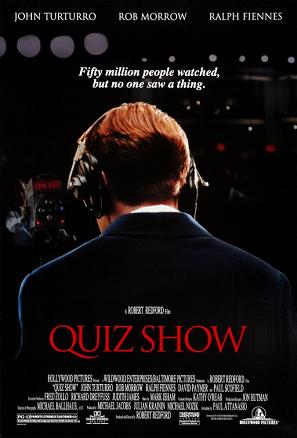
Directed by Robert Redford and based on a true story, Quiz Show was nominated for the Academy Award for best picture but lost to Forrest Gump.  Among those of us who obsess over Oscar history, Quiz Show is often overshadowed by not only Forrest Gump but two of the other nominees as well, Pulp Fiction and The Shawshank Redemption.  When compared to Pulp Fiction, Quiz Show certainly feels old-fashioned.  At the same time, it’s not quite as much of a sentimental crowd-pleaser as Gump or Shawshank.  Perhaps for those reasons, Quiz Show never gets quite as much attention as some other films that have been nominated for best picture.  However, taking all of that into consideration, Quiz Show is still one of the best films of the 90s.

Quiz Show takes us back to the 1950s.  The most popular show on television is 21, a game show in which two contestants answer questions, win money, and try to be the first to score 21 points.  The American public believes that all of the questions asked on 21 are locked away in a bank vault until it’s time for the show.  What they don’t know is that the show’s producers have instead been rigging the show, giving the answers to contestants who they feel will be good for ratings.

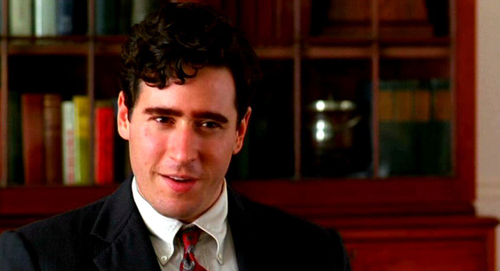
When Quiz Show begins, nerdy Herbie Stempel (John Turturro) has been the champion for several weeks.  However, both the show’s producers and sponsors feel that the untelegenic Herbie has peaked.  Hence, the handsome and charismatic Charles Van Doren (Ralph Fiennes) is brought on the show and Herbie is ordered to lose to him.  Reluctantly, Herbie does so.

john_turturro_quiz_show

Charles is initially reluctant to cheat but, as he continues to win, he finds himself becoming addicted to the fame.  Charles is the son of the prominent academic Mark Van Doren (Paul Scofield) and his success on television finally gives him a chance to escape from his father’s shadow.  Indeed, the film’s subtle and nuanced portrait of Charles and Mark’s loving but competetive relationship is one of the film’s greatest strengths.

ralph_fiennes_quiz_show

Herbie, however, is bitter over having to lose and has subsequently gambled away all of his winnings.  When 21′s producer (David Paymer) refuses to help Herbie get on another TV show, Herbie reacts by going to the New York County district attorney and publicly charging 21 as being fixed.  Though the grand jury dismisses Herbie as being obviously mentally unbalanced, his charges come to the attention of a congressional investigator, Richard Goodwin (Rob Morrow).

rob_morrow_quiz_show1

Goodwin launches his own investigation into 21 and discovers that the show is fixed.  (As the ambitious Goodwin puts it, he wants to “put television on trial.”)  Along the way, he also meets and befriends Charles Van Doren and finds himself torn between his desire to expose the show and to protect Charles from the bad publicity.  Again, the film is to be applauded for the subtle way that it uses Goodwin’s investigation of both Charles and Herbie as a way to explore issues of both class resentment and class envy.  Goodwin may have come from the same ethnic background of Herbie but it quickly becomes obvious that Goodwin has more sympathy for the genteel (and very WASPy) world that produced Charles Van Doren.  When Goodwin tries to justify protecting Charles, his wife (played by Mira Sorvino) responds by calling him “the Uncle Tom of the Jews” and it’s hard not to feel that she has a point.

1quiz3

While I greatly enjoyed Quiz Show, I do have to say that, on one major point, the film fails.  Try as he might, director Redford never convinces us that a rigged game show is really as big of a crime as he seems to be believe it to be.  Perhaps in the 1950s, people were still innocent enough to be shocked at the idea of television reality being fake but for cynical contemporary viewers, it’s hard not to feel that the “scandal” was more about Richard Goodwin’s ambition and less about any sort of ethical or legal issue.  Towards the end of the film, one character suggests that television will never be truly honest unless the government steps in to regulate it.  “What?” I yelled back at the TV.

Seriously, it seemed like a bit of an overreaction.

As I watched Quiz Show, I found it hard not to think about the reality shows that I love.  For instance, I know that The Bachelor and The Bachelorette are largely staged.  I know that the previous season of Big Brother was largely set up so that Amanda could win.  (And, believe me, if Amanda hadn’t sabotaged her chances by turning out to be a mentally unstable racist bully, she would have won and she would probably would have been invited back for the next all-stars season.)  I know that shows like Storage Wars and Dance Moms are “unscripted” in name only.  I know that reality shows aren’t real but my attitude can basically be summed up in two words: “who cares?”  Perhaps I would be more outraged if I lived in the 50s which, to judge from both Quiz Show and a host of other movies, was apparently a much more innocent time.

quiz-show-morrow-scorsese

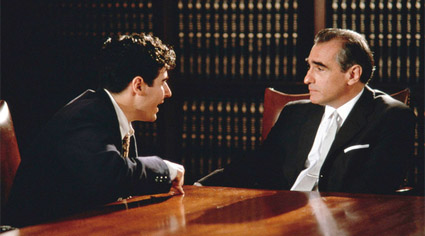
That said, I really enjoyed Quiz Show.  A lot of that is because I’m a history nerd and, therefore, I have a weakness for obsessively detailed period pieces.  But even beyond that, Quiz Show is a well-made, entertaining film that features three excellent lead performances and several strong supporting turns.  If you love to watch great actors playing great roles then Quiz Show is the film for you.  Rob Morrow lays his Boston accent on a bit thick but otherwise, he does a good job of suggesting both Goodwin’s ambition and the insecurities that lead him to desire Charles’s friendship even as he tries to expose him as a fraud.  John Turturro brings an odd — if manic — dignity to Herbie Stempel while Johann Carlo is well-cast as his wife.  Best of all, Ralph Fiennes makes Charles Van Doren into a sad, frustrating, and ultimately sympathetic character while Paul Scofield is the epitome of both paternal disappointment and love as his father.  The film is full of great supporting turns as well, with David Paymer and Hank Azaria perfectly cast as the show’s producers and Christopher McDonald playing the show’s host with the same smarmy charm that he brought to a similar role in the far different Requiem For A Dream.  Perhaps best of all, Martin Scorsese shows up as the owner of Geritol and gets to bark, “Queens is not New York!”

Even if Robert Redford doesn’t quite convince us that the quiz show scandal was as big a deal as he obviously believes it to be, Quiz Show is still an uncommonly intelligent film and one that deserves to rediscovered.

QuizShowPoster

Other entries in the 44 Days Of Paranoia:

  1. Clonus
  2. Executive Action
  3. Winter Kills
  4. Interview With The Assassin
  5. The Trial of Lee Harvey Oswald
  6. JFK
  7. Beyond The Doors
  8. Three Days of the Condor
  9. They Saved Hitler’s Brain
  10. The Intruder
  11. Police, Adjective
  12. Burn After Reading

44 Days of Paranoia #12: Burn After Reading (dir by Joel and Ethan Coen)


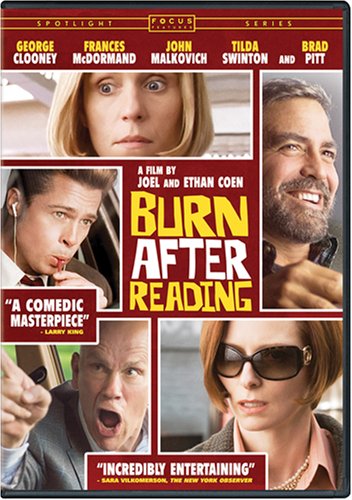
For today’s entry in the Days of Paranoia, let’s take a look at Joel and Ethan Coen’s wonderfully satiric look at espionage, greed, lust, and stupidity, 2008’s Burn After Reading.

Like most Coen Brothers films, Burn After Reading tells the dark story of a group of obsessives who all think that they’re far more clever than they actually are.  Osborne Cox (John Malkovich) is a CIA analyst who, because of his alcoholism and generally sour personality, is demoted.  Cox angrily quits his job and then starts working on his memoirs.  Meanwhile, Cox’s wife Katie (played by Tilda Swinton) is having an affair with the handsome but idiotic Mark (George Clooney).  On the advice of her divorce lawyer, Katie secretly downloads copies of all of Osborne’s records, including his memoirs.  Katie gives the disc to her lawyer’s secretary.  The secretary then proceeds to accidentally leave the disc at Hardbodies Gym.

This is where things, in typical Coen Brothers fashion, start to get complicated.  Two trainers at the gym — Linda (Frances McDormand) and her fitness obsessed friend Chad (a hilarious Brad Pitt) — find the disc and mistake Osborne’s very mundane files for national security secrets.  Linda, who is obsessed with raising enough money to get a boob job, convinces Chad that they should blackmail Osborne and demand that he pay them before they return his disc.  Osborne, who has no idea that Katie copied his records, refuses to pay so Linda takes the disc to the Russians.  This leads to a series of misunderstandings that eventually lead to several murders, all of which have to be covered up by the CIA, despite the fact that both the director of the CIA and his assistant agree that there’s no way to understand how any of this happened and that, in the end, neither one of them has learned anything from the experience.

Perhaps because it was released between the Oscar-winning No Country For Old Men and the Oscar-nominated A Serious Man, many critics tend to dismiss Burn After Reading as just being an enjoyable lark and nothing more.  While it’s true that there’s not a lot going on underneath the surface of Burn After Reading, the surface itself is so fun, vivid, and vibrant that it seems rather petty to complain.  Burn After Reading finds the Coen Brothers at their most playful and snarky.

The Coen Brothers have made films in several different genres and styles but all of their work has one thing in common.  The Coens tell stories about obsessive characters who aren’t anywhere close to being as smart as they think they are.  When critics complain that the Coens tend to view their characters with a rather condescending attitude, they’re usually talking about films like Burn After Reading.  Fortunately, in the case of Burn After Reading, the Coens assembled one of their strongest casts.  From the insanely focused Frances McDormand to the perpetually smiling Brad Pitt to cynical John Malkovich, everyone does such a great job that you can overlook the fact that they’re all essentially playing idiots.  Perhaps the film’s best performance comes from George Clooney who, in the role of Harry, proves himself to be a very good sport by satirizing both his own reputation as a womanizer and his career as an old school movie star.  In one of the film’s best moments, Harry, gun drawn, dramatically leaps and then rolls into an empty bedroom.  Like almost all of the characters in Burn After Reading, Harry is just a big kid playing action hero and Clooney’s performance here is perfect.

As for Burn After Reading, it may not be perfect but it’s certainly a lot of fun.

51CW76jX8fL

Other entries in the 44 Days Of Paranoia:

  1. Clonus
  2. Executive Action
  3. Winter Kills
  4. Interview With The Assassin
  5. The Trial of Lee Harvey Oswald
  6. JFK
  7. Beyond The Doors
  8. Three Days of the Condor
  9. They Saved Hitler’s Brain
  10. The Intruder
  11. Police, Adjective

44 Days of Paranoia #11: Police, Adjective (dir by Corneliu Porumboiu)


For today’s entry in the 44 Days of Paranoia, I want to take a look at Police, Adjective, a Romanian film from 2009.

Alex (Alexandru Sabadac) is a teenager who has recently been accused of being a drug dealer by a police informant.  Burned-out detective Cristi (Dragos Bucur) is assigned to follow Alex and keep him under surveillance and, ultimately, gather enough evidence to send Alex to prison.

However, Cristi quickly realizes that Alex is just a bored kid who likes to smoke weed with his friends.  Cristi realizes that Alex isn’t a threat to anyone and, that by doing his job, Critsi will essentially be ruining Alex’s life.  As well, Cristi feels that the informant is a bigger threat than Alex but he’s told that the informant is the son of a powerful man and therefore, won’t be prosecuted.

After spending the majority of the film watching Alex and dealing with the drudgery of the never-ending police bureaucracy, Cristi has a meeting with his superior, Anglehache (played, with a subtle brilliance, by Vlad Ivanov).  Cristi argues that there’s no reason to arrest Alex and send him to prison for seven years.  Anglehache responds by opening a dictionary, forcing Cristi to read the definition of the word “police,” and then explaining why the law must be rigidly enforced regardless of logic.  It’s now up to Cristi to decide what’s more important, his conscience or the demands of the state.

I can still remember the Saturday afternoon that I spent watching Police, Adjective.  My reason for wanting to see the film was simple: I had never seen a Romanian film before and, living in Texas, there was a pretty good chance that Police, Adjective would be my only opportunity to do so.  I approached all of my friends and every member of my family and I said, “We have to see this movie!  It’s from Romania!”  I could tell by their reactions that they weren’t quite as enthusiastic as I was.  “Fine!” I declared, “I’ll see it by myself!”  And that’s exactly what I did.  Early in the morning,  I went down to the Dallas Angelika and I saw Police, Adjective.

When the film started, there were 7 other people sitting in theater.  The first two walked out after 15 minutes.  The next one left at the 30 minute mark.  As the rest of the film played out, I was aware of the other four viewers getting frustrated.  I could hear them impatiently rattling their popcorn bags.  I could hear a few of them demanding, under their breath, to know how The Dallas Morning News could have possibly given this film a good review.  I could hear them as, one-by-one, they stood up and walked out of the theater.  By then end of the movie, I was the only one left.

Now, you should understand that Police, Adjective features no violence, no profanity, no nudity, and no mention of religion.  In short, the audience didn’t leave because it was offended by anything it had seen.  Instead, they left because Police, Adjective is quite literally one of the slowest films ever made.  It’s a police film that features no action but instead emphasizes the drudgery of both the work and existence in general.  For 90 minutes, we watch as Cristi secretly follows and observes Alex.  During that time, Alex pretty much does nothing.  Then eventually, Cristi goes back to a depressingly shoddy-looking police station, questions whether the law is worth enforcing, and gets a lecture from a guy with a dictionary.

Exciting stuff, no?

Well, in its own way, it is.  Police, Adjective is a film about ideas and, despite what some filmmakers seem to believe, ideas can very exciting.  By emphasizing the drudgery of Cristi’s job and rejecting the clichés that audiences have been conditioned to expect when it comes to police films, Police, Adjective invites the viewer to consider their own attitude towards the law.  Why do we have laws and do we really need them?  Cristi is forced to consider whether his superior’s attitude — that the law must be obeyed just because of the fact that is the law — is correct or if it’s just another excuse to justify the power of the state at the expense of the rights of the individual.

Not only is it a good question but it’s a question that not many films have the courage to ask.

Fortunately, Police, Adjective does.

police-adjective_970x390