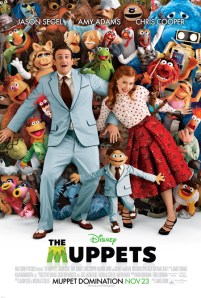
Bottom Line: If you’re buying a ticket to go see The Muppets, you’re treating yourself to a Kid’s film. If you’re expecting the film to be life affirming and/or soul changing, you may want to look elsewhere (though it might do that, in some ways). It’s not a knock on the film by any means, but walking into The Muppets with any expectations other than to just enjoy yourself, you might be asking too much. How can you not like this film? It’s got Muppets in it.
Growing up with the Muppets as kid was a weird thing. When I think back on it, I only remember 3 distinct things: I remember the Muppet Intro which I always sung along to, I remember the blue eagle, and I remember Gonzo and his Chickens. I have to admit I spent a lot of time laughing out loud on this one, though everyone’s tastes are different. That’s just me.
The Muppets must have been a really hard sell. Imagine taking something that was popular in the 70’s and trying to present it in such a way that both the original audiences could appreciate it along with those who only knew of the Muppets from Muppet Babies (or worse, never ever even heard of them). The fact that it’s a movie about Muppets and that it really doesn’t take itself seriously makes it work so well. I haven’t any “I wish they had” or “it would have been if they” moments for this. The film has a simple premise and does what it needs to.
Looking at it, I don’t know if I can call it a Kid’s film or a Muppets Fan Film. I have a tough time classifying it, I just know I really, really loved it.
The Muppets is the tale of two brothers, Gary (Jason Segel) and his Muppet brother, Walter. While Walter had his problems growing up, one of his biggest joys was watching The Muppets on TV. His lifelong dream is to visit Muppet Studios and meet his idols. Gary loves his girlfriend Mary (Amy Adams), but he’s so caught up with Walter’s happiness that he hasn’t asked Mary to marry him. She hopes with their trip to Hollywood, they’ll spend a romantic time and he’ll finally do so. Bringing Walter along with them doesn’t help things.
When they visit the Muppet Studios, Walter discovers that an oil magnate (played by Chris Cooper) wants to acquire the unused Muppet Studios for his own, the decision is made to try to reach the rest of the Muppets and raise enough money to save the Studios. It’s essentially the same premise as The Blues Brothers, but with Muppets. Only here, the Muppets have to deal with an audience where they’re really no longer relevant. Can they really be fun in this day and age? That’s one of the questions that come up in the film.
The film happily pokes fun at itself, breaking the 4th wall a number of times and coming up with some pretty cute ways to move the story along. The musical numbers are plenty (I picked up the Soundtrack when I got home and am listening to it while writing this) and I think only one was worthy of a “Oh wow, they really went there?” with Amy Adams’ & Miss Piggy’s “Me Party”, but again, it’s not trying to be super serious.
For anyone who’s watched The Muppet Show in their lifetime, the movie is a real treat. That my audience actually sung along to some of the songs was a fun feeling. For anyone grown up and new to the Muppets, it might all go over their heads. Kids (young ones at least), should have a lot of fun with the movie.
Here’s hoping that Jason Segel finally gets to do that Dracula Musical from Forgetting Sarah Marshall.
Hi out there. As I sit here typing this, I am so freaking sick, it is not even funny! Seriously. I’m congested, I’m running a fever, and I’m taking way too many naps while everyone else in the world is having a lot of fun playing outside and going to the new Twilight film. However, despite feeling all bleh, nothing will stop me from sharing another edition of Lisa Marie’s Favorite Grindhouse and Exploitation Film Trailers. NOTHING!
1) A Nightmare On Elm Street (1984)
One of the classic “old school” horror trailers. The bit with the stairs always freaks me out.
2) Alone in the Dark (1982)
Not to be confused with the later film from Uwe Boll.
3) Without Warning (1980)
Martin Landau was apparently busy in the early 80s.
4) Deadtime Stories (1986)
This film appears to be an alternative take on beloved bedtime stories and…wait. Bedtime. Deadtime. Hey, I just got that! Neat.
5) Hello Mary Lou: Prom Night 2 (1987)
Apparently, this film has next to nothing to do with the original Prom Night and you have to ask yourself: if there’s no elaborate disco dance-off, then what’s the point? Still, I own this one on DVD and I’ll be watching it soon if I don’t start to feel better.
6) Pet Sematary 2 (1992)
I remember that I saw this movie on TV one late night when I was like ten or eleven and oh my God, it scared the Hell out of me! I mean, literally everyone dies in it! Even kids! Trust me, that’s a really scary thing to see when you’re still just a kid yourself. But anyway, I rewatched it last year and was mostly bored.
A few days ago, I finally went and saw Puss in Boots, the new animated entry into the Shrek franchise and a film that has spent (at least) two weeks at the top of the box office. Now, before I launch into my review, I should admit that I’m biased. I love cats, I love fairy tales, I loved all of the Shrek movies (even the ones that weren’t that good), and I love Antonio Banderas. Puss in Boots is one of my favorite characters of all time and I fully expected to love this movie. And you know what?
I did love it.
Taking place before Shrek, Puss in Boots follows the titular feline (voiced by Antonio Banderas, who seriously deserves some sort of Oscar for Best Sexy Voice) as he swashbuckles his way across Far Far Away. Reuniting with his childhood friend Humpty Dumpty (Zach Galifianikis, and not Jonah Hill as I assumed while listening to his voice durin the film) and with the equally skilled cat thief Kitty Softpaws (Salma Hayek), Puss finds himself stealing magic beans from the notorious outlaws Jack and Jill (Billy Bob Thornton and Amy Sedaris) and using the resulting beanstalk to help Kitty and Humpty to steal the goose that lays the golden eggs. Along the way, we also get some flashbacks to Puss’s kittenhood at the orphanage and oh my God!, is it ever adorable.
Puss In Boots is a pretty simple film and, to be honest, it’s almost too simple. There’s none of the subversive satire or subtext that distinguished the best of the Shrek films. But then again, as a character, Puss in Boots has little of the existential angst that defined Shrek and, as a film, Puss in Boots probably makes the right decision to just keep things simple, cute, and fun. When all is said and done, the main appeal of Puss in Boots is that he’s a cute little kitty who acts like a cute little kitty and who sounds exactly like Antonio Banderas. He’s an adorable character and here, he stars in an adorable movie and that’s more than enough to make me happy.
Hi, everyone! Well, I am in a much better mood than I was when I wrote my last post and that’s because I just remembered that November is the start of Oscar season! Yay!
Now, I know that a lot of people make a big deal about how little they care about the Oscars and they always sit around and bitch about how such-and-such movie didn’t win and how the Academy always honors mediocrity and the Academy is biased towards the mainstream and blah blah blah blah blah. As I explained many times last year, I am aware of all of this and I don’t care. On an annual basis, the Oscars prove themselves to be a big, tacky, spectacular train wreck and I love them!
Anyway, as Oscar season slowly creeps to life (it won’t really be here until the various critic groups start handing out their equally silly awards in December), the Academy has released the list of the 18 films that have qualified to compete for the title of Best Animated Film. Since there are 18 contenders, that means that we’ll actually have five nominees this year as opposed to just three and I for one say, “Yay!” to that. Whenever I see only three films listed in a category, I have flashbacks to trying to understand the concept of the Holy Trinity.
Anyway, here are the contenders:
The Adventures of TinTin
“Alois Nebel”
“Alvin and the Chipmunks: Chipwrecked” “Arthur Christmas” “Cars 2” “A Cat in Paris” “Chico & Rita” “Gnomeo & Juliet” “Happy Feet Two” “Hoodwinked Too! Hood vs. Evil” “Kung Fu Panda 2” “Mars Needs Moms” “Puss in Boots” “Rango” “Rio” “The Smurfs” “Winnie the Pooh” “Wrinkles”
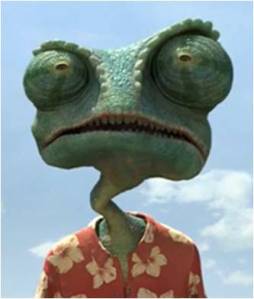
I have to admit that this has been kind of a strange year for animated films, largely because, as my fellow contributor Leonard Wilson once pointed out on twitter, this is the first year in which it appears that Pixar might not have a contender. I recently saw Cars 2 and did not shed a tear and quite frankly, going to a Pixar film and not crying is a bit like going to New Orleans, flashing your boobs, and not getting any beads. It just makes you question everything. Winnie the Pooh made me cry. So did Rango and Kung Fu Panda 2 for that matter. I haven’t seen Puss In Boots yet but I expect I’ll love it because it’s about a cat and I love cats. However, I have a feeling that the award will be given to Adventures of TinTin just to keep Steven Spielberg from throwing a hissy fit after War Horse fails to live up to expectations.
For my first horror review of October, I want to tell you about a movie that was directed by one of my favorite Italian filmmakers, Lucio Fulci. That movie is the unjustly neglected Gato nero, or the Black Cat.
In The Black Cat (loosely — and I do mean loosely — based on Edgar Allan Poe’s short story), the great David Warbeck plays a detective who is sent to a small English village to investigate a series of mysterious deaths. Corpses are turning up covered in scratches. A man crashes his car after a black cat suddenly shows up in the passenger’s seat. A young couple is found dead in a locked-up boathouse. Evidence suggests that the killer entered through a small air vent. No human could fit through that vent but…how about a cat? Warbeck enlists the aid of a visiting American photographer (Mimsy Farmer) to investigate the crimes and he soon comes across a half-crazed medium (Patrick Magee) who just happens to own an adorable, if ill-tempered, black cat…
Fulci is well-known for directing such seminal (and gory) horror films as Zombi 2 and The Beyond trilogy. The Black Cat was made during the same period of time as his more infamous films but it has never received as much attention. Perhaps that’s because The Black Cat almost doesn’t feel like a Fulci film. The gore is played down, the plot is coherent and (for a Fulci film) surprisingly linear, and the film even has a playful sense of humor to it. Indeed, this often feels more like a minor, if entertaining, Hammer film than a Fulci film. However, visually, this film is clearly the work of Lucio Fulci. With his constantly prowling camera following isolated characters through dark streets and passageways, Fulci manages to make a small English village feel just as menacing as the dying Caribbean island from Zombi 2. For all the attention given to Fulci as a “master of gore,” the true strength of his best films came from Fulci’s ability to create a palpable atmosphere of dread. Fulci used gore as a tool but not as a crutch and if The Black Cat is a minor Fulci film, it’s still a film that proves that he was a far better director than even many of his fans give him credit for.
The Black Cat is surprisingly well-acted by a cast that’s made up of an appealing combination of Fulci regulars and English B-movie veterans. I read an old interview in which Warbeck complained that he felt his performance here was “boring,” but actually he was the perfect lead for this type of film, likable and with enough of a sense of humor to keep you watching. Al Cliver may not be a household name but he and his blonde mustache seemed to show up in just about every movie Fulci made and he shows up here as well. This time, he’s playing a local English constable and he’s no more believable here than he was playing a scientist in The Beyond or a boat captain in Zombi 2. Still, any true Fulci fan will always be happy to see Cliver show up in a Fulci film because — much like familiar but bland wall paper — he lets us know that we’re home. Patrick Magee is probably best known for his over-the-top performance as Mr. Alexander in A Clockwork Orange. Magee goes just as much over-the-top here but, just as in A Clockwork Orange, Magee’s performance fits in perfectly with the film he’s appearing in. Much as Stanley Kubrick contrasted Magee’s performance with Malcolm McDowell’s more subtle work, Fulci contrasts Magee’s theatrical approach with the more relaxed performances of Warbeck and Farmer. Did I just compare Lucio Fulci to Stanley Kubrick? Yes, I did and I stand by it.
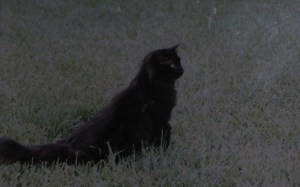
However, the real star of this film is the black cat. Trust me, this black cat (or black cats as I imagine several were used) is both adorable and blood-thirsty. I still say that our cat Doc is the cutest black cat in the world but this film’s murderous feline comes in a very close second.
Over the past two years, golf has become my favorite spectator sport. I have never played it. I can’t tell you the difference between an iron and a wedge. I definitely can’t tell from a player’s swing whether the ball’s more likely to land on the green or in the woods somewhere. I suppose I’m approaching the sport completely backwards from the vast majority of people who take interest in it.
No, I have zero technical knowledge of golf. When I was growing up my family watched the Masters every year, and my best efforts to ignore it amounted to all I ever experienced of the game prior to two years ago. Then, maybe for tradition’s sake, maybe as a complete fluke, I actually tuned in and paid attention to all four rounds of the Masters in 2010. I had no idea who Phil Mickelson and Lee Westwood were, but watching them battle for the win turned out to excite and entertain me as much as any football or hockey game I’d witnessed. The U.S. Open came and went before I ever realized that there were four big tournaments each year, and then the British Open finally hooked me for good.
I haven’t missed a day of the four majors since, but it was the players that dragged me in–the confidence, determination, ease under pressure, and extraordinary patience it took to compete in a major tournament. McIlory’s triumphal return after choking in the Masters, Clarke’s late-career comeback in the face of personal tragedy, Westwood’s ability to stay cool despite having come just short of victory so many times, that aura of greatness that surrounds Tom Watson everywhere he goes–that’s why I fell in love with golf. I’m only slowly learning how it all works after the fact. The physical techniques don’t interest me that much, but it’s time I started to get a feel for what professional golf consists of beyond the four majors.
I figured the logical place to start would be the official world golf rankings, but the data provided there looks pretty wild at first glance. Take Luke Donald, the current top-ranked player in the world. I know relatively little about the guy–he hasn’t stood out enough in the majors I’ve watched for me to really take notice of him. But he’s number one by a pretty big margin. The data, which can be found here, looks like this:
Pt.s Avg.: 10.41
Tot. Pts.: 551.71
# of Evts.: 53
Pts. Lost 2009/10: -181.07
Pts. Gained 2011: 422.21
The gist of it is pretty simple. You gain points based on your performance in events. Donald has 551.71 points over the course of 53 events, making his average points per event 10.41. This is the number by which he is ranked.
Simple enough. The other two columns are what threw me for a loop, and my confusion turned out to be well justified after reading more about the calculation process. No math is going to get you from the Pts. Lost and the Pts. Gained columns to the Tot. Pts. column; They aren’t directly relevant statistics. Here’s what’s really going on:
The # of Evts. column is the total number of events a player has participated in which can award points in the past two years from the current week. That is, not in the past two seasons, but in the past 104 weeks. Points from events diminish over time beginning with the 14th week, in order to give higher precedence to current performance. So let’s say you win the Masters. That’s worth 100 points. For 13 weeks, those 100 points will be included in your Tot. Pts., from which your average is derived. On the 14th week they begin to diminish. So 104 weeks minus 13, that means, as I understand it, for the next 91 weeks you will lose about 1.1 points from your total, until the value of that Masters win eventually reaches 0.
The Pts. Lost 2009/10 column is an oddly worded category, since you can lose points earned in 2011 as well. It should (and elsewhere does) read Pts. Lost 2011. It really means points lost due to diminishing values in the 14 through 104th weeks as of the start of the 2011 season. With that in mind, if Luke Donald has 551.71 points right now, gained 422.21 this season and lost 181.07, he must have ended the 2010 season with 310.57 points. And that he did. So this column is a mildly abstract way of tracking a player’s improvement between seasons. The result is a chart that simultaneously measures success over a 104 week period and performance in the two most recent calendar years.
Of course, the ultimate ranking is derived by dividing total points by the number of tournaments participated in, and this opens a whole new string of questions. In order to rank at all, a player has to have participated in 40 tournaments in the past 104 weeks. The maximum number of tournaments is in the process of changing, but by January 1st will be 52. That is, once you’ve competed in your 53rd tournament in 104 weeks, the results of your earliest tournament in that timespan will be dropped. It’s the minimum of 40 that intrigues me though. It begs the question of qualification for recognized events.
Let me shift focus to Tiger Woods. Currently ranked 44th, his world ranking stats are:
Pt.s Avg.: 3.03
Tot. Pts.: 121.02
# of Evts.: 40
Pts. Lost 2009/10: -239.66
Pts. Gained 2011: 45.42
If you watched the PGA Championship, you can’t have missed the commentary on Woods. By failing to make the cut, he dropped out of the top 125 points leaders for the 2011 season, and that is the qualification standards for the FedEx Cup. This cup consists of four tournaments and is currently underway. Since Woods can’t compete, did in 2010, and currently sits at 40 events, I gather that a week from yesterday he will cease to be a ranked golfer.
Digging into the consequences of that, I found that the standards to compete in an average tournament aren’t so high once you’ve got tour membership. Tiger Woods, as I understand the qualification process, is already a lifetime member of the PGA Tour. With the exception of a few tournaments with specific demands, like those of the FedEx Cup, I’m pretty sure a PGA Tour member is eligible to enter any tournament in the rotation, with the available slots going in the order of priority listed here. In other words, whatever all Woods’ fall has cost him, it’s not going to prevent him from playing with the other pros if he wants to.
I’m still a little thrown off, because pgatour.com’s official list of active members includes a number of names not on the exemption chart I just linked. To this I found no clear answer, but it might just be that the active list isn’t as up to date as the exemption list.
At any rate, my last questions return to the topic at hand. Sure, players gain points by performing well in tournaments, but how many options do they have, and what exactly determines how many points a tournament can provide? The second, third, and fourth ranked players in the world aren’t even on the PGA Tour, so there’s got to be a lot more to it than that. A quick glance across wikipedia will show you just how extensive the opportunities for ranked matches can be. The PGA Tour alone includes 49 events this year, and while it might be the most prestigious tour, it is still only one of twelve from which a golfer can earn points. The European Tour stands almost equal in its number of matches and potential rating values, followed by the Japan Golf Tour and PGA Tour of Australasia, then the Sunshine Tour (South Africa), Asian Tour, and Nationwide Tour (USA), then the Challenge Tour (Europe), and lastly the Canadian Tour, OneAsia Tour, Tour de las Américas, and Korean Tour. Not all are quite so large, and each has its own method for attaining membership, but generally speaking there are a lot more opportunities out there to participate in matches that factor into the World Golf Ranking than I’d thought.
The last bit of math we have to do to figure out exactly how players move up the ranks–how many points a particular tournament can award–involves Total Rating Values. I googled this term and golf and got 8 results, so perhaps there is a more common phrase used than the official one, but all you really need to understand it is the pretty thorough breakdown provided on the Official World Golf Rankings website. This looks pretty complex at a glance, but it’s actually really straight forward, and while you might need a calculator and a lot of free time to figure out how the points will break down for a given tournament, the necessary data is all quite accessible.
The most important thing to note on this chart is that Total Rating Values and Ranking Points are completely different sets of numbers. A tournament’s Total Rating Value determines which Ranking Points column it will fall into. If a tournament has a rating value of 35, for example, the winner will earn 14 ranking points, second place will earn 8.4, and so on. There is a minimum column for each Tour and Premier Event, but theoretically any tournament willing to open its doors to the top 200 players in the world can have a Rating Value of 925, and if the top 30 in the world all happen to be part of that Home Tour–were they all, for example, PGA Tour members in a PGA Tour event–the tournament would have a Rating Value of 1000. A 1000 Rated tournament is thus entirely possible but completely unrealistic.
The World and Home Tour Event Rating Values listed on the bottom of the first page are what give you the tournament’s rating value. As you can see by the breakdown, each tournament’s Rating Value goes up based on the number of high ranking pros participating. The top ranked player in the world, just by participating, adds 45 points to an event’s Rating Value. If the event is on that player’s home tour, the second smaller chart’s value is added on top of it. So Luke Donald adds 53 rating value to any European Tour event he attends. The effect this has on how many actual ranking points are awarded to each position diminishes the higher up the Rating Value gets. For example, adding 32 rating value points to an event that would otherwise have zero (if say, a Canadian reached world #3), would bump the ranking points awarded to the winner from 6 to 14, whereas in an event that would otherwise have a 556 rating value, adding 32 makes no difference at all.
Here are some other examples in case it’s not clear. Even though a Canadian Tour event can have a minimum Rating Value of 0, if Luke Donald was eligible and willing to participate it would be bumped into the 41-50 bracket. If Westwood joined him it would already be up to the 76-90 bracket. So if that was it–Donald, Westwood, no one else but players under 200 in the world rankings–the winner would take home 22 ranking points. This is the number that’s divided by a player’s number of tournaments to create their average, the final determiner of their world rank. If, on the other hand, not enough high ranking player participated to bump the tournament out of that 0-5 column, the winner would take home 6 (so long as we’re still talking a Canadian Tour event.) If it was a PGA Tour event and the entire world top 200 decided to sit out, the winner would still gain 24.
Note that an event’s Rating Value always starts at 0, not at the minimum. The minimum only comes into effect if the combined total of all world rank-derived Event and Home Tour Rating Values of participants fails to exceed it. (Thus if Donald and Westwood were the only players in the top 200 in a European Tour event, its rating value would not be the minimum (91) plus 97. It would be just 97. These minimum values come more into play in “Alternative” events. An Alternative event takes place at the same time as a Regular event, designed for players who couldn’t get into the Regular. An Alternative event’s Rating Value is cut in half, so the minimum pretty much always kicks in.
The big exceptions to these (and thus the most important matches of the year ranking points-wise) are the four majors and the Players Tournament. The majors each have a fixed value of points awarded by position independent of Rating Value, and the Players’ minimum is set to the maximum possible–the 906 to 1000 column, making its point distribution likewise fixed.
This might all sound like a bunch of useless detail to you, but I’ve had an interesting time figuring it all out. It’s nice in any sport to see a big list of numbers and be able to tell what it all means, and golf rankings are a bit less straight forward than the fantasy football stats I’m used to reading. It’s taught me a couple of other things too: that the Players is decidedly the fifth most important tournament of the year, and that if you’re really wondering how important a given tournament will be for the World Golf Rankings, you just have to look at who all’s playing in it.
For Day 3 of the 33 Days of Thousand Years of Dreams we have the Lost Odyssey dream sequence called “White Flowers”.
Like the first two dreams already posted this one continues to have Kaim remembering one of the uncounted memories he thought had had lost. Memories which stretches a thousand years or more. “White Flowers” is a dream memory that leans towards melancholy, but with a sense that it was still one of the happier moments in the life of the eternal warrior. For those who are not eternal it’s a poignant short story on how calamitous events and how they’re initially remembered change through the decades and centuries. How the farther one gets from the initial catastrophe the less mournful each anniversary becomes until it finally turns celebratory for how survivors have recovered and their descendants prospered.
In the end, “White Flowers” more personal and intimate meaning as scene from the eyes of Kaim gives the lesson that we should always live our lives to the fullest. Lives that could continue for decades and into old age, but also lives easily snuffed out just before it has truly begun to live. Live life every day like it was the last then do the same when a new day begins.
White Flowers
Lovely white flowers mask the town. They bloom on every street corner, not in beds or fields set aside for their cultivations, but blending naturally and in line with every row of houses, as though the buildings and the blossoms have grown up together.
The season is early spring and snow still lingers on the nearby mountains, but the stretch of ocean that gently laps the town’s southern shore is bathed in refulgent sunlight.
This is an old and prosperous harbor town.
Even now, its piers see many cruise ships and freighters come and go.
Its history, however, is sharply divided between the time “before” and the time “after” an event that happened one day long ago.
People here prefer not to talk about it—the watershed engraved upon the town’s chronology.
The memories are too sorrowful to make stories out of them.
Kaim knows this, and because he knows it, he has come here once again.
“Passing through?” the tavern master asks him.
At the sound of his voice, Kaim responds with a faint smile.
“You’re here for the festival, I suppose. You should take your time and enjoy it.”
The man is in high spirits. He has joined his customers in glass after glass until now and is quite red in the face, but no one shows any signs of blaming him for overindulging. Every seat in the tavern is filled and the air reverberates with laughter. Happy voices can be heard now and then as well from the road outside.
The entire town is celebrating. Once each year the festival has people making merry all night long until the sun comes up.
“I hope you’ve got a room for the night, Sir. Too late to find one now! Every inn is full to overflowing.”
“So it seems.”
“Not that anyone could be foolish enough to spend a night like this quietly tucked away under the covers in his room.”
The tavern master winks at Kaim as if to say “Not you, Sir. I’m sure!”
“Tonight we’re going to have the biggest, wildest party you’ve ever seen, and everybody’s invited—locals or not. Drink, food, gambling, women: just let me know what you want. I’ll make sure you have it.”
Kaim sips his drink and says nothing.
Because he is planning to stay awake all night, he has not taken a room—though he has no plans to enjoy the festival, either.
Kaim will be offering up a prayer at the hour before dawn when the night is at its darkest and deepest. He will leave the town, sent off by the morning sun as it pokes its face up between the mountains and the sea, just as he did at the time of his last visit. Back then, the tavern master, who a few minutes ago was telling one of his regular customers that his first grandchild is about to be born, was himself just an infant.
“This one’s on me, drink up!” says the tavern master, filling Kaim’s shot glass.
He peers at Kaim suspiciously and says, “You did come for the festival, didn’t you?”
“No, not really,” says Kaim.
“Don’t tell me you didn’t know about it! You mean you came here by pure chance?”
“Afraid so.”
“Well, if you came here on business, forget it. You’ll never get serious talk out of anybody on a special night like this.”
The tavern master goes on to explain what is so special about this night.
“You must’ve heard something about it. Once, a long time ago, this town was almost completely destroyed.”
There are two great events that divide history into “before” and “after”: one is the birth or death of some great personage—a hero or a savior.
The other is something like a war or plague or natural disaster.
What divided this town’s history into “before” and “after” was a violent earthquake.
It happened without warning and gave the soundly sleeping people of the town no chance to flee.
A crack opened up in the earth with a roar, and roads and buildings just fell to pieces.
Fires started, and they spread in the twinkling of an eye.
Almost everyone was killed.
“You probably cant imagine it. All I know is what they taught me in school. And what does ‘Resurrection Festival’ mean to a kid! It was just something that happened ‘once upon a time.’ I live here and that’s all it means to me, so a traveler like you probably can’t even begin to imagine what it was like.”
“Is that what they call this holiday? ‘Resurrection Festival’?”
“Uh-huh. The town was resurrected from a total ruin to this. That’s what the celebration is all about.”
Kaim gives the man a grim smile and sips his liquor.
“What’s so funny?” the tavern master asks.
“Last time I was here, they were calling it ‘Earthquake Memorial Day.’ It wasn’t a festival for this kind of wild celebrating.”
“What are you talking about? It’s been the ‘Resurrection Festival’ ever since I was a kid.”
“That was before you were old enough to remember anything.”
“Huh?”
“And before that, they called it ‘Consolation of the Spirits.’ They’d burn a candle for each person who died, and pray for them to rest in peace. It was a sad festival, lots of crying.”
“You sound as if you saw it happening yourself.”
“I did.”
The tavern master laughs with a loud snort.
“You look sober, but you must be plastered out of your mind! Now listen, it’s festival night, so I’m going to let you off the hook for pulling my leg, but don’t try stuff like that in front of the other townspeople. All of our ancestors—mine included—are the ones who barely escaped with their lives.”
Kaim knows full well what he is doing. He never expected the man to believe him.
He just wanted to find out himself whether the townspeople were still handing down the memories of the tragedy—whether, deep down behind their laughing faces, there still lingered the sorrow that had been passed down from their forefather’s time.
Called away by one of his other customers, the tavern master leaves Kaim’s side but not without first delivering a warning.
“Be careful what you say, Sir. That kind of nonsense can get you in trouble. Really. Think about it: the earthquake happened all of two hundred years ago!”
Kaim does not answer him.
Instead, he sips his liquor in silence.
Among the ones who died in the tragedy two hundred years ago were his wife and daughter.
Of all the dozens of wives and hundreds of children that Kaim has had in his eternal life, the wife and child he had here were especially unforgettable.
In those days, Kaim had a job at the harbor.
There were just the three of them—he, his wife, and their little girl. They lived simply and happily.
The same kind of days that had preceded today would continue on into endless tomorrows. Everyone in the town believed that—including Kaim’s wife and daughter, of course.
But Kaim knew differently. Precisely because his own life was long without end and he had consequently tasted the pain of countless partings, Kaim knew all too well that in the daily life of humans there was no “forever.”
This life his family was leading would have to end sometime. It could not go on unchanged. This was by no means a cause for sorrow, however. Denied a grasp upon “forever,” human beings knew how to love and cherish the here and now.
Kaim especially loved to show his daughter flowers—the more fragile and short-lived the better.
Flowers that bloomed with the morning sun and scattered before the sun went down. They were everywhere in this harbor town: lovely, white flowers that bloomed in early spring.
His daughter loved the flowers. She was a gentle child who would never break off blossoms that had struggled so bravely to bloom. Instead, she simply watched them for hours at a time.
That year, too…
“Look how big the buds are! They’ll be blooming any time now!” she said happily when she found the white flowers on the road near the house.
“Tomorrow, maybe?” Kaim wondered aloud.
“Absolutely!” his wife chimed in merrily. “Get up early tomorrow morning and have a look!”
“Poor little flowers, though,” said the daughter. “It’s nice when they bloom, but then they wither right away.”
“All the better” said Kaim’s wife. “It’s good luck if you get to see them blooming. It makes it more fun.”
“It may be fun for us,” answered the girl. “But think about the poor flowers. They work so hard to open up, and they wither that same day. It’s sad…”
“Well, yes, I guess so…”
A momentary air of sadness flowed into the room, but Kaim quickly dispelled it with a laugh.
“Happiness is not the same thing as ‘longevity’!” he proclaimed.
“What does that mean, Papa?”
“It may not bloom for long, but the flower’s happy if it can open up the prettiest blossom and give off the sweetest perfume it knows how to make while it is blooming.”
The girl seemed to be having trouble grasping this and simply nodded with a little sigh. She then broke into a smile and said, “It must be true if you say so, Papa!”
Your smile is more beautiful than any flower in full bloom.
He should have said it to her.
He later regretted that he had not.
The words he had uttered so carelessly, he came to realize, turned out to be something of a prophecy.
“Well now, young lady,” he said. “If you’re getting up early to see all the flowers tomorrow morning, you’d better go to bed right now.”
“All right, Papa, if I really have to…”
“I’m going to bed now, too” said Kaim’s wife.
“Okay, then. G’nite, Papa.”
His wife said to Kaim, “Good night, dear. I really am going to bed now.”
“Good night” Kaim replied, enjoying one last cup to ease the day’s fatigue.
These turned out to be the last words the family shared.
A violent earthquake struck the town before dawn.
Kaim’s house collapsed in a heap of rubble.
Kaim’s two loved ones departed for that distant other world before they could awaken from their sleep and without ever having had a chance to say “Good morning” to him.
The morning sun rose on a town that had been destroyed in an instant.
Amid the rubble, the flowers were blooming—the white flowers that Kaim’s daughter had wanted so badly to see.
Kaim thought to lay a flower in offering on his daughter’s cold corpse, but he abandoned the idea.
He could not bring himself to pick a flower.
No one—no living being on the face of the earth, he realized—had the right to snatch the life of a flower that possessed that life for only one short day.
Kaim could never say to his daughter, “You go first to heaven and wait for me: I’ll be there before long.”
Nor would he ever know the joy of reunion with his loved ones.
To live for a thousand years, meant bearing the pain of a thousand years of partings.
Kaim continued his long journey.
A dizzying numbers of years and months followed by: years and months during which numberless wars and natural calamities scourged the earth. People were born, and they died. They loved each other and were parted from the ones they loved. There were joys beyond measure, and sorrows just as measureless. People fought and argued without end, but they also loved and forgave each other endlessly. Thus was history built up as the tears of the past evolved gradually into prayers for the future.
Kaim continued his long journey.
After a while, he rarely thought about the wife and daughter with whom he had spent those few short days in the harbor town. But he never forgot them.
Kaim continued his long journey.
And in the course of his travels, he stopped by this harbor town again.
As the night deepened, the din of the crowds only increased, but now, as a hint of light comes into the eastern sky, without a signal from anyone, the noise gives way to silence.
Kaim has been standing in the town’s central square. The revelers, too, have found their way here one at a time, until, almost before he knows it, the stone-paved plaza is filled with people.
Kaim feels a tap on the shoulder.
“I didn’t expect to find you here!” says the tavern master.
When Kaim gives him a silent smile, the tavern master looks somewhat embarrassed and says, “There’s something I forgot to tell you before…”
“Oh…?”
“Well, you know, the earthquake happened a long time ago. Before my father and mother’s time, even before my grandparents’ generation. It might sound funny for me to say this, but I can’t imagine this town in ruins.”
“I know what you mean.”
“I do think, though, that there are probably things in this world that you can remember even if you haven’t actually experienced them. Like the earthquake: I haven’t forgotten it. And I’m not the only one. It may have happened two hundred years ago, but nobody in this town has ever forgotten it. We can’t imagine it, but we can’t forget it, either.”
Just as Kaim nods again to signal his understanding of the tavern keeper’s words, a somber melody echoes throughout the square. This is the hour when the earthquake destroyed the town.
All the people assembled here close their eyes, clasp their hands together, and offer up a prayer, the tavern master and Kaim among them.
To Kaim’s closed eyes come the smiling faces of his dead wife and daughter. Why are they so beautiful and so sad, these faces that believe with all their hearts that tomorrow is sure to come?
The music ends.
The morning sun climbs above the horizon.
And everywhere throughout the town bloom countless white flowers.
In two hundred years, the white flowers have changed.
The scientists have hypothesized that “The earthquake may have changed the nature of the soil itself,” but no one knows the cause for sure.
The lives of the flowers have lengthened.
Where before they would bloom and wither in the space of a single day, now they hold their blooms for three and four days at a time.
Moistened by the dew of night, bathed in the light of the sun, the white flowers strive to live their lives to the fullest, beautifying the town as if striving to live out the portion of life denied to those whose “tomorrows” were snatched away from them forever.
There’s a commercial out for Summer’s Eve that I’ve seen in the theatre. In it, it shows various battles while in the background, there’s a voice over explaining that “Men have fought for it, killed and died for it.” While that ends up being a little humorous at the end, it does point out something. Guys will often do anything for love (or is it lust)?
Take Olive Oyl as a case in point. I know, it’s off the wall and weird with all of the Hotties that have graced the Shattered Lens (and I could get myself kicked for all this), but hear me out. I made something of a fun dare with Arleigh that I could write this – despite the shame that may come from it – and am getting it out there.
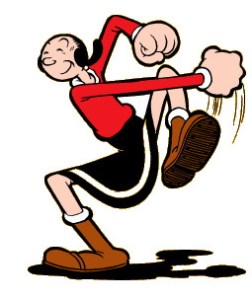
That red shirt.
Her Leia-like hairdo, complete with the ponytail.
And those sexy boots.
It’s Olive’s apparent flaws that make her beautiful, at least to two men.
Ms. Oyl, the love of Popeye the Sailor, manages throughout to always attract the attention of both Popeye and his rival, Bluto (or Brutus, in some stories). Like the characters in Twilight, the two men are always at each other to defend her honor over the years in Max Fleischer’s serials. While she may be petite by today’s standards, Olive brings a sense of vitality and clumsiness that adds to her allure, not to mention her bright smile. She’s all woman.
Olive Oyl is also a resourceful girl, whether it’s by helping her man sneak into a Rodeo or even putting up a fight for him (she once at the spinach and beat up a girl), she shows she’s not one to always wait to be saved (note that I say always – she does have her times where she needs help). Imagine how she’d be if she were written differently, with a darker tone. Perhaps she’d be like Catherine Trammell, Sharon Stone’s character in Basic Instinct, dancing between but never being “owned” by either suitor. As long as Bluto has an interest in her, Popeye will run to her defense. Thus, she owns all the cards. A wise one, that cutie.
Jonathan Hensleigh’s fact-based gangster film Kill The Irishman had a brief (and limited) theatrical run earlier this year and received generally mixed reviews. I myself didn’t see it in the theaters but instead, caught it OnDemand a few weeks ago and I was genuinely surprised to discover that this film, while far from being perfect, is also hardly the simple Goodfellas rip-off that I had originally been led to suspect. Instead, Kill The Irishman is a somewhat flawed but ultimately quite rewarding David-and-Goliath story about a real-life David who was known as “the Irishman.”
Kill The Irishman tells the true story of Danny Greene (played by Ray Stevenson), an Irish-American gangster who went from being a corrupt union boss to challenging the Sicilian mafia’s dominance of the criminal underworld of Cleveland, Ohio. In 1977, Greene became, for a brief period of time, a media celebrity when he survived several assassination attempts while fighting a war for control of the Cleveland rackets. As the film both informs and shows us, this violent, underground war led to a total of 35 bombings, all designed to kill either Greene or one of his allies. By surviving these attacks, Greene briefly appeared to be indestructible and seemed to be on the verge of reviving the long-dormant Irish mafia.
As a film, it takes a while for Kill The Irishman to really click. From the start director Hensleigh shows a real feel for capturing the feel of a once great city slowly dying but the 1st half of the movie still threatens to get bogged down in all the clichés of the modern gangster film — there’s a bit too much clunky narration from Val Kilmer (who sleepwalks through his role as a fictional police detective who grew up with Greene) and a few too many montages set to old rock tunes. It’s all watchable enough and there’s a few memorable sequences (my favorite being the early scenes of Greene on the job, slaving away under an oppressive sun) but on the whole, it just feels like the 100th low-budget remake of Goodfellas. The highlight of this part of the film is Christopher Walken’s typically eccentric yet genuinely sinister performance as an early Greene mentor-turned-enemy.
However, once Greene goes on his own and starts to blow up every inch of Cleveland, the film comes into its own and establishes its own rough identity. Hensleigh proves to be very adept at orchestrating chaos and, with the entire Mafia out to kill him, Greene goes from just being a thug to being a true underdog. It’s impossible not to root for him and, much like the film, it’s here where Ray Stevenson comes into his own. For the 1st half of the film, Stevenson seems like an adequate but uninspired choice for the role of Danny Greene. However, once Cleveland starts exploding around him, Stevenson comes into his own. He not only captures Greene’s cocky defiance but, as the film reaches its inetivable conclusion, he also captures Greene’s own growing paranoia and fear. By the end of the film, Stevenson has given a performance that has masterfully juggled pride and regret, defiance and fear. Regardless of whether it’s an accurate statement about the real Danny Greene, Ray Stevenson makes his version into a true tragic hero.
Along with Stevenson’s anchor of a performance and Walken’s scene-stealing characterization, Kill the Irishman is filled with familiar mob movie character actors, most of whom contribute some nicely realized turns as the various members of the Cleveland underworld. Tony Lo Bianco, Mike Starr, and Paul Sorvino are all convincingly brutish as the leaders of the local Mafia and Vincent D’Onofrio is wonderfully flamboyant as Greene’s one Italian ally. My personal favorite supporting performance came from character actor Robert Davi who was almost a little bit too believable as a cold-blooded murderer. Not to get too specific here but if I ever happen to hire a professional assassin, I hope he looks like Robert Davi.
I have to admit that one reason why I ultimately enjoyed this flawed but worthwhile film is because I’ve always wished that I could have been a member of the Irish mafia. (I wanted to be like Maggie from Gangs of New York and use my fingernails to rip open throats.) For many of us Irish-Americans, there’s just this romance to the whole idea of the Irish Mafia and we’re always looking for evidence that the organization wasn’t, more or less, wiped out by the Italians. (Fortunately, I happen to be a fourth Italian along with being a fourth Irish so the St. Valentine’s Day Massacre is a smidgen less traumatic for me). If nothing else, the Irish mafia epitomizes two things that every true Irish-American knows to be true: 1) the Irish will never stop fighting no matter how intimidating the odds and 2) we’re all ultimately doomed regardless. Kill the Irishman may not be a perfect film but it’s a fitting tribute to a better kind of criminal.





 Through the Shattered Lens