Happy Halloween! For today’s special edition of Lisa Marie’s Favorite Grindhouse and Exploitation Film Trailers, we are paying tribute to the great George Romero! Here are six trailers, all for films directed by the master of American horror! How many of them have you watched this October?
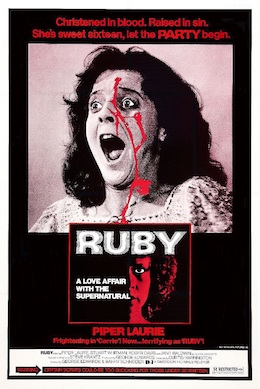
The 1977 film, Ruby, opens with a scene set in 1935. The Great Depression is still raging and the only people making money are industrialists like Joseph P. Kennedy and gangsters like Lucky Luciano and Frank Costello. In the Florida swamps, gangster Nicky Rocco (Sal Vecchio) is betrayed by both his gang and his pregnant girlfriend, Ruby (Piper Laurie). As Nicky’s bullet-ridden body sinks into the bayou, Ruby goes into labor and gives birth to Leslie.
16 years later, Ruby owns her own drive-in. The theater employs several members of the old gang and Ruby is herself married to one of Nicky’s former partners, the crippled and blinded Jake Miller (Fred Kohler, Jr.). Ruby’s lover is another former member of the gang, Vince Kemper (Stuart Whitman). Leslie, meanwhile, is now 16 years old and has never spoken a word in her life. Ruby laments that she never made it as a lounge singer but she does a good job running the theater and it seems to be a popular place to see movies. She’s even able to show Attack of the 50 Feet Woman, even though that film came out in 1958 and Ruby is set in 1951. That’s the power of having mob-connections, I guess.
When strange things start to happen at the theater, it could just be a case of Ruby having bad luck and the former gangsters that she’s hired not being particularly good at their jobs. Or maybe it has something to do with the fact that Nicky swore to get revenge on everyone with his dying breath. One employee is found hanging in a projection booth. Another is found hanging from a tree. Another is left in a cold drink machine and the lady who puts in a quarter to get a cup of tea instead gets a cup of blood. While Ruby might be in denial about the fact that her business is obviously cursed, Vince realizes that something has to be done so he brings a psychic/exorcist named Paul Keller (Roger Davis, who also provides some narration at the start of the film).
Of course, it’s not just ghosts that Ruby and the gang have to worry about. Leslie is acting strange as well! At one point, Leslie even speaks but it’s not with her voice. It’s with Nicky’s voice! Leslie has been possessed and soon, Nicky himself is appearing on the drive-in’s screens and repeating, “I love you, I love you.”
Ruby is a real mess of a film, one that attempts to rip-off The Exorcist while tossing a bit of Carrie in as well. Director Curtis Harrington plays up the campier aspects of the story and Piper Laurie gives a scenery-chewing performance that suggests that she realized it was pointless to try to take anything about Ruby seriously. Stuart Whitman plays Vince as being the most well-meaning but also the most clueless man in Florida while poor Roger Davis is stuck with the most earnest role in the film and, as such, gets the unenviable task of trying to explain what’s going on in a rational manner. There’s nothing rational about Ruby, which goes from being a film about gangsters to being a film about ghosts to being a film about possession without even stopping to catch its breath. It’s a deeply silly film but one gets the feeling that it was made to be silly. Ruby works as long as you just accept the weirdness of what you’re watching while you’re watching it and you don’t give it too much thought afterwards.
For today’s edition of Lisa Marie’s Favorite Grindhouse And Exploitation Film Trailers, we share some trailers from the maestro of Italian horror, Mario Bava!
Black Sunday (1960)
After starting his career as a cinematographer and a visual effects engineer, Mario Bava made his directorial debut with 1960’s Black Sunday, starring Barbara Steele!
2. Black Sabbath (1963)
In 1963, Bava directed one of his most popular films, the horror anthology Black Sabbath. The trailer put the spotlight on the great Boris Karloff.
3. Planet of the Vampires (1965)
One of Bava’s best films, Planet of the Vampires, was later cited by many as an influence on the Alien films.
4. Bay of Blood (1971)
One of the first slasher films, Bay of Blood was also a social satire that featured Bava’s dark sense of humor.
5. The House of Exorcism (1974)
When it was released in the United States, Bava’s Lisa and the Devil was re-titled House of Exorcism and, after new scenes were filmed, sold as a rip-off to The Exorcist.
6. Shock (1977)
Bava’s final film as a director was Shock, which starred Daria Nicolodi as a woman who is being haunted by the ghost of her first husband.
The title of this 1972 film is definitely a case of truth in advertising.
Children definitely should not play with dead things! I don’t care how mature they are or how lenient of a parent you’re trying to be. When you see your child playing with a dead thing, it is on you to step forward and say, “Child, leave that dead thing alone unless you want to forever burn in Hell.” I know that type of language might be traumatic for some children but you’ll be glad you did it. You know who played with dead things when he was a child? Jeffrey Dahmer! And look how that turned out. He got a miniseries made about him and became an internet meme.
Now, it should be pointed out that they’re aren’t any children to be found in Children Shouldn’t Play With Dead Things. The children of the title are actually a group of wannabe actors who are led by a pretentious douchebag named Alan (played by the film’s writer, Alan Ormsby). With his mustache and his long hair and his hip clothes and his vocabulary of psychobabble and buzzwords, Alan considers himself to be quite the chic 70s gentleman. He refers the other actors as being his “children,” and they let him get away with it. Personally, I would be kind of insulted but whatever.
One night, Alan and his theatrical troupe ride a boat off to an island that is sitting off the coast of Miami. The island is reputed to be haunted and Alan tells the actors several rather gruesome stories about things that have supposedly happened to the inhabitants of the island. According to Alan, the island is used as a cemetery for criminals who were so vile that no one wanted to collect their bodies.
Why are the actors on the island? Along with leading his theatrical troupe, Alan considers himself to be a bit of a warlock. He wants to perform a ceremony at midnight and he expects his actors to help him out. If they don’t help, they’ll lose their jobs. If they do help, they’ll probably lose their lives. Alan and his actors dig up the body of a man named Orville (played by the wonderfully named Seth Sklarey). The ceremony that Alan performs at midnight fails to bring Orville back to life but it does cause the dead who were left in their graves to rise from the Earth as zombies. The zombies are not happy that their island has been invaded and they’re especially not happy about Alan digging up Orville.
Children Shouldn’t Play With Dead Things is a mix of comedy and horror, with Alan’s pretentious foolishness dominating the first half of the film while the second features the zombies laying siege to a cottage. It starts out slow but, once the zombies come to life, the film achieves a surreal grandeur. For an obviously low-budget film, the zombie makeup is surprisingly effective and the zombies themselves are so relentless and determined in their pursuit of the living that they help Children Shouldn’t Play With Dead Things survive the inevitable comparisons to Night of the Living Dead. The film’s final scene, which plays out in near silence, has an undeniable horrific power to it.
Children Shouldn’t Play With Dead Things was the third film to be directed by Bob Clark. He also directed films like Deathdream, Black Christmas, Murder By Decree, and the infamous (and very financially successful) Porky’s. Of course, his most beloved film is the one that we’ll all be watching in a little less than two months, A Christmas Story.
Obviously, I was going to have to share the trailer for the original Halloween eventually. This is still the best of the franchise. In fact, all of the attempts by other directors to “improve” on it just serves to remind us of the fact that John Carpenter said everything that needed to be said in the first film.
2. Assault on Precinct 13 (1976)
How did Carpenter get the chance to direct Halloween? Well, the producers were impressed with his previous film, Assault on Precinct 13. Also impressed by this film was Angela Pleasence, who subsequently convinced her father, Donald, to read Carpenter’s script for Halloween.
3. The Fog (1980)
Carpenter followed up Halloween with The Fog, which featured several cast members of both Halloween and Carpenter’s next film, Escape From New York.
4. The Thing (1982)
Incredibly underappreciated when it was first released, Carpenter’s remake of The Thing has gone on to become one of his most popular and influential films.
5. Prince of Darkness (1987)
Speaking of underappreciated, it would also be several years before Carpenter’s Prince of Darkness started to receive the attention that it really deserved.
6. John Carpenter’s Vampires (1998)
Finally, with Vampires, Carpenter mixed the horror genre with the western genre and came up with a hybrid that continues to be influential to this day.
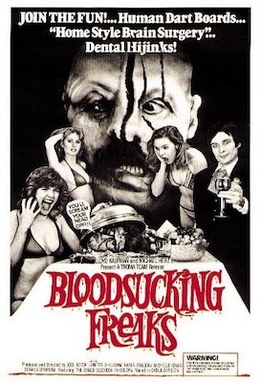
Well, with a title like Blood Sucking Freaks, it has to be good!
Right?
First released in 1976, Blood Sucking Freaks is one of those not particularly good films that every horror fan has to sit through at least once. Historically, it’s important as an example of a film that generated a thoroughly unnecessary moral panic, largely amongst people who had never actually seen the stupid thing. It tells the story of Master Sardu (Seamus O’Brien), who runs a Grand Guignol-style theater in SoHo. Wealthy New Yorkers flock to the theater on a nightly basis, to watch as Sardu and his dwarf assistant, Ralphus (Luis de Jesus), torture women on stage. The crowd thinks that it’s all fake but what they don’t know is that Sardu and Ralphus are abducting real women and forced them to live in a cage underneath the theater, where they are occasionally brought out to be abused by high-paying patrons. All of the torture and death that takes place on stage is real.
Most members of the audience enjoy the show and consider Sardu to be a master of transgressive art. However, critic Creasy Silo (Alan Dellay) doesn’t think much of Sardu or his show and he writes a review in which he refers to whole thing as being pretentious. Sardu apparently considers “pretentious” to be the worst insult that can be uttered against his production of pain and murder so he orders his followers to abduct Silo. Held prisoner in the theater, Silo is told the truth about the show and then brainwashed to become a part of the show himself.
Meanwhile, Sardu’s followers have also kidnapped a ballerina named Natasha (Viju Krem). Sardu feels that, if Natasha can be brainwashed to perform in the show, it’ll lead to greater things. The show might move to Broadway and then someone might make a movie about Master Sardu! Natasha’s lunkhead boyfriend, Tom (Niles McMaster), is not happy about Natasha being kidnapped. He teams up with a sleazy cop (Dan Fauci) and they head down to the theater.
Much as with Snuff, Blood-Sucking Freaks generated a lot of controversy when it was first released, with some speculating that the murders in Blood-Sucking Freaks may have actually been real murders. It was originally released in grindhouse theaters with an R-rating. That R-rating might take some people by surprise when you consider how graphic the film supposedly was but it must be understood that the R-rating was self-imposed. The filmmakers refused to submit the film to the MPAA and just rated it themselves. When Troma acquired the film and submitted an edited version of the film to the MPAA, the organization refused to even watch the film. That’s how controversial Blood-Sucking Freaks is! The MPAA won’t even watch it long enough to tell other not to!
Also, much like Snuff, Blood-Sucking Freaks is actually a pretty boring movie. Blood-Sucking Friends does deserve some credit for satirizing the pretentions of the underground arts scene but, for the most part, it’s a slow-moving and terribly acted film and the gore, while plentiful, is not particularly convincing. Seamus O’Brien, who was murdered in an unrelated incident shortly after the film’s release, gives an absolutely lousy performance as Sardu. Controversy aside, it’s a dumb movie and the only thing that really redeems it is that it knows it’s a dumb movie and doesn’t pretend otherwise.
The main lesson of Blood-Sucking Freaks is that it’s the type of movie that probably would have vanished into obscurity if not for the controversy that it has generated over the years. Outrage sells.
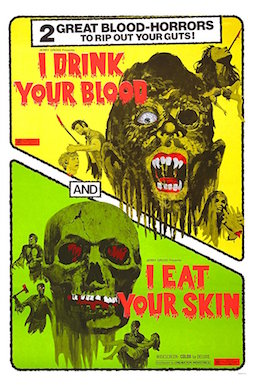
Put yourself in the shoes of the townspeople in 1971’s I Drink Your Blood.
Here you are. You’re minding your own business. Life isn’t great because of the economic downtown. Your town is nearly deserted and is basically full of empty buildings. In fact, it seems like there are currently more construction workers around then townspeople. The workers are working on the dam. Maybe a dam will help the area. Maybe it won’t.
The sexist construction workers are kind of a pain but then, things get even worse when a bunch of hippies show up. Led by the mysterious Horace Bones (played by dancer Bhaskar Roy Chowdhury), these are not your typical (if annoying) peace-and-love hippies. These hippies have more in common with the Manson Family than they do with the commune folks from Easy Rider. They are a remarkably diverse group of hippies. Some of them are young. Some of them are older. Some of them really enjoy attacking other people. Some of them are just along for the ride. For his part, Horace is really into Satanism and human sacrifice and he encourages his followers to feel the same way. Has anyone nice ever been named Horace Bones?
When the cultists assault a local girl named Sylvia (Arlene Farber), they are confronted in the abandoned building in which they are squatting by Sylvia’s grandfather, Doc Banner (Richard Bowler). They proceed to beat up the kindly doctor and they force him to take LSD. Sylvia’s younger brother, Pete (Riley Mills), get revenge by injecting the blood of a rabid dog into several pies and then selling them to Horace and his hippies. Almost all of the hippies eat the pies and soon, they are foaming at the mouth and rampaging through the countryside, infected by and spreading rabies. One of the hippie women ends up having sex with all of the construction workers, which leads to the rabies spreading even more. Soon, it’s hippies vs hardhats as the fights happening across the real world are repeated in small town America. Of course, there’s no police around to break up the fights and, thanks to the rabies, everyone is fighting to the death. Heads are ripped off. Electric knives are used to carve more than just food. People are set on fire. Blood is definitely drank.
Only one hippie didn’t eat the pies. Andy (Tyde Kierney) was never a big fan of Horace’s Manson-like tendencies and he pretty much draws the line at human sacrifice. Andy flees from Horace’s world and finds himself with Sylvia, Pete, and Mildred (Elizabeth Marner-Brooks), the owner of the local bakery. The four of them struggle to survive in a world that has literally gone mad.
I Drink Your Blood was, not surprisingly, controversial when it was first released. It was one of the few films to be given an X-rating for its violence as opposed to its sexual content. It is definitely violent, though it’s really nowhere near as graphic as some of the R-rated horror films that have come out over the past few years.
I Drink Your Blood is a classic grindhouse film, one that takes a fairly ridiculous premise and works wonders with it. The crazed hippies fighting the far more blue collar construction workers stand in for the fanatical soldiers in America’s cultural wars, with innocents like Sylvia, Pete, and Mildred caught in the middle with Andy. Director David Durston mixes horror and satire with a deft hand, suggesting that the rabies is ultimately just allowing people to show their true selves. I Drink Your Blood is an underground classic and thematically, it’s portrayal of a rabid world is just as relevant today as when it was first released.
Filmed in 1965 but not released until 1971, Blood Thirst takes place in Manila. Young women, many of whom work at or near the Bario Club, are turning up dead with all of their blood drained from their body. Inspector Miguel Ramos (Vic Diaz) thinks that the crimes are the work of one homicidal maniac but there are whispers that the women are falling victim to a cult of devil worshippers. Hoping to solve the case before a full-fledged panic breaks out, Ramos summons a friend of his from New York, Detective Adam Rourke (Robert Winston).
Detective Rourke, who is perhaps a bit too quick to smirk, thinks that it’s going to be easy to solve this case but it turns out the opposite is true. He goes undercover as a visiting writer and starts to hang out at the Bario Club. He gets to know the people who work there and he introduces himself to the club’s owner, Calderone (Vic Silayan). Calderone is immediately suspicious of Rourke, something that he ascribes to his natural concern for his employees. However, the club’s most popular dancer — the beautiful blonde Serena (Yvonne Nielsen) — informs Rourke that Calderone murdered his previous wife.
Both Detective Rourke and Miguel’s sister, Sylvia (Katherine Henryk), suspect that the killer is Calderone. However, the viewers have a bit more information than Rourke and Sylvia. We know that the killer is a horrifyingly disfigured monster who always seem to emerge from the shadows. What is the monster and why is it obsessed with draining the blood of young, beautiful women? That’s the mystery that Rourke will eventually have to solve.
Just from the plot description, Blood Thirst might not sound that impressive and I have to admit that I went into the film with low expectations. But I was actually surprised to discover that the film was far more effective than I was expecting. Visually, the stark black-and-white cinematography creates an appropriately ominous atmosphere and the scenes in the club feel like they could have been lifted from the best examples of film noir. Characters literally emerge and occasionally disappear into the darkness, with shadows often obscuring half an actor’s face as if to remind us that any one of the characters could be the murderer (and, by that same token, any of them could actually be innocent). When Serena performs in the club, her blonde hair and pale skin almost seem to glow in the darkness. The monster itself is effectively frightening as it makes it way through the film, moving like a crazed animal that has found itself outside of its natural habitat.
Of course, it’s hardly a flawless film. Rourke is a remarkably unlikable character, one who smirks his way through the entire film. The scenes where he flirts with Sylvia are cringeworthy and redeemed only by Sylvia’s habit of both slapping him and kicking him out of her car. There are a few moments of humor that don’t quite work. The film is at its best when it focuses on atmosphere and shadows as opposed to the characters. Blood Thirst works as a filmed dream, a vision of dark and disturbing things.
In this film from 1977, the great Piper Laurie plays Ruby, a former gun moll who owns her own haunted drive-in theater!
2. Drive-In Massacre (1976)
Ruby was not the only 70s horror film to be sent at a drive-in. There was also 1976’s Drive-In Massacre!
3. The Texas Chainsaw Massacre (1974)
And what were they all watching at the drive-in? Depending on the year, they could have very well have been watching the original Texas Chainsaw Massacre!
4. The Legend of Boggy Creek (1972)
Another drive-in of the 70s was this documentary about the search for the Fouke Monster.
5. The Town That Dreaded Sundown (1976)
The Legend of Boggy Creek was such a hit that director Charles B. Pierce was able to follow up withThe Town That Dreaded Sundown.
6. The Evictors (1979)
The Town That Dreaded Sundown was a bit enough hit that Charles B. Pierce was able to follow it up with The Evictors.
The 1975 film, Lord Shango, takes place in a small, rural town in the Deep South, where the population appears to be firmly divided between those who worship at an evangelical Christian church and those who follow the Yoruba religion.
(To answer the obvious question, I have no idea how faithful this film is to the realities of the Yoruba religion.)
Jenny (Marlene Clark), who is a waitress at a local restaurant, is a member of the evangelical church, largely because her boyfriend is a member and he thinks that her attending the church will help her to get pregnant. Her daughter, Billie (Avis McCarther), is in love with Femi (Bill Overton), who is a follower of the Yoruba religion. One Sunday morning, while all the church people sings hymns, a series of baptisms are held in a nearby river. When it is time for Billie to baptized, Femi rushes into the water and objects. After he shoves her out of the river, the men of the church grab Femi and announce that the evil must be taken out of him through what appears to be a forced baptism. They force him under the water but, with Femi struggling, the end up holding him down for too long and Femi drowns.
Traumatized, Billie sinks into depression and Jenny grows disillusioned with the church, especially when the men who held Femi down refuse to take any responsibility for their actions. She also learns that her boyfriend, Memphis (Wally Taylor), had sex with Billie after Billie mistook him for being the spirit of Femi. When she finds Memphis praying in the church, she proceeds to yell and curse at him while he pathetically apologizes.
The next morning, Jenny wakes up to discover that Billie has run away, leaving behind a note that simply reads, “I can no longer live in your house.” When the men of the church again prove to be insensitive and ineffectual when it comes to finding out where Billie has gone (and instead are more concerned about why Jenny and Memphis has not been coming to the prayer meetings), Jenny turns to Femi’s friend, Jabo (Lawrence Cook). Under Jabo’s guidance, Jenny offers up a series of sacrifices to the local Yoruba priest (Maurice Woods) and asks for her daughter to return home.
The sacrifices appear to work. Billie returns home and reveals that she’s pregnant with a baby that she believes to be Femi’s and which Jenny believes to be Memphis’s. Jenny, now firmly under the control of Jabo, continues to make sacrifices and bad things continue to befall the men that she holds responsible for Femi’s death….
A frequently surreal film, Lord Shango is an interesting, if not always easy-to-decipher, portrayal of the battle of two different belief systems. While the evangelical Christianity that Jenny first followed could only promise an eventual reward, Jabo’s tribal religion offers her immediate reward and revenge. (Significantly, even though Billie was in love with Femi and wants to have his child, she has no interest in following his religion.) The film is often edited to provide a direct contrast between the staged cermonies of evangelical Christianity and the sensuality of the Yoruba religion. The film is full of Southern gothic atmosphere and is well-acted, particularly by Lawrence Cook and Marlene Clark. That said, the film is also frequently very difficult to follow. At times, one gets the feeling that the film is being surreal simply to be surreal and it’s hard to find a coherent message in the film’s collection of odd scenes and strange dialogue.
Lord Shango is a frequently intriguing film, as long as you’re willing to accept a little incoherence.



 Through the Shattered Lens