As of this writing, there’s been news about a plane crash in California. The plane was registered to Film Composer James Horner, and supposedly, the pilot didn’t survive. There’s a possibility that Horner has passed, but I’m going write this as if he wasn’t and update it later if it changes.
I just hope it doesn’t.
Note: We’ve received confirmation from various sources citing Horner’s assist that the composer has indeed died. Such a loss.
I’ve always loved James Horner’s music, from way back in the eighties with Wolfen, Krull and Star Trek II: The Wrath of Khan. I’ve also spent a lot of time making fun of the notion that if you listen to these films and many of Horner’s other pieces, there were these familiar sounds in them. It was as if he recycled a lot of his themes to a degree that would put Hans Zimmer to shame. Still, he won an Oscar for Titanic. Below are some of my favorite Horner related tracks.
Wolfen (1981)
Star Trek II: The Wrath of Khan (1982) – The Genesis Countdown – Love this one.
Krull (1983)
Commando (1982) – Some thought this to be one of Horner’s worst, but I liked it.
Aliens (1986) – The beginning of this song, Resolution and Hyperspace, was never used in the film Aliens. It was, however, featured near the end of Die Hard, for some reason.
Willow (1988) – Escape from the Tavern.
The Rocketeer (1991) – The Flying Circus was one of my favorite tracks. This was a wonderful action piece.
Braveheart (1994) – The Battle of Stirling – Where William Wallace asks his men to Hold.
Titanic (1997) – Hard to Starboard – Everything seems great for Jack & Rose, but something looms in the distance. Great piece.
A Beautiful Mind (2001) – Real or Imagined. Beautiful at the start, tragic near the end.
On Thursday morning, jazz legend Ornette Coleman died. He was 85.
My father loves jazz and I grew up listening to a soundtrack that included Miles Davis, Charlie Parker, John Coltrane, and Ornette Coleman. Out of all of them, Coleman was his favorite. As he would always say, no one else sounded like Ornette Coleman.
Ornette Coleman spent a lifetime reinventing both himself and jazz. A tireless innovator and a fearless experimenter, Ornette Coleman returned jazz to its improvisational roots. With his 1961 album Free Jazz: A Collective Improvisation, he not only popularized a new approach to jazz but gave it a name as well. As Coleman himself once said, “For me, being an innovator doesn’t mean being more intelligent, more rich, it’s not a word, it’s an action.”
“Hotel California” by The Eagles has been one of my favorite songs and this came about due to my own father loving the band and this song being his favorite. It was hard not to love the song when it’s played over and over. For some hearing the song would get them sick of it, but the song most associated with this great American band remains a classic to fans young and old.
This is why the latest Song of the Day sees the return of “Hotel California” but a cover version by a young talent out of Sweden. This particular cover of the song is by Gabriella Quevedo who is all of 18 years-old. She had taken up the acoustic guitar at the age of 12 and self-taught herself how to play “fingerstyle acoustic” after hearing another musical prodigy, Sungha Jung, play the same style.
Many people have covered “Hotel California” and many more will continue to do so. What makes Gabriella Quevedo stand out if the fact that her rendition of the song she literally plays every section of the song with her one guitar. She plays not just the guitar section, but the vocal melodies as well as the bassline. She also happens to insert the back-up melodies into her playing. What she ends up doing with her version of this song is play an entire band’s worth of playing with just one guitar.
Anyone who has listened to “Hotel California” can easily tell what she has accomplished which for a person of such a young age is extraordinary. She has made herself into a sensation with her many covers of rock songs both classic and new. Of all her covers, this one happens to be my favorite.
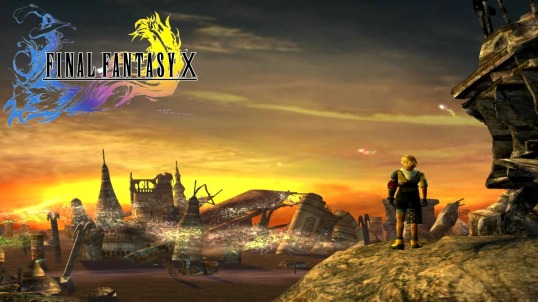
After necromoonyeti helped rekindle memories of days, weeks and months playing Final Fantasy and listening to it’s soundtrack I thought it was only appropriate that the latest “Song of the Day” comes from that very series.
“To Zanarkand” is the theme to Final Fantasy X. An entry in the venerated rpg franchise that has been underrated since it came out in 2001. While the game never reached the sort of acclaim and fan devotion as earlier entries like Final Fantasy IV and Final Fantasy VI (I’m of the few that thought Final Fantasy VII was average, at best) this tenth entry still managed to include a soundtrack that was some of composer Uematsu Nobuo’s best work.
This piano solo version takes the original song and brings it down to it’s emotional core. The other versions are just as powerful, especially the full orchestra version, but the simplicity of the piano solo conveying the themes of loss, sorrow and redemption that the game’s narrative was built on works best for me.
“Kaze Wo Atsumete” by Happy End (はっぴいえんど) appears twice in Lost in Translation: once outside a karaoke room at the end of a long night, and once at the end of the credits. Since that movie was so central to how I remember the late 90s and early 2000s, I thought I might end with it too.
Here are links to the previous entries in my series. They all clearly share :???: in common. (Well, I had fun, anyway):
The dream has to end somewhere. Science fiction seems to agree on that. Futuristic technology produces what biology could not: logic-based systems so functional and adept at survival that humanity becomes obsolete. Whether we assimilate into a borg colony or a zerg hive mind, imagination is pretty screwed. Our best bet might be something like The Matrix. Perhaps some utility will compel our robot overlords to spare the sheep who spawned them. Yay!
I cannot say what it must feel like to be enslaved by a post-human species, but I fancy it would sound a lot like the 777 trilogy by Blut Aus Nord. Between 2011 and 2012, these French black metal legends offered up a journey through a world that was beyond dystopian. Discordant melodies and unorthodox rhythms taken to the extreme are usually a recipe for disaster–the tools of technically proficient but creatively deprived math rock and avant-garde musicians I would only listen to under duress. Blut Aus Nord masterfully avoided that pitfall by envisioning a coherent aesthetic framework and driving the music forward as a consistent conceptual progression across 18 tracks. Radical experimentation joins forces with dark industrial grooves to place the listener in a futuristic, post-human world where mechanical gods rule apathetic over mortals bred in gestation crates.
The trilogy does not actually offer any textual insight into what its world is supposed to be. The minimal lyrics are highly esoteric, and Blut Aus Nord ultimately leave it to the instrumentation to tell their tale. You might not experience it as a futuristic world at all, but rather as some bleak corner of hell from which a lost soul digs through the madness and witnesses his overlord. But as far as it speaks to me, the 777 trilogy is the vision of a feckless human slave awakening from his dream into terrifying, incomprehensible world. He slowly comes to understand his master and, perhaps, ultimately assimilates into the hive mind. The final track, “Epitome XVIII”, is a grim, cold trance in which a soulless machine reigns on triumphant.
I can’t say that any entertainment franchise has given me more cause to think than Ghost in the Shell. It presents a mid-21st century post-apocalyptic earth in which society has more or less stabilized. Events revolve around Public Security Section 9, a counter-terrorism agency focused on investigating cyberterrorism, which is rather interesting because the original manga by Masamune Shirow launched in 1989, before cyberterrorism actually existed (or the modern internet, for that matter). Throughout their investigations, the team deals with the social and philosophical issues that arise in an age where society is fully integrated across a world-wide network and technology has been integrated directly into the body, rendering people intimately vulnerable to hacks and computer viruses.
I am as guilty as most of having never read the original manga. I became acquainted with Shirow’s world through Ghost in the Shell (1995) and Ghost in the Shell 2: Innocence (2004), both directed by Mamoru Oshii, and the 2002 anime series Ghost in the Shell: Stand Alone Complex, by Kenji Kamiyama. While the two directors take rather different aesthetic approaches–the movies present Section 9 as a harsh, disenchanted unit in a somewhat dystopian world, whereas the television series is lively and a bit cartoonish–both remain dedicated to questioning the impact of highly integrated technology.
Stand Alone Complex lies much closer to the root of my music series, because some of the key issues it tackles have since arisen online in the real world. Everyone is well familiar with the use of V for Vendetta-styled Guy Fawkes masks in protests originating from the internet, but there is a decent chance you have also caught a glimpse of an odd blue smiley face among the rabble. The Laughing Man image originates from Stand Alone Complex, where it functions as a mask employed anonymously by individuals taking public action independently of each other. At first, an advocate for social justice uses it to disguise himself while committing a ‘terrorist’ act, but the image quickly overreaches his motives. Others commit unrelated political sabotage under the guise. Corporations employ it to discredit their competitors. Pranksters use it as a sort of meme, forming the shape with chairs on a rooftop and cutting it into a field as a crop circle, for instance. The image has no concrete meaning, and everyone who uses it essentially ‘stands alone’, but the public perceive the Laughing Man as a single individual.
The actual anime gives a fairly shallow interpretation of this. The creator of the image, Aoi, explains that he never intended the mask to become a social phenomenon, and that its arbitrary usage dislodged the image from its original meaning. He sums this up by asking “Who knew that copies could still be produced despite the absence of an originator?” The ‘profoundness’ of this ties back to a long history of bad philosophy which assumes that signs have universal objective meaning in some sort of fundamental way which mystically transcends subjectivity of the mind. Basically, certain Greek ideas saw a resurgence of popularity in the late 19th and early 20th centuries, probably as a consequence of high society’s fascination with antiquities at the time. The plethora of ready-at-hand counterexamples to these archaic notions provided easy meat for countless grad students to earn their PhDs, so long as they did not throw the baby out with the bath water and ruin the game for everybody else.
But I digress. While the intended idea behind “Stand Alone Complex” is a bit naive, the Laughing Man does represent a unique sort of game that can only be played in the information age. To the public, the Laughing Man was a single individual, or at most a closely coordinated group, but the participants knew better. They knew that there was no real ‘Laughing Man’, but their independent actions were performed under the expectation that they would be written into ‘his’ public profile. The game was exclusive; you had to be aware of the mask in order to dawn it. The game also had rules; an action totally out of line with the Laughing Man’s pattern of behavior would be perceived as a fraud. (You could not, for instance, reveal the truth behind the Laughing Man.) By playing, you added a little piece of yourself to the puzzle, and it might slowly assimilate you in turn.
Ghost in the Shell has remained a uniquely relevant franchise in science fiction because it got so many ideas right. In 1989, at a time when internet was still a novelty of college libraries, the manga offered a world of total connectivity, where every human and device belonged to a global network. In 2002, Stand Alone Complex introduced the Laughing Man, and shortly afterwards the real world knew an equivalent. Whether this bodes well for the franchise’s dabblings into cyborg technology, only time can tell, but history has certainly made an inherently fascinating fictional world all the more compelling. In the Ghost in the Shell universe, science has fully bridged the gap between computers and neural systems, allowing electronic implants to directly convert wireless digital information into stimuli compatible with the senses. The average citizen possesses visual augmentations which allow them to directly browse the internet via voice command. More complex technology delves deeper, creating a sort of sixth sense whereby users can engage a network through thought command. Some individuals, especially accident victims with the means to afford it, might have their entire bodies replaced by neurally triggered machine components.
The 1995 Ghost in the Shell film gets especially creative in tackling this–enough that it became the chief inspiration for The Matrix four years later. It revolves around brain-mapping technology and its implications regarding sentience and identity. From the start of the film, the ability to copy and read brain data appears to be common. Presumably, these digital copies would remain stagnant until encoded back into a neural network, but as the government develops better software for interpreting and editing the massive content at its disposal, funny things start to happen. The software gains a sort of temporary sentience while performing its complex tasks, and eventually it uploads itself to a cyborg body in an act of self-preservation. This new entity possesses the capacity to read other augmented brains and incorporate them into its internal network. At least, that is how I’ve interpreted it. The movie does leave a lot to the imagination. Perhaps it is recycled from earlier science fiction, and far-fetched besides–I wouldn’t really know–but Ghost in the Shell presents it all as if it were right around the corner, not lost in a distant galaxy of Star Trek.
Ghost in the Shell is so steeped in ideas that it’s a wonder I don’t forget it is a collection of animations, not a book series. Stand Alone Complex is presented as rather typical–and relatively forgettable–anime, but the 1995 movie definitely denies dismissal. It is a real work of art. The city is dirty and a bit washed-out without feeling downright destitute; the masses still lead normal lives. Emptiness expands upward; the characters are perpetually surrounded by massive, sort of dusty-looking structures that feel vacant despite signs of life. The music is simultaneously vast and minimalistic. Generally, the artistic direction projects a feeling that the protagonists are isolated–cut off from the massive world surrounding them–perhaps by the knowledge they possess.
The score Kenji Kawai (川井憲次) crafted for Ghost in the Shell ranks among the best soundtracks I’ve ever encountered. Without it, the film might easily unravel. The plot really does take a lot of creative liberties. What amount of entertainment value could convince people to open up their brains to potential hacking? Or, if they are doing it to maintain memory backups, why is a brain hack so devastating? Can’t you just resume from your last save? Why would a hacker go to the trouble of replacing an entire memory system in the first place, if they could just encode an impulse into an existing one? To these questions, I say “shhhh!”, because Kawai has so utterly convinced me that my cyborg brain will be shipping in from Japan any day now. The music shrouds the film in imminent mystery. It is a moment of quiet awe, before the very foundations of human experience become uprooted and replaced by a higher state of computer-enhanced perception.
‘Interesting’ nerd note on Kawai: while the majority of his discography appears in anime and film, he is credited with arranging the TurboGrafx-16 port of Sorcerian, one of Yuzo Koshiro and Takahito Abe’s better 1980s NEC PC-8801 projects. I am pretty excited to dig that one up. Aren’t you? …Bueller?
If you are looking for a careful plot showcasing the new challenges of a technologically advanced, post-apocalyptic earth, then Katsuhiro Otomo’s 1988 classic Akira is not a great option. The film does not try to raise any questions, the story is vague, and it revolves around characters who are empowered supernaturally, not enhanced through technology. Akira‘s legacy lies in its music, art, and shock value.
Set in a dystopian Neo-Tokyo in 2019, 31 years after the ubiquitous cataclysm uproots every tenet of modern society, Akira displays a violent, futuristic world where law and order amounts to little more than brute force. The military police force is ruthless. Suspects are executed in public spaces with no concern for who might get caught in the cross-fire. When protests turn to riots, machine guns and tanks bulldoze down all opposition to the state. In one memorable scene, a group of protesters is bombarded with tear gas, and a choking helpless civilian staggers into an unclouded space that happens to be occupied by a policeman. After a moment’s pause, he blasts him in the stomach with a smoke grenade at point blank range. The incessant violence permeates everything. Within the first ten minutes, the hero, Kaneda, has murdered a half dozen members of a rival gang for entering his turf. The antagonist, Tetsuo, while certainly not evil, does not think twice about slaughtering the millenarian following attracted to his psychic powers.
Akira keeps you attentive with an endless escalation of weirdness and destruction. At every turn, events outpace your expectations, culminating in a transformation sequence that is not even worth trying to explain. I suppose it does raise one question, and only one: “What the fuck did I just watch?” It only works, though, because the art is so distinct that it leaves little to the imagination. Akira is a visual tour through everything that the most dystopian, vulgar cyberpunk city is supposed to be.
The soundtrack, composed by Tsutomu Ōhashi of Geinoh Yamashirogumi (芸能山城組), is inescapable throughout the film. It’s a bit of a counterbalance to the grim, futuristic visuals, relying heavily on Japanese and Indonesian traditional instrumentation and avant-garde vocals. It focuses more on capturing Akira‘s supernatural side, both in style and in strangeness. The opening track, “Kaneda”, does this while racing full speed into the heart of a towering metropolis.
I will never summon ethereal fire spirits to rend my foes, and unless the unknown reaches of physics politely comply with Hollywood, I will never receive a post card from the dark side of the Milky Way. I will also never applaud a director’s effective use of taste and smell, or upload a backup of my memory to external storage in between breakfast and a morning shower, but there is a difference here…
Nearly every cyberpunk story I have encountered begins with an apocalypse shortly after its publication. I guarantee you someone is writing one right now in which, in 2020, either Putin or radical Islamists nuke the shit out of everybody. Now it is 2060, and all of a sudden everyone is rocking cybernetic implants, babies grow in artificial wombs, and Lunar Colony Beta just declared independence. It’s not an absurdity. It’s not as if people just go “it’s the future; of course it will be futuristic!” and ignore the context. The assumption is that a cataclysmic act of destruction will somehow propel technology towards radical progress.
This makes sense, if you think about the forces that drive technology forward. In capitalism, there is always an incentive to stagnate. The longer you can milk a product, pumping out new models with superficial “upgrades”, the less you have to invest into research and development. Especially in oligopolies like America, once you establish a monopoly you can dig in your heels for years, even decades, before competition on other fronts undermines your turf. Technology is also hardballed by the western world’s incoherent, slapped-together code of ethics. Since the 1980s, our society has been pretty thoroughly convinced that free will is an endangered species preservable only in captivity. Half of the potential at our fingertips is illegal to research let alone implement, on the grounds that it somehow violates our sanctity.
The post-apocalyptic setting washes us clean of our old ethics and oligarchs. The society that emerges might be a terrible place to live, but it may well be a technocracy. When capitalism undermined the old aristocracy, revolution created bourgeois democracy. The First World War birthed all sorts of hyper-industrial dictatorships, even at the far fringes of the Industrial Revolution’s sphere. A catastrophic event in the information age should, if the trend holds, generate Google empires. How long can conventionally mechanized warlords withstand against soldiers modified to receive live satellite imagery of their terrain and fully regenerate major wounds in a matter of months? Is 45 years too soon for all this? Mother Russia went from de facto feudalism to Sputnik in fewer. And we have to make some allowances for fiction…
There is nothing fundamental preventing massive progress towards biological enhancement–at least nothing we are commonly aware of. The Cyborg Age won’t emerge in our lifetimes, realistically, but only because of entrenched social, political, and economic conditions. The fictional cataclysm is compelling for a lot of bigger reasons, but plausibility still hangs in the air. Our cozy modern lives won’t take us anywhere, but maybe a little pandemonium will usher in the paradigm shift to a society which praises integration of digital technology into our biological systems.
Kinski are a post-rock band from Seattle that formed in 1998. “Semaphore” appears on their 2003 Sub Pop release, Airs Above Your Station. I am pretty sure that the opening two minutes contains a formula to reconcile quantum mechanics with general relativity, but I am too old to do acid. At any rate, I hear it as some sort of major shift in perspective inaugurating an era of progression.
The Album Leaf is an electronic-oriented post-rock band headed by Jimmy LaValle. While the project has been around since 1998, LaValle made it onto most post-rock radars with his third album, In a Safe Place. Released in 2004, is was LaValle’s first album on Sub Pop, and it featured most of Sigur Rós as studio musicians. The album was significant, I think, for affirming that great post-rock did not have to conform to the structure and instrumentation standards that were beginning to overwhelm the genre.
For me though, it filled a very different role. I was pretty obsessed with Lost in Translation at the time, and that soundtrack had a bit of a love affair with Rhodes piano and similar tones. That sound happened to be The Album Leaf’s trademark, and it fit in beautifully, especially with Brian Reitzell’s contributions and “Tommib” by Squarepusher. I ended up inserting my favorite track off In a Safe Place into the middle of my Lost in Translation playlist, and that’s how a song called “The Outer Banks” came to make me think of Japan.


 Stand Alone Complex lies much closer to the root of my music series, because some of the key issues it tackles have since arisen online in the real world. Everyone is well familiar with the use of V for Vendetta-styled Guy Fawkes masks in protests originating from the internet, but there is a decent chance you have also caught a glimpse of an odd blue smiley face among the rabble. The Laughing Man image originates from Stand Alone Complex, where it functions as a mask employed anonymously by individuals taking public action independently of each other. At first, an advocate for social justice uses it to disguise himself while committing a ‘terrorist’ act, but the image quickly overreaches his motives. Others commit unrelated political sabotage under the guise. Corporations employ it to discredit their competitors. Pranksters use it as a sort of meme, forming the shape with chairs on a rooftop and cutting it into a field as a crop circle, for instance. The image has no concrete meaning, and everyone who uses it essentially ‘stands alone’, but the public perceive the Laughing Man as a single individual.
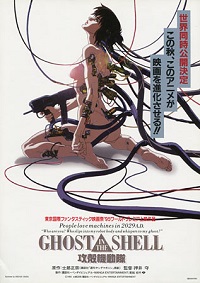 Ghost in the Shell has remained a uniquely relevant franchise in science fiction because it got so many ideas right. In 1989, at a time when internet was still a novelty of college libraries, the manga offered a world of total connectivity, where every human and device belonged to a global network. In 2002, Stand Alone Complex introduced the Laughing Man, and shortly afterwards the real world knew an equivalent. Whether this bodes well for the franchise’s dabblings into cyborg technology, only time can tell, but history has certainly made an inherently fascinating fictional world all the more compelling. In the Ghost in the Shell universe, science has fully bridged the gap between computers and neural systems, allowing electronic implants to directly convert wireless digital information into stimuli compatible with the senses. The average citizen possesses visual augmentations which allow them to directly browse the internet via voice command. More complex technology delves deeper, creating a sort of sixth sense whereby users can engage a network through thought command. Some individuals, especially accident victims with the means to afford it, might have their entire bodies replaced by neurally triggered machine components.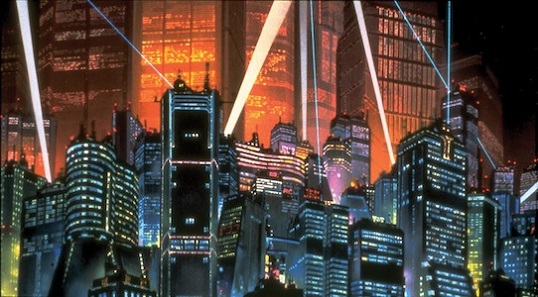
 Through the Shattered Lens