Meow!
Meow!
Meow!
Meow!
Meow!
Julee Cruise, R.I.P.
(The person who uploaded this video to YouTube says it was directed by David Lynch. While Lynch has directed several music videos and he did write the lyrics for this song, I have not seen this video listed in any of his official credits. This very well could have been directed by Lynch, don’t get me wrong. It wouldn’t surprise me if it was. But until I get a little bit more confirmation, I am going to hold off on officially listing him as the director.)
Enjoy!
Things get a little easier
Once you understand
That is the message of TSL’s latest guilty pleasure, a little song from 1971 called Once You Understand. In case you missed that message the first time, don’t worry. It will be repeated. In fact, it’s the only lyric in the entire song. The song starts with one voice singing, “Things get a little easier/once you understand” but soon, several other voice join in until there’s a heavenly choir of sorts. It’s really enthusiastic choir, too. In fact, it’s so enthusiastic that it’s a little bit creepy. No one’s that happy about understanding.
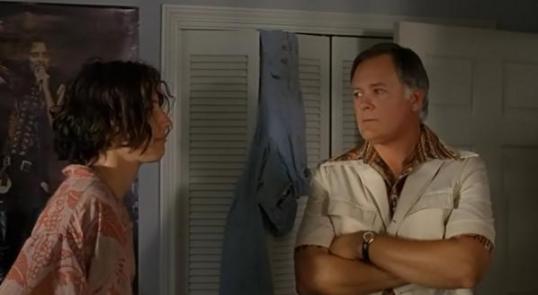
While the voices are singing to us that things get a little easier once you understand, we also get to listen to a few scenes from the late 60s/early 70s generation gap. The scenes are acted out by a bunch of uncredited actors who give it the old community theater try. We listen to teenagers argue with their parents and parents talk down to their children and what we immediately notice is that no one is trying to understand and therefore, things will never get a little easier.
One mother accuses her daughter of doing more than babysitting and demands that she stay out of a certain neighborhood. A father demands that his son get a haircut and reminds him that he had to work hard when he was young. Another kid is super excited to have gotten a guitar and he’s planning on starting a band. His father replies that there’s more to life than music.
Things get a little easier
Once you understand
Things get a little easier
Once you understand
Things get a little
Suddenly, the music stops. We listen as one of the fathers gets a tragic phone call about his son, the one that he didn’t understand. The father sobs uncontrollably as the song ends and I guess it could, in theory, have been a powerful moment if not for the fact that father is so obviously reading a script. The other problem is that 99% of the song consists of parents acting like jerks but then, in the final few moments, it turns out that at least one of the parents was right about his son throwing his life away. So maybe, it was the son who needed to understand. Who knows?
Anyway, Once You Understand is one of those songs that’s often included in lists of the worst songs of all time. However, much like The Dawn of Correction, I like Once You Understand because it is so totally a product of its time. It’s a cultural artifact and listening to it is a bit like stepping into a time machine. That said, I kind of doubt this song inspired anyone to understand. If anything, everyone comes across as being kind of whiny.
Previous Guilty Pleasures
Thank you, Calvin.
Enjoy!

The year was 1964 and folk singer Barry McGuire had just released a new song called Eve of Destruction. In Eve of Destruction, McGuire painted an apocalyptic view of the world and put a lot of the blame on the Cold War. McGuire wrote about 18 year-olds being sent to war when they weren’t even allowed to vote. (At that time, the voting age was 21.) McGuire wrote about the nuclear arsenals of the U.S. and Russia, saying that nuclear annihilation was just one push of a button away. McGuire sang about the Civil Rights struggle and the feeling that all of the well-meaning protests hadn’t led to any real change.
Not surprisingly, this early protest song was as controversial as it was popular. While many claimed that McGuire was one of the few singers willing to sing the truth, others said that he wasn’t being unpatriotic and excessively negative.
That’s where The Spokesmen came in. The Spokesmen were a trio, made up of John Madera, David White, and Ray Gilmore. Feeling that McGuire wasn’t being fair in his critique of the good old U.S., the Spokesmen released an “answer song,” one that addressed all of McGuire’s charges and which dismissed them all. McGuire sang about the “Eve of Destruction.” The Spokesmen decided that they would sing about the …. DAWN OF CORRECTION!
As the song’s chorus says:
So over and over again, you keep sayin’ it’s the end
But I say you’re wrong, we’re just on the dawn of correction
What exactly is “the dawn of correction?” I honestly have no idea. But it probably sounded profound while the song was being written. Plus …. destruction …. correction …. it rhymes!
Anyway, the Dawn of Correction was a minor hit when it was released, though it was soon forgotten about as the protest movement grew and teenagers in the 60s saw far more evidence to support McGuire’s vision of the world than the vision of the Spokesman. Among music aficionados, Dawn of Correction has developed a reputation for being one of the worst songs ever written.
I have to admit though that, when I recently listened to the song, I kind of liked it, in much the same way that I like zero-budget polemical films and kitschy dance scenes. It’s one of those songs that is so definitely rooted to one cultural moment that, from a historical point of view, it becomes rather fascinating. It’s lyrics are just so strangely literal. (It takes a certain …. something …. to try to put a positive spin on the policy of mutually assured destruction in a folk song.) Even more than that, lead singer John Madera attempts to duplicate the raspy growl the McGuire used while singing Eve of Destruction and, even though he doesn’t succeed, there’s something oddly touching about how hard he tries. With a Dylanesque harmonica playing in the background, the song is so determined to be “with it,” that you just know some government teacher in 1967 probably tried to reach her apathetic students by forcing them to listen to this song in class.
Finally, to be honest, that chorus is kind of catchy. Watch the band perform below and be sure to pay attention to the dancers.
Previous Guilty Pleasures
With this video, DJ Snake pays tribute to his Algerian roots. The song is named after an Algerian record label.
Enjoy!
 Through the Shattered Lens