Doctor Who — Destiny of the Daleks, City of Death, The Creature From The Pit, Nightmare of Eden, Horns of Nimon, Shada


Remember when I was writing about classic Doctor Who for Halloween?  Let’s get back to that with a look at the 17th season of the original series.  This season is a controversial one.  It featured some of the show’s worst serials but also one of its best.  Today, it’s remembered for introducing Lalla Ward as the second Romana and for featuring Douglas Adams as the script editor.

One frequent complaint about this season is that, under Adams’s influence, the season featured more comedy than before and it sometimes felt more like a version of Hitchhiker’s than Doctor Who.  There’s some truth to that but Adams’s influence also made Season 17 into a season unlike any other.  Many of Adams’s ideas didn’t work but he did give us City of Death.

Destiny of the Daleks (1979, directed by Kim Grieve)

Destiny of the Daleks will always have a place in my heart because it opens with Romana regenerating into Lalla Ward.  I will admit right now that, as a kid watching Doctor Who on PBS, I had a huge crush on Lalla Ward.  So did Tom Baker.  He ended up marrying Ward, though the marriage did not last for long.  The relationship between Baker and Ward often seemed to reflected in the relationship between The Doctor and Ward’s Romana.  Long before the Doctor Who reboot had people buzzing about the Doctor and Rose, fans of the original series knew that the Doctor and Romana were in love.

Destiny of the Daleks opens with Lalla Ward’s Romana cheerfully informing the Doctor that she’s decided to regenerate because she was bored and she’s decided to look like Princess Astra.  The Doctor points out that Princess Astra is a real person and Romana can’t just take on her appearance.  Romana then tries out several other appearances before The Doctor tells her to go with Astra.  This goes against everything that the show had established about Time Lords and regeneration but at least we end up with Lalla Ward as Romana.

It’s too bad that the rest of the serial itself isn’t that interesting, even if it does feature the first appearance by the Daleks since Genesis of the Daleks.  Davros returns as well, though he’s now more or less just another generic villain.  The Daleks have a new enemy, a group of robots called the Movellans.  The war between the Daleks and the Movellans are at a standstill because both are governed by logic.  That goes against everything we know about the Daleks.

This was Terry Nation’s final script for Doctor Who.  Reportedly, he was angered when Douglas Adams extensively rewrote the script.  Nation moved to America and later created the original MacGyver.

City of Death (1979, directed by Michael Hayes)

City of Death is a Doctor Who classic.  Romana and the Doctor visit modern-day Paris and the BBC found the money to allow the production to shoot on location.  The Doctor and Romana walk around Paris, hand-in-hand.  Count Scarlioni (Julian Glover) is actually an alien who wants to steal the Mona Lisa so that he can use it to fund his time travel experiments.  Countess Sacrlioni (Catherine Schell) is a classic femme fatale.  An American private investigator named Duggan (Tom Chabdon) wears a trench coat and solves problems by punching first and asking questions later.  John Cleese and Eleanor Bron appears as museum patrons who think the TARDIS is a work of modern art.  Douglas Adams later reworked bits of his script into Dirk Gentley’s Holistic Detective Agency.

Even people who cannot stand the rest of season 17 will agree that City of Death is one of the best of Tom Baker’s serials.  City of Death balances humor and drama and it features an excellent villain in the form of Julian Glover.  Tom Baker and Lalla Ward are at their best, the story is genuinely interesting, and — much like Jago and Lightfoot from The Talons of Weng-Chiang — Duggan deserved his own spin-off.

The Creature From The Pit (1979, directed by Christopher Barry)

This serial features the season’s first appearance by K-9, who is now voiced by David Brierley.  Though this serial was third to be aired, it was the first to be filmed.

It’s not much of a serial.  The TARDIS materializes on yet another feudal planet where Lady Adastra (Myra Frances) rules through fear.  Lady Adastra’s critics are thrown in the pit, which is said to be home to a great monster.  Instead, it’s home to a gentle blob that was sent to the planet as an ambassador.  The Doctor helps the blob gets its freedom while Romana and K-9 are briefly detained by a group of bandits.  Whatever potential the story had is short-circuited by the very unconvincing monster.

Nightmare of Eden (1979, directed by Alan Bromley and Graham Williams)

Two ships materialize in the same location and end up locked together.  Then the TARDIS materializes and the Doctor offers to find a way to unlock the two ships.  One of the ships is a luxury space liner and the passengers are soon being menaced by clawed monsters that look like stuntmen in rubber suits.  The other ship is a trade ship that the Doctor comes to suspect is involved in a drug-running operation.

Once again, the monsters were not at all convincing but the Doctor investigating the interstellar drug traffic was at least something different.  Much like City of Death, Nightmare of Eden, with its luxury spaceliner, had a few moments of satire that worked.  Unlike City of Death, the supporting characters were not that interesting and Tom Baker himself just seemed to be going through the motions.  Nightmare of Eden was better than a lot of Season 17 but it still ultimately comes across as being rather muddled.

The Horns of Nimon (1979 — 1980, directed by Kenny McBain)

The Horns of Nimon, is it terrible or is it great?  Some defend it because of its allusions to Greek mythology, its deliberate humor, and the over-the-top performance of Graham Crowden as Soldeed, the leader of the Skonnan Empire.  Others, like me, point out the turgid pacing, the bad creature effects, and the fact that the majority of the serial is just people walking around.  Based on the myth of the minotaur, The Horns of Nimon looks and feels cheap.  Crowden splits his pants at one point and I guess there was no time to stitch them back up.  The whole thing is just too slapdash.

Shada (2018, directed by Pennant Roberts and Charles Norton)

For decades, Shada was the Holy Grail of Doctor Who.  The final serial of the 17th century, Shada was in the process of filming when the BBC’s technicians went on strike.  With 50% of the serial filmed, production was suspended and eventually canceled.

Afterwards, Shada developed a legendary reputation.  It was often described as being a potential masterpiece, despite the fact that Season 17 was not one of Doctor Who‘s best.  Footage of the Doctor and Romana visiting Cambridge was widely released and even used in The Five Doctors.  The footage itself did look good but that was because it was mostly just Tom Baker and Lalla Ward relaxing and trading funny quips.  There was very little of the actual plot to be found in those scenes.

Finally, in 2017, Shada aired.  Animation was used for the unfilmed sequences and a white-haired Tom Baker even returned to shoot some new linking scenes.  Shada was finally broadcast in the U.S.  And, it wasn’t bad.  It may not have been the masterpiece that so many assumed it would be but it was certainly an improvement on The Creature From The Pit, Nightmare on Eden, and the Horns of Nimon.  

The Doctor and Romana travel to Cambridge to help out another timelord, Prof. Chronitis (Denis Carey).  After Chronitis is apparently killed, The Doctor and Romana discover that space criminal Skagra (Christopher Neame) is seeking a Time Lord named Salyavin who is somewhere on the prison planet, Shada.  Things get muddled once the Doctor actually travels to Shada but the Cambridge scenes are a definite highlight of the serial, a very British diversion for a very British show.  Much as with City of Death, the best moments are the ones where Tom Baker and Lalla Ward just get to play off of each other without having to deal with any sort of intergalactic menace.  Also, as with City of Death, Douglas Adams would borrows bits and pieces of Shada for Dirk Gentley’s Holistic Detective Agency.

Shada may not have been a masterpiece but it would have been a decent end for the seventeenth season.



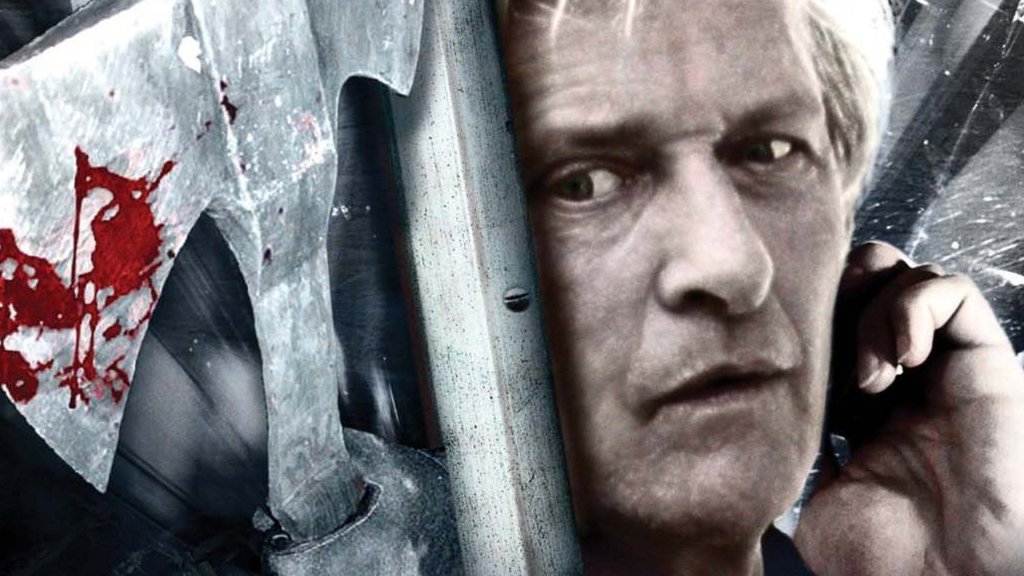
Brad reviews DEAD TONE (2007), starring Rutger Hauer!


DEAD TONE (2007), also known as 7EVENTY 5IVE, opens with a group of kids entertaining themselves while their parents are drinking and partying downstairs. The kids are playing a prank-calling game called “Seventy-Five,” where the goal is to place a random phone call and tell such a believable story that the person who answers will stay on the line at least 75 seconds. One guy seems particularly upset with the kids when they call him. Later that night, while everyone is sleeping, a psycho with an axe comes in the house and brutally murders all the parents while the kids hide and watch in terror. Jump forward ten years and most of the kids who survived the night of terror are now college students. Invited to a weekend party at a wealthy classmate’s mansion, the group resumes their prank-calling game. Needless to say, when the maniac from ten years earlier answers the phone, the members of the group find themselves being stalked and murdered again. Hopefully Detective John Criton (Rutger Hauer), who worked the original murders 10 years earlier, and his partner Anne Hastings (Gwendoline Yeo), will figure out who killer is and stop him before everyone dies! 

DEAD TONE is directed by Brian Hooks and Deon Taylor, who also star in the film. They’ve created a gory, low-budget slasher that blends elements of ‘80s and ‘90s horror films with an urban twist. For a guy who did his share of prank calls as a kid, I think the “psycho on the receiving end of a prank call” storyline is pretty cool. And the opening scene where the kids watch as their parents are killed because of their phone calls is horrific and pulls you right into the story. Unfortunately, once we get past the interesting open, there’s nothing that special about the rest of the movie. The characters aren’t particularly memorable or likable, and they sure as hell aren’t very smart. Call me crazy, but I’m thinking that I would never make another prank call again if I survived a mass murder event that was brought on by prank phone calls. These folks have no such qualms, which may not make any sense in the real world, but I guess is necessary if you need more axe murders for your plot. I will admit that there are a few awesome kills in the film, especially if you enjoy a good beheading. I won’t spoil the scenes, but the ones I’m specifically thinking of are both surprising and jarring at the same time. I’m also the kind of guy who will watch anything featuring the legendary Dutch actor Rutger Hauer. DEAD TONE’s Detective John Criton isn’t a character highlight of his career, but I still enjoy watching him go through the motions of investigating the crimes both in the present and in the past. It’s a part that he could have completed in his sleep, but this movie would have benefited from more “Hauer time.”

Overall, DEAD TONE is the kind of movie to watch with little to no expectations. My wife and I enjoyed the film as we cuddled up on the couch and watched it a couple of nights before Halloween. It’s not great, but if you’re in the mood for a slasher movie with jump scares, silly characters, some decent gore, and even an acting legend thrown in for good measure, you could do a lot worse than DEAD TONE!

Horror on the Lens: How To Make A Monster (dir by Herbert L. Strock)


You’ve seen I Was A Teenage Werewolf….

You’ve watched I Was A Teenage Frankenstein….

Now, it’s time to watch How To Make A Monster!

Released in 1958, How To Make A Monster is a clever little horror satire from American International Pictures in which the stars of Teenage Werewolf and Teenage Frankenstein are hypnotized into believing that they actually are the monsters that they played!  The main culprit is a movie makeup artist (Robert H. Harris) who has been deemed obsolete by the new bosses at AIP.

Be sure to watch for the finale, which features cameo appearances from several other AIP monsters!  And read my full review of the film by clicking here!

4 Shots From 4 Horror Films: 2010s Part Two


This October, I’m going to be doing something a little bit different with my contribution to 4 Shots From 4 Films.  I’m going to be taking a little chronological tour of the history of horror cinema, moving from decade to decade.

Today, we continue with the 2010s!

4 Shots From 4 Films

The Conjuring (2013, dir by James Wan)

The Conjuring (2013, dir by James Wan)

You're Next (2013, dir by Adam Wingard)

You’re Next (2013, dir by Adam Wingard)

The Babadook (2014, dir by Jennifer Kent)

The Babadook (2014, dir by Jennifer Kent)

It Follows (2015, dir by David Robert Mitchell)

It Follows (2015, dir by David Robert Mitchell)

October True Crime: Holy Spider (dir by Ali Abbasi)


2022’s Holy Spider opens in the Iranian city of Mashahd.  We follow a woman as she spend her night as a sex worker, standing on a street corners, going off with any man who stops for her, and hiding in the shadows whenever the infamous morality police are nearby.  There’s nothing glamorous about her work.  The men who pick her up are brutes who treat her like property and there’s little about the city that is beautiful or aesthetically pleasing.  If anything, it looks bombed-out, as if no one could be bothered to repair any of the obvious cracks that are stretching across the city ancient’s facade.  Towards the end of the night, the woman is picked up by a man who, in a harrowing scene, proceeds to choke her to death.

Journalist Arezoo Rahimi (Zar Amir Ebrahimi) arrives in the city to investigate the recent murders of several sex workers and immediately discovers that the authorities have no interest in discussing the case.  When she pushes them, they taunt her about her private life and they snap at her for not properly covering her hair.  Whenever she steps out into the street, she’s told that she’s going to get in trouble if she’s spotted by the Morality Police.  (The attitude appears to be that it’s a greater crime for a woman to fail to fully cover her hair than for a man to kill a woman, whether her hair is properly covered or not.)   Eventually, she teams up with a newspaper editor named Sharifi (Arash Ashtiani).  Sharifi has been receiving letters from the murderer, ones in which he explains that he is cleansing the city in the name of Imam Reza, the eighth Shia Imam.

The murderer is a construction worker named Saeed Azimi (Mehdi Bajestani), a middle-aged man who previously served in the Iraq-Iran War and who it is suggested might be suffering from PTSD.  On the outside, Saeed seems almost normal.  He has friends.  He has a family.  He is very religious.  To the outside viewer, he might not look like a killer.  But, every night, he prowls the streets and he searches for potential victims.  When Rahimi goes undercover as a sex worker, she comes close to becoming one of them.

More than just a recreation of a serial killer’s crimes, Holy Spider examines the misogynistic attitudes that allowed Saeed that get away with so many murders.  Saeed himself becomes a folk hero amongst many Iranians, who are quick to say that they agree with his mission to cleanse the city.  Even when on trial, Saeed is approached by members of the government who promise him his safety, though it soon becomes clear that their promises don’t necessarily mean much.  The more that his crimes are celebrated, the more smug Saeed becomes.  Even when his sentence comes down, Saeed remains convinced that he will be protected.  Afterall, everyone seems to agree with him that the victims, and not the murderer, are to blame for their deaths.

Dark, disturbing, and ultimately infuriating, Holy Spider is a powerful film.  The film’s power can be seen in the fact that it was not only banned in Iran but that the government also announced that anyone involved in the filming would also be censured.  (Russia, a longtime ally of Iran, also banned the film.)  Saeed is a hateful figure but even more hateful are the misogynists who celebrated him and nearly allowed him to get away with his crimes.  Holy Spider may have been banned in Iran but it can still be seen in the rest of the world.

And it should be seen.

These Skeletons Are Ready For Halloween!


Skulls and bones were a mainstay on the covers of pulp and especially horror related magazines.  For this Halloween, take a trip back into the bony past with a few skeletal covers from the pulp era!

by Rudolph Belarski

by Rafael De Soto

by Robert Stanley

by Robert Gibson Jones

Cave, AI Short Film Review by Case Wright


The intro looks terrible. It’s bad even for anything I have seen up to this point. We open with a meteor heading towards earth.

A bear watches the impact and goes to investigate because why not? The meteor was hiding a spaceship. Later, there is a cute couple taking a selfie during their camping trip. I wonder what will happen?

They enter a cave and hear growling. They are confronted by a MONSTER BEAR. A huge huge bear. I’m guessing the bear is part alien now. The monster bear attacks and kills the husband, but the wife escapes and has PTSD hallucinations.

The ending was not great. I would have ended in the cave rather than tack on this boring segment. So, when the angry mobs come to feed the AI creators to sharks, I would just let the sharks gnaw on this creator, but nothing terrible. It was bad though; so, know that and if the creator reads this, please stop doing this.

Horror On The Lens: Carnival of Souls (dir by Herk Harvey)


1962’s Carnival of Souls was the only feature film to be directed by Herk Harvey.  It was made on a budget of $33,000 and was filmed in Kansas and Utah, often without permits.  The film was also the feature acting debut of model Candace Hilligoss, cast here as a emotionally withdrawn church organist who is involved in a serious car accident and then finds herself haunted by pasty-faced ghosts and surreal visions.

When it was initially released, Carnival of Souls was dismissed by American critics.  Indeed, it would a little over twenty years before the film started to be appreciated as both a classic independent film and also a truly eerie horror movie.  Today, it’s recognized as a classic of the genre, an expressionistic ghost story that also works as a character study of a woman who is haunted by not just physical death but also emotional malaise.

Carnival of Souls is a Halloween tradition here at the TSL offices.  This year, the tradition continues.


A Blast From The Past: Orson Welles’s 1938 Broadcast of The War of the Worlds


On October 30th, 1938, Orson Welles and the Mercury Theater On The Air broadcast an adaptation of H.G. Wells’s War of the Worlds and, legend has it, they scared the ever-loving heck out of America.

Actually, there’s some debate as to just how panicked America got when they heard the Mercury Theater On The Air’s adaptation of War of the Worlds.  There was definitely some panic but there are differing reports on just how wide spread it was.  For our purposes, let’s assume that the entire country was terrified at the same time and that everyone was loading up a shotgun and planning to go out and look for aliens. With his adaptation of War of the Worlds, Orson Welles managed to invent the whole found footage genre that would later come to dominate horror cinema in the late 90s and the aughts.  Every found footage horror film owes a debt to what Orson Welles accomplished with War of the Worlds.  Ultimately, it’s just another example of how far ahead of his time Orson Welles was.

H.G. Wells, the original author of War of the Worlds, and Orson Welles only met once, while they were both in San Antonio, Texas in 1940.  (Orson Welles and H.G. Wells hanging out in San Antonio?  To be honest, that sounds like it would make a good movie.)  They were interviewed for a local radio station.  H.G. Wells expressed some skepticism about the reports of Americans panicking while Welles compared the radio broadcast to someone dressing up like a ghost and shouting “Boo!” during Halloween.  Both Wells and Welles then encouraged Americans to worry less about Martians and more about the growing threat of Hitler and the war in Europe.

I’ve shared this before but this just seems like the time to share it again.  Here, for Halloween Eve, is the 1938 Mercury Theater On The Air production of The War of the Worlds!