Since today is Sigourney Weaver’s birthday, I think it’s probably a given that today’s scene of the day would feature her defeating an alien. In this scene from 1979’s Alien, Ripley shows why she is the last human survivor of the Nostromo.
(As cool as Ripley is, she’s still nowhere close to being as much of a badass as Jonesy the Cat. Jonesy just had to hiss and the alien knew better than to mess with the ship’s cat.)
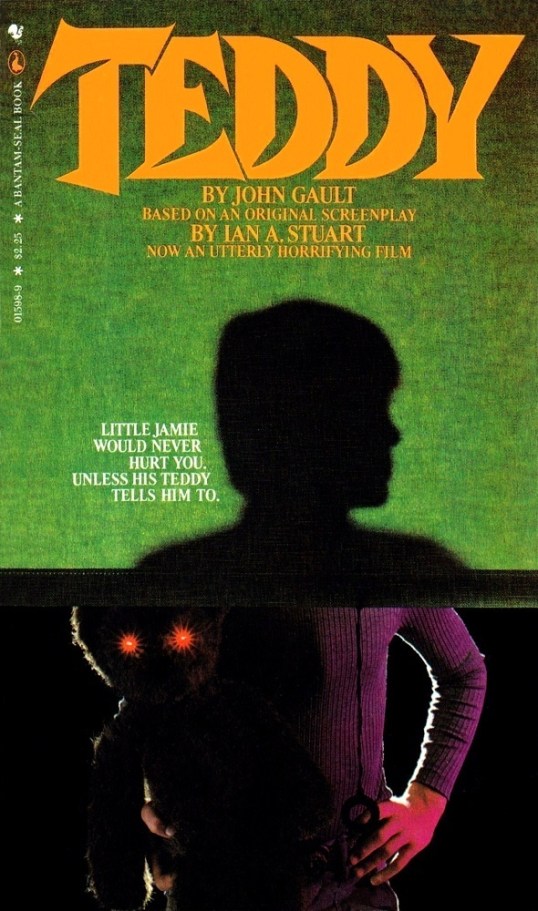
Yesterday, I wrote about a Canadian horror film called The Pit. I mentioned that it was a film about a creepy 12 year-old named Jamie who had conversations with his teddy bear, developed a not-so-innocent crush on his babysitter, and who regularly fed the people he disliked to a bunch of underground monsters who lived in a pit in the woods.
Yesterday, I also read Teddy, the 1980 novelization of The Pit.
(The Pit was originally titled Teddy.)
Teddy is even more creepy than The Pit, largely because it includes all of the disturbing details that were either cut from the finished film or perhaps dropped when the script was rewritten. Jamie is still a creepy 12 year-old who talks to his teddy bear. Unlike the film, the novel makes it clear that Teddy is actually a living force of evil and that his words are not just a figment of Jamie’s imagination. The book actually suggests that Teddy moves from child to child, corrupting each of its owners. Teddy in the book is also a hundred times more pervy than Teddy in the movie, making some rather crude comments about Jamie’s mom and later encouraging Jamie to join him in checking out some porno magazines.
The book also delves into the investigations surrounding the disappearance of Jamie’s many victims. As a result, we get to know the victims a bit better in the book than we did in the movie. Also as a result, Jamie also comes across as much more deliberately evil in the book than he does in the movie. Even if he is under the possible demonic influence of Teddy, Jamie still seems to take way too much pleasure in people dying. This is especially true of the scene where his babysitter falls into the pit. In the movie, Jamie tries to help her escape. In the book, Jamie not only pushes her but smiles afterwards as he listens to her screams.
1993’s Murder So Sweet, also known a Poisoned By The Love: The Kern County Murders (seriously, try to say that ten times fast), tells the story of Steven David Catlin.
Steven David Catlin lived in Bakersfield, California. Catlin was a career criminal who was married six times and who found some personal redemption for himself as a member of the pit crew for a professional race car driver in Fresno. Trust me, I’ve lived in enough small, country towns to know that people will overlook a lot as long as someone knows how to work on a car.
One thing that people noticed about Catlin is that the people around him had a habit of dying of mysterious illnesses. Multiple wives, his adoptive parents, they all died with fluid in their lungs and they left behind not only a medical mystery but also quite a bit of money for Steven David Catlin. Catlin would always insist on holding a cremation just days after his loved ones passed away. Not only did that allow Catlin to move on but also kept anyone from being able to do a thorough autopsy.
Eventually, the police figured out that Catlin was just poisoning anyone who got on his nerves or threatened to divorce him. He wasn’t even a particularly clever poisoner. He used paraquet, a highly toxic herbicide and he kept the bottle sitting in plain view in his garage. He might as well have just labeled it his “Poisoning Thermos.” Catlin was convicted of multiple murders and he was sentenced to die in 1990. Of course, this being California, Catlin is sill alive and sitting in San Quentin. This really is a case of “If you lived in Texas, you’d be dead by now.”
In Murder My Sweet, Catlin is played Harry Hamlin, who steals the film as a dumb but charming redneck who walks with a confident swagger and has no fear of hitting on his ex-wife, even after he realizes that she’s trying to convince the police that he’s a murderer. Helen Shaver played Edie Bellew, the ex who knows better than to trust Catlin. Her current husband is played by Terence Knox and there’s plenty of scenes of him telling Edie that she needs to back off and that everyone knows that Steve Catlin isn’t a murderer. In many ways, this is the ultimate Lifetime film in that Edie Bellew not only gets to put her ex-husband in prison but she also proves that her current husband doesn’t know what he’s talking about.
Murder My Sweet takes place in rural California and, as a result, everyone in the film speaks with a shrill country accent and we spend a lot of time in a really tacky beauty parlor. Indeed, the film portrayal of country eccentricity is so over-the-top that I was tempted to say that it seemed as if the director was trying to rip-off David Lynch. However, Lynch may have made films about eccentric characters but he never portrayed them as being caricatures. Lynch loved his eccentrics while this film takes a bit of a condescending attitude towards them. Still, it’s worth watching for Harry Hamlin’s sleazy turn as Steve Catlin, a guy who enjoys fast cars and making ice cream.
Today, the Shattered Lens wishes a happy birthday to the one and only Sigourney Weaver. Seen here with Jonesy the Cat, Weaver will always be best-remembered for bringing to life Ellen Ripley and totally revolutionizing both horror and science fiction!
Today’s song of the day comes from Jerry Goldsmith’s iconic score for Alien.
This October, I’m going to be doing something a little bit different with my contribution to 4 Shots From 4 Films. I’m going to be taking a little chronological tour of the history of horror cinema, moving from decade to decade.
Today, we complete the 1930s.
4 Shots From 4 Films
Dracula’s Daughter (1936, dir by Lambert Hillyer)
Revolt of the Zombies (1936, dir by Victor Halperin)
Sweeney Todd: The Demon Barber of Fleet Street (1936, dir by George King)
That’s really the main message that I took away from the 1982 film, The Seduction. In TheSeduction, Morgan Fairchild stars as Jamie Douglas. Jamie is a anchorwoman for a local news channel in Los Angeles. She has an older boyfriend named Brandon (Michael Sarrazin). She has a sex-crazed best friend named Robin (Colleen Camp). She has a beautiful home in the Hollywood Hills. She’s doing wonderfully for someone whose main talent is the ability to read what’s on the teleprompter. Much like Ron Burgundy, she’ll read whatever is put on that teleprompter without even thinking about it. Some might say that indicates that Jamie is a fairly vacuous character and …. well, they’re right. She is.
Jamie starts receiving flowers at work and mysterious phone calls from someone named Derek. Derek (Andrew Stevens) is a fashion photographer. He’s young. He’s handsome. He’s charismatic. His assistant, Julie (Wendy Smith Howard), is absolutely in love with him. In fact, Derek would seem to have it all but he’s obsessed with Jamie. Soon, he’s breaking into Jamie’s house so that he can watch her undress and then confronting her at the mall. At one point, he shows up in her living room and starts taking pictures of her. Jamie screams. Brandon beats him up. After Derek leaves, Jamie and Brandon go to the police and ask if there’s something that they can do about Derek. The police say that there are not many options because Derek has not technically broken the law …. uhm, what? I get that things were different in the 80s but I still find it hard to believe that showing up in someone else’s living ro0om without an invitation and then refusing to leave would have been considered legal back then. As you probably already guessed, Derek’s obsession soon turns lethal.
Perhaps the weirdest thing about The Seduction is that Derek is basically Jamie’s neighbor but she doesn’t ever seem to realize it. Watching this film, there were time when I really had to wonder if maybe Jamie was just an idiot. As well, throughout the film, Jamie reports on an unknown serial killer who is terrorizing Los Angeles. The killer is dubbed the Sweetheart Killer and, when I watched this film, I wondered if the Sweetheart Killer and Derek were one in the same. I don’t think that they were but, still, why introduce an unknown serial killer without providing any sort of resolution? It’s all indicative of just how sloppy the plotting on TheSeduction truly was. That’s especially true of the ludicrous ending of the film. A murder is committed in Jamie’s hot tub and when Jamie calls the police to report it, she’s put on hold. Meanwhile, Derek buries the body in Jamie’s backyard and somehow manages to do it without really breaking a sweat or being noticed by anyone. Derek’s big secret turns out to be not that much of a shock.
Morgan Fairchild’s performance isn’t great but that’s largely because she’s stuck with a character who is never allowed to behave in a consistent manner. Andrew Stevens is a bit more convincing as Derek, playing him as a photographer who doesn’t need cocaine because he’s already get his obsessive personality keeping up at nights. Michael Sarrazin, as Brandon, bellows nearly all of his lines and gives a performance that just shouts out, “Why did I agree to do this movie!?” He’s amusing. As for director David Schmoeller, he did much better with both Tourist Trap and Crawlspace.
Seriously, though, a lot of the horror and drama in this film could have been avoided by Jamie just getting to know her neighbors. I’ve been very lucky to have some very good neighbors over the years. When my Dad passed away, my neighbors Hunter and Hannah checked in on my nearly every day afterwards and let me use their hot tub whenever I wanted to. Neighbors, they can be pretty special.
The 1958 sci-fi/horror hybrid, It! The Terror From Beyond Space, opens with a NASA press conference. The assembled reporters are reminded that, earlier in the year, America’s first manned mission to Mars was presumed to have been lost. However, a second mission was sent to Mars and they discovered that the commander of the first mission, Edward L. Carruthers (Marshall Thompson), was still alive.
Unfortunately, all of Carruthers’s crewmates were dead. Carruthers claimed that the murders were committed by a monster. The commander of the second mission, Col. Van Heusen (Kim Spalding), instead suspected that Carruthers killed his crewmates when he realized they were stranded on Mars. The ship had enough provisions to last the entire crew for one year or ten years for just one man.
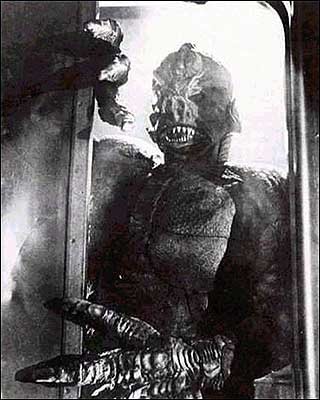
The second mission is now on their way back to Earth, with Carruthers under house arrest. While one crewman does believe that Carruthers’s story could be true, the others are convinced that Carruthers is a murderer. What they don’t know is that the monster from Carruthers’s story is not only real but that it also snuck onto their ship during lift-off. Tall and scaly with huge claws and a permanently angry face, the Monster — It, for lack of a more formal name — is lurking in the lower levels of the ship and hunting for food.
To state what is probably already obvious, It! is not a film that worries much about being scientifically accurate. While it does explain how living on the surface of Mars caused It to develop into the predator that it is, this is also a science fiction film from 1958. It’s a film where, instead of going to the Moon, the first manned spaceflight is to Mars. It’s also a film where there’s no weightlessness in space, the two women on the ship serve everyone coffee, and a nuclear reactor is casually unshielded at one point in an attempt to destroy It. Bullets are fired on the spaceship. Grenades are tossed. Airlocks are rather casually opened.
Fortunately, none of that matters. Clocking in at a mere 69 minutes, It! is a surprisingly suspenseful horror film, one that makes good use of its claustrophobic locations (a lot of the action takes place in an air duct) and which features a surprisingly convincing and, at times, even scary monster. It may be a man in a rubber suit but that doesn’t make it any less shocking when its claw bursts out of an an open hatch and starts trying to grab everything nearby. The cast of It! are all convincing in their roles. Watching them, you really do believe that they are a crew who have seen a lot together and it makes the subsequent deaths all the more effective,
It! was a troubled production, The monster was played by veteran stuntman Ray Corrigan, who reportedly showed up drunk a few times and also managed to damage the monster suit. Many members of the cast were not happy about being cast in a B-movie. (Fortunately, their resentment probably helped their performances as the similarly resentful crew of the second mission to Mars.) Marshall Thompson, who played Carruthers, was one of the few cast members who enjoyed making It! and, perhaps not surprisingly, he also gives the best performance in the film.
Troubled production or not, It! was not only a box office success but, along with Mario Bava’s Planet of the Vampires, it was later cited as one of the inspiration for Alien. At its best, It! has the same sort of claustrophobic feel as Alien. The scene where one of the crewman is found in an air duct brings to mind the fate of Tom Skerritt’s character in Alien.
It! is still a very effective work of sci-fi horror. Remember, another name for Mars is …. DEATH!
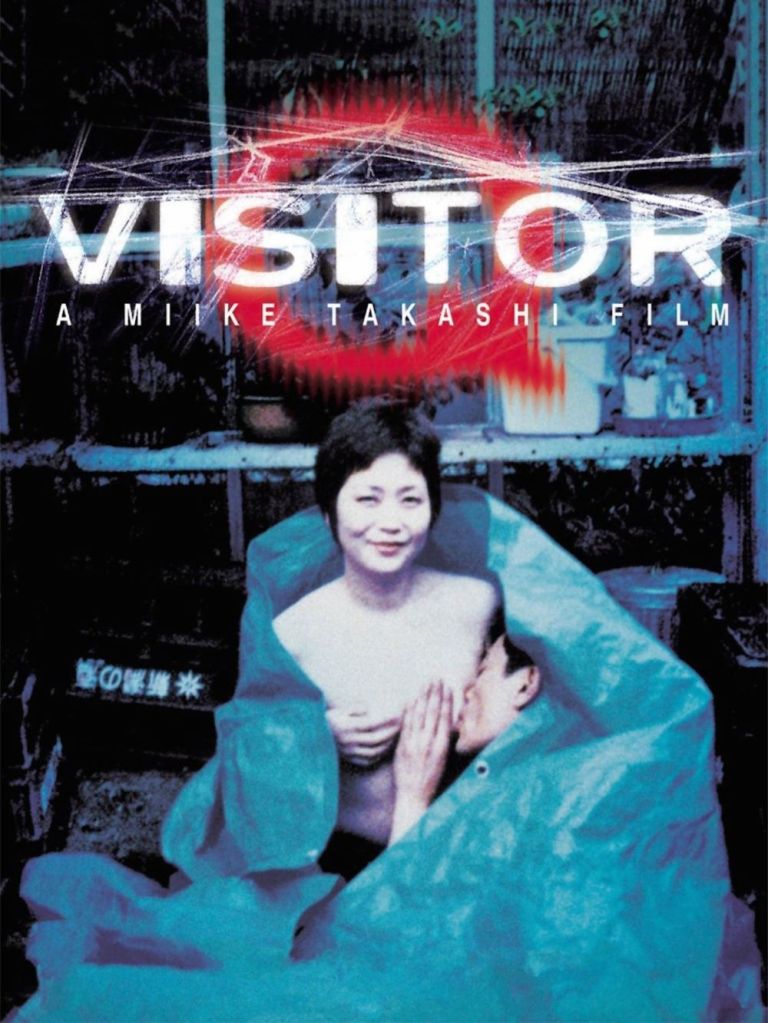
Miike Takashi’s 2001 film Visitor Q (called Bizita Q in Japan) is definitely one of the most bizarre and disturbing movies out there. It often gets compared to the work of Quentin Tarantino, but that comparison really doesn’t do Miike justice. Tarantino’s style is all about showing violence in a flashy, stylized way that sometimes feels more like entertainment or homage than outright shock. Miike, on the other hand, takes a very different approach—his films are much more raw, unfiltered, and transgressive. Where Tarantino’s violence can almost feel like a performance, Miike’s hits you in a way that’s meant to provoke and unsettle on a deeper level.
Visitor Q is a wild, surreal ride that dives headfirst into the messy mix of violence and sex that’s so common in today’s media, with a cheeky nod toward reality TV culture. The film came out of Japan at a really interesting time, when the culture was pretty conflicted about Western influences. Japan often points fingers at the West for “decadence” and moral decline, but at the same time, it produces some of the most intense and boundary-pushing entertainment around—like anime and manga filled with everything from weirdly sexualized creatures (yes, tentacles, lots of tentacles) to ultra-violent stories that Western media would blush at.
The plot itself is maybe the simplest part of the whole thing. It’s about a down-on-his-luck former TV reporter named Q Takahashi who’s trying to support his dysfunctional family by filming a documentary about how violence and sex in media affects young people today. From there, the story quickly spins into something much darker and more uncomfortable, focusing on his family’s raw problems: drug abuse, emotional numbness, incest, necrophilia, and other twisted stuff that’s hard to even put into words.
What really makes Visitor Q stand out is how Miike doesn’t hold anything back. This film isn’t trying to make you comfortable or distract you with flashy effects. Instead, it confronts you with some very real, very uncomfortable issues. Miike has a fearless way of showing violence and sex that feels totally unfiltered and even brutal, forcing you to face parts of human nature and society that most movies would shy away from or sugarcoat.
It’s easy to see how this movie channels the spirit of the Marquis de Sade, that infamous figure known for embracing taboo and shock to criticize societal hypocrisy. Miike takes this spirit and uses it to spotlight the way media—and especially the voyeuristic culture of reality TV—turns personal pain and dysfunction into public spectacle. The movie asks us to think about how watching violence and sex over and over might warp not just society’s values, but how people actually relate to one another.
One thing Visitor Q pokes at pretty hard is voyeurism, the idea of watching other people’s lives like it’s entertainment. The former TV reporter filming his family for the documentary is both an observer and a participant, and the film forces viewers to question the ethics of watching intimate, often tragic moments unfold just for the sake of entertainment. It’s a powerful reminder of what media voyeurism can do to real lives.
Another theme that hits home is how desensitized people have become to violence and sex. The family in the movie often reacts to brutal, horrible things with complete indifference—almost like they’re numb from being exposed to this stuff all the time. Miike seems to be saying that when we see violence and sex as everyday entertainment, it dulls our emotions and disconnects us from the human suffering behind those images. This is especially relevant for young people growing up in a media-saturated world, which is exactly what the film’s documentary narrator is trying to get at.
Some of the film’s more extreme themes, like incest and necrophilia, are obviously shocking, but Miike uses them to highlight just how broken the family is. These aren’t just there for shock value—they’re symbols of how far relationships can fall apart when love, respect, and communication break down entirely. The film uses these taboos as metaphors for emotional neglect and societal decay, asking us to look hard at the dark corners of family life and human nature that most media avoids.
Watching Visitor Q is definitely not an easy ride. At first, most people find themselves looking away or flinching because the content is so wild and graphic. But it’s interesting how, over time, viewers start watching the movie without turning away, even if what they see is still deeply disturbing. The film somehow pulls you in with its surreal style and brutal honesty, making you confront just how far you’re willing to go in understanding these messed-up family dynamics and cultural critiques.
Stylistically, the film bounces between stark realism and surreal, almost absurd imagery. This gives it a rollercoaster tone that keeps you off balance—one moment it’s brutally raw, the next it’s almost darkly comedic or bizarre. This mix mirrors the instability of the family and the unpredictable nature of their world. Miike really embraces both the artistic and the extreme exploitation sides of filmmaking here, unapologetically pushing boundaries with each scene.
Despite all the shocking stuff, the film comes with a clear message about the relationship between media, sex, and violence. It’s not just reflecting society’s problems; it’s suggesting that media actually shapes how we think, feel, and behave—especially for kids. The film also takes a swipe at reality TV, highlighting how people get a twisted sense of pleasure from watching others’ suffering and humiliation. This is even more relevant today with social media and constant livestreams making all aspects of life a public show.
Miike’s gritty and unfiltered take makes it clear he isn’t just copying Western transgressive directors—he’s got his own voice and style that’s as challenging as it is unique. Where Tarantino’s films entertain and provoke with wit and style, Miike’s work disturbs and pushes, asking viewers to get uncomfortable and reflect. Comparisons to Pasolini, the Italian filmmaker known for his raw and provocative films, fit well here. Like Pasolini, Miike straddles the line between art and exploitation, using shock to force deeper questions about society.
In the end, Visitor Q isn’t a movie for casual watching or easy enjoyment. It’s intense, often repugnant, and demands a tough kind of attention. But for those willing to dive into its messy, surreal, and disturbing world, it offers a powerful look at how media influences family, society, and morality. Miike Takashi is definitely not Japan’s Tarantino—he’s a far more transgressive filmmaker who dares to challenge audiences by taking them into the most uncomfortable and raw parts of human experience. If one has the courage and curiosity, Visitor Q is an unforgettable, provocative film that forces us to think hard about voyeurism, media excess, and just how dark and strange life can get behind closed doors.
“Today it is science fiction, tomorrow it will be science fact….”
So declared the trailer from 1973’s The Clones.
One of the first films to be made about cloning, this movie tells the story of Dr. Gerald Appleby (Michael Greene), who discovers that there’s another version of him living his life. Dr. Appleby and his clone both find themselves being pursued by two government agents (Gregory Sierra and Otis Brown) and a mad scientist (Stanley Adams).
TheClones requires some patience. It moves at its own deliberate pace and there’s quite a few scenes of Dr. Appleby running through the desert. That said, the film builds up to wonderfully twisted conclusion and the final roller coaster shoot-out makes everything more than worth it.
Ever since I first saw this ennui-drenched film in 2012, I’ve been recommending it to people. I’m happy to share it with you today!
That’s a question that’s asked frequently in the 1975 film, Tommy. An adaptation of the famous rock opera by the Who (though Pete Townshend apparently felt that the film’s vision was more director Ken Russell’s than anything that he had meant to say), Tommy tells the story of a “deaf, dumb, and blind kid” who grows up to play a mean pinball and then become a cult leader. Why pinball? Who knows? Townshend’s the one who wrote Pinball Wizard but Ken Russell is the one who decided to have Elton John sing it while wearing giant platform shoes.
Tommy opens, like so many British films of the 70s, with the blitz. With London in ruins, Captain Walker (the almost beatifically handsome Robert Powell) leaves his wife behind as he fights for his country. When Walker is believed to be dead, Nora (Ann-Margaret) takes Tommy to a holiday camp run by Frank (Oliver Reed). Oliver Reed might not be the first person you would expect to see in a musical and it is true that he wasn’t much of a singer. However, it’s also true that he was Oliver Reed and, as such, he was impossible to look away from. Even his tuneless warbling is somehow charmingly dangerous. Nora falls for Frank but — uh oh! — Captain Walker’s not dead. When the scarred captain surprises Frank in bed with Nora, Frank hits him over the head and kills him. Young Tommy witnesses the crime and is told that he didn’t see anything and he didn’t hear anything and that he’s not going to say anything.
And so, as played by Roger Daltrey, Tommy grows up to be “deaf, dumb, and blind.” Various cures — from drugs to religion to therapy — are pursued to no avail. As the Acid Queen, Tina Turner sings and dances as if she’s stealing Tommy’s soul. As the Therapist, Jack Nicholson is all smarmy charm as he gently croons to Ann-Margaret. Eric Clapton performs in front of a statue of Marilyn Monroe. Ann-Margaret dances in a pool of beans and chocolate and rides a phallic shaped pillow. As for Tommy, he eventually becomes the Pinball Wizard and also a new age messiah. But it turns out that his new followers are just as destructive as the people who exploited him when he was younger. It’s very much a Ken Russell film, full of imagery that is shocking and occasionally campy but always memorable.
I love Tommy. It’s just so over-the-top and absurd that there’s no way you can ignore it. Ann-Margaret sings and dances as if the fate of the world depends upon it while Oliver Reed drinks and glowers with the type of dangerous charisma that makes it clear why he was apparently seriously considered as Sean Connery’s replacement in the roles of James Bond. As every scene is surreal and every line of dialogue is sung, it’s probably easy to read too much into the film. It could very well be Ken Russell’s commentary on the New Age movement and the dangers of false messiahs. It could also just be that Ken Russell enjoyed confusing people and 1975 was a year when directors could still get away with doing that. With each subsequent viewing of Tommy, I become more convinced that some of the film’s most enigmatic moments are just Russell having a bit of fun. The scenes of Tommy running underwater are so crudely put together that you can’t help but feel that Russell was having a laugh at the expense of people looking for some sort of deeper meaning in Tommy’s journey. In the end, Tommy is a true masterpiece of pop art, an explosion of style and mystery.
Tommy may seem like a strange film for me to review in October. It’s not a horror film, though it does contain elements of the genre, from the scarred face of the returned to Captain Walker to the Acid Queen sequence to a memorable side story that features a singer who looks like a junior Frankenstein. To me, though, Tommy is a great Halloween film. Halloween is about costumes and Tommy is ultimately about the costumes that people wear and the personas that they assume as they go through their lives. Oliver Reed goes from wearing the polo shirt of a holiday camp owner to the monocle of a tycoon to the drab jumpsuits of a communist cult leader. Ann-Margaret’s wardrobe is literally a character of its own. Everyone in the film is looking for meaning and identity and the ultimate message (if there is one) appears to be that the search never ends.




 Through the Shattered Lens