First released in 2006, Richard Linklater’s A Scanner Darkly is one of the unacknowledged great films of the past ten years. The scene below, featuring Rory Cochrane as the hapless Charles Freck, is all the stronger for being adapted almost word-for-word from Philip K. Dick’s source novel.
“The theory I think summarizes the situation most succinctly is, the gorge is the door to Hell and we’re standing guard at the gate.” — Jasper “J.D.” Drake
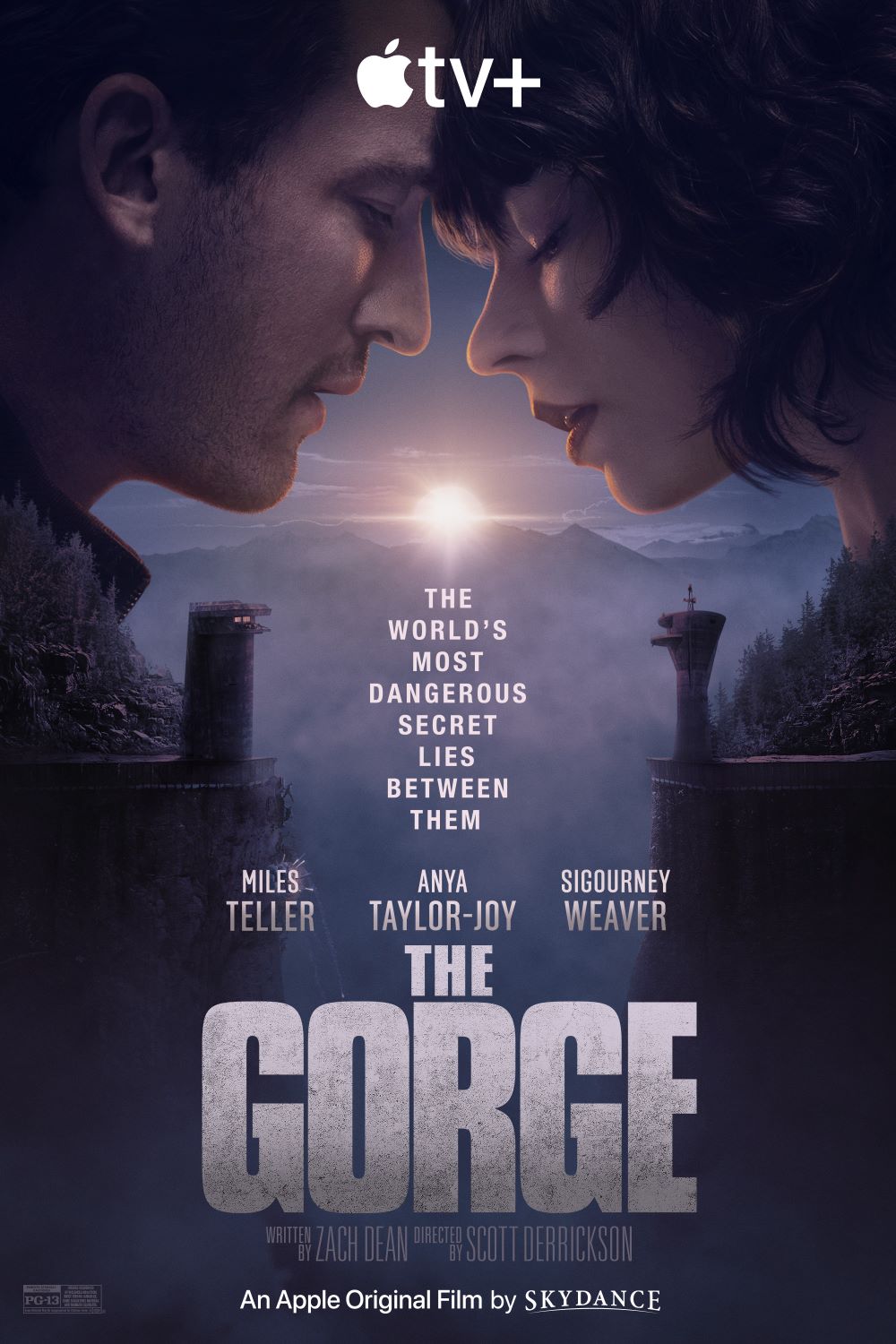
The Gorge delivers a gripping streaming thriller anchored by a fresh premise and strong performances, even if it doesn’t always sustain its early promise. Directed by Scott Derrickson, this Apple TV+ film stars Miles Teller and Anya Taylor-Joy as elite snipers posted on opposite rims of a massive, shadowy chasm, charged with guarding against mysterious dangers rising from its depths. Mixing sci-fi intrigue, budding romance, and horror-tinged action, it hooks you early but shows some cracks later on.
The setup grabs attention right away. Levi Kane (Teller), a haunted ex-Marine sniper, signs on for a year-long solo stint in a high-tech tower overlooking the gorge’s west side—no outside contact allowed, and strict radio silence with whoever’s stationed opposite. Anya Taylor-Joy’s Drasa, a tough Lithuanian operative with Kremlin roots, faces her own isolation on the east rim, wrestling with personal demons tied to her family’s struggles. Trapped in these fortified outposts, they scan the foggy abyss through scopes and monitors, the vast divide amplifying their solitude. Sweeping drone shots make the gorge feel alive and oppressive, a character in itself that looms over every scene.
The film’s strongest stretch comes in the first half, where tension simmers through daily grind broken by fleeting human sparks. Levi copes with PTSD nightmares by scribbling poetry in quiet moments, while Drasa bends rules on her birthday—flashing signs across the void to goad Levi into a long-distance shooting duel. What starts as competitive jabs turns into warm, flirtatious banter, like forbidden notes swapped in a deadly game. Teller brings coiled intensity with an everyman edge, making Levi instantly sympathetic, while Taylor-Joy layers Drasa with fierce independence and subtle vulnerability. Their chemistry bridges the chasm convincingly, nurturing a romance that cuts through the routine. When threats finally breach the surface—nightmarish entities clawing upward—the defense sequences snap to life: precise sniper fire synced with automated turrets and mine blasts, all taut and thrilling.
Derrickson keeps the pace deliberate yet engaging, drawing on isolation vibes from classics but spiking them with sharp combat and emotional beats. Sound design builds dread masterfully—distant rumbles and unnatural cries echoing from below—while the score pivots from pulsing synth menace in fights to softer strains during tender interludes, like Levi’s daring zipline crossover for a candlelit meal from scavenged supplies. A shared poem moment lands with quiet impact, balancing the gunfire without veering into cheese. It’s this blend of intimacy and adrenaline that gives the movie its heart.
The story shifts midway when Levi’s routine relief mission derails spectacularly, pulling both snipers into the gorge’s underbelly for a chaotic fight for survival. What follows cranks up the stakes with bigger set pieces—vehicle chases, mercenary clashes, and desperate ingenuity against escalating horrors—but the momentum dips as exposition rushes in and spectacle overtakes nuance. Some creature designs impress with gritty practical work, though CGI falters in brighter spots, and the human drama gets sidelined by the frenzy. The leads hold it together, capping things with a synchronized shot that unveils hidden tech and forces tough choices. The wrap-up aims for bittersweet punch but ties threads a bit too neatly, dodging bolder risks.
Teller and Taylor-Joy shine as the core duo. Teller charts Levi’s arc from withdrawn loner to committed partner with grounded charisma that tempers the sci-fi weirdness. Taylor-Joy owns every frame as Drasa, her sharp gaze conveying both killer instinct and inner turmoil. Sigourney Weaver’s cameo as a steely handler adds weighty presence, though her role follows a familiar path. The tight cast serves the contained story well, with no fat to trim—brief warnings from predecessors hint at deeper peril without overexplaining.
Visually and technically, The Gorge punches above streaming norms. Derrickson’s flair for genre hybrids—honed on atmospheric horrors—lends moody lighting: hazy green fog in the depths versus sterile tower blues. Action choreography feels authentic, rooted in real stunts for those sniper exchanges, and the gorge’s scale stuns in wide shots. The soundscape lingers, from guttural threat growls to metallic turret whirs. A few nitpicks persist—runtime drags in probe-heavy stretches, and some effects look dated up close—but the craftsmanship stands out.
At its best, the movie teases thoughtful isolation amid global secrecy, but it leans harder into creature chaos and corporate shadows than profound mystery. Romance fans will warm to the leads’ spark, action lovers get solid payoffs, while horror buffs might crave more bite given the PG-13 leash. It promises slow-burn depth yet settles for crowd-pleasing beats, leaving a few gorge secrets hanging just out of reach.
Overall, The Gorge works as a lively genre cocktail, driven by star power and a killer hook. It nods to tight-quarters thrillers with extra heart and hardware, making for engaging viewing despite uneven gears. The leads and atmosphere carry it far enough to recommend for fans of smart popcorn flicks on a chill night.
“You and I both know that this clock is bullshit. You make your decisions about the people in this courtroom before they’re even in this chair.” — Det. Chris Raven
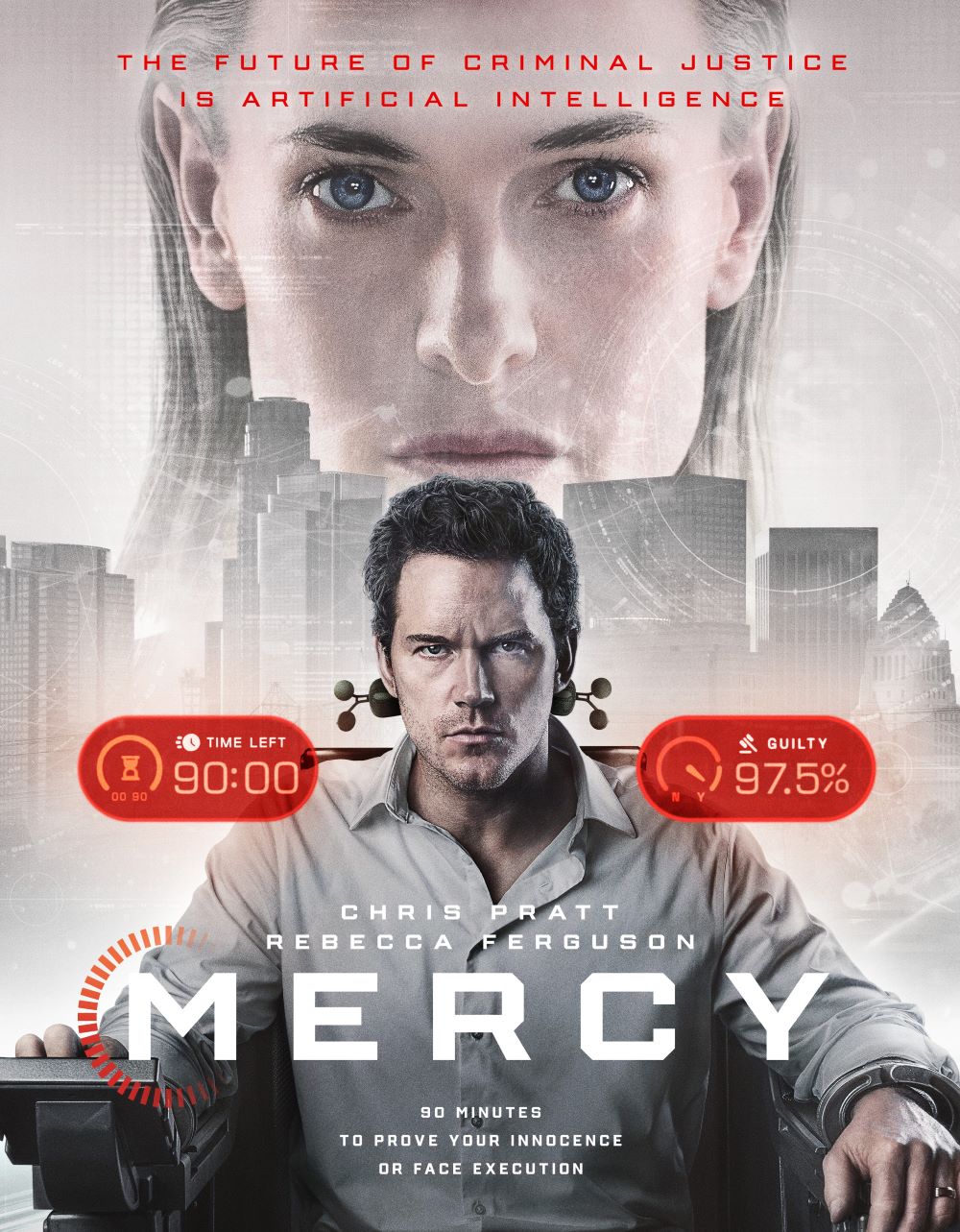
Mercy is the kind of movie that looks great in a trailer and promises a slick, high‑concept thriller, but then sputters once you sit through it. It’s set in a near‑future Los Angeles where the LAPD relies on a program called the “Mercy Court,” in which AI judges rapidly process violent crime cases, and the whole thing is framed as a techno‑noir twist on the courtroom thriller. The central gimmick is compelling on paper: detective Chris Raven wakes up strapped into a high‑tech chair, accused of brutally murdering his wife, and has 90 minutes to prove his innocence before being executed by a sonic blast. That setup alone should guarantee at least a tense, scrappy B‑movie; instead, the film keeps undercutting itself with lazy writing, cluttered subplots, and a surprising lack of nerve.
The biggest problem is the script, which feels like it’s trying to be three different movies at once and doesn’t really commit to any of them. On one level, Mercy wants to be a real‑time investigation, where Raven works with an AI judge to access security feeds, social media, emails, and police databases to piece together his wife’s murder. In practice, this becomes a series of exposition dumps—Raven talking out his thought process, the AI reciting rules, and side characters popping in just long enough to drop information before the movie rushes on. It’s not building tension; it’s building a checklist. The film’s pacing stays brisk, but that’s because so much of the middle act feels like procedural filler rather than a genuine mystery.
Tonally, Mercy swings wildly between modes. At times it’s going for something like a sleek, dystopian Minority Report–style narrative, then it veers into a revenge‑driven character drama about a cop who may be too reliant on an authoritarian justice system, and then it suddenly transforms into a generic bomb‑plot action movie. The initial setup—a world where people suspected of murder are strapped into a chair, presumed guilty, and given a brutally short window to prove themselves—feels genuinely unsettling. But the movie doesn’t really sit with those implications; it flirts with the moral and ethical questions and then rushes off to a more conventional, physical threat. What should be a caustic, uncomfortable critique of automated justice reduces to another last‑minute rescue mission.
The central mystery is another missed opportunity. The evidence stacked against Raven is substantial—blood on his clothes, footage from cameras, his drinking problem, and a history of violent outbursts—but the film telegraphs the real culprit so early that the final reveal feels less like a twist and more like a completion of prior signposting. The story tries to make the framing of Raven seem like a master‑plan‑level conspiracy, but the plan hinges on an almost impossible level of predictability on his part. The more the movie explains, the harder it becomes to buy into the logic of the setup. Instead of feeling like the net has tightened around him in a sophisticated way, it feels like the script is forcing contrivances to land on top of him.
Chris Pratt’s performance is an odd fit for the material. The movie seems determined to present him as a darker, more tortured version of himself, and there are a few moments where that dynamic works—Raven’s vulnerability, his self‑loathing, his conflicted belief in the system he helped create. But the script never really lets him live in the morally grey space it clearly wants him to inhabit. Instead, it keeps reassuring us that he’s essentially a good cop who’s been wronged, which undercuts any real tension about whether he might actually be guilty or at least dangerous. You get glimpses of a more interesting character, but they’re constantly being smoothed over by the need for a likable protagonist.
The AI judge, voiced and embodied by Rebecca Ferguson, is one of the few genuinely strong elements here. She plays the voice and presence of the system with a cool, clipped rationality that occasionally shades into dry wit, and her interactions with Raven hint at a more ambitious film lurking underneath. The idea of an AI judge slowly questioning its own assumptions—pushing back on emotional appeals, probing inconsistencies, and gradually developing something resembling curiosity—is inherently compelling. Ferguson gives the character enough personality and nuance to make that arc feel plausible, but the script mostly treats her as a glorified search engine and a moral referee for the final act, when she should be the co‑lead driving the film’s central conflict.
The supporting cast is fine, but underused. Raven’s partner mostly exists to run errands off‑screen—tracking suspects, raiding houses, reacting over the comms—so the movie can cut away from the courtroom whenever it gets bored. Raven’s AA sponsor is saddled with a mix of clumsy foreshadowing and heavy‑handed motivation, which only becomes relevant when the revenge angle kicks in. Raven’s daughter functions almost entirely as emotional leverage and a hostage, escalating the stakes in a way that feels mechanical rather than organic. You can tell the film wants these relationships to carry weight, especially when it leans on family flashbacks and guilt, but they play out like bullet points instead of lived‑in dynamics.
Visually, the film leans into its creator’s usual fondness for screens within screens, overlay graphics, and multimedia collage. The Mercy Court itself is a striking concept—an almost clinical chamber where Raven is strapped into a chair while the AI’s interface shifts around him—yet the movie keeps cutting away to external action once the premise might otherwise grow too tense or claustrophobic. The pacing is brisk, and there are a few set‑pieces—an intense raid on a suspect’s house, the final assault on the courthouse—that deliver a basic level of genre competence. The issue is that competence is about as high as Mercy ever aims; it never really experiments with the form or stakes of its own setup.
Where the film stumbles most is in its attempt at commentary. The world it presents is, on paper, horrifying: defendants are presumed guilty, strapped into a chair, surveilled across every aspect of their digital life, and given a brutally short window to clear their name before being executed. That’s fertile ground for a scathing critique of mass surveillance, algorithmic justice, and the erosion of due process. But the movie is oddly kind to the system itself; by the end, the AI judge is portrayed as more reasonable and “fair” than most humans, and the real villain is just an individual with a personal grudge. The film nods at privacy violations and the moral grey zones of automating justice, then quickly moves on to a more traditional, physical threat. For something that positions itself as a provocative AI courtroom thriller, it ends up feeling strangely apolitical and conflict‑averse.
To be fair, there are a few things Mercy gets right. The core structure—a detective investigating his own case against a clock—remains inherently watchable, even when handled clumsily. Ferguson’s performance gives the material a center of gravity whenever it threatens to spin out into nonsense. And there’s an occasionally interesting tension between Raven’s instinct‑driven, emotionally charged approach and the AI’s cold, probabilistic logic, suggesting a better film that really pits those worldviews against each other instead of letting them conveniently converge. If you go in with low expectations and a tolerance for generic sci‑fi thrillers, you might find it mildly diverting.
But for anyone hoping Mercy would be a sharp, nasty, high‑concept genre piece with something to say about AI, policing, and due process, it’s a disappointment. The movie leans on an admittedly strong premise, some slick production design, and a few scattered performances, yet it never commits to either being a full‑tilt B‑movie or a genuinely thoughtful techno‑thriller. It’s not unwatchable, just frustratingly timid—content to skim the surface of its own ideas and then blow something up when things get complicated. By the time the credits roll, you’re left with the sense that the AI judge wasn’t the only one operating on a strict time limit; somewhere along the way, the film seems to have run out of patience with itself, too.
“Now when they remember us, they ask themselves: Why didn’t we all get to come back? What does it all mean? You’ll need to find out yourselves. ‘Cause the answer is in you.” — Numa Turcatti
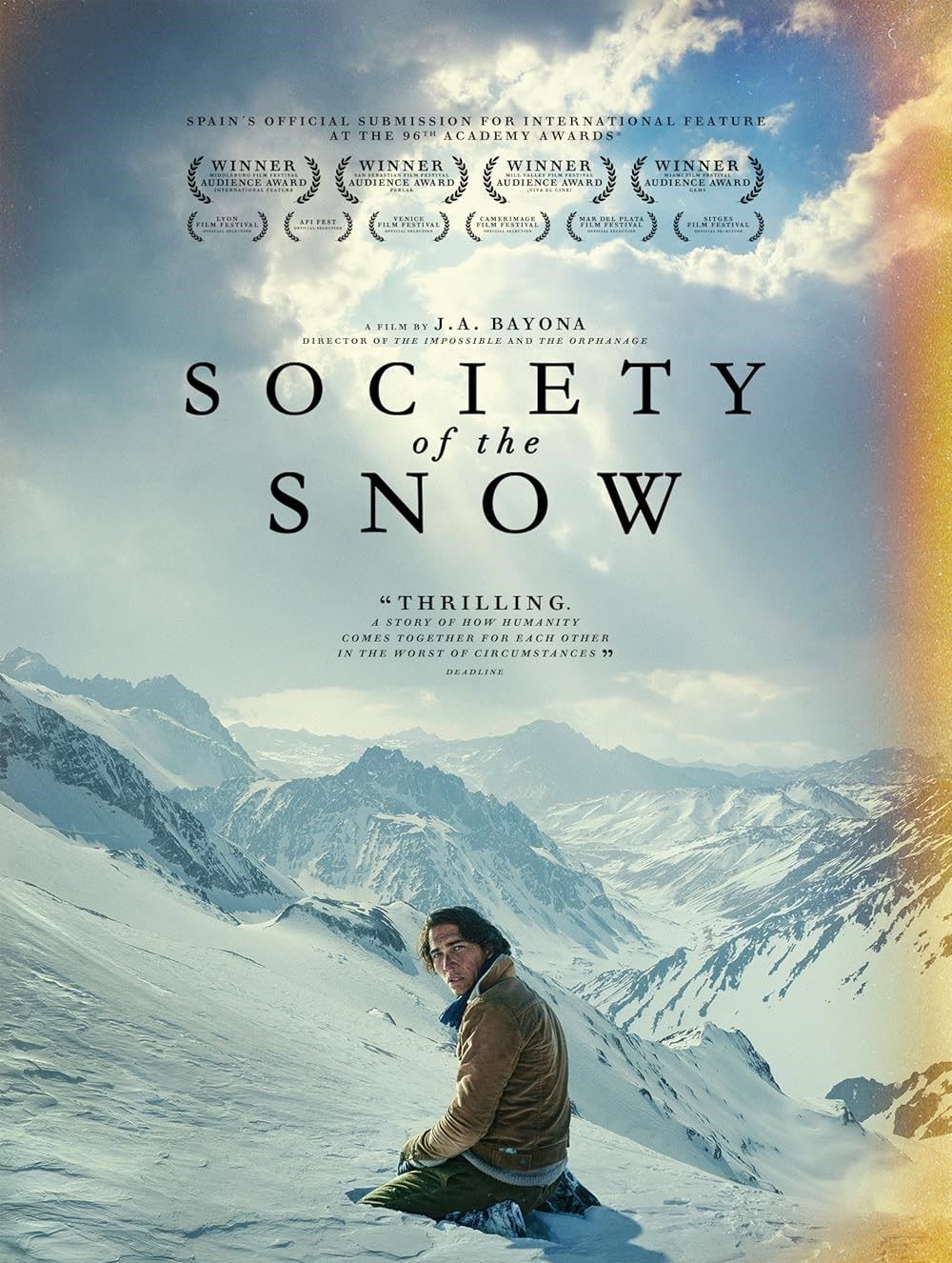
Society of the Snow is the kind of survival movie that sneaks up on you, starting as a rugby team’s joyride and morphing into an existential gut-punch about faith, God, and what binds people when hell freezes over. Directed by J.A. Bayona, it revisits the 1972 Andes crash of Uruguayan Air Force Flight 571, stranding the Old Christians rugby club, pals, and kin in a snowy nightmare 72 days long. No heroes hog the spotlight; it’s an ensemble of mostly newbie Uruguayan and Argentinian actors embodying a group forged by crisis, tackling taboos like cannibalism not as shock value, but as a collective leap of desperate faith.
The setup hooks you quick: carefree banter on the flight from Montevideo to Santiago, singalongs, rugby dreams bubbling. Then boom—the wings shear off, the fuselage cartwheels into a glacier, and 45 souls face subzero isolation with slim rescue odds. Bayona’s crash sequence is visceral chaos: screams swallowed by crunching metal, bodies tumbling, sudden silence under starlit peaks. It’s not Hollywood gloss; it’s the indifferent brutality of nature claiming lives, leaving the rest to improvise in a metal tomb.
Early days blur into tending wounds, rationing snacks, scanning skies for choppers that never come. Characters emerge gradually—Numa Turcatti’s narration grounds us, Nando Parrado’s grit shines later, Roberto Canessa’s smarts anchor medicine—but it’s the group’s dynamic that carries the load. Some introductions rush by, making deaths more statistical than soul-crushing at first, a fair knock since 16 eventually perish from crashes, avalanches, exposure. Still, that haze mirrors real panic, where faces and flickers of personality become your lifeline.
As weeks grind on, Society of the Snow almost becomes an existential exercise in the meaning of faith, belief in God, and how disaster can pull survivors together despite their differences to make that collective decision to perform something that others safe and sound would consider abhorrent. These devout Catholics debate God’s role: Is the crash punishment, test, or sheer accident? Priests invoke Eucharist parallels—body of Christ sustaining the living—while doubters rage at a silent heaven amid freezing nights and howling winds. Disaster doesn’t just bond them through shared misery; it forces this collective buy-in, where atheists, believers, and everyone in between hash it out in the fuselage’s dim light, snow piling up outside.
Differences in personality or background fade fast when hypothermia and starvation make every choice a referendum on humanity itself; rugby jocks, quiet thinkers, hotheads form a tribe, voting on the unthinkable: eating the dead to cheat death themselves. Safe outsiders might recoil in horror, but up there, it’s reframed as sacred reciprocity, a group oath blending survival instinct with spiritual rationale. Bayona doesn’t linger on gore—he shows enough to unsettle, focusing on the hushed consent, the tears, the way it reshapes their souls without breaking the bond.
Visually, it’s stunning restraint: Pedro Luque’s cinematography paints the Andes as majestic jailer, vast whites dwarfing ant-like survivors. Makeup sells the toll—cheeks hollow, skin ashen, eyes haunted—as bodies waste away on meager flesh. Sound design immerses: fuselage creaks like a dying beast, wind a constant roar, silence after avalanches deafening. Score stays subtle, melancholic strings underscoring faith’s quiet wrestling rather than cueing cheap tears.
Mid-film drags a tad, the routine of despair—avalanche buries them alive, failed expeditions limp back—testing patience as it mirrors their grind. At 144 minutes, repetition risks numbing, though it aptly conveys time’s cruelty. Humor peeks through: dumb jokes, rugby chants, home stories keeping spirits flickering, proving they’re not just victims but vibrant lives interrupted.
Climax shifts to Parrado and Canessa’s epic trek—shoeless, rag-wrapped, scaling cliffs with rugby posts as ice axes. Physically punishing to watch, it culminates in that eerie rescue meet: a gaucho across a torrent, civilization’s whisper after eternity. Their return sparks media frenzy, but the film ends introspective, faith renewed not in miracles, but in human will and collective defiance.
Bayona’s take earns widespread acclaim, including Oscar nods for International Feature, makeup, and score, praising its dignity over prior adaptations like Alive. It honors survivors’ input, shot partly on location with Uruguayan authenticity. Downsides? Ensemble sprawl blurs some arcs; heavy themes demand stamina, no popcorn thrills here. If gore or bleakness turns you off, skip it—but for raw humanity amid atrocity, it’s top-tier.
Ultimately, Society of the Snow lingers because it asks: What’s faith when God seems absent? How does abhorrence become salvation through unity? Just as Frank Marshall’s 1993 Alive left an indelible mark on that generation’s filmgoers, grappling with survival’s raw ethics amid the early ’90s thirst for true-story grit, this film resonates powerfully in today’s fractured world. In an age of endless online division and existential dread—from climate crises to global unrest—it spotlights unbreakable human bonds forged in the worst conditions, reminding us that shared ordeal can still transcend differences and redefine what we’re capable of. Disaster doesn’t divide; it welds them, turning horror into testament. Powerful, flawed, profoundly human.
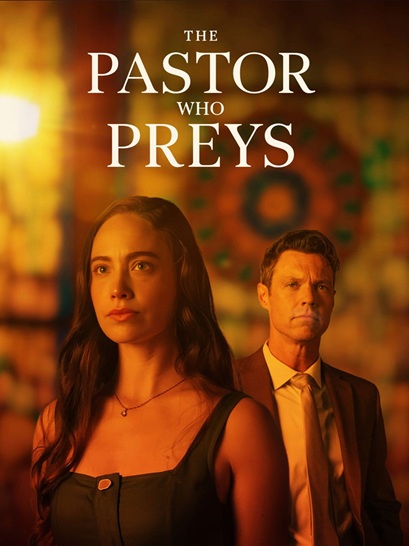
Caleb Whitley (Daniel Stine) is an energetic and handsome pastor who is also a coach at the local high school. His father was a pastor and Caleb inherited the church that his old man founded. Caleb’s loyal mother, Hattie (Annette Saunders), is there to protect Caleb in all that he does because she believes that he is meant for something special. Caleb’s wife, Jenn (Clark Sarullo), appears to be the perfect pastor’s wife. She’s blonde, she’s composed, and she always seem to have control over the situation.
And that’s good because Caleb …. well, Caleb often falls to temptation.
Caleb is the type of pastor who makes a big deal about running shirtless every morning so that the single women of the neighborhood can appreciate him. Caleb says he’s just trying to take care of his body but we all know what he’s doing. Caleb also has a history of cheating on Jenn and his mistresses have a tendency to turn up dead once they become inconvenient. Is the Pastor truly preying? Or is something else happening?
That’s what fashion designer Nicole (Amanda Nicholas) is determined to find out. After her cousin, Amanda (Analisa Wall) is found dead, Nicole immediately suspects the pastor. She shares her concerns with Detective Chandler (Wade Hunt Williams) but does she have any proof? Not yet….
I should say a few words about Detective Chandler. There are a lot of memorable characters to be found in The Pastor Who Preys but Detective Chandler is one of the most entertaining, just because he seems to be so genuinely perplexed by everything that he hears. Most detectives tend to be cynical but Detective Chandler seems to be genuinely shocked at the idea that the pastor could be a serial adulterer. When the detective later talks to Jenn about the rumors of her husband’s infidelity, he has no problem revealing the name of the person who said that Caleb’s a cheater. It seems like most detectives would know better than to reveal the name to a potential suspect. Chandler is so incompetent at his job that he becomes oddly likable. I mean, he’s just trying so hard! His facial expressions during the film’s finale really should be put in a museum.
This is a Lifetime church melodrama. I have to admit that almost everything I know about protestant churches, I learned from watching Lifetime. I’ve learned that the pastors are always charismatic but they shouldn’t be trusted. The church men always want to get home to watch the game. The church women always spend their meetings gossiping about who is cheating on whom. There’s always a divorcee who wears leopard-print dresses and who has her eye on the pastor. In this film, that role is filled by Lacey (Erika Monet Butters) and she’s definitely the best character in the film.
The Pastor Who Preys is an enjoyable melodrama in the time-honored Lifetime tradition. It offers up several credible suspects and I have to admit that my first guess as to who was guilty turned out to be wrong. Caleb is one smooth operator. I expect he’ll return when they get around to The Pastor Who Stalked Me.
The most interesting thing about In The Blink Of An Eye is who directed it.
Andrew Stanton got his start at PIXAR, directing films like A Bug’s Life, Finding Nemo, Finding Dory, and my personal favorite, WALL-E. (He also directed Toy Story 5, which will be coming out later this year.) Stanton’s PIXAR films were some of the best to come out of that legendary studio. Especially when it came to WALL-E, he showed not only his skill as a visual storyteller but also his ability to craft compelling narratives that sold their message without necessarily feeling preachy. (If you didn’t cry while watching WALL-E, you don’t have a heart.) Stanton’s first live action film was John Carter, a legendary flop that was more betrayed by its producers than its director. After the failure of John Carter, Stanton redeemed himself by directing episodes of shows like Stranger Things, Better Call Saul, and For All Mankind.
In The Blink Of An Eye is Stanton’s second live action film. It’s an earnest film. One can tell that both Stanton and the film’s screenwriter, Colby Day, felt they had something important to say. (Day’s screenplay appeared on the 2016 Black List, which is the annual list of the “best” unproduced screenplays in Hollywood. Unfortunately, as anyone who has sat through Cedar Rapids can tell you, merely getting on the Black List is not a guarantee that a script will be transformed into a good or even watchable movie.) Like WALL-E, it’s a film with a message. Unfortunately, it’s nowhere near as watchable or compelling as Stanton’s animated work.
It’s a film that tells three interconnected stories, each one taking place at a different time in human history. In 45,000 BC, a family of cave people struggle to survive and to start a civilization on the beach of a largely untouched Earth. In the 21st century, anthropologist Claire (Rashida Jones) falls in love with Greg (Daveed Diggs) and eventually, they have a son who inherits their shared interest in science and their appreciation for Paleolithic culture. (Don’t let Claire hear you suggest that Neanderthals were dumb.) Meanwhile, in the far future, Coakley (Kate McKinnon) lives on a spaceship where her only companion is an AI named Rosco (voiced by Rhona Rees). When Coakley’s mission appears to be in jeopardy, Rosco suggests that the only solution might be Coakley shutting Rosco down. The stories share a connection, one that most audiences will guess before the film gets around to revealing it.
As I said, In The Blink Of An Eye is an earnest and well-intentioned film. (Colby Day also wrote the screenplay for the underrated Spaceman, a film that dealt with similar themes.) And yet, it really doesn’t work. The pacing is off. This is a 90 minute film that feels considerably longer. The stories themselves are not particularly compelling. The cave people are well-acted and I appreciated the fact that they spoke they’re own language as opposed to crude English but they were also way too clean. For a group of people who lived without soap, toothpaste, razors, and deodorant, they were way too physically pleasant to be credible. Rashida Jones and Daveed Diggs are sweet when they’re falling in love but then they become rather insufferable once they start a family. As for the future scenes, Kate McKinnon has never been a particularly consistent actress and that trend continues here. She gets outacted by the voice of Rosco. (Having the AI be more likable than the actual human worked well in 2001 but it’s far less effective here.)
As I said, it was well-intentioned but, in the end, it just left me wanting to watch WALL-E again.
In 2024’s Saturday Night, there’s a scene where the president of NBC (played by Willem DaFoe) tells a young and arrogant Chevy Chase (Cory Michael Smith) that, if he plays his cards right, he might someday replace Johnny Carson as America’s most popular talk show host. When Chase brags about this to one of the writers of Saturday Night Live, the writer — who is portrayed as being a weary industry veteran — tells Chase that he will never replace Johnny Carson. In exacting detail, he predicts that Chase will start strong. He’ll be one of the early stars of Saturday Night Live but then he’ll let the adulation go to his head and his arrogance will alienate everyone who once believed in him and, in the end, Chevy Chase will end up a faded, nearly forgotten star.
The film obviously meant for this scene to be a crowd-pleaser. Personally, I found it to be gratuitously cruel. While watching Saturday Night, we all know what the future holds for Chevy Chase but having a fictional character show up for just one scene so that he can say it to Chase’s face feels excessive. It’s not only a bit too on-the-nose but it’s also not necessary. However, the scene does speak to a larger truth. It’s socially acceptable to hate Chevy Chase.
The stories of Chase’s bad behavior are legendary. People have heard the stories about him being difficult to work with on the set of Community. They’ve heard about him suggesting a skit in which Terry Sweeney, the first openly gay member of the Saturday Night Live cast, would announce that he had AIDS. Everyone can visualize the famous brawl that occurred between Bill Murry and Chase when the latter first returned to host SNL and I think nearly everyone agrees that they’d rather have Bill Murray crash their wedding than Chevy. Chase is famous for being rude and for snapping at people in interviews. It’s not only socially acceptable to hate Chevy Chase but it’s kind of expected, especially if you’re an extremely online comedy nerd.
Myself, I have to admit that I wonder why Chase’s personality is the business of anyone other than the people who have work with him. Does the fact that he’s not lovable in real life somehow make Christmas Vacation less entertaining to watch in December and if so, why? One might be tempted to wonder if some grace can be given to an 82 year-old man who is obviously in frail health and whose ideas about comedy were developed in a time very different from today.
That many people would answer that question with a resounding “no,” is evidence of just how bad of a reputation Chevy Chase has. Marina Zenovich, the director of I’m Chevy Chase And You’re Not, described Chevy Chase as being the “rudest” person that she has ever interviewed and you can see more than a little of that while watching the documentary. He replies to one question with, “You b*tch.” (I gave up cursing for Lent and I’m not going back on my word just to quote Chevy Chase.) Another question leads to him telling the interviewer that she’s stupid. When asked about Terry Sweeney, Chase’s first reaction is to laugh and his second reaction is to say that he had heard Sweeney was dead. (Sweeney is alive and, like many of the people who have worked with Chase in the past, declined to be interviewed for the documentary. We can probably learn more from so many of them not wanting to talk about working Chase than we could from any of their interviews.)
And yet, there are scenes where you can see evidence of the aging and very human person hiding underneath all of the rudeness and the bluster. When Zenovich mentions that a lot of people dislike Chase, the pain in his eyes will take you by surprise. When he meets a fan in a diner, he seems to be genuinely touched. Chase’s love for his family comes through, as does their love for him. His daughter talks about a time when Chase nearly died and the viewer is reminded that, regardless of all the stories, he’s still a father and a husband. There’s a moment where Chase seems to forget the name of his first wife. Is he being a jerk or is he an 80-something man with memory issues? It’s far too easy to make assumptions, both good and bad, about famous people who we don’t actually know.
The first fourth of the documentary discusses the early days of Chase’s career while the second fourth deals with his declining stardom and his reputation for being difficult. Performers like Dan Aykroyd, Beverly D’Angelo, and Goldie Hawn all appear to defend him while others are a bit less charitable. And yet, the most important part of the documentary comes towards the end, when Chase attends a showing a Christmas Vacation and takes questions from people in the audience. Even then, Chase is a profane smart-aleck and the audience loves it.
And, for at least a little while, Chevy Chase seems to love it too.
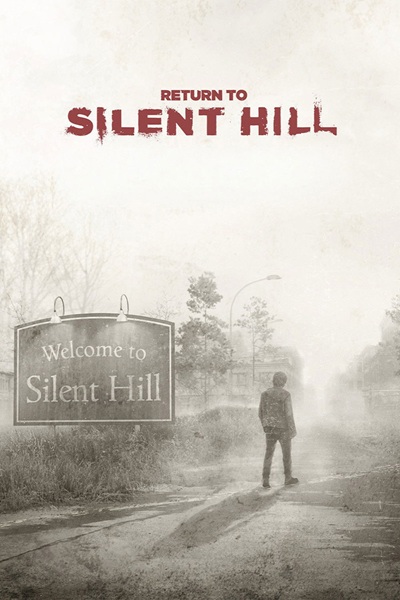
Alcoholic painter James Sunderland (Jeremy Irvine) is consumed with bad memories. He remembers the time that he met Mary Crane (Hannah Emily Anderson) at a bus stop on a mountain that overlooked the idyllic town of Silent Hill. He remembers falling in love with Mary. He remembers living in Silent Hill with her. And he remembers the circumstances that led to him leaving the town without her. Now, James spends him time in bars and dodges meetings with his therapist (Nicola Alexis).
Then, from seemingly out of nowhere, James receives a letter from Mary, asking him to return to Silent Hill and to save her. He heads into a town that is far different from the place that he remembers. A permanent mist now fills the streets of Silent Hill and ash continually falls from the sky. Every time static is heard on a radio, it means that something dangerous is nearby. Monsters emerge from the darkness. James meets a variety of people, from the slovenly Eddie (Pearse Egan) to Maria (Hannah Emily Anderson), who looks enough like Mary that they could be sisters. (And, as you already noticed, both Mary and Maria are played by the same actress.)
It’s a deadly and dangerous town. Myself, if I had been lucky enough to get out of Silent Hill the first time, I would probably never return. However, James has his own guilt and personal demons to confront….
Return to Silent Hill is based on a video game, Silent Hill 2. Now, before I say anything else, I should make clear that I have not played Silent Hill 2. I’ve been told that the film sticks to the basics of the game’s plot while changing some very important details. The biggest change appears to be that Return to Silent Hill features the cult from the earlier Silent Hill game (and film) whereas Silent Hill 2 did not. From what I’ve read, that’s actually a pretty big change and it actually alters the way that some of James’s actions are interpreted. I don’t want to spoil the film but I will say that I can understand why fans of the game were not particularly happy with the movie.
As for the movie itself, it has some effective moments. The Silent Hill imagery is undeniably creepy. After watching the movie, I took a nap and I actually had a nightmare about a killer with a pyramid head. I have Return to Silent Hill to thank for that. (Thanks a lot, movie!) But, my goodness, is this ever a slow film! If any movie needed to be a 70-minute animated film, it was Return to Silent Hill. Instead, excluding the end credits, it’s a 94-minute live action film that feels considerably longer. Hannah Emily Anderson is boring as Mary but considerably better as Maria. Jeremy Irvine delivers his lines with a bland blankness. The faceless, acid-bleeding zombie thing had more personality.
A lot of effort was obviously made to capture the look of the video game while shooting Return to Silent Hill. I actually appreciated the filmmakers dedication to the film’s visual style. That said, the end result was that watching the film felt a lot like watching someone else play a video game. It’s slightly interesting at first but eventually, you just want to grab the controller and steal a car of your own.
“You don’t choose to be a killer, you are chosen.” — The Chancellor
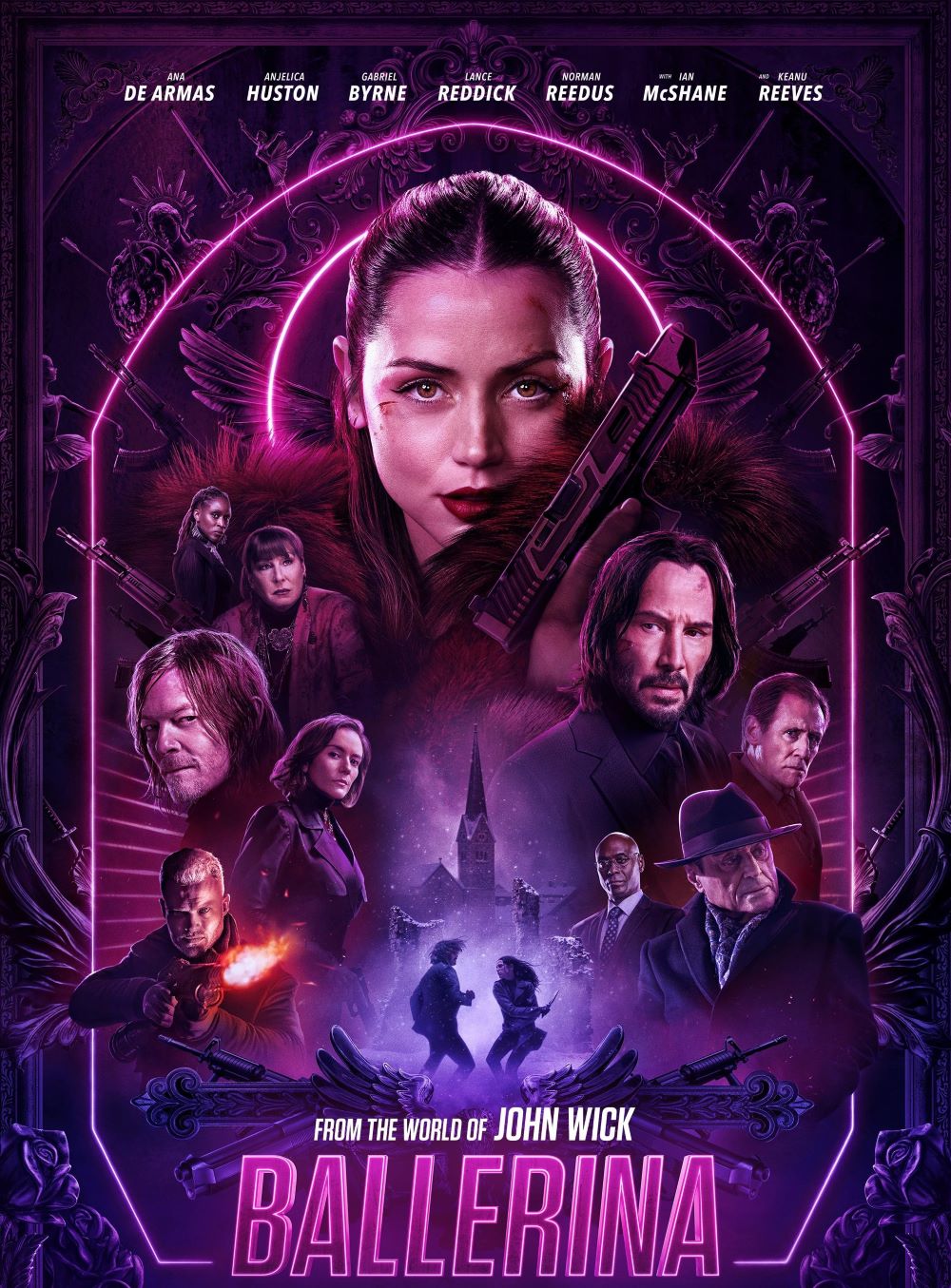
Ballerina lands in theaters feeling like someone finally turned the volume up on the quieter, more balletic side of the John Wick universe. Anchored by Ana de Armas’s poised, ferocious turn, the film doesn’t reinvent the neon‑lit, bullet‑cartoon rules of the franchise so much as rearrange them into a new rhythm. It’s still a very familiar kind of action movie—assassins, codes, bodies on the floor—but it carves out its own niche by centering a woman who’s not just another lethal accessory to John’s world, but someone the world has already trained into a weapon.
At the same time, Ballerina leans hard on the style and flourish of the later John Wick films, and that’s both its main selling point and its biggest limitation. The way shots linger on gun grips, the way the camera circles around bodies mid‑spin, the way every hallway fight feels like stage choreography—it’s all very familiar, very polished, and very much a continuation of the franchise’s visual language. That’s great if you’re here for the aesthetic, but it also means the film sometimes feels more like an extension of the Wick universe’s attitude than a story that confidently stands on its own two feet.
Ana de Armas plays Eve Macarro, a young assassin who grew up in the shadow of the Ruska Roma and the Continental, groomed to kill long before she fully understood what she was doing. The story unfolds in a loose “between films” slot in the Wick timeline, so fans who care about franchise continuity will get their little Easter eggs and cameos, but the film smartly never gets completely bogged down in explaining how this fits into every rulebook. Instead, it leans into the idea that the John Wick universe is big enough that other hunters can walk around in it, following their own grudges and grief. Eve’s motive is straightforward: she wants to track down the people she believes killed her father when she was a child, and along the way she has to square off against both the old guard of her upbringing and the cult‑like killers who seem to operate just outside the established order.
Like a lot of John Wick entries, though, Ballerina is ultimately more interested in expanding the world and reinforcing its rules than drilling deep into its own plot. Eve’s revenge‑driven quest gives the film its spine, but the mechanics of that revenge are often secondary to the chance to show off another assassin enclave, another weird code, or another showdown that feels like a set‑piece first and a character beat second. You can feel the priorities: where she travels, who she bumps into, and how this underworld operates often matter more than whether her arc is especially surprising or emotionally rich. The plotting starts to feel like connective tissue between bigger, more stylized sequences, and that’s where the reliance on franchise style starts to hurt more than help.
The film’s greatest strength is how it employs the language of ballet and violence in the same breath. The title Ballerina might make you expect a lot of literal tutus and pirouettes, and there’s a bit of that in the opening stretches, but the real choreography is in the fight scenes. Eve’s movement is light‑on‑her‑feet one moment—a few spins, a quick sidestep—and then suddenly brutal, close‑quarters savagery the next. The camera doesn’t just document her skills; it dances with them, letting wide‑angle shots show off the architecture of a fight before snapping into tight, impact‑heavy close‑ups. It’s unmistakably a Wick‑style approach, only dialed into a slightly more feminine, almost theatrical register.
De Armas deserves a lot of credit for making Eve feel like a real person, not just a killing machine with a pretty face. She’s cold, yes, but there’s weariness under the surface, the kind that comes from being raised in a world where emotions are a liability. The script doesn’t drown her in backstory; it just lets small moments—a hesitation, a glance at a photo, the way she holds a gun—do the work. When she finally loses her composure and starts to scream, grunt, and visibly struggle during later fights, the effect is more powerful than if she’d been effortlessly killing everyone from minute one. She sweats, she bleeds, she gets thrown around, and that makes her victories feel earned, not just cool.
Stylistically, Ballerina is very much in line with the rest of the franchise: glossy, slightly over‑the‑top, and hyper‑aware of its own aesthetic. The camera work is sleek, the color grading pops, and the score leans into synth textures that feel like a slightly more elegant cousin of the usual Wick pulse. There are also some deliberately playful musical choices—bits of Tchaikovsky and other classical motifs that echo in the background during key scenes—which tie the idea of ballet back to the film’s emotional core. The setting shifts from the familiar New York–style Continental spaces to a quieter, almost fairy‑tale European village that houses a different kind of assassins’ retirement community. It’s a neat trick: the filmmakers give us something that still feels like the same universe but just enough of a different flavor that it doesn’t feel like a rerun.
But that lush style also underlines how much the film is prioritizing world‑building over a tight narrative. Conversations about the Ruska Roma, the Continental, and the cult‑like assassins’ outpost are there less to advance Eve’s inner journey and more to remind us that the John Wick universe is vast, layered, and full of hierarchies. Fans who love the lore will probably eat that up, but if you’re hoping for a more self‑contained narrative, it can start to feel like you’re watching a very expensive lore compendium. The emotional core is there—it just has to fight for space amidst all the visual flexing and mythology maintenance.
Where Ballerina becomes a bit uneven is in its plotting. The basic “one girl, one very long night of revenge” template is solid, but the script doesn’t always give it enough depth or surprise. There are too many conversations where characters explain the rules of the world to each other, or recap what’s already been established, rather than using those moments to add nuance to the characters or relationships. The side figures—like various crime bosses, elders, and reluctant allies—do their jobs entertainingly enough, but they don’t all get the same level of interior life that Eve has. Some of the supporting performances are strong across the board, but the material doesn’t always push them to do anything more than punctuate the action beats.
Keanu Reeves drops in briefly as John Wick, and the cameo is handled with the kind of restraint that makes it feel like a favor rather than a stunt. He doesn’t hang around; he makes a sharp, efficient entrance, has a few quiet exchanges, and then exits, leaving the movie firmly in Eve’s hands. That’s crucial, because one of the criticisms of earlier spin‑off ideas was that they’d feel like vanity detours or glorified cameos. Here, John’s presence actually reinforces the idea that this is someone else’s story now, and that he’s just another player in a much larger ecosystem of killers.
The film’s worst moments are also some of its most visually striking: the bigger, more outlandish set‑pieces that lean fully into the franchise’s “go‑no‑go” action logic. The final third, in particular, is one long, almost goofy crescendo of fights, stunts, and absurdly lethal props. It’s a lot of fun in the moment, but it also underlines how thin the actual plotting can be. When the camera is spinning around a flamethrower‑wielding Eve or a hallway of assassins dropping in from the ceiling, the movie doesn’t always give us enough emotional context to care about who’s living or dying beyond the immediate spectacle. It’s the kind of sequence that will make fans cheer in the theater, but might look a bit clumsier on a second viewing.
One area where Ballerina arguably improves on the core series is its handling of gender dynamics. Eve isn’t fetishized; she’s allowed to be both emotionally grounded and physically dominant without being framed as some kind of fantasy object. The film nods to the idea of “girl power” in the assassin world, but it also lets the character operate within familiar constraints—tradition, hierarchy, and expectation—instead of pretending she’s a one‑woman revolution. She’s tough, but she’s also vulnerable, and that balance keeps the tone from tipping entirely into empty empowerment sloganeering. The way the movie treats her relationships—with her father’s memory, with her mentors, and with the people she’s ordered to kill—adds a layer of emotional sophistication that earlier entries in the franchise often glossed over for the sake of pure momentum.
If you’re coming into Ballerina expecting a radical reinvention of the series, you’ll probably leave a little underwhelmed. It doesn’t rip up the rulebook or deliver a huge thematic twist on what we already know about this universe. Instead, it refocuses the camera on a different kind of protagonist, lets the familiar style breathe a little differently, and proves that the world of John Wick is big enough to house more than just one lone wolf. It’s a stylish, violent, occasionally silly, definitely pulpy action film that knows exactly what it wants to be: a long, bloody ballet in which the lead is a woman who’s finally ready to dance on her own terms—even if the choreography sometimes matters more than the story it’s supposedly telling.
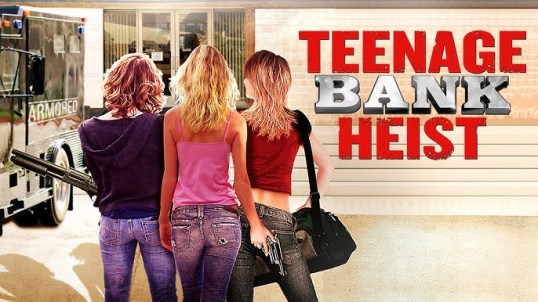
Cassie Aveson (Abbie Cobb) is a directionless teenager whose life has been going nowhere since high school. Her mother, Joyce (Maeve Quinlan), encourages Cassie to at least consider going to junior college but Cassie says that she’s not even sure that she ever wants to go to college at all. (I tried that same argument on my mom after I graduated high school. I didn’t get very far.) Wanting to spend more time with her daughter, single mother Joyce arranges for Cassie to get a job at the same bank where Joyce works.
So far so good, right? Unfortunately, when three masked robbers using voice distortion devices rob the bank, one of them grabs Cassie and takes her as a hostage. Another one of the robbers shoots a security guard. After the robbers take off with Cassie and $600,000 in stolen money, Joyce is shocked to discover that FBI Agent Mendoza (Rosa Blaasi) suspects that Cassie was in on the robbery.
“Do you have children?” Joyce asks Mendoza..
After hesitating, Mendoza admits that she does not. Well, that’s all we need to know about her! Unless you have children, you have no right to suspect that anyone’s child might be involved in a crime. So, I guess, maybe don’t join the FBI if that’s the case because your job is going to be super-difficult.
As for Cassie, she is innocent as far as the bank robbery is concerned. However, she does know the three people under the masks. She went to high school with them. Grace Miller (Davida Williams) is the concerned and responsible friend who is planning on going to law school, even if she’s currently serving as a get away driver. Marie (Augie Duke) is the bad girl who has a heavily tattooed boyfriend named Nick (James Ferris) and who was probably voted Most Likely To Shoot A Security Guard. And finally, Abbie (Cassi Thomson) is the apologetic outcast who Cassie was once suspended for defending.
It’s a teenage bank heist!
Released in 2012, Teenage Bank Heist is one of the best of the old school Lifetime films. It not only embraces the melodrama but it holds on tight and demands even more. Grace and Abbi have a reason for robbing the bank that goes beyond simple thrills but to reveal all of the details would not be fair to those who have yet to see the film. One of the joys of Teenage Bank Heist is that it’s a film that continually leaves you shocked as to how far it takes things. Teenage Bank Heist is totally over-the-top, ludicrous, and just a ton of fun. Watching this film, you will believe that a bunch of teenage girls can rob a bank and get involved in an international incident. You will also believe that a suburban movie can pick up a gun and become an ice cold vigilante when she needs to. It’s Lifetime at its best.
Early on in the film, there’s a beautiful shot of a bunch of loose bills floating in the air. It’s the type of shot that reminds us that we’re watching a film by Doug Campbell, who was responsible for the best Lifetime films. Teenage Bank Heist is currently streaming on Prime and Tubi and you should watch it immediately. Do it for every teenager who has ever literally had no choice but to rob a bank. It happens more often than you may think.

 Through the Shattered Lens