10 Films For The Weekend (7/25/25)


Leaving Soon

With the end of July approaching, I decided to take a look at what would soon be leaving Tubi.  I should mention that just because these films are leaving Tubi, that doesn’t mean they’re not going to start streaming somewhere else.  In fact, I imagine the reason that they’re leaving is because they’re going to start streaming somewhere else.  Here’s a few worthwhile films that are currently listed as “leaving soon” on Tubi.

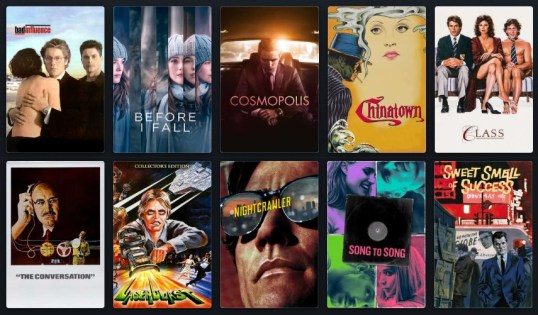
Sweet Smell of Success (1957) stars Burt Lancaster as a viscous columnist and Tony Curtis as his henchmen.  When Lancaster discovers that his sister is dating a jazz musician, Lancaster decides to destroy the man’s life.  One can view this film as a satire on the tabloids, a metaphor for McCarthyism, or a commentary on cancel culture.  All those interpretations are legitimate.  Then again, it can also be viewed as just being a tremendously enjoyable and endlessly quotable pulp masterpiece, a noir where the damage isn’t done by bullets but instead by words.  Here’s the link on Tubi.

Terence Malick’s Song to Song (2017) is an intriguing Texas-set film.  It’s a Malick film and, in many ways, it’s Malick at his most self-indulgent.  There are times when the film, with its languorous shots and its multiple narrators, almost becomes a self-parody.  But there are also images that are so strikingly beautiful that they stick with you.  A talented cast — Michael Fassbender, Ryan Gosling, Natalie Portman, Val Kilmer, and others — wanders through the film and offers up tantalizing hints of what’s going on underneath the surface of their ennui-drenched lives.  It’s left to the viewer to decide what it all means.  It’s a Malick film and, because of that, worth taking a chance on.  Here’s the link on Tubi.

Based on a novel by Don DeLillo and directed by David Cronenberg, Cosmopolis (2012) is a surreal film that follows a businessman (Robert Pattinson) as he is driven around New York.  This is one of those films that people seem to either love or hate.  I loved it and I thought this was the first film that showed Pattinson was capable of doing more than just Twilight.  In a key supporting role, Paul Giamatti gives a notably disturbing performance.  Here’s the link on Tubi.

What would you do if you had the chance to live the last day of your life over and over again?  That’s the question asked by one of my favorite films of the past ten years, Before I Fall (2017).  This is a film that brough back memories of me and my friends in high school and left me wondering if I needed to apologize to anyone.  Here’s the link on Tubi.

I’m still annoyed (if not necessarily surprised) that Nightcrawler (2014) was thoroughly ignored by the Academy.  Jake Gyllenhaal definitely deserved, at the very least, a nomination for his performance as a sociopath who finds a successful career in crime journalism.  Bill Paxton and Rene Russo give excellent supporting performances.  This may be a mainstream film but its heart belongs to the grindhouse.  Here’s the link on Tubi.

Finally, what can I say about Chinatown (1974) that hasn’t already been said by a hundred other critics?  It’s one of the best noirs ever made and it’s debatable whether or not Jack Nicholson has ever been better than he was here.  Along with an intriguing mystery, the film features one of the most loathsome villains of all time, John Huston’s Noah Cross.  Faye Dunaway is excellent as the femme fatale with a devastating secret.  Here’s the link on Tubi.

Odds and Ends

After watching Chinatown, why not check out Francis Ford Coppola’s The Conversation (1974)?  I have to admit that I envy those who were alive in 1974 and who got to see the second Godfather, Chinatown, and The Conversation when they were all first released.  What’s it like to live during a cinematic golden age?  The Conversation is a brilliant thriller, featuring Gene Hackman at his best.  This is a true masterpiece of paranoia and it can be viewed on Prime.

If you’re in the mood for something completely different, the dramedy Class (1983) features Andrew McCarthy as a nerdy student who has an affair with the mother (Jacqueline Bisset) of his roommate (Rob Lowe).  It’s a very 80s film and definitely a guilty pleasure.  It can be viewed on Prime.

Speaking of Rob Lowe, he plays a bad guy in the enjoyably melodramatic Bad Influence (1990).  James Spader plays the good guy for once, an adorably nerdy guy who discovers that his new best friend doesn’t exactly have his best interests at heart.  Directed by Curtis Hanson, Bad Influence is sordid fun.  It can be viewed on Prime.

Finally, I should mention that I bought a copy of Gianni Russo’s autobiography this week.  Russo is the entertainer who played Carlo Rizzi in The Godfather and who appeared in a handful of other films, usually playing a gangster.  I’m disappointed to say that Russo did not write about the experience of co-starring in the gloriously absurd, totally 70s sci-fi flick, Laserblast (1978).  Fortunately, you can watch the film for yourself.  Russo’s role is actually pretty small but the Claymation aliens are just adorable!  This is also probably the only film ever made to feature Eddie Deezen as a bully.  Laserblast is on Prime.

You can check out last week’s films but clicking here!
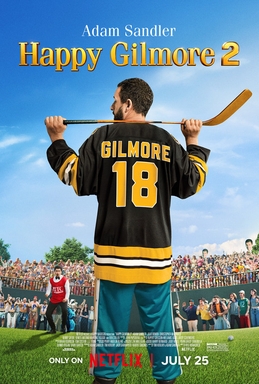
 

The Films of 2025: Happy Gilmore 2 (dir by Kyle Newacheck)


I love 1996’s Happy Gilmore and, over the past few months, I have very much been looking forward to the release of the long-delayed sequel, Happy Gilmore 2.  Still, I was a bit concerned when I opened the film on Netflix and discovered that the sequel had a nearly two-hour running time.  (The original clocked in at an efficient and fast-paced 90 minutes.)  Comedy is all about timing and, in general, shorter is funnier.  I know that Judd Apatow and Adam McKay might disagree with me on that but let’s be honest.  For all of the acclaim that it was met with, when was the last time you actually felt any desire to rewatch The King of Staten Island?  For that matter, if you have to pick between Anchorman or Anchorman 2, which are you going to pick?  The 90 minute original or the sequel that takes more than two hours to tell essentially the same story?

Having now watched the film, I can say that Happy Gilmore 2 does run a bit too long.  There are a few sequences that could have been trimmed without hurting the film.  I can also say that I thoroughly enjoyed the film.  I laughed more often than not.  It’s a funny film but it’s also a surprisingly touching one.

Taking place 29 years after the first film, Happy Gilmore 2 features an older and slightly more mature Happy.  It also features an older and slightly more mature Adam Sandler and, to its credit, the film acknowledges that.  It doesn’t try to convince us that Sandler and Gilmore are still the young hell-raisers that they once were.  (Happy’s Happy Place has changed considerably.)  I’ve often written that there are two Adam Sandlers.  There’s the youngish Sandler who made silly and often stupid films where he basically just hung out with his friends and didn’t seem to put much effort into anything.  That’s the Sandler who has won multiple Razzie awards.  And then there’s the older and wiser Adam Sandler, the sad-eyed character actor who gives sensitive performances as world-weary characters.  This is the Adam Sandler who seems to be overdue for an Oscar nomination.  If an alien came to Earth and only watched Adam Sandler’s serious films, they would probably think he was one our most-honored actors.  While Happy Gilmore 2 is definitely a comedy, it still features quite a bit more of the serious Sandler than I was expecting.

At the start of the movie, Happy is not in a happy place.  His grandmother has passed away.  His wife, Virginia, was killed by an errant tee shot.  He has four rambunctious sons and a daughter, Vienna (played by Sunny Sandler, who was so good in You Are So Not Invited To My Bat Mitzvah).  After Virginia’s death, Happy gave up golf.  He lost his money.  He lost his grandmother’s house.  Now, he’s working in a grocery store and he’s an almost forgotten figure.  He’s also an alcoholic, keeping bottles of liquor hidden around the house.  (A tiny liquor bottle is hidden in the cuckoo clock.)  And while this film is certainly not Uncut Gems or even The Meyerowitz Stories, Sandler still does a good job of capturing the reality of Happy’s depression.  There’s a true sense of melancholy running through the film’s first hour, as Happy returns to golf to try to make enough money to pay for Vienna to attend a prestigious dance academy.  The second hour, in which Happy leads a team of pro golfers against a team of “extreme” athletes is far more goofier but Happy’s love for his family is a theme that runs through the entire film.

Aging is the other theme that runs through the film.   Forced to play with three younger players (including Eric Andre and Margaret Qualley) at a local golf course, the rusty Happy grimaces when he hears one of them say, “Is he trying to do the Happy Gilmore swing?”  When Happy rejoins the PGA, he discovers that all of the younger players now hit the ball as hard as he used to.  An obnoxious tech bro (Benny Safdie) wants to start a new, extreme golf league, one that will “continue the revolution” that Happy started.  Happy finds himself defending traditional golf and it’s an acknowledgement that both Gilmore and Adam Sandler have grown up and have come to appreciate that not everything needs to change.  Sometimes, you just want to play a nice round of golf on a pretty course without having to deal with the sensory overload of the 2020s.

It’s a funny movie.  Even when he’s playing it straight, Sandler still knows how to deliver a funny line.  Ben Stiller returns as Hal L., who is now an addiction recovery specialist.  (His techniques include ordering people to wash his car.)  Christopher McDonald also returns as Shooter McGavin, having escaped from a mental asylum and now fighting, alongside Happy, to save the game that they both love.  As someone who always felt that Shooter kind of had every right to be upset during the first film, I was happy to see him get a bit of redemption.  Several professional golfers appear as themselves.  A running joke about Scottie Scheffler getting arrested and then forcing all of his cellmates to watch golf made me laugh a lot more than I was expecting it too.

The sequel is full of shout-outs to the first film.  A fight in a cemetery reveals that everyone who died during and after the first film just happens to have a gravestone and it was actually kind of a nice tribute.  (Even the “Get Me Out Of Here” Lady gets a headstone.)  It’s a sequel that truly appreciates and values the legacy and the fans of the first film.  It’s also a sequel that seems to truly love the game of golf, which is not necessarily something that could be said about the first film.

Happy Gilmore 2 is a worthy sequel, even if it is a bit long.  It made me laugh but, at the same time, it was hard not to be touched by the obvious love that Happy had for his family and that they had for him.  (It didn’t hurt that Happy’s daughter was played by Sandler’s daughter.)  In the first film, Happy played golf for his grandmother.  In the second film, he returns to the game for his daughter.  It’s all about family, as Adam Sandler’s unexpectedly heartfelt performance makes clear.

Film Review: Transformers: The Movie (dir. by Nelson Shin)


1986 was such a fantastic year.

With movies like Top Gun, Labyrinth and Ferris Bueller’s Day Off already out, the summer would give us Big Trouble in Little China, Aliens, & The Fly (Which at one point you could catch as a double feature with Aliens). The two best announcements at home were that a new baby was on the way and Transformers: The Movie was coming out. By August, we knew the baby would be a boy and a name was already set aside for him. We were naming him after a fallen Officer who was a friend of my father’s on the Force.

Impending older brotherhood was nice, but for 11 year old me, it all took a backseat to the Death of Optimus Prime. Up until then, the most shocking fictional event we had in school was either Return of the Jedi closing the book on Star Wars some years prior, K.I.T.T. getting destroyed (and rebuilt with Super Turbo Boost) in Knight Rider, or Rico losing Angelina in a car bomb during the Season Finale of Miami Vice just a few months back.

I didn’t get a chance to see Transformers: The Movie during the film’s initial run, simply because there wasn’t anyone at home who wanted to sit through it with me. My older brother, through other means, managed to score a VHS copy of the film within the first week or so of its theatrical release. I watched and re-watched that video so many times, and would even pause it to try to draw some of the characters. Eventually, I was able to catch a re-release for the film’s 30th Anniversary.

After two full seasons of the show, Transformers: The Movie was basically Hasbro’s way of cleaning house from the 1984 Generation 1 toy line to introduce a new set. The show sold figures, and the hopes were that the film would do the same. Granted, there were already a large number of Transformers to work with by the time the movie came out. With nearly 50 Autobots and about 35 Decepticons to choose from, the film focused on a few, such as the Insecticons, Dinobots and some of the G1 favorites like Soundwave, Starscream, Jazz & Bumblebee. The Constructicons (and Devestator)were the only group set to be featured in the movie. The Stunticons & Aerialbots would sit this one out. Hasbro really didn’t care too much about the impact of any of these changes on the movie’s plot. While most of the trailers asked “Does Optimus Die?”, their toy commercial line already introduced Rodimus Prime.

Produced by De Laurentiis Entertainment Group (Near Dark, Blue Velvet), Transformers: The Movie takes us to the future of 2005. The Autobots and Decepticons are still fighting it out, with a few changes in the war. The Decepticons own the Transformers home planet of Cybertron, but the Autobots have control of two of Cybertron’s Moons and a city on Earth. Lead by Optimus Prime (Peter Cullen, Eeyore on The Adventures of Winnie the Pooh), the plan is get back to Earth and then handle the Decepticons from there. Of course, the Decepticons and their leader, Megatron (Frank Welker, The Golden Child) find out about this and intercept an Autobot shuttle, outright killing classic show staples Prowl, Brawn, Rachet and Ironhide. I can’t imagine what it was like to be a kid, bring your favorite toy to the movies, only to see the character it’s based on killed on screen. To make things worse, a planet eating transformer named Unicron threatens both parties, including Cybertron. Can Unicron be stopped?


It wasn’t a total loss. We were introduced to new Autobots in the rookie Hot Rod (Judd Nelson, The Breakfast Club), the war hero Kup (Lionel Stander, TV’s Hart to Hart), the fast talking Blurr (John Moschitta, Jr., Dick Tracy), would be leader Ultra Magnus (Robert Stack, Airplane), an Autobot First Lady in Arcee (Susan Blu), and Triple Changer Springer (Neil Ross). The two most famous vocal additions were Leonard Nimoy (Invasion of the Body Snatchers) the new Deception leader Galvatron and Orson Welles (The Third Man) as Unicron. As a kid, it was pretty awesome to know that both Spock and the “No Wine Before It’s Time” guy were joining in all of this. It made Transformers seem a bit larger. My parents would point out that Orson Welles was “the” Orson Welles, but as Citizen Kane wasn’t on my radar (despite my Dad owning and watching it), I associated him with Wine commercials. To both their credit, Nimoy and Welles did just fine with their vocal talents.

While the animation for Transformers was never fantastic, the movie was a bit of an improvement. It never quite reached the levels of anime films like Fist of the North Star & Golgo 13: The Professional. The Soundtrack was ultimately where the film shined, with a mix of rock music from bands like Lion and Stan Bush and a score by Vince DiCola. Coming off of Staying Alive and Rocky IV, DiCola’s work on Transformers: The Movie was great, and remains a go to album for me when music is needed for a situation.

The Death of Optimus Prime was a bit of a shock to the audiences that saw (and cared about) it. Hasbro would eventually bring Prime back temporarily as a Zombie in an episode of the show’s 3rd Season, and then again to lead in the season’s 2 part finale, “The Return of Optimus Prime”.

After seeing the film, I asked me parents for some of the movie based Transformers. Christmas was put on hold by my Mom as she went into labor around Christmas Eve. I was able to open just one gift before Christmas. This happened to be a Hot Rod figure that I found in a toy store back in November, which was quickly snatched and wrapped for the Christmas Pile before I could get to open it. She had my little brother on Christmas Morning, and we eventually celebrated the holiday half a week later. Bless her heart, she gave me almost the entire Movie line – Galvatron, Rodimus Prime, Springer, Cyclonus, and the Predacons (who weren’t in the movie). Playing with them took a backseat to diaper detail, but hey, that Christmas was one of the best.

Overall, Transformers: The Movie is one of those films I happily return to from time to time. It’s not incredible in any major way, but it takes me back to one element of a magical year.

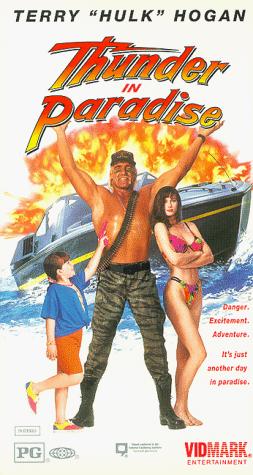
Thunder In Paradise (1993, directed by Douglas Schwartz)


R.J. “Hurricane” Spencer (Hulk Hogan) is a former Navy SEAL who now lives in Florida and makes his living with his superboat, Thunder.  Spencer’s best friend, Bru (Chris Lemmon), is also his business partner.  There’s nothing that Spencer and Bru can’t do.  This movie starts with Spencer taking the boat down to Cuba so he can rescue the family of a dissident and bring them back to Florida.  It ends with his using his boat to save the lives of his wife (Felicity Waterman) and his stepdaughter (Robin Weisman) from some treasure hunters who have made the mistake of kidnapping them.  Spencer’s marriage is one of convenience.  His wife needed a husband to get her fortune and he needed a rich wife to keep his business going.  His father-in-law (Patrick MacNee) doesn’t trust him but Spencer’s a top-notch American hero.

Though it was initially released direct-to-video, Thunder in Paradise was actually a pilot for a syndicated television show that started a few months later.  Both the film and the show were from the producers of Baywatch and it shows with the emphasis on the beach, the bikinis, the corny humor, and the cartoonish villains (led, in this case, by Flash Gordon himself, Sam Jones).  Of course, it’s a Hulk Hogan movie so none of that is really a negative.  Hogan might be playing Hurricane Spencer but he’s really playing himself and there’s enough self-aware humor to make Thunder In Paradise entertaining in a way that No Holds Barred definitely was not.  (I liked that, during a fight on another boat, there just happened to be a wooden chair sitting on the deck that Hogan could break across his opponent’s back.)  Chris Lemmon and Hulk Hogan are a surprisingly good team (Lemmon’s brain provide a needed  contrast to Hogan’s bawn) and Carol Alt is on-hand as the owner of a beach bar.  Naturally, a handful of Hogan’s fellow wrestlers shows up as well, Brutus Beefcake, Jim “The Anvil” Neidhardt, Giant Gonzalez, Jimmy Hart, and others.  As a fan of The Avengers, I was happy to see Patrick MacNee, even if his character was just a typical distrustful father-in-law.

Corny, silly, dumb, and more fun than it probably should be, Thunder In Paradise is an entertaining product of its time.

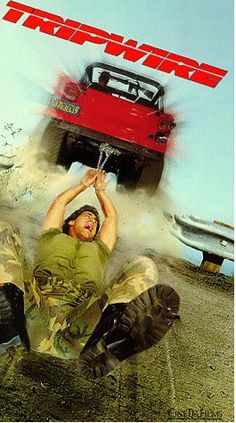
Tripwire (1989, directed by James Lemmo)


Terrorist Josef Szabo (David Warner) and his team (including Viggo Mortensen, Charlotte Lewis, and Sy Richardson) attempt to hijack a train that’s carrying weapons that they can use in their plans for world conquest.  Renegade ATF agent Jack DeForest (Terence Knox) catches them in the act and, in the resulting crossfire, Szabo’s son is killed.  Now looking for revenge, Szabo kidnaps Jack’s estranged wife (Meg Foster) and Jack’s son.   Even though his supervisor (Yaphet Kotto) claims that Jack is dangerous and out-of-control, fellow ATF agent Anne (Isabella Hofmann) teams up with Jack to rescue his family.

This is a well-done B action movie, featuring villains who have more depth than usual and an interesting opening sequence that plays out with almost no dialogue.  Terence Knox is not the most exciting of heroes (he was better served by television than the movies) but the supporting cast makes up for his character’s blandness.  Where also can you see Meg Foster, David Warner, Yaphet Kotto, Viggo Mortensen, and Tommy Chong (!) all in the same movie?  The mountainous Utah setting gives the film  a modern western feel and, though this may be a direct-to-video B movie, the cast gives it their all.  Tripwire is cinematic fast food, quick and just satisfying enough to leave you happy.

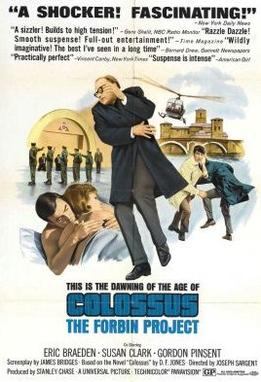
Colossus: The Forbin Project (1970, directed by Joseph Sargent)


Deep in a complex that is hidden away in the Rocky Mountains, Dr. Charles Forbin (Eric Braeden) has put together and programmed a computer called Colossus.  A super computer, Colossus has been designed to control the nuclear arsenal of the United States and its allies.  Colossus will not only keep America safe but it was also remove the chance of human error or human hesitation.  No longer will two men sitting in a silo with a key have to make the decision whether to obey the orders coming from the commander in chief.  No longer will people have to make the split-second decision that could plunge the world into war.

To Forbin’s surprise, the Soviet Union has developed their own super computer, called Guardian.  Colossus asks to be “linked” to Guardian and the Russians agree to allow it as a gesture of good will.  What no one realizes is that both computer systems have become sentient and that they soon decide that humans cannot be trusted to not destroy themselves and the planet.  To Forbin’s horror, Colossus starts to take over the world.

Based on a novel by Dennis Feltham Jones, Colossus was originally filmed in 1968 but it wasn’t released until 1970.  The film looks dated with its gigantic computer but it feels prophetic with its storyline about an AI taking over the world and deciding that it knows better than its makers.  Director Joseph Sargent adroitly mixes science fiction with Bond-style intrigue as Charles Forbin tries to reason with his creation and both the CIA and the KGB try to take down the computers.  The film even tosses a bit of 70s-style paranoia, with both the American and the Soviet governments trying to keep the public from discovering that the supercomputers are trying to take over the world.

Colossus: The Forbin Project is an intelligently written and thought-provoking science fiction film.  Eric Braeden does a great job as Charles Forbin, the engineer who goes from being arrogant and cocky to desperate to finally defiant as his creation slips out of his control.  William Schallert, so often cast as a nice father figure, turns in a good performance as the head of the CIA as does Susan Clark, cast as a colleague who has to pretend to be Forbin’s mistress just so she and Forbin can talk and plot without being monitored by Colossus.

Colossus is a smart sci-fi film that is more relevant than ever.

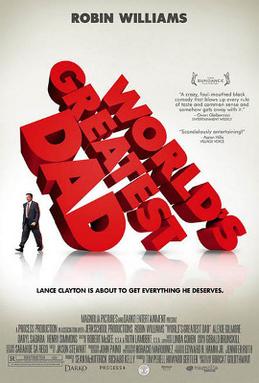
World’s Greatest Dad (2009, directed by Bobcat Goldthwait)


Lance Clayton (Robin Williams) is an English teacher who has a rotten teenage son named Kyle (Daryl Sabara).  Some teenagers go through a rebellious phase.  Some teenagers are troubled because of how they were raised or a recent trauma.  Some teenagers are misunderstood.  Kyle is just a disrespectful and stupid jerk who seems destined to do nothing his life.  He’s the type of fifteen year-old boy who uses his phone to secretly take upskirt pictures of his Dad’s girlfriend while they’re all out for dinner.

Those upskirt pics prove to be the last thing that Kyle sees as he’s looking at them where he dies in a case of autoerotic asphyxiation gone wrong.  Lance impulsively stages Kyle’s death to look like a suicide, both to preserve Kyle’s dignity and his own.  Lance, a frustrated writer, composes a suicide note and signs it with Kyle’s name.  When the note is leaked to the press, Kyle is hailed as a sensitive young man and becomes a hero to the former classmates who used to hate him.  Lance goes on to forge and publish a journal, which he claims was written by Kyle.  Kyle is hailed as a hero and Lance as the “world’s greatest dad.”  Lance enjoys the fame, until he doesn’t.

World’s Greatest Dad is a dark comedy, one that has the courage to often be downright unpleasant in its portrayal of how Kyle’s memory is idealized after his death.  It also features one of Robin Williams’s best performances.  Almost every performance that Williams gave had at least a hint of sadness to it.  In this film, he plays one of his saddest characters, a well-meaning teacher who cannot understand how his son has become such a jerk.  By writing the journal, Williams is not only deceiving the rest of the world but also himself.  He’s recreating Kyle as the son that he wanted as opposed to the one he got.  It’s one of Williams’s most emotionally honest and open performances.

For obviously reasons, it’s not easy to watch Williams playing such a depressed character, especially one who staes a suicide but the film really does show what a great actor Robin Williams could be.  In the end, his talent is what we should remember and celebrate.


10 Movies For The Week (7/20/25)


Here Comes Shark Week

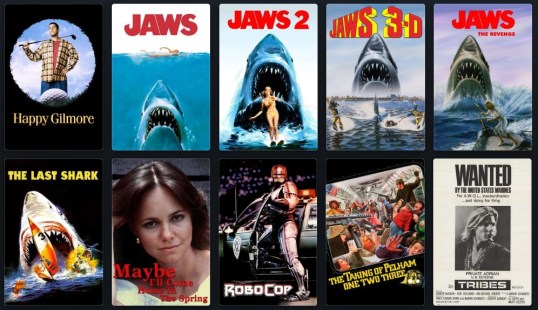
This upcoming week is Shark Week.  At the risk of making the most obvious recommendation ever, Jaws (1975) is currently on Netflix.  I doubt that I need to sell anyone on the film.  Jaws is one of those films that everyone accepts is a classic.  I’ll just say that every time that I watch Jaws, I’m surprised at how well it has held up over the years.  I watched it a few weeks ago while flying to Hawaii and, even when viewed in less than ideal conditions, it still held my attention and made me jump a little.  To be honest, I sometimes miss the Spielberg who directed Jaws.  It’s such a fun and scary movie, all the more so because it was made by a director who clearly lived for film.  Jaws is currently streaming on Netflix.

Jaws 2 (1978) does not get the same respect as the first Jaws, nor does it deserve it.  That said, I can’t help but kind of like Jaws 2.  If the first Jaws has a timeless quality to it, Jaws 2 is proudly a product of the 1970s.  Jaws 2 has some pacing issues but it also features Roy Scheider going totally crazy at the end of the film.  After giving a fairly subdued performance in the first Jaws, Scheider went all out for Jaws 2.  Just listen to him yell at that shark!  Jaws 2 is also on Netflix.

Jaws 3 (1983) is a bit of a guilty pleasure, largely because it was originally filmed in 3-D and the special effects are charmingly bad.  Roy Scheider does not return for this one but Dennis Quaid shows up as Chief Brody’s son.  This film was shot at SeaWorld Orlando but the main message seems to be, “Stay away from Seaworld!”  For the record, I relate to Lea Thompson’s character.  It can be viewed on Netflix!

The makers of Jaws: The Revenge (1987) decided to see what would happen if they made a Jaws film that centered on the least interesting character from the first film.  With Chief Brody having died of a heart attack and one of her sons having been eaten by a shark, Mrs. Brody heads down to the Caribbean and is apparently followed by a shark.  Its dumb but Michael Caine is charming and I’m a completist at heart.  If you’re going to watch one this week, you might as well watch all four!  Jaws: The Revenge is on Netflix.

Great White (1981) is an Italian film that was also released under the title The Last Shark.  Directed by Enzo G. Castelleri, Great White was so similar to Jaws that Universal actually sued the filmmakers in an attempt to keep the film from being released in the States.  To me, that’s always seemed like an overreaction.  There were hundreds of Jaws rip-offs released after 1975.  Great White is actually a pretty entertaining film.  James Franciscus and Vic Morrow team up to take on a giant shark.  The shark eats a helicopter.  This film can currently be viewed on YouTube.

In Praise of Joseph Sargent

Jaws: The Revenge was directed by Joseph Sargent.  Sargent would have been a hundred years old on July 22nd.  Sargent was a classic, no-nonsense director who could handle many different genres.  Here’s a few Sargent films that are not Jaws: The Revenge.

The Taking of Pelham One Two Three (1974) is probably Sargent’s best film.  Four criminals hijack a subway train.  The police spend their time negotiating, arguing, and searching.  It’s certainly my favorite example of the “New Yorkers Will be Rude To Anyone” genre.  Featuring great performances from Walter Matthau, Robert Shaw, Jerry Stiller, and Martin Balsam, this is one of the great New York heist films.  It can be viewed on Tubi.

Maybe I’ll Come Home In The Spring (1972) is a personal favorite of mine, a made-for-television film featuring a young Sally Field as a hippie who returns home and David Carradine as her controlling boyfriend.  This is a lowkey but effective look at life in the suburbs and it features an excellent performance from Sally Field.  It can be viewed on Tubi.

Tribes (1970) features Jan-Michael Vincent as a peace-loving hippie who is drafted and Darren McGavin as the drill sergeant who tries to turn him into a soldier.  Jan-Michael Vincent is absolutely gorgeous in this film.  It can be viewed on YouTube.

Odds and Ends

Paul Verhoeven celebrated a birthday a few days ago.  The original (and still the best) Robocop (1987) is available on Tubi.  Much like Jaws, it’s a film that has stood the test of time and survived countless imitations.

Finally, with the sequel due to be released on the 25th, this week is a great time to amuse yourself with the original Happy Gilmore (1996)!  I love this film and I make no apologies for it.  Bob Barker beating up Adam Sandler?  Seriously, how can you not love this film? Personally, I’ve always felt bad for Shooter McGavin.  Making him hit that ball off of Richard Kiel’s foot?  Totally unfair!  Happy Gilmore is streaming on Netflix.

Click here for last week’s movies!


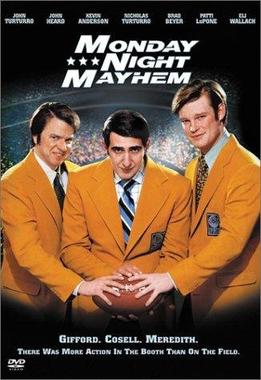
Monday Night Mayhem (2002, directed by Ernest Dickerson)


In the late 1960s, television coverage of football is dull and boring.  The games are played during the day and the announcers have no personality.  An executive at ABC named Roone Arledge (John Heard) changes all of that by convincing the NFL to start scheduling games for Monday night.  Arledge launches Monday Night Football, a broadcast that puts the viewers at home in the stadium.  Arledge explains that he wants cameras everywhere.  He wants the sidelines and the stands to be mic’d up.  And he wants announcers who will make the game interesting.  He picks an experienced radio announcer named Keith Jackson (Shuler Hensley), former Dallas quarterback Don Meredith (Brad Beyer), and finally an egocentric, loquacious, and opinionated sports reporter named Howard Cosell (John Turturro).  The straight-laced Jackson only lasts a season and finds himself overshadowed by Meredith’s good ol’ boy charisma and Cosell’s eccentricities.  Arledge brings in Frank Gifford (Kevin Anderson) as a replacement and changes both sports and television forever.  Monday night football becomes huge but so do the egos of the men involved.

Based on a non-fiction book by Bill Carter, Monday Night Mayhem is a look at the early days of Monday Night Football, with most of the attention being given to the mercurial Howard Cosell.  As a work of history, it’s pretty shallow.  There’s a lot of montages set to familiar 70s tunes and there’s plenty of familiar stock footage.  Beyer and Anderson do adequate impersonations of Meredith and Gifford without really digging for much under the surface.  Monday Night Mayhem is dominated by John Turturro’s performance as Howard Cosell.  Turturro doesn’t look like Cosell and he really doesn’t sound that much like Cosell but he does capture the mix of arrogance and bitterness that made Howard Cosell such a memorable and controversial announcer.  In its breezy manner, the film hits all the well-know points of Cosell’s life and career, from defending Mohammad Ali to considering a run for the Senate to trying to reinvent himself as a variety show host to the controversy when he was though to have uttered a racial slur during one of the games.  I wish the film had a bit more depth but John Turturro’s committed but bizarre performance keeps it watchable.

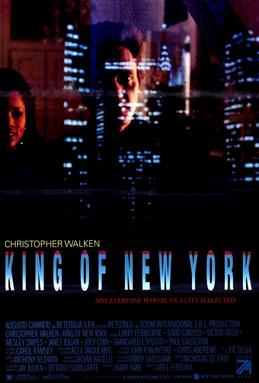
King of New York (1990, directed by Abel Ferrara)


Drug kingpin Frank White (Christopher Walken) has been released from prison and is again on the streets of New York City.  Frank might say that he’s gone straight but, as soon as he’s free, he’s  partying with his old crew (including Laurene Fishburne, Steve Buscemi, Giancarlo Esposito, and others).   While Frank’s agent (Paul Calderon) goes to all of the other city’s gangsters and explains that they can either get out of Frank’s way or die, three detectives (Victor Argo, David Caruso, and Wesley Snipes) make plans to take Frank out by any means necessary.  Meanwhile, Frank is donating money to politicians, building hospitals, and presenting himself as New York’s savior.

King of New York is the epitome of a cult film.  Directed by Abel Ferrara, the dark and violent King of New York was originally dismissed by critics and struggled to find an audience during its initial theatrical run.  (It was lumped in with and overshadowed by other 1990 gangster films like Goodfellas and Godfather Part III.)  But it was later rediscovered on both cable and home video and now it’s rightly considered to be a stone cold crime classic.  Walken gives one of his best performances as Frank White and that’s not a surprise.  The film was clearly made to give Walken a chance to show off what he could do with a lead role and Walken captures Frank’s charisma and humor without forgetting that he’s essentially a sociopath.  Walken gives a performance that feels like James Cagney updated for the end of the 80s.  What’s even more impressive is that all of the supporting characters are just as memorable as Walken’s Frank White.  From Laurence Fishburne’s flamboyant killer to David Caruso’s hotheaded cop to Paul Calderon’s slippery agent to Janet Julian’s morally compromised attorney, everyone gives a strong performance.  (I’m usually not a Caruso fan but he’s legitimately great here.)  They come together to bring the film’s world to life.  Everyone has their own reason for obsessing on Frank White and his return to power.  I’ve always especially appreciated Victor Argo as the weary, veteran detective who finds himself trapped by Caruso and Wesley Snipes’s impulsive plan to take down Frank White.  Frank White and the cops go to war and it’s sometimes hard to know whose side to be on.

Director Abel Ferrara has had a long and storied career, directing films about morally ambiguous people who are often pushed to extremes.  Personally, I think King of New York is his best film, a portrait of not just a criminal but also of a city that combines the best and the worst of human nature.  The action is exciting, the cast is superb, and Frank’s justifications for his behavior sometimes make a surprising amount of sense.  Thought there’s occasionally been speculation that it could happen, there’s never been a sequel to King of New York and it doesn’t need one.  King of New York is a film that tell you all that you need to know about Frank White and the city that he calls home.