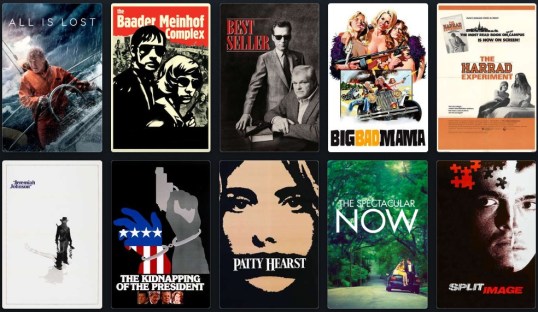
With the passing of Robert Redford last week, I want to start things off by recommending one of his last films, 2013’s All Is Lost. Redford gives a great performance as a nameless man trying to survive on a damaged boat. The film opens with a brief Redford voice over and then, towards the end of the film, Redford utters one other line. Even without dialogue, Redford dominates the screen and shows why he was one of great movie stars. All Is Lost is streaming on Tubi.
Also streaming on Tubi is 1972’s Jeremiah Johnson, starring Redford as a mountain man who is trying to escape from civilization. Jeremiah Johnson is today probably best-known for giving the world the nodding Redford meme but it’s also a strong film in its own right and it features Redford at his best. Jeremiah Johnson can be viewed here.
I was very happy to recently see that one of my favorite films, 1982’s Split Image, is now streaming on Tubi. Split Image is one of those films that I am always recommending to anyone who hasn’t seen it. Michael O’Keefe plays a college athlete who is brainwashed into joining a cult led by Peter Fonda. O’Keefe’s father (Brian Dennehy) hires a sleazy cult deprogammer (James Woods) to rescue his son. This is an intelligent and well-acted film. It was also shot in my part of the world. If you watch it, pay attention to the scene in which O’Keefe is abducted from a college campus. The scene was shot at Richland Community College. It’s a lovely campus that still looks the same in 2025 as it did in 1982. Split Image is on Tubi.
James Woods and Brian Dennehy also teamed up in 1987’s Best Seller, a smart thriller that was written by Larry Cohen and directed by Rolling Thunder’s John Flynn. Dennehy plays a cop-turned-writer. Woods plays the hitman who has decided that he wants Dennehy to write his life story. Best Seller can be viewed here.
2013’s The Spectacular Now is listed as “leaving soon” over on Tubi so now is as good a time as any for you to watch this well-written and surprisingly poignant coming-of-age story. Miles Teller and Shailene Woodley both give strong performance as teen lovers. Kyle Chandler steals the film as Teller’s alcoholic father. The Spectacular Now is streaming here.
In a world where politics is becoming increasingly violent, 2008’s The Baader Meinhof Complex feels as relevant as ever. This film takes a look at the group of middle and upper-class activists who decided to play at being revolutionaries and how their actions spiraled out of-control. This film is a powerful portrait of a group of people who some proclaimed to be heroes and who some (correctly) portrayed to be political LARPers. It can be viewed on Prime.
Follow up The Baader Meinhof Complex with 1988’s Patty Hearst, Paul Schrader’s film about the kidnapping and subsequent brainwashing of heiress Patty Hearst. The film’s first half is especially harrowing. By the end of the film, Patty has almost become a powerless bystander as she watches her own story unfold in front of her. Patty Hearst can be viewed on Tubi.
1974’s Big Bad Mama is a Roger Corman-produced Depression epic, in which Angie Dickinson and her daughters rob banks and shoot guns. This one is worth watching not just for Dickinson’s performance but also for the supporting turns of two very different actors, William Shater and Tom Skerritt. It can be viewed on Prime.
William Shatner is also present in The Kidnapping of the President (1980), a Canadian-made and -set film in which President Hal Holbrook is taken hostage while visiting Toronto. William Shatner is the Secret Service agent negotiating for the President’s release. Van Johnson is the Vice President and Ava Gardner is his wife. Maury Chaykin appears as one of the kidnappers. With a cast like that, you can be assured that there’s not a piece of unchewed scenery to be found in this slight but entertaining thriller. It is streaming on Tubi.
Finally, it doesn’t get more 70s than 1973’s The Harrad Experiment, in which a group of students enroll at Harrad College, a progressive school where everyone is encouraged to lose their clothes, hug trees, and have open relationships. James Whitmore and Tippi Hedren play the unlikely founders of the college. Don Johnson, Laurie Walters, and Bruno Kirby are students. Fred Willard has a brief cameo as himself. It’s not necessarily a good film but it’s such a product of its time that it’s interesting from a historical perspective. It’s streaming on Prime.
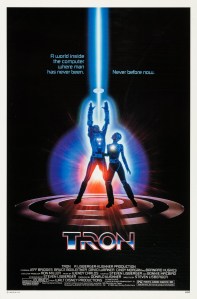
Many years ago in Southern Oregon, I had a conversation with friends about some of our favorite films growing up. Movies like The Goonies, The Dark Crystal, Watership Down and The Secret of Nimh were all on the list, as well as Disney’s Tron. In our excitement for all these movies, we ended up renting the films from a local video store to relive our childhood. While the nostalgia was nice, we all ended falling asleep halfway through Tron, despite our love for it.
I guess one’s enjoyment of Tron is based on how it’s viewed. I caught the film two years ago at the Museum of the Moving Image, in 70MM. The first thing that caught my attention was the film grain. I’ve grown so used to the clarity of digital film presented in 4K that I couldn’t help but catch the little flicks and “cigarette burns” in at the start. This was life before digital, and it was beautiful to revisit. In a theatre, the film’s 96 minutes blazed by for me. The early 1980s was basically made up of bike rides and video arcades. The little boedga on the corner of my block back home even had a few arcade machines in the front of the store in the first half of the 80s. The Bodega’s still there, the arcade’s now a deli/hot meal area. Times can and do change.
Tron is the story of Kevin Flynn (Jeff Bridges, Bad Times at the El Royale), a former employee at Encom, a major computing and videogame company. Encom’s made some wonderful strides in technology as of late, by 1980’s standards. Encom performs special matter tests in a specialized lab, while the programmers grind away code in their cubicles. All of their work is overseen by the Master Control Program, an operating system of sorts. Granted, the workforce at Encom isn’t too pleased about having the MCP monitor their applications. Alan Bradley (Bruce Boxleitner, Kuffs) and Lori Baines (Cindy Morgan, Caddyshack) also have programs and projects of their own that are being culled. Alan’s program, Tron (also played by Boxleitner) is of particular interest to the MCP, as it acts an a security threat that could bring some serious problems. Kevin tries to hack his way into Encom with the use of a program he created called Clu (also Bridges), but the MCP and the Senior Vice President of Encom, Ed Dillinger (David Warner, The Omen, Teenage Mutant Ninja Turtles II: The Secret of the Ooze) keep Flynn at bay. When Alan and Lori discover what Flynn’s up to, they confront him at his arcade, where he explains that he was the actual creator of Encom’s top games. He only needs the data as proof. This leads to the team breaking into Encom, where the MCP digitizes Flynn and brings him into the computer world. Can Flynn escape and help liberate the programs enslaved by the MCP and its henchman, Sark (both also played by Warner)? Can Flynn find the proof to exonerate him? And just who is this Tron fellow, anyway?
The plot for Tron inside the machine becomes a bit theological. The programs believe in the Users, and that they were each created for a particular purpose. From Ram (Dan Shor, Bill & Ted’s Excellent Adventure) being an Actuarial Program to Tron being a defense against the MCP, it’s kind of interesting once Flynn shows up. As a User, he doesn’t have much more power than a program, save that he can’t really be derezzed and that he can mimic the neon glow of anyone he touched. I always thought they could have given him something cooler to do, though for 1982, repurposing machines does have some benefits. The story slows down a bit in the middle, feeling like it’s somewhat unsure of itself, but picks up in the final act with Tron vs. Sark and the MVP. Though Flynn is important to the outcome, he’s more like Big Trouble in Little China’s Jack Burton, kind of just watching this happen around him. He does have his moments, though.
When I was little, my dad owned a Commodore 64 and a Floppy Disk Drive. He would regularly pick up magazines like Byte! to catch up on new innovations. In most of these magazines, they’d have a program that you could enter in at home to create various effects like making a balloon fly across your screen. Those programs were usually written over a number of pages with hundreds of lines of code. For Tron, there were 3 teams dedicated for the Visual Effects. According to the behind the scenes documentary on the disc, Information International Inc., known as Triple-I, was brought in to handle the major work along with Mathematic Applications Group Inc. (MAGI), who director Steven Lisberger worked for at one point early in his career. Digital Effects of New York handled some of the responsible for some of the original CGI work used in Michael Crichton’s Westworld (considered one of the first CGI movie uses ever) and it’s sequel, Futureworld. For the time, the effects were groundbreaking. Mind you, most of this was all before we ever hit the 8-bit era of Nintendo, the Commodore Amiga or even the high resolution arcade games of Sega’s heyday like Space Harrier, Outrun or Afterburner. In an actual arcade in 1982 had games like Q-Bert or Dig Dug with the kind of graphics you’d never see on home systems.
Kevin Flynn (Jeff Bridges) and others (including a young Michael Dudikoff to his right) watch Tron fight for the users. This would inspire Dudikoff to become an American Ninja.
The designs for the look and feel of the computer world came from Lisberger himself, with a bit of assistance from both futurist Syd Mead and legendary artist Jean “Mobius” Giraud. Both men were extremely popular. Mead was the equivalent of Apple’s former Chief Design Officer Jony Ive, having created the “V’ger” model for Star Trek:The Motion Picture. Ironically, Mead’s work (both on the set design and the flying cars) would be seen by audiences watching Ridley Scott’s Blade Runner just a month shy of Tron’s release. Having worked on Alien years prior, Giraud helped to design and inspire both the clothing and some of the vehicles, such as the weird cradle for Dumont (Bernard Hughes, The Lost Boys) and the Light Cycles.
A film dealing with computers needed a composer familiar with electronic music.It seemed fitting that Wendy Carlos(A Clockwork Orange, The Shining) took on the challenge. Having built a computer at 14, Carlos’ love for music over the years lead her (with Robert Moog) to help develop the Moog synthesizer system. The Moog would go on to be used by Kraftwerk, Giorgio Mororder, Nine Inch Nails, The Prodigy Daft Punk and even J Dilla, among others. The Tron Soundtrack was a mix of orchestra, choir and electronic music. Although the sound may not be as dark and digital as Daft Punk’s score for Tron: Legacy, I felt it worked for the time and moves well with the film. In addition to Carlos’ score, Journey wrote the song “Only Solutions” for the film, which also happens to be a line uttered by Kevin Flynn.
Overall, Tron is one of those movies I can happily rewatch without much in the way of expectation. I enjoy it for its place in Sci-Fi cinema, and the memories it awakens. I don’t think Disney ever fully recognized the full potential of where they could take the story, though the animated Tron: Uprising was a great part of the saga. I’m just hoping Tron: Ares doesn’t stray too far from the fold.
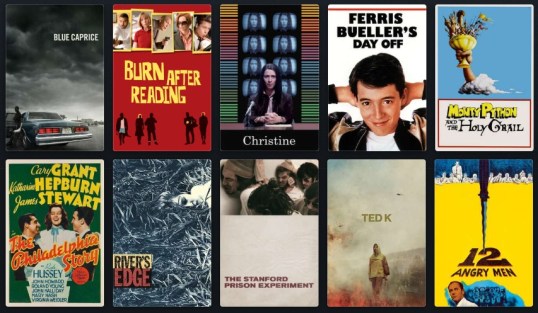
Ted K (2021) is a film about Ted Kaczynski, the overeducated loser who moved into a Montana cabin and who sent people bombs because of …. reasons, I guess? I know that Ted had a big manifesto and that there are people who claim to have found some sort of genius in his ramblings but truth be told, Ted was a second-rate philosopher who has been embraced by third-rate people. This film features Sharlto Copley at Ted and it takes an honest and unbiased look at him, his beliefs, and his crimes. If you’re wondering how we got to where we are, this is one of the films to watch. The film is on Tubi.
River’s Edge (1987) features Keanu Reeves, Crispin Glover, and Ione Skye as teenagers who learn that one of their friends (Daniel Roebuck) has murdered his girlfriend and who …. do nothing. Eventually, one of them does go to the police and finds himself being targeted by his former friends. Meanwhile, Roebuck hides out with a one-legged biker (Dennis Hopper). This is a disturbing and well-acted true crime film. We’ve all seen a lot of examples of bystander syndrome over the past few years. This week, I’ve wondered why so many people, on that North Carolina bus, just walked away after Iryna was stabbed. This is film examines an early example of that tendency. It’s on Tubi.
Blue Caprice (2013)was a film made about the DC snipers. It didn’t really get the attention that it deserved when it was initially released, largely due to the fact that 1) it starred Isaiah Washington and 2) it was such a disturbing movie that I imagine a lot of people had a hard time recommending it. But if you want to see a film about how a madman can find ways to justify his amoral behavior, this film provides a lot of insight. It’s on Tubi.
The Stanford Prison Experiment (2015) tells the true story of an infamous social experiment from the early 70s. It examines just how quickly people will lose themselves in a situation. While the students playing the prisoners feel as if they are literally fighting for their lives, the students playing the guards enjoy their power trip and never seem to consider that things are going too far. This film features a great performance from Michael Angarano, as the most enthusiastic of the guards. It’s on Tubi.
Finally, Christine (2016) tells the story of Christine Chubbuck, the Florida news anchor whose on-air suicide partially inspired the film, Network. Christine is not a happy film but it does feature a great performance from Rebecca Hall. It’s on Tubi.
Ferris Bueller’s Day Off (1986) remains the ultimate teen fantasy. Actually, it’s also probably the ultimate adult fantasy. Everyone deserves a day off. Ferris Bueller skips school and manages to fit a month’s worth of events into just 9 hours. We should all be so lucky. I love this film. Alan Ruck deserved all the Oscars in the world. The film is currently streaming on Netflix.
Burn After Reading (2008)never seems to get the respect that it deserves. The Coen Brothers followed up the award-winning No Country For Old Men with an absurdist CIA comedy in which no one learned anything and nothing was accomplished. It’s hilarious, as both a film and a concept. John Malkovich, Brad Pitt, Frances McDormand, J.K. Simmons, David Rasche, and George Clooney are all wonderfully used. Burn After Reading is currently on Prime.
Odds and Ends
12 Angry Men (1957)is a true rarity, a classic that everyone agrees is a classic. Not only are all 12 of the angry men perfectly cast (Henry Fonda, Jack Warden, Ed Begley, Martin Balsam, Lee J. Cobb, E.G. Marhsall, Robert Webber, and all the rest …. I could go on for paragraphs about how brilliantly cast this film is) but it’s also still a thought-provoking look at the justice system. Personally, I think the kid was guilty. And I think that the men all deciding that the woman was too vain to admit that she wore glasses is a perfect example of why women should serve on juries. Henry Fonda talked them into letting a murderer loose! It’s still a great film though. It’s streaming on Tubi.
The Philadelphia Story (1940)features James Stewart, Cary Grant, and Katharine Hepburn. It also features a lot of great lines, a lot of funny moments, and — most importantly — Jimmy Stewart singing Somewhere Over The Rainbow! What more could you ask for? It’s streaming on Tubi.
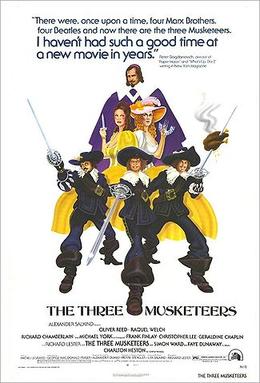
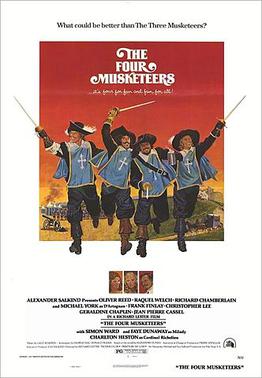
In 1973, director Richard Lester and producer Ilya Salkind decided to try to get two for the price of one.
Working with a script written by novelist George McDonald Fraser, Lester and Salkind had assembled a once-in-a-lifetime cast to star in an epic film adaptation of Alexandre Dumas’s The Three Musketeers. Michael York was cast as d’Artagnan, the youthful swordman who goes from being a country bumpkin to becoming a King’s Musketeer. His fellow musketeers were played by Oliver Reed, Richard Chamberlain, and Frank Finlay. Faye Dunaway and Christopher Lee were cast as the villains, Milady and Rochefort. Charlton Heston played the oily Cardinal Richelieu. Geraldine Chaplin played Queen Anne while Simon Ward played the Duke of Buckingham. Comedic relief was supplied by Roy Kinnear as d’Artagnan’s manservant and Raquel Welch as Constance, d’Artagnan’s klutzy love interest. The film was a expensive, lushly designed epic that mixed Lester’s love of physical comedy with the international intrigue and the adventure of Dumas’s source material.
The only problem is that the completed film was too long. At least, that’s what Salkind and Lester claimed when they announced that they would be splitting their epic into two films. The cast and the crew, who had only been paid for one film, were outraged and the subsequent lawsuits led to the SAG ruling that all future actors’ contracts would include what was known as the Salkind clause, which stipulates that a a single production cannot be split into two or more films without prior contractual agreement.
But what about the films themselves? Both The Three Musketeers and The Four Musketeers are currently available on Tubi. I watched them over the weekend and, of the many films that have been made out of Dumas’s Musketeer stories, Richard Lester’s films are the best. Lester captures the swashbuckling spirit of the books while also turning them into two films that are easily identifiable as Lester’s work. There’s a lot physical humor to be found in Lester’s adaptation, especially during the first installment. d’Artagnan runs through the streets of Paris, convinced that he has been insulted by the haughty Rochefort. d’Artagnan manages to get challenged to three separate duels, all to take place on the same day. After his first swordfight as a member of the Musketeers, d’Artagnan tries to tell the men that he wounded about an ointment that will help them with their pain. Raquel Welch also shows a genuine flair for comedy as Constance, which makes her fate in the second film all the more tragic.
For all the controversy that it caused, splitting the story into two films was actually the right decision. If The Three Musketeers is an enjoyable adventure film, The Four Musketeers is far more serious. In The Four Musketeers, Oliver Reed’s melancholic Athos steps into the spotlight and his story of his previous marriage to the villainous Milady casts his character in an entirely new light. In The Four Musketeers, the combat is much more brutal and the humor considerably darker. Likable characters die. The Musketeers themselves commit an act of extrajudicial brutality that, while true to Dumas’s novel, would probably be altered if the film were made today. From being a naive bumpkin in The Three Musketeers, The Four Musketeers finds d’Artgnan transformed into a battle weary soldier.
The cast is fabulous. This is a case of the all-star label living up to the hype. Oliver Reed, Frank Finlay, and Richard Chamberlain all seems as if they’ve been riding and fighting together for decades. Christopher Lee plays Rochefort as being an almost honorable villain while Faye Dunaway is a cunning and sexy Milady. What truly makes the film work, though, is the direction of Richard Lester. Lester stay true to the spirit of Dumas while also using the material to comment on the modern world, with the constant threat of war and civil uprising mirroring the era in which the films were made. Interestingly enough, Richard Lester first became interested in the material when Ilya Salkind reached out to the Beatles to try to convince them to play the Musketeers. While the Beatles were ultimately more interested in a never-produced adaptation of The Lord of the Rings, Richard Lester was happy to bring Dumas’s characters to life.
Both The Three Musketeers and The Four Musketeers are currently on Tubi, for anyone looking for a truly great adventure epic.
59 years ago today, the first episode of Star Trek aired in America.
There’s been a lot of different StarTrek shows and crews over the decades. I have to admit that I’ve always preferred the Original Series, with Kirk sleeping with every alien he met, McCoy and Spock bickering about logic, and Scotty warning that the engines can’t take much more. The Next Generation was strong as well, especially in the later seasons. The subsequent series have been hit-and-miss for me.
I was born long after the Original Series went off the air so, like a lot of people, my real introduction to Star Trek came through watching the films. This weekend, I sat down and watched all fourteen of the Star Trek films in order, from The Motion Picture to Section 31. Here are my thoughts.
Star Trek: The Motion Picture (1979, directed by Robert Wise)
In the first Star Trek film, Voyager returns to Earth, now known as V’ger. James T. Kirk (William Shatner) returns to the Enterprise with his old crew and takes command from Decker (Stephen Collins). Spock (Leonard Nimoy) returns from Vulcan is not happy about it.
Directed by Robert Wise, the first Star Trek film feels out-of-place amongst the films that followed it. It’s long and slowly paced and it doesn’t have the sense of humor that runs through the best of the films featuring the original cast. The film favors Kirk and Spock, with the rest of the original cast being largely used as bit players. Even the costumes are different from the uniforms worn in the later films, making Star Trek: The Motion Picture feel like an entry from an alternate universe.
Despite mixed review, Star Trek: The Motion Picture made the most money of any of the pre-reboot films at the box office. Because the film itself was so expensive, it was still judged to be a box office disappointment. The Star Trek films would continue but in a new direction.
Star Trek II: The Wrath of Khan (1982, directed by Nicholas Meyer)
Featuring a character-driven script, exciting action, the best villain in the history of the franchise, and an ending that will bring tears to the eyes of the most cynical viewer, The Wrath of Khan is the film that set the standard for the Star Trek films that would follow.
Ricardo Montalban, recreating a character that he originally played in the television series, is a compelling villain as the vengeance-driven Khan. Montalban and William Shatner make for perfect rivals, two sides of the same coin. At the same time, the other members of the original cast all get their moments to shine, especially Walter Koenig as Chekhov. Kirstie Alley is the sexist Vulcan to ever appear in the franchise and even the revelation that Kirk has a son is handled effectively. Kirstie Alley, Bibi Besch, and Merritt Butrick all fit in with the original crew.
But the thing everyone remembers about The Wrath of Khan is the death of Spock. Even though the movie features plenty of hints that Spock will return (including his command of “Remember” to McCoy), it’s impossible not to get emotional when Spock sacrifices himself for the crew. “I have always been your friend.” To quote George Costanza, that was hell of a thing when Spock died. In that scene, Leonard Nimoy shows that he was the (logical) heart of the franchise. Just as Spock brought out the best in the rest of the crew, Nimoy brought out the best in his co-stars. Shatner was never better than when he was mourning Spock.
Star Trek III: The Search For Spock (1984, directed by Leonard Nimoy)
Spock’s back! It’s not a surprise. I think everyone knew, at the end of Wrath of Khan, that the Genesis Project would bring back Spock. Star Trek III isn’t bad. Christopher Lloyd reminds us of how brutal the Klingons were before their Next Generation makeover. The self-destruction of the Enterprise is a powerful moment. I just wish that a film about Spock being given a new life hadn’t featured so much death. Both the revelation that David Marcus tampered with the Genesis Project and his subsequent death feel like missteps. Robin Curtis takes over the role of Saavik and Kirstie Alley is very much missed. DeForest Kelley playing McCoy possessed by Spock was, for me, the highlight of the film.
Star Trek IV: The Voyage Home (1986, directed by Leonard Nimoy)
Returning home after rescuing Spock from the Genesis Planet, the Enterprise crew is instead sent back into the past so that they can bring two whales into the future. The Voyage Home might not be the best Star Trek film (that honor belongs to Wrath of Khan) but it is the most likable and the most entertaining. Every member of the cast gets something to do in 20th Century San Francisco. The film is full of classic moments, from Chekhov looking for the “nuclear wessels” to Scotty trying to speak to the computer. The moment with the punk on the bus is a crowd-pleaser. I always laugh at Spock’s “One damn minute, Admiral.” After the violence in The Search for Spock, The Voyage Home‘s humor, gentle sincerity, and emphasis on the efforts of the entire ensemble is a welcome development.
Star Trek V: The Final Frontier (1989, directed by William Shatner)
Leonard Nimoy got his chance to shine as the director of the previous two Star Trek films so William Shatner was allowed to direct The Final Frontier. The Enterprise crew is brainwashed by a religious fanatic (Laurence Luckinbill) who is also, improbably, Spock’s brother. Only Kirk is able to resist and confront the entity claiming to be God. “What does God need with a starship!?” Kirk demands. It’s such an obvious question that I can’t believe the entity didn’t already have an answer worked out.
The Final Frontier gets no respect and it was probably doomed as soon as Shatner was announced as director. Shatner also developed the story and it’s probably not surprising that the main theme is that Kirk was the only person on the Enterprise strong enough to not be brainwashed by the film’s fake God. Laurence Luckinbill gave a good performance as Sybok but this film really does feel like an unfortunate episode of the original television series.
Star Trek VI: The Undiscovered Country (1991, directed by Nicholas Meyer)
Star Trek VI featured the final appearance of the Original Series cast as a group and they get a send-off worthy of their legacy. Having been previously established as the Federation’s greatest enemies, the Klingons finally pursue peace. Just as only Nixon could go to China, only Kirk and the original Enterprise crew can go to the Klingons. This movie is what Star Trek was all about, with enough world-building and continuity for the hardcore fans and a story that was interesting enough to hold the attention of the casual viewers. By featuring the start of the era of peace between the Federation and the Klingons, this film also filled in some of the Next Generation‘s backstory. The Final Frontier was meant to be the final Star Trek film featuring any of the original cast and it would have been the perfect entry for Captain Kirk to go out on. Unfortunately, that didn’t happen.
Star Trek Generations (1994, directed by David Cason)
William Shatner meets Patrick Stewart as one Star Trek crew passes the torch to the new Star Trek crew. Malcolm McDowell is the latest villain with an ill-defined plan. Picard and Kirk team up to stop McDowell’s villain. They succeed but at the cost of Kirk’s life. As opposed to Spock’s death in Wrath of Khan, Kirk’s death feels pointless and tacked on for no reason other than to signify the arrival of The Next Generation to the films. Seeing Shatner and Stewart together is interesting. Stewart may have been the better actor but Shatner still dominates their scenes together. Not giving Kirk a better send-off was one of the franchise’s biggest sins.
Star Trek: First Contact (1996, directed by Jonathan Frakes)
After the disappointing Generations, Picard and his crew finally got a film worthy of them with First Contact. Not only do the Borg return but the crew goes back into their past and experience a key date in the history of the Federation. After being outshone by Shatner in Generations, Patrick Stewart takes control in this film, giving a multi-layered and commanding performance that still gives the rest of the cast room to shine. Director Jonathan Frakes not only handles the action well but he also shows that he understands what makes the characters click. This was, without a doubt, the best of the Next Generation films and one the best of the Star Trek films overall.
Star Trek: Insurrection (1998, directed by Jonathan Frakes)
Entertaining but forgettable, Insurrection features Picard pulling a Kirk and defying orders from from a superior officer (played by Anthony Zerbe) and going out of his way to save Data from being decommissioned. Insurrection feels like an extended episodes of the Next Generation television series and lacks the epic scale of First Contact. Under the direction of Jonathan Frakes, the ensemble is strong and watching them interact feels like spending time with a group of old friends. F. Murray Abraham and Anthony Zerbe make for effective villains.
Star Trek: Nemesis (2002, directed by Stuart Baird)
Just as the Original Series crew sought peace with the Klingons in The Undiscovered Country, the final Next Generation film finds Picard, Riker, and the rest seeking peace with the Romulan Empire. Tom Hardy plays a clone of Picard who is now the leader of the Romulans. Data sacrifices himself in a move that tries too hard to duplicate the death of Spock. Picard retires. Director Stuart Baird emphasizes action over the chemistry of the Next Generation cast and the end result is a disappointing finale that left critics and audiences underwhelmed.
Star Trek (2009, directed by J.J. Abrams)
I think people forget about what a big deal this Star Trek reboot was when it first came out. Today, people focus on things like Kirk being a Beastie Boys fan and they forget how exciting it was to see Chris Pine, Zachary Quinto, Karl Urban, Simon Pegg, Anton Yelchin, John Cho, and Zoe Saldana all effortlessly stepping into the roles of the younger versions of the original cast. The storyline is predictable and Eric Bana’s a bland villain but the scenes between Leonard Nimoy and Zachary Quinto were a reminder of how important Spock was and is to Star Trek.
Star Trek wasn’t perfect, of course. In retrospect, I think creating an alternate timeline was a mistake because it created a situation where, even if someone died, it was just an alternate version dying and not the version that audiences knew and cared about. The alternate timeline would also lead to one of the biggest missteps in the history of the franchise.
Star Trek Into The Darkness (2013, directed by J.J. Abrams)
After the surprising success, both critically and commercially, of his Star Trek reboot, J.J. Abrams. Robert Orci, Alex Kurtzman, and Damon Lindelof wasted most of that good will by messing around with one of the franchise’s most memorable characters.
There are some good things to be said about Star Trek Into The Darkness. I like the action sequences and the climatic battle in the film’s futuristic version of San Francisco. But casting Benedict Cumberbatch, of all people, as Khan is a misstep that can’t be overcome. That the movie brought back Khan instead of exploring “strange new worlds” exposed the weakness of Abrams entire reboot. For all the hype, did the Star Trek reboot actually have anything new or original to offer? The answer here seemed to be no.
Star Trek Beyond (2016, directed by Justin Linn)
The final (for now) Star Trek theatrical film featured a memorable villain in the form of Idris Elba and a plot that felt like it could have just as easily been an episode of the original series. In retrospect, the film is mostly memorable for featuring the announcement of the death of Ambassador Spock. (The film was released a year after the death of Leonard Nimoy.) The death of Spock, this time with no Genesis Project around to bring him back, makes this installment feel like right place to end the films. For many of us, Nimoy was Star Trek.
Stark Trek: Section 31 (2025, directed by Olatunde Osunsanmi)
Though there have been many subsequent televisions shows, there hasn’t been a Star Trek theatrical release since 2016. The next installment has been in pre-production limbo for nearly ten years. (Quentin Tarantino was supposedly attached at one time.) Instead of coming to theaters, the latest Star Trek movie came to Paramount Plus.
I debated whether or not to include Section 31 in this list, both because it was a “made-for-TV” movie and also because it was so bad that I think most Star Trek fans would rather forget about it. A mediocre heist film that wastes star Michelle Yeoh and which doesn’t feel like it belongs in the Star Trek universe, Section31 may still represent the way forward for the franchise. With theaters having never recovered from the COVID shut-downs and more and more people preferring to stream their entertainment at home, the future of the Star Trek films could very well be a collection of assembly line Paramount Plus movies.
Finally, Case turned me onto this short film:
765874: Unification (2024, directed by Carlos Baena)
A collaboration between Otoy, a VFX company, and The Roddenberry Archive, with support from Paramount, 765874: Unification is a 10-minute short film that imagines Kirk meeting Spock in the afterlife. Shatner returns as Kirk, de-aged with CGI. Just as Kirk and Spock were friends in the film, the same was true of Shatner and Nimoy in real life. (You only have to compare Nimoy’s comments about Shatner with George Takei’s endlessly bitter takes to see what true class actually is.) This short film gives both characters the finale that they deserved.
It’s possible that we may never see another true Star Trek film. Most of the original cast is gone now. Patrick Stewart will always be Picard but even he is now approaching 90. But whatever the future may hold, I’m happy for the films that Star Trek gave us.
My wife and I spent some time with our kids this weekend. Both of them mentioned to us at different times this new documentary they had watched on Netflix called UNKNOWN NUMBER: THE HIGH SCHOOL CATFISH, from director Skye Borgman. It had blown them both away, so we decided to watch it when we got home, and it’s a doozy.
Here’s a brief summary of the events covered… in the small community of Beal City, Michigan, teenage sweethearts Lauryn Licari and Owen McKenny, both around 13 years old, begin receiving disturbing text messages from an unknown number in October 2020. The initial messages say things like Owen is breaking up with Lauryn because he doesn’t like her anymore and wants to be with the person sending the messages instead. The messages pause for a few months, but when they resume in 2021 they get way worse, spamming the kids with up to 50 messages a day over the next year or so. These texts say awful stuff: insulting Lauren’s body, describing sexual acts the sender wants to do to Owen, telling Lauryn to just kill herself, etc. The person sending the texts uses details that only someone close could know. Owen and Lauren finally tell their parents, who go to the school’s administration and from there, local sheriff Mike Main. As you can imagine, the parents’ suspicions begin falling on some of the local teenage girls, especially an excellent young athlete and popular girl named Khloe Wilson. When the sheriff’s investigation comes up empty, the case is escalated to the FBI’s cybercrimes task force and agent Bradley Peter, who is able then to apply advanced forensics techniques. The case finally begins coming to a head when agent Peter is able to link key IP addresses to one specific phone number, a number that matches a person in the community. I won’t go any further so you can discover the rest for yourself if you haven’t watched it yet.
This is one of those documentaries that may stay with me for awhile. As a father whose kids are now past the ages of the kids who were viciously harassed, I’m mostly left wondering how I would have handled a situation like this if it was happening to one of them. Here are a few thoughts I had while watching the film. First, I’ve watched my beautiful daughter struggle with issues of body image, especially in high school, and she still struggles with it today. I know firsthand the physical and emotional dangers involved with these types of issues. If someone was anonymously attacking her, I would probably explode, and I honestly don’t know what I would have done. It makes me sick just thinking about it. Second, the inadequacy of local law enforcement in many rural communities for solving crimes and punishing criminals is glaringly on display. I’ve always lived in small, rural communities, and I’ve been a victim of crimes on two separate occasions, a hit and run in 1998, and identity theft in 2005. Both times, I solved the crimes myself and passed the info on to the police. As far as I know, even though I filed the proper reports as well as the proof for the crimes, nothing ever happened to the perpetrators. In this specific case, to his credit, the sheriff did finally escalate the situation up to the FBI, but for many months, the kids had to deal with the harassment, the community had suspicions against innocent people running wild, and the parents were at their wits end. If the sheriff had not escalated the situation, this case would probably never have been solved. Finally, I’m amazed by the shit that is going on underneath the surface of the “normal people” all around us each day. I probably shouldn’t be, because my life has had its own share of drama that all but the closest people to me knew nothing about. David Lynch even plays with this theme in his weird and excellent BLUE VELVET. My wife likes to remind me that we should always be kind to people because we never know what they’re dealing with. There’s a lot of truth to that. I periodically remind her not to honk at people who cut her off in traffic because you never know who’s behind that other wheel either. At the end of the day, the craziest stories usually emerge from communities and people that we can all relate to. A place like Beal City is a lot like the places I grew up.
Overall, if you enjoy real life documentaries that explore the crazy acts that normal people are capable of, you will probably like UNKNOWN NUMBER: THE HIGH SCHOOL CATFISH. It will definitely reinforce your ongoing inability to fully trust your family, friends and neighbors!
Last night, while my sister and my boyfriend were watching the Cowboys lose to the Eagles, I took refuge from it all by watching Big Brother (Go Ava!) and then an episode of the Dark Side of Comedy. The Dark Side of Comedy episode was about Dustin Diamond, the actor who will forever be known for playing Screech Powers on Saved By The Bell.
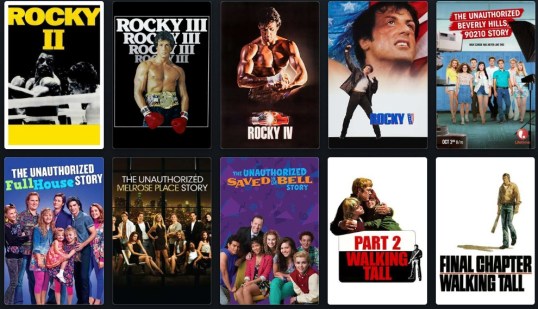
Watching the episode on Diamond reminded me of the fact that, in 2015, Lifetime turned his terrible, lie-filled memoir into a made-for-TV movie. They didn’t actually credit Behind the Bell as being the source material for 2014’s the Unauthorized Saved By The Bell Story but it was pretty clear that it was. That said, The Unauthorized Saved By The Bell Story was entertainingly daft. The actor who played Dustin Diamond bore a surprising resemblance to him. The rest of the cast was not quite as well-selected. Still, if you like cheesy and over-the-top behind-the-scene docudramas about mediocre TV shows, The Unauthorized Saved By The Bell Story is the gold standard. It can be viewed on Prime.
The Unauthorized Saved By The Bell Story was such a hit that, in 2015, Lifetime gave us The Unauthorized Beverly Hills 90210 Story, which featured a nice nod to continuity by casting the same actress as Tiffani-Amber Thiessen who played the role in the Saved By The Bell film. Thanks to the Vanessa Parise’s direction, The 90210 film was surprisingly good and it also featured an excellent performance from Degrassi’s Samantha Munro as Shannen Doherty. The film portrays Doherty as being a bit of a diva but it also makes a compelling argument that Doherty, as a veteran of the industry, understood that, in Hollywood, you could either fight for respect or you could be a victim. It can be viewed on Prime.
Lifetime followed up their 90210 film with The Unauthorized Melrose Place Story, which was a bit of a disappointment when compared to the other two films. (The main theme seems to be that everyone got along.) It’s a film that I recommend only because I’m a completist. It can be viewed on Prime.
Usually, I only recommend films that are streaming for free but, since we’re talking about the Lifetime Unauthorized series, I will mention that 2015’s The Unauthorized Full House Story is available for rent on Prime. Unfortunately, most of the really interesting stories involving the cast of Full House (like Aunt Becky going to prison for a nothing crime) occurred after this film aired. The most interesting thing about this film is how little any of the actors resemble their real-life counterparts. Still, if you’re a completist and you don’t mind paying for it, it’s on Prime.
While I was rummaging around on Prime, I discovered that From Justin To Kelly (2003)is currently streaming! I can’t help it. As bad as this film is, I just love it. Some of it is because Kelly and I are both from Texas. (From what I understand, Kelly doesn’t like this movie. While it is clear that neither she nor Justin Guarini were trained actors, they were both very liable.) Some of it is because it’s just so unbelievably bad that it becomes oddly charming. Justin and Kelly are cute together, even though they have zero romantic chemistry. Apparently, American Idol was envisioned as including an annual film as well but they abandoned that idea after the commercial failure of From Justin To Kelly. We were robbed of a Taylor Hicks/Katharine McPhee romantic comedy! From Justin To Kelly is on Prime.
Remember Buford Pusser?
Two weeks ago, the Tennessee Bureau of Investigation held a press conference about the legendary Sheriff Buford Pusser, whose life and death in the early 70s inspired the Walking Tall films. A huge part of Pusser’s legend is that his wife was killed by the Dixie Mafia. The TBI, however, is now of the opinion that Pusser murdered his wife, shot himself, and then made up a story about having been ambushed …. which, when you think about it, actually makes a lot more sense than anything portrayed in the Walking Tall films.
That said, the saying goes that you should always print the legend. The original 1974 Walking Tall, starring Joe Don Baker, is streaming for free on one location. Unfortunately, it’s a pretty suspect site and I’m not really comfortable linking to it. However, the sequels — 1975’s Walking Tall Part 2 and 1977’s Walking Tall: Final Chapter — are both on YouTube. Part 2 actually opens with Buford getting plastic surgery that makes him look like Bo Svenson. (I don’t care how much plastic surgery someone gets, there’s no way someone could go from looking like Joe Don Baker to looking like Bo Svenson). Part 2 features Buford going after the Dixie Mafia. The Final Chapter is more of a family drama, with Buford losing reelection but discovering that Hollywood wants to make a movie about his life. Part 2 and Final Chapter are both on YouTube.
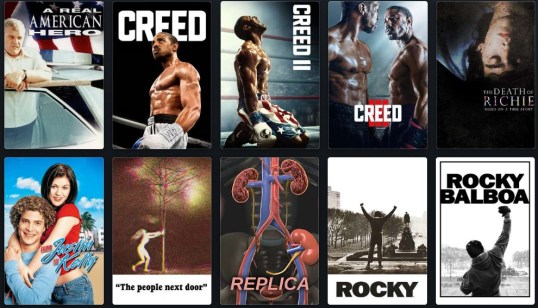
Finally, 1978’s A Real American Herois a made-for-TV movie that features Brian Dennehy as Buford Pusser. Needless to say, it’s not easy to watch Brian Dennehy play a redneck sheriff without immediately assuming that he’s going to arrest John Rambo for wanting to get a cup of coffee. A Real American Hero is on a lot of sites, including YouTube.
For instance, I still occasionally roll my eyes at the first Rocky (1976) but I’ve come to appreciate Talia Shire’s performance as Adrian and Burt Young’s performance as Paulie. The raw sincerity of Stallone’s performance eventually won me over (even if I do think Stallone was better in First Blood) and I actually now better appreciate the fact that Rocky lost the big fight but was still a winner. Rocky II (1979) is a bit too slow for me. One got the feeling that Stallone was trying too hard as both an actor and a director with this one. But, on the plus side, at least Carl Weathers got his own redemption arc as Apollo.
Rocky III (1982) is where things really start to work for me. With Rocky III, Stallone fully embraces the melodrama, stops worrying about the Academy, and he truly gives us a wonderfully over-the-top film that one can’t help but enjoy. Mr. T’s Clubber Lang is a great villain. For fans of Burt Young, the film features Paulie at his slovenly best. And I dare anyone not to cheer as Rocky and Apollo jump up and down in the ocean. Rocky IV (1985) features Rocky defeating the Russians and delivering a heart-felt plea for world peace. Again, how can you not love that? Apollo Creed died to teach us all to appreciate our nation. Remember that during the 250th birthday celebrations next year.
Rocky V (1990) was supposed to be the final Rocky film and it featured Stallone giving a performance that was so bizarre that it simply has to be seen in all of its glory. Everyone realized that Rocky V really wasn’t the ending that the franchise deserved and, many years later, Stallone tried again with Rocky Balboa (2006), an undeniably touching film about a 70 year-old risking his life in a boxing ring. Somehow, Paulie outlived Adrian.
Finally, the first two Creed films are also available to stream on Prime. Creed (2015) featured perhaps Sylvester Stallone’s best performance as Rocky Balboa. Creed II (2018) allowed Rocky to forgive himself for Apollo’s death and, to its credit, also gave Drago a hint of redemption. Creed III (2023) does not feature Rocky, which I was actually kind of happy about, if just because it indicated that maybe Rocky had finally found some sort of life outside of the ring. Creed III does, however, feature excellent work from Michael B. Jordan and (yes, I’m going to say it) Johnathan Majors. Creed and Creed II are available to stream on Prime. Creed III, you’ll have to rent.
Odds and Ends
In The People Next Door (1970), Eli Wallach and Julie Harris play a suburban couple who discover that their kids have gotten involved with hippies and drugs! This is the type of over-the-top melodrama that I love. It can be viewed on Tubi.
If you really want to depress yourself, follow up The People Next Door with The Death of Richie (1977), a true story about a suburban father (Ben Gazzara) and his teenage son (Robby Benson). Benson gives a surprisingly good performance as the out-of-control Richie. Gazzara brings his trademark intensity to the role of the Dad. Don’t watch this movie unless you’re ready to cry. It can be viewed on a lot of streaming sites, including Tubi.
Finally, since James Nguyen’s celebrate a birthday earlier this week, I will just mention that his best film, Replica (2005) is currently available on YouTube. Some films defy description and that’s certainly the case here. Find it on YouTube.
After reading the memoir THE BOYS, from Ron Howard and Clint Howard, I’ve taken a renewed interest in their careers. While scanning Ron’s IMDB listing, I noticed that he directed a film in 2022 called THIRTEEN LIVES. Movies had such strange release patterns in the post-Covid years, and somehow this film had flown completely under my radar. Seeing that the movie was very highly rated and that it was based on what seemed like an incredible true story, I became very interested. So much so, that I started the two and a half hour movie after midnight!
THIRTEEN LIVES is based on a real life “flooded cave” rescue in Thailand in 2018 after 12 boys and their soccer coach become stranded deep inside a cave system when unexpectedly early monsoon rains hit the area. We watch as an international coalition of Thai Navy SEALS, British cave divers, including Rick Stanton (Viggo Mortensen) and John Volanthen (Colin Farrell), and other expert volunteers take part in an extremely urgent and dangerous mission to save the thirteen lives. When it appears that all hope may be lost, the men come up with a risky, experimental plan requiring the expertise of anesthetist and cave diver Harry Harris (Joel Edgerton). As scary as the plan is, everyone agrees it’s the only chance they have…
I mentioned earlier that one of the reasons that THIRTEEN LIVES piqued my interest is the fact that it’s based on a true story. The real world has been full of heartbreaking tragedy this year, and this story seemed like something I really needed to see. On a personal note, 2018 was one of the most difficult years in my life. I don’t remember hearing about this real life drama out of Thailand, so I honestly didn’t know what was going to happen. I’ll give Director Ron Howard a lot of credit for how effectively he captures the seemingly hopeless and terrifying situation over the 18 day period from the time the team was first trapped to the time that the rescue attempt reaches its conclusion. His deliberate pacing doesn’t rush the story, and we can’t help but become invested in the emotions being experienced by the families and the rescue teams. I also enjoyed watching people from all over the world working together and not caring who gets the credit. There was tension at times of course, but the focus was never about ego. It was always about their mission to save those who were trapped. This movie is about regular people who became real heroes. The film captures the psychological cost of that transition as not every person will survive the 18 day journey.
The incredible real-life story of THIRTEEN LIVES is complimented very well by an excellent cast. I’ve been a fan of Viggo Mortensen since he starred in the film THE INDIAN RUNNER in 1991, which happened to co-star my movie hero Charles Bronson. I’ve also been a fan of Colin Farrell since he emerged in what seemed like a concerted effort in the early 2000’s to make him a star. Both men bring their “A” games here in understated and powerful performances. Other actors that stood out to me include Joel Edgerton as the expert who holds the key to the rescue plan, Sahajek Boonthanakit as Governor Narongsak, the man who takes the ultimate responsibility for their mission, and Pattrakorn Tungsupakul, the distraught mother of one of the trapped boys. Howard assembled a great cast that brings the incredible story to life.
I mentioned earlier that I started watching THIRTEEN LIVES after midnight. For a 51 year old man, the fact that I watched the entire film at that time of the night, without falling asleep, says a lot about the way this extraordinary story pulled me in. I highly recommend this powerful film to any person who enjoys movies based on true stories.
The Black List is a survey of the unproduced screenplays that are considered the “most-liked” by various studio executive and producers. It comes out the second Friday of December and it’s always the top news story for at least half the weekend. After the weekend, everyone promptly forgets about it.
Now, I will admit that some good movies have been made from Black List scripts. The King’s Speech, Hell or High Water, Argo, Promising Young Woman: they all appeared on the Black List. But, to be honest, I’m far more interested in the amount of forgettable and downright bad movies that appeared on The Black List, some of them often listed near the top of list. Anonymous, The Bucket List, Cedar Rapids, The Beaver, Broken City, The Ides of March: they all appeared on the Black List too. Appearing on The Black List is no guarantee of quality.
That’s bring us to Borderline. The screenplay for Borderline appeared on the 2020 Black List and evidently that appeared paid off because the script was put into production with screenwriter Jimmy Warden making his directorial debut. (Undoubtedly, it probably helped that Warden’s wife, Samara Weaving, agreed to star in the film.) The film was released in March of this year and, if you’re so inclined, you can currently watch it on Peacock.
Borderline takes place in the early 90s. Weaving plays a vacuous pop star named Sofia. Ray Nicholson plays Paul Duerson, who is obsessed with Sofia and believes that he’s destined to marry her. When we first see Paul, he’s stabbing Sofia’s head of security, Bell (Eric Dane), and then dancing around Sofia’s house. At the time, Sofia is out. However, when Paul returns 6 months later, Sofia is home. Paul somehow has managed to gather some crazy associates who are willing to work with him. Penny (Alba Baptista) is just as unstable as Paul and I’m going to assume that her character was meant to be an homage to Sandra Bernhard’s character in The King of Comedy. (Indeed, the film seems to owe a lot to The King of Comedy.) Sofia and a Dennis Rodmanesque basketball player named Rhodes (Jimmie Falls) finds themselves trapped by Paul and his fantasy of marrying Sofia.
It’s easy to see why this screenplay would get the attention of the studio execs who voted on the Black List. It mixes comedy, drama, and horror in a way that is very trendy right now. It also features a lot of crazed monologuing on the part of Paul. Unfortunately, as a director, Jimmy Warden doesn’t seem to know how to manage his own script’s frequent shifts in tone and the film itself drags to such an extent that it could almost be mistaken for a Project Greenlight film. (Seriously, remember The Leisure Class?) Add to that, the film features some remarkably bad acting. There are undoubtedly worst performance out there than Alba Baptista’s but I doubt I’m going to see more annoying one for a while.
For this film really to work, Paul would have to be at least interesting in his insanity. It’s possible to make a character like Paul compelling but having Ray Nicholson do an imitation of Christian Slater imitating Ray’s father Jack is not the way to go. Ray Nicholson bears a passable resemblance to Jack and he throws himself into playing Paul as being a nutcase. What Ray Nicholson doesn’t have is Jack’s screen presence. Ironically, that means that Ray Nicholson probably gives a pretty realistic performance as the type of anonymous loser who would fantasize about marrying his favorite singer but who wants to spend 90 minutes watching one of those people?
In the end, Borderline is another mediocre Blacklist film.
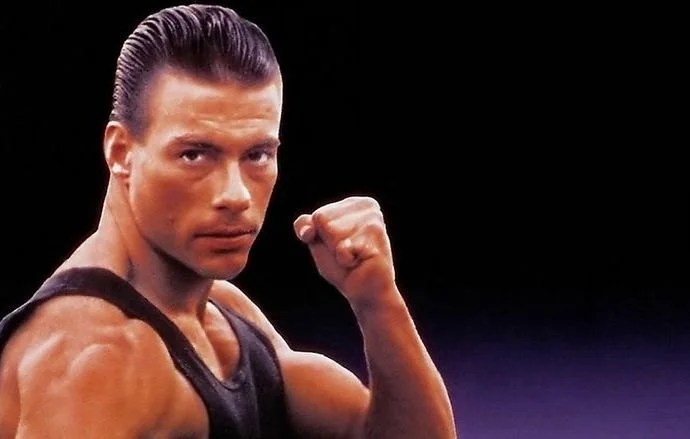
As a teenager of the late 80’s, I became a huge fan of Jean-Claude Van Damme when I watched movies like BLOODSPORT (1988), CYBORG (1989), KICKBOXER (1989), and DEATH WARRANT (1990). He really seemed to be going big-time with movies like UNIVERSAL SOLDIER (1992), HARD TARGET (1993) and especially TIMECOP (1994). Unfortunately, through a variety of problems, including a reportedly uncontrollable ego, a seemingly never ending supply of gratuitous butt shots for the ladies, and potential drug issues, his star would begin to wane in the mid-1990’s and he’d soon find his career heading the wrong direction. Through it all though, I’ve always loved Van Damme, and I still like to watch his movies (both new and old) to this day. One of the films that he made in his prime was LIONHEART (1990). I remember renting the movie as soon as it became available at our local video store, and even though I don’t hear it spoken of often these days, it’s always been one of my favorite films of the so-called “Muscles from Brussels!”
LIONHEART stars Van Damme as Lyon Gaultier, a French Foreign Legionnaire who deserts his post in North Africa after finding out that his drug addict brother, who lives in Los Angeles, has been set on fire and is barely clinging to life. Determined to help his brother’s family, Lyon goes AWOL and hops a boat to the United States of America. Unfortunately, Lyon finds himself stranded in New York with no money, until he stumbles across an underground street fight. With the connections of a hustler named Joshua (Harrison Page) and a sexy fight organizer named Cynthia (Deborah Rennard), Lyon’s talent in the ring allows him to make the money he needs to go to L.A. When he finally makes it to the west coast, his brother has passed away, leaving huge medical bills for his wife Helene (Lisa Pelikan) and young daughter, Nicole (Ashley Johnson). Continuing to fight in the underground market in L.A. to provide funds for his sister-in-law, Lyon takes on increasingly dangerous opponents, including the savage Attila (Abdel Qissi) in a high-stakes fight that could settle his family’s financial problems for good… if it doesn’t kill him.
I mentioned earlier that I’m a big fan of LIONHEART. With that said, I can certainly see some flaws in the film. The performances aren’t all great. For example, Deborah Rennard is somewhat ridiculous as the sexy, duplicitous Cynthia. Her character is as cliched as it gets, even if she does look good in her see-through stockings. It’s also too long. Clocking in at almost an hour and fifty minutes, the film is at least twenty minutes too long. There are definitely scenes that could have been trimmed down to make for a more efficient movie. Flaws acknowledged, I watched it again today, and I still love the movie. Directed by Sheldon Lettich (DOUBLE IMPACT), LIONHEART delivers the goods as a badass, fight film with a heart. The action sequences drew me in with Van Damme’s athletic spins and kicks, but it also reminded me of my favorite film of all time, HARD TIMES (1975) starring Charles Bronson. In HARD TIMES, Bronson takes out a cocky bastard with one punch to the face. In LIONHEART, Van Damme takes out a cocky bastard with one punch to the nuts. Both films deliver final showdowns against awesome opponents that deliver brutal and satisfying climaxes to the action. And both films go for real emotion. In HARD TIMES, those relationships are limited to the men in Bronson’s life, but in LIONHEART, Lyon’s relationships with his friend Joshua, as well as his love for his niece and widowed sister-in-law really set the film apart. Van Damme isn’t a great actor at this point in his career, but there’s just something really appealing about his unconditional love for his family. He won me over with his earnest performance, and I was all in when everything comes to a head at the end. It was also fun seeing producer Lawrence Bender (PULP FICTION, ANNA AND THE KING, KILL BILL) cameo in an early fight scene as a doofus with a pony tail who gets his ass handed to him by Van Damme. That’s just fun movie stuff.
Playing on Amazon Prime as I type, I easily recommend LIONHEART to any person who likes Van Damme or action films of the 80’s and 90’s. It may be as cheesy as hell, but in my opinion, it’s one of the star’s best films.






 Through the Shattered Lens