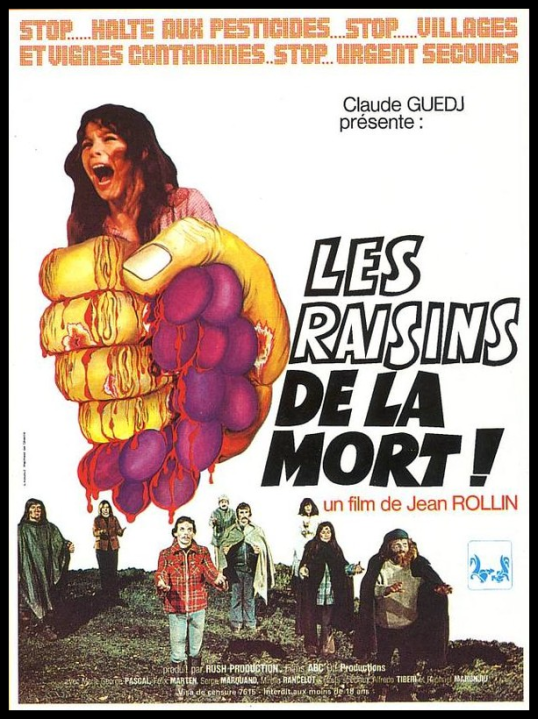
1978’s The Grapes of Death is a zombie film that moves at a relentless place, combining effective body horror with an ominous atmosphere that leaves you feeling as if anyone could be the next victim of the zombie horde.
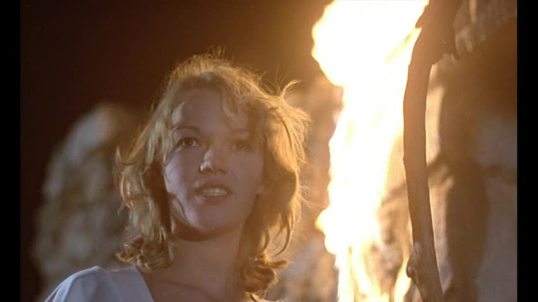
At a vineyard, a worker complains about the new pesticides that are being used and is told, by his smug manager, not to worry so much. Later, when that worker stumbles aboard a train, his face is pulsing with hideous ulcers. He kills one woman and chases another, Elizabeth (Marie-Georges Pascal), off the train. Elizabeth, who is just trying to visit her boyfriend in a nearby village, makes her way across the French countryside, meeting men and women who have been infected by something and who are now going mad. They may not technically be the undead but, with their nonstop pursuit and their obsession with killing everyone that they come across, they are definitely zombies.
The Grapes of Death is also one of the most French films ever made. In this film, the zombies are not the creation of a voodoo curse or outer space radiation or even there no longer being room in Hell. (In fact, it becomes fairly obvious that The Grapes of Death takes place in a world in which there is no Heaven or Hell.) Instead, this film features people who are transformed into zombies because they drank contaminated wine at an annual festival. When Elizabeth does eventually meet two men who have not been turned into zombies, they are both revealed to be beer drinkers. One could actually argue that, despite the film’s grim atmosphere and all of the violence committed and the blood shed and the philosophical discussions that occur, The Grapes of Death is ultimately a satire of French culture. Only in France could a bad crop of wine lead to the zombie apocalypse.
The Grapes of Death was one of the more commercially successful films to be directed by the great Jean Rollin. Rollin is best-known for his surreal and dream-like vampire films. In an interview, he stated that The Grapes of Death was his attempt to make a commercial horror film and that, when he was writing the script, he closely studied the structure of Night of the Living Dead. While the film does have its similarities to Romero’s classic zombie film, The Grapes of Death is still definitely the work of Jean Rollin. The lingering shots of the fog-shrouded French countryside and the ancient French villages, with blood staining the cobblestone streets, could have come from any of Rollin’s vampire films. The film also uses the same serial structure that Rollin used in many of his film, with Elizabeth going from one adventure to another and almost always managing to narrowly escape danger. Elizabeth goes from fleeing the infected man on the train to finding herself a near prisoner in an isolated house to protecting a blind girl (Mirella Rancelot) for her crazed boyfriend to being menaced by the mysterious Blonde Woman (played by frequent Rollin collaborator Brigitte Lahaie). There’s a new cliffhanger every fifteen minutes or so.
(Rollin said that he originally envisioned contaminated tobacco as being the cause of the zombie outbreak but he ultimately went with wine instead. Not everyone smokes but, in France, just about everyone drinks wine.)
First released as Les raisins de la mort, The Grapes of Death has been described as being “France’s first zombie film.” I don’t know if it was the first but it’s certainly one of the best, a relentless chase through the French countryside that ends on a proper note of downbeat horror. This film made me happy that I’m not a wine drinker.
The Shining is one of the few horror movies that still scares me.
I say this despite the fact that I’ve lost track of the number of times that I’ve watched Stanley Kubrick’s 1980 adaptation of Stephen King’s third novel. It’s a film that I watch nearly every October and it’s a film that I’ve pretty much memorized. Whenever I watch the film, I do so with the knowledge that Jack Torrance (Jack Nicholson), the caretaker of the Overlook Hotel, is eventually going to start talking to ghosts and he’s going to try to kill his wife Wendy (Shelley Duvall) and his son, Danny (Danny Lloyd). Whenever I watch this film, I know what Jack is going to find Room 237. I know about the blood pouring out the elevator like the Tampax commercial from Hell. I know what Danny means when he says, “Redrum….” I know about the twins and their request of “Come play with us, Danny.” And, of course, I know about the film’s famous ending.
Whenever I start watching this film, I know everything that is going to happen. And yet, as soon as I hear the booming beat of of Wendy Carlos’s theme music and I see the overhead shot of the mountain roads leading to the Overlook Hotel, I start to feel uneasy. Whenever Barry Nelson (played the hotel’s general manager) starts to blandly explain that a previous caretaker got cabin fever and chopped up his twin daughters, I smile because Nelson delivers the lines so casually. But I also get nervous because I know Charles (or is it Delbert) Grady is going to show up later.
(Incidentally, Barry Nelson never gets enough credit for his brilliant cameo as the friendly but guarded hotel manager. In Stephen King’s original novel, the character was a stereotypically unsympathetic middle manager, a martinet who existed largely to be told off. In Kubrick’s film, the manager is one of the most fascinating of the supporting characters.)
I still get nervous when I see Wendy and Danny, sitting in their disturbingly sterile Colorado home while Jack interviews for the caretaker job. Wendy smokes and Danny talks about how his imaginary friend, Tony, doesn’t want to go to the hotel. With her unwashed her and her tentative voice, Shelley Duvall is a far cry from the book’s version of Wendy. However, Duvall’s Wendy is also a far more compelling character, an abused woman who finds her strength when her son is put in danger. Duvall is the perfect choice for Wendy because she seems like someone who you might see in the parking lot of your local grocery store, trying to load the bags in her car and keep an eye on her young child at the same time. She seems real and her reactions remind us of how we would probably react if we found ourselves in the same situation. Wendy makes the mistakes that we would all probably make but she refuses to surrender to her fear.
Why does The Shining remain so powerful and so frightening, even after repeated viewings? Most of the credit has to go to Stanley Kubrick. Stephen King has been very vocal about his dislike of the film, claiming that The Shining was more Kubrick’s version than his. King has a point. Film is a director’s medium and few directors were as brilliant as Stanley Kubrick. (Along with The Shining, Kubrick also directed Paths of Glory, 2001, Barry Lyndon, Dr, Strangelove, Spartacus, Lolita, The Killing, A Clockwork Orange, Eyes Wife Shut, and Full Metal Jacket. Stephen King directed Maximum Overdrive.) From the minute we see the tracking shots that wind their way through the desolate mountains and the empty hallways of the Overlook, we know that we’re watching a Kubrick film. Those tracking shots also put us in the same role as the spirits in the Overlook. We’re watching and following the characters, observing and reacting to their actions without being able to interact with them. King has complained that Kubrick’s version of The Shining offers up no hope. But, honestly, what kind of hope can one have after discovering that ghosts are real and they want to kill you? Once Jack Torrance finally accepts that drink from Joe Turkel’s Lloyd and meets Phillip Stone’s Grady, there is no more room for hope. King’s book ends with the Overlook destroyed and Jack Torrance perhaps redeeming himself in his last moments. Kubrick’s film suggests that Jack Torrance never cared enough about his family to be worthy of redemption and that the evil that infected the Overlook is never going to be destroyed. In the end, not even the kindly presence of Scatman Crothers in the role of Dick Halloran can bring any real hope to the Overlook.
The Shining is unsettling because, more than being a ghost story, it’s a film about being tapped. Physically, the Torrances are trapped by the blizzard. Mentally, Jack is trapped by his addictions and his resentments. One gets the feeling that he’s deeply jealous of Danny, viewing him as someone who came along and took away all of Wendy’s attention. Wendy is trapped in a bad and abusive marriage and there’s something very poignant about the way Duvall both captures Wendy’s yearning for outside contact (like when she uses the radio to communicate with the local rangers station) and her hope that, if she’s just supportive enough, Jack will get his life together. Danny’s trapped by his psychic visions and his knowledge of what’s to come. The victims of the Overlook appear to be trapped as well. Grady’s daughters are fated to always roam the hallways, looking for someone to play with them. The Woman in 237 will always wait in her bathtub. Were these spirits evil before they died or were the twisted by the Overlook? It’s an unanswered question that sticks with you.
As I mentioned earlier, Stephen King has been very vocal about his dislike of both The Shining and its director. (King once boasted about outliving Kubrick, a comment that showed a definite lack of class on the part of America’s most commercially successful writer.) Why does King hate the Kubrick film with such a passion?
I have a theory. Both King’s second novel, Salem’s Lot, and The Shining feature a writer as the man character. In both cases, King obviously related to the main character. Ben Mears in Salem’s Lot is charming, confident, articulate, and successful. He’s a writer that everyone respects and he’s even well-known enough to have a file with the FBI. Jack Torrance, on the other hand, is a struggling writer who has a drinking problem, resents authority figures (like the hotel manager), and has issues with his father. Torrance is a much more interesting character than Ben Mears, precisely because Torrance is so flawed. (King, and I give him full credit for this, has been open about his own struggles with substance abuse and how he brought his own experiences to the character of Jack Torrance.) I’ve always suspected that, at the time that King wrote Salem’s Lot and The Shining, Ben Mears was King’s idealized version of himself while Jack Torrance, with all of his struggles and flaws, reflected how King actually felt about himself. (That the Wendy Torrance of the novel is a beautiful blonde who sticks with her husband despite his drinking problem feels like a bit of wish fulfillment on the part of King.) When Stanley Kubrick made his version of The Shining and presented Jack Torrance as essentially being a self-centered jerk who, even before arriving at the hotel, had a history of abusing his wife and son, it’s possible King took it a bit personally. Since King had poured so much of himself into Jack Torrance, it was probably difficult to see Kubrick present the character an abusive narcissist whose great novel turned out to be literally a joke. And so, Stephen King has spent the last 45 years talking about how much he hates Kubrick’s film.
King’s opinion aside, Kubrick’s The Shining is probably the most effective Stephen King adaptation ever made, precisely because Kubrick knew which parts of the book would work cinematically and which parts were best excised from the plot. As opposed to later directors who often seem intimidated by King’s fame, Kubrick was able to bring his own signature style to the story. Stanley Kubrick’s The Shining is a masterpiece and one that I look forward to revisiting this October.
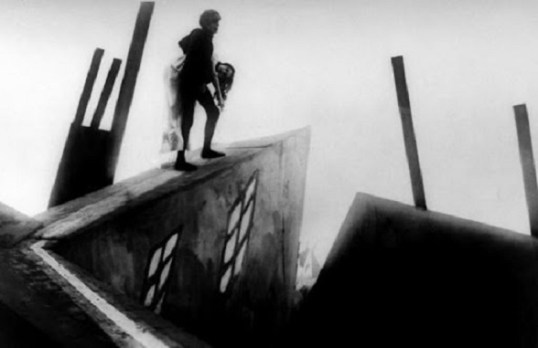
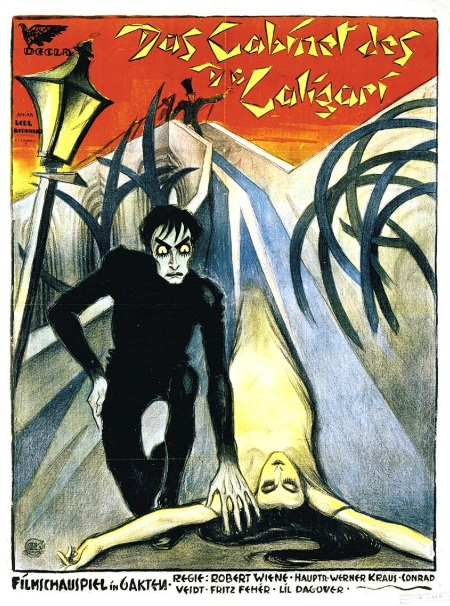
The Cabinet of Dr. Caligari (1920, dir by Robert Wiene, DP: Willy Hameister)
Sitting on a bench, a man named Franzis (Friedrich Feher) tells a story of how he and his fiancée Jane (Lil Dagover) suffered at the hands of Dr. Caligari (Werner Krauss), the owner of a traveling carnival who used an apparent sleepwalker named Cesare (Conrad Veidt) to commit murders for him. Franzis’s story takes place in an odd village, one that is full of crooked streets, ominous buildings, and dark shadows. It’s a bizarre story that gets even stranger as we start to suspect that Franzis himself is not quite who he claims to be.
Released in 1920, the silent German film The Cabinet of Dr. Caligari is one of those films that we’ve all heard about but far too few of us have actually seen. Like most silent films, it requires some patience and a willingness to adapt to the narrative convictions of an earlier time. However, for those of us who love horror cinema, The Cabinet of Dr. Caligari remains required viewing. Not only did it introduce the concept of the twist ending but it also helped to introduce German expressionism to the cinematic world. The film’s images of twisted roads and ominous structures that seem to be reaching out to capture the people walking past them would go on to influence a countless number of directors and other artists. The film captures not only the logic and intensity of a nightmare but the look of one as well.
It also captures something very true about human nature. Running through the story is a theme of authoritarianism. Before Caligari can bring his carnival to the show, he has to deal with a rude town clerk who seems to take a certain delight in making even the simplest of request difficult. Caligari keeps Cesare in a coffin-like box and only brings him out when he’s needed to do something. The sleepwalking Cesare does whatever he is ordered to do, without protest. Even the film’s twist ending leaves you wondering how much you can trust the people in charge. When the film was released, Germany was still struggling to recover from World War I, a war that was fought by people who had been trained not to question the orders of those who were sending them to die. Caligari, like a general, sends Cesare into danger and Cesare, being asleep, never questions a thing.
(Of course, thirteen years after The Cabinet of Dr. Caligari was released, Germany would once again embrace authoritarianism. Director Robert Wiene left Germany after the rise of Hitler and died in France in 1938. Co-writer Carl Mayer and star Conrad Veidt also fled Germany, with Veidt landing in Hollywood and playing the villainous Nazi in Casablanca. Meanwhile, Werner Krauss was reportedly a virulent anti-Semite who supported the Nazi Party and who became one of Joseph Goebbels’s favorite actors. Lil Dagover also remained in Germany and continued to make films. She was known to be Hitler’s favorite actress though Dagover always claimed that she didn’t share Hitler’s views.)
Needless to say, it takes some adjustment to watch a silent film. That’s certainly true in the case of a The Cabinet of Dr. Caligari, though the twisted sets and the bizarre story actually help the mind to make the adjustment. Dr. Caligari takes place in a world so strange that it actually seems appropriate that the dialogue is not heard but only read on title cards. (If I could imagine a soundtrack to The Cabinet of Dr. Caligari, it would probably involve a lot of industrial noise in the background, in the manner of David Lynch’s Eraserhead. Lynch, incidentally, is a filmmaker who was clearly influenced by Caligari.) For modern audiences, watching The Cabinet of Dr. Caligari also means accepting that there was a time when CGI was not a thing and films had to make due with practical effects. But Conard Veidt’s performance is all the more impressive when you realize that it was one that he performed without any of the filmmaking tricks that we now take for granted.
Ever since I first watched it on a dark and rainy night, The Cabinet of Dr. Caligari has stayed with me. The night after I watched it, I even had a nightmare in which Dr. Caligari was trying to break into my apartment. Yes, Dr. Caligari looked a little bit silly staring through my bedroom window but it still caused me to wake up with my heart about to explode out of my chest.
In short, The Cabinet of Dr. Caligari passes the most important test that a horror film can pass and one that most modern film fail. It sticks with you even after it’s over.
1945’s The Vampire’s Ghost takes place in the African port of Bakunda. It’s the colonial period and the port is full of not just adventurers and local plantation owners but also all sorts of disreputable people who are looking to disappear from civilization for a while. A series of murders have recently rocked the port. Victims, almost all of them women, have been discovered drained of blood. The natives claim that it is the work of vampire but the colonialists dismiss that as superstition. Plantation owner Thomas Vance (Emmett Vogan) says that there is no such things are vampires. Thomas’s daughter, Julie (Peggy Stewart), says that there is no such things as vampires. Julie’s boyfriend, Roy (Charles Gordon), says that there is no such thing as vampires. Mysterious casino owner Webb Fallon (John Abbott) says that …. well, actually, Webb’s thoughts on the subject are a bit less certain.
Webb Fallon is known to be an expert on the occult and voodoo. The natives consider him to be a vampire and it turns out that they’re right! After he is wounded in an assassination attempt, Fallon is forced to reveal the truth of his existence to Roy. He also puts Roy under his psychic command, forcing him to serve as Fallon’s servant while Fallon proceeds to kill several people. Can Father Gilchrest (Grant Withers) save Roy from Fallon’s control and also prevent Fallon from turning Julie into his eternal vampire bride? And why exactly did Thomas think it was a good idea to buy a plantation next to the infamous Temple of Death in the first place?
It may not sound like it from the plot description but The Vampire’s Ghost is actually a fairly interesting take on the traditional vampire story. The film was made by Republic Studios and, as was so often the case with Republic, the budget was noticeably low and the film’s African locations were obviously just sets on a Hollywood soundstage. The film was apparently shot in ten days, which was considered to be a long shoot by Republic standards. And yet, despite the low budget, director Lesley Selander does a good job of creating a properly eerie atmosphere, opening with a POV shot of the vampire stalking a native woman and filling the soundtrack with the sound of beating drums in the distance. The beautiful Adela Mara appears as a dancer in Abbott’s casino and her dance scene is definitely one of the film’s highlights, a sudden burst of energy that fills the screen with life. With his somewhat wan appearance, John Abbott may not immediately strike most viewers as the most intimidating of vampires but, as the film progresses, Abbott’s performance win us over. He plays Webb Fallon as being a calculating villain who suffers from just a touch of ennui. He’s grown weary of his existence but he’s still driven by his vampiric urges.
This film was an early credit for screenwriter Leigh Brackett. Apparently, Howard Hawks hired her to adapt The Big Sleep after seeing this film. Brackett would go on to work on the scripts for Rio Lobo, El Dorado, The Long Goodbye, and The Empire Strikes Back. And it all started with a vampire named Webb.
Hi there and welcome to October! This is our favorite time of the year here at the Shattered Lens because October is our annual horrorthon! For the past several years (seriously, we’ve been doing this for a while), we have celebrated every October by reviewing and showing some of our favorite horror movies, shows, books, and music. That’s a tradition that I’m looking forward to helping to continue this year!
Let’s get things started with 1982’s Mazes and Monsters!
Based on a best-seller by Rona Jaffe, Mazes and Monsters tell the story of some college students who enjoy playing a game called Mazes and Monsters. Now, I realize that Mazes and Monsters may sound a lot like Dungeons and Dragons but they are actually two separate games. One game takes place in a dungeon. The other takes place in maze, got it?
When the players decide to play the game in some nearby caves, it causes the newest member of the group (Tom Hanks — yes, Tom Hanks) to snap and become his character. Convinced that he’s living in a world full of monsters and wizard, Hanks runs away to New York. How does that go? During a moment of clarity, Hanks calls his friends and wails, “There’s blood on my knife!”
It’s all fairly silly. There was a moral panic going on about role playing games when this film was made and this film definitely leans into the panic. But, in its own over-the-top way, it works. If you’ve ever wanted to see Tom Hanks battle a big green lizard, this is the film for you. And I defy anyone not to tear up a little during the final scene!
From 1982, here is MazesandMonsters! Happy Horrorthon!
Happy Horrorthon! I’m writing this in July because I enjoy it, not this particular short- this short is garbage trash. It got 1.2 Million views and I’m certain at least 3 of those views were On Purpose! Mustafa Nohekhan should be featured on the Real Men of Genius ad campaign. Here’s to you Mr. Super Low-Budget Horror Film Maker [sung]. It’s hard to make a movie when all you have is your iPhone, Party City makeup, and some leftover jello for blood from your Sunday picnic, but you showed them- YOU SHOWED THEM ALL! Here’s to you – God of the bloody goop and unpaid crew. Mr. Super Low-Budget Horror Film Maker because when your critics said that this film couldn’t and shouldn’t be done. You responded, “I can do it!” They responded, “But why?”
This short does have a beginning, middle, and an end. The protagonist, an actress, says bloody mary in a mirror and is killed by “Mary” between takes. The acting is worthy of the finest 7th grade home movies. It has a we’ve got an iPhone let’s make a movie vibe. If you don’t want to take my word for it and wish to watch this piece of cinema- Here is the link:
I have Jeff to thank for introducing me to the British ska band Madness. The first Madness song that he played for me was Our House, which was the band’s biggest hit in America. I liked the song, so much that I found myself humming it incessantly after first listening to it. Perhaps to get to me hum something else, Jeff then sent me a playlist including Night Boat To Cairo, The Prince, One Step Beyond, It Must Have Been Love, Michael Caine, Driving In My Car, Grey Day, and a host of other songs. It was not only my introduction to Madness but also my introduction to two-tone ska in general. I was quickly hooked.
Here in America, Madness is often incorrectly described as being a one hit wonder. While it is true that Our House was Madness’s biggest hit in America, it’s also true that, ever since the late 70s, Madness had been hugely successful in their native UK, spending 214 weeks on the UK Singles Charts and essentially becoming a bit of a cultural institution. They’ve had 16 singles reach the UK top ten and, somewhat charmingly, the band that formed in 1976 is still largely together.
Ever since the Beatles made A Hard Day’s Night, it’s been almost a rule that almost any successful British band should make a movie. 1981’s Take It Or Leave It is the Madness movie. Admittedly, it’s not a film with a great reputation. The members of the band have themselves described the film as being a bit amateurish and, as I watched the film, I couldn’t help but notice that lead singer Suggs always seemed to be struggling not to look straight at the camera when delivering his lines. Watching the film, it was obvious that the members of Madness were better musicians than actors. It’s interesting to consider that one of the things that makes Madness such an amazing band is that every member comes across as being a star. Watching them perform in their music videos, you get the feeling that you’re watching a group of seven extroverts having the time of their lives. And yet, even though the film’s director also directed the majority of the band’s videos, the members of the band still seemed to be unsure how to play themselves in Take It Or Leave It. It wasn’t just Suggs looking at the camera. It was also the other members of the band, often looking down at the floor when they had to deliver their lines or speaking so softly that it was a struggle to actually hear what they were saying.
The film attempts to tell the story of Madness, from the early days of Chris Foreman, Lee Thompson, and Mike Barson playing in a living room to the full band heading out on their international tour. Along the way, there’s arguments about the band’s musical direction, frequent personnel changes, and Suggs becoming the lead singer, leaving, and then becoming the singer again. The drama is all very lowkey. It’s perhaps a bit too lowkey. A scene where one of the members of the band attacks a drummer seems to come out of nowhere because the members of the band all just come across as being too mellow and friendly to really attack anyone.
Here’s the thing, though. None of that mattered. The members of the band were all so likable that it really didn’t matter that they weren’t particularly good actors. The scenes of the band performing were full of so much energy and joy that it more than made up for the parts of the film that dragged. Watching the band perform One Step Beyond in a pub, it’s impossible not to get pulled into the excitement. Even the use of slow motion during a performance of Night Boat To Cairo works because it allows us to watch a group of young men who are obviously having the best night of their lives. It’s moments like those that make life worth it. It’s moments like those that make you love a band like Madness.
In the end, Take It Or Leave It is a film that will best be appreciated by people who already like the band. It may not work as a drama but, as a celebration of music and performance, it’s the nutsiest sound around.
I’m a huge fan of the 1984 film, THE KARATE KID. The stars aligned perfectly for my lifelong love affair. I was 10 or 11 years old, and my family had recently purchased our first VCR when the movie was released on VHS tape. I’ll never forget that first viewing. It was one of the most exhilarating films I had ever watched, and it’s fair to say that I literally wanted to be the karate kid. I was also smitten with Elizabeth Shue as the kid’s girlfriend, “Ali with an I!” I’m still infatuated with her to this day. I watched THE KARATE KID PART II (1986) and THE KARATE KID PART III (1989) at the movie theater, especially enjoying Part II, although I did miss the beautiful Ali. For a short, skinny guy from Toad Suck, Arkansas, the story of a skinny kid getting the best of the much stronger bullies was irresistible to me. The strong relationship between Daniel (Ralph Macchio) and Mr. Miyagi (Pat Morita) gives the stories so much heart, which makes the rousing finales even more emotionally satisfying. I didn’t care so much for THE NEXT KARATE KID (1994) where Hillary Swank stepped in as the kid. Even with the return of Mr. Miyagi, I wasn’t very interested in a movie that didn’t feature the character of Daniel LaRusso.
After being away for sixteen years, THE KARATE KID was given new life in 2010 when it was rebooted with Jackie Chan as the martial arts master and Jaden Smith as his bullied student. I wasn’t that interested in watching it due to the presence of Jaden Smith, but I ended up watching it because I love Jackie Chan. It didn’t make a lasting impact on me, but I must admit that I did end up enjoying the film. Then when the T.V. series COBRA KAI came out in 2018 with William Zabka and Ralph Macchio in the leads, I was immediately taken back to my teenage years, and I loved it all over again. I especially loved how the series brought back so many of the characters from the first three movies, including my beloved Ali! The series paid homage to the original 80’s films, which satisfied old farts like me, while introducing a bunch of new teenagers and drama that brought in a whole new audience. I was so happy the “karate kid” world was back in my life.
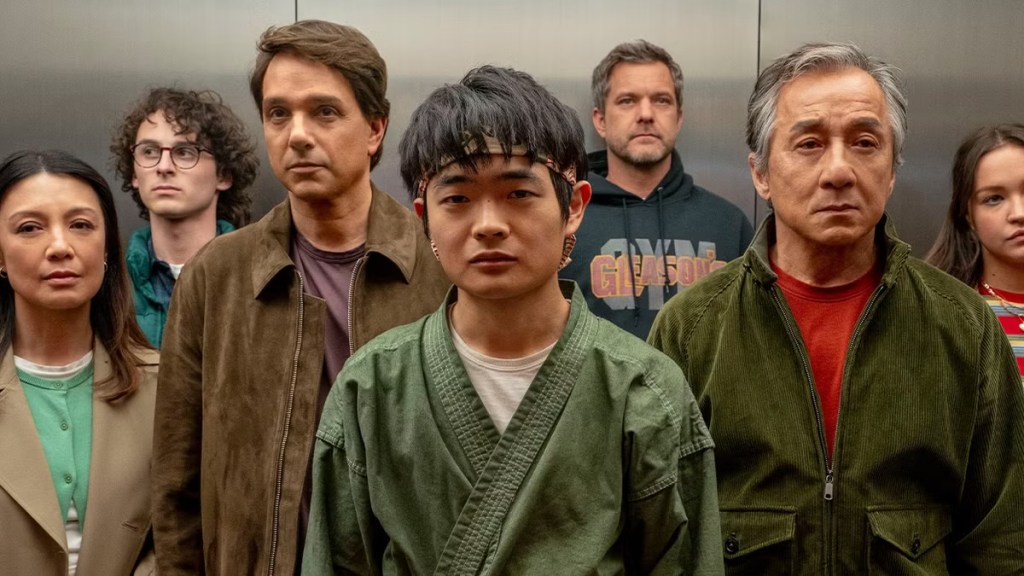
Which brings us to KARATE KID: LEGENDS (2025), a movie that blends the world of the original KARATE KID and COBRA KAI, with Mr. Miyagi and Daniel LaRusso, with the world created in the KARATE KID reboot starring Jackie Chan as Master Han. When I first saw the trailer for “Legends” that features LaRusso and Master Han working together to train the young Li Fong, I knew it was a movie I wanted to see. The plot is nothing new as kung fu prodigy Fong (Ben Wang), haunted by his brother’s tragic death, relocates from Beijing to New York City with his mom (Ming-Na Wen). Forbidden from fighting by his protective mother, Li meets and starts falling for his classmate Mia (Sadie Stanley). Unfortunately for Li, Mia’s ex-boyfriend turns out to be a badass karate bully named Conor (Aramis Knight), who proceeds to demonstrate his skills with fists to Fong’s face and kicks to Fong’s torso. With the contrived help of a wise-cracking Master Han and an emotionally earnest Sensei LaRusso, Fong enters the “5 Boroughs Fighting Tournament” to settle the score with Conor and prove that he’s all the man that Mia will ever need.
I liked KARATE KID: LEGENDS. The pure nostalgia of watching Daniel LaRusso show his love for Mr. Miyagi by sharing the master’s teachings with Li Fong is quite satisfying for me. Adding to that feel-good vibe is the opportunity to see Ralph Macchio and Jackie Chan working together on screen. The legendary Chan may be over 70 years old, but he’s still fun and energetic. And Ralph Macchio still seems to be defying the aging process. At 63 years of age when filming KARATE KID: LEGENDS, Macchio is twelve years older than Pat Morita was when he starred as Mr. Miyagi in the original 1984 film. That fact is amazing to me. And the familiar storyline of an underdog standing up to a bully is engaging no matter how many times we’ve seen it before. With fight choreography that’s both acrobatic and bone-crunching at times, as well as a running time of just over an hour and a half, director Jonathan Entwistle delivers a fast, easy-to-watch, and entertaining film. With that said, KARATE KID: LEGENDS does have some issues. Primarily, I wanted more Chan and Macchio. A lot of the film’s run-time focuses on Li Fong’s move to New York, his blossoming relationship with Mia (and her dad), his troubles at school and with the bully, as well as the tragedy of his brother. By the time Chan and Macchio start training him, a big part of the movie is over. Since they’re the main reason I wanted to watch the film, that was a little disappointing. Also, the relationship between Mr. Miyagi and Daniel-san is so important in the original films, but this movie misses that part completely between Li Fong and either of his teachers, Master Han or Sensei LaRusso. Without an emotional connection being created in this film, the overall impact is blunted for new viewers who aren’t bringing in 40 years of nostalgia with them.
Overall, I’m happy I spent an hour and a half of my life revisiting the world of THE KARATE KID. This film itself may not bring in a lot of new fans, but it offers tons of fan service to old timers like me.
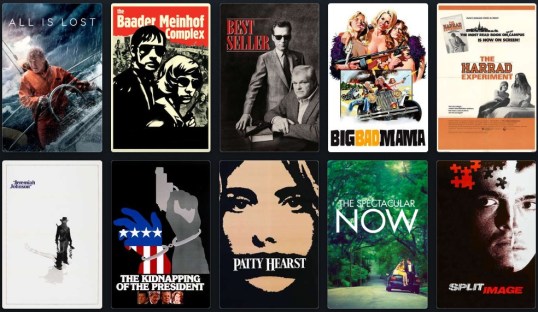
With the passing of Robert Redford last week, I want to start things off by recommending one of his last films, 2013’s All Is Lost. Redford gives a great performance as a nameless man trying to survive on a damaged boat. The film opens with a brief Redford voice over and then, towards the end of the film, Redford utters one other line. Even without dialogue, Redford dominates the screen and shows why he was one of great movie stars. All Is Lost is streaming on Tubi.
Also streaming on Tubi is 1972’s Jeremiah Johnson, starring Redford as a mountain man who is trying to escape from civilization. Jeremiah Johnson is today probably best-known for giving the world the nodding Redford meme but it’s also a strong film in its own right and it features Redford at his best. Jeremiah Johnson can be viewed here.
I was very happy to recently see that one of my favorite films, 1982’s Split Image, is now streaming on Tubi. Split Image is one of those films that I am always recommending to anyone who hasn’t seen it. Michael O’Keefe plays a college athlete who is brainwashed into joining a cult led by Peter Fonda. O’Keefe’s father (Brian Dennehy) hires a sleazy cult deprogammer (James Woods) to rescue his son. This is an intelligent and well-acted film. It was also shot in my part of the world. If you watch it, pay attention to the scene in which O’Keefe is abducted from a college campus. The scene was shot at Richland Community College. It’s a lovely campus that still looks the same in 2025 as it did in 1982. Split Image is on Tubi.
James Woods and Brian Dennehy also teamed up in 1987’s Best Seller, a smart thriller that was written by Larry Cohen and directed by Rolling Thunder’s John Flynn. Dennehy plays a cop-turned-writer. Woods plays the hitman who has decided that he wants Dennehy to write his life story. Best Seller can be viewed here.
2013’s The Spectacular Now is listed as “leaving soon” over on Tubi so now is as good a time as any for you to watch this well-written and surprisingly poignant coming-of-age story. Miles Teller and Shailene Woodley both give strong performance as teen lovers. Kyle Chandler steals the film as Teller’s alcoholic father. The Spectacular Now is streaming here.
In a world where politics is becoming increasingly violent, 2008’s The Baader Meinhof Complex feels as relevant as ever. This film takes a look at the group of middle and upper-class activists who decided to play at being revolutionaries and how their actions spiraled out of-control. This film is a powerful portrait of a group of people who some proclaimed to be heroes and who some (correctly) portrayed to be political LARPers. It can be viewed on Prime.
Follow up The Baader Meinhof Complex with 1988’s Patty Hearst, Paul Schrader’s film about the kidnapping and subsequent brainwashing of heiress Patty Hearst. The film’s first half is especially harrowing. By the end of the film, Patty has almost become a powerless bystander as she watches her own story unfold in front of her. Patty Hearst can be viewed on Tubi.
1974’s Big Bad Mama is a Roger Corman-produced Depression epic, in which Angie Dickinson and her daughters rob banks and shoot guns. This one is worth watching not just for Dickinson’s performance but also for the supporting turns of two very different actors, William Shater and Tom Skerritt. It can be viewed on Prime.
William Shatner is also present in The Kidnapping of the President (1980), a Canadian-made and -set film in which President Hal Holbrook is taken hostage while visiting Toronto. William Shatner is the Secret Service agent negotiating for the President’s release. Van Johnson is the Vice President and Ava Gardner is his wife. Maury Chaykin appears as one of the kidnappers. With a cast like that, you can be assured that there’s not a piece of unchewed scenery to be found in this slight but entertaining thriller. It is streaming on Tubi.
Finally, it doesn’t get more 70s than 1973’s The Harrad Experiment, in which a group of students enroll at Harrad College, a progressive school where everyone is encouraged to lose their clothes, hug trees, and have open relationships. James Whitmore and Tippi Hedren play the unlikely founders of the college. Don Johnson, Laurie Walters, and Bruno Kirby are students. Fred Willard has a brief cameo as himself. It’s not necessarily a good film but it’s such a product of its time that it’s interesting from a historical perspective. It’s streaming on Prime.
Many years ago in Southern Oregon, I had a conversation with friends about some of our favorite films growing up. Movies like The Goonies, The Dark Crystal, Watership Down and The Secret of Nimh were all on the list, as well as Disney’s Tron. In our excitement for all these movies, we ended up renting the films from a local video store to relive our childhood. While the nostalgia was nice, we all ended falling asleep halfway through Tron, despite our love for it.
I guess one’s enjoyment of Tron is based on how it’s viewed. I caught the film two years ago at the Museum of the Moving Image, in 70MM. The first thing that caught my attention was the film grain. I’ve grown so used to the clarity of digital film presented in 4K that I couldn’t help but catch the little flicks and “cigarette burns” in at the start. This was life before digital, and it was beautiful to revisit. In a theatre, the film’s 96 minutes blazed by for me. The early 1980s was basically made up of bike rides and video arcades. The little boedga on the corner of my block back home even had a few arcade machines in the front of the store in the first half of the 80s. The Bodega’s still there, the arcade’s now a deli/hot meal area. Times can and do change.
Tron is the story of Kevin Flynn (Jeff Bridges, Bad Times at the El Royale), a former employee at Encom, a major computing and videogame company. Encom’s made some wonderful strides in technology as of late, by 1980’s standards. Encom performs special matter tests in a specialized lab, while the programmers grind away code in their cubicles. All of their work is overseen by the Master Control Program, an operating system of sorts. Granted, the workforce at Encom isn’t too pleased about having the MCP monitor their applications. Alan Bradley (Bruce Boxleitner, Kuffs) and Lori Baines (Cindy Morgan, Caddyshack) also have programs and projects of their own that are being culled. Alan’s program, Tron (also played by Boxleitner) is of particular interest to the MCP, as it acts an a security threat that could bring some serious problems. Kevin tries to hack his way into Encom with the use of a program he created called Clu (also Bridges), but the MCP and the Senior Vice President of Encom, Ed Dillinger (David Warner, The Omen, Teenage Mutant Ninja Turtles II: The Secret of the Ooze) keep Flynn at bay. When Alan and Lori discover what Flynn’s up to, they confront him at his arcade, where he explains that he was the actual creator of Encom’s top games. He only needs the data as proof. This leads to the team breaking into Encom, where the MCP digitizes Flynn and brings him into the computer world. Can Flynn escape and help liberate the programs enslaved by the MCP and its henchman, Sark (both also played by Warner)? Can Flynn find the proof to exonerate him? And just who is this Tron fellow, anyway?
The plot for Tron inside the machine becomes a bit theological. The programs believe in the Users, and that they were each created for a particular purpose. From Ram (Dan Shor, Bill & Ted’s Excellent Adventure) being an Actuarial Program to Tron being a defense against the MCP, it’s kind of interesting once Flynn shows up. As a User, he doesn’t have much more power than a program, save that he can’t really be derezzed and that he can mimic the neon glow of anyone he touched. I always thought they could have given him something cooler to do, though for 1982, repurposing machines does have some benefits. The story slows down a bit in the middle, feeling like it’s somewhat unsure of itself, but picks up in the final act with Tron vs. Sark and the MVP. Though Flynn is important to the outcome, he’s more like Big Trouble in Little China’s Jack Burton, kind of just watching this happen around him. He does have his moments, though.
When I was little, my dad owned a Commodore 64 and a Floppy Disk Drive. He would regularly pick up magazines like Byte! to catch up on new innovations. In most of these magazines, they’d have a program that you could enter in at home to create various effects like making a balloon fly across your screen. Those programs were usually written over a number of pages with hundreds of lines of code. For Tron, there were 3 teams dedicated for the Visual Effects. According to the behind the scenes documentary on the disc, Information International Inc., known as Triple-I, was brought in to handle the major work along with Mathematic Applications Group Inc. (MAGI), who director Steven Lisberger worked for at one point early in his career. Digital Effects of New York handled some of the responsible for some of the original CGI work used in Michael Crichton’s Westworld (considered one of the first CGI movie uses ever) and it’s sequel, Futureworld. For the time, the effects were groundbreaking. Mind you, most of this was all before we ever hit the 8-bit era of Nintendo, the Commodore Amiga or even the high resolution arcade games of Sega’s heyday like Space Harrier, Outrun or Afterburner. In an actual arcade in 1982 had games like Q-Bert or Dig Dug with the kind of graphics you’d never see on home systems.
Kevin Flynn (Jeff Bridges) and others (including a young Michael Dudikoff to his right) watch Tron fight for the users. This would inspire Dudikoff to become an American Ninja.
The designs for the look and feel of the computer world came from Lisberger himself, with a bit of assistance from both futurist Syd Mead and legendary artist Jean “Mobius” Giraud. Both men were extremely popular. Mead was the equivalent of Apple’s former Chief Design Officer Jony Ive, having created the “V’ger” model for Star Trek:The Motion Picture. Ironically, Mead’s work (both on the set design and the flying cars) would be seen by audiences watching Ridley Scott’s Blade Runner just a month shy of Tron’s release. Having worked on Alien years prior, Giraud helped to design and inspire both the clothing and some of the vehicles, such as the weird cradle for Dumont (Bernard Hughes, The Lost Boys) and the Light Cycles.
A film dealing with computers needed a composer familiar with electronic music.It seemed fitting that Wendy Carlos(A Clockwork Orange, The Shining) took on the challenge. Having built a computer at 14, Carlos’ love for music over the years lead her (with Robert Moog) to help develop the Moog synthesizer system. The Moog would go on to be used by Kraftwerk, Giorgio Mororder, Nine Inch Nails, The Prodigy Daft Punk and even J Dilla, among others. The Tron Soundtrack was a mix of orchestra, choir and electronic music. Although the sound may not be as dark and digital as Daft Punk’s score for Tron: Legacy, I felt it worked for the time and moves well with the film. In addition to Carlos’ score, Journey wrote the song “Only Solutions” for the film, which also happens to be a line uttered by Kevin Flynn.
Overall, Tron is one of those movies I can happily rewatch without much in the way of expectation. I enjoy it for its place in Sci-Fi cinema, and the memories it awakens. I don’t think Disney ever fully recognized the full potential of where they could take the story, though the animated Tron: Uprising was a great part of the saga. I’m just hoping Tron: Ares doesn’t stray too far from the fold.








 Through the Shattered Lens