Horror Film Review: I Married A Monster From Outer Space (dir by Gene Fowler, Jr)


The 1958 film I Married A Monster From Outer Space tells the story of Marge (Gloria Talbott) and Bill Farrell (Tom Tryon).

Just one year ago, they seemed like the perfect couple.  They were newlyweds, looking forward to starting a family and living in a nice house in the suburbs.  Bill seemed like the perfect guy, warm, friendly, humorous, and loving.

However, things have changed.  On their one-year anniversary, Bill is cold and distant.  He certainly seems to have little interest in romance or anything like that.  When Marge gives Bill a new dog as his anniversary present, he doesn’t seem to be sure how to react to it.  When the dog later ends up dead, Bill gives her an implausible excuse.

Bill has changed but he’s not the only one.  Marge notices that all of her friend’s husbands are acting strange as well.  It’s as if something has magically turned every man into the neighborhood into a stiff, humorless jerk.

(Either that or it’s the 50s!)

One night, Marge decides to follow Bill into the forest and she sees something that challenges everything that she previously thought she knew about her husband.  What does she discover?  Well, it’s right there in the title.  Marge has married a monster from outer space!

I imagine that most people’s natural instinct with a film like this is to make fun of the title and just go on from there but actually, I Married A Monster From Outer Space is an intelligent and well-done sci-fi film.  Gloria Talbott does a great job in the lead role and Tom Tryon’s rather stiff screen presence is perfectly suited for the role of Alien-Bill.  Gene Fowler, Jr. directs the film as if it were a film noir where the usual gangsters and bank robbers have been replaced by humanoid aliens who don’t like dogs.

Since this movie is from 1958, there’s all sorts of subtext creeping around.  The most obvious, of course, is that America is being invaded from within.  You don’t think your husband could be an alien?  Well, Alger Hiss’s mother probably didn’t think her son was a communist spy!  You think it’s a silly idea that normal seeming humans would be working to conquer the world?  Have you not heard of Julius and Ethel Rosenberg?  When Bill and the other men turn cold and impersonal, it’s easy to see that they’ve embraced an ideology opposed to individual freedom and we all know what that means.

However, for me, this film works because it strikes at a very primal fear.  How well do you really know the people who you love?  Is he always going to be as perfect as he seems when you first start going out or is he going to totally change once he’s sure that you’re not going to leave him?  Like many women who have tried to escape from abusive boyfriends and spouses, Marge discovers that no one believes her.  She lives in a world controlled by men and all of the men have been taken over by the same thing that’s taken over Bill.  Even if you’ve never married a monster from outer space, you know what Marge is going through.

So, don’t dismiss this film because of the melodramatic title.  I Married A Monster From Outer Space is an intelligent sci-fi horror film, one that’s still relevant today.

Feeling the Burn: Death Spa (1989, directed by Michael Fischa)


Michael (William Bumiller) owns the hottest health club in Los Angeles but that may not stay true if he can’t do something about all the guests dying.  Members get baked alive in the sauna.  Another is killed when a malfunctioning workout machine pulls back his arms and causes a rib to burst out of one side of his body.  Shower tiles fly off the wall and panic a bunch of naked women.  A woman loses her arm in a blender and a man is somehow killed by a frozen fish.  Strangely, all of the deaths don’t seem to hurt business as people still keep coming to the gym.  Surely, there are other, safer health clubs in Los Angeles.
Michael suspects that his brother-in-law, David (Merritt Butrick), might be to blame for all of the trouble.  David is good with computers and since this movie is from 1989, that means that he can do anything.  (David is described as being a “hacker,” which may be the first time that overused term was used in a film.)  Michael feels that David has never forgiven him for the suicide of his sister.  Two useless cops show up to investigate the murders while the spa gets ready for Mardi Gras night.

This incredibly cheesy horror movie used to be a mainstay on HBO, where young viewers like me appreciated all of the gore and slightly older viewers appreciated all of the nudity.  Viewed today, Death Spa is a real nostalgia trip.  From the leg warmers to the bulky computers to the choreographed workout routines, this is a movie that could only have been made in the 80s.  The plot is beyond stupid but some of the gore effects were well-executed and that scene where the frozen fish comes to life continues to amaze.  Sadly, this was Merritt Butrick’s last film.  The actor, who was best known for playing Captain’s Kirk’s son in The Wrath of Khan and The Search for Spock, died the same year that Death Spa was released.

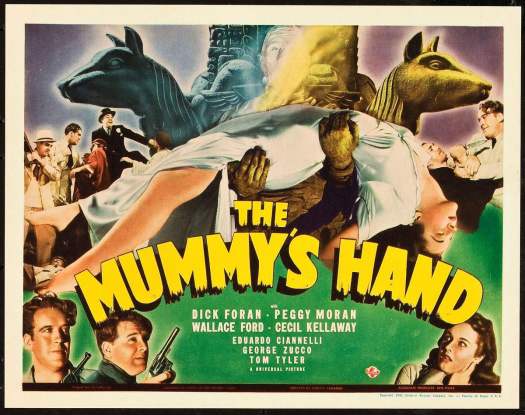
Halloween Havoc!: THE MUMMY’S HAND (Universal 1940)


gary loggins's avatarcracked rear viewer

Universal revived The Mummy in 1940’s THE MUMMY’S HAND, but except for the backstory (and judicious use of stock footage), there’s no relation to the 1932 Karloff classic . Instead of Imhotep we’re introduced to Kharis, the undead killing machine, as the High Priest of Karnak (Eduardo Cianelli in old age makeup) relates the tale of Princess Ananka, whose tomb is broken into by Kharis, who steals the sacred tanna leaves to try and bring her back to life. Kharis gets busted, and is condemned to be buried alive! For he “who shall defile the temple of the gods, a cruel and violent death shall be his fate, and never shall his soul find rest for all eternity. Such is the curse of Amon-Ra, king of all the gods”. So there!

The High Priest croaks, making Andoheb (George Zucco ) the new High Priest. Meanwhile in Cairo, Americans Steve…

View original post 591 more words

Horror on the Lens: Nosferatu (dir by F.W. Murnau)


Today’s Horror on the Lens is a classic film that really needs no introduction!  Released in 1922, the German silent film Nosferatu remains one of the greatest vampire films ever made.  It’s a film that we share every October and I’m happy to do so again this year!

Enjoy!

The TSL’s Horror Grindhouse: Eyes of a Stranger (dir by Ken Wiederhorn)


In this 1981 slasher film, bad things are happening in the city of Miami.

There’s a serial killer on the loose.  He’s chopping off heads and leaving bodies on the beach and basically just making a huge mess of things.  Local new anchorwoman Jane (Lauren Tewes) is upset that there’s a killer roaming the streets of her hometown.  She even talks about how upset she is during a local newscast, which takes everyone at the station by surprise.  I don’t know why they’re so shocked.  Don’t they know that Jane has a younger sister named Tracy (Jennifer Jason Leigh) and that Tracy’s been blind, deaf, and mute ever since she was attacked by a maniac?

One day, Jane is returning to the apartment that she shares with her sister.  As she’s parking her car, she sees her neighbor, Stanley (John DiSanti), stuffing what appears to be a bloody shirt in a trash can.  Oh my God, could he be the murderer!?

Well, yes, he is.  The film actually makes no attempt to hide the fact that Stanley is the murderer.  Stanley is one of those movie murderers who is either hyper competent or totally oblivious, depending on what the scene demands.  For instance, despite being a rather heavyset, middle-aged man, he can still sneak up behind people without them ever hearing and chop off their head with one wave of a meat cleaver.  On the other hand, when he kills a couple on the beach, his car ends up getting stuck in the sand.

Anyway, Jane is pretty much instantly convinced that Stanley is the killer and she immediately starts doing stuff like taunting him over the telephone.  (Despite the fact that she’s on TV every night and her voice is apparently heard by everyone in Miami, she makes no effort to disguise her voice whenever she calls Stanley.)  She also breaks into his apartment to look for clues.

As I watched this film, I found myself thinking about how much more interesting it would have been if Stanley hadn’t been the killer and if Jane felt so guilty about what happened to her sister that she ended up harassing a totally innocent bystander.  But no, Stanley is the murderer so naturally all of this leads to an extended sequence where Stanley breaks into and then follows Tracy around Jane’s apartment.

So, Eyes of a Stranger is a fairly mediocre film, one that would probably be totally forgotten if not for the fact that it’s also the debut film of Jennifer Jason Leigh.  While the film is obviously meant to showcase Lauren Tewes (a TV actress who gives a rather wooden performance), Jennifer Jason Leigh steals every scene in which she appears.  Her total commitment to her character shines through and she even manages to sell a rather implausible plot twist that occurs towards the end of the film.  John DiSanti also deserves some credit for his performance as Stanley.  Again, it’s hard not to feel that the film would have worked better if it had tried to keep us guessing as to the question of Stanley’s guilt.

Eyes of a Stranger was directed by Ken Wiederhorn, who also did the far superior zombie movie, Shock Waves.  It’s interesting to note that both Lauren Tewes and Jennifer Jason Leigh would subsequently appear in Twin Peaks: The Return, though Leigh’s role was significantly larger.


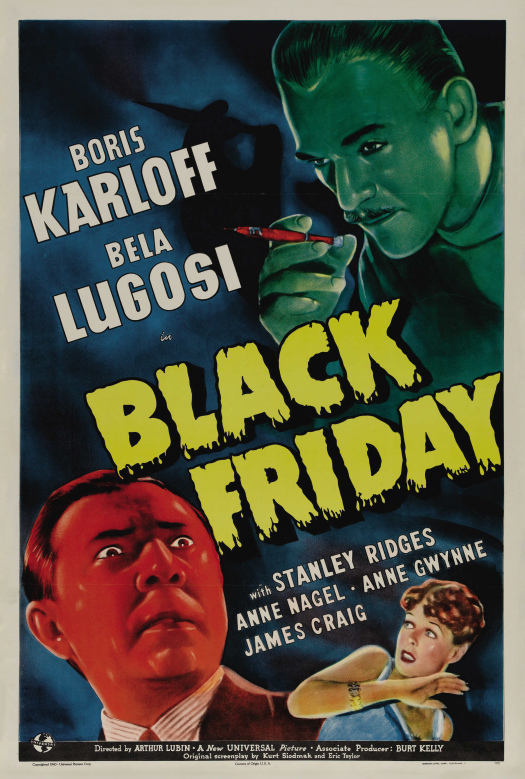
Halloween Havoc!: BLACK FRIDAY (Universal 1940)


gary loggins's avatarcracked rear viewer

The Twin Titans of Terror, Boris Karloff and Bela Lugosi, reteamed for their fifth film together in 1940’s BLACK FRIDAY. Horror fans must’ve been salivating at the chance to see the duo reunited after the success of the previous year’s SON OF FRANKENSTEIN, but left the theaters let down upon discovering Boris and Bela share no scenes together, and the bulk of the action is carried by character actor Stanley Ridges in a dual role.

The movie’s a variation on the old Jekyll & Hyde theme, with a twist: instead of a secret formula, the change occurs via brain transplantation! The preposterous premise finds Karloff on death row as Dr. Ernst Sovac, walking that last mile to his fate in the electric chair. Sovac hands his notes and records to a sympathetic newspaper reporter, and our film begins in earnest. Flashbacks relate the tale of kindly old English literature Professor…

View original post 415 more words

Griffith Gets Serious: Winter Kill (1974, directed by Jud Taylor)


Eagle Lake, a mountain resort town in California, has a problem.  It’s almost tourist season and there is a sniper stalking through the night, using his rifle to pick off citizens and painting messages like “The First” and “The Second” in the snow.  It’s up to police chief Sam McNeill (Andy Griffith) to figure out the killer’s motives and capture him before the vacation season begins!  To catch the killer, McNeill is going to have to investigate his friends and neighbors, all of whom have secrets that they don’t want to have revealed.

1974 was a busy year for Andy Griffith.  Best-known for playing the folksy and reassuring Sheriff Taylor for over ten years on The Andy Griffith Show, Griffith tried to change his image by appearing in three unexpectedly dark made-to-TV movies.  In Pray For The Wildcats and Savages, Griffith played the villain.  In Winter Kill, he’s back in a more familiar role.  He is once again playing a lawman, though this one carries a gun and doesn’t have time to sit on his porch and play the guitar while Aunt Bea makes dinner.  Instead, he’s getting pressure from all sides to capture a psycho sniper who, at the start of the movie, shoots an old woman after throwing pebbles at her bedroom window.  Eventually, the sniper even ends up kidnapping Chief McNeill’s girlfriend!  This never happened in Mayberry!

Winter Kill is a pretty good mystery.  It’s not strictly a horror film but the sight of the masked sniper, making his way through the night and coldy gunning down unsuspecting victims is scary enough that it might as well be.  Andy Griffith was surprisingly tough and gritty as Chief McNeill.  He might be a good guy in this movie but you still know better than to mess with him.  The rest of the cast is made up of television regulars but keep an eye out for a youngish Nick Notle playing a cocky ski instructor.

Winter Kill was actually meant to be a backdoor pilot for a show where Chief McNeill would battle crime on a weekly basis.  Though that didn’t happen, the concept was later retooled and became a short-lived series called Adams of Eagle Lake.

Italian Horror Showcase: Aenigma (dir by Lucio Fulci)


If there’s anything be learned from 1988’s Aenigma …. well, actually, that might be giving the film too much credit.  There’s probably nothing to learn from Aenigma.  The film does start with a pretty cruel prank and that prank leads to some snail-related mayhem but really, you should have already learned the truth about pranks after Carrie burned down the prom.

The prank involves the cruel girls at St. Mary’s boarding school tricking their classmate, Kathy (Milijana Zirojevic), into thinking that she’s on a date with a gym teacher (Riccardo Acerbi) and then jumping out of the shadows and surprising her when Kathy and the teacher start making out in his car.  This leads to a humiliated Kathy running out into the middle of traffic, where she’s promptly hit by a car and goes into a coma.  While everyone agrees that sucks for Kathy, at least it means that no one will ever know the truth about the prank.

Then people start dying.

They die in a variety of weird ways and since only the people involved with the prank are the ones being targeted, it doesn’t take much effort to guess that the comatose Kathy is probably involved.  It also doesn’t take much effort to guess that the newest student at the school, Eva (Lara Lamberti), has been possessed by Kathy and is mostly just hanging around to make sure that everyone’s dead.

What’s weird is that, in her coma, Kathy has so many different powers that you have to wonder why exactly she needed to possess Eva.  For instance, the gym teacher is strangled when his own reflection jumps out of a mirror.  One of the girls is killed when a statue in a museum suddenly comes to life and attacks her.  Yet another girl is somehow killed by snails.

Yes, you read that right.  She wakes up to discover that she’s covered in snails and this leads to her dying.  Aenigma is regularly criticized for the scene with snails.  “Why didn’t she just get out of bed and take a shower or something?” many a commentator has asked.  I guess they have a point but, honestly, if I woke up and there were a few hundred snails on me, I would totally freak out.

Apparently, the main reason that Eva’s there is so she can try to seduce Kathy’s handsome doctor (Jared Martin) but the doctor is more interested in Jenny Clark (Ulli Reinthaler), who was involved in the prank but who, unlike everyone else, felt really bad about it afterward.  I’m sure that would lead to any complications….

There’s kind of a sad story behind this rather forgettable if occasionally entertaining horror film.  After making horror history by directing films like Zombi 2 and The Beyond, director Lucio Fulci entered into a career decline.  Struggling with ill-health and having had a falling out with some of his former collaborators, Fulci found himself working with lower budgets and less interesting premises.  That’s certainly the case with Aenigma, which was shot in Sarajevo with a largely unknown cast and which blatantly ripped off the plots of Carrie and Patrick.

Aenigma has got a terrible reputation among fans of Italian horror.  Personally, I think it’s a very flawed film but I also think that it’s not quite as bad as some have made it out to be.  I mean, the snails are ludicrous but they’re also so weird that you can’t help but kind of love it when they show up.  For that matter, the coach being killed by his own reflection and the scene where the statue come to life are clever ideas, even if their execution leaves something to be desired.  Even in his later years, Fulci still had his talent.  Unfortunately, when it came to films like Aenigma, he rarely had the resources necessary to truly make his vision come to life.

Horror Film Review: Wishmaster (dir by Robert Kurtzman)


Remember the Wishmaster films?

There were four of them and they all deal with this ancient Djinn (Andrew Divoff) who, during each film, would escape from his magical prison and then wander around granting people their wishes.  Of course, since the Djinn was evil, there was always a catch.  He would either interpret the wish very literally or he would manipulate people into asking for the wish in the wrong way.  As a result, people would always get their wish but they’d get in a way that would make them suffer.

For instance, a typical Wishmaster conversation would go something like this:

“I wish I was a better actor.”

“Am I to understand that you wish you were John Wilkes Booth?”

“Wait …. what?”

“As you wish.”

Sic semper tyrannis!”

The first Wishmaster was released in 1997 while the fourth (and, to date, last) installment was released in 2002.  They’ve never gotten as much attention as some of the other horror franchises from that period, largely because there was really only so much that you could do with a character like the Djinn.  Part of the problem was that almost every scene depended on someone not understanding the importance of being clear when making a wish.  There’s only so many times that you can watch the Djinn trick people into saying, “I wish I never get old,” before the whole novelty of it all wears off.

That said, the Wishmaster films did have one thing going for them and that was Andrew Divoff.  A veteran character actor (and one who you might recognize from Lost, where he played a member of the Others who was both Russian and who had only one eye), Divoff was always creepy as fug in the role of the Djinn.  Whenever someone made the mistake of making a wish, this little smile would appear on Divoff’s face and you knew that someone was about to learn an important lesson about being careful what you wish for.  Divoff was seriously frightening of the Djinn, so much so that you regretted that the films themselves could never quite keep up with his performance.

Last night, I watched the first Wishmaster film for the first time in six years and it was actually a little bit better than I remembered.  The plot itself is typical Wishmaster stuff.  The Djinn is trapped inside of a gem that eventually makes it way to the United States.  An idiot lab worker attempts to experiment on it, which leads to the gem exploding, the Djinn getting free, and an epidemic of mass wish granting.  Nobody seems to have learned the lesson that the first thing you wish for is more wishes.

Wishmaster is stupid but fun.  The first film was produced by Wes Craven and perhaps that explains why the film is full of cameos from everyone who was anyone in low-budget 90s horror.  As a result, you’ve got Kane Hodder saying that he would “love it if” the djinn “tries to go right through him,” and Robert Englund playing a businessman and Tony Todd showing up as a doorman.  It’s nice to see them all, though ultimately the main reason to watch the film is for Andrew Divoff’s wonderfully smirky turn as the Djinn.  It’s hard not to wish that he had another horror franchise to dominate.

Be care what you wish for!

(Sorry, had to do it….)


Horror on the Lens: The Cabinet of Dr. Caligari (dir by Robert Wiene)


The Cabinet of Dr. Caligari is a film that I’ve shared four times previously on the Shattered Lens.  The first time was in 2011 and then I shared it again in 2014, 2015, 2016, and 2017!  Well, you know what?  I’m sharing it again because it’s a classic, it’s Halloween, and everyone should see it!  (And let’s face it — it’s entirely possible that some of the people reading this post right now didn’t even know this site existed in 2017.  Why should they be deprived of Caligari just because they only now arrived?)

Released in 1920, the German film The Cabinet of Dr. Caligari is one of those films that we’ve all heard about but far too few of us have actually seen.  Like most silent films, it requires some patience and a willingess to adapt to the narrative convictions of an earlier time.  However, for those of us who love horror cinema, The Cabinet of Dr. Caligari remains required viewing.  Not only did it introduce the concept of the twist ending (M. Night Shyamalan owes his career to this film) but it also helped to introduce German expressionism to the cinematic world.

My initial reaction to The Cabinet of Dr. Caligari was that it simply wasn’t that scary.  It was certainly interesting to watch and I was happy that I was finally experiencing this film that I had previously only read about.  However, the film itself was obviously primitive and it was difficult for my mind (which takes CGI for granted) to adjust to watching a silent film.  I didn’t regret watching the film but I’d be lying (much like a first-year film student) if I said that I truly appreciated it after my first viewing.

But you know what?  Despite my dismissive initial reaction, the film stayed with me.  Whereas most modern films fade from the memory about 30 minutes after the end credits,The Cabinet of Dr. Caligari has stuck with me and the night after I watched it, I even had a nightmare in which Dr. Caligari was trying to break into my apartment.  Yes, Dr. Caligari looked a little bit silly staring through my bedroom window but it still caused me to wake up with my heart about to explode out of my chest.

In short, The Cabinet of Dr. Caligari passes the most important test that a horror film can pass.  It sticks with you even after it’s over.

For the curious with an open mind to watch with, here is Robert Wiene’s The Cabinet of Dr. Caligari!

Enjoy!