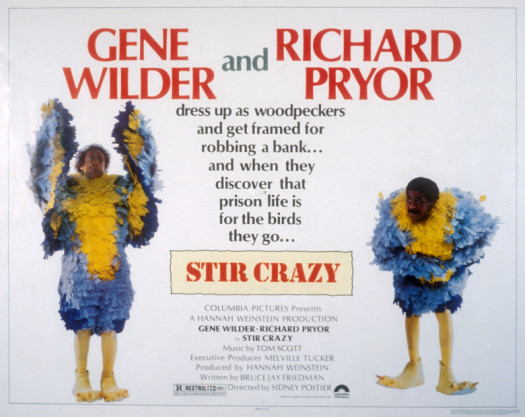
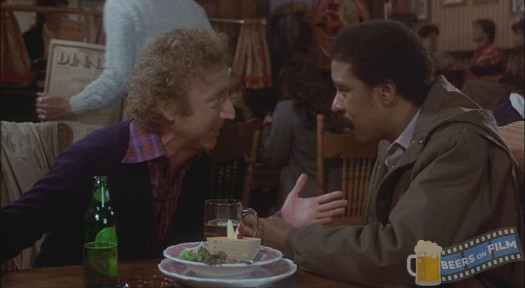
Gene Wilder and Richard Pryor weren’t really a comedy team at all, just two incredibly funny comic actors who happened to work well together. Both were stars in their own right, first appearing together in the 1976 comedy-thriller SILVER STREAK, with Pryor in the pivotal supporting role as a thief who aides the in-danger Wilder. Audiences loved the chemistry between the two, and of course Hollywood took notice. STIR CRAZY is not a sequel, but a funny film of its own allowing Gene and Richard to be their loveably loony selves.
New Yorkers Skip Donahue (Wilder) and Harry Monroe (Pryor) are a couple of buds who’ve both lost their jobs. Playwright Skip’s a dreamer, while aspiring actor Harry’s a realist, but somehow Skip talks his pal into leaving The Big Apple to seek fame and fortune in Hollywood. Their cross-country trek ends when Harry’s decrepit Dodge van breaks down in…
I will be the first to admit that I’m not as much of an expert on Hallmark Christmas films as some members of my family but I think that I have figured out that general formula. Basically, in every Hallmark Christmas movie, one of the girls from Full House either lives in or returns to a small town where it snows all the time and she falls in love while celebrating the holidays. There is always one person who doesn’t have the holiday spirit but, by the end of the movie, they’re saying “Ho ho ho” and drinking eggnog.
In Finding Santa, it’s Jodie Sweetin’s turn to fall in love during Christmas. She plays Grace, who lives in the town of Green River. From her parents, she inherited an all-year Christmas store and the responsibility for organizing the town’s annual Christmas parade. With the parade’s 50th anniversary approaching, Grace wants everything to be perfect but then the town’s Santa Claus, Tom (Jay Brazeau), slips and breaks his arm. Tom runs a Santa school but he says that none of his students are ready to don the red suit. Tom says that only his son, Ben (Eric Winter), can steer his sleigh. The only problem is that Ben has no Christmas spirit and doesn’t want to be Santa. Grace goes to Boston to try to change his mind.
Finding Santa starts out like a typical Hallmark Christmas film, with Grace loving Christmas and Ben feeling that Grace is making too big a deal about it. The thing that sets Finding Santa apart from other Hallmark movies is that, for once, the Christmas skeptic has a point. Grace does make too big a deal about the Christmas parade and protecting her parent’s legacy. Grace is so obsessed with making everyone else’s holiday season perfect that she forgets to enjoy it herself. Of course, by the end of the movie, both Ben and Grace have fallen in love and learned an important lesson about the true meaning of Christmas. It’s a cute movie that teaches an important lesson about taking time for yourself. Plus, I like the idea that there’s a school where you can get a Santa Claus degree.
Before I watched this movie, I was feeling bad because I overslept and missed our annual Christmas parade this weekend. Getting to see the Green River Christmas Parade in Finding Santa made me feel better, I don’t know the name of the man who plays Santa in our parade but he’s been doing it for years and he always does a great job. He probably graduated at the top of his class from Santa School.
The Real Santa Claus, circa 2015 (picture taken by me)
On Saturday night, I needed some cheering up so I watched Mingle All The Way on the Hallmark Channel.
Mingle All The Way is a Hallmark Christmas movie, which means that everyone in the movie goes from Grinch to angel in just two hours. Molly (Jen Lilley) has created an app that pairs professionals together so that they can attend events together without having to worry about it turning into a romance. Jeff (Brant Daugherty) works in public relations and is a single father. When Molly allows her co-worker to set up her profile and Jeff lets his sister to do the same thing for him, the end result is that they end up getting paired together. At first, they don’t like each other, because Molly thinks that Jeff is rude and Jeff thinks that Molly is to wrapped up in her work. Then, Molly meets Jeff’s daughter and Jeff meets Molly’s family and they all come to loe each other. It’s a Christmas miracle!
There was nothing surprising about Mingle All The Way but that’s not a problem. It’s a Christmas Hallmark film so it’s not like I was expecting it to reinvent the wheel or anything like that. I just wanted it to be a sweet and cute movie about people falling in love during the holidays and that’s what the movie delivered. Hallmark movies have become as much a part of Christmas as the tree, the stockings, and old St. Nick coming down the chimney. The holidays can be a difficult time for a lot of people and Hallmark movies like Mingle All The Way are there to provide an escape. On Hallmark, every gift is perfect, every season is merry and bright, and we all get to experience our ideal Christmas.
As for why I needed to cheered up, it all has to do with baseball. Ever since Adrian Beltre announced he was retiring, I’ve been feeling down. If my Rangers couldn’t make it to the World Series with Adrian batting for them, how are they going to do it without him? All I want for Christmas is a home run hitter who can play third base. Until that happens, at least I know I can turn over to Hallmark and watch movies like Mingle All The Way.
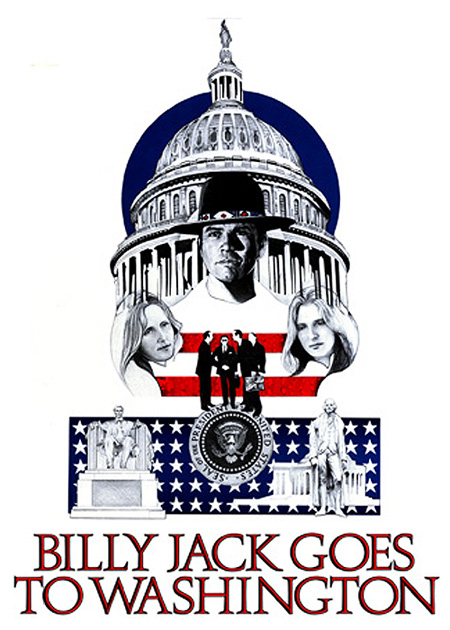
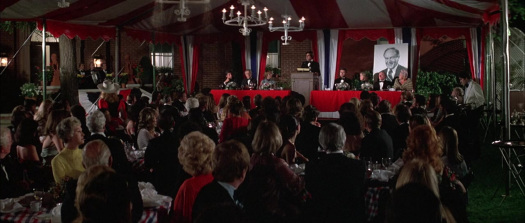
Billy Jack, hero of the oppressed, goes up against an enemy he can’t wrap his head around – the politicians of Washington, D.C. in BILLY JACK GOES TO WASHINGTON, the final chapter in the Billy Jack saga. I know I harped on the fact that the last film, THE TRIAL OF BILLY JACK , didn’t contain enough action, and this one has even less, but I liked this film better. It’s a remake of Frank Capra’s 1939 classic MR. SMITH GOES TO WASHINGTON (Capra’s son is the producer), retooled for the modern era and casting Tom Laughlin’s Billy Jack character in the Jimmy Stewart role. You’d think a forty-plus year old political film would be dated, but truth to tell, not a lot has changed since then… if anything, it’s gotten worse.
When Senator Foley has a heart attack and croaks, the powers-that-be look for a patsy to replace him…
“No, you must not miss the newsreels. They make a point this week no man can miss: The war has strewn the world with corpses, none of them very nice to look at. The thought of death is never pretty but the newsreels testify to the fact of quite another sort of death, quite another level of decay. This is a putrefaction of the soul, a perfect spiritual garbage. For some years now we have been calling it Fascism. The stench is unendurable.”
Those words were written in 1945 by director Orson Welles. He was writing about the footage that had been filmed at the Nazi concentration camps during the final days of World War II. These films not only revealed the crimes of the Third Reich but they also proved the existence of evil. With World War II finally ended and Hitler dead, many people were eager to move on and forget about the conflict. Many even claimed (and some continue to do to this very day) that the reports of the Nazi death camps were exaggerated. Writing in his syndicated column for the New York Post, Welles told those doubters that the reports of the Nazi death camps were not exaggerated and that, unless people confronted the horrors of the Nazi regime by watching the newsreels and seeing for themselves, history would repeat itself.
A year later, Welles would use that documentary footage in a key scene of his 1946 film, The Stranger. A government agent named Mr. Wilson (Edward G. Robinson) shows the footage to Mary Longstreet Rankin (Loretta Young), the daughter of a Supreme Court justice. Wilson is hoping that, by showing her the footage, he’ll be able to convince her to help him bring a Nazi war criminal to justice. Complicating things is that Wilson believe that the Nazi war criminal is Mary’s new husband, Professor Charles Rankin (played by Orson Welles, himself).
In this shot, the horrors of the Holocaust are literally projected onto Edward G. Robinson’s face, a reminder that is on us to prevent it from ever happening again.
Rankin’s real name is Franz Kindler. One of the architects of the Holocaust, he escaped from Germany at the end of World War II and, after making his way through Latin America, he ended up in a small town in Connecticut. He got a job at the local prep school, where he instructs impressionable young minds. He also found the time to work on the town’s 300 year-old clock.
When we first see Kindler/Rankin, he’s walking out of the school and it’s obvious that all of his students love him. Rankin has a quick smile, which he uses whenever he has to talk to Mary or any of the other townspeople. However, that smile disappears as soon as he’s approached by another Nazi fugitive, Konrad Meinike (Konstantin Shayne). Rankin assures Meinike that he’s merely biding his time until he can establish a Fourth Reich. Meinike, meanwhile, announces that he’s found God and he suggests that Rankin should turn himself in. Correctly deducing the Meinike is being followed by Wilson, Rankin promptly strangles his former collaborator and spends the rest of the movie trying to cover up his crimes.
Welles was best known for playing characters who had the potential for greatness in them but who were ultimately brought down by their own flaws. Think about Charles Foster Kane or Harry Lime or the detective in Touch of Evil or even Falstaff in Chimes at Midnight. The Stranger is unique as one of the few instances in which Welles played an outright villain. Unlike Kane or Falstaff, there’s no greatness to be found in Rankin/Kindler. He’s fooled the town into thinking that he’s a good man but, instead, he’s a soulless sociopath who is even willing to murder his wife if that’s what he has to do to protect his secret. Franz Kindler is the Third Reich and, by having him thrive under a new name in America, Welles argues that the Nazi threat didn’t end just because Hitler killed himself in Berlin.
The Stranger was Welles’s third completed film as a director. It was a film that he reportedly agreed to direct in order to prove that he was capable of bring in a film on budget and ahead-of-schedule. Because Welles was largely acting as a director-for-hire on this film, there’s a tendency to overlook The Stranger when discussing Welles’s films. While that’s understandable, The Stranger is clearly a Welles film. From the use of shadow to the skewed camera angles, the film has all of Welles’s visual trademarks. Thematically, this is another one of Welles’s films about a man who is hiding a secret underneath his ordinary facade.
It’s a good film, with Welles giving an appropriately evil performance as Kindler and Loretta Young providing strong support as Mary. That said, the film’s soul is to be found in Edward G. Robinson’s performance. Robinson was born Emmanuel Goldenberg in Romania. In 1904, his family fled to America after one of his brothers was attacked by an anti-Semitic mob. As someone who had experienced anti-Semitism firsthand, Robinson brought a righteous fury to the role of Mr. Wilson. Wilson isn’t just pursuing a fugitive in The Stranger. Instead, he’s seeking justice for the six million Jews who were murdered by men like Franz Kindler.
The Stranger is an important film and it seems like the right film with which to end my 30 Days of Noir. Noirvember is ending and so ends our 30-day walk through the shadowy streets of noir cinema.
The 1947 film, Johnny O’Clock, invites us to take a behind-the-scenes look at the sleazy and sordid world of casino management. If that doesn’t intrigue you, just consider that the man character is named Johnny O’Clock.
Seriously, that’s a really kickass name. I have to admit that, if my last name was O’Clock, I would be tempted to name my child Four Twenty. But, that said, Johnny is a pretty good name too. On the one hand, he’s got an all-American name like Johnny but he’s also got a last name — O’Clock — that promises mystery and danger. Johnny O’Clock is also played by Dick Powell, who was always good at playing tough guys who had a heart of gold. (Along with appearing in several noir films, Dick Powell was also the first actor to ever play the famed detective, Philip Marlowe.)
Johnny O’Clock is a partner in a casino with Guido Marchettis (Thomas Gomez). Johnny and Guido are longtime business partners who find the future of their casino threatened when a hat-check girl named Harriet Hobson (Nina Foch) dies under mysterious circumstances. Even though the crime scene was clearly set up to make it appear as if Harriet committed suicide, it doesn’t take Inspector Koch (Lee J. Cobb) long to figure out that Harriet was actually murdered.
Who killed Harriet?
Was it her boyfriend, Chuck Blayden (Jim Bannon)? Chuck is a corrupt cop who has been trying to convince Guido to force Johnny out of the casino and instead hire Chuck instead.
Or is the murderer Guido’s wife, Nellie (Ellen Drew)? Nellie used to be Johnny’s girlfriend and, as soon becomes obvious, she still has feelings for him. When she attempted to give Johnny a romantic present, Johnny’s response was to give it to Harriet so that Harriet could return it. Did Johnny’s rejection of Nellie push her over the edge and did she take her anger out on Harriet?
Or maybe the murderer was Guido. Guido, after all, is a rather shady sort. Maybe Harriet discovered something that she shouldn’t have.
Then again, you could also say the same thing about Johnny O’Clock….
Inspector Koch isn’t the only person determined to get to the truth! Harriet’s sister, Nancy (Evelyn Keyes), also shows up and starts to investigate on her own. Soon, she and Johnny are falling in love but Johnny knows that the situation is too dangerous for either him or Nancy to stick around the casino. He starts to make plans to flee with her to South America but he’s got just a few things to do before they can leave….
Johnny O’Clock was the first film to be directed by Robert Rossen, who is often credited as being one of the most important filmmaers in development of American film noir. A year after Johnny O’Clock was released, Rossen’s All The King’s Men would win best picture. Rossen’s career was derailed when he was accused of being a communist and blacklisted in the 50s. Like Elia Kazan, Rossen initially took the fifth but he later relented and “named names” to the House UnAmerican Activities Committee. Though Rossen would later direct the Oscar-nominated The Hustler in 1962, it can be argued that Rossen’s career never recovered from either being blacklisted or from naming names.
Clocking in at 93 minutes, Johnny O’Clock is probably about 20 minutes too long and the murder mystery is never really as intriguing as you might hope it would be. On the positive side, the casino is stylish and the cast is full of noir talent. Dick Powell is a likable, if occasionally bull-headed, protagonist and Lee J. Cobb is well-cast as Inspector Koch. (The film has some fun contrasting the glitz of the casino with the shabbiness of Koch.) Burnett Guffey’s black-and-white cinematography gives the film a properly noirish look and, while the pace may be slow, the occasional bursts of action are well-handled. The scene where Johnny is nearly the victim of a drive-by shooting is particularly exciting. Johnny O’Clock is a flawed noir but the cast is good enough to hold the interest of fans of the genre.
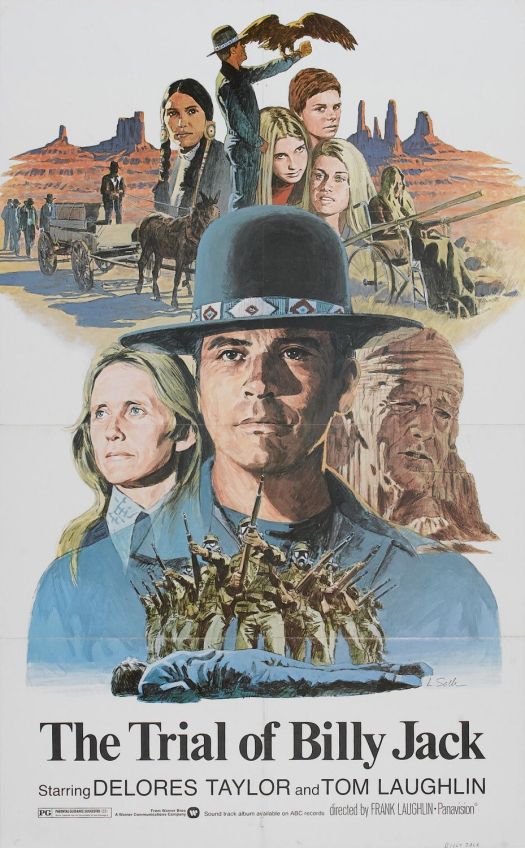
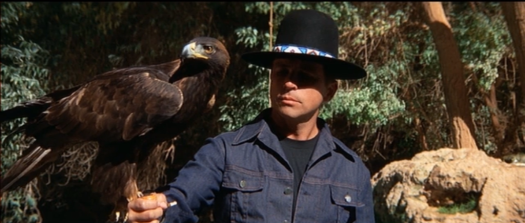
The last time we saw BILLY JACK , he was being hauled off to jail – and raking in about 60 million bucks at the box office! The eponymous hero of the surprise 1973 indie hit struck a chord with young audiences disillusioned with the Establishment’s endless wars and crushing their hobnail boots on the throats of dissidents (like I always say, the more things change…), and cheered as Billy Jack struck karate blows and Hapkido kicks in the cause of freedom. A sequel was inevitable, with Tom Laughlin returning as star/director/co-writer (along with wife Delores Taylor, who plays Jean) in a film loaded with political and spiritual philosophies designed to open those young moviegoers’ hearts and minds (not to mention wallets!).
But while BILLY JACK (and its predecessor, BORN LOSERS ) are fun flicks, THE TRIAL OF BILLY JACK suffers from that dreaded disease many filmmakers are prone to…
Like many good crime films, this 1956 film noir opens on a train.
A passenger has suddenly been taken ill and his wife, Linda (Felecia Farr), wants to know if there’s a doctor on board! Fortunately, there is! Dr. Paul Bucker (Wesley Addy) just happens to be on the train and it only takes him a few minutes to figure out that the man is suffering from polio. Paul arranges for the train to make an unscheduled stop in the next town so that the man can be taken to the hospital. Paul also asks to be allowed to go to the baggage car, so that he can retrieve his doctor’s bag. Of course, he can! Who is going to say no to doctor, especially in a situation this serious?
Paul goes back to the baggage area to claim his little black bag and that’s when something unexpected happens. He opens up his bag and pulls out a gun. It turns out that Paul is not only a doctor but he’s a thief as well. After tying up everyone in the car and knocking them out with a sleeping drug, Paul proceeds to blow open a safe and steal all the money within.
When the train makes it unscheduled stop, Paul, the man, and Linda (who is actually Paul’s wife), disembark. They get into an ambulance driven by the shady Frankie Page (Jack Klugman) and they head off. It’s only after Paul’s escaped that the robbery is discovered.
With authorities baffled by the crime, insurance investigator Charlie Norman (Mark Stevens) is assigned to investigate the robbery with railroad policeman, Joe Armstrong (King Calder). Despite the fact that Charlie has been promising to take a vacation with his wife (Marianne Stewart), Charlie takes the case. Everyone knows that Charlie is one of the best in the business. If anyone’s going to catch these criminals, it’s going to be Charlie!
Of course, Charlie has another reason for taking the case. It turns out that Charlie’s the one who masterminded the entire robbery! He’s the one who first met Paul while the alcoholic doctor was attempting to file a false claim. It also turns out that Charlie has been having an affair with Linda and that Charlie’s planning on running off with her as soon as they take care of Paul.
Mark Stevens both directed and starred in Time Table and the end result is a well-made and genuinely exciting film noir, one that features all of the hard-boiled dialogue, shadowy interiors, and twisty complications that one could hope for from a good heist film. Stevens not only keeps the action moving at a steady pace but he also keeps you guessing about whether our band of criminals are going to make it to Mexico or if they’re going to all fall victim to one betrayal too many. The film is full of nice character turns, though the strongest performance comes from Wesley Addy, who brings a wounded dignity to his duplicitous character.
For fans of film noir, this is definitely one to watch.
The 1948 film noir, Parole, Inc., begins with a lengthy opening crawl, informing the viewer that this film — though fictional — deals with a real-world problem.
Apparently, too many people are getting out of prison!
That’s right! The opening crawl informs us that half of all crimes are committed by people who have already served time in prison. Apparently, there would be less crime if we just never released people from prison but, unfortunately, state parole boards are way too quick to let some criminals out early. Is it because the members of the board truly believe that these offenders have been rehabilitated in prison? Or is it because they’ve been bribed?
That’s what FBI Agent Richard Hendricks (Michael O’Shea) is going to find out!
Now, we already kind of know what he’s going to discover and what’s going to happen to him as a result because, for some reason, the film opens with Hendricks in a hospital bed, dictating the events of his latest case. The rest of the film is largely an extended flashback, occasionally interrupted by a shot of Hendricks recovering from his injuries. I’m not sure why the filmmakers decided that this would be a good format to go with. It basically robs the story of any suspense. Whenever a gangster says that he’s going to kill Hendricks, the declaration doesn’t carry any weight because we know that Hendricks is alive and that he managed to solve the case.
Anyway, in the flashback, Richard is working directly for the governor of California. The governor is worried that the state parole board is accepting bribes so Richard goes undercover as an ex-con who wants to buy a parole for a friend of his who is still in jail. As a part of his assignment, Richard befriends a recently paroled criminal named Harry Palmer (Charles Bradstreet). It turns out that, for a criminal, Harry isn’t that bad of a guy. He may still have underworld connections but, for the most part, Harry seems like he could easily go straight. Of course, that doesn’t make much difference to the nefarious crows that Harry runs around with and Harry ends up getting gunned down about halfway through the film. Richard seems to be more annoyed over the inconvenience of Harry dying than anything else. Now, he’s going to have to do all sorts of extra work!
Though Michael O’Shea has just enough screen presence to be an acceptable hero, the main reason to see the film is for Turhan Bey and Evelyn Ankers. Bey plays the crooked attorney who is in charge of the parole buying ring. Evelyn Ankers play the wonderfully named JoJo Dumont, who owns the bar out of which the gangsters operate. These two actors both throw themselves into their roles, bringing just the right amount of B-movie grit to their characters. Horror fans may recognize Evelyn Ankers from her performance as Lon Chaney Jr.’s girlfriend in The Wolf Man. Ankers appeared in several classic Universal horror films and was menaced by everyone from Dracula to Frankenstein’s Monster to the Invisible Man. Turhan Bey also appeared in his share of horror films, even co-starring with Evelyn Ankers in The Mad Ghoul.
Parole, Inc is a largely forgettable movie but worth seeing if you’re a fan of Universal horror and you’re interested in seeing Turhan Bey and Evelyn Ankers in a change-of-pace film.
“Tuesdays in Noirvember” concludes with the genre’s biggest icon, Humphrey Bogart (and he’s bringing Lauren Bacall along for the ride!):
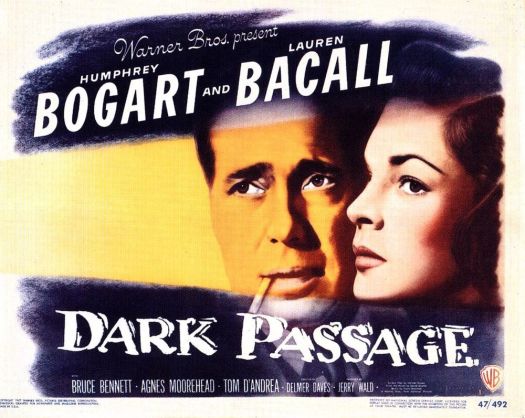
The year 1947 belonged to filmnoir, as some of the dark genre’s true classics saw the light of day: Robert Mitchum donned that iconic trenchcoat in OUT OF THE PAST , Richard Widmark snarled his way through KISS OF DEATH, Burt Lancaster battled sadistic Hume Cronyn with BRUTE FORCE , Tyrone Power got trapped in NIGHTMARE ALLEY , Rita Hayworth bedeviled Orson Welles as THE LADY FROM SHANGHAI , Ronald Colman won an Oscar as a cracked actor leading A DOUBLE LIFE, and Lawrence Tierney terrorized the hell out of everyone in his path in BORN TO KILL . Humphrey Bogart and Lauren Bacall, noir’s power couple thanks to the previous year’s THE BIG SLEEP , teamed again for DARK PASSAGE, an slam-bang crime drama that may not…







 Through the Shattered Lens