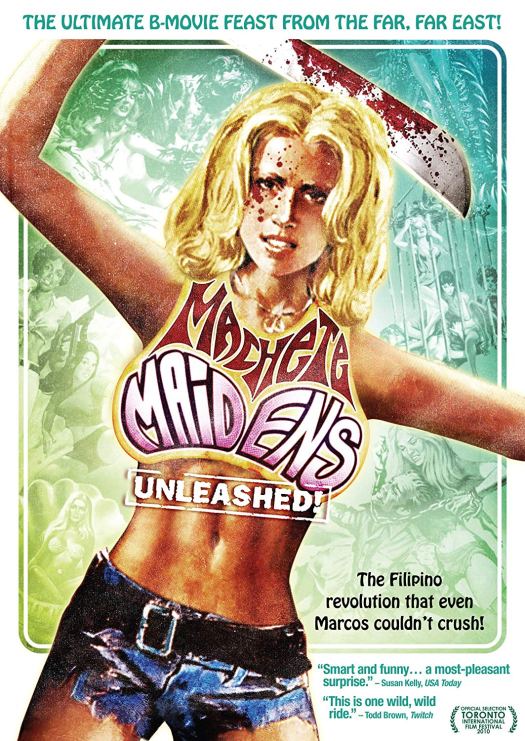
Tonight we celebrate baseball with MLB’s 90th annual All-Star Game, and… what’s that you say, Dear Readers? You don’t LIKE baseball?!? (*sighs, shakes head, mutters “must be some kinda Commies”*) Luckily for you, I’ve got an alternative for your viewing pleasure this evening. It’s an All-Star salute to the halcyon days of low-budget Exploitation filmmaking in the Philippines that lasted roughly from 1959 (Gerry DeLeon’s TERROR IS A MAN, with Francis Lederer and Greta Thyssen) to the early 80’s and the advent both of VHS, which effectively ended the Drive-In/Grindhouse Era, and political upheaval caused in part by Fernando Marcos’s imposition of martial law on the island nation.
1971’s “Beast of the Yellow Night”
This Australian-made documentary by writer/director Mark Hartley covers the wild, wild world of making Exploitation movies in the jungle on a shoestring budget through judicious use of clips, trailers, and interviews with the people who made…
She’s a former high school outcast who can now legally carry a gun. How much of an outcast was Penny? She was such an outcast that she was humiliated at a school dance by a bunch of popular kids who tied her down to a chair, made her up to look like a pig, and then displayed her in front of the entire class. Seriously, how do teenage bullies come up with stuff? I mean, I was never one to take part in bullying but, even if I was, my ADD would make it impossible for me to pull off most of the elaborate schemes that always seem to take place in movies like this.
Anyway, Penny was traumatized by the whole incident but she still managed to graduate and eventually become a cop. That’s right. Penny is upholding the law and she’s got an entire department to back her up in case she happens to shoot anyone and …. well, can you see why this might be a problem for her former high school classmates?
One night, Penny is called out to investigate a home invasion. After Penny shoots the home invader dead, she meets with the home’s owner and it turns out to be a former classmate, Tara (Kaitlyn Black)! Tara, who seems to have no memory of Penny’s life being destroyed in high school, is soon hanging out with her old classmate. She invites her to a party. She and Penny go out to the desert for target practice. The whole time, of course, Penny keeps imagining that she’s surrounded by the taunting laughter of her former classmates. Penny’s going to get her revenge, even if it means coming up with a scheme that’s even more ludicrously elaborate as the one that embittered her in the first place.
Hometown Killer is a classic Lifetime film, one that full embraces every melodramatic possibility of its storyline. Penny may be a dishonest murderer but you still feel sorry for her because of what she went through in high school. This is one of those films that makes you think, “Y’know, she probably she shouldn’t be doing this but maybe she should.” Director Jeff Hare adds enough little quirky touches to distinguish Hometown Killer from other, similar films. I especially liked the way the he took us in and out of Penny’s mind, always keeping us off-balance as to whether or not we were seeing what was really happening or if we were instead seeing what Penny thought was reality. It kept the audience off-balance and, as a result, Hometown Killer generated a lot more suspense than the average Lifetime film.
The success of a film like this pretty much hinges on the actress playing the killer and Ashley Gallegos did a great job of making Penny both sympathetic and frightening. Perhaps her greatest moment in the film is when she simply watches the chaos that she’s created and allows herself a slightly satisfied smirk. It’s a small moment but it tells us everything that we need to know about what’s going on in her head. Also impressive was Kelly Marcus, who was wonderfully obnoxious as the prototypical high school bully who never adjusted to life in the real world.
Hometown Killer aired on Lifetime and, Lifetime being Lifetime, it will undoubtedly air again. Keep an eye out for it!
Breaker One-Nine, Breaker One-Nine, it’s time to put the hammer down with a pair of Trucksploitation flicks from the sensational 70’s! The CB/Trucker Craze came to be because of two things: the gas crisis of 1973 and the implementation of the new 55 MPH highway speed limit imposed by Big Brother your friendly Federal government. Long-haul truckers used Citizen’s Band radios to give each other updates on nearby fueling stations and speed traps set up by “Smokeys” (aka cops), and the rest of America followed suit.
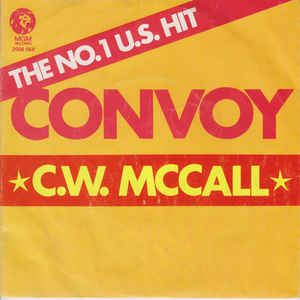
Country singer C.W. McCall had a massive #1 hit based on CB/trucker lingo with “Convoy”, and the trucker fad was in full swing. There had been trucker movies made before – THEY DRIVE BY NIGHT, THIEVES’ HIGHWAY, HELL DRIVERS, and THE WAGES OF FEAR come to mind – but Jonathan Kaplan’s 1975 WHITE LINE FEVER was the first to piggy-back on the new gearjammer…
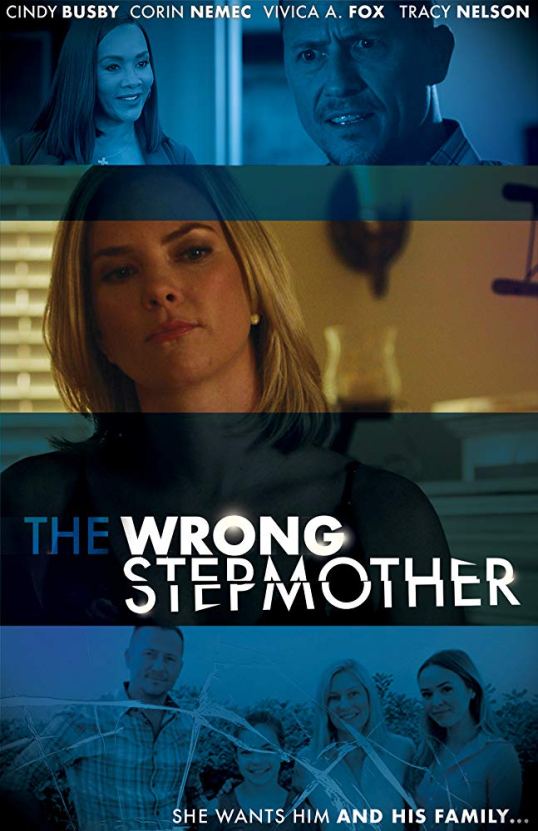
Actually, Maddie (Cindy Busby) is not a mother, though she would like to be. She not even a stepmother, despite what the title says. Instead, she’s just dating the recently widowed Michael (Corin Nemec). If she does end up marrying Michael, Maddie will become a stepmother — perhaps even a WRONG stepmother — to his two daughters, Lilly (Calli Taylor) and Nicole (McKinley Blehm).
It doesn’t take Lilly long to realize that there’s something off about Maddie. For one thing, she catches Maddie trying to check her social media. Then she overhears Maddie claiming to be her mother. And finally, Maddie changes up Lilly’s college admission essay. See, Lilly wrote about how much her late mother influenced her. Maddie, however, changes it into an essay about how much Lilly loves her future stepmother.
Yes, Maddie has some issues. As we discover at the start of the film, she has a history of stalking people. About halfway through the film, she murders two people. Whenever you’re watching a film on Lifetime, you know someone’s going to get murdered at exactly halfway through the film. You can set the time by it.
As with all of Lifetime’s “Wrong” films, Vivica A. Fox has a small role. In this one, she plays Ms. Price, the high school guidance counselor who is extremely unimpressed by Lilly’s college admissions essay. When Ms. Price confronts Lilly about how unimpressive her essay was, Fox delivers the lines with such subtle fury and annoyance that it brought back a lot of high school memories for me. As played by Fox, Ms. Price is the type of high school counselor who scares you to death but who also changes your life for the better. If Ms. Price had been my counselor, I definitely wouldn’t have spent so much time skipping class and shoplifting makeup at Target.
Anyway, the main complaint that you always hear about Lifetime films is that they’re all exactly the same but that’s actually their appeal. They’re fun to watch, precisely because 1) they’re predictable and 2) the viewer is always going to be smarter than the people in the movie. I mean, we can take one look at Maddie and say, “Okay, don’t let her in the house.” However, Michael’s not that smart and, if he was, we really wouldn’t have a movie. Sometimes, you just have to stop crying about plausibility and enjoy what you’re watching.
The Wrong Stepmother gets a big boost from the casting of the always likable Corin Nemec as Michael. I mean, it’s pretty much impossible not to root for a character played by Corin Nemec, even if that character is way too trusting of someone who he met on a dating app. Meanwhile, Cindy Busby is properly psychotic as Maddie and, of course, you’ve got Vivica A. Fox changing lives as Ms. Price.
The Wrong Stepmother is an entertaining Lifetime film. Watch it with your snarkiest friends.
Franklyn Carlysle (William Katt) is a fine, upstanding city councilman, with a rich wife (Wendy MacDonald) and a bright future. Carlysle wants to be mayor and he’s come up with the perfect scheme. He’s going to work with a developer to renovate Dante’s Square, the city’s notorious red light district.
One night, while Franklyn is driving through Dante’s Square, he’s carjacked. Someone knocks him out before stealing both his car and his wallet. When Franklyn comes to, he discovers that he’s being watched over by Sam Silver (played by Rick Dean). Sam is apparently a homeless philosopher, who tells Franklyn that he’s been taking life too seriously and that sometimes, you just have to yell, “Fuck this shit!” at the top of your lungs. When Franklyn asks where he can find a phone so he can call the cops, Sam leads Franklyn to the Yin Yang Club. It’s there that Franklyn sees Lynne (Maria Ford), a dancer to whom he is immediately attracted. Suddenly, his missing car and his stolen wallet no longer seem that important. With his marriage already in trouble, Franklyn returns to the club the next night.
Franklyn soon discovers that Lynne has a thing for being choked during sex. Even though Sam keeps telling him things like, “Nothing wrong with the dark – you spend half your life in it – trouble is, most people keep their eyes closed,” Franklyn is worried that his affair with Lynne will derail his mayoral ambitions. However, when Lynne shows up dead, Franklyn finds himself dealing with a much bigger problem. He’s now the number one suspect in her murder. Things just get stranger as Franklyn discovers that he wasn’t the only one cheating, meets a masked, gun-wielding stripper, and discovers that Sam might not even be of this world.
William Katt and Rick Dean in Naked Obsession
It can be said, without fear of hyperbole, that Naked Obsession in the Citizen Kane of Roger Corman-Produced Straight-To-Video Maria Ford-Stripper movies. This is largely due to the performance of the late, great Rick Dean in the role of Sam. Sam’s not just just a homeless drunk with a motormouth. As played by Dean, he’s a philosopher king and, the film hints, much more. He comes across like an angel of the devil and he’s exactly what Franklyn Carlysle needs to liven up his too safe life. Maria Ford, who specialized in playing troubled strippers in Roger Corman films, gives one of her best performances and, in the role of Franklyn’s secretary, Elena Sahagun, has some great scenes too. Finally, William Katt classes up the joint, giving a real performance as Franklyn instead of just sleepwalking through the film. Dan Golden’s direction emphasizes the surreal and, by the time the end credits roll, Naked Obsession will leave you wanting to spend a night or two at Dante’s Square.
Like so many classic films from the golden age of late night Cinemax. Naked Obsession has never been released on DVD or Blu-ray but it can be found on YouTube.
The other night, I watched 2018’s The House That Jack Built on Showtime and I have to say that, sitting here the morning afterwards, I kind of wish that I hadn’t. It’s a well-made film and there’s a bit more going on underneath the surface that some other reviews might lead you to suspect but, at the same time, it’s also deeply unsettling and, even by the standards of Lars von Trier, disturbing. It’s not a film to watch right before you go to bed, nor is it a film to watch at the beginning of a long week. I’m still feeling the after effects of having watched this movie and I imagine I’ll probably be jumpy for the next few days.
The title character, Jack (Matt Dillon), is someone who loves to talk about himself. He’s an engineer but he wishes he was an architect. He thinks of himself as being an artist and an intellectual and he has no hesitation about informing you that he’s smarter than just about everyone else on the planet. He’s annoyed that he’s not better-known. He feels that his work is underappreciated.
The House that Jack Built runs two and a half hours and, as a result, we spent a lot of time listening to Jack talk. One thing that quickly becomes apparent is that Jack knows a lot but he understand very little. He spends a lot of time talking about Glenn Gould, Goethe, and Nazi architecture but his thoughts on them are rather shallow and predictable. When we see flashbacks to Jack’s youth, we don’t see any signs of the intelligence that he claims to possess as an adult. Instead, we just see a scowling country boy who used to abuse animals. Jack may insist on calling himself “Mr. Sophistication” but there’s really nothing sophisticated about him and one gets the feeling that his faux intellectualism is something that he developed to justify the fact that he’s a sociopath and a serial killer. Jack claims to have murdered at least 60 people and he also says that each murder was a work of art. If art reflects the time and place in which it was made than how can we condemn Jack for reflecting the soullessness and cruelty of the real world in his own creations? The answer, of course, is that we can very easily condemn Jack. Jack uses the state of the world to justify his actions but that doesn’t mean we have to buy what he’s selling.
The House That Jack Built is built around a lengthy conversation between Jack and an enigmatic character named Verge (Bruno Ganz). Jack shows Verge the “five incidents” that, over the course of 12 years, have defined who Jack is as a person and a serial killer. The five incidents feature Jack killing everyone from a stranded motorist (Uma Thurman) and a grieving widow (Siobhan Fallon Hogan) to a terrified mother and her two sons. Jack has a brief and toxic relationship with one of his victims (heart-breakingly played by Riley Keough) and it leads to an act of violence that’s so disturbing that I don’t even want to relive it long enough to write about it. Throughout it all, Jack tries to justify himself while Verge continually calls him out on his bullshit. Watching the film, I found myself very thankful for Verge. The film would have been unbearable if it has just been Jack bragging on himself, unchallenged. Verge not only calls out Jack but also anyone who would idolize someone like Jack. At times, the film itself seems to be ridiculing the whole idea of the Hannibal Lecter-style serial killer. There’s nothing suave or witty about Jack. He’s just a loser with no soul.
Even though I was watching the R-rated version (as opposed to the unrated director’s cut), the murders were still disturbingly graphic. But what really made the film unsettling was its peek into Jack’s nihilistic worldview. As much as he may try to convince you otherwise, it soon becomes clear that there’s nothing going on inside of Jack’s head. When Jack isn’t suffering from delusions of grandeur, he’s mired in self-pity. (Listening to Jack, one is reminded of the infamous BTK Killer, who spent hours in court describing his murders without a hit of emotion but who later broke into tears when informed that he would be spending the rest of his life in prison.) Unlike most movie serial killers, Jack doesn’t have a flamboyant origin story or any sort of trauma-related motive for his crimes. He kills because he wants to. Jack is capable of being superficially charming. As a sociopath, he’s learned how to put people at ease. But there’s nothing behind that charm. When he performs some post-mortem surgery to give one of his victims a permanent smile, the results are grotesque because Jack has no idea what a real emotion looks like. (Jack weakly waves at the body, as if he’s trying to teach himself how to act like a normal person.)
Throughout the film, we get a lot of stock footage. (It’s justified by the fact that Jack is talking about art and history, two subjects about which he only has a surface knowledge.) Interestingly enough, we also get several clips that were lifted from Von Trier’s previous films. At one point, Jack passes a cabin that some viewers will recognize from Antichrist. While Jack tries to dispose of a body, David Bowie’s Fame plays on the soundtrack and it’s hard not to be reminded of how Bowie’s Young Americans played over the closing credits of both Dogville and Manderlay. We’re left to wonder if Jack is meant to be, in some way, a stand-in for Von Trier. Much like Jack, Von Trier is often accused of using his own artistic pretensions to justify a nihilistic and misogynistic worldview. It’s easy to imagine Verge as a stand-in for some of Von Trier’s fiercest critics. What then are we to make of the fact that the film also portrays Verge as being correct and Jack as being (literally) bound for Hell? Is Von Trier telling us that, as much as some people may dislike him and his work, at least he’s not a serial killer like Jack? Is Von Trier attacking himself? Or is Von Trier perhaps satirizing his own controversial persona? Perhaps all three are correct.
By the film’s end, Jack is in Hell. Interestingly enough, the portal to Hell is found in a house that’s made up of the bodies of Jack’s many victims. Verge — short for Virgil, of course — gives him a tour. When Jack sees a broken bridge, Virgil informs him that it once led to Heaven but it can’t be crossed now. However, Jack is convinced that he can climb over a cliff and make his way to Heaven. Virgil assures Jack that many have tried but none have succeeded. Jack, of course, tries and, needless to say, he doesn’t make it. In the end, redemption is impossible and yet you wonder how, in a world with Heaven and, one assumes, God, Jack even came to exist in the first place. If Jack had channeled his sociopathic nature into something more productive than murder, would he have been allowed into Heaven?
As I said, it’s a well-made film but it’s also deeply unsettling. I’m probably going to be jumping at my own shadow for at least a week or two. At the very least, I’m not answering the door for anyone….
You couldn’t go anywhere in 1984 without hearing “On the Dark Side” blaring from a car radio or your neighborhood bar’s jukebox. That’s thanks in large part to audiences rediscovering 1983’s EDDIE AND THE CRUISERS via repeated showings on HBO, turning the film into an instant cult classic and veteran Providence-based rockers John Cafferty & The Beaver Brown Band into FM-radio favorites. The film hadn’t done well when first released to theaters, but exposure on the fairly-new medium of Cable TV garnered new fans of both it and Cafferty’s soundtrack album.
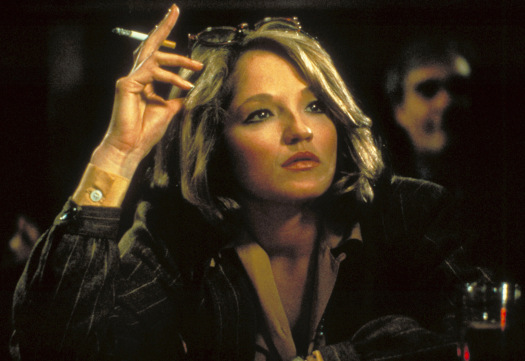
Investigative reporter Ellen Barkin looks into the mysterious death of Eddie Wilson (played by Michael Pare’), lead singer of The Cruisers, whose death in a car accident is shrouded in secret, as the body was never found. Was it suicide? murder? or is Eddie still alive? She digs deep to uncover the facts about what happened that fateful night…
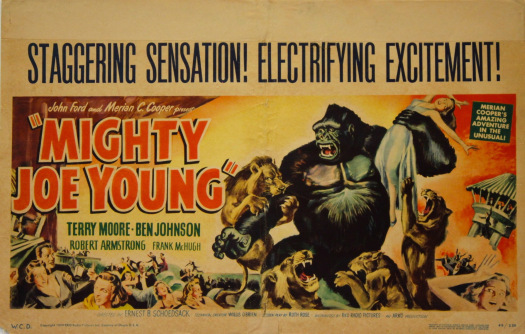
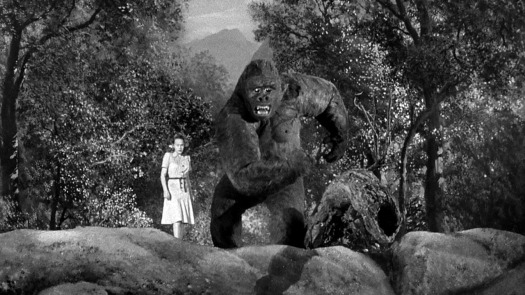
The folks who brought you KING KONG – producer Merian C. Cooper, director Ernest Shoedsack, writer Ruth Rose, animator Willis O’Brien – returned sixteen years later to the giant ape theme with MIGHTY JOE YOUNG, a classic fantasy that can stand on its own. Though the film usually gets lumped into the horror genre, it’s more a fable than a fright fest, a beautifully made flight of fancy for children of all ages, and one of my personal favorites.
In deepest darkest Africa, little Jill Young buys a cute baby gorilla from the natives. Twelve years later, impresario Max O’Hara, along with rodeo wrangler Gregg and his crew, travel to The Dark Continent in search of exotic animal acts for a new show he’s producing, when they come face to face with the now 12 foot tall, 2,000 pound gargantua, affectionately called Joe by a grown Jill. She’s the only…
The 1970 film, The Adventurers, is a film that I’ve been wanting to watch for a while.
Based on a novel by Harold Robbins, The Adventurers was a massively expensive, three-hour film that was released to terrible reviews and even worse box office. In fact, it’s often cited as one of the worst films of all time, which is why I wanted to see it. Well, three weeks ago, I finally got my chance to watch it and here what I discovered:
Yes, The Adventurers is technically a terrible movie and Candice Bergen really does give a performance that will amaze you with its ineptitude. (In her big scene, she sits in a swing and, with a beatific look on her face, begs her lover to push her “Higher! Higher!”)
Yes, The Adventures is full of sex, intrigue, and melodrama. Director Lewis Gilbert, who did such a good job with Alfieand The Spy Who Loved Me, directs as if his paycheck is dependent upon using the zoom lens as much as possible and, like many films from the early 70s, this is the type of film where anyone who gets shot is guaranteed to fall over in slow motion, usually while going, “Arrrrrrrrrrrrgh….” A surprisingly large amount of people get shot in The Adventurers and that adds up to a lot of slow motion tumbles and back flips. Gilbert also includes a sex scene that ends with a shot of exploding fireworks, which actually kind of works. If nothing else, it shows that Gilbert knew exactly what type of movie he was making and he may have actually had a sense of humor about it. That’s what I choose to believe.
Despite the fact that The Adventurers is usually described as being a big-budget soap opera, a good deal of the film actually deals with Latin American politics. For all the fashion shows and the decadence and the scenes of Candice Bergen swinging, the majority of The Adventures takes place in the Latin American country of Cortoguay. If you’ve never heard of Cortoguay, that’s because it’s a fictional country. Two hours of this three-hour film are basically devoted to people arguing and fighting over who is going to rule Cortoguay but it’s kind of impossible to really get to emotionally involved over the conflict because it’s not a real place.
Ernest Borgnine plays a Cortoguayan named — and I’m being serious here — Fat Cat. Seriously, that’s his name. And really, how can you not appreciate a movie featuring Ernest Borgnine as Fat Cat?
Fat Cat is the guardian of Dax Xenos (Bekim Fehmiu). Dax’s father is a Cortoguayan diplomat but after he’s assassinated by the country’s dictator, Dax abandons his home country for America and Europe. While he’s abroad, Dax plays polo, races cars, and has sex with everyone from Olivia de Havilland to Candice Bergen. He also gets involved in the fashion industry, which means we get two totally 70s fashion shows, both of which are a lot of fun. He marries the world’s richest heiress (Bergen) but he’s not a very good husband and their relationship falls apart after a pregnant Bergen flies out of a swing and loses her baby.
Throughout it all, Fat Cat is there, keeping an eye on Dax and pulling him back to not only Cortoguay but also to his first love, Amparo (Leigh Taylor-Young), who just happens to be the daugther of Cortoguay’s dictator, Rojo (Alan Badel). In fact, when Fat Cat and Dax discover that an acquaintance is selling weapons to Rojo, they lock him inside of his own sex dungeon. That’s how you get revenge! And when Dax eventually does return to Cortoguay, Fat Cat is at his side and prepared to fight in the revolution. Incidentally, the revolution is led by El Lobo (Yorgo Voyagis), who we’re told is the son of El Condor.
The Adventurers is melodramatic, overheated, overlong, overdirected, and overacted and, not surprisingly, it’s eventually a lot of fun. I mean, the dialogue is just so bad and Lewis Gilbert’s direction is so over the top that you can’t help but suspect that the film was meant to be at least a little bit satirical. How else do you explain that casting of the not-at-all-Spanish Bekim Fehmiu as a Latin American playboy? Candice Bergen plays her role as if she’s given up any hope of making sense of her character or the script and the rest of the cast follows her lead. Ernest Borgnine once said that The Adventurers was the worst experience of his career. Take one look at Borgnine’s filmography and you’ll understand why that’s such a bold statement.
The Adventurers is three hours long but it’s rarely boring. Each hour feels like it’s from a totally different film. It starts out as Marxist agitprop before then becoming a glossy soap opera and then, once Fat Cat and Dax return home and get involved in the revolution, the film turns into “modern” spaghetti western. It’s a film that tries so hard and accomplishes so little that it becomes rather fascinating.
And, if nothing else, it reminds us that even Fat Cat can be a hero….
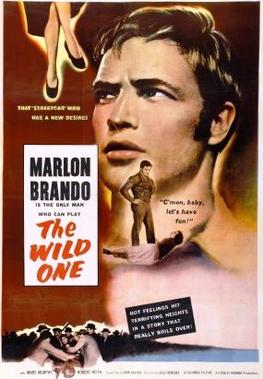
Motorcycles have always been unbelievably sexy and, in 1953, so was Marlon Brando.
1953 was the year that Brando played Johnny Strabler in The Wild One. Johnny’s the leader of the Black Rebels Motorcycle Club. He wears a leather jacket and always has a cap tilted rakishly on his head. When Johnny moves, he makes it a point to take his time. He doesn’t run from anyone and, perhaps most importantly, he doesn’t run to anyone. Johnny’s a rebel and he doesn’t care who knows it. “What are you rebelling against?” Johnny is asked. “Whaddya got?” Johnny replies and, when he says it, you not only believe him but you want to join him in his rebellion.
And yet, from the minute that we see Johnny, it’s obvious that there’s more to him than just his jacket and his attitude. He speaks softly and when he smiles, there’s something almost shy about the expression. You look into his brooding, soulful eyes and you know that Johnny isn’t just about making trouble. He’s searching for something that society alone can’t deliver. Johnny’s a bad boy, the type who you fool yourself into thinking that you — and only you — can reach and help heal.
At least, that’s the way that Kathie (Mary Murphy) feels about him, even though she’s way too smart to accept his invitation to go to a dance with him. Kathie works at a diner in a small California town. When Johnny and his gang ride into the town, all of the boring, responsible citizens want to force him to leave. Kathie, alone, sees that Johnny’s not as bad as everyone assumes he is. And if there’s any doubt about the fact that Johnny’s got a good soul despite his brooding nature, Chino (Lee Marvin) shows up to remind everyone of what a truly bad biker is like.
Chino and Johnny may both love their motorcycles but otherwise, they’re opposites. If Johnny has the soul of a poet, Chino has no soul at all. Johnny’s searching for freedom while Chino is merely searching for power. Chino and Johnny were once friends, all part of the same gang. However, Johnny eventually went off on his own and took the younger gang members with him. Chino, in many ways, represents America’s destructive and wild path. He’s an old west outlaw who rides a motorcycle instead of a horse. Johnny, meanwhile, is a wanderer who represents the part of America that created Kerouac and Dylan.
(Interestingly enough, both Brando and Marvin were 29 years old when they made The Wild One. However, Brando looked much younger and Marvin looked considerably older, which only added to the film’s theme of generational conflict. Brando, himself, has never rode a motorcycle before making The Wild One and reportedly avoided the actual bikers who were hired to act as extras. Lee Marvin, on the other hand, was an experienced rider and fit right in with the film’s cast. To be honest, Lee Marvin is actually more convincing than Brando but Brando had the eyes and the wounded way of speaking whereas Marvin was every single guy who needlessly revs his motorcycle’s engine in the middle of the night.)
Anyway, needless to say, the townspeople are even less happy once Chino’s gang shows up. Unfortunately, few of them understand the difference between Johnny and Chino. In fact, the majority of the upright citizens prove themselves to be just as and, in some cases, more violent than the bikers that they’re trying to run out of town. It all leads to violence, tragedy, and, ultimately, understanding. This was a 50s film after all. Director Laszlo Benedek may have played up the more sordid aspects of the story but the film was produced by the reliably and safely liberal Stanley Kramer and the film concludes on a very Krameresque note.
If you only know Marlon Brando from the latter half of his career, when he was best known for his weight, his eccentricities, and his personal tragedies, than watching The Wild One is quite a revelation. It’s a well-directed film with a host of effective supporting turns but it’s Brando who makes the film unforgettable. Watching the film, you understand why Brando became a star and you also see just how much he inspired so many of the actors who came after him. James Dean’s performance in Rebel Without A Cause owes a huge debt to Brando’s work here. In fact, every rebel owes a debt to The Wild One. In the role of Johnny, Brando invites and inspires us all to ride down the road and see what we find.
The Wild One was a huge hit in 1953, leaving teenagers excited and parents concerned. That same year, Brando also played Mark Anthony in Julius Caesar and received an Oscar nomination for the performance. The Wild One was ignored at the Oscars but lives on whenever anyone hit the road and goes searching for America.

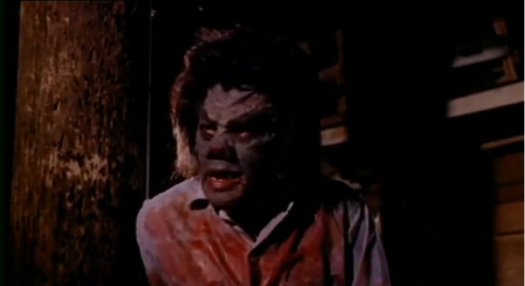 1971’s “Beast of the Yellow Night”
 Franklyn Carlysle (William Katt) is a fine, upstanding city councilman, with a rich wife (Wendy MacDonald) and a bright future. Carlysle wants to be mayor and he’s come up with the perfect scheme. He’s going to work with a developer to renovate Dante’s Square, the city’s notorious red light district.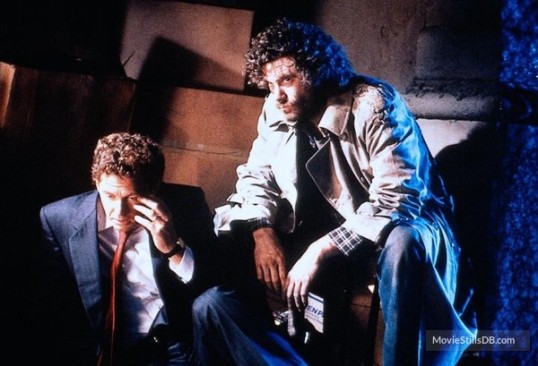



 Through the Shattered Lens