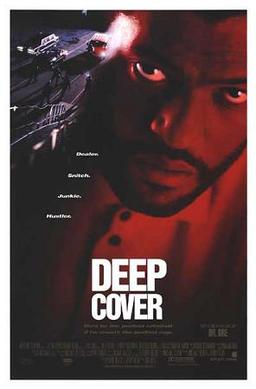
Deep Cover (1992, directed by Bill Duke)


When Russell Stevens was 10 years old, he saw his father get gunned down while holding up a liquor store.  Now, 20 years later, Russell (Laurence Fishburne) is a cop who is so straight that he doesn’t even drink.  But because of his father’s background, a psychological profile that indicates Russell is unique suited to understand how the criminal mind works, and the fact that he has no loved ones at home, he is recruited to work undercover.  His weaselly handler, Carver (Charles Martin Smith), explains that going undercover means that Russell is going to have to become a criminal 24/7.  He can’t just do his job for 8 hours a day and then go back to his normal life at night.

With the government’s money, Russell sets himself up as a dealer, buying and selling the drugs that are destroying his community.  It does not take long before Russell meets David Jason (Jeff Goldblum), a lawyer and aspiring drug kingpin.  At first, David makes Russell as being an undercover cop but, after Russell is arrested by the righteous but clueless Detective Taft (Clarence Williams III), David changes his mind and brings Russell into the operation.  The line between being a cop and a criminal starts to blur, especially after David and Russell start to bond over their mutual dislike of their boss, Felix (Gregory Sierra).  It doesn’t take long for Russell to get in over his head.

There have been a lot of films made about undercover cops losing themselves in their new criminal identity but few take the story to its logical conclusion like Deep Cover does.  Russell may start out as a straight arrow but, by the end of the movie, he’s killed a dealer in cold blood and broken his own personal pledge to never do cocaine himself.  He also discovers that David is often a more trustworthy partner than his own colleagues in law enforcement.  Fishburne and Goldblum both give excellent, spot-on performances as Russell and David and they’re supported by an able cast of weasels and tough guys.  I especially liked Charles Martin Smith’s performance as Carver.  (When Russell asks Carver if he’s ever killed a man, Carver laughs and says that he went to Princeton “just to avoid that shit.”)  Gregory Sierra is also great in the role of Felix and I loved that, of all people, Sidney Lassick played one of Felix’s henchmen.  That’s like seeing John Fiedler play the Godfather.

One of the best crime thrillers of the 90s, Deep Cover is not only a detective film but it’s also a politically-charged look at why America’s war on drugs was doomed to failure.  No sooner does Russell get into position to catch the man behind Felix’s operation than he’s told to drop the case because the State Department thinks that the drug lord could be politically helpful to them in South America.  As Russell discovers, the War on Drugs is more interested in taking out the soldiers on the streets than the generals in charge.  While men like Carver sit in their offices and move people around like pieces on a chess board, people like Russell are left to clean up the mess afterward.
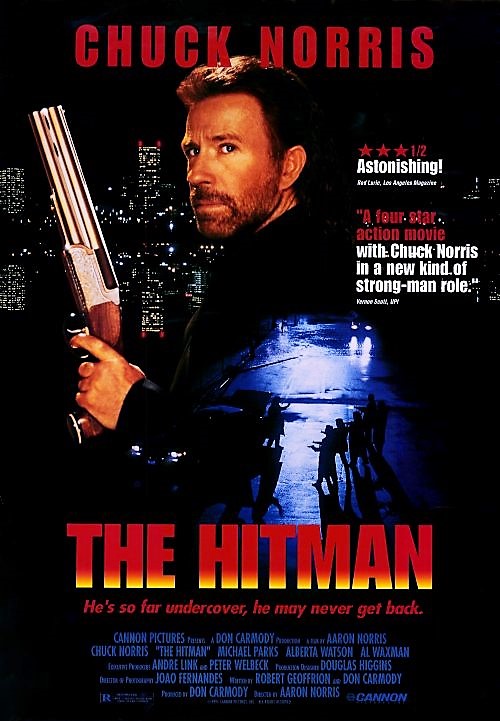
The Hitman (1991, directed by Aaron Norris)


When cop Cliff Garrett (Chuck Norris) gets shot by his corrupt partner, Ronny Delaney (Michael Parks), he dies and nearly gets to go to heaven.  However, at the last minute, the doctor’s manage to bring Cliff back to life.  Since everyone believes Cliff to be dead, his superiors come up with a brilliant plan.  What if Cliff changes his name to Grogan, grows his hair long, and goes undercover as a hitman?

Cliff’s up for it and is soon working for an Italian mobster named Marco Luganni (Al Waxman).  Marco wants to eliminate all of the other mobsters in town but he also has to deal with a bunch of drug-dealing Iranians who are trying to move in on his territory.  Cliff soon works his way into the inner circle and plays all sides against each other.  What’s strange is that Cliff manages to fool everyone into thinking that he’s Grogan despite the fact that all he’s really doing is wearing his hair long.  In fact, the only person who he doesn’t fool is his former partner, Delaney.  Delaney is not happy to discover that Cliff is still alive and sets out to take him out once and for all.

Because this is a Chuck Norris film, there’s a subplot where Cliff helps a bullied youth named Tim (Salim Grant) learn how to stick up for himself.  One thing that set Chuck Norris apart from other 80s action heroes is that Chuck always tried to teach all the kids in the audience of his R-rated films a good lesson about staying off drugs, standing up to bullies, and not doubting the American way.  I always have mixed feelings about this aspect of Chuck’s films because the message scenes usually don’t fit in with the rest of the narrative and it’s always questionable if a film featuring Chuck killing people is the right place for a wholesome life lesson but, at the same time, Chuck is so sincere that these scenes usually feature his best acting.  When Tim beats up a bully and then Chuck beats up the bully’s father, it really makes you realize that someone missed an opportunity by not making a movie where Chuck Norris played a computer science teacher who prepared his students not just for a career in STEM but also taught them how to put the members of football team in their place.  In the case of The Hitman, the crime subplot and the bullying subplot come together when Delaney decides to use Tim to strike at Cliff.

The Hitman is one of Chuck’s later films, which means the budget is lower than the films he did for Cannon and the action scenes are not as elaborate.  Chuck’s brother, Aaron, directs and he does okay but he’s no Joe “Missing In Action” Zito or Menahem “Delta Force” Golan.  The fight scenes are competently done in a workmanlike manner but they’re never as exciting as what we’ve come to expect from the Norris brand.  The main appeal here is to see Chuck Norris and Michael Parks in the same movie.  Chuck, as always, underplays while Parks, as always, overplays and it’s always entertaining to watch them go at each other.  Otherwise, The Hitman is for Chuck completists only.

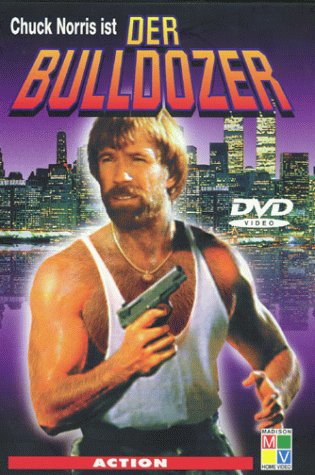
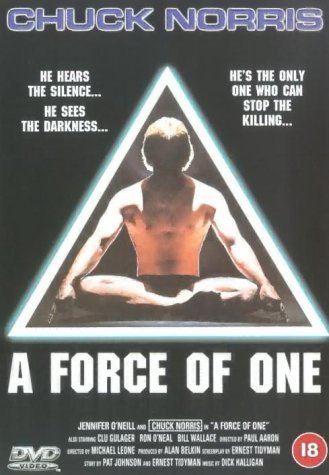
A Force of One (1979, directed by Paul Aaron)


Someone is targeting a squad of undercover narcotics detectives, killing them by taking them by surprise and breaking their necks before they even have a chance fight back.  Lt. Dunne (Clu Gulager) doesn’t like seeing his best detectives getting murdered so he orders all of them — including Mandy Rust (Jennifer O’Niell) and Rollins (Superfly himself, Ron O’Neal) — to take martial arts training so that they can defend themselves.  And who better to train them than karate champ and dojo owner, Matt Logan (Chuck Norris)?  The no-nonsense Logan teaches the detectives a few moves and even starts a tentative romance with Mandy.  But when his adopted son (played by future director Eric Laneuville) is murdered by the drug dealers, Logan goes from being a teacher to being an avenger.

Since today is Chuck Norris’s 80th birthday, it only seems appropriate to review one of Chuck Norris’s better films.  A Force of One was made at a time when Chuck was still trying to make the transition from being the karate instructor to the star to being a star himself.  Norris had been disappointed by his previous few starring vehicles, all of which strangely played down Norris’s martial arts skills.  After his friend and student, Steve McQueen, told Chuck that he needed to specialize in playing strong, silent types, Norris followed his advise with A Force Of One, which features considerably less dialogue than Norris’s previous films but also a lot more fighting.

Though the character may be named Matt Logan, Chuck Norris is basically playing himself in A Force of One.  In the scenes where he’s training the detectives and talking about why he’s personally so opposed to drugs, Chuck comes across as so earnest that it doesn’t matter that he’s not much of an actor.  What he’s always lacked in range, Chuck makes up for in general badassery and A Force Of One features him at his most badass.  Chuck’s final fight with the ninja assassin is one of his best.

Jennifer O’Neill got top billing in A Force Of One and she and Chuck actually have decent romantic chemistry.  She seems to bring him a little bit out of his shell and she’s also actually believable as a tough cop.  Because this was early in Chuck’s career and the script was co-written by police procedural specialist Ernest Tidyman, A Force Of One spends as much time following round the other cops as it does with Chuck and the squad’s camaraderie is believable.  The cops are all played by good character actors like Ron O’Neal, Clu Gulager, Pepe Serna, and James Whitmore Jr. and they all give pretty good performance while, at the same time, not upstaging Chuck.

One final note: There’s a scene where Chuck and Jennifer O’Neill are in an evidence room.  Keep an eye out for a box that is labeled K. Reeves.  That’s a reference to director Paul Aaron’s stepson, Keanu Reeves, who worked as a production assistant on this film.

The German version of A Force Of One

Spring Breakdown: Jurassic Shark (dir by Brett Kelly)


When it comes to Spring Break, there’s nothing worse than having all of your plans ruined by a prehistoric shark.

I mean, let’s just ask the characters at the center of the 2012 film, Jurassic Shark.  Jill (Emannuelle Carriere), Tia (Christine Emes), Kristen (Celine Filion), and Mike (Kyle Martellacci) were planning to spend their Spring Break taking a boat across the least impressive lake in Canada.  They thought it would be a good time but then the giant shark showed up, ate Mike, and left Jill, Tia, and Kristen stranded on a tiny island….

“Wait?” you’re saying,  There’s a shark in a lake?”

Yes.

“Sharks can’t live in lakes.”

This one can.

“Why?”

Because it’s prehistoric and shit.  Hence, the name of the film.

“But if it’s prehistoric, what’s it doing alive in the 21st Century?”

Well, y’see, the shark was frozen in a glacier but than a big evil oil company did some big evil things and, as a result, the glacier either melted or it fell apart or maybe there was an earthquake or something and now, as a result, there’s a big prehistoric shark swimming around the lake.

“That doesn’t make any sense.”

It doesn’t have to make sense.  It’s a Spring Break shark movie.  Now, if I may continue my review….

Anyway, Jill, Tia, and Kristen are stranded on an island but it turns out that they’re not alone!  Not only is there a random oil company scientist guy but there’s also three suspicious-looking people who are dressed in all black and are carrying guns!  It turns out that the people dressed in all-black are art thieves.  They were attacked by the shark while trying to make a getaway with a stolen painting.  Now, the painting is at the bottom of the lake and no one can retrieve it because of the prehistoric shark.  However, once everyone gets together, surely they can figure out a way to escape with a minimal loss of life….

Nope!  Not going to happen!  Unfortunately, no one on the island is smart enough for the audience to really root for.  Instead of working together, they just point guns and debate who is going to distract the shark while someone else gets the painting.  This is a movie that will have you cheering for the shark all the way, which is probably the way it was meant to be.  Out of everyone in the film, the shark’s got the most personality and it’s always easy to understand his motivations.  He wants to eat.  It’s as simple as that.

The main reason I watched Jurassic Shark is because it’s got a 1.5 rating on the imdb and was, for a little while, the lowest rated film on the entire site.  Whenever I discover that a film is disliked by that many people, I simply have to watch.  As is often the case, I think the imdb voters are being a bit overly critical with Jurassic Shark.  Yes, the film is pretty bad and the shark spends way too much time offscreen.  There’s way too many scenes of people slowly walking from one end of the island to the other.  There are some major continuity errors and the CGI is really bad and there’s a scene that’s supposed to be set at night but the day for night lighting is so ineptly handled that it’s almost to follow what’s going on.

But — and here’s the thing — there’s absolutely nothing about this film that indicates that it was meant to be taken seriously.  I think for a film to be truly terrible, it has to lack self-awareness.  It has to be clueless as to how bad or silly or pretentious it is.  For better or worse, Jurassic Shark seems to realize that it’s a low-budget Z-grade horror film and that sets it apart from a serious relationship drama like The Room or an environmentalist statement like Birdemic.  I mean, as easy as it is to criticize almost every aspect of Jurassic Shark, this is a film that features a slow-motion shot of giant shark flying over someone’s head.  It’s a scene that is just ludicrous and silly enough to work.

Jurassic Shark may not be good but it’s not really pretentious enough to be terrible.  If nothing else, it teaches the viewers an important lesson about how easily Spring Break can go wrong, especially when you’re celebrating in Canada.  For the most part, it’s a forgettable film but it has just enough lunacy to occasionally be memorable.

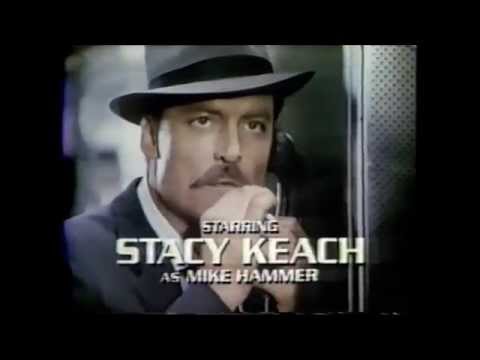
Murder Me, Murder You (1983, directed by Gary Nelson)


When two employees of an all-female courier service are murdered, Private Investigator Mike Hammer (Stacy Keach) is on the case.  The service was owned by his ex-girlfriend, Chris (Michelle Phillips), and she wants him to protect her while she testifies in front of a grand jury.  It turns out that her courier service has gotten involved in some shady business, transporting deliveries between a helicopter company and a South American dictator.  Chris fears that she’ll be murdered to keep her from testifying.  Hammer agrees to protect her and she tells him that he has a 19 year-old daughter who he’s never met.

While Chris is testifying, she suddenly dies on the stand.  The doctors say that it was a heart attack but Hammer knows that it was murder.  Hammer sets out to not only get revenge for Chris but also to find his daughter, who has disappeared into the world of underground pornography.  It’s all connected though, as is traditional with Mike Hammer, it can sometimes be difficult to keep up with how.

Murder Me, Murder You was a pilot film for a brief-lived but fondly-remembered Mike Hammer TV series that aired in the 80s.  Murder Me, Murder You takes Mickey Spillane’s famous detective into what was then the modern age but it allows him to remain a man of the hard-boiled noir era.  Hammer’s narration is tougher than leather, he’s more interested in listening to swing music than new wave, and he still dresses like an old-fashioned private eye, complete with a fedora on his head.  As played by Stacy Keach, he’s also just as dangerous and quick to kill as Hammer was in Spillane’s original novels.  In the novels, Hammer was an unapologetic brute who often bragged about how much he enjoyed killing criminals and communist spies and whose closest associate was his gun, which he nicknamed Betsy.  When Spillane’s novels were filmed, the violence of Hammer’s character was often downplayed.  (A notable exception was Robert Aldrich’s Kiss Me Deadly, which suggested that Hammer was such a fascist that he would eventually be responsible for the end of the world.  The Mike Hammer of Spillane’s novels would probably dismiss Kiss Me Deadly as being red propaganda and set out to deliver American justice to the Hollywood communists who wrote it.)  In Murder Me, Murder You, Mike Hammer is just as brutal an avenger as Spillane originally imagined him to be.  With his hulking frame, grim eyes, and his surly manner, Stacy Keach is the perfect Mike Hammer.

Murder Me, Murder You is a convoluted and often difficult-to-follow murder mystery but with Keach’s bravura lead performance, a strong supporting cast (including notable tough guys Tom Atkins and Jonathan Banks) and good direction from TV movie vet Gary Nelson, this movie comes about as close as any to capturing the feel of Mickey Spillane’s original novels.  Murder Me, Murder You was released on DVD fourteen years ago.  Though it is now out-of-print, copies are still available on Amazon.

Spring Breakdown: 7 Deadly Sins (dir by Glenn Plummer)


Before I really get started on this review, I think I should make clear two things:

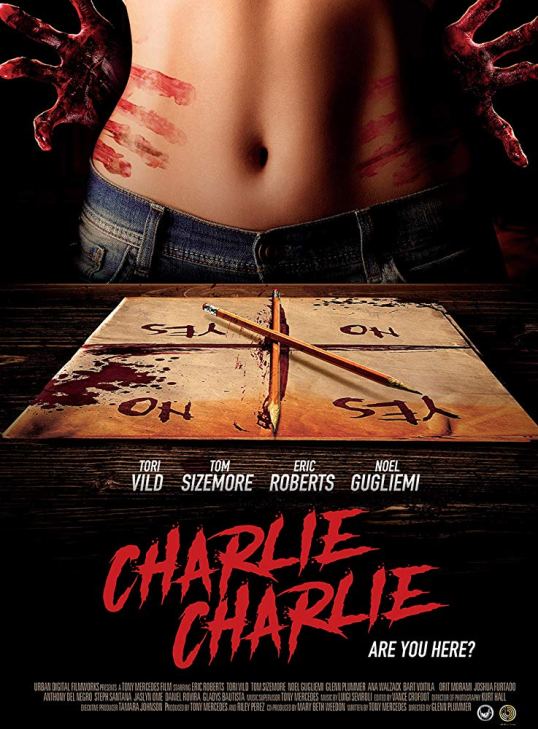
First off, this film can be found, for free, on Amazon Prime under the title 7 Deadly Sins.  That’s also the title under which it’s listed on the imdb.  However, all of the poster art that I’ve found for this film indicates that this film was originally entitled Charlie Charlie.  It makes sense, as the whole point of the film is that 7 idiots play a game called “Charlie Charlie,” where the point is to talk to some dead guy who never went to church and was therefore never cleansed of his sins.  Apparently, playing Charlie Charlie gets you killed.  Who would have guessed contacting an evil spirit would have such dire consequences.

Secondly, I tend to be forgiving of low budget horror films.  Some of my favorite films are low-budget horror films.  I respect any director who can create a frightening scene or maintain an ominous atmosphere on a low budget.  If you can make the paranormal seem real even when you can’t afford CGI, I have a tremendous amount of respect for your filmmaking skills.  My point is that when I tell you that this is not a good film and that it’s actually one of the worst horror films that I’ve seen in  while, I’m not just saying that because of the low budget.  I’m saying it because the movie freaking sucks.

7 Deadly Sins takes place at a Spring Break house party being thrown by the least likable teenagers on the planet.  Most of them are celebrating because it’s their last Spring Break before college.  Jamal (Steph Santana), on the other hand, is celebrating because it’s his last weekend before he starts a five year prison sentence.  At the start of Spring Break, Jamal was pulled over by a cop who discovered a huge amount of weed in the trunk of his car.  Apparently, in the world of 7 Deadly Sins, the justice system moves a lot quicker than it does in the real world because it only takes Jamal a few days to be found guilty and sentenced to prison.

Jamal’s girlfriend, Kim (Tori Vild), was in the car as well.  However, because she’s rich and she’s white, she’s only sentenced to a few months of house arrest.  She has to wear an ankle bracelet and listen to her racist mom and her pervy stepfather complain about her boyfriend. Kim swears to Jamal that she’ll wait for him to get out of prison.  Jamal suggests a threesome to help him prepare for life behind bars.  Kim kicks him out of her room.  It’s that type of party.

Sara (Gladys Bautista) has been hired, by Kim’s stepfather, to keep an eye on Kim for the weekend.  Kim is upset because Sara is Mexican and they’re both the same age.  Sara is upset because everyone screwed up the Charlie Charlie game.  “You have to play the game,” she repeats, “You have to repent your sins.”

“Shit’s fucked up,” Jamal says at one point and he’s probably right.

Anyway, 7 Deadly Sins is one of those films that tries to be both a horror film and a comedy but it doesn’t work as either, largely because the characters aren’t sympathetic enough to care about and none of the actors are particularly comedic.  You don’t care when they die and it’s hard to be amused when someone says that Sara should be selling oranges along the freeway.

7 Deadly Sins does feature two semi-celebrity cameos.  Tom Sizemore plays a dude in an mental hospital while Eric Roberts plays the judge who sentences Jamal and Kim.  Eric Roberts has a lot of fun with his role, railing about how much he hates drug dealers and marijuana.  Unfortunately, Roberts only gets one scene and then he’s out of the film.

Anyway, 7 Deadly Sins is pretty dumb.  It takes forever to get to the “Charlie Charlie” game and it doesn’t do anything particularly creative with any of the sins.  (At one point, we see written in blood: “Envy is a sin.”  Well, no shit.)  As far as Spring Break horror films go, you could just go down to Galveston and shoot your own and the end results would probably be superior to this one.

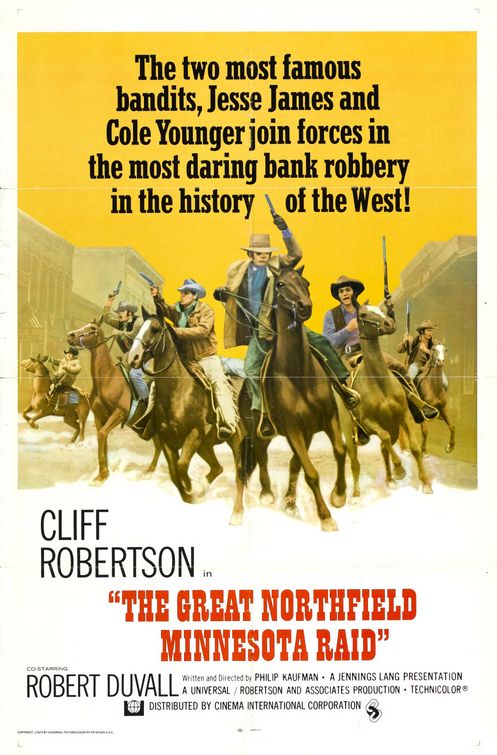
The Great Northfield Minnesota Raid (1972, directed by Philip Kaufman)


Despite having received pardons from the Missouri legislature in recognition of their military service to the Confederacy, Jesse James (Robert Duvall) and Cole Younger (Cliff Robertson) simply cannot stop robbing banks.  The James-Younger Gang has set their sights on the bank in Northfield, Minnesota, which is said to be the biggest bank west of the Mississippi.  Cole arrives in Northfield before the rest of the gang and scouts the location.  What he discovers is that most of the town’s citizens aren’t putting their money in the bank because they all assume that it will eventually be robbed.  With Jesse determined to pull off the crime of the century, Cole and Jesse have to figure out not only how to escape after the robbery but also how to get the people to deposit their money in the bank’s vault in the first place.

Philip Kaufman is a director who made a career out of reinterpreting history (his best known film is The Right Stuff) and, when it was first released in 1972, The Great Northfield Minnesota Raid was a revisionist western that mixed moments of comedy with moments of brutal violence.  Today, of course, presenting Jesse James and Cole Younger as being ruthless outlaws is no longer that daring of a narrative choice.  In The Great Northfield Minnesota Raid, Robert Duvall plays Jesse as being the western equivalent of a corrupt businessman, sending others to do his dirty work and not accepting any of the consequences for his own bad decisions.  Robertson plays Cole as being more a free spirit, an outlaw who is determined to enjoy himself.  Both of them give interesting performances but they also seem to be too contemporary for the characters that they’re playing.

Like most revisionist westerns of the early 70s, the film is full of hints that the old west and the time of the outlaws is coming to an end.  There’s a steam engine sitting outside of the bank and Kaufman spends almost as much time focusing on people reacting to that as he does on the planning and execution of the robbery.  When the robbery does finally occur, it’s not an easy robbery like you might find a 1940s western.  Instead, it’s a violent comedy of errors that leaves much of the film’s characters dead or wounded in the streets of Northfield.  The contrast between the quirky comedy of the first part of the film and the violence of the robbery is occasionally interesting but it often feels forced.  Sometimes, Kaufman seems like he’s trying too hard to be Sam Peckinpah.  In the end, Kaufman often doesn’t seem to be sure what he’s trying to say with this film.  He seems to be suggesting that Jesse and Cole are soon to be relics of a bygone era but why then cast Duvall and Robertson in the roles and have them play the roles like two mid-level hoodlums in 20th Century New York?

It’s an interesting but muddled film that never quite works.  For the definitive film about the James/Younger Gang, check out Walter Hill’s The Long Riders.

Film Review: Spenser Confidential (dir by Peter Berg)


Spenser Confidential, which is currently streaming on Netflix, is the latest Mark Wahlberg/Peter Berg collaboration.

It’s a crime film and it’s set in Boston and it will probably remind you every other Boston-set crime film that you’ve ever seen.  It’s got all the usual ingredients.  People sing Sweet Caroline.  A fat gangster wears a tracksuit.  We get a long overhead shot of the streets of Southie and there’s a scene set in an Irish bar.  One of the film’s big scenes takes place at what appears to be a deserted racing track.  (I’ve never been to Boston but, just from the movies, I know that the city is basically made up of Harvard, Southie, and hundreds of deserted race tracks.)  The Red Sox get a shout-out.  And, of course, the movie stars Mr. Boston himself, Mark Wahlberg.  Seriously, if your Boston movie doesn’t feature Mark Wahlberg or an Affleck brother, it might as well just be a St. Louis movie.

In this one, Mark Wahlberg plays Spenser.  Spenser was a cop until a gangster in a tracksuit murdered someone from the neighborhood and the head of homicide tried to bury the case.  This led to an angry Spenser beating the man up in front of his own house.  Spenser was sent to prison, where he served five years as an ex-cop in the general population.  That’s right!  He wasn’t even put in protective custody but somehow, he survived.  Right before Spenser is released from prison, he’s attacked by a Neo-Nazi who is played by Post Malone.  It’s not really that relevant to the overall plot but it does give viewers a chance to say, “Wait a minute …. is that Post Malone?”

Anyway, once he gets out of prison, Spenser moves in with his mentor and former boxing coach, Henry Cimoli (Alan Arkin).  He also gets a new roommate, an aspiring MMA fighter named Hawk (Winston Duke).  After Captain Boylan,  the head of homicide — yes, the same guy that Spenser beat up five years ago, is decapitated by 20 sword-carrying assailants, Spenser is the number one suspect.  Fortunately, for Spenser, another cop commits suicide and it’s quickly announced that the cop who killed himself also killed Boylan.  It’s a murder/suicide!  So, Spenser’s off the hook and I guess the movie’s over, right?

Nope, it doesn’t work like that.  It turns out that Spenser has his doubts about the whole story and he wants to investigate because he has “a strong moral code.”  Unfortunately, as a convicted felon, Spenser is not allowed to become a private investigator.  So, Spenser and Hawk conduct an unofficial investigation, which largely amounts to talking to Spenser’s former partner, Driscoll (Bokeem Woodbine) and getting into a brawl while Sweet Caroline plays in the background.

It’s a Boston thing.

The mystery are the heart of the film pretty much leads exactly where you think it’s going to lead.  For a 2-hour crime thriller, there aren’t exactly a lot of twists and turns to be found in Spenser Confidential, which is a problem.  The mystery’s solution is so obvious that it’s hard not to resent the fact that Spenser is apparently too stupid to figure it out on his own.  There’s an extended scene where he gets attacked by a dog and you know what?  That would have never happened to any other movie detective because every other detective would have figured out who the murderer was long before getting attacked by that dog.

On the plus side, Peter Berg knows how to stage a fight scene and he also knows how to make the best use of Wahlberg’s mix of sensitivity and working class arrogance.  Unfortunately, the rest of the cast is let down by a script that doesn’t give them much to do.  Winston Duke is physically imposing as Hawk but he spends too much of the film standing around and waiting for Spenser to take the lead.  Alan Arkin appears to be having fun in the role of Henry but again, his character is underwritten.  About the only person, other than Wahlberg, who gets to make much of an impression is Iliza Shlesinger, who is cast as Spenser’s ex-girlfriend.  Shlesinger may be playing a stereotype (she’s loud, crude, and has a thick Boston accent) but she fully embraces the character and makes her seem like the only person in the film who actually has a life beyond what’s happening onscreen at any given moment.

Anyway, Spenser Confidential isn’t terrible as much as it’s just forgettable.  It’s a generic Boston crime film and you can probably safely watch it if you’re not looking for something to which you would actually have to pay attention.  Some of the action scenes are well-shot.  If you liked Mark Wahlberg in other films, you’ll probably like him in this.  Whether you enjoy it or not, you’ll probably forget about this film about an hour after watching it.

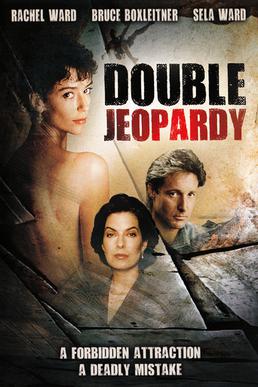
Double Jeopardy (1992, directed by Lawrence Schiller)


Salt Lake City is riveted by the sensational murder trial of mountain climber Lisa Burns Donnelly (Rachel Ward).  Lisa killed her ex-boyfriend, Eddie.  She says that she did it in self-defense after Eddie raped her.  The prosecution claims that she murdered Eddie after he caught her cheating on him with another man.  Lisa’s lawyer, Karen Hart (Sela Ward), is up for a judgeship.  Her husband, Jack (Bruce Boxleitner) is Lisa’s ex-boyfriend.  What Karen doesn’t know is that, other than Lisa, Jack is the only person who witnessed what happened the night of the murder because, just moments before, he and Lisa had been committing PG-13-rated adultery in her shower.

One of the interesting things — in fact, maybe the only interesting thing — about Double Jeopardy is that several online sellers claim that the film stars Aaron Eckhart.  It is true that Eckhart is in the movie.  It was shot in Salt Lake City while he was a student at BYU and it was his film debut.  However, Eckhart has about a minute of screen time and about five lines.  He plays a Marine named Dwayne who someone meets in an airport.  His big line is, “Semper Fi, babe!”

As for the film, since it’s set in Salt Lake City, there’s a lot of talk about how Lisa is being unfairly judged for her unconventional (read: non-Mormon) life style and there’s a heavy-handed subplot about Jack trying to put on a production of The Crucible but it doesn’t add up too much.  It would probably have been easier for the movie to make a point about religious and moral persecution if Lisa wasn’t actually guilty of murdering Eddie.  Instead, the movie leaves you thinking, “Maybe those Mormons have a point.”

Double Jeopardy tries hard to be something more than your standard legal thriller but it’s pretty forgettable.  Rachel Ward was always a great femme fatale and Sally Kirkland gives a good performance as the cop who sees through both Lisa and Jack.  The film was produced for Showtime at a time when cable was still trying to prove that it could provide original content worth paying for so there’s some cursing and sideboob tossed in, as if to say, “See?  You don’t get this on NBC!”  Otherwise, this is a by-the-numbers made-for-TV movie.

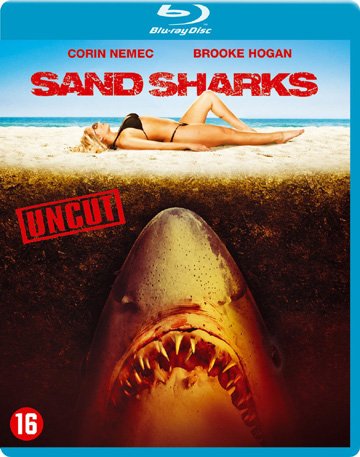
Spring Breakdown: Sand Sharks (dir by Mark Atkins)


“There ain’t no party like a Sandman party!” Jimmy Green (played by Corin Nemec) announces in the 2012 film, Sand Sharks, and he’s right.

Jimmy is infamous for throwing (or, at least, attempting to throw) big parties and organizing wild festivals.  This movie was made before the Fyre Festival but watching Jimmy as he runs around and assures everyone that he’s about to put together the greatest music festival that the world has ever seen, it’s hard not to be reminded of the determined and incompetent people who were behind that legendary disaster.  Then again, no one was eaten by a shark during the Fyre Festival.  Jimmy can’t make the same claim about his parties.

In fact, when we first meet Jimmy, he’s trying to rebuild his reputation after his previous party ended in tragedy.  Apparently, 15 people died at that party and, though we don’t get all the details, it’s insinuated that they were eaten by sharks.  Jimmy isn’t one to let shark-related tragedy get him down, however.  Instead, he’s doing to put on another Sandman Festival and this time, he’ll keep everyone on the beach and out of the water!  Fortunately, for Jimmy, his father just happens to be the mayor of a beachside community.

Unfortunately, it turns out that sharks aren’t just in the ocean.  There’s also on the beach, swimming underneath the sand.  They’re sand hharks!  Now, the movie does provide an explanation for why all of those sharks are moving around underneath the sand but it’s really not important.  The important thing is that they’re out and they’re eating just about everyone that they meet.  That’s going to be a problem as far as the Sandman Festival is concerned.  Fortunately, Jimmy and the authorities are able to kill one sand shark.  However, when Jimmy discovers that there’s more than one sand shark, he keeps that news to himself.  The show must go on!

You can probably guess what happens next….

The sand sharks are a lot of fun and this SyFy film provides plenty of spring break mayhem as festival goers are yanked under the sand but, for me, the main attraction of this film is seeing Corin Nemec just unleashed like a force of nature.  Nemec starts the film going at about 100 miles per hour and he doesn’t slow down for a single second.  As played by Nemec, Jimmy never stop talking and he never stops hustling and he’s so committed to putting on the greatest festival ever that it’s impossible not to like him, even if his actions do end up getting a lot of people killed.  Nemec seems to be having a lot of fun with the role of Jimmy and it’s just as much fun to watch him.

Of course, Jimmy isn’t the only character in the film.  Brooke Hogan plays Dr. Sandy Powers, who is a shark expert.  At one point, Sandy looks out at the beach and tells Sheriff John Stone (Eric Scott Woods) that “We’re stuck between a rock and a shark place,” and if you don’t cheer for that line, I worry about you and your sense of humor.  As that line indicates, Sand Sharks is a film that cheerfully embraces the ludicrousness of it’s storyline.  It doesn’t take itself too seriously and neither should you.  This is the type of film where people often snap, “Bite me!” right before a shark leaps out of the sand and does just that.  This is pure entertainment and, if you’re a fan of SyFy shark films, Sand Sharks is a lot of fun.  Between the sand sharks and Corin Nemec playing the hipster-from-Hell, what more could you want?