Film Review: Threads (dir by Mick Jackson)


Yesterday, after I watched the 1984 film, Threads, I sat on my couch for about ten minutes trying to catch my breath and trying to vanquish a sudden wave of anxiety.  I then watched old episodes of The Office and King of the Hill because I desperately needed to laugh.  I needed to get my mind off what I had just seen.

Threads is one of the most depressing films that I’ve ever seen.  It’s also one of the most disturbing.  The film opens a few days before a nuclear attack on the UK and it ends thirteen years later.  We meet two families, the Kemps and the Becketts.  The two families live in Sheffield, the fourth largest city in England.  The Kemps are working class while the Becketts are middle class.  They both seems like nice enough families.  Due to an unplanned pregnant, Ruth Beckett (Karen Meagher) and Jimmy Kemp (Reece Dinsdale) are planning on getting married.

While the two families get to know each other, we hear news stories in the background.  Russia has invaded Iran.  America has said that this act of aggression will not stand.  The world is heading towards war but hardly anyone seems to notice.  People are used to bad news and besides, what can be done about it?  The best assurance that the British government can offer its citizens is a series of out-dated public service announcements.  The Kemps build a makeshift bomb shelter out of a door and a mattress.  The Becketts prepare to head into the basement.  Over the radios and the television, an official voice informs listeners that, in case of a bombing, the safest thing to do is to lie down and be perfectly still.  The Sheffield emergency management board sets up operations in an underground bomb shelter, located underneath the city hall.  The members of the board chain smoke and argue.  No one really seems to know who is in charge.

Though the war starts with America and Russia launching missiles at each other, it’s not long before the UK is hit.  Sheffield is bombed because of its steel and chemical factories and the fact that a nearby airfield would probably be used to house American forces.  When we last see Jimmy, he’s running down a road, trying to get to Ruth.  The city becomes an inferno.  Those who aren’t killed in the fires are left to try to survive the nuclear winter, the radioactive fallout, the looters, and the heavily armed policemen who attempt to maintain order through fear, intimidation, and executions.

Ruth is the first to explore the remains of the city and her exploration becomes a literal walk through Hell.  Charred corpses and dead animals litter the rubble.  A woman sits in a corner, holding a dead baby.  A trip to the infirmary reveals people screaming agony as limbs are amputated with anesthetic.  Angry survivors demands to be given food, just to have tear gas fired at them by scarred policemen.  Every minute of the film, society collapses just a little bit more until soon, Ruth has gone from being a hopeful soon-to-be bride to being just another person desperate for a piece of bread.  Indeed, for me, one of the most disturbing parts of the film was that, after the bomb dropped, Ruth largely stopped speaking.  It makes sense, though.  What’s the point of talking when there’s nothing left to say?

But it doesn’t just end with Sheffield.  We follow Ruth as she leaves the city and then we watch over the next 13 years as the UK is reduced back to medieval levels.  Ruth gives birth to a daughter named Jane (Victoria O’Keefe), who grows up in a world where there is no structure or education.  How bad do things get?  At one point, we see Ruth prostituting herself in exchange for three dead rats, just so she and her daughter can eat.  Jane, for her part, is so poorly educated that she can barely speak in coherent sentences.

And the thing is, it just keeps going.  Every moment when you think that things can’t possible get any worse, Threads keeps going and shows you that things can and do get worse.  It’s a relentlessly grim film, a vision of a future that offers up zero hope.  It’s a thoroughly bleak film, one that’s made all the more powerful by the fact that all of the characters just seem like ordinary people who you could meet on any street corner.  As opposed to something like The Day After, in which the main characters included a doctor and a soldier, the characters in Threads have no idea what’s happening to them or what the future might hold.  (One character talks himself into eating a dead sheep despite the fact that it probably died due to radiation poisoning by pointing out that it’s possible that it died of something else.  The Day After at least had John Lithgow around to explain to everyone how radioactivity works.)  Instead, the Becketts and the Kemps simply have to try to survive day-to-day.  Most of them don’t make it.

Threads left me drained and exhausted.  It’s one of those incredibly powerful and grim films that I’ll probably never be able to bring myself to watch again.

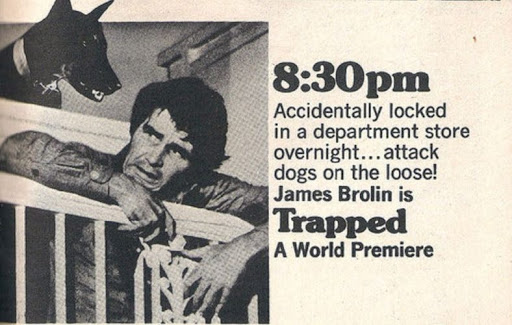
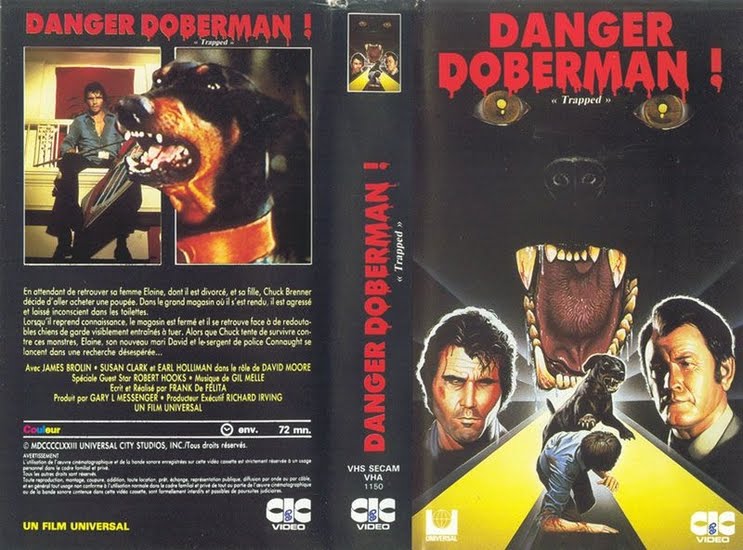
Trapped (1973, directed by Frank De Felitta)


Chuck Brenner (James Brolin) is out shopping when he’s mugged and left unconscious in a men’s room stall.  By the time Chuck wakes up, the store is closed for the weekend and the place is deserted except for him and six doberman guard dogs.  The dogs are trained to hunt down and attack anyone who shouldn’t be in the store and, as far as they’re concerned, that includes Chuck.  Chuck now has to survive the night and try to figure out a way to get out of the store.  Not helping is that Chuck still hasn’t recovered from taking a blow to the head and he’s been bitten by one of the dogs, leaving a blood trail for them to follow.

This made-for-TV movie is a simple but effective thriller about an ordinary man trapped in an extremely dangerous situation.  Frank De Felitta (who would later direct one of my favorite made-for-tv horror film, The Dark Night of the Scarecrow) does a good job of creating suspense as Chuck tries to make it from one area of the department store to the next without getting attacked.  (One of the best scenes involves Chuck, dizzy because he has a concussion, jumping from one cabinet to another while the dogs wait below him.)  Even dog lovers will become nervous as the dobermans prowl the aisles, looking for their prey.  James Brolin gives a good everyman performance and he’s ably supported by Susan Clark as his ex-wife and Earl Holliman as Clark’s new husband.  The film is so well-executed that it was only after it ended that I started to wonder why any store would leave six dog unsupervised in their store overnight.  Just the effort that would have to be made to clean up after them would cancel out whatever money was being saved by not using a human security guard.

Trapped has been released under several titles, the best known of which is The Dobermn Patrol.  My personal favorite, though, is Danger Doberman!

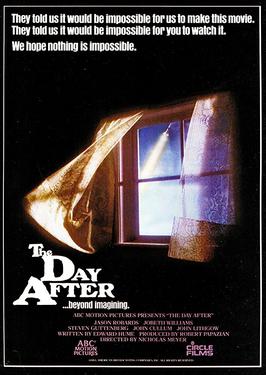
Film Review: The Day After (dir by Nicholas Meyer)


“This is Lawrence. This is Lawrence, Kansas. Is anybody there? Anybody at all?”

The words of Joe Huxley (John Lithgow) hang over the ending of The Day After, a 1983 film that imagines what the aftermath of a nuclear war would be like not on the East or the West Coasts but instead in the rural heartland of America.  Huxley is a professor at the University of Kansas and, as he explains early on in the film, Kansas would be an automatic target in any nuclear war because it houses a number of missile silos.  When he explains that, it’s in an almost joking tone, largely because the missiles haven’t been launched yet.  Instead, the only thing we’ve heard are a few barely noticed news stories about growing tensions between America and Russia.  About halfway through The Day After, the bombs go off and there are suddenly no more jokes to be made.

When the bombs drop over Kansas, we watch as cities and field and people burst into flames.  In a matter of minutes, several thousands are killed.  I’m almost ashamed to admit that I was probably more upset by the image of a horse being vaporized than I was by the death of poor Bruce Gallatin (Jeff East), the college student who was planning on marrying Denise Dahlberg (Lori Lethin).  I guess it’s because horses — really, all animals — have nothing to do with the conflicts between nations.  Humans are the ones who take the time to build bigger and better weapons and The Day After is one of the few films about war that’s willing to acknowledge that, when humans fight, it’s not just humans that die.

The bombing sequence is lengthy and I have to admit that I was a bit distracted by the fact that I recognized some of the footage from other movies.  A scene of panicked people running through a building was taken from Two-Minute Warning.  A scene of a building exploding and a construction worker being consumed by flames was lifted from Meteor.  As well, there’s some stock footage which should be familiar to anyone who has ever seen a documentary about the early days of the Cold War.  Still, despite that, it’s an effective sequence simply because it’s so relentless.  Some of the film’s most likable characters are vaporized before our eyes.  Steve Guttenberg, of all people, is seen ducking into a store.

Guttenberg plays Stephen Klein, a pre-med student who manages to survive the initial attack and takes shelter with the Dahlberg family at their ranch.  At first, it’s a bit distracting to see Steve Guttenberg in a very serious and very grim film about the nuclear apocalypse but he does a good job.  The sight of him losing both his teeth and his hair carries a punch precisely because he is reliably goofy Steve Guttenberg.

If the film has a star, it’s probably Jason Robards, the doctor who witnesses the initial blast from the safety of his car and then treats the dying in Lawrence, Kansas.  He does so, despite the fact that he doesn’t know if his wife, son, and daughter are even still alive.  He continues to do so until he also falls ill with radiation poisoning.  Knowing that he’s dying, he heads home just to discover that there is no home to return to.

Home is reccuring theme throughout The Day After.  Everyone wants to return to their home but everyone’s home has been wiped out.  “This is my home,” Jim Dahlberg (John Cullum) tries to explain before he’s attacked by a group of feral nomads.  Home no longer exists and trying to pretend like life can go back to the way it once was is an often fatal mistake.

Real happy film, right?  Yeah, this isn’t exactly a film that you watch for fun.  I have to admit that I made a joke about how I wouldn’t want to die while wearing the unfortunate blue jumpsuit that Jason Robards’s daughter chooses to wear on the day of the nuclear attack and I felt guilty immediately.  (Well, not that guilty.  Seriously, it was a terrible fashion choice.)  The Day After is a film that gives audiences zero hope by design.  It was made at a time when it was generally assumed that nuclear was inevitable and it was designed to scare the Hell out of everyone watching.  And while I can’t attest to how audience may have reacted in 1983, I can say that, in 2020, it’s still a powerful and disturbing film.

“Is anybody there? Anybody at all?” Joe Huxley asks and by the end of the film, the answer doesn’t matter.  The damage has already been done.

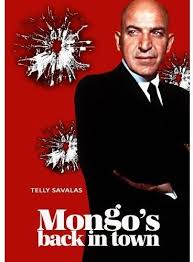
Mongo’s Back In Town (1971, directed by Marvin J. Chomsky)


During the Christmas season, Mongo (Joe Don Baker) returns home.  However, Mongo hasn’t just come back for the holidays.  Mongo is professional killer, one of the best in the business.  His older brother, mob boss Mike Nash (Charles Cioffi), has a job for him.  He wants Mongo to wipe out a rival gangster.  Mongo’s willing to do it but he expects to be properly compensated for his trouble.  Family is family but Mongo’s a professional and a professional has to get paid.  Lt. Pete Tolsted (Telly Savalas) and his partner, Gordon (Martin Sheen), are the two cops who know that Mongo is bad news and who are determined to discover why Mongo is back in town.  Meanwhile, Mongo is falling in love with the naive Vicki (a very young Sally Field), a young woman who has fled West Virginia and is looking to restart her life in the big city.

This made-for-TV movie may not contain any huge surprises but it’s worth tracking down just for the cast.  Joe Don Baker, Telly Savalas, Martin Sheen, and Sally Field, all in the same movie and all at the top of their considerable game?  That’s more than worth the effort.  Joe Don Baker, in particular, is good.  Unfortunately, Baker doesn’t always get the respect that he deserves an actor.  It’s true that he’s appeared in his share of bad films and his range is limited.  But whenever he was cast in the right role — like in this movie or the first Walking Tall — he was a force of nature.  What’s most interesting about Mongo is that he doesn’t really like his work and he resents that it’s something that he’s been trapped into doing but, at the same time, he’s so good at it that it’s hard not to wonder what other career he could have possibly found as much success in.

Mongo’s Back In Town was released theatrically overseas under the title Steel Wreath.  (Maybe someone realized that Mongo’s Back In Town makes the movie sound like a screwball comedy.)  It can be viewed, under its original title, on YouTube.


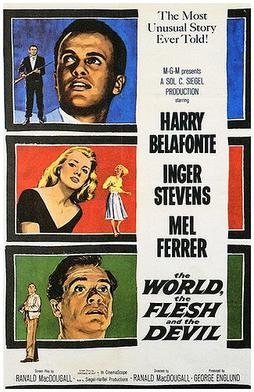
Film Review: The World, the Flesh, and the Devil (dir by Ranald MacDougall)


The 1959 film, The World, the Flesh, and the Devil, opens with a mine cave-in in Pennsylvania.  Trapped in the cave-in is a mine inspector named Ralph Burton (Harry Belafonte).  Despite being trapped underground, Ralph remains in surprisingly good spirits.  (In fact, as the movie progresses, Ralph’s tendency to joke when faced with bleak reality will become a recurring theme.)  Ralph sings to himself.  Ralph tells jokes.  Ralph listens to the sound of the men who are digging a tunnel to rescue him.  Except, one day, Ralph can no longer hear anyone digging.  Realizing that he’s going to have to save himself, Ralph manages to dig his way out of the cave.  Once again above ground, Ralph discovers that he’s alone.

The world has changed.  Cars and buildings sit deserted.  Everything that was made by mankind is still there but it’s all now empty.  Confused but understanding that something huge has happened, Ralph makes his way from Pennsylvania to New York.  During his journey, he comes across old newspapers and a recording in a radio station and he’s able to piece together what’s happened.  Some country — no one was ever sure which one — released a radioactive isotope into the atmosphere.  For five days, the air was poisoned.  Everyone who didn’t get to shelter died.  The only reason Ralph survived was because he was trapped underground.

At first, New York appears to be as deserted as Pennsylvania.  (The film was shot on location in Manhattan, reportedly in the early morning hours before rush hour, when there was no one on the streets.  The visuals of the empty city are often hauntingly bleak.)  Struggling to maintain his own sanity, Ralph steals two mannequins and spends his days talking to them.  He comes up with projects to pass the time.  He’s able to get the power flowing in Times Square.  And he even meets another survivor!

Sarah Crandall (Inger Stevens) was one of three friends who hid in a bunker when the world started to end.  Sarah’s two friends left the bunker after two days and were killed by the radioactive cloud.  Sarah waited the entire five days and survived.  Though we don’t learn much about her background, it’s heavily suggested that Sarah was rich and didn’t have a care in the world before society collapsed.  Now, she and Ralph are just happy to have found each other.

Sarah and Ralph quickly become friends.  Sarah has obvious romantic feelings towards Ralph but, to her frustration, he keeps his distance.  When Sarah asks why they don’t just live together instead of maintaining separate apartments, Ralph nervously jokes that if they got a place together, people would talk.  Sarah is white and Ralph is black.  When Sarah says that doesn’t matter anymore, Ralph tells her that it does matter and that she has no idea what his life was like before the world ended.  When a frustrated Sarah says that she can move in with Ralph because she’s “free, white, and 21 and I can do whatever I want,” Ralph looks like she’s just slapped him.  Later, Ralph tells her that, because she’s white, she will never be able to understand the pain that her words caused him.  I can only imagine how audiences in 1959 reacted to this scene.

Eventually, Ralph discovers that there are scattered survivors across the world.  One of them, Benson Thacker (Mel Ferrer), even comes to New York and joins Ralph and Sarah.  With the arrival of the white Thacker, Ralph suddenly finds himself being treated like a servant.  Thacker not only attempts to take over the group but he also tells Ralph that Sarah belongs to him.  When Thacker, a self-described “former idealist,” tells Ralph, “I have nothing against Negroes,” Ralph coldly replies, “That’s mighty white of you,” and again, the modern viewer cannot help but wonder how audiences in 1959 reacted to hearing those words uttered on a movie screen.

The World, the Flesh, and the Devil is a frequently fascinating film.  Belafonte brings a lot of charm and wit to the role of Ralph but he also doesn’t shy away from portraying Ralph’s anger at still being limited by the conventions of a society that, for all intents and purposes, has destroyed itself.  Ralph brings New York back to life, just to watch as Thacker moves in and claims it for himself.  Significantly, Thacker doesn’t view himself as being a racist.  Instead, in his mind, he’s simply living the way that he’s always lived.  By treating Ralph like a second class citizen, he’s keeping society alive.  Sarah, meanwhile, is torn between her desire to create a new world and the temptation to return to her spoiled and privileged upbringing.  While the film is dominated by Belafonte’s performance, both Inger Stevens and Mel Ferrer bring some shadings to characters that, in lesser hands, could have been extremely flat and predictable.

The film falls apart a bit during the third act.  The World, the Flesh, and the Devil spends a good deal of time building up to a rather downbeat climax just to suddenly reverse itself.  The film ends on a hopeful note that just doesn’t feel realistic after everything that we’ve just seen.  The film’s conclusion brings a promise of renewal that feels like it was tacked on at the last moment.  Still, up until that moment, it’s a compelling and intelligent film and one that’s feels ever more relevant today than it probably did in 1959.

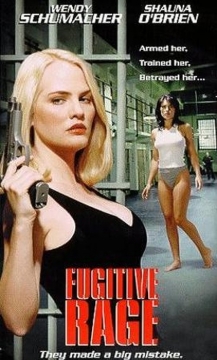
Cinemax Friday: Fugitive Rage (1996, directed by Fred Olen Ray)


When gangster Tommy Stompanato (Jay Richardson) is acquitted of murdering her sister, ex-cop Tara McCormick (Wendy Schumacher) gets justice her own way.  She shoots him.  Six times.  In the middle of a crowded courtroom.  Somehow, Tommy survives taking six bullets at point blank range while Tara is arrested and sent to prison.

In prison, Tara stands up to the usual collection of cruel inmates and predatory guards.  She bonds with her cellmate, Josie (Shauna O’Brien).  Josie may be a murderer but the only man she killed was her abusive husband so, like Tara, she had a good reason for committing her crime.  Tara and Josie become so close that when an federal agent named O’Keefe (Tim Abell) offers to spring Tara from jail in return for her help in taking down Tommy, Tara demands that Josie receive a pardon as well.

After O’Keefe agrees to her demands, Tara leaves the prison with him.  While they get busy at a safehouse, Tommy and his right-hand man, Ryker (Ross Hagen), arrange for Josie to be kidnapped from the prison.  With Josie being held as a hostage, it’s time for a final confrontation between Tara and Tommy.  There’s a “surprise” twist at the end so don’t you dare to tell anyone about the final ten minutes of Fugitive Rage.

Fugitive Rage may be a typical hyrbid of the action and women-in-prison genres but it’s also a Fred Olen Ray film, which means that it’s got even more nudity than expected and that it’s more self-aware of the conventions of the genre than some other films about women behind bars.  There’s a lot that you can say about Fred Olen Ray’s style of filmmaking but no one will ever accuse him of taking himself too seriously and Fugitive Rage at least has a sense of humor about itself.  It’s hard to watch scenes like the one where Tara guns down a crooked lawyer just because he’s a lawyer without thinking that Fugitive Rage is deliberately poking fun at itself.

Fugitive Rage ends with the promise that Tara and Josie are going to become the new “Thelma and Louise” but, as far as I know, Fugitive Rage never got a sequel.  Instead, it just found a home on late night Cinemax.

Film Review: Murder on the Orient Express (dir by Sidney Lumet)


There’s been a murder on the Orient Express!

In the middle of the night, a shady American businessman (Richard Widmark) was stabbed to death.  Now, with the train momentarily stalled due to a blizzard, its up to the world’s greatest detective, Hercule Poirot (Albert Finney), to solve the crime.  With only hours to go before the snow is cleared off the tracks and the case is handed over to the local authorities, Hercule must work with Bianchi (Martin Balsam) and Dr. Constantine (George Coulouris) to figure out who among the all-star cast is a murderer.

Is it the neurotic missionary played by Ingrid Bergman?  Is it the diplomat played by Michael York or his wife, played by Jacqueline Bisset?  Is it the military man played by Sean Connery?  How about Anthony Perkins or John Gielgud?  Maybe it’s Lauren Bacall or could it be Wendy Hiller or Rachel Roberts or even Vanessa Redgrave?  Who could it be and how are they linked to a previous kidnapping, one that led to the murder of an infant and the subsequent death of everyone else in the household?

Well, the obvious answer, of course, is that it had to be Sean Connery, right?  I mean, we’ve all seen From Russia With Love.  We know what that man is capable of doing on a train.  Or what about Dr. No?  Connery shot a man in cold blood in that one and then he smirked about it.  Now, obviously, Connery was playing James Bond in those films but still, from the minute we see him in Murder on the Orient Express, we know that he’s a potential killer.  At the height of his career, Connery had the look of a killer.  A sexy killer, but a killer nonetheless….

Actually, the solution to the mystery is a bit more complicated but you already knew that.  One of the more challenging things about watching the 1974 version of Murder on the Orient Express is that, in all probability, the viewer will already know how the victim came to be dead.  As convoluted as the plot may be, the solution is also famous enough that even those who haven’t seen the 1974 film, the remake, or read Agatha Christie’s original novel will probably already know what Poirot is going to discover.

That was something that director Sidney Lumet obviously understood.  Hence, instead of focusing on the mystery, he focuses on the performers.  His version of Murder on the Orient Express is full of character actors who, along with being talented, were also theatrical in the best possible way.  The film is essentially a series of monologues, with each actor getting a few minutes to show off before Poirot stepped up to explain what had happened.  None of the performances are exactly subtle but it doesn’t matter because everyone appears to be having a good time.  (Finney, in particular, seems to fall in love with his occasionally indecipherable accent.)  Any film that has Anthony Perkins, John Gielgud, Lauren Bacall, Sean Connery, Ingrid Bergman, and Albert Finney all acting up a storm is going to be entertaining to watch.

Though it’s been a bit overshadowed by the Kenneth Branagh version, the original Murder on the Orient Express holds up well.  I have to admit that Sidney Lumet always seems like he would have been a bit of an odd choice to direct this film.  I mean, just consider that he made this film in-between directing Serpico and Dog Day Afternoon.  However, Lumet pulls it off, largely by staying out of the way of his amazing cast and letting them act up a storm.  It looks like it was a fun movie to shoot.  It’s certainly a fun movie to watch, even if we do already know the solution.

Film Review: Testament (dir by Lynne Littman)


The 1983 film, Testament, is about death.  It’s about the death of a family, the death of a town, the death of a way of life, and the death of hope.

And you may be saying, “Well, gee, Lisa — that sounds like a really happy movie.”

Well, it’s not meant to be a happy movie.  Testament is a painfully grim movie about the end of the world.

The movie takes place in the town of Hamelin, California, which we’re told is 90 minutes away from San Francisco.  It’s a nice town, the type of place where everyone knows each other.  Mike (Mako) runs the local gas station and cares for his disabled son, Hiroshi (Gerry Murillo).  Elderly Henry Abhart (Leon Ames) spends his time on his radio, talking to strangers across the world.  Fania (Lilia Skala) offers up piano lessons.  Father Hollis (Philip Anglim) looks over the spiritual needs of the parish.  It’s a normal town.

The town is home to the Weatherlys.  Carol (Jane Alexander) is a stay-at-home mom who does volunteer work and who is directing the school play.  Tom (William Devane) is a common sight riding his bicycle through town every morning before heading off to work in San Francisco.  They have three children.  Mary Liz (Roxanna Zal) is a teenager who is taking piano lessons.  Brad (Ross Harris) is always trying to impress his father and is looking forward to his 14th birthday.  Scottie (Lukas Haas, in his first film) is the youngest and never goes anywhere without his teddy bear. They’re a normal family living a normal life in a normal town.

And then, one day, everything changes.  Scottie is watching Sesame Street when the program is suddenly interrupted by a clearly terrified anchorman who announces that New York has been bombed.  The president is about to speak but, before he can, there’s a bright flash of light, an distant explosion, and the entire town loses power.

At first, the people of Hamelin try to remain hopeful.  Though Tom works in San Francisco and San Francisco is among the many cities that have apparently been bombed (by who, we never learn), he also left a message on the family’s answer machine, telling them that he was on his way home.  Even with Tom missing, Carol continues to insist the he’ll be coming home at any minute.

Tom doesn’t come home.

The rest of the film follows the slow death of the town.  Even though the town was not damaged by the blast, the fallout soon hits.  Cathy (Rebecca De Mornay) and Phil (Kevin Costner) bury their newborn baby after it falls ill from radiation poisoning.  Mike, Henry, and Fania all start to grow physically ill and, in some cases, dementia sets in.  Father Hollis goes from being hopeful to being tired and withdrawn as he tries to attend to each and every death.  Larry (Mico Olmos), a young boy whose parents have disappeared, briefly moves in with the Wetherly family.  He disappears about halfway through the movie and we never learn if he left or if he died.  All we know is that no one mentions him or seems to notice that he’s gone.

Over the course of the film, Carol buries two of her children.  By the end of the film, her remaining child is starting to show signs of being sick, as is she.  Testament, which opened with bright scenes of a happy town, ends in darkness, with only a handful of people left among the living.  Even those who are alive are clearly dying and can only speak of the importance of remembering all of it, what they had and what they lost.

Sounds like a really happy film, right?  Well, it’s meant to be depressing.  It was made at a time when nuclear war was viewed as being not just probable but also inevitable.  Testament is a film that portrayed what a lot of people at the time were expecting to see in the future and, as a result, it’s not meant to be a particularly hopeful movie.  It’s a film that accomplishes what it set out to do, thanks to a great (and Oscar-nominated) performance from Jane Alexander and Lynne Littman’s low-key direction.  Unlike a lot of atomic war films, Testament does not feature any scenes of burning buildings or excessive gore.  That actually what makes it even more disturbing.  Even after the war, Hamelin still looks like it did beforehand, with the exception that many of the houses are now empty and that all of the residents are slowly dying.

(Would I have reacted as strongly to the film if I hadn’t watched it at a time when many people are afraid to go outside?  Perhaps not.  But this pandemic has brought extra power to a lot of films that may not have had as much of an impact in 2018.)

Testament is a powerful film, though not necessarily one that I ever want to watch again.

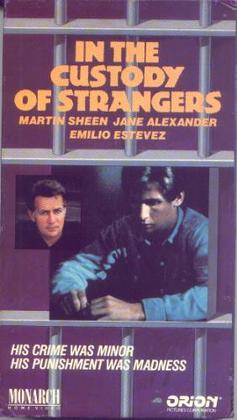
In The Custody of Strangers (1982, directed by Robert Greenwald)


In this television film, Emilio Estevez plays the world’s worst son but his behavior makes sense because he also has the world’s worst father (played by Estevez’s real-life father, Martin Sheen).

When teenager Danny Caldwell (Estevez) gets arrested for crashing into a police car while driving drunk, his mother, Sandy (Jane Alexander), wants to bail him out and bring him home.  However, Frank Caldwell (Sheen) is an old-fashioned disciplinarian and he decides that his son needs to spend a night in jail in order to teach him a lesson.  Even though, as a juvenile, Danny is given a private cell, he still snaps when the older inmate in the cell next door starts coming onto him.  After smashing the man’s head against the cell bars, Danny picks up a battery charge and is sucked into the system.

While Frank and Sandy struggle to get Danny released from jail, Danny falls deeper and deeper into despair and anger.  It’s an overcrowded, busy jail and Danny is often left in isolation for both his safety and the safety of the other prisoners.  Even though the warden (Kenneth McMillan) is sympathetic to Danny and can tell that he’s not really a hardened criminal, there’s only so much that he can do for him.  Meanwhile, on the outside world, Frank stubbornly refuses to admit that he made a mistake by leaving Danny in jail overnight.  When a job opportunity presents itself in another state, the unemployed Frank misses some of Danny’s hearings so that he can interview for it, leaving Danny feeling abandoned all over again.

For obvious reasons, the casting of Martin Sheen and Emilio Estevez as father and son works very well in this film.  Not only is there the obvious family resemblance but both Sheen and Estevez project the same attitude of anger and resentment towards the world.  If Danny has a chip on his shoulder, it’s because he inherited from his father.  In The Custody of Strangers does a good job of showing how being imprisoned can often turn someone who made a mistake into a hardened criminal but, even though it’s mostly critical of the criminal justice system, it doesn’t let Frank off the hook either.  Frank may say that he was just trying to discipline his son but the film makes clear that what he actually wanted was for jail to do his job as a parent.  The results are disastrous and the film ends on a note of ambiguity.  After what Danny has been through, it’s clear that he’ll never be the same person again.

Sheen, Alexander, and Estevez all give good performances in In The Custody of Strangers.  The only ray of hope that the film offers is the kindly warden and he’s also the film’s biggest flaw because it’s hard to believe that, with everything else going on in the jail, he would have had time to take such a benevolent interest in just one inmate.  In real life, Danny Caldwell would have been even more lost than in this movie.

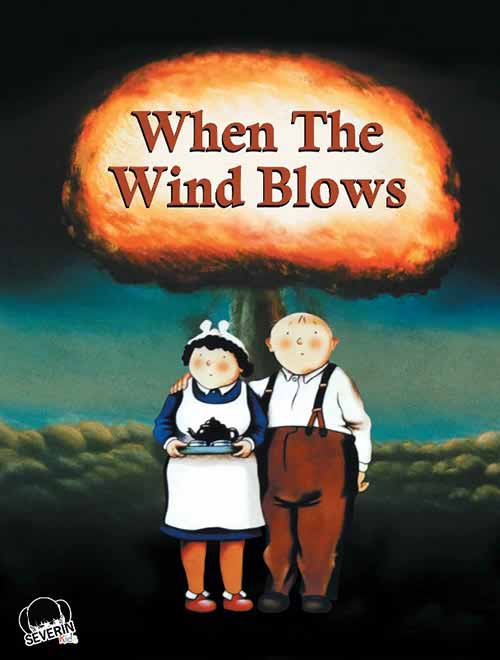
Film Review: When The Wind Blows (dir by Jimmy Murakami)


Over the past few years, I’ve seen some extremely depressing animated films.

I cried during the first fifteen minutes of Up.  I cried during the final ten minutes of Toy Stories 3 and 4.  Actually, now that I think about it, I think I’ve sobbed through every single PIXAR film, with the exception of the movies about the talking cars and the one about the good dinosaur.  My point is that I’m not one of those people who automatically assumes that, just because a film is animated, it’s necessarily going to make me laugh.  I fully understand that not all animated films are for children and that a cartoon can be just as serious and dark as a live action movie.

That said, I don’t think anything could have prepared for the 1986 film, When The Wind Blows.  To say that When The Wind Blows is bleak would be an understatement.  Is When The Wind Blows a depressing film?  Yes, you could say that.  It’s a film about an elderly couple facing the end of the world with optimism and a never-ending faith that things will turn out okay.  This is the most trusting couple in the world and, in the end, they end up crawling into their own separate potato sacks, where they struggle to recite the Lord’s Prayer as they both die a slow and painful death.  It’s not just that When The Wind Blows is depressing.  It’s also that it’s a film that takes place in a world bereft of hope.  It’s a film that has a message but, at the same time, it also seems to be convinced that it’s a message to which no one will bother to listen.

Jim and Hilda Bloggs (voiced by John Mills and Dame Peggy Ashcroft) are a loving couple who own a rather nice cottage in rural England.  They’re very content in their life and more than a bit complacent.  They have faith that both the milk and the paper will be delivered every morning.  Hilda has a nice garden going.  Jim regularly takes the bus down to the library, where he reads the newspapers and picks up pamphlets about what to do in case of a nuclear attack.  When the news comes over the radio that Britain will probably be attacked in 3 days, Jim industrially sets out to make a shelter for himself and Hilda.

It’s not much of a shelter.  In fact, it’s really just two doors leaning against a wall.  However, Jim and Hilda are simply following the instructions that they found in a government-printed pamphlet and both of them have a good deal of faith in the “power that be.”  As they wait for the war to break out, they remember just how much they enjoyed World War II.  Everyone was in it together during World War II!  And Jim has faith that everyone will continue to be in it together during this latest war.

The bomb eventually drops.  The animation, which previously had the feel of an old school Christmas special, becomes dark and ominous as the world around Jim and Hilda’s house erupts into flames.  Jim and Hilda hide in their little shelter.  Though the pamphlets say that they shouldn’t leave the shelter for at least two weeks, Jim and Hilda leave within a few hours.  They walk around outside and look at the charred remains of the garden.  Hilda wonders what fallout looks like.  Jim isn’t sure.

And, at this point, we know they’re both as good as dead.  (Interestingly enough, it does appear that they survived longer than their neighbors, who perhaps did not hide behind a door.)  The rest of the film is essentially watching Jim and Hilda waste away while remaining convinced that someone from the government is going to come and save them.  You find yourself wondering if the two of them are really as naive as they seem or if they’re both in a shared denial about what’s happened.  It’s probably a combination of the two.

It’s an undeniably effective film.  It not only works as an anti-war film but also as an anti-government film.  Both the Left and the Right will find things to appreciate in the film’s story.  But my God is it ever a depressing movie.  It’s a well-made film that I’ll probably never voluntarily watch again.

19