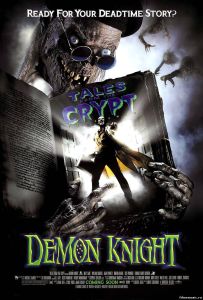
Tales from the Crypt: Demon Knight (dir. by Ernest Dickerson)


Demon Knight PosterI remember going to the movies for Demon Knight. I loved Tales from the Crypt on HBO, and the idea of a movie was cool at the time. My sister and my best friend joined me for the showing. It was treat to watch. I left the cinema thinking of different tales that could come up using some of the elements in this story.

For those unfamiliar with Tales From the Crypt, the show aired on HBO during the late 1980s, and part of the 1990s. Based off of the old horror tales from EC Comics, each episode was a horror story. Unlike Tales From the Darkside, Monsters and Darkroom, Tales from the Crypt had the bonus of being on cable. This meant they were able to get away with more gore and nudity than their prime time counterparts. Perhaps that’s the only real disadvantage with the film. At least with Tales From the Darkside: The Movie, the story could push into darker elements with their restrictions lifted.

As with every episode of the show, Demon Knight is sandwiched between a scene with the Crypt Keeper (John Kassir) greeting the audience with some corny jokes and introducing the story. Frank Brayker (William Sadler – The Mist, Bill & Ted Face the Music) is on the run from The Collector (Billy Zane – Titanic). With his options dwindling and the strange seven-star pattern tattoo on his hand slowly forming a circle, Brayker makes his last stand at a motel with a group of individuals. In his possession is a key shaped vial that has the power to create wards. These wards hold back the army of demons that wish to reclaim the key and bring darkness across the land. Can Brayker make it through the night, while protecting the key and everyone around him? That’s pretty much the plot.
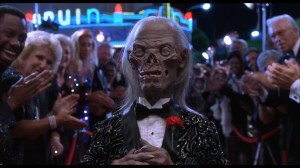
Demon Knight CryptKeeper

The Crypt Keeper is ready for his close up in Demon Knight. 

Having previously worked as a Cinematographer for Spike Lee, Ernest Dickerson made the jump to directing with 1992’s Juice. Demon Knight was his follow up and for the most part, it’s good. The creature design is interesting, reminiscent of Top Cow’s comic book, The Darkness. The demons are thin and indeed strange to behold, but they mostly take a back seat to Billy Zane’s Collector, who tries to seduce everyone into turning against the rest of the group.  Zane brings a lot of humor to the movie with his villain, as does Thomas Hayden Church (Sideways) playing that one guy you’d really like to slug in the mouth. CCH Pounder (Avatar), Jada Pinkett (Collateral), Brenda Bakke (L.A. Confidential), the legendary Dick Miller (Gremlins and just about everything Joe Dante did), and Charles Fleisher (Who Framed Roger Rabbit?) and Gary Farmer (Forever Knight) round it all out. It’s Sadler’s film to carry, however, and he does a great job here playing the hero.

From a sound/musical standpoint, Demon Knight boasts a interesting soundtrack, which I picked up around the time I first saw the film. Filter’s “Hey Man, Nice Shot” seemed like the only song featured in the film, but Ministry’s “Tonight We Murder”, Henry Rollins “Fall Guy” and Pantera’s “Cemetary Gates” are the standouts. The pacing of the film is pretty even, despite being a one shot. There’s not enough of a slowdown to feel bored. Demon Knight is just one regular Tales from the Crypt tale in a longer format. I would have preferred shorter pieces in this larger timespan, but that’s more a nitpick than anything.

Overall, Tales From the Crypt: Demon Knight is a fun film to visit around Halloween. Just make sure your doors and windows are locked (and sealed, if possible), when watching.
 

Horror Film Review: The Crazies (dir by George Romero)


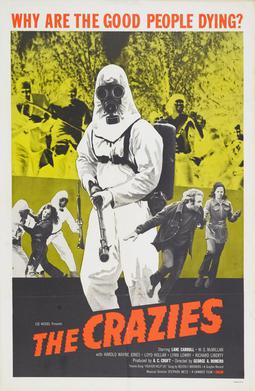
Ah, The Crazies.  The original Crazies.

This 1973 film is one of George Romero’s best non-Dead films, though it never seems to get the respect that it really deserves.  Even today, the original is often overlooked in favor of the remake.  And don’t get me wrong — the remake of The Crazies is good and it features several effective jump scares.  But the remake is a slick Hollywood film and, watching it, you always have the safety of knowing that you’re watching a slick Hollywood film.  The original, though, is rough and low-budget and it looks and it feels real.  As a result, it sticks with you long after the haunting final scenes.

The storyline is simple but effective.  People in a small Pennsylvania town are going crazy and murdering each other.  Usually, it’s impossible to tell who is infected until they’re already attacking you.  The infected are just like the zombies from Night of the Living Dead with one key difference.  The crazies may be as relentless as the Dead but they’re also human beings.  They think.  They plan.  They scheme.  And when they die, they die like humans and we’re reminded that, just a few short hours ago, they were friendly and, more or less, harmless.

The government, of course, shows up in the town and tries to contain the outbreak.  The main image that most people will carry away from The Crazies is of men in white hazmat suits, walking through small-town America and killing almost everyone they see.  As is typical for a Romero film, the so-called solution often seems to be worse than the problem.  We also get the typical conflict between the scientists and the military.  The  military wants to destroy the infected.  The scientists want to cure them.  The film is bleakly cynical as the one man who knows how to cure the disease is ignored and finally killed in a stampede of quarantined citizens.

The film follows six people as they attempt to escape from the town and avoid getting sick themselves.  Needless to say, it’s not as easy as it sounds.  The characters who everyone seems to remember are Artie (Richard Liberty) and his daughter, Kathy (Lynn Lowry).  What happens to them is perhaps the most disturbing moment in a film that’s full of them.  The other members of the group can only hope to survive, even as they slowly lose their grip on sanity.

It’s a disturbing film, precisely because it’s not slick.  The actors are not movie star handsome and the attacks are not perfectly choreographed.  The grainy cinematography gives the entire film a documentary feel and serves as a reminder that Romero made industrial films before he revolutionized the horror genre.  The Crazies works because it feel like it could be happening in your community or your back yard.  And, ultimately, it offers up no solution.  Mankind could save itself, Romero seems to be saying, if only mankind wasn’t so stupid.

Needlessly to say, a film as bleak as The Crazies was not a hit in 1973.  But it’s lived on and continued to influence other horror makers.  It’s one of Romero’s best.

Dracula Part 2 (Netflix), Review by Case Wright


Happy Horrorthon! Dracula is saaaaaaailing, sailing takes me away to where I’ve always heard it could be and he’s eating every one the boaaaat. This episode was almost a bottle episode. Dracula REALLY wants to go to England. I love meat pies too; I can relate! Drac spends the episode eating …. EVERYONE!!! Dracula, Food does not equal love!

Mmmmm Talking Fudge!!!

I enjoyed the episode, but it was kinda rediculous. Dracula was eating everyone and NO ONE really suspected him until the end? Really? Nah, couldn’t be the weird Eastern European guy whose cabin smells like rotting flesh. Really, just look at the guy! No suspicions?!

Dramatization:

SEE WHAT I MEAN!!!!

There are some interesting people on board, but really I just felt like they were kind of a distraction from the much more Frost/Nixon style debate between Dracula and Agatha. Their dialogue was masterful. It pulled you in and it was SUNDAY SUNDAY SUNDAY – Enlightenment Vs Reason! We’ll sell you the whole seat, but you’ll only need the EDGE!!!!

It turns out that Agatha is Dinner. When Agatha awakens, she and the remaining snacks manage to blow up the ship and Dracula is off the coast of England. He’s next to a hole, a hole, a hole at the bottom of the sea! When he wakes, he walks ashore and it’s MODERN DAY with helicopters! I didn’t see that coming, but why not? This was fun!

Horror Film Review: Eye of the Devil (dir by J. Lee Thompson)


If you thought Bohemian Rhapsody was overedited, you wait until you see the 1966 British horror flick, Eye of the Devil.

Seriously, I lost track of average number of of cuts that were used in each scene.  It was like, “There’s Deborah Kerr!  There’s Deborah Kerr from another angle!  There’s Donald Pleasence staring at something!  There’s David Hemmings in a corner.  There’s Deborah Kerr again!  There’s an overhead shot of the entire room!  Hemmings again, staring off to the left.  Now, a different shot of Hemmings staring off to the right.  Pleasence!  Kerr!  Hemmings!  There’s Sharon Tate, was she there the whole time?  Another overhead shot.”  All in five minutes.

Now, I will admit that the frantic editing style was a bit more effective in Eye of the Devil than in Bohemian Rhapsody, if just because Eye of the Devil was meant to be a bit of a filmed dream.  The whole movie was set up to be a surreal journey into the heart of French darkness so the disorientating visual style was effective, even if it did kind of give me a headache while I was watching it.

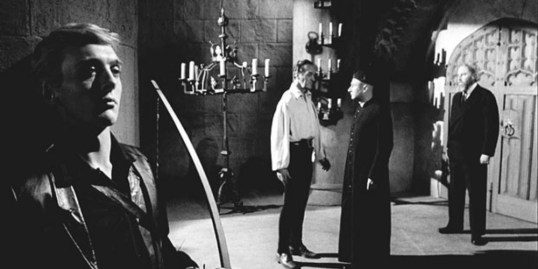
In the film, Deborah Kerr play Catherine, who is the wife of Philippe (David Niven), who owns a vineyard and who is perfectly charming and David Niven-like until he returns to the vineyard.  Then he suddenly becomes withdrawn and cold.  It turns out that the vineyard is struggling a bit.  It’s the dry season, which I guess is a bad thing when you’re making wine.  While Philippe tries to keep morale up among the peasants, two siblings — Christian (David Hemmings) and Odile (Sharon Tate) — wander around the castle.  Christian carries a bow and arrow and seems to be kind of arrogant.  Odile smiles enigmatically and turns frogs into doves.  Meanwhile, Donald Pleasence plays the vineyard priest, who appears to believe that something drastic needs to be done to reverse the dry season.

Soon, Catherine is stumbling across strange ceremonies and discovering that no one seems to care about her concerns that Christian and Odile are going to be a bad influence on the children.  She’s especially upset when Christian points an arrow at her.  Philippe, meanwhile, just laughs off her concerns.  Obviously, it was just a joke! he says.

Eye of the Devil is about as enjoyably pretentious as a British film from 1966 can be.  It’s not just that the movie is edited to the point of chaos.  It’s also that characters have a bad habit of going off on discussions about relationship between magic and reality.  And yet, it’s so pretentious and so silly and so overdirected that you can’t help but love it.  It’s just such a film of its era that it’s impossible not to get something out of it.  Add to that, Sharon Tate and David Hemmings share an otherworldly beauty as the two siblings.  Deborah Kerr shows that she could make even the silliest of situations of compelling.  David Niven is surprisingly effective as a non-charming character.  And then you’ve got Donald Pleasence, making enigmatic statements and showing off the intense stare that would later make Dr. Sam Loomis an icon of horror.

Eye of the Devil may be a mess but it’s a beautiful mess.

Horror on the Lens: Night of the Living Dead (dir by George Romero)


Happy Halloween everyone!

Well, as another horrorthon draws to a close, it’s time for another Shattered Lens tradition!  Every Halloween, we share one of the greatest and most iconic horror films ever made.  For your Halloween enjoyment, here is George Romero’s Night of the Living Dead!

(Be sure to read Arleigh’s equally famous review!)

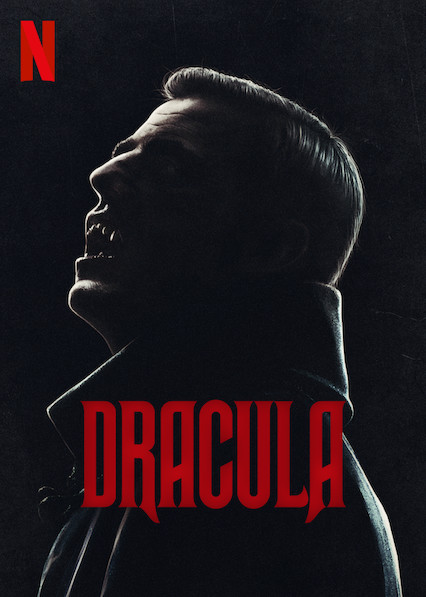
Dracula (Netflix) Review By Case Wright


Happy Horrorthon fellow travelers. It’s been a awhile. I’ve been struggling with engineering classes and it’s been hard to set time aside for this essential part of my life. How does this relate to Dracula? Dracula at its core is an unrequited love story. It drips with sanguine hopes and failed dreams (pun intended). Really, we’ve all that relationship that we really wanted, but it was always doomed, doomed, doomed.

I got to enjoy this mini-series the best way possible: a live tweet with the TSL staff. Back to Dracula, this series was originally broadcast on the BBC. It took Dracula from the past to the present. I have read most of Bram Stoker’s Dracula. It’s kinda boring, which is why the first episode was uneven in terms of excitement because it held close to the book, which was b o r i n g. Part I established Dracula at home. As in the book, he wanted to see the World, meet new and interesting people in England, and eat them.

To whet his appetite and get waaaaay younger, he decided to feast on a lawyer- Jonathan Harker. This Dracula gets all the memories and knowledge from the people he feeds on, which begs the question: Why travel anywhere? Just hang out at a train station and snack on people. Come on, Drac! I did like how the first episode set up the Courtly Love Interest – Agatha Van Helsing; she’s a Nun with ice water in her veins.

Sister Agatha (Van Helsing) gets a visitor at her convent – Jonathan Harker. He looks dead…well undead. He even has a fly crawl across his eyeball without him noticing. Flies buzzing and crawling about eyeballs is a big theme in this mini-series; you just have to get used to it.

Jonathan describes meeting the Count under the presumption of a land holding trans… sorry I dozed off there. The book was a lot like that too. It would have exciting moments and then BAM… Back to the real estate transactions! As Jonathan stays at the Count’s castle, the Count gets younger and he gets older. His lifeforce is drained away. In fact, all of his memories get drained away as well to the Count after one feeding ah ah ah and then two feedings ah ah ah.. Jonathan appears to succumb to the Count and feel nothing, but his resignation is all an act. DUN DUN DUN!

Jonathan is searching for a way out of the castle and it works….kinda. I mean he ends up at a convent and we learn that he’s undead and under the power of Dracula. This is gleaned from Sister Agatha who relentlessly interrogates …well everyone. I wish she were my best friend. She attracts a lot of monsters, but nobody’s perfect.

Unfortunately, Dracula can sense Jonathan and he has pursued him to the convent. This is where Dracula meets the true love of his life Sister Agatha. She’s fearless, smart, and scientific; the opposite of everyone else whom Dracula encounters. Agatha is a force of reason like Dracula is a force of nature. He represents feudalism and magic, she enlightenment and technocratic future. She is what he aspires to be, but cannot. She hopes that in solving the mystery of Dracula she will understand the mystical and develop her elusive affinity with God.

Of course, by getting close to understand Dracula, Agatha inadvertently allows Dracula to enter the convent and eat everyone, including……her and he does it by wearing a dead man’s face. That was awesome! Gotta see it again!

Two and three will post tomorrow!!!!

The TSL’s Horror Grindhouse: Edge of Fury (dir by Robert J. Gurney Jr. and Irving Lerner)


Damn, this is a dark movie.

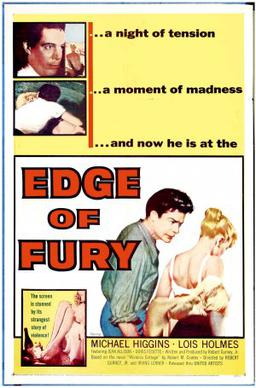
The 1958 film, Edge of Fury, opens with a man standing on the beach.  It seems like it should be a pleasant opening but instead, the entire scene feels threatening.  The man, Richard Barrie (Michael Higgins), is a veteran of the Korean War and he’s working on a painting with what appears to be an almost possessed intensity.  Thanks to the film’s black-and-white, noir-like cinematography, the beach does not look inviting.  Instead, it looks dark and cold.  A voice over informs us that Richard once asked to be confined for not only his own good but also the good of society.  However, the authorities could not intervene because Richard had yet to commit a crime.

Suddenly, the police arrive.  They arrest Richard and take him away, suggesting that Richard has finally proven just how much of a threat he actually is.

The rest of the film is told in flashback.  We watch as Richard, who works in a bookstore, comes across a beach house that he quickly rents.  It turns out that he wants to stay there with the Hacketts, Florence (Lois Holmes) and her daughters, Eleanor (Jean Allison) and Louisa (Doris Fesette).  Somewhat improbably, Richard and Florence are friends, having met in a grocery store.  Florence trusts Richard because he’s so polite and nice.  Eleanor has a crush on Richard because he’s handsome and brooding.  And Louisa just thinks that Richard is kind of a loser.

The Hacketts move into the beach house and Richard sets up an artist’s studio in the shed.  He paints a lot of pictures of Louisa, despite the fact that Louisa has a boyfriend and wants nothing to do with him.  Though the three women don’t realize it, Richard is growing increasingly unstable and obsessed.  He wants the three women to be his new family and when he realizes that he’s not going to get his way, he turns violent….

And certainly, this is not the only film to be made about a mentally disturbed man who becomes obsessed with what he considers to be the perfect family.  It’s also not the only film to end with an act of shocking violence and to leave the audience feeling as if they’ve just taken a journey into a waking nightmare.  What does set Edge of Fury apart from some other films is that it was made in 1958 and, in many ways, it’s the exact opposite of what we expect a 1958 film to be.  This is a dark, dark movie that suggests that the universe is ruled by chaos and that kindness will be rewarded with pain.

Seriously, it’s dark.

That said, it’s definitely a flawed film.  You never buy that Florence would trust Richard as much as she does.  Michael Higgins is frighteningly intense as Richard but the rest of the cast often seems to simply be going through the motions.  That said, it’s definitely a film that sticks with you.  This isn’t a story that you just shrug off and forget.

Probably the best thing about the film is the cinematography.  This film was an early credit for Conrad L. Hall, who later went on to become one of the great cinematographers.  He fills the film with ominous shadows and hints of the madness to come.  As filmed by Hall. the beach looks like some alien landscape, as twisted as the inside of Richard’s mind.

Edge of Fury took me by surprise.  It’s nowhere close to being perfect but it’s worth tracking down on YouTube.

Cinemax Friday: Relentless IV: Ashes to Ashes (1994, dir by Oley Sassone)


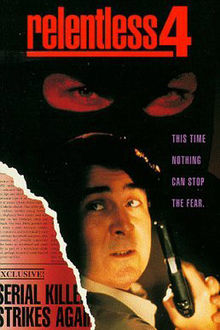
Sam Deitz (Leo Rossi) is back to hunt one last serial killer in this, the last of the Relentless films.

This time the killer is a boring nonentity.  He’s not as interesting as the killers played by Miles O’Keeffee or William Forsythe.  Nor is he as unintentionally funny as the one played by Judd Nelson in the first Relentless film.  Instead, he’s just your run-of-the-mill religious fanatic, killing sinners and performing rituals.  His trademark is that he only kills the person that he wants to kill.  Anyone else who might be around is just taken out with a stun gun.  That’s a boring if considerate trademark.

Deitz is assigned to track down the killer, along with his new partner, Jessica Pareti (Colleen Coffey).  While Deitz is trying to solve the case, he’s also having to deal with his rebellious teenage son (Christopher Pettiet).  Between this film and the last, Deitz’s ex-wife died and now Deitz is a single father.  He and his son barely know each other.  Deitz tries to keep his son under control while all his son wants to do is spend time with his girlfriend, Sherrie (Lisa Robin Kelly).

Relentless IV is the least interesting of the Relentless film.  It’s so trapped by the now-stale Relentless formula that not even the casting of Famke Janssen as a possible femme fatale can save it.  Janssen is a psychiatrist who is connected not only to one of the victims but possibly to the killer as well.  She and Deitz are obviously attracted to each other and Deitz is torn between that attraction and treating her like a possible suspect.  The relationship between Deitz and the doctor has potential but it keeps getting sidetraced by scenes of Deitz trying to deal with his teenage son and it never really lives up to what it could have been.  Janssen is beautiful and Rossi gives a typically good performance but watching the film, it’s obvious that there wasn’t much left to do with the character of Detective Sam Deitz.

Direct-to-video mainstay Oley Sassone directs in a flat and unmemorable manner and the entire film just seems tired.  When the best your serial killer can do is kill someone with a Campbell’s soup can, you know you’re running on empty.  There would not be a Relentless V.  Hopefully, Sam Deitz finally found some peace and figured out how to balance being an intense New Yorker with living in laid back California.

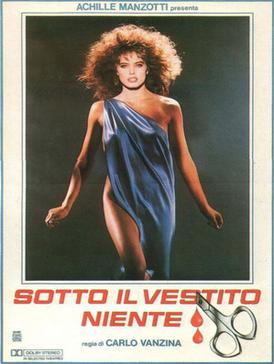
International Horror Film Review: Nothing Underneath (dir by Carlo Vanzina)


The 1985 Italian film, Nothing Underneath, is a giallo that’s achieved some notoriety based on the fact that it’s not a very easy film to find.

Seriously, I’ve spent years looking for this film.  I had read enough good things about it to make me believe that it was a film that I, as an unapologetic fan of Italian horror, simply had to see.  Unfortunately, as far as I can tell, it’s never gotten a proper DVD or Blu-ray release in the United States.  It’s not so much that the film is controversial or even particularly graphic.  Apparently, the main problem is that the film takes place in the world of high fashion and that means that there are several scenes that take place at fashion shows and most of those scenes feature songs that were very popular in 1985.  Nothing Underneath has never gotten a proper video release because of all the music.  It’s kind of unfortunate, really.  There are so many good movies that are currently in limbo because of disputes over the rights to the music on the film’s soundtrack.

Anyway, the good news is that last night, I was able to find Nothing Underneath on YouTube!  So, I finally got to watch it.

The bad news is that I watched it in Italian with no subtitles.

Now, that’s not quite as big of an issue as you might think.  The thing with Italian horror films is that the story is often less important than how it’s told.  The best Italian horror films are all about style and suspense and less about keeping track of who did what to whom.  That’s certainly appears to be the case with Nothing Underneath.  Film is a visual medium, after all.

The film is about a brother and a sister.  Bob (Tom Schanley) is a park ranger who works at Yellowstone and is very happy with his simple and honest life.  Jessica (Nicole Peering) is a fashion model who currently lives in Milan and who spends all of her days modeling lingerie and fighting off sleazy coke addicts.  Bob and Jessica have such an extremely strong bond that, occasionally, Bob has visions of Jessica’s life in Milan.  Whenever Jessica is in danger, Bob knows it.  When Bob has a vision of someone stalking Jessica while carrying scissors and wearing black gloves, he rushes back to his ranger station and calls Italy to warn her.  Unfortunately, he’s too late.  By the time he convinces the surly desk clerk as Jessica’s apartment building to give Jessica the message, Jessica has disappeared.

Bob flies to Milan, determined to find his sister.  He teams up with Commissioner Danesi (Donald Pleasence) to investigate Jessica’s disappearance.  As soon as I saw Donald Pleasence, I automatically assumed that he would eventually turn out to be involved in Jessica’s disappearance but no.  Pleasence actually plays a good guy in the film, one who appears to harbor no dark secrets.  That was kind of a nice change of pace and, even though he was dubbed into Italian, I could tell that Pleasence gave a likable and sympathetic performance in this film.

It turns out that the black-gloved killer is murdering models all over Milan.  Can Bob discover the killer’s identity?  Will he be able to protect Barbara (Renee Simonsen), the killer’s latest target?  And will he discover all of the sordid details about Jessica’s life in Milan?

Despite the language barrier, I enjoyed Nothing Underneath.  It’s an old school giallo, right down to the whodunit mystery and the point-of-view shots of the black-gloved killer.  Visually, the film is impressive.  The opening sequence neatly contrasted the simplicity of Yellowstone with the decadence of Milan and the scenes of the killer stalking their latest victim were nicely done and very suspenseful.  It was a bit hard to judge the actors (as usual, some of the dubbing was very poorly done) but Donald Pleasence was a delight as always and Tom Schanley come across as being very sincere and likable as the park ranger.

I’m glad to have seen Nothing Underneath.  I hope it gets a decent video release at some point in the future.

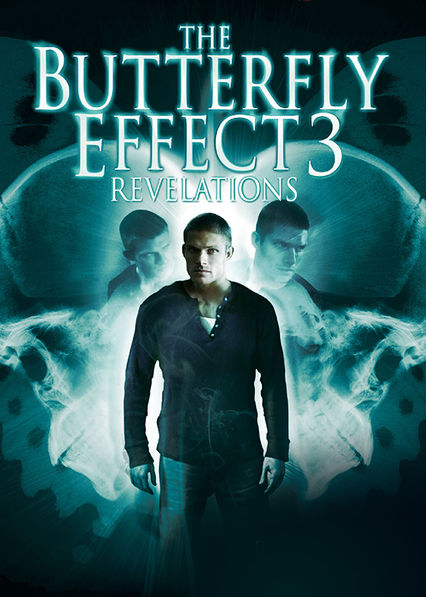
Cleaning Out The DVR: The Butterfly Effect 3: Revelations (dir by Seth Grossman)


I’m continuing my efforts to clean out my DVR.  I just finished watching the 2009 film, The Butterfly Effect 3: Revelations.  I recorded this film off of Cinemax way back in June.  To be honest, I was surprised when I came across it because I have absolutely no memory of having recorded it.  I can only hope that it wasn’t recorded by a time traveler because, after seeing enough Butterfly Effects, you know that nothing good comes from time travel!

The Butterfly Effect 3 starts in medias res.  Sam Reide (Chris Carmack) already knows how to jump back and forth in time and, even more importantly, he already knows all of the dangers.  He knows that he can’t change the past.  He can’t try to help people.  He can’t do anything but stay hidden and observe because the least little alteration to the past could totally screw up the present.  And, as we all know, studying the past is the present that we give to the future.  (GAG!  Seriously, though, I’ve been looking for a excuse to say that for like 10 years now.)  So, the good thing here is that we don’t have to sit through a lot of pointless scenes of Sam learning what we already know.

Sam actually has a pretty good scam going.  He goes back into the past, observes a murder taking place, and then tells the police who committed the crime.  He’s convinced that cops that he’s a psychic, which I guess cops would be more likely to believe than that he’s a time traveler.  I don’t know.  Whatever.  We’ll go with it.  Helping Sam out is his sister, Jenna (Rachel Miner).  Jenna, we’re told, would be dead if not for the fact that Sam jumped into the past and saved her from a house fire.  Of course, by doing that, he also accidentally killed off his parents!  That’s how Sam learned not to mess with the past!  As a result, despite his ability to time travel, Sam leads a pretty squalid existence.  He drinks at the local bar.  He hangs out in the worst sections of Detroit.  He visits Jenna in her run-down apartment.  And yet, he doesn’t use time travel to invest in Facebook or anything like that because he knows that it’ll change the present.  That’s dedication!

Sam is also still mourning the murder of his girlfriend.  (Has anything ever gone right in Sam’s life?)  The man convicted of her murder is due to be executed but Sam has reason to believe that the man might be innocent.  When Sam visits the man and lets him know that he’s going to go to the past to prove the man’s innocence, the man is not impressed.  According to the man, Sam is the murderer!

Anyway, Sam starts jumping into the past to see what really happened but, of course, he can’t help himself and he ends up changing stuff.  As a result, the presents gets messed up though not as dramatically as it did in some of the previous Butterfly Effect films.  For instance, the slutty bartender is suddenly engaged.  At one point, Sam wakes up to find out that he no longer has an apartment.  It’s kind of weak.  (To be honest, this film might have worked better if it had just been a time traveling mystery as opposed to a Butterfly Effect film.)  The mystery, however, is intriguing and the film ends with a somewhat satisfying twist.  As far as third entries in bad franchises are concerned, The Butterfly Effect 3 is actually better than you would probably expect it to be.