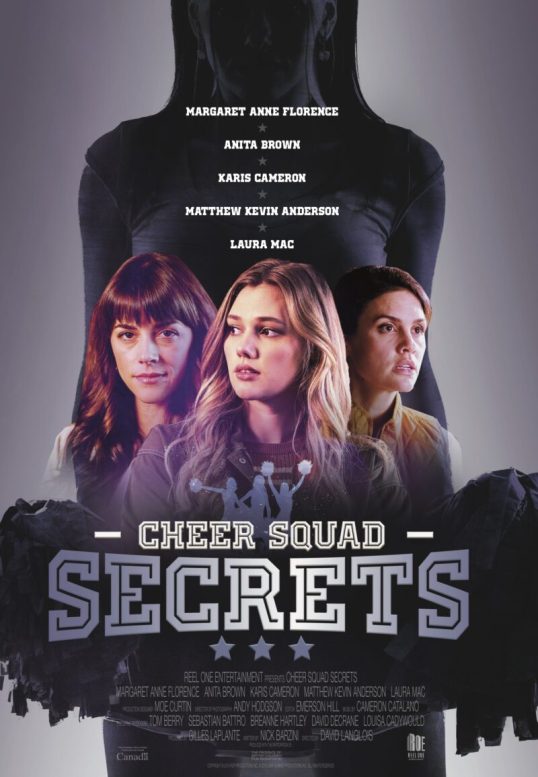
Lifetime Film Review: Cheer Squad Secrets (dir by David Longlois)


It’s a dangerous life, being a cheerleader.

Most people already know that from watching countless horror movies and Lifetime films.  Of course, I know that because my sister was a cheerleader and she told me about all of the dangerous things went on once the cheering stopped.  I was often invited to become a cheerleader when I was in high school.  At the time, I refused because I wanted to carve out my own identity and all of that other good stuff.  Looking back, though, I should have refused because apparently, there’s nothing more dangerous than being a cheerleader in high school.

Take Cheer Squad Secrets, for instance.  In this film, Coach Nina (Anita Brown) is so obsessed with winning a championship and also so haunted by her own traumatic experiences as a cheerleader that she ends up giving the members of the squad steroids in order to make sure that they’re always performing at 110%.  Unfortunately, steroids also leads to mood swings, violence, sprained arms, and potential jail time!  Nina, however, is so obsessed with winning a championship that she’s even willing to commit murder to make sure that everyone gets their “supplements.”  She shows no hesitation when it comes time to stab a drug dealer to death.  And when it looks like some bothersome bystander might reveal the squad’s secrets, Nina promptly drowns her in a swimming pool.

And you know what?  It’s easy to say that Coach Nina is crazy and that she’s taking things too far but Nina gets results!  I mean, I made my sister watch this movie with me and she agreed that Nina was definitely putting together a championship-worthy squad.  Nina may have been a bit intense and she may have been a bit unconventional in her methods but isn’t that what we want from our teachers?  Don’t we want teachers and coaches who will do anything to help our children succeed?

Well, Kelly Regan (Margaret Anne Florence) isn’t quite as enthused about Nina’s methods as perhaps some parents would be.  Kelly was a cheerleader when she was in high school.  In fact, she was such a great cheerleader that she’s something of a legend.  Her daughter, Amelie (Karis Cameron), wants to live up to her mom’s example.  Kelly is overjoyed when Amelie becomes a cheerleader but she’s less happy once the violent fights start to break out.  I guess it’s understandable but seriously, Nina is doing what she has to do.  I mean, doesn’t Kelly want Amelie to go to college on a cheerleading scholarship?

Anyway, Cheer Squad Secrets was an enjoyably silly melodrama.  I’m going to enjoy any film that mixes steroids with a crazy coach who occasionally has conversations with the ghost of her younger self.  I mean, really, who wouldn’t?  Anita Brown gives an appropriately intense performance as Coach Nina and director David Langlois does a good job of embracing the melodrama.  A good Lifetime film will always push the limits of how far it can take its storyline and Cheer Squad Secrets certainly does that.  This is a good one to watch for the next time you need an extra push to succeed.

Lifetime Film Review: Birthmother’s Betrayal (dir by John Murlowski)


So, you’ve been betrayed by your birthmother!

Well, these things happen.  Especially if you’re a character in a Lifetime movie.  I’ve always argued that Lifetime movies can best be viewed as wish fulfillment and, in this one, the fulfilled wish belongs to every mother who has ever hoped that their daughter would admit that they should have listened to them.  In this film, Amy (Tanya Clarke) warns his adopted teenage daughter, Tara (Monica Rose Betz), about trying to track down her birthmother, Grace (Aria Pullman).  And wow, is Amy ever proven right!

Of course, it’s understandable that Tara would want to track down her birthmother.  First off, Tara has all sorts of weird allergies and it would really help her understand her medical history if she knew who her mother was.  Secondly, Amy is kind of overprotective and won’t even let Tara date or buy a bikini, despite the fact that Tara is nearly 17 years old.  I mean, that’s extreme!  So, even though Amy is a loving mom and owns a big house and works for Habitat for Humanity, it’s understandable that Tara would want to see what else is out there.  Amy shouldn’t have sheltered her daughter but then again, Tara should have listened to Amy about the whole “your birthmother could be dangerous” thing.

At first, Tara is overjoyed when she manages to track down Grace.  Grace seems like the perfect birthmother.  She teaches Tara how to drive.  She buys Tara that forbidden bikini.  She encourages Tara to live her own life.  Yet, there are some strange things about Grace.  For instance, Grace refuses to divulge too much information about her own background.  Grace also insists that Tara not tell Amy about her.

Eventually, though, Amy tracks down Grace on her own and invites Grace to come over to the house and meet her daughter “for the first time.”  However, when Grace arrives at the house, she’s no longer acting like the confident and unpredictable Grace that Tara met.  Instead, Grace is now jumpy and nervous and suffers from terrible dizzy spells.  Even more strangely, Grace acts as if she barely knows Tara.  What’s happening?

You may be tempted to say that Grace is just unbalanced but actually, there’s more to it than that.  There’s a neat little twist to this story and I won’t spoil it but I will say that it took me by surprise when it was revealed.  A surprise twist is always a good thing and Birthmother’s Betrayal executes it well.  Admittedly, the twist itself is a bit over-the-top but that’s what we love Lifetime movies for.  Save the normal twists for movies on other networks.  This is Lifetime we’re talking about!

Anyway, I enjoyed Birthmother’s Betrayal, largely because of the twist.  Right when you think the movie is going to be one thing, it turns out to be something else.  Aria Pullman does a good job playing Grace, as both a confident sociopath and a rather frail and neurotic woman who suffers from suddenly dizzy spells.  Keep an eye out for Birthmother’s Betrayal and remember that, when it comes to sending your DNA off to a website, it’s sometimes best to listen to the people who raised you.

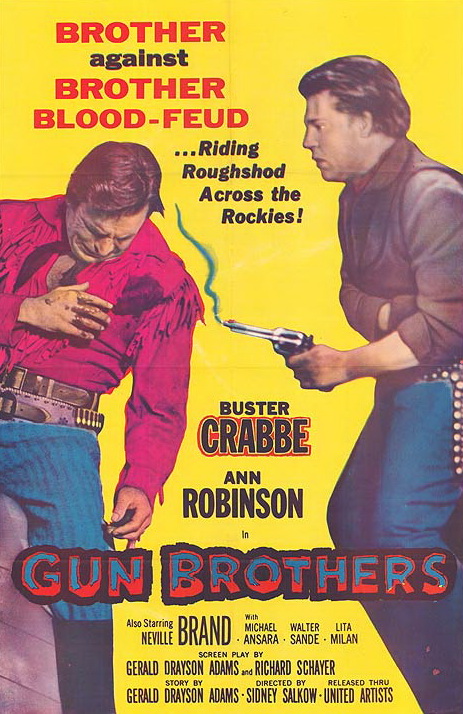
Gun Brothers (1956, directed by Sidney Salkow)


In this western, Buster Crabbe plays Chad Santee, a former Calvary officer who has traveled to Wyoming so he can visit his brother Jubal (Neville Brand) and see Jubal’s ranch.  Traveling by stagecoach, Chad meets and falls in love with a saloon singer named Rose Fargo (Ann Robinson).  When the stagecoach is held up by outlaws and one of them steals Rose’s broach, Chad decides to track the outlaws down.  What Chad doesn’t know is that Jubal is one of those outlaws.

Gun Brothers is an entertaining B-western.  There’s nothing surprising about the story but Buster Crabbe is a believable hero and Ann Robinson gets a chance to show off her saloon singing skills.  Neville Brand steals the film as Jubal.  Before going into acting, Brand was a highly decorated World War II combat officer and he brought his real-life toughness to every role that he played.  He could throw a punch and shoot a gun with an authority that few other actors could match.  Jubal, like Brand, has obviously seen and experienced things that his self-righteous brother will never be able to understand and, as a result, he’s not as tied down to the laws of society as everyone else.   Also turning in good performances are Michael Ansara as an outlaw and Lita Milan, as a Native American woman who is involved with the gang.

Not surprisingly, for a B-western, Gun Brothers is full of characters with names like Shawnee Jack, Yellowstone Kelly, Blackjack Silk, and Moose McClain.  It’s a simple movie but one that will be enjoyed by fans of old fashioned western action.

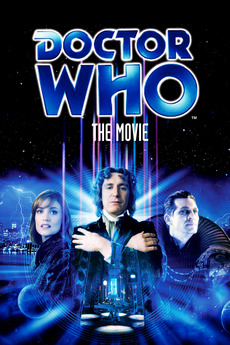
Doctor Who (1996, directed by Geoffrey Sax)


Paul McGann had the potential to be a great Doctor.

There’s a lot of negative things that can be said about the controversial 1996 attempt to reboot Doctor Who but I don’t think anyone can dispute that Paul McGann gave it his best.  Released during the period between the end of the original series and the 2005 revival, the 1996 version of Doctor Who features Sylvester McCoy’s Doctor getting gunned down by a San Francisco street gang and regenerating into Paul McGann.  McGann was a youthful Doctor, in the spirit of Peter Davison’s take on the character.  He played the role with a lot of enthusiasm and optimism.  If the 1996 film had led to the series getting revived, it’s easy to imagine Paul McGann making the role his own and becoming as identified with the Doctor as David Tennant and Matt Smith.

The presence of Sylvester McCoy was another praiseworthy aspect of the television film.  Though the TV movie is rightfully criticized for rewriting a good deal of the show’s continuity, it was still smart enough to bring back both McCoy and the TARDIS.  I wish McCoy had gotten a a more heroic death, though getting gunned down by a street gang is still more exciting than the bump on the head that led to Colin Baker turning into Sylvester McCoy in the first place.

The film features the newly regenerated Doctor trying to stop The Master (Eric Roberts) from using an artificial black hole known as the Eye of Harmony to destroy the Earth.  For some reason, the Eye of Harmony is located inside of the Doctor’s TARDIS and the Master needs to access the TARDIS so he can access the eye.  Meanwhile, the Doctor has just regenerated and doesn’t have all of his memories yet so he’s only fighting at half-strength.  Actually, the less said about the plot, the better.  The plot doesn’t make much sense.  Though Eric Roberts might seem like the perfect choice to play The Master, he doesn’t bring much to the role.  Roberts plays The Master as just being another generic villain, with none of the wit that Roger Delgado, Anthony Ainsley, or even Derek Jacobi brought to the role.

The most controversial part of the movie comes when the Master discovers that the Doctor is half-human, which is something that feels like it was forced on the production by an American television executive.  They probably thought that the audience wouldn’t be able to relate to the Doctor unless he has some human blood but it actually robs the character of the mystery that made him so popular.  Part of the Doctor’s appeal is that he’s an enigma but the television movie gives him an origin that seems like it was lifted from a comic book.  I guess we should just be happy that the people who made the film understood that Doctor Who wasn’t actually the character’s name.

Doctor Who was meant to be a pilot for a revival of the show, one that would have been an American/British co-production.  It didn’t lead to a reboot and I guess we should be happy about that because the weakest moments of the movie are the moments that were obviously designed to appeal to an American television audience, like the Doctor dealing with a very 90s street gang or sharing a kiss with an ER doctor.  It’s easy to imagine that the film would have led to a series that would have had more in common with The X-Files than the original Doctor Who.  With the film not leading to a series, Doctor Who would have to wait another 9 years before finally getting rebooted.

Still, it’s hard not to regret that Paul McGann didn’t get more opportunities to play the Doctor.  With a better script, he could have been one of the great ones.


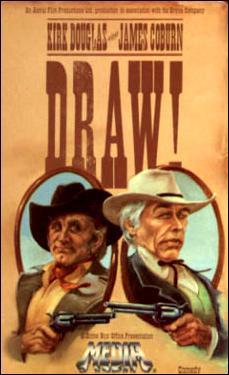
Draw! (1984, directed by Steven Hilliard Stern)


Harry Holland (Kirk Douglas) is an aging cowboy who used to be one of the old west’s more fearsome outlaws.  When the newly reformed Harry wins $200 in a poker game, local weasel Reggie Bell (Derek McGrath) tries to get out of paying him by accusing Harry of cheating.  A gunfight leads to Harry getting wounded, the sheriff accidentally getting killed, and Harry locking himself away in a hotel room with a Shakespearean actress, Bess (Alexandra Bastedo).

Unsure of how to get Harry to leave the hotel room and surrender himself, the townspeople send meek Deputy Wally Boldgett (Graham Jarvis) to track down the legendary lawman Sam Sterrett (James Coburn).  Like Harry, Sam is a veteran gunfighter and if anyone can face down Harry Holland, it’s him!  Unfortunately, as Wally soon discovers, Sam is now an alcoholic who no longer has much interest in enforcing the law on the frontier.

While Wally tries to sober up Sam and deliver him to the town, Harry and Bess remain in the hotel room and fall in love.

Draw! is a light-hearted western comedy.  Though it deals with the classic western theme of aging outlaws trying to find their place in a changing society, Draw! is more interested in laughs than pathos.  Reggie Bell, for instance, is such a weasel that he’s never a credible villain, despite all of the times that he tries to be.  Even once he’s trapped in the hotel room, Harry is never really worried.  Even when the gallows start to go up in the towns square, it’s mostly played for laughs.

The main appeal of this film is to watch two genre vets act opposite of each other and both Kirk Douglas and James Coburn deliver.  The film is split almost evenly between the two actors, with Coburn especially digging into his role.  When he’s first introduced, Sam is so drunk that he can barely see straight and it’s not until he actually reaches the town and pins on his old sheriff’s badge that he starts to straighten up and become the cool and confident James Coburn that we all know.  Coburn does a great job of showing Sam gradually starting to once again care about things like justice and doing the right thing (regardless of what the law says).  Coburn’s laid back style compliments Douglas’s natural intensity.  When Sam and Harry finally speak to each other, their shared history as friends and competitors comes across naturally.

Draw! is both a good western and a showcase for two iconic actors.

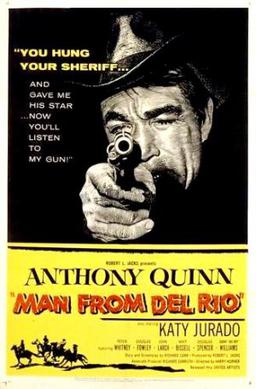
Man From Del Rio (1956, directed by Harry Horner)


In this western, Anthony Quinn plays Dave Robles, a Mexican gunslinger who rides into the town of Mesa, searching for an outlaw named Dan Ritchey (Barry Atwater).  When Dave finds Ritchey, he discovers that Ritchey has been invited to Mesa by one of the town’s richest men.  Dave doesn’t let that stop him from gunning Ritchey down in the street.

No one in town is upset that Ritchey’s dead.  Instead, they’re impressed with how quick Dave is on the draw.  When Dave runs another group of outlaws out of town, the townspeople decide to hire him as their new sheriff.  Reluctantly, Dave agrees.  At first, saloon keeper Ed Bannister (Peter Whitney) thinks that Dave will be easy to control but Dave surprises him by taking his new position seriously.  Soon, Dave is having to fight off all sorts of bad guys.  Meanwhile, Estella (Katy Jurado), the town’s nurse, goes from distrusting Dave to falling in love with him and begging him to set down his guns and join her in a peaceful life.

Man From Del Rio is a surprisingly good and intelligent B-western.  Anthony Quinn gives a brooding performance as Dave, who is a far cry from the type of upright lawmen who typically appeared in the westerns of the period.  As played by Quinn, Dave Robles is a brute who becomes the film’s default hero just because everyone else is even worse than he is.  Dave may be an outlaw and a killer but he’s neither dishonest nor a sadist, which is what sets him apart from the other bad men who ride through Mesa.  Dave only kills when he feels that he has to and he doesn’t do it for pleasure.  Because he’s inarticulate and uncomfortable with the trappings of civilization, men like Bannister assume that Robles will be easy to control but he proves them wrong.  Quinn’s outstanding performance sets the stage for the type of morally ambiguous western heroes who would become prominent in the late 60s and the 70s.  He gets good support from Katy Jurado and, in the role of the town’s previous sheriff, Douglas Spencer.

Along with an interesting plot, Man From Del Rio also has all of the gunfights and tough talk that a western fan could hope for.  Capped off by Anthony’s Quinn’s star turn, it’s a superb B-western.

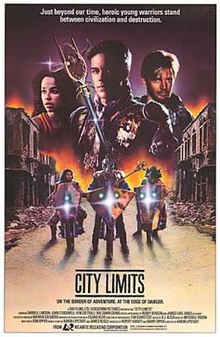
Cinemax Friday: City Limits (1984, directed by Aaron Lipstadt)


Fifteen years into the future, a plague has wiped out almost everyone legally old enough to drink and it has instead left behind a post-apocalyptic hellscape dominated by teenagers.  Tired of living in the boring desert, Lee (John Stockwell) hops on his motorcycle, puts on a skull mask, and drives to a nearby city.  He hopes to join the Clippers, one of the two gangs that is fighting for control of the city.  However, the Clippers aren’t as easy to join as Lee thought they would be.  As well, an evil corporation (led by Robby Benson of all people) is manipulating the two gangs as a part of a plan to take over the city and also the world.

City Limits is one of those films that would probably be totally forgotten if it hadn’t been featured on an episode of Mystery Science Theater 3000.  It’s a good episode but, unfortunately, it’s also led to City Limits getting a reputation for worse than it actually is.

City Limits is a dumb, low-budget movie that was made to capitalize on the success of films like Mad Max.  The plot is impossible to follow, too many scenes are shot in the middle of the night, and Robby Benson is somehow even less intimidating as the villain as you would expect him to be.  (All of Benson’s scenes take place in the same bare office and feature him sitting at a desk.  It probably took a day at most for Benson to do all of his scenes.)  Even with all that in mind, though, City Limits is a fun movie, especially if you can turn off your mind, just relax, and not worry about trying to make it all make sense.  John Stockwell is a likably goofy hero and, Benson aside, the film has got a surprisingly good supporting cast, including Rae Dawn Chong, Kim Cattrall, Tony Plana, Darrell Larson, and even Kane Hodder in a blink-and-you’ll-miss-him type of role.  James Earl Jones wears a big fur coat and blows people up.  He also narrates the film, which automatically elevates everything that happens.  Some of the action scenes are exciting.  Fans of people shouting insults while riding motorcycles will find a lot to enjoy in City Limits.  And, finally, there are a few genuinely funny moments.  I loved that the gangs borrowed all of their plans for old comic books.

City Limits is stupid but entertaining, whether you’re watching it on your own or with Joel and the Bots.


Film Review: Small Axe: Mangrove (dir by Steve McQueen)


Say whatever else you might want to say about 2020 as a cinematic year, at least it’s giving us five new films from Steve McQueen.

This British director is one of the most consistently interesting filmmakers working today and anytime we get new work for him, it’s a cause for celebration.  His latest project is Small Axe, an anthology of five feature-length films that examines the real-life history of London’s West Indian community.  In the UK, the film are premiering on the BBC while, here in the States, they’ll be premiering on Prime.  Through mid-December, we’ll be getting a new Steve McQueen film every week.

The first of these films is Mangrove.  The film opens in the late 60s, with activist Frank Crichlow (Shaun Parkes) opening a restaurant in London’s Notting Hill neighborhood.  The restaurant is called The Mangrove and it quickly becomes a base for the community.  It also becomes a target for the Metropolitan Police.  PC Pulley (Sam Spruell) claims that the Frank has a history of tolerating petty crime and that the Mangrove is probably just a front for some nefarious operation.  Of course, what quickly becomes obvious is that Pulley’s main problem with the Mangrove is that its owner is black and so are the majority of its customers.  Pulley is an unrepentant racist, the type of man who sits in his patrol car and complains that the military hasn’t been called in to enforce the law in the neighborhood.  (As obsessed as he is with the military, Pulley also says, with some pride, that he’s never actually served in the army.)  When a new rookie shows up, Pulley informs him that his priority for the night is to arrest the first black person that he sees.

Every chance that he gets, Pulley raids the Mangrove.  When Frank complains, he loses his liquor license.  When the members of the community stage a peaceful protest (“Hands Off The Mangrove!” goes one chant), Frank and eight others are arrested and charged with inciting a riot and affray, charges that could lead to all of them spending several years in prison.  (Affray is the legal term for “disturbing the peace.”)  Among those arrested, along with Frank, are activist Darcus Howe (Malachi Kirby) and British Black Panther leader Altheia Jones-LeCointe (Letitita Wright).  Both Darcus and Altheia insist on acting as their own counsel during the trial, giving them the chance to cross-examine the police and to also take their case directly to the jury.

Though Mangrove is a courtroom drama, the trial doesn’t being until almost an hour into the film’s running time.  Wisely, McQueen instead spends the first sixty minutes of the film introducing us to the neighborhood surrounding the Mangrove and also allowing us to get to know the people who not only work there but also the ones who eat there.  The film shows how, for a community of outsiders, the Mangrove became more than just a restaurant.  It became a center for the entire neighborhood, a place where the members of the London’s West Indian community could safely gather.  For someone like Pulley, the Mangrove was a symbol of everything that he couldn’t control and therefore, it had to be destroyed and its owners had to be humiliated.  As well-handled as the courtroom scenes are, they would be considerably less effective if the film hadn’t shown us why it was felt that the Mangrove was something worth fighting for.  When the Mangrove Nine go on trail, they’re not just nine people who have been unjustly accused.  Instead, they represent an entire community that refuses to continue to bow down to their oppressors.

It’s an often effective film, one that is all the more powerful for being based on a true story.  Much as he did with Shame, Steve McQueen makes effective use of the harsh and rather cold urban landscape that his characters inhabit. One needs only watch Frank walk down a dreary London street to understand why the Mangrove was so important to the community.  As presented by McQueen, the Mangrove provides not only an escape from the harshness of the world but also a safe place to discuss how to make that world maybe a little bit less harsh for future generations.  McQueen is brave enough to allow his camera to keep running, even beyond the point that most directors would have said “Cut.”  McQueen shows us Frank yelling after being brutally pushed into a prison cell, as any director would.  However, McQueen doesn’t cut away once Frank falls silent.  Instead, his camera remains on Frank, making us feel his isolation and his feeling of hopelessness.  It takes just a minute to go from the exhilaration of hearing Frank curse out his jailers to the horror of realizing that Frank is basically at their mercy.

For the most part, the actors make a strong impression, with the only false note coming from Rochenda Sandall, who plays Darcus’s partner and often seems to be performing in a different movie from everyone else.  Malachi Kirby and Shaun Parkes have several strong moments as Darcus and Frank while Sam Spruell plays Pulley as being an all-too familiar monster.  That said, the film is pretty much stolen by Letitia Wright, who brings both fury and wit to the role of Altheia.  Whether she’s exposing the Crown’s medical examiner as a fraud or angrily reprimanding a defendant who is considering pleading guilty, Letitia Wright dominates every scene in which she appears.

Is Mangrove eligible for the Oscars?  Under normal circumstances, it wouldn’t be.  But, with the rule changes and the fact that Mangrove was not only selected to compete at Cannes (before Cannes was cancelled, of course) but that it also opened the BFI London Film Festival, I think a case can be made for considering Mangrove to be a feature film as opposed to being a television movie.  This is a strange year so who knows?  Personally, I think Mangrove deserves to be considered.  If it’s not nominated for any Oscars, it’ll definitely be nominated for the Emmys.  That’ll be determined in the future.  For now, it can be viewed on Prime.

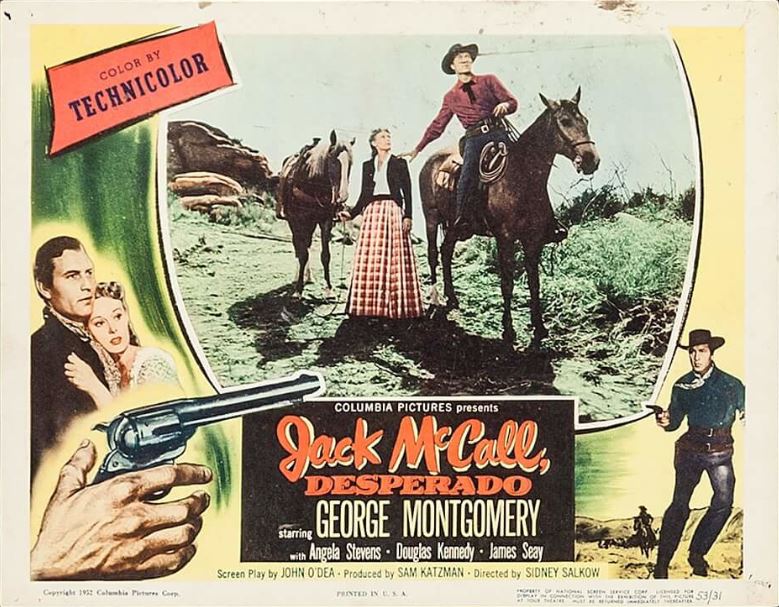
Jack McCall, Desperado (1953, directed by Sidney Saklow)


On August 2nd, 1876, the legendary western lawman “Wild Bill” Hickok was shot and killed while playing poker in Deadwood, South Dakota Territory.  His murderer, who shot Hickok in the back, was Jack McCall.  McCall was known for being a local drunk and it is believed he shot Hickok because he had lost money to him in a previous game.  After shooting Hickok, McCall attempted to flee but ended up falling off of his horse.  When McCall was put on trial for Hickock’s murder, he clamed that it was revenge for Hickok having murdered his brother in Kansas.  Since no one knew much about McCall’s past, he was acquitted.  (Modern historians believe that McCall grew up in Kentucky and never had a brother.)

Unfortunately, for McCall, it was later determined that the Deadwood courts didn’t have legal authority to try anyone and he was hauled into federal court.  After first claiming that he had been too drunk to remember why he shot Hickok, McCall then claimed that he was actually wasn’t Jack McCall at all and that the wrong man had been arrested.  The judge didn’t believe either one of McCall’s claims and Jack McCall was subsequently hanged on March 1st, 1877.  It’s believed that he was 24 years old.

The life and murder of Wild Bill Hickok has been the subject of many books and films, the majority of which have portrayed Hickok in a heroic light while Jack McCall has typically been portrayed as being a low-life coward.  Jack McCall, Desperado, however, takes the opposite approach.  In this film, George Montgomery plays McCall as being an upstanding hero while Douglas Kennedy portrays Hickok as being a cruel and sociopathic murderer.

Jack McCall, Desperado comes up with a backstory for McCall and Hickok, one that I don’t think has ever been suggested by any of the many books written about Hickok’s life and death.  The movie portrays McCall as being a Southerner who, during the Civil War, joined the Union Army.  Because of his Southern heritage, he is distrusted by most of the other men in his unit.  When a group of rebel spies trick McCall into revealing the location of the Union army’s headquarters, McCall is accused of treason and sentenced to death.  McCall manages to escape but, upon returning to his family’s plantation, he discovers that both his mother and his father have been killed by Hickok and Jack’s cousin, Bat (James Seay).  When McCall discovers that Wild Bill and Bat have headed up to the Deadwood, plotting to swindle the Native Americans out of a gold mine, and that they’re accompanied by a former Confederate who can clear Jack’s name, Jack purses them, intent on getting revenge for his family and justice for himself.

It’s a pretty standard western, one that is notable mostly for its portrayal of Wild Bill Hickok as being a bloodthirsty outlaw.  While Hickok may not have been the hero that he was often made out to be (and let’s not even talk about the reality of Wyatt Earp), he probably wasn’t the mustache-twirling villain that he’s portrayed to be here.  Still, Douglas Kennedy is an effectively dastardly villain and George Montgomery is an adequate hero.  Even if it’s in no way based on fact, the Civil War subplot, with Jack supporting the Union cause despite his Southern heritage, is occasionally interesting.  If you’re already a fan of B-westerns and not a stickler for historical accuracy, Jack McCall, Desperado is a decent enough way to pass the time.

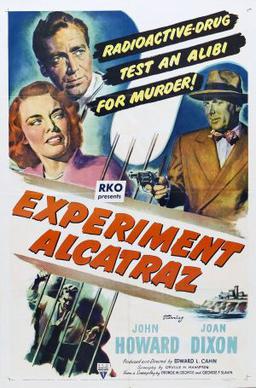
Experiment Alcatraz (1950, directed by Edward L. Cahn)


Dr. Ross Williams (John Howard) has a theory that injecting patients with a radioactive isotope can be used to treat a serious blood disease.  However, he needs people on which to test his theory and, since it involves radiation, volunteers aren’t exactly lining up.  Finally, five prisoners at Alcatraz agree to be used as test subjects in return for early parole.  The prisoners are whisked off to a military where Williams and nurse Joan McKenna (Joan Dixon) oversee the experiment.  Joan has her own reasons for hoping that Williams’s treatment is a success.  Her own brother is currently dying of the disease.

Unfortunately, things go terribly wrong when one of the convicts, Barry Morgan (Robert Shayne), grabs a pair of scissors and stabs another prisoner to death.  Morgan claims that he was driven mad by the treatment and, as a result, the experiments are canceled.  Both Joan and Dr. Williams are convinced that Morgan had another reason for killing the prisoner.  With Morgan and his cronies now free, Williams launches his own investigation into what happened.

Experiment Alcatraz starts out with an intriguing premise but then settles into being a typical B-crime film.  Robert Shayne does a good job playing the viscous criminal but Morgan’s motives for committing the murder turn out to be fairly predictable and the story’s conclusion won’t take anyone by surprise.  Howard and Dixon are competent leads but both are playing dull characters and too much of the film’s story depends on getting the audience to believe that a potentially revolutionary medical treatment would be tested in a thoroughly haphazard manner.  Worst of all, despite the title, there’s very little Alcatraz to be found in Experiment Alcatraz.  The prisoner leaves the prison early and never look back.

Experiment Alcatraz is one of the many films to be directed by the incredibly prolific and fast-working Edward L. Cahn.  Between 1931 and 1962, Cahn is credited as having directed 127 movies.  In 1961 alone, he directed 11 feature films!  1950 was actually a slow year for Cahn.  Including Experiment Alcatraz, he only directed 5 films that year.  As you can guess with that many movies, Cahn’s output was uneven.  For every Experiment Alcatraz, there was an It!  The Terror From Beyond Space.  Despite a promising premise, Experiment Alcatraz is one of Cahn’s more forgettable films.