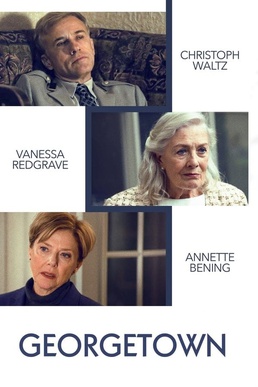
Film Review: Georgetown (dir by Christoph Waltz)


Georgetown is one of those films that’s been around for a while.

The movie, which is the directorial debut of Christoph Waltz. was originally filmed in 2017.  It made its debut at the Tribeca Film Festival in 2019, where it received respectful reviews.  It played in at least some parts of Europe in 2020.  But it didn’t get a limited theatrical release in America until May of 2021 and it was released on VOD just a few days later.  Some of the delays in the film’s release were undoubtedly due to the uncertainty bred by the COVID lockdowns.  And some of it was probably due to no one being sure how to market a true crime film about murder amongst the rich and powerful of Washington D.C.  As such, Georgetown didn’t really get much attention when it was released.  That’s a shame, because it’s actually a pretty good movie, a clever mix of social satire and legal drama.

Christoph Waltz not only directs but also stars as Ulrich Mott.  Mott is a somewhat ludicrous figure.  His past is shadowy.  He claims to have served as a member of the French Foreign Legion, though his breaks down in tears after a snarky State Department official points out that none of Mott’s medals appear to be genuine.  Mott claims to have a lot of powerful and influential acquaintances, even though many of them only know him because he aggressively approached them at a party and forced them to take one of his business cards.  He occasionally wears a eye patch, even though he doesn’t need it.  After the fall of Saddam Hussein, Mott announces that he has been named a brigadier general in the Iraqi army and he claims to be a lobbyist for the new government.  Mott is also the head of a consulting firm called the Eminent Persons Group, which is later described as just being a Ponzi scheme for the rich and powerful.

It’s easy to make fun of Ulrich Mott but, throughout the film, we watch as he arranges dinners with men like future Defense Secretary Chuck Hagel and former French Prime Minister Michel Rocard.  He meets with former Defense Secretary Robert McNamara.  He mentions the he knows George Soros.  Mott is well-known among America’s elite, if not exactly respected.  This is almost entirely due to his marriage to the much older Elsa Breht (Vanessa Redgrave), a journalist who is, at one point, described as being “the queen of Georgetown society.”

When the 91 year-old Elsa is discovered dead at the foot of her staircase, the police originally think that she may have just suffered from an accidental fall.  Mott, however, declares that it’s obvious that Elsa was murdered by his enemies and that he will dedicate the rest of his life to tracking them down and getting justice.  Meanwhile, Elsa’s daughter (played by Annette Bening) is convinced that Mott murdered her mother.  The police agree and Ulrich Mott is soon on trial.  Mott’s main concern is that he be allowed to wear his red beret in the courtroom.  After all, it’s apart of his uniform as a brigadier general in the Iraqi army.

Flashing back and forth from the past to the present, Georgetown is primarily a character study of a man who has little talent and not much of a conscience but who does have a lot of ambition and a lot of charm.  Mott works his way up into the upper channels of D.C. society through a combination of flattery and compulsive lying and Waltz gives such a charismatic performance in the lead role that you believe every minute of it.  He’s appealingly vulnerable when he approaches the first clients for what will become the Eminent Persons Group and it’s hard not to sympathize with him when he breaks down in tears after being exposed, for the first time, as a fraud.  However, as the film progresses, we’re left to wonder if the vulnerability and tears were genuine or if they were just another part of Ulrich Mott’s performance.  Mott is both diabolically arrogant and almost compulsively self-destructive and Waltz does a great job of portraying those two seemingly conflicting sides of his personality.  He’s well-matched by Vanessa Redgrave, who makes Elsa’s love for Mott feel real and credible.  Watching the film, one can understand why Elsa initially believed in Mott and also why she stayed with him even as she discovered that he was never quite who he claimed to be,

Georgetown is nicely done portrait of duplicity and murder among America’s elite.  It’s both sharply satiric and, in its way, rather heart-breaking.  It definitely deserves more attention that it originally received.
Film Review: Land (dir by Robin Wright)


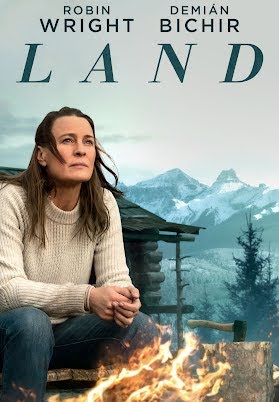
Land tells the story of Edee, a woman who thinks that she wants to die.  Edee is played by Robin Wright, who also directed the film.

Edee is dealing with a tragedy, one that the film provides clues to understanding without going into too much details.  Edee has visions of a man and a child and it’s easy to figure out that they were once her family.  There are other flashbacks of Edee’s sister, Emma (Kim Dickens), begging Edee not to harm herself.  Edee meets with a therapist and says that she doesn’t want to share her grief with other people.  She wants to deal with her grief alone, a perfectly reasonable request but no one that is likely to be understood in today’s age of social media oversharing.

When Edee drives out tp an isolated, mountain cabin, she says that she’s looking to start a new life, off the grid.  However, as is quickly revealed by a conversation with the helpful Cole (Brad Leland), Edee doesn’t know anything about living in the wilderness.  What’s more, she doesn’t appear to want to learn anything either.  She has little interest in Cole’s advice.  She asks Cole to return her rental car for her.  When Cole says that it’s not a good idea to live in the mountains without some sort of a vehicle, Edee shrugs him off.  She’s obviously not planning on coming down from the mountain.

Instead, she plans to die in the cabin.  The sight of the man and the child, standing ghost-like in the woods, does not change her mind.  And yet, when Edee finds herself with her forehead resting atop the barrel of a rifle, she cannot bring herself to pull the trigger.  When she is approached by a bear, she retreats to her cabin, showing that she still has an instinct for self-preservation.  (Either that, or she would just rather die in a less gruesome way than a bear attack.)  Edee leaves it to nature to determine her fate.  She’ll stay in the cabin and starve herself to death or she’ll let the elements take her out.  It’s a plan that takes the responsibility off of her.

However, there’s a nurse named Alawa (Sarah Dawn Pledge) and a hunter named Miguel (Demien Bircher) in the area and when they discover Edee near death in her cabin, they nurse her back to health.  Miguel tells her that there are better ways to die than starving herself and, in his polite but direct way, calls her out for not appreciating the fact that she has something that most other people don’t, the ability to retreat to her cabin when life gets to difficult.  Miguel is recovering from his own tragedy and is also living off the grid.  He offers to show Edee how to hunt and survive.  Edee agrees, on the condition that he not tell her about anything that’s happening in the outside world.

The scenery looks beautiful and both Robin Wright and Demian Bircher give effective performances as two people who don’t necessarily talk a lot but who instinctively understand that they have much in common.  The film is respectful of the grief that’s felt by both Edee and Miguel without descending into mawkishness or cheap dramatics.  It’s a steadily-paced movie that trusts the audience to figure things out without having to spell everything out.  Land is a simple film but it works.

The Man From Bitter Ridge (1955, directed by Jack Arnold)


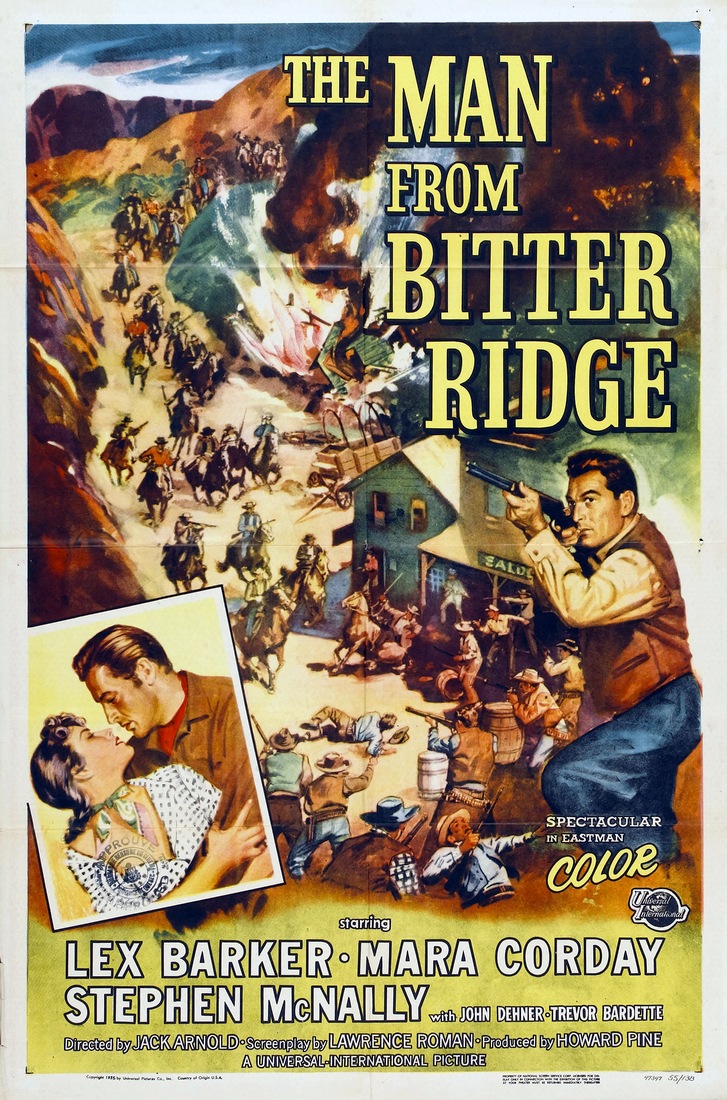
When Jeff Carr (Lex Barker) comes riding into the town of Tomahawk, he’s nearly lynched by the townspeople, who are convinced that Carr must be responsible for a series of recent stagecoach robberies.  Luckily, before they can finish the deed, they discover that Carr has actually been sent by the government to investigate the very same robberies!

Once the townspeople realize that Carr isn’t responsible, they go back to blaming the the local sheepherders.  When Carr investigates the number one suspect, Alec Black (Stephen McNally), he quickly realizes that Ale is not the guilty party.  Carr and Alec team up to solve the crime but complicating their efforts is the fact that Carr has fallen in love with Alec’s girl, Holly (the beautiful Mara Corday).

The Man From Bitter Ridge is mostly a generic Western but the plot does have one interesting wrinkle.  The man who is actually behind the stagecoach robberies is planning on using the stolen loot to fund his political career!  This is actually historically accurate, as many outlaws in the post-Civl War west attempted to either redeem or protect themselves by seeking political office and many of those efforts were funded by money that had been stolen from the very people who were now expected to vote for them.  Several of the outlaws were actually successful in their efforts, proving that the more things change, the more they stay the same.

Otherwise, The Man From Bitter Ridge is a typical B-western with Mara Corday’s lovely screen presence providing occasional relief from the bland performances of Barker and McNally.  The movie does wrap up with an exciting gun battle in the town square but. overall, The Man From Bitter Ridge is most just for for B-western completists and fans of Mara Corday.

Incident at Phantom Hill (1966, directed by Earl Bellamy)


During the final weeks of the Civil War, a group of Confederates, led by Joe Barlow (Dan Duryea,) hijacked a shipment of Union gold and buried it near Phantom Hill, Texas. Now that the war is over and Barlow is in custody, he makes an offer. He’ll lead the government to the gold in return for a pardon. Needing the money, the government agrees to Barlow’s conditions. A group of Cavalrymen, led by Matt Martin (Robert Fuller), are ordered to accompany Barlow to Phantom Hill and retrieve the gold. Because the gold itself is buried near Comanche territory, the men will be traveling undercover. If Martin and his men are captured or killed, the U.S. government will disavow any knowledge of the them. Cue the Mission Impossible theme.

It’s an eventful journey to Phantom Hill. When a local sheriff recognizes Barlow as a wanted criminal, Martin has to convince him not to kill Barlow. The sheriff agrees, on the condition that Martin and his men escort a prostitute named Memphis (Jocelyn Lane) out of town. When a group of outlaws discover that Martin and Barlow are heading for the gold, they take off after them. Meanwhile, Barlow has a few plans of his own.

Incident at Phantom Hill is a fast-moving B-western, the type that will be appreciated by fans of the genre. There are a few good shootouts. Jocelyn Lane is beautiful as Memphis, Robert Fuller is firm at Matt Martin, and Dan Duryea is dangerous as Joe Barlow. The outlaws are unusually cruel and the scene where the kill a comic relief character was probably shocking for 1966. The most interesting thing about the movie is its portrayal of Union officers working with former Confederates and the struggle to determine where everyone fits in now that the Civil War is over. Barlow is not to be trusted by the relationship between Memphis and Matt suggests that the country can come back together as long as everyone has a common enemy that needs to be defeated.


The Raiders (1963, directed by Herschel Daughtery)


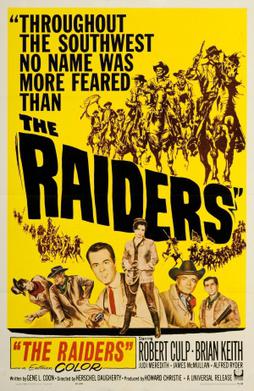
In the years immediately following the Civil War, seven Texas cattleman, led by Col. John McElroy (Brian Keith), try to drive their cattle into Missouri.  The terrains proves treacherous and the local Pawnees refuse to allow the cattlemen to pass through their land without paying a hefty fee for the right.  McElroy and his followers go to Fort Hays and demands that the local railroad magnate, Huntingon Lawford (Addison Richards), extend his line into Texas.  When both Lawford and martinet Calvary officer Capt. Benton (Alfred Ryder) refuse to help, McElroy and his man start sabotaging the railroad’s western expansion.

This brings them into conflict with Wild Bill Hickok (Robert Culp), Buffalo Bill Cody (Jim McMullan), and Calamity Jane (Judi Meredith), all of whom are working for the railroad!  Hickok is an old friend of McElroy’s and Cody is sympathetic to McElroy’s cause but will they be able to broker a peace between the two sides?  When Captain Benton plans to lure McElroy into a trap where he and his friends will fired on with a Gatling gun, it’s up to Cody and Hickok to try to prevent a massacre.

The Raiders starts out as a downbeat look at a cattle drive in the years when America was still trying to rebuild from the devastation of the Civil War.  Brian Keith was one of those actors who was always ideally cast in westerns and war movies and he’s convincing as the tough but fair-minded McElroy.  If the film had just been about McElroy, it would have been a good B-western.  Instead, it brings heavily fictionalized versions of Wild Bill Hickock, Buffalo Bill Cody, and Calamity Jane into the story.  Robert Culp, Jim McMullan, and especially Judi Meredith all overact in their roles and a lot of time is wasted on subplots like Calamity Janes being in love with Wild Bill and Buffalo Bill trying to prove himself to the older man.

The Raiders started out as a made-for-TV movie and it appears that it was a pilot for a proposed TV show about Calamity Jane and the Bills.  (Brian Keith is even listed in the credits as being a “special guest star.”)  When the pilot wasn’t picked up, the film was given a theatrical release but The Raiders still has the flat look and unimaginative editing of a television show.  No matter how authentic Brian Keith’s performance might be, he can’t make up for the fact that the majority of the film was clearly shot on a studio backlot.

Cattle Drive (1951, directed by Kurt Neumann)


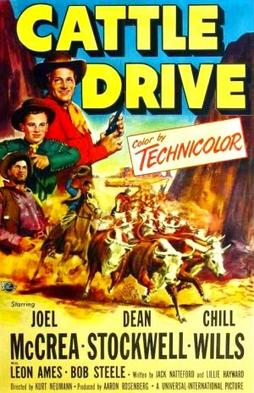
In this coming-of-age Western, Dean Stockwell plays Chester Graham, Jr., the spoiled and unruly son of a railroad owner (Leon Ames).  While riding on his father’s train and making trouble for the conductor, Chester overhears his father talking about sending him to a military school.  When the train makes as top, Chester impulsively runs away.  The train leaves without him and Chester finds himself stranded in the middle of the wilderness.  That’s when he sees cowboy Dan Matthews (Joel McCrea) trying to catch a wild stallion.

Dan is a part of a cattle drive.  Knowing that he can’t leave Chester to die in the wilderness, Dan brings him back to his camp.  The other members of the company aren’t too keen on having to look after a spoiled brat along with the cattle and Chester isn’t too happy to hear that he’ll be expected to work if he expects to get fed.  But with no choice but to work together, Chester, Dan, and the rest of the company make the journey to Santa Fe.  Chester finally drops his attitude enough to work with the company’s cook (Chill Wills) while Dan deals with a rival cowboy named Currie (Henry Brandon). Chester learns about responsibility and Dan finally finds the courage to consider settling down.

Of the many westerns that Joel McCrea made over the course of his career, he considered Cattle Drive to be his favorite and it’s easy to see why.  Cattle Drive features McCrea doing what he did best, playing a tough but good-hearted and down-to-earth cowboy who looked after an outsider.  If you were ever lost in the old west, Joel McCrea is precisely the type of cowboy that you would hope would come to your rescue.  The plot features almost every single cattle drive cliché that you could imagine but McCrea plays his role with a winning combination of grit and compassion and he and Dean Stockwell, who is also very good, make a good team.  Shot in Death Valley and Utah, Cattle Drive feels and look authentic and should be enjoyed by anyone looking for good, heartfelt western.

Wyoming Renegades (1955, directed by Fred F. Sears)


Brady Sutton (Philip Carey) used to be one of the most feared members of the Hole in the Wall Gang.  He robbed banks with Butch Cassidy (Gene Evans) and the Sundance Kid (William Bishop) and he developed a reputation for being a ruthless outlaw.  But that’s in the past.  Brady has spent three years in prison and now, he’s ready to return home, marry Nancy (Martha Hyer), and go straight.  Though most of the townspeople don’t trust Brady, he’s managed to find a sponsor in newcomer Charlie Veer (Douglas Kennedy), who has given Brady the money to open his own blacksmith shop.

Unfortunately, Brady might be done with the Hole in the Wall Gang but they’re not done with him.  When Brady spots some members of the gang in town, he realizes that they’re casing the bank.  Despite Brady’s attempts to warn the sheriff, the town assumes that Brady must be in on the plot.  Brady grows so frustrated that he finds himself tempted to go back to his old ways.  Meanwhile, Charlie is suddenly very interested in being introduced to the infamous Butch Cassidy himself.

Wyoming Renegades is a straight-forward, B-western.  The plot is nothing special but Philip Carey and Douglas Kennedy both give good Western performances and Gene Evans is memorably evil as Butch Cassidy.  For those who only know the characters as Paul Newman and Robert Redford’s performances in Butch Cassidy and the Sundance Kid, the most interesting thing about Wyoming Renegades will be seeing Cassidy and Sundance portrayed as being sadistic and humorless villains.  The truth about Cassidy and his gang is probably somewhere in-between the fun-loving rogues played by Newman and Redford and the unforgiving bastards presented in Wyoming Renegades.  In reality, it’s said that Butch Cassidy always tried to avoid killing people while Sundance rarely hesitated to draw his gun and start firing.

As for Wyoming Renegades, the ending does feature an unexpected twist, with Nancy proving herself to be more than just a docile love interest.  Fans of classic television will want to keep an eye out for a young Aaron Spelling, playing a loathsome outlaw named Petie Carver.

A Bonus Horror Scene That I Love: Conal Cochran’s Speech From Halloween III


With horrorthon coming to a close for another year, I figured why not allow Conal Cochran to get in a word or two.

This is from Halloween III: Season of the Witch.  Playing Conal Cochran, of course, is the great Dan O’Herlihy.

We hope you’ve all had a wonderful Halloween.

The TSL’s Grindhouse: Satan’s School For Girls (dir by David Lowell Rich)


Have you ever wanted to enroll in a private school so that you could investigate a murder and maybe uncover some sort of occult conspiracy?  Sure, we all have!  Well, don’t worry …. there’s a place for you!  Welcome to Salem Academy, an exclusive all-girl’s college where students learn all the basic subjects, along with taking courses in art and human sacrifice!

Salem Academy is overseen by the feared and intimidating Mrs. Williams (Jo Van Fleet), who keeps a close eye on her students and tries to make sure that they aren’t distracted or corrupted by any outside influences. However, not even Mrs. Williams can keep Martha Sayers (Terry Lumley) from fleeing the school and going to her sister’s house in Los Angeles. When Martha’s sister, Elizabeth (Pamela Franklin), returns home, she discovers that Martha has been hanged. The police say that it was suicide. Elizabeth believes that it’s something else.

So, Elizabeth does what any vengeance-seeking sister would do. Using an assumed name, she enrolls in Salem Academy herself. She meets and befriends three other students (played by Kate Jackson, Jamie Smith Jackson, and Cheryl Ladd). She gets to know two rather suspicious teachers, Prof. Delacroix (Lloyd Bochner) and Dr. Clampett (Roy Thinnes). She also manages to raise the concerns of Mrs. Williams, who doesn’t like the fact that the new girl keeps asking so many questions about why so many students at Salem Academy have died recently.

Still, Elizabeth continues to investigate. Perhaps the secret can be found in a mysterious painting that she comes across, one that appears to be of Martha? Perhaps the teachers and the students know more than they’re telling. But who can Elizabeth trust?

A made-for-television film from 1973, Satan’s School For Girls is frequently as silly as its name.  Fortunately, the film, which was produced by Aaron Spelling and directed David Lowell Rich, seems to understand just how ludicrous it is and it totally embraces both the melodrama and the silliness of its plot. This film is totally product of the time in which it was made, from the dialogue to the hairstyles to the fashions to the ending that you’ll see coming from a mile away. At the same time, that’s also why this film is a lot of fun. It’s such a product of its time that it doubles as a time capsule. Do you want to go back to 1973? Well, go over to YouTube and watch Satan’s School For Girls.  After you’ve watched it, step outside and ask anyone who the president is and they’ll probably say, “Richard Nixon.”  And if you ask them who they’re favorite Brady is, they’ll look at you like your crazy because everyone know that Marcia is the best Brady.  If you even have to ask, it’s obvious that you don’t really watch the show.  After that, you should probably try to find a way to get back to 2021 before you change the future or something.  You know how tricky time travel can be.

As for Satan’s School for Girls, it’s just a really fun movie so check it out and be sure not to be late for class!

Afraid of the Dark (1991, directed by Mark Peploe)


Lucas (Ben Keyworth) is an 11-year-old boy who lives in London and who enjoys watching the neighborhood through his telescope.  Because Lucas’s mother is blind, Lucas is concerned that there is a serial killer who is going around and attacking blind women.  Lucas is determined to help his father (James Fox), an inspector with Scotland Yard, capture the killer.  Lucas starts to sneak out of the house, visiting cemeteries and spying on the same blind women that the killer is stalking.  Investigating on his own, Lucas discovers who the killer might be.

Or does he?

Outside of the imaginary world where he spends most of his time, Lucas is a shy boy and his father is not a detective but instead a florist.  While Lucas’s mother actually is blind, Lucas himself is starting to lose his eyesight as well.  Lucas is scheduled to undergo an experimental surgery.  He’s due to go under the knife, just as surely as the victims of the serial killer that he thinks he’s hunting.  Meanwhile, his mother is pregnant and the increasingly unstable Lucas is both obsessed with his older stepsister and jealous of all the attention that his new baby sister is already getting.

Afraid of the Dark is a British psychological thriller that deserves to be better known.  Intelligently written and directed Mark Peploe, it’s both a poignant and a frightening look at a child who, due to being forced to deal with something that few others can understand, has retreated so far into his own imaginary world (where he can be the hero) that he can no longer tell what is real and what isn’t.  Lucas is both frightening and sympathetic and the movie will keep viewers guessing as to what is real and what isn’t.  James Fox and Fanny Ardant are perfectly cast as Lucas’s parents and David Thewlis, Paul McGann, and Robert Stephens all make an impression as the men who Lucas investigates in his search for the serial killer.  Tense, intelligent, and surprising, Afraid of the Dark is a film that is worth discovering.