The Bad Guys (dir by Pierre Perifel)


I’ve always loved movies about heists, and The Bad Guys hits the mark on so many levels. Based on the Scholastic books by Aaron Blabey, The Bad Guys focuses on a group of thieves known for their dastardly deeds. They also happen to be some of the scariest animals around. We have Mr. Wolf (Sam Rockwell, Moon), the charismatic leader of the group. Mr. Shark (Craig Robinson, This is the End) is a master of disguise. Mr. Snake (Marc Maron, Netflix’s Glow) can slither through any vent and doubles as rope when necessary. Mr. Piranha (Anthony Ramos, In the Heights) is the brute force / muscle of the team. And finally, my favorite is Ms. Tarantula, a.k.a. “Webs” (Awkwafina, Jumanji: The Next Level), who can hack into any computer system. They are the 2nd most wanted thieves in the city (the top spot going to the elusive jewel thief , The Crimson Paw) and Officer Misty Luggins (Alex Bornstein, Amazon’s The Marvelous Mrs. Maisel) is doing her best to apprehend them.

After a cool opening that introduces us to the team, they’re challenged by Mayor Diane Foxington (Zazie Beetz, Deadpool 2) as being off their game. This turns the crew’s attention to Professor Marmalade (Richard Ayoade, The Watch) and his Golden Dolphin as a possible trophy. When their plot fails and they are arrested, Professor Marmalade strikes a deal with the Mayor to help turn The Bad Guys into The Good Guys. Will the team put their thieving ways behind them or are they incapable of change?

Pierre Perifel previously worked on Kung Fu Panda 2 and directed the animated short film Bilby, the latter of which is closer in style to The Bad Guys. It’s almost a comic book style that reminds me of Spider-Man: Into the Spider Verse, mostly. I liked it overall, but there are some moments where it seems like the anthropomorphic characters have better designs to them than their human counterparts. It’s not terrible (It’s not even truly noticeable unless you’re really paying attention), but just a nitpick.

Where The Bad Guys shines is the cast. Each main character has a good match with the voice actor behind it. Robinson’s Shark is a huggable bear at heart. The only one who threw me off in the cast was Ayoade’s Marmalade, who reminded me a lot of Rhys Darby (Jumanji). He’s still great, though, trying to help the group turn over a new leaf. It’s Rockwell and Maron’s performances that are the strongest here, even from the start of the film. Rockwell’s Wolf is charismatic and smooth (and is a great dancer). Maron’s gruff and grumbly, unless the moment brings a guinea pig in view. I couldn’t imagine anyone else for these roles.

Ms. Tarantula (Akwafina) is an expert hacker and a member of The Bad Guys.

The pacing for the film is pretty quick, for a movie that runs an hour and 40 minutes. I would have preferred a few more heists in the film, but the story we are given works. Although the last 3rd of the film is a little over the top and I would have liked to have seen more with the ending, The Bad Guys comes with a number of twists and surprises that had me laughing and cheering on the team. Much of the dialog and style seems like it could have come from films like Tarantino’s Pulp Fiction, Mann’s Thief or Soderbergh’s Out of Sight, but set in such a way that it’s tailored to younger audiences. While the story does have some morals to it, the film never really reaches early Pixar levels of emotion. Only the youngest of fans may want to reach for a tissue or two at some point, if that. I wouldn’t mind seeing this get a sequel at some point.

Daniel Pemberton (Spider-Man: Into the Spider Verse) brings a blues/jazzy tone to the score of The Bad Guys. It almost channels David Holmes’ Ocean’s 11 in some ways, but again, that just the genre. Additionally, tracks like “Brand New Day” by The Heavy, “Good Tonight” by Anthony Ramos, and “Stop Drop Roll” by Can’t Stop Won’t Stop help are great touches to the movie. One nitpick I did have was that the trailer used Billie Eilish’s “Bad Guy” to promote the film, but it wasn’t actually used in the movie. I thought it would have made a perfect fit.

Overall, The Bad Guys is a great little heist film for kids (and adults alike), with a great set of characters. The redemption arc isn’t a heavy hitting one, but it does offer the notion that even the scariest of characters aren’t as bad as they appear.
A Blast From The Past: Name Unknown (dir by Sid Davis)


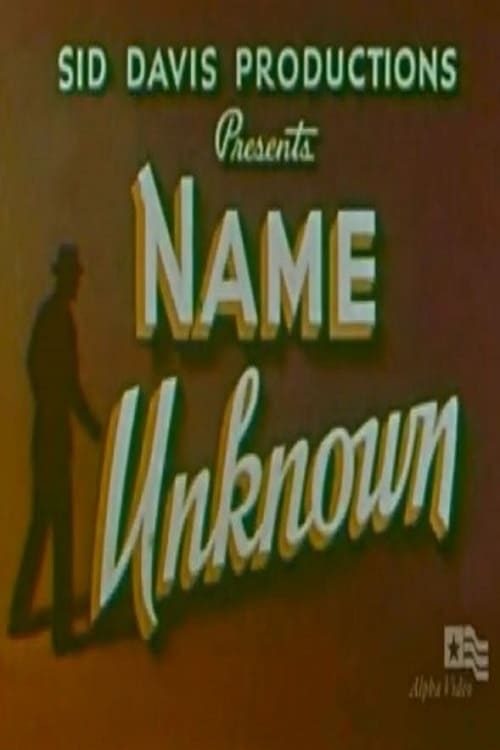
In this 1964 short film from Sid Davis, a teenage girl has been arrested.  It turns out that her boyfriend was a bank robber.  Even though she didn’t know that he was a criminal when she got together with him, the theme of this film appears to be that she should have known and, as a result of being foolish, she is now the worst person who ever lived.

In other words, this is a typical Sid Davis production.  Sid Davis films were always the most judgmental of all the old educational films.  Sid Davis specialized in using holier-than-thou narrators, who would often say things like, “And now, you’ve ruined your life.”  In this film, the narrator is a judge who is fond of saying that juveniles are “delinquent in good sense.”  As proof, he tells the story of two lovers who were robbed, a babysitter who was murdered, and another girl who was assaulted by a man who asked her out on a date.  In each case, the judge seems angrier with the victims than with the actual criminals.  As for the case of the unknowing girlfriend of the bank robber, the judge has no choice but to sentence the girl to 3 months of hard time at a juvenile detention center.  It’s for her own good because she was delinquent in good sense.

Sid Davis’s film are still popular today, precisely because they are so bizarrely angry and judgmental.  If Sid thought 1964 was a dark time for society, one can only imagine what he would think of 2022!  Watch Name Unknown below and ask yourself, “In this crazy world of ours, is there room for forgiveness?”

The TSL’s Grindhouse: Steele Justice (dir by Robert Boris)


“You don’t recruit him!  You unleash him!”

That’s what they say about John Steele, the man who Martin Kove plays in 1987’s Steele Justice.  John Steele served in Vietnam and he was one of the best and most fearless members of the special forces.  On the final day of the war, he was on the verge of arresting the corrupt General Kwan (Soon-Tek Oh) until Kwan suddenly announced that the war was over and the Americans were leaving.  Steele laughed, shrugged, and turned his back on Kwan and started to walk away.  Was Steele planning on just walking back to America?  Well, regardless, Kwan shot Steele and his friend in the back.  Fortunately, Steele survived.  Steele may be stupid but he’s strong.

Years later, both Steele and Kwan are now living in California.  Kwan is a prominent businessman who is also the secret leader of the Vietnamese mafia.  Naturally, his main henchman is played by Al Leong.  If Al Leong’s not working for you, are you even evil?  John Steele has not been quite as successful.  He was a cop until he got kicked off the force.  Then he got a job transporting horses across California.  Despite his cool guy name, John Steele doesn’t seem to be that good at anything that doesn’t involve killing people.

But then Kwan murders Steele’s best friend and former partner, Lee (Robert Kim).  In fact, Kawn not only murders Lee but he also kills Lee’s entire family.  The only survivor is Lee’s daughter, Cami (Jan Gan Boyd), a piano prodigy who is supposed to be 14 years old even though she’s being played by someone who is in her 20s.  Steele and Lee’s former boss, Bennett (Ronny Cox), gives Steele permission to track down the people responsible for Lee’s death.

John Steele sets out to destroy Kwan.  The film gives us a lot of reasons to be on Steele’s side but it’s hard not to notice that a lot of innocent people end up getting killed as a result of Steele’s vendetta.  Any time that Steele goes anywhere, Kwan’s people attack and a bunch of innocent bystanders get caught in the crossfire.  For example, Steele’s ex, Tracy (Sela Ward), agrees to look after Cami.  It turns out that Tracy is a music video director and, of course, she takes Cami to work with her.  The video shoot turns into a bloodbath, with even the members of the band getting gunned down.  And yet, not even Tracy seems to be particularly disturbed by that.  One might think that Tracy would at least sarcastically say something like, “Hey, John, thanks for getting the band killed before I got paid,” but no.  Tracy just kind of laughs it all off.  At no point does Steele or Bennett or really anyone seem to feel bad about all of the people who get killed as a result of the decision to unleash John Steele.  Those people had hopes and dreams too, you know.

I really like Martin Kove on Cobra Kai.  I love how his portrayal of the over-the-hill and burned-out John Kreese manages to be both intimidating and pathetic at the same time.  I’ve also seen a number of interviews with Kove, in which he’s discussed his career as an exploitation mainstay and he always comes across as being well-spoken and intelligent.  That said, Martin Kove appears to be totally lost in Steele Justice, unsure if he should be playing John Steele as a grim-faced avenger or as a quick-with-a-quip action hero.  Whenever Steele is angry, Kove looks like he’s on the verge of tears.  Whenever Steele makes a joke, Kove smiles like an overage frat boy who, while cleaning out his old storage unit, has just discovered his long lost copy of Bumfights.  It’s a confused performance but, to be honest, no one really comes out of Steele Justice looking good.  This is a film that features a lot of talented actors looking completely and totally clueless as to why they’re there.

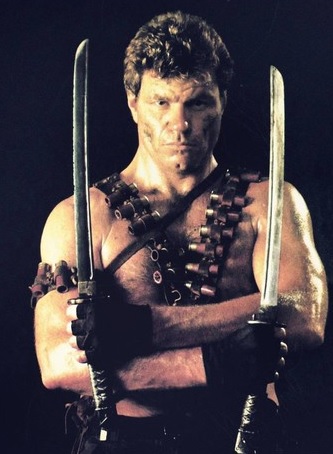
On the plus side, Steele Justice did give this world this totally intimidating shot of Martin Kove, preparing to be get and give justice.  Recruit him?  No, just unleash him!

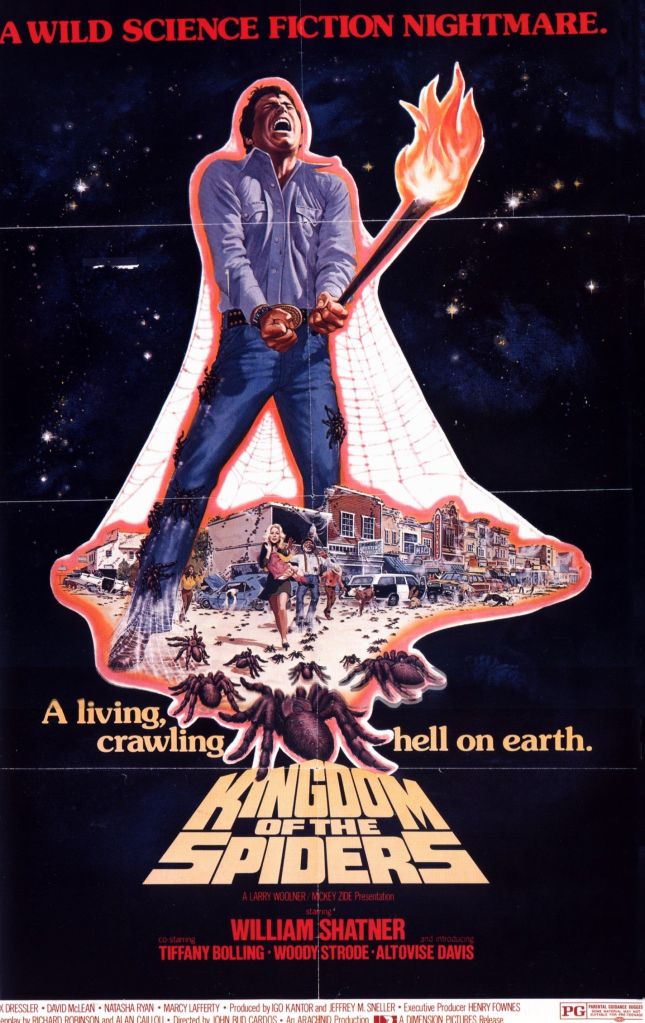
Kingdom of the Spiders (dir by John “Bud” Carlos)


While many celebrated International Cat Day on August 8th, it also happened to be National Tarantula Appreciation Day. As a result, I decided to return to a film that terrified me when I was little (and watched when I was far too young), 1977’s Kingdom of the Spiders.

As a kid growing up near the beginning of cable, movies were regularly during the weekends shown on prime time TV. This consisted of about 5 main channels in New York City: CBS (Channel 2), NBC (Channel 4), ABC (Channel 7), WNYW (Channel 5, which would become Fox in the Mid80s), WWOR (Channel 9), and WPIX (Channel 11). In addition to this, Channel 5, 9, and 11 would have movies playing on weekday afternoons just before the nightly news. I ended up watching Kingdom of the Spiders at my grandmother’s house, from under her bed. I didn’t sleep well for a while after this movie.

I don’t know why she ever owned it, but my Grandmother had this near clear shower curtain with a giant red and black spider on it. The web started from the center and spread out to the edges of the curtain. The image below is the closest approximation I could find to the one she owned. This was the source of my arachnophobia, which caused me to either enter the bathroom with my eyes closed, or use the basement bathroom (which had the rare added chance of seeing actual spiders). She tried to make me see the reality of it once, scooping me up and lifting me in front of the curtain to realize it was just a plastic sheet. My imagination was a little too much, however, and all I saw was something that wanted to cocoon and drink me dry. I screamed and flailed in her arms, and that was the end of that.

The premise for Kingdom of the Spiders is incredibly simple. At first, life is pretty comfortable in Verde Valley, Arizona. You’ve a family of cattle ranchers in the Colby’s (played by Spartacus‘ Woody Strode and Can’t Stop the Music‘s Altovise Davis). However, when a farmer’s cattle begin to fall ill and eventually dies, Dr. Rack Hansen (William Shatner, Miss Congeniality) is brought in to figure out what’s happening. Between heavily flirting with this brother’s widow Terry (Marcy Lafferty, Star Trek: The Motion Picture and Shatner’s wife at the time) and taking care of her daughter, Laura (Natasha Ryan, The Amityville Horror), it’s a surprise Rack has the time to help the Colby’s out.

When he sends in the blood samples to a lab for more research, the diagnosis is spider venom on a highly toxic scale. It’s so toxic that a spider specialist, Diane Ashley (Tiffany Bolling, Open House) is brought in to help. Of course, this springs Rack into action. After they meet, he cuts her off on the road, gives her his best one liner and then picks her up and takes her to his favorite restaurant (in her car, mind you). Rack’em, indeed.

Over lunch, they come to an understanding that DDT might be the cause of their tarantula menace. Having killed off their regular food sources of insects, the spiders have moved on to larger game. A quick visit back to the Colby Ranch confirms their fears. A spider mound is on their farm and the decision is eventually made to burn it down. Burning helps, but little do the humans realize that the spiders had exit strategies of their own. They also had additional mounds that the humans never even noticed.

With time running around out, Rack and Diane eventually decide the answer is more DDT, but the spiders thwart the attempt and decide from that point on, it’s all out war. Can the town survive the assault?

So, the spiders in Kingdom of the Spiders are just tarantulas. While all tarantulas are spiders, not all spiders are tarantulas. We’re not talking about the small house spiders from Frank Marshall’s Arachnophobia. They can be dangerous too, depending on the type. The Brown Recluse in particular has venom that is necrotic and will eat away the flesh around a bite. This movie focuses on the large hairy ones.

From what I’ve read, while most tarantulas have venom, it’s not particularly dangerous to humans. The only real exception to this are the Funnel Web spiders of Australia. They’re super aggressive and their venom can kill. Thankfully, according to a USA Today article, no one on that continent’s been killed by one since 1980. Additionally, some tarantulas only really use their fangs as a last resort. They will usually choose to flick the hairs off their back, which sting the eyes and noses of most predators.

There were about 5000 tarantulas used in the movie, with a mix of real ones for the early close ups and fake models for some of the wider shots. I’ve always wondered if the American Humane Society supervised the film, because it looks looks like a number of them were killed (at least in the last third).

Shatner is pretty much himself here, bringing that style he always does to a role. It’s not the over the top levels of Captain Kirk or Denny Crane, but it’s still fun to watch. Though I haven’t been able to confirm it, I’m told that Tiffany Bolling was one of the few people that wasn’t scared to work with the arachnids and that helped to get her the role. Most of the cast are okay, thought their reactions to spiders might cause one to laugh more than to share in their fear. Granted, I’d probably react the same way as most of them.

There’s one part involving Mrs. Colby with a gun that shares the same musical piece used in David Cronenberg’s Rabid and Scott Sanders’ Black Dynamite. Much like the classic Wilhelm scream, this musical piece seems to pop up in older movies now and then.

Overall, Kingdom of the Spiders is a decent film to unleash upon your Arachnophobic friends to watch them squirm. The spiders may spend more time running away from their prey, but some low to the ground camera shots help to make things more interesting.

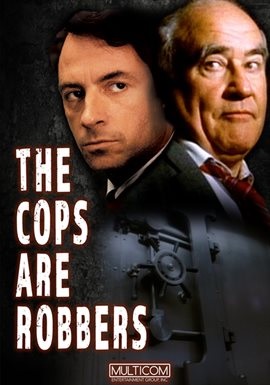
The Cops Are Robbers (1990, directed by Paul Wendkos)


When Kirkland (George Kennedy) appoints veteran cop Jake Quinn (Ed Asner) to command a division of the Massachusetts Metropolitan Police, one of Quinn’s main duties is to root out corruption.  Everyone knows that Captain Jerry Clemente (Ray Sharkey) is crooked but no one’s been able to prove anything.  This has led to Clemente getting so cocky that he tries to pull off the biggest bank robbery of all time.  Working with two other corrupt cops (played by Steve Railsback and James Keach) and some ex-cons who owe him a favor, Clemente masterminds the theft of $25,000,000 worth of jewelry.

Unfortunately, stealing that much brings in not only the FBI but it also makes Quinn even more determined to expose Clemente and all of his crooked associates.  As well, the Mafia wants their part of the action and the members of Celemente’s gang aren’t as smart as their leader.  Soon the walls are closing in.  Will Clemente get away with his crime or will he end up getting arrested and eventually writing a book about the theft that will eventually be turned into a television movie?

Though the title seems more appropriate for a comedy, The Cops Are Robbers is a drama based on a true story.  It actually could have used some comedy because the movie itself is pretty dry and straight forward.  Ed Asner and George Kennedy give their usual competent performances, cast as the type of characters that they could have played in their sleep.  Unfortunately, Ray Sharkey is nowhere near as effective as the man they’re trying to put behind bars.  When he first started out, Sharkey made a name for himself by giving convincing performances as characters who were tough and streetwise but also sometimes neurotic.  He received Emmy and Golden Globe nominations before he became better known for his trips to rehab than his acting ability.  I think that. as an actor, Sharkey’s downfall was that he saw himself compared to Al Pacino so many times that he started to buy it and he eventyally started to attack every role with the same method-style intensity.  Sometimes, like when he played Sonny Steelgrave during the first season of Wiseguy, it worked.  Most of the time, though, it just led to him overacting and bellowing all of his lines.  That’s the case with The Cops Are Robbers.  Sharkey is so loud and perpetually angry that it’s hard to believe that he’s managed to get away with his crimes for as long as he has.

For those of us who don’t live in Massachusetts, the most interesting thing about watching The Cops Are Robbers is trying to keep track of who works for what agency.  When it was mentioned that Clemente works for the Metropolitan Police, I immediately assumed that meant he was a Boston police officer.  Only later did I learn, via a review on the imdb, that the Metropolitan Police were actually a state agency.  That Clemente was a state official and not just a city cop does make his crimes slightly more interesting, though not enough to really liven up The Cops Are Robbers.

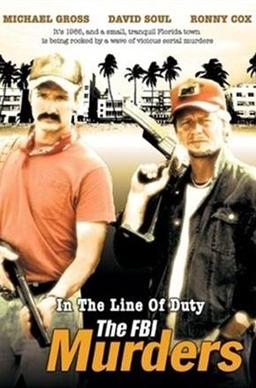
In The Line of Duty: The FBI Murders (1988, directed by Dick Lowry)


Last night, after I wrote up my review of the last In The Line of Duty movie, I checked and discovered that the first In The Line of Duty movie is now available on YouTube.

In The Line of Duty: The FBI Murders is the one that started it all.  This was the first installment and it set the general format of all the In The Line of Duty films to follow.  It was based on a true story.  The movie was evenly split between the criminals and the members of the law enforcement trying to catch them.  Here, the criminals were two bank robbers played by David Soul and, in an effective turn against type, Michael Gross.  (When this film was released, Gross was best known as the wimpy father on Family Ties.  Today, he’s better known as the survivalist from the Tremors films.  He went on to play cops in two subsequent In The Line of Duty films.)  The FBI agents pursuing them were played by Ronny Cox, Bruce Greenwood, and several other recognizable TV actors.

The FBI Murders was not only the first In The Line of Duty film but it was also the best.  All of the subsequent installments, both good and bad, pale in comparison.  Though the story is familiar and the foreshadowing is sometimes obvious (“Try not to get shot,” one FBI agent’s wife tells him), The FBI Murders still holds up today because of the strong cast and Dick Lowry’s direction of the final shootout between the cops and the criminals.  No matter how many times David Soul gets shot, he keeps getting up and firing more rounds.  Making this part of the film all the more effective is that it’s based on fact.  During the actual incident, the real-life criminals played by Soul and Gross continued firing and killing even though they had been shot a tremendous number of times.  Remarkably, it was discovered that neither had been on any type of pain-killing drug at the time.  Instead, they were determined to just keep shooting until the end.  Though the two men were outnumbered by the FBI, the agents were not prepared to go up against the military-grade weapons that the men were carrying with them.

The actors who play the FBI agents are all effective, especially Ronny Cox as the veteran who has seen it all.  As with the other In The Line of Duty films, a lot of time is spend showing the comradery between the agents and how, even when they’re not at work, they’re all still together.  In other In The Line of Duty films, the comradery could sometimes feel forced but, in The FBI Murders, it feels natural and scenes like Bruce Greenwood’s character finally getting a nickname and one of the older agents deciding to go on a stakeout just for old times sake carry a lot more emotional weight than you might expect.  It makes the final shootout all the more powerful.

Eleven more In The Line of Duty films would follow but none of them would top The FBI Murders.

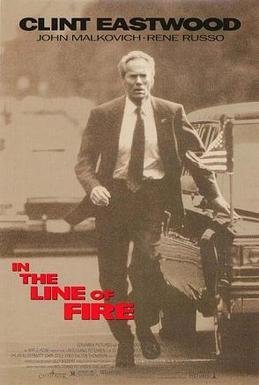
Film Review: In The Line of Fire (dir by Wolfgang Petersen)


Earlier today, it was announced that director Wolfgang Petersen had passed away.  He was 81 years old and had been suffering from pancreatic cancer.  Though Petersen started his career making films in his native Germany (and his 1981 film, Das Boot, remains the most Oscar-nominated German film of all time), Petersen eventually relocated to Los Angeles and established himself as a very successful director of thrillers and star-filled action films.

Last month, I watched one of Petersen’s films.  First released in 1993, In The Line of Fire stars Clint Eastwood as Frank Horrigan.  Frank is a veteran member of the Secret Service, still serving at a time when almost all of his colleagues have either retired or died.  When we first meet Frank, he and his new partner, Al (Dylan McDermott), are arresting a gang of counterfeiters and Frank (and the then 63 year-old Eastwood) is proving that he can still take down the bad guys.

But is Frank still up to protecting the President?  Of the agents that were with President Kennedy when he was assassinated in 1963, Frank Horrigan is the last one standing.  He’s the only active secret service agent to have lost a president and he’s haunted by what he sees as being his failure to do his job and the feeling that America has never recovered from Kennedy’s death.  Also obsessed with Frank’s history is a mysterious man who calls himself Booth.  Booth (played by John Malkovich, who received an Oscar nomination for his performance) starts to call Frank.  He informs Frank that he’s planning on assassinating the president, who is currently traveling the country as a part of his reelection bid.  Booth views Frank as being a worthy adversary and Frank, looking for redemption, requests to be returned to the Presidential Protective Division.

While Frank struggles to keep up with both the President and the younger agents, Booth slowly and methodically puts his plan in motion.  He builds his own wooden gun and tries it out on two hunters who are unfortunate enough to stumble across him.  Making a heart-breaking impression in a small role, Patrika Darbo plays the bank teller who, unfortunately, comes a bit too close to uncovering Booth’s secret identity.  Booth is friendly and sometimes apologetic and he quickly shows that he’s willing to kill anyone.  It’s a testament to both the skill of Malkovich’s performance and Petersen’s direction that the audience comes to believe that there’s a better than average chance that Booth will succeed.  He just seems to have such a strong belief in himself that the audience knows that he’s either going to kill the President or that he’s going to willingly die trying.

Meanwhile, no one believes in Frank.  The White House Chief of Staff (Fred Dalton Thompson, later to serve in the Senate and run for President himself) views Frank as being a nuisance.  The head of the detail (Gary Cole) thinks that Frank should be put out to pasture.  Only Lilly Raines (Rene Russo), another agent, seems to have much faith in Frank.  While Frank is hunting Booth, he falls in love with Lilly and she with him.  (Fortunately, even at the age of 63, Eastwood still had enough of his old Dirty Harry charisma that the film’s love story is credible, despite the age difference between him and Russo.)  The hunt for Booth reawakens something in Frank.  Just as Booth has a psychological need to be pursued and challenged, Frank needs an enemy to which he can re-direct all of his guilt and self-loathing.  Frank becomes a stand-in for everyone who fears that, because of one particular incident or tragedy, America will never regain the strength and promise that it once had.  (In Frank’s case, that strength is symbolized by his idealized memories of JFK.)  Defeating Booth is about more than just saving America.  It’s about redeeming history.

It all makes for an very exciting thriller, one in which Eastwood’s taciturn style of acting is perfectly matched with Malkovich’s more cerebral approach.  Just as the two characters are challenging each other, Eastwood and Malkovich also seem to challenge each other as actors and it leads to both men giving wonderful performances.  Wolfgang Petersen not only does a good job with the action scenes but also with generating some very real suspense.  The scene in which Malkovich attempts to assemble his gun under a table is a masterclass in directing and evidence that Petersen had not only watched Hitchcock’s films but learned from them as well.

As directed by Petersen and performed by Malkovich and Eastwood, In The Line of Fire emerges as a film that was more than just an exciting thriller.  It was also a mediation on aging, guilt, love, redemption, and the national traumas of the past.  It’s a film that stands up to multiple rewatches and as a testament to the talent of the man who directed it.

In The Line of Duty: Blaze Of Glory (1997, directed by Dick Lowry)


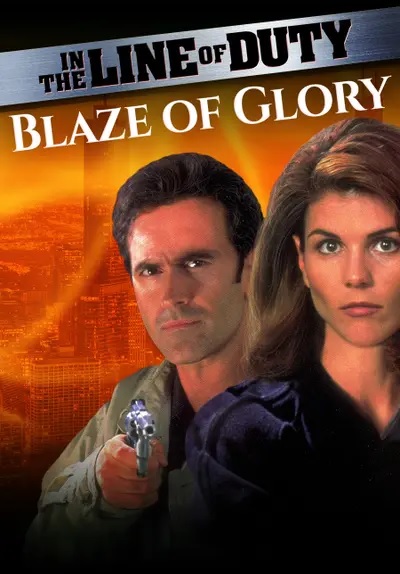
In 1997, NBC’s series of In The Line of Duty movie went out in a blaze of glory with Lori Loughlin and Bruce Campbell!

Lori and Bruce play Jill and Jeff Erickson, an attractive couple who finance their perfect life by robbing banks.  Jeff wears an obvious fake beard and, because he’s played by Bruce Campbell, it is easy to initially treat his crime spree as being a big joke.  Jeff and Jill use their money to buy a big house and to open up their own used bookstore.  Their robberies start to get bigger and more elaborate and Jill goes from being a passive observer to an active participant.  Jill gets such a rush from the robberies that she can’t stop.  While the press treats the two of them like a modern day Bonnie and Clyde, FBI agent Tom LaSalle (Bradley Whitford) tries to bring them to justice before someone gets killed.

Blaze of Glory is based on a true story.  The crime spree of Jill and Jeff Erickson also inspired another film, John McNaughton’s Normal Life, which starred Luke Perry as Jeff and Ashley Judd as Jill.  Normal Life is told almost entirely from the point of view of the bank robbers while Blaze of Glory, like all of the In The Line of Duty movies, is firmly on the side of law enforcement.  Both films tell the same story and stay fairly close to the facts of the case but it’s interesting to see how behavior that was presented as being romantic and tragic in Normal Life is portrayed as being dangerous and arrogant in Blaze of Glory.

Bruce Campbell and Lori Loughlin are the two main reasons to watch Blaze of Glory.  Campbell plays Jeff Erickson as being a slightly smarter version of Ash.  Jeff may enjoy running his used bookstore and talking to people about literature but he simply cannot stay out of trouble.  He has the confidence necessary to rob a bank but he’s also so reckless that he doesn’t think much about what he’s going to do after he puts on his fake beard and fires his gun at the ceiling.  Lori Loughlin, having finally escaped from Full House, gives an uninhibited and sexy performance as Jill, who is never happier than when she’s helping her husband to rob a bank.  Eventually, she turns out to be just as reckless as her husband and even more willing to fight her way out of a police chase.  Campbell and Louglin are so good that it’s too bad that half of the movie is Bradley Whitford as the lead FBI agent and Brad Sullivan as his father.

After sitting out Kidnapped, Dick Lowry returns to the director’s chair for the final In The Line of Duty and it’s one of the best of the series.  The action scenes are exciting and Campbell and Loughlin burn up the screen.  Blaze of Glory was the finale of In The Line of Duty but what a way to go!

Kidnapped: In The Line of Duty (1995, directed by Bobby Roth)


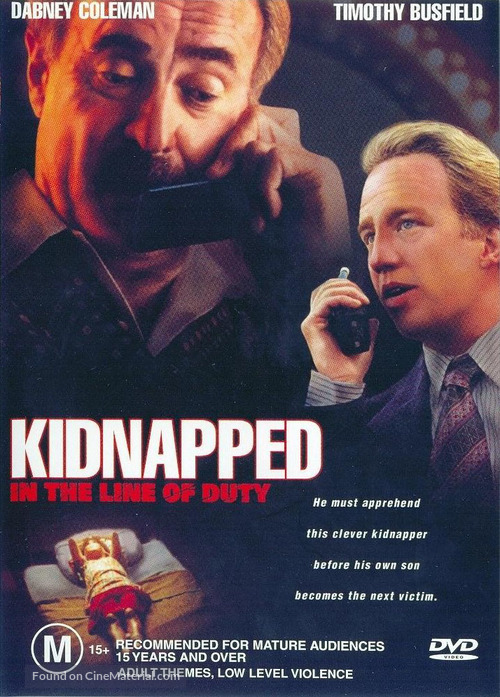
Arthur Milo (Dabney Coleman) is an IRS agent who uses his government position and the powers that with it to commit heinous crimes.  (A corrupt IRS agent?  What a shock!)  Milo kidnaps the children of the wealthy, using legally-filed tax returns to select his target.  Most of his accomplices all have the perfect alibi because they’re all in prison!  As an agent of law enforcement, Milo is able to check them out of prison for hours at a time.  Milo claims that they’re helping him out with an investigation but actually, they’re kidnapping children and digging graves in return for Milo’s help with their tax problems.  Once the crime has been committed, Milo returns them to jail.  It seems like the perfect plan but Milo may have met his match in hard charging FBI agent Pete Honeycutt (Timothy Busfield).

Loosely based on a true story, Kidnapped was the tenth of NBC’s In The Line of Duty films and it was one of the few not to be directed by Dick Lowry.  It’s also the only one of the In The Line of Duty films to not feature a member of law enforcement getting gunned down nor does it end with a title card of statistics about the number of cops who are killed on the job each year.  All of this leads me to suspect that Kidnapped was not originally meant to be an In The Line of Duty movie and that it was added to the series at the last minute.  NBC was obviously hoping that the rating success of Ambush in Waco would rub off on Kidnapped.

Kidnapped is a pretty typical eccentric criminal vs eccentric investigator movie.  Pete is obsessed with taking down Milo and Milo is obsessed with showing up Pete.  It’s not a surprise when Milo starts to personally taunt Pete and it’s also not a surprise that Pete’s family is put at risk.  There are a few strange moments of humor, most of them supplied by Tracey Walter as Milo’s spacey accomplice.  The humor, though, doesn’t always seem to go along with a fact-based story about an IRS agent who abducted children and held them for ransom.

The best thing about the film is Dabney Coleman as Arthur Milo.  Coleman has always been an underrated actor.  Nobody did as good at a job at playing a curmudgeon as Dabney Coleman.  In Kidnapped, Coleman takes his usual persona up a notch by playing Milo as someone who is not just annoyed by people but who is willing to kill them too.  While Arthur Milo’s schemes are usually clever, he’s so arrogant and determined to show off how much smarter he is than everyone else that he’s usually his own worst enemy.  He’s the type of criminal who wears a white suit and a panama hat, despite the fact that his outfit will make him instantly recognizable to anyone who witnesses his crimes.  The character is a strange one but Coleman brings him to life and makes him believable.  Kidnapped is a pretty standard police procedural but worth seeing for Coleman’s villainous turn.

So, I Watched Girls of Summer (2008, dir. by Max Tash)


I was looking for a baseball movie to help me get over the Losing Season Rangers Blues.

I settled for a softball movie.

I won’t make that mistake again.

Jake McBride (Tom Pilleri) makes a bet that he can turn a group of models into a championship softball team.  The only problem is that none of the models know how to play softball, except for Christine (Sasha Formoso) and Jake’s cousin, Holly (Tarah DeSpain).

Christine and Holly, I liked.  Everyone underestimated them because they were girls and they proved all of the boys wrong.  Plus, Tarah DeSpain was believable as an athlete.  Those were the only characters that I liked.  None of the other models had any personality and Jake was a jerk even when he was doing the right thing.  Who is dumb enough to bet that much money on a softball game?  The humor was frat boy humor and the movie looked like it was filmed on someone’s phone.  A League of their Own, this was not.

Girls of Summer did not make me feel better about the Rangers currently being 50-63 for the season.  In fact, it made me feel even worse because, as bad as the model were, they at least had a winning season.  But then I remembered that the Athletics were 41-73 and I felt better.  One good thing about the AL West is that, even when the Rangers aren’t having their best season, there’s usually at least one other team doing worse.  Go Rangers!