The TSL’s Horror Grindhouse: Embrace of the Vampire (dir by Anne Goursaud)


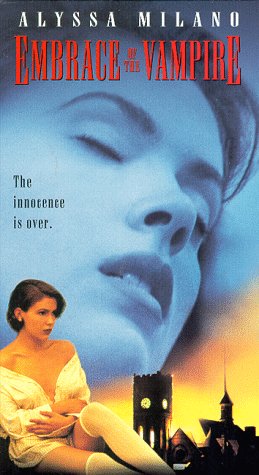
In this incredibly silly film from 1995, Martin Kemp plays The Vampire.  He doesn’t get a name but he does get a backstory.  Back when he was mortal, the Vampire pursued a secret and forbidden affair with a princess.  One day, after making love, the man who would became the Vampire was laying down next to a stream when he was approached by three naked women who proceeded to bite his neck and vampirize him.

Centuries later, the Vampire is sickly and approaching the end of his existence.  He only has three days to convince the reincarnation of his former lover to allow him to drink her blood so that he can continue to exist.  And apparently it won’t work unless she’s a virgin and unless she rejects all others and loves only him.  That sounds like a lot of rules to me and, to be honest, most of them seem to be kind of arbitrary.  Not only does The Vampire have to find the reincarnation of the Princess but he has to find her before she loses her virginity or otherwise, what?  She’ll cease to be the reincarnation?  Her love will somehow be devalued?  Her blood will no longer be worth drinking?  If this vampire has had to spend centuries only drinking blood from virgins who were in love with him, no wonder he looks so sickly.  I really think that maybe the other vampires were playing a practical joke when they explained the rules to him.  Hazing the new guy, it has consequences!

Anyway, the princess has been reincarnated as Charlotte (a young Alyssa Milano).  Fortunately, for the Vampire, Charlotte was raised in a convent and, even though she is now a college student, she’s still a virgin who blushes when she even hears the word sex.  Unfortunately, Charlotte has a boyfriend named Chris (Harrison Pruett) and she’s thinking about losing her virginity if she can convince herself that she loves Chris more than any other person that she will ever possibly meet.  So, the Vampire not only has to convince Charlotte to fall in love with him but he also has to make sure that she doesn’t have sex beforehand.  It’s going to be difficult because everyone on campus is determined to get Charlotte laid.  This has all the makings of Italian sex comedy but Embrace of the Vampire instead takes its plot very seriously.

The Vampire starts to appear in Charlotte’s dreams.  He gives her an ankh to replace the cross that Chris gave her.  Because the Ankh is a symbol of desire, just wearing it makes Charlotte more sexually aggressive and soon, she’s wearing short skirts, low-cut tops, and white stockings.  She’s also making out with Sarah (Charlotte Lewis), the photographer who lives in the dorm room next to hers.  (As played by Charlotte Lewis, Sarah is actually an interesting character and it’s a shame that the film pretty much just uses her for titillation.)  But since the Vampire’s whole thing is keeping Charlotte from losing her virginity, why would he give her something that would make her more open to sexual experiences?  Again, it’s hard not to think that the Vampire is just the victim of an elaborate practical joke.

As I said at the start of the review, Embrace of the Vampire is incredibly silly.  It’s also a film that seems to be a bit popular with viewers of a certain age.  I’m assuming that’s because of the frequent Alyssa Milano nudity and that one scene with Charlotte Lewis.  For the most part, Alyssa Milano gives a bland performance in Embrace of the Vampire.  It’s not so much that she’s bad as everything about her performance is on the surface.  One gets the feeling that there’s really not much going on with Charlotte’s inner life, both before and after she starts dreaming about The Vampire.  As The Vampire, Martin Kemp appears to be absolutely miserable.  He comes across as if he’d rather be anywhere than appearing in this movie.

That said, the film’s director got her start working with Francis Ford Coppola and she has a good eye for gothic scenery and atmosphere.  A scene where Charlotte imagines a frat party turning into a Hellish orgy is effectively done.  Jennifer Tilly has a small role as a vampire and she has said that Quentin Tarantino approached her at the Oscars to tell her that he enjoyed the movie.  It’s a silly movie (yes, third time I’ve used that specific term and that should tell you just how silly it is) but, for better or worse, it epitomizes an era.
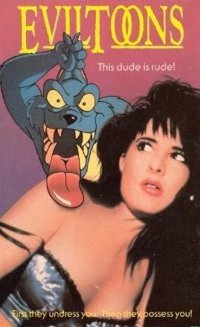
Evil Toons (1992, directed by Fred Olen Ray)


Evil Toons opens, disturbingly enough, with David Carradine hanging himself.  Carradine is playing Gideon Fisk, the owner of both a run-down mansion and an ancient book that appears to be bound in human skin.  Though Fisk kills himself, he still appears several years later so that he can deliver a copy of the book to the four girls who have been hired to clean his home.

The girls are all students at Miskatonic University, a name that will be familiar to any fans of the work of H.P. Lovecraft.  (Those same fans will also have figured out that the book is the Necronomicon.)  Jan (Barbara Dare) and Terry (Suzanne Auger) want to get the house cleaned so they can get paid.  Roxanne (Madison Stone) wants to party overnight with her idiot boyfriend, Biff (Don Dowe).  Shy and intellectual Megan (Monique Gabrielle) is mostly just worried about surviving until morning.  After the girls open the book, they get Megan to translate the Latin writing within.  This brings to life a cartoon monster, one who looks much like a combination of the Big Bad Wolf and the Tasmanian Devil but which is far more bloodthirsty and horny than either of them.  After killing one of the girls and possessing her body, the Monster stalks the other inhabitants of the house.

Not meant to be taken seriously in any way shape or form, Evil Toons was made by Fred Olen Ray for $150,000.  That probably explains why, despite the title, there’s only one evil toon and it only gets a minute and a half of screen time before possessing its first victim.  Most of the dialogue is deliberately obtuse, with none of the girls showing any alarm upon realizing that forcing Megan to translate the book has condemned everyone to an eternity of torment.  The good thing is that there are enough funny lines to hold your interest and the cast is game (and frequently undressed, which is probably why this film still has a cult following).  Monique Gabrielle proves that she can scream with the best of them while Madison Stone is genuinely funny as Roxanne, delivering her lines with a playful quirkiness and even indulging in a little physical comedy with a hard-to-open wine bottle.

Fans of B-horror will be happy to see Dick Miller in the role of Burt, the man who hires the girls to clean up the house.  After leaving the girls at the house, Burt goes home and watches Bucket of Blood (starring Dick Miller, of course) on television.  “How come that guy never won an Academy Award?” Burt asks.  Burt’s wife is played by scream queen Michelle Bauer, who gets a guest starring credit for a two-minute role that consists of her reminding Burt what Friday night is supposed to be for.

Evil Toons is undeniably dumb but I laughed more than I was expecting too.  I think it helps that the movie confirmed what anyone who grew up watching Saturday morning cartoons has always suspected.  Most cartoon characters aren’t that innocent, especially the ones that are drawn in the margins of the Necronomicon.

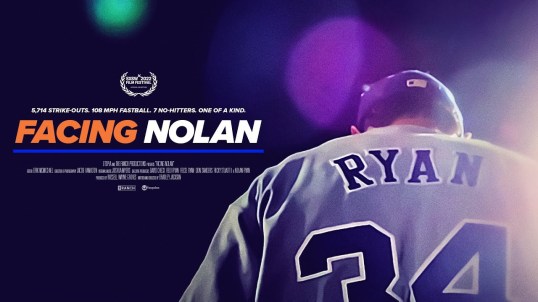
I Watched Facing Nolan (2022, dir. by Bradley Jackson)


Yesterday, I was feeling down about the Texas Rangers and their 66-89 record so I watched Facing Nolan on Netflix.

Facing Nolan is a documentary about Nolan Ryan, the Texas icon who played in the Major Leagues for 27 seasons and who proved himself to be the greatest pitcher who ever played the game.  He started his career with the Mets, working as a relief pitcher until he saved the Mets from losing Game 3 of the 1969 World Series.  (Somehow, it would be his only World Series appearance as a player.)  He was traded to the Angels, where he finally worked with a coach who was able to get wild pitching style under control.  After his son was nearly killed in a car accident, Ryan returned to Texas and played first for the Astros and then for the Rangers.  After he finally retired from baseball, Ryan became a businessman and a rancher.  He was President and CEO of the Rangers during the two seasons that we made it to the World Series.  I can remember Ryan being interviewed during those exciting playoff games as the Rangers made their way to their first two World Series appearances.  I’ll always associate Nolan Ryan with my two favorites seasons of baseball.

Ryan holds a total of 52 MLB records, including:

5,714 career strikeouts
215 career double-digit strikeout games
7 career no-hitters
12 career 1-hitters, tied with Bob Feller
18 career 2-hitters
31 career 3-hitters
15 200-strikeout seasons
6 300-strikeout seasons
6.555 career hits per nine innings
5.26 single-season hits per nine innings (1972)
Lowest batting average allowed, career (minimum 1500 innings) .204
26 seasons with at least one win
2,795 career walks
10 grand slams allowed (tied)
757 career stolen bases allowed

How did Nolan Ryan set all those records?  According to Facing Nolan, he did it by just being naturally better than every other pitcher in the game.  From his childhood on, Nolan Ryan was a powerful pitcher and a natural leader.  At first, he didn’t even realize how good he was.  When he was drafted into the Mets after high school, Ryan thought he would just play for four seasons, get his pension, and then return to his hometown of Alvin, Texas and work as a vet.  It took the Mets a while to realize how good he was too.  Up until his World Series performance, he was considered to just be a relief pitcher who was as likely to hit the batter as to get the ball over the plate.  When he was with the Mets, he got paid $7,000 a season and, after the Mets won the world series, Ryan still had to get a job installing air conditioning units to support himself during the off-season.  Ryan kept playing as he moved from team to team and, by the time he threw his second no hitter in 1973, everyone knew how good he was.  Ryan also knew how good he was and made sure he got paid a salary that reflected it.  There would be no more installing air conditioners to make ends meet!

Facing Nolan features interviews with Ryan’s family, his former teammates, and his former managers.  George W. Bush is interviewed and it’s obvious that Nolan Ryan’s time with the Rangers is one of his favorite things to talk about.  Facing Nolan was made by a fan for the fans and watching it, I was transported back to those days when the Rangers were winning every game and it seemed like our first World Series victory was just one strikeout away.  Hopefully, all of us fans will get to reexperience that feeling someday soon and, when the Rangers do finally win a Series, Nolan Ryan will sitting in the stands watching.

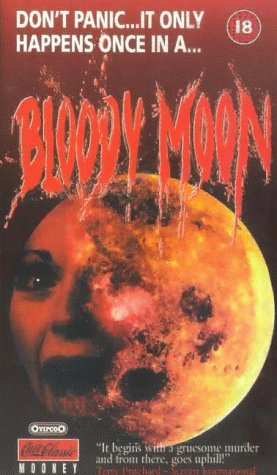
International Horror Film Review: Bloody Moon (dir by Jesus Franco)


A 1981 West German/Spanish co-production, Bloody Moon open with a disfigured man named Miguel (Alexander Waechter) putting on a Mickey Mouse mask and sneaking into a party being held on the campus of a private school that is known as (deep breath) Europe’s International Youth-Club Boarding School of Languages.  It’s a school that is meant for the young, the rich, and the unburdened.  In short, it’s not a place for Miguel at all.

With his face safely hidden behind the smiling image of Disney’s favorite mouse, Miguel meets a young woman who is dancing by herself.  She mistakes him for her boyfriend and heads into a nearby bungalow with him.  They start to make love but — uh oh! — the mask falls off!  The woman screams at the sight of Miguel’s scarred face.  Miguel grabs a pair of scissors and stabs her to death while Mickey Mouse’s smiling face smiles on the floor.  (One can only imagine how Disney reacted to this film.)

A few years later, Miguel is being released from a mental hospital.  He’s released into the custody of his sister, Manuela (Nadja Gerganoff).  Miguel’s doctor (played by the film’s director, Jesus “Jess” Franco) says that Miguel should be fine as long as he’s not around anything that reminds him of the incident.  Manuela says that she’ll look after him and then promptly takes him back to the school where he committed the murder.  What part of not reminding him did she fail to understand?

Manuela does actually have an excuse for bringing Miguel to the school with her, though.  She and her aunt, Countess Maria (Maria Rubio), own the school.  Countess Maria is an angry, wheelchair-bound woman who is convinced that Manuela wants to kill her so that she can take over the school and it does seem that Manuela does have some hostility towards her aunt.  Of course, another reason for bringing Miguel back to the school to live with her is that he and Manuela have an incestuous relationship …. or, at least, they did.  Now that Manuela refuses to sleep him, Miguel is reduced to lurking around campus and staring at all the students while they sunbathe topless at the pool.  While Manuela stands naked in her room and stares at the moon (the bloody moon?), Miguel is hunched down in the shrubbery and peeping through windows.

Among the students is Angela (Olivia Pascal).  Angela is upset because she discovered a dead body but no one’s willing to believe her because she also enjoys reading mystery novels.  Angela knows that someone is committing murders on campus but is it Miguel or it is Professor Alvaro (Christoph Moosbrugger) or could it even be the enigmatic Bueno (Otto Retzer), a bald guy who seems to randomly pop up around campus?  Can Angela convince her remarkably stupid classmates that there’s a murderer on campus before it’s too late?

Bloody Moon was one of the many films directed by the Spanish auteur and former Orson Welles collaborator, Jesus Franco.  In a career that lasted over 60 years, Franco directed at least 173 feature films.  (It’s felt that he actually directed quite a bit more, usually under a pseudonym.  Franco, himself, claimed that he didn’t really remember how many films he had directed.)  As a director, Franco is remembered for his low budgets, his unapologetic embrace of the sordid, his rather casual attitude towards maintaining continuity from one scene to another, and for occasionally framing an interesting shot or two.  By his own admission, Bloody Moon was not a personal project for Franco.  It’s something that he did for the money, as a director-for-hire.  However, Bloody Moon is unmistakably a Franco film.  The budget is low.  The subject matter is often so sordid that it borders on parody.  As far as continuity goes, Angela goes from wearing a nightshirt when she discovers a dead body inside her bungalow to wearing a colorful sweater when she runs outside in a panic.  (I guess she could have stopped to change clothes with a dead body on the bed and a killer lurking somewhere in the bungalow but I doubt it.  When there’s a dead body on your bed, modesty should be the least of your concerns.)  And yet, as silly as it all is, there are moments when Bloody Moon does achieve a certain dream-like intensity.  The mix of badly dubbed performers, sudden jump cuts, bloody violence, and the total lack of narrative logic makes Bloody Moon feel a bit like a filmed nightmare.  It works despite itself.

Bloody Moon is one of the films that was, for a while, banned in the UK due to its violence and bloodshed.  And indeed, there is a lot of blood and the violence is a bit more graphic than what one might expect to find in the American slasher films that Bloody Moon was obviously meant to capitalize upon.  This film is notable for just how cruel the killer is.  Not even Michael Myers or Jason Voorhees resorted to using a giant radial saw.  That said, this is one of those films that has a reputation for being bloodier than it actually is.  The majority of the film is taken up with scenes of people wandering around campus, either searching for their friends or stalking a potential victim.  Personally, I felt the nonstop searching scenes added to the film’s dreamlike feel but I imagine those who only watch films like this for the kills will find it all to be a bit slow.

Bloody Moon was clearly made to capitalize on the success of American slasher films like Halloween and Friday the 13th.  That said, Bloody Moon has more in common with the Italian giallo genre, right down to the whodunit nature of the plot, the ludicrously sleazy motives of the killer, and the total lack of intentional comic relief.  Like so many giallo films, Bloody Moon takes place in a world where everyone’s either a victim or a killer and no one’s particularly likable.  It’s not one of Franco’s personal films but there’s still enough of his signature style to appeal to his fans.  As with most of Franco’s film, it will be best appreciated by those who like a little ennui mixed with their horror.

Horror Film Review: Await Further Instructions (dir by Johnny Kevorkian)


The 2018 film, Await Further Instructions, takes place in the United Kingdom during the Christmas season.  However, it tells a story that could take place anywhere and at any time.  That’s even more obvious today than when the film was first released.

A dysfunctional family has gathered for the holidays.  Nick (Sam Gittins) brings his girlfriend, Annji (Neerja Naik).  Nick’s sister, Kate (Holly Weston), is both pregnant and a racist.  She brings her husband, Scott (Kris Saddler).  Tony (Grant Masters) and Beth (Abigail Cruttendon) are the parents, trying to keep some sort of order as dinner is served.  Finally, Granddad (David Bradley) dislikes everyone as grandfathers are allowed to do.  Once someone reaches a certain age, bad behavior is casually dismissed as someone just having a bad day.

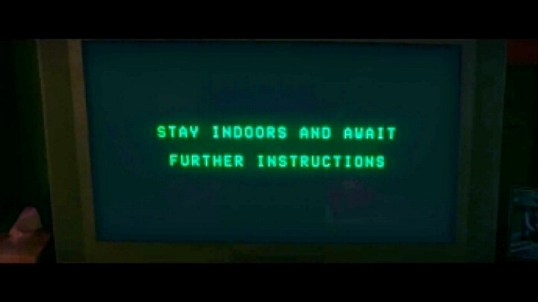
The family dinner is interrupted by reports of some sort of ill-defined disaster.  A dark substance appears to have surrounded the house, trapping them inside.  Bizarre messages start to appear on the television, telling the family to obey orders and to await further instructions.  Some members of the family dare to unplug the television, just for Tony quickly plug it back in.  Hypodermic needles are dropped through the chimney, along with a message that one of them is infected and that they have to take the vaccine if they’re going to survive.  Even after taking the shot leads to one member of the family vomiting to death, Tony continues to insist that everyone has to follow the instructions coming from the television.  The television accuses one of them being a sleeper agent.  The television demands a sacrifice.  The television warns of terrible consequences if its instructions are not followed.  Those who try to resist find themselves being attacked by the other members of the family.  “Worship me,” the television suggests at one point and much of the family is willing to do just that.

Await Further Instructions was made in 2018 but it’s a film that feels as if it was specifically made for the COVID era.  (I write this as someone who is voluntarily vaccinated and who is still more than happy to put on a mask if someone politely requests that I do so.)  While a good deal of the film’s horror does come from grotesque imagery and Cronenberg-style body horror, the reason why the film sticks with the viewer is because it perfectly captures the paranoid atmosphere that everyone has had to deal with over the past two years.  (Indeed, if this film had been made today, critics would probably say that the film was a bit too on the nose in its portrayal of people putting blind faith in instructions coming from unseen forces.)  Tony goes from being a slightly addled father to being a monster, precisely because that’s what he’s ordered to do and he doesn’t have the courage or the imagination to question why.  This is the story of a family that’s destroyed because they put more faith in authority than in their own common sense.  It’s a story about family that turns on itself because it’s ordered to do so.  It’s a story that feels very relevant today.  One need only read one of the thousands of self-pitying social media updates from people talking about how they’ve shut their families out of their lives to realize that many people, if they were in the same situation, would probably behave the same way that Tony behaves in this film.

By confining the action to one location, the film creates a visceral atmosphere of claustrophobia.  Even if the family could escape from the house, the viewer has to wonder if there’s anywhere left to go.  The film declines to make clear if the same horror is happening to the rest of the world or if it’s just concentrated on that one house.  Is everyone being told to await further instructions or is just that one family?  Await Further Instructions not only captures the horrors of blind conformity and overwhelming paranoia but also the horror of isolation and again, it’s hard not to feel that this 2018 film predicted the future.  For all the horrors of the COVID era, the isolation was the most psychologically damaging.  Families were destroyed.  Friendships were broken.  Faith in institutions was lost.  All while people were ordered to shut up and await further instructions.

Even more now than when it was first released, Await Further Instructions is a powerful and visceral horror film.

Killer Pizza, Short Film Review, By Case Wright


Here we are! The Most Wonderful Time of the Year! Shout out to Lisa our Glorious Leader and Friend!

Killer Pizzer Delivers! See what I did there?! That’s right, it’s Horrorthon! It’s on! Basically, pizza

is killing people at and home and restaurants. Nikki, our heroine, loses her mother to my people’s food! Side Note: isn’t it awesome to be Italian?! Our food owns the BEST DAY OF THE WEEK!!! Our food makes a party! You have four unrelated people together- that’s a meeting, but add pizza and you have…. wait for it….. A PIZZA PARTY!!!

Back to Killer Pizza! That’s it! It’s 2 minutes and 24 seconds! Enjoy!

Horror on the Lens: The Horror at 37,000 Feet (dir by David Lowell Rich)


Hi there and welcome to October! This is our favorite time of the year here at the Shattered Lens because October is our annual horrorthon! For the past several years (seriously, we’ve been doing this for a while), we have celebrated every October by reviewing and showing some of our favorite horror movies, shows, books, and music. That’s a tradition that I’m looking forward to helping to continue this year.

To start things off, we have the 1973 made-for-TV movie, The Horror at 37,000 Feet.  This film starts off like a typical disaster film, with a collection of familiar celebrities catching a flight from Heathrow Airport.    What they don’t know is that celebrity is not the only thing flying across the ocean!  There’s a sacrificial altar sitting in the baggage hold and soon, all sorts of strange things are happening!  Truly, it’s a horror at 37,000 feet!

This film is silly and perhaps even a little bit dumb but it’s also definitely a lot of fun.  To be honest, when you’ve got William Shatner playing an ex-priest who is wondering what happened to his faith, how can you go wrong?  Along with Shatner, keep an eye out for Chuck Conners, Buddy Ebsen, Roy Thinnes, Paul Winfield, Tammy Grimes, and France Nuyen.  Basically, every TV actor who needed a job in 1973 boarded The Horror at 37,000 Feet. 

Happy October and enjoy The Horror at 37,000 Feet!

Lisa Marie Reviews An Oscar Nominee: Nightmare Alley (dir by Guillermo del Toro)


In March, CODA won the Oscar for Best Picture.

By May, I think most people had forgotten about it.

I point this out not to be snarky about CODA (which, for the most part, I found to be a well-made and sweet-natured movie) but to just point out that occasionally, the Oscar for Best Picture Of The Year does not go to the nominee that’s necessarily going to be remembered and watched by future generations.  CODA’s victory is not a travesty, regardless of what some members of Film Twitter insisted.  This isn’t like when Green Book won.  It’s just that CODA seems to be destined to be remembered in much the same way that we remember Argo and Spotlight, i.e. a well-made and well-acted film that gets the job done but don’t necessarily stick around in your mind for long after you watch it.

In fact, looking back at all of the 2021 Best Picture nominees, the one that has really stuck with me is Guillermo del Toro’s Nightmare Alley.

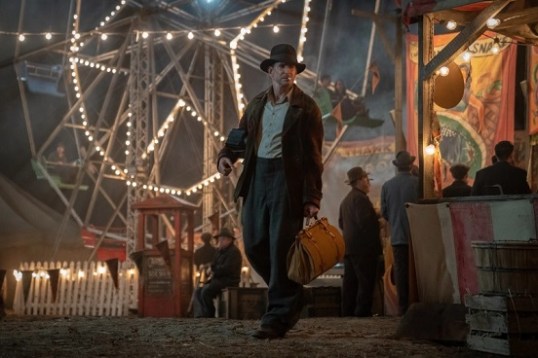
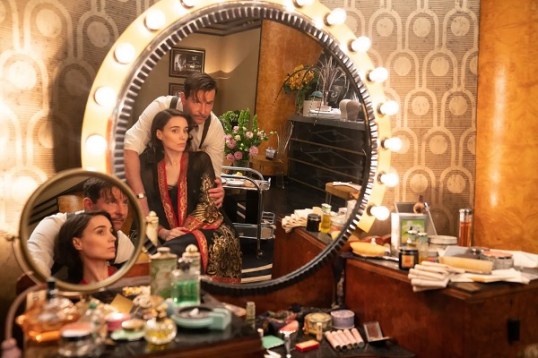
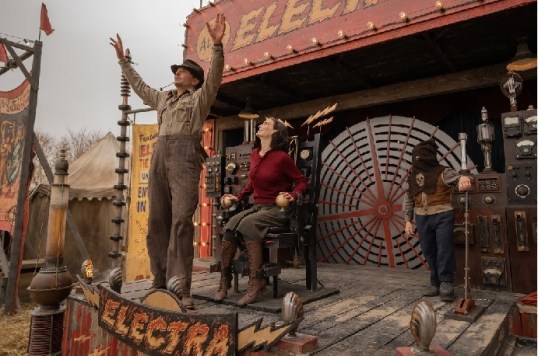
Nightmare Alley tells the story of Stan Carlisle (Bradley Cooper), a drifter who, in 1939, gets a job with a carnival.  Stan is running from his past.  He’s haunted by visions and dreams of a dying old man and a burning farm house.  When we first meet him, he avoids alcohol which is perhaps a good thing as getting drunk at the carnival just makes someone easier to exploit and, ultimately, the carnival is all about exploitation.  The carnival’s owner, Clem (Willem DaFoe), specializes in tricking alcoholics into becoming opium-addicted “geeks,” who bite the heads off of chickens for gawking country audiences.

It’s not a glamorous life but it’s one that allows Stan to hide from his past.  He comes under the tutelage of Madame Zeena (Toni Collette) and her husband, Pete (David Straithairn).  They teach him how to give “cold readings,” and Stan proves to be an eager student.  Pete tells Stan to never pretend to be able to speak to the dead and, from the minute that Pete says it, we can tell that Stan is already thinking about how much money he could make by doing just that.  Stan also appears to fall in love with Molly (Rooney Mara), a performer whose act involves a fake electric chair.  When Stan eventually abandons the carnival, Molly goes with him.  When Stan finds success as a fake medium, Molly is his assistant.

Stan becomes quite a success in Buffalo, trading in his shabby clothes and his unshaven appearance for a tuxedo and suave mustache.  With success comes arrogance and Stan soon ignore what Pete told him about pretending to be able to speak to the dead.  When Stan meets a psychologist named Dr. Lillian Rith (Cate Blanchett), he gets involved in a plot to con a judge who is still mourning for his deceased son.  It also leads to Stan meeting a corrupt and murderous businessman (Richard Jenkins).  Ignoring Pete’s lesson sets off a chain of events that leads Stan right back to where he started.

There’s something wonderfully subversive about taking Bradley Cooper, a legitimate movie star who is probably one of the most personable and likable actors working today, and casting him as such a sleazy character.  This isn’t a case, as in American Hustle or even The Hangover movies, where Cooper is playing a goof who gets in over his head.  Instead, Stan is someone who uses his eager manner and his natural charm to cover up the fact that he’s hollow on the inside.  Watching the film, you’re never quite sure as to whether or not Stan truly cares about any of the people who come into his life.  Does he love Molly or is he just using her?  Does he care about his friends from the carnival or is he just manipulating them into acting as a shield to keep out his former life?  When he goes against Pete’s lessons about pretending to speak to the dead, is he motivated by greed or arrogance?  Or does he truly want to believe that he’s somehow become the all-powerful psychic that he pretends to be?  Stan becomes a success because he knows how to con everyone but eventually, he meets someone who is even emptier than he is.  Ultimately, Stan cons himself.  He tricks himself into believing that he’s more clever than he actually is and he ends up facing the fate that he secretly always knew was waiting for him.  Cooper gives an outstanding performance as Stan.  Both he and del Toro cleverly play with what audiences expect when they see Bradley Cooper onscreen.  In the end, the film suggests that not even charm can ward off karma.

Nightmare Alley is work of what Lucio Fulci called “pure cinema,” one in which the imagery and the emotions generated by that imagery is even more important than the story itself.  The sets, whether it’s the carnival or Dr. Ritter’s office or the Buffalo ballroom where Stan cons the wealthy, are large and ornate.  The cinematography is gorgeous.  The supporting performances are arch and witty.  Cate Blanchett’s and Rooney Mara’s costumes are to die for.  Nearly every shot feels as if it could have been lifted from a particularly vivid dream.  Guillermo del Toro’s love of cinema is evident in every frame of Nightmare Alley.  It’s a film that celebrates the grandeur and the power of imagination and also warns about the destructive power of hubris.  Despite the fact that del Toro has gone on the record saying that there’s nothing supernatural about Nightmare Alley, it’s still a wonderful film for the Halloween season.  The costumes are beautiful and the final third of the movie plays like an homage to the classic German expressionistic horror films, with Blanchett playing her role as a mix of Dr. Caligari and a classic noir feeme fatale.  Nightmare Alley is a big, flamboyant, and unforgettable work of pure cinema and, looking back, it’s my favorite film of 2021.

It’s a film that stays with you.

Death Kiss (2018, directed by Rene Perez)


An unnamed city has been turned into a war zone by gangsters like Tyrell (Richard Tyson).  Men, women, and children are killed in the streets.  Muggers haunt every corner.  Pimps exploit women in dirty trailers.  A right-wing radio host named Dan Forthright (Daniel Baldwin) rants that if the police aren’t going to do their job then it’s up to the citizens to take up arms and take the streets back.

Making that dream a reality is a man known only as the Stranger (Robert Bronzi).  The Stranger walks the streets, wearing a dark suit and carrying a gun.  He has a mustache and a grim expression and he doesn’t say much.  He approaches criminals and he guns them down without hesitation.  If the criminals beg for their lives, the Stranger just shoots them again.  There’s no one that the Stranger hates more than a criminal who preys on the weak and defenseless.  (The Strangers reminds me someone.  As the film’s tagline puts it, “Justice has a familiar face!”)  For years, the Stranger has been sending money to a single mother named Ana (Eva Hamilton).  He goes to her house and they meet when she catches him slipping an envelope full of cash into her mailbox.  The Stranger won’t explain why he’s sending her money but he will take the time to teach her how to use a shotgun.  “For coyotes,” The Stranger says, handing her the weapon.

Death Kiss is one of the many recent, low-budget action films to have starred Robert Bronzi.  Bronzi is a Hungarian actor who owes his entire career to the fact that he bears a passable resemblance to Charles Bronson.  (Bronzi doesn’t speak much in his films but, when he does, his voice is usually dubbed by a Bronson sound alike.)  The problem is that Bronzi only looks like Bronson in long shots.  In a medium shot or a close-up, it becomes obvious that he’s just a middle-aged man who does not seem to be comfortable reciting dialogue and who often looks straight at the camera.

Death Kiss doesn’t have much of a plot.  The Stranger visits Ana, who is not at all worried about a mysterious, gun-toting man showing up at the home that she shares with her young daughter.  The Stranger also tracks down Tyrell.  Along the way, he shoots nearly everyone that he meets.  There are a few one liners but none of them are as good as the “Do you believe in Jesus?” scene from Death Wish II.  Because The Stranger is not allowed to just come out and say that he’s Paul Kersey from the Death Wish films, he’s not allowed to reveal any motivation for his activities.  He just shows up and starts shooting people.  Say what you will about some of the movies that he made during the latter part of his career, the real Bronson would have held out for a better script or at least a bigger budget.  I hope they at least gave Robert Bronzi a nice trailer so that he could put his feet up between scenes.

I Watched The Furnace (2019, dir. by Darrell Roodt)


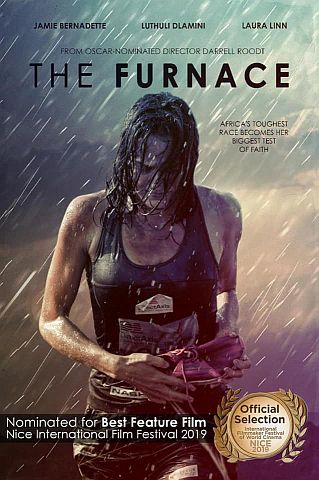
Mary (Jamie Bernadatte) and Matt (Armand Aucamp) are both newlyweds and competitive runners.  For their next event, they are planning on entering the Furnace, an annual race that is held at Africa’s biggest game reserve.  The race takes several days to complete and it is a challenge for even the most elite runners.  The race is called The Furnace because of how hot the temperature gets and how much sweat and hard work it takes to complete the run.  Their plans are ruined when, on Christmas Day!, their car is sideswiped by a truck.  Matt is killed and Mary ends up bitter and on oxygen.  She gives up on ever racing again but, a year later, she meets a man named Coffin (Luthuli Dlamini) who renews her faith in herself.  Under his training, she prepares to finally enter the Furnace.

I really liked The Furnace.  Coffin, who was a doctor in Africa but can only find work as a gravedigger in America, was an interesting character with an fascinating backstory.  Helping Mary run the race race is not only about helping her honor the memory of her late husband but also finding redemption for himself.  Once Mary enters the race, she has to deal with both the heat and the wild animals.  She even gets stung by a scorpion!  She has to do it all on her own while Coffin waits for her at the next rest stop and worries about whether or not he’s accidentally led Mary into a deathtrap.  But, no matter how hard things get, Mary never gives up because The Furnace is not about winning but about having the courage to see things through to the end.  The Furnace is an inspiring movie about people helping each other, never surrendering, and finding the faith to keep going even when everything seems to be lost.