International Horror Film: Robo Vampire 3: Counter Destroy (dir by Godfrey Ho)


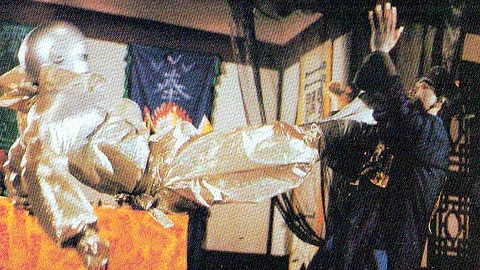
In 1989, Hong Kong director Godfrey Ho made what might be the most confusing film of all time.  It has been released under many different name.  The Vampire Is Still Alive was one.  Another was Counter Destroy.  And finally, there’s  the title that I’m choosing to use for this review — Robo Vampire 3!  This is indeed the third part of the Robo Vampire trilogy, though the guy in the robot suit doesn’t show up until the very end of the movie and even then, it’s never quite clear whether he’s really there or if he’s just a figment of someone’s imagination.

Robo Vampire 3 is actually two movies in one.  Half of the film deals with a private detective named Jackie.  Jackie has been hired by a movie mogul named Lawrence.  Lawrence is producing a film about the last emperor of China but, apparently, there are several other film companies that want to make a movie about the same subject.  (Uhmmm, guys …. Bernado Bertolucci beat all of you to it by about two years.)  Lawrence is concerned that the other film companies and their gangster allies are going to try to disrupt his production so he hires Jackie to find out what their plans are.  Jackie accepts the assignment and then go around killing all of the other studio heads and gang bosses.  Jackie is presented as being one of the film’s heroes, even though she’s basically just tracking down middle-aged men and murdering them in cold blood.  Now, in fairness to Godfrey Ho, the efforts of the Triads to control the Hong Kong film industry are fairly well-documented so, when seen in that context, Lawrence and Jackie’s action might make more sense.  It’s still kind of jarring to watch Jackie assassinate a man, at close range, with a crossbow.

Meanwhile, Joyce has been assigned to write the script for Lawrence’s Last Emperor movie and she’s been given a week to do all the research and get the script done.  Joyce and her assistant, Cindy, are working in a villa.  However, after Joyce and Cindy have a conversation with a mysterious monk, a scarred guy who has a Freddy Krueger-style glove knife shows up at the villa and starts to haunt Joyce’s nightmares.  Meanwhile, a bunch of hopping vampires (in Chinese folklore, vampires hop) are approaching the house.  Who do they work for?  Are they connected to all of the other productions of The Last Emperor?  Are they college students who have been brainwashed by Bertolucci’s Marxist cinema?  It’s never really made clear.

But where is Robo Vampire?  As I said, he shows up eventually.  Long after Joyce has been possessed by an evil spirit and it appears that the film set is going to be overrun by hopping vampires, the director of this film’s version of The Last Emperor suddenly spins around and is transformed into the cyborg Shadow Warrior dude from the previous two films.  No one is particularly shocked when this happens.

As you may have guessed, Robo Vampire 3 is a bit of a disjointed film but it’s pretty much what we’ve come to expect from Godfrey Ho.  One gets the feeling that Robo Vampire 3 was stitched together with stock footage and outtakes from several unrelated movies.  It also wouldn’t surprise me to discover that there were several different versions of the film out there.  The version I saw was badly dubbed so who knows what the film’s plot actually was.  The whole thing has a “make it up as you go along” feel to it.  With the previous Robo Vampire films, the shoddiness was kind of charming but Robo Vampire 3 takes forever to get going.  It needed more hopping vampires.

As far as I know, this was the last Robo Vampire film.  Hopefully, Robo Vampire’s version of The Last Emperor was a big enough success that he could retire from shadow warrioring and devote himself to cinema.  Now, that’s a happy ending!

Horror Film Review: The Fog (dir by John Carpenter)


“Time for one more story,” Mr. Machen (John Houseman) declares the beginning of John Carpenter’s 1980 horror film, The Fog.

Mr. Machen is a resident of Antonio Bay, California, a coastal town that was founded with the help of gold stolen from a ship that was owned by a wealthy man named Blake (Rob Bottin). Blake wanted to start a leper colony. Instead, he was betrayed by six sailors who sank Blake’s ship, stole the gold, and used it to start the town of Antonio Bay.

At 12 midnight, on the day that the town is to celebrate its 100 anniversary, strange things start to happen. Windows shatter. Masonry falls from walls. A thick fog rolls across the ocean and seems to move from house to house. Inside the fog are several angry spirits, led by Blake. They not only want their gold back but they also want to take six lives as a way of getting revenge on the six conspirators who stole their gold and sank their ship.

It all starts with knock at the door and, if you look out a window, maybe you’ll see a dark shadow standing in an all-enveloping fog. Answering the door is a mistake. At the same time, so is not answering the door. It’s not easy to escape the vengeful spirits in the fog.

The Fog (1980, dir by John Carpenter, DP: Dean Cudney)

The Fog plays out like a disaster film, albeit one with a supernatural twist. The film follows several characters who are trying to survive the night and the majority of them don’t even meet until the final half of the film. There’s a truck driver (Tom Atkins) and a hitchhiker (Jamie Lee Curtis). There’s the alcoholic priest (Hal Halbrook) and the chairwoman (Janet Leigh) of the anniversary committee. Nancy Loomis, who co-starred with Curtis in Carpenter’s Halloween, plays an administrative assistant while Carpenter’s wife, Adrienne Barbeau, plays the local radio DJ whose son is briefly targeted by the fog. There’s even a coroner named Dr. Phibes!

In fact, the whole film is full of references to other films. The Fog finds John Carpenter in a rather playful mood, with characters named after Carpenter associates like Dan O’Bannon, Tommy Wallace, and Nick Castle. There’s even a mention of Arkham, the fictional New England town that served as the setting for many of H.P. Lovecraft’s stories.

42 years after it was made, The Fog holds up as a very well-told ghost story. I mean, fog is just creepy in itself. Then you add in a bunch of silent shadows standing in the fog and it gets even scarier! For the most part, the actors all do a good job playing rather thinly-drawn characters. Tom Atkins is always fun to watch! The true stars of the film, of course, are the ghosts and they will definitely give you nightmares.

The Fog is a good film for Halloween viewing so watch it and don’t answer the door!

The Fog (1980, dir by John Carpenter, DP: Dean Cundey)

(Don’t just take my word for it!  Be sure to read Leonard’s review of The Fog!)

Horror on the Lens: Bride of the Monster (dir by Edward D. Wood, Jr.)


Bride of The Monster (1955, dir by Ed Wood)

Since yesterday was the great man’s birthday, it seems appropriate that today’s horror film on the lens is Edward D. Wood’s 1955 epic, Bride of the Monster.

(Much like Plan 9 From Outer Space, around here, it is a tradition to watch Bride of the Monster in October.)

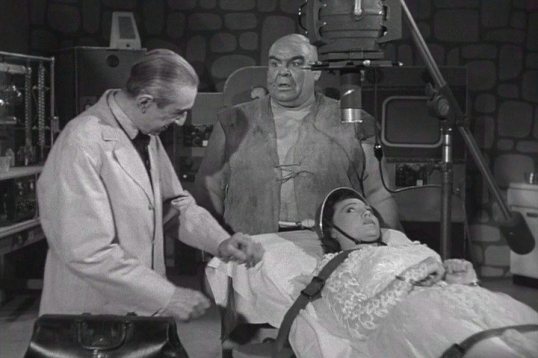
The film itself doesn’t feature a bride but it does feature a monster, a giant octopus who guards the mansion of the mysterious Dr. Vornoff (Bela Lugosi).  Vornoff and his hulking henchman Lobo (Tor Johnson) have been kidnapping men and using nuclear power to try to create a race of super soldiers.  Or something like that.  The plot has a make-it-up-as-you-go-along feel to it.  That’s actually a huge part of the film’s appeal.

Bride of the Monster is regularly described as being one of the worst films ever made but I think that’s rather unfair.   Appearing in his last speaking role, Lugosi actually gives a pretty good performance, bringing a wounded dignity to the role of Vornoff.  If judged solely against other movies directed by Ed Wood, this is actually one of the best films ever made.

(For a longer review, click here!)

October Positivity: Late One Night (dir by Dave Christiano)


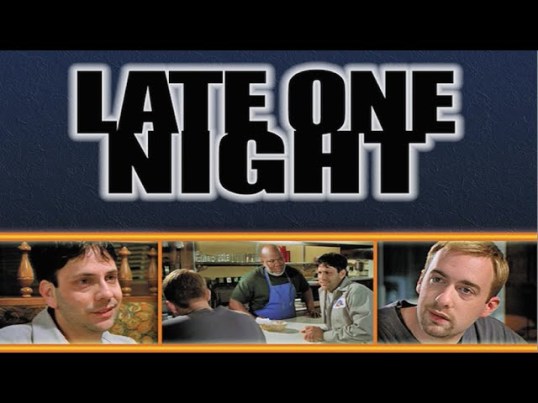
The 2001 film, Late One Night, takes place in a diner.  As you can probably guess from the title, it also takes place late one night.  It’s so late that there are only five people in the diner.  There’s a cook.  There’s three men who work at a local factory, the main one of which is named Larry (Brad Heller).  And then, there’s a quiet guy (John Gaffga) sitting at the counter.  Though the guy never introduces himself, Larry decides to call him Jesus.

To say that Larry is a bit of an obnoxious character really doesn’t do justice to just how grating a human being Larry is.  At work, Larry sexually harasses the only woman working at the factory.  In the diner, he sexually harasses a waitress as her shift ends.  When he sees the quiet man sitting at the counter, Larry starts to harass him.  Larry is angry.  Larry, as we learn, was abandoned by his father, raised by an unstable mother, and he spent several years in jail before ending up at a go-nowhere job at a bottling factory.  Larry has his reasons but that doesn’t make him any more likable.

In fact, Larry is such a jerk that you kind of wonder why the cook even allows him to hang out in the diner.  From the dialogue, it becomes clear that Larry has a long history of harassing people.  At one point, Larry does point out that he spends a lot of money at the diner but you have to consider how many people probably avoid the place whenever they see Larry and his co-workers sitting in their booth.  No matter how much money Larry spends, it seems likely that he keeps even more money out.  Really, the cook should call the cops whenever he sees Larry and maybe slap with him a trespassing charge.  I imagine Larry probably isn’t even a good tipper.

Anyway, on this night, Larry is obsessed with the quiet stranger.  When the stranger briefly goes into the restroom, Larry searches the stranger’s jacket and finds a pamphlet about Christianity.  When the stranger returns, he’s been given the nickname “Jesus” and he now has to deal with Larry mocking him by asking, “Am I going to Hell when I die?”  “Jesus” controls his temper, no matter how much he is taunted.

If you’ve seen any other films from director Dave Christiano, you might be excused for expecting “Jesus” to reveal himself to actually be Jesus.  In this case, though, I think he’s simply meant to be a believer who simply wants to eat in peace.  For that matter, you might also expect the film to end with Larry converting but instead, he’s as confused and angry at the end of this short film as he was at the beginning.  Particularly when compared to the films that he was making in the 80s and the 90s, Late One Night shows a certain dramatic restraint on the part of Christiano.  The main theme, of course, still seems to be that non-believers are going to suffer forever but, for once, Christiano doesn’t seem to be asking the viewer to take any pleasure out of that.

That said, I do have to say that, in college, I spent a lot of time in a lot of late night diners and I never once saw anyone get into the type of random verbal altercation that Larry gets into in this film.  I kind of suspect that might not happen in the real world as often as it happens in the movies.

The TSL’s Horror Grindhouse: Studio 666 (dir by B.J. McDonnell)


In Studio 666, the members of Foo Fighters play themselves.  Struggling with writer’s block and hoping to remain musically relevant in a world where the culture belongs to the young, the band heads to an Encino mansion so that they can work on their latest album.  The mansion is infamous because years ago, another band was murdered while attempting to record there.  (Oddly enough, Jenna Ortega plays the drummer of the murdered band.  Ortega had quite a year as far as the horror genre is concerned.)

The band arrives at the mansion and things quickly go downhill.  The band isn’t getting along.  Lead singer Dave Grohl is revealed to be a bit of megalomaniac.  One of the band’s electricians is killed in what appears to be a freak accident.  Most people would move out of a house after someone dies under mysterious circumstances but not this band!  Instead, the band decides to dedicate the album to the memory of the dead guy.

Soon, however, there are a lot more dead people at the mansion.  Why are there so many dead people there?  This is going to sound like a spoiler but it’s not….

DAVE GROHL IS KILLING THEM!

Yes, Dave Grohl has been possessed by the evil spirit of mansion.  On the one hand, it’s given him the inspiration necessary to get over his writer’s block.  On the other hand, it also leads to him killing the other members of the band in various grotesque ways.  Studio 666 is a horror comedy that doesn’t shy away from the gore.  If you’ve ever wanted to see a member of Foo Fighters get cut in half with a chainsaw while having sex with Whitney Cummings, I guess this is the film to track down.  (Cummings, I should note, does not play herself.  This film stars the band as themselves but it’s also filled with recognizable actors who are not playing themselves.)

Studio 666 is a bit of a lark, a horror film starring a band that most people don’t really associate with the horror genre.  Indeed, a good deal of the film’s humor comes from the fact that it’s Dave Grohl doing all of the killing.  In real life, a good deal of Dave Grohl’s appeal is that he comes across as being as close to a regular guy as a rock star can be.  He’s one those famous guys who most people could imagine having a beer with.  Studio 666 gets a lot of mileage out of presenting Dave Grohl as being a pretentious taskmaster who would happily sell his soul for the chance to have a successful solo career.  It helps that Dave Grohl seems to be having a blast playing such an exaggerated version of himself.  It’s hard not to be happy for him because he really does appear to having the time of his life.

That said, once Grohl is revealed to be the killer (and that happens very early in the film so, again, this is not a spoiler), the film really has nowhere else to go.  The whole thing simply becomes Grohl tracking down various members of the band and killing them in grotesque ways and it gets to be a little boring.  There’s little suspense and, since the Foo Fighters are playing themselves, there really aren’t any stakes because we know the band wasn’t actually murdered while recording a new album.  With a 106-minute running time, Studio 666 really grinds its one joke into the ground.

I will say that longtime fans of Foo Fighters will probably enjoy the film, if just because there’s several jokes and comments that are obviously meant to be inside jokes that only a select few will get.  Personally, I think it’s nice that the band did something for the fans, even if the movie itself doesn’t really work.

The Munsters (2022, directed by Rob Zombie)


Have you ever wondered how Herman and Lily Munster came to live at 1313 Mockingbird Lane?

No?

That’s too bad, because Rob Zombie is going to tell you anyways.

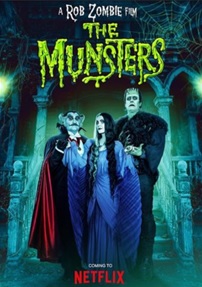
Rob Zombie’s The Munsters is a prequel to the 60s sitcom of the same name.  It shows how Herman Munster (Jeff Daniel Phillips) came to be created, how he became a Rob Zombie-style rock star, and how he overcame the opposition of the Count (Daniel Roebuck) and married Lily (Sheri Moon Zombie).  It also shows how Lily’s brother, Lester (Tomas Boykin), tricked Herman into signing over the deed for the Count’s castle in Transylvania.  There’s not much of a plot but there was never much of a plot when it came to the original sitcom either.  Just like the show that the movie is based on, The Munsters exists to show classic monsters making corny jokes and freaking out at the prospect of dealing with what the rest of the world considers to be normalcy.  Unlike the multi-faceted Addams Family, The Munsters have always been a one-joke family.

There have always been elements of satire and subversive humor in everything that Rob Zombie has done, as both a musician and a director.  Those who claim that Rob Zombie does not have a sense of humor are mistaken.  However, the comedy in The Munsters is deliberately broad and vaudevillian, like the show on which the movie is based.  As a director, Zombie doesn’t always seem to know how to best present that type of humor.  The Munsters is the rare movie that would have benefitted from a laugh track because the jokes are definitely sitcom-level.  They were designed to be followed by canned laughter.  Zombie’s affection for the material and the characters come through and the deliberately artificial production and costume design actually works better than I was expecting but, at nearly two hours, The Munsters often feels directionless.  

Jeff Daniel Phillips and Daniel Roebuck do adequate imitations of Fred Gwynne and Al Lewis, respectively, but its Sheri Moon Zombie who steals the show, bringing a lot of mischievous energy to Lily.  Of the principle cast, Sheri Moon Zombie is the only one makes her character feel like something more than just a tribute to an old sitcom.  The camera loves her and she convinces us that she loves Herman, no matter how childishly he behaves.

One final note: Sylvester McCoy — the seventh doctor, himself! — plays the Count’s assistant, Igor.  McCoy doesn’t get to do much but it was still good to see him.  Igor was the type of role that Tom Baker used to specialize in before he was cast as the Fourth Doctor.  By casting McCoy as Igor, it almost felt as if Zombie was keeping the role in the family.

International Horror Review: Robo Vampire 2: Devil’s Dynamite (dir by Godfrey Ho)


There are some films that just defy description.

Sometimes, as with the films of David Lynch, it’s because the films themselves are so surreal and visually stunning that there’s no way to actually describe them.  They have to be experienced.  The same can be said of films that are so experimental and unique that they simply have to be watched.  For instance, if I told you that Derek Jarman’s final film Blue, was 70 minutes of people talking over a blue screen, you’d probably think it was pretty boring.  But if you’ve actually seen the film, you know that the opposite is true.

And then there are films that are impossible to describe because they don’t make any damn sense.  These are films where the storyline is so nonsensical and the direction is so random and the editing is so ragged that it is essentially impossible to understand what’s going on from one scene to the next.  That brings us to 1987’s Robo Vampire 2: Devil’s Dynamite.

And really, it shouldn’t be a surprise that Robo Vampire 2 is impossible to follow.  It was directed by Godfrey Ho, the Hong Kong director who built a career out of his ability to build a brand new film out of stock footage and unused takes from other movies.  If Robo Vampire 2 feels like it’s a dozen different films rolled into one, that’s probably because it actually is a dozen different films rolled into one.

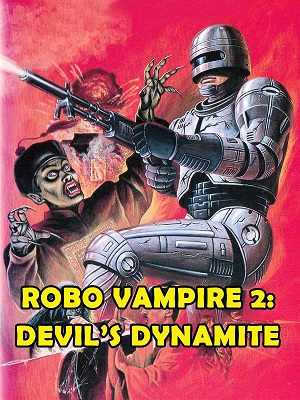
As you can tell from the title (one of the many titles that the film was released under), this film was sold in a few territories as being a sequel to Robo VampireRobo Vampire 2: Devil’s Dynamite does feature a cop who wears a uniform that makes him look like a knock-off Robocop and it does feature vampires but otherwise, it has little in common with the first Robo Vampire.  (Indeed the cop is actually referred to as being the Shadow Warrior, instead of a cyborg as was the hero of Robo Vampire.Robo Vampire 2 deals with the plans of Madame Mary (Angela Mao), who is concerned that her criminal empire will be taken down by a combination of the cops and a rival gangster named Steve (Tsung Hua).  Madame Mary employs a monk who creates an army of vampires.  When the vampires go on a rampage, killing cops and threatening random children, Alex (Lin Yun) turns into Shadow Warrior and fights them off.

Interestingly, no one is surprised to see the Shadow Warrior, so I guess he’s a pretty well-known figure.  But it’s never really clear whether everyone also knows that Alex is the Shadow Warrior nor is it ever that clear just how exactly Alex became the Shadow Warrior in the first place.  (The film’s title would seem to suggest that Alex is the meant to be the same hero from the first Robo Vampire but the hero from the first Robo Vampire was a cyborg whereas Alex is not.)  Even more surprisingly, no one is shocked by the sudden appearance of the vampires so I guess vampire attacks are a common thing in the world of Robo Vampire 2.  Why would Hong Kong’s biggest crime lord need to create any army of vampires in the first place?  The film never quite says.

That said, there are a few entertaining fights.  Even better, the vampires hop from place to place and they usually have their arms extended in front of them, like kids pretending to be zombies.  That’s actually kind of fun to watch.  If you’re going to unleash any army of vampires on a town, at least make sure they hop.

Horror Film Review: X (dir by Ti West)


The year is 1979 and the easiest way to get rich and become a star is to appear in a porno film.  At least, that’s what Maxine (Mia Goth) and her older boyfriend, Wayne (Martin Henderson), think.  Wayne’s the producer.  Maxine is one of the stars.  The name of the movie is going to be The Farmer’s Daughter and it’s going to star Jackson Hole (Kid Cudi) as a man who stumbles across as a farm and gets to know the farmer’s daughters, played by Maxine and Bobby-Lynne (Brittany Snow).  Directing the film will be a film student-turned-director named RJ Nichols (Owen Campbell).  Holding the boom mic and otherwise helping out will be RJ’s girlfriend, Lorraine (Jenna Ortega).  Lorraine may say that she’s not impressed with the idea of working on a pornographic film but everyone an tell that’s a lie.  Everyone except for RJ, of course….

Wayne has even found a farm where they can shoot.  The farm belongs to Howard (Stephen Ure) and Pearl (Mia Goth, made up to look like she’s in her 80s).  Howard suspects that Wayne is making an adult film and he doesn’t exactly approve of it but it also appears that he and Pearl could use the money.  Howard warns Wayne not to bother Pearl while they’re filming.  However, it doesn’t take long for Pearl to wander out of the house and to discover what’s going on in the guest house.  That night, people start to die….

X caused quite a stir when it was released earlier this year, with critics declaring it be a horror classic.  I finally watched the film last week.  X is undeniably a well-made film and it deserves a huge amount of  credit, in this repressed era of trigger warnings, for not holding back on either the violence or the sex.  Mia Goth deserves all of the praise that she’s received for playing both Pearl and Maxine.  At first, it might seem like stunt casting to cast Goth in both roles but actually, it works well with the film’s subtext.  Pearl wants to kill Maxine (and her friends) because they represent the youth that she’s lost.  Maxine initially fears Pearl because she represents the inevitability of getting older.  Unless you die young, you’re going to get old and much of Maxine’s actions are all about doing whatever it takes not to get old.  If that means running straight into danger while fueled only on cocaine and fury, that’s what Maxine is going to do.  The cocaine that Maxine snorts is as important to the story as Pearl’s resentment, Wayne’s greed, and the preacher who continually appears on television.  Maxine probably couldn’t do half of what she does in the film if she wasn’t continually snorting coke and it’s significant that the other characters in the film remain relatively drug-free.  Cocaine is a drug for those who want to confident and free of the worries and the self-doubt that comes with age.  X becomes a film about the battle between the young and the old, a conflict that has defined much of recent history as the younger generation wonders when the older generation is finally going to surrender their power.

At the same time, it’s hard not to feel that the film itself was a bit overpraised by critics who were stunned to discover that a horror film could feature good acting, carefully composed shots, and clever editing.  Judging from some of the reviews, you would get the feeling that some of these critics have never seen a subversive horror film before.  X is a well-made slasher film that refuses to buy into the old trope that one has to be an innocent or a good person to survive a film like this.  Indeed, the biggest mistake that people make in X is to trying to do the right thing.  But it’s hardly the first film to comment on the rules of the genre by breaking them.

In the end, the most important thing about X is that it’s an effective and well-made horror movie.  Visually, the film does a great job of capturing the isolation of rural Texas and all the members of the cast do a good job bringing their characters to life, even if some of the country accents a bit overdone.  Martin Henderson is amusing playing a role that seems like it was written for Matthew McConaughey and Jenna Ortega does a good job playing a character who manages to be both annoying and sympathetic.  (She’s far better here than she was in The Fallout.)  The film ultimately belongs to Mia Goth, playing two different characters who both seem destined to meet the same fate.

As far as Ti West horror films go, X is never as energetic or as much fun as The House of the Devil.  But still, it’s a good rural slasher film.

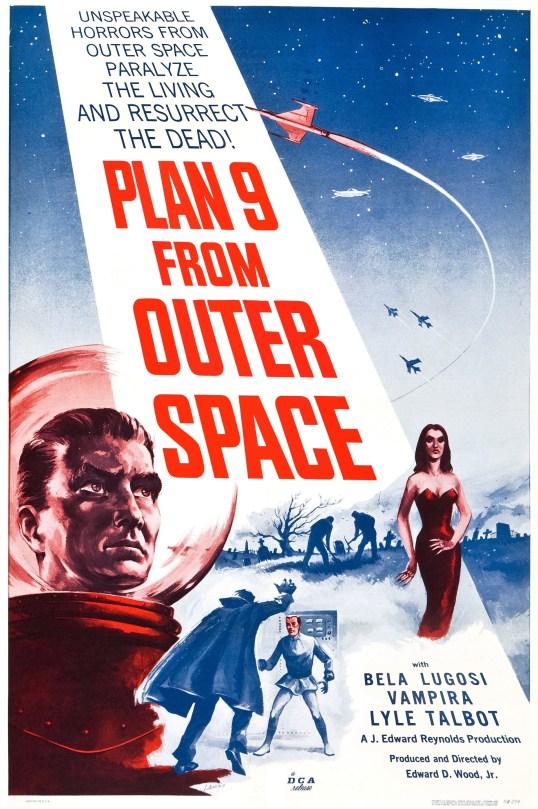
Horror on the Lens: Plan 9 From Outer Space (dir by Edward D. Wood, Jr.)


Viewing Plan 9 From Outer Space during October is a bit of a tradition around these parts and here at the Shattered Lens, we’re all about tradition.  And since today is the 97th anniversary of the birth of Ed Wood, Jr., it just seems appropriate to watch his best-known film.

Speaking of tradition, this 1959 sci-fi/horror flick is traditionally cited as the worst film ever made but I don’t quite agree.  For one thing, the film is way too low-budget to be fairly judged against other big budget fiascoes.  If I have to watch a bad movie, I’ll always go for the low budget, independent feature as opposed to the big studio production.  To attack Ed Wood for making a bad film is to let every other bad filmmaker off the hook.  Ed Wood had his problems but he also had a lot of ambition and a lot of determination and, eventually, a lot of addictions.  One thing that is often forgotten by those who mock Ed Wood is that he drank himself to death and died living in squalor.  The least we can do is cut the tragic figure some slack.

Plan 9 From Outer Space is a ludicrous film but it’s also a surprisingly ambitious one and it’s got an anti-war, anti-military message so all of you folks who have hopped down the progressive rabbit hole over the past few years should have a new appreciation for this film.  I mean, do you want the government to blow up a Solarnite bomb?  DO YOU!?

Also, Gregory Walcott actually did a pretty good job in the lead role.  He was one of the few members of the cast to have a mainstream film career after Plan 9.

Finally, Plan 9 is a tribute to one man’s determination to bring his vision to life.  Ed Wood tried and refused to surrender and made a film with a message that he believed in and, for that, he deserves to be remembered.

Now, sit back, and enjoy a little Halloween tradition.  Take it away, Criswell!

Can you prove it didn’t happen?

WELL, CAN YOU!?

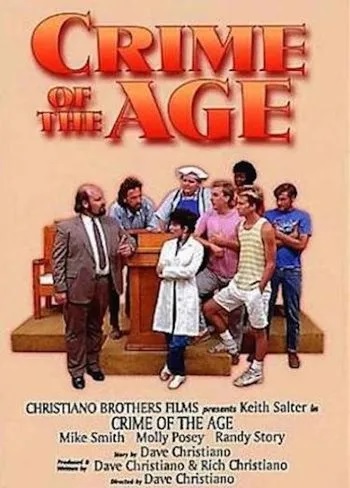
October Positivity: Crime of the Age (dir by Dave Christiano)


“Do you like carrots?”

The question gets asked a lot over the course of the 1988 film, Crime of the AgeCrime of the Age deals with the theft of a book.  The director of the local Christian summer camp discovers that someone broke into his office and stole a book called How To Be A Christian.  The only clue is a carrot, which was left behind by the thief.

When the Detective (played by Keith Salter, who has previously played the world’s most obnoxious atheist in The Daylight Zone) shows up, he takes a look at the carrot.  He realizes that the carrot is the only clue that he and the Director have towards solving a very serious crime.  As the Detective explains it, only someone on staff could have stolen the book.  And that means that one of the staff members is …. wait for it …. NOT A CHRISTIAN!

*Cue the Dramatic Music*

No, seriously, I’m not kidding.  There are a lot of dramatic music cues in this film.

The Detective proceeds to interview the rest of the staff.  He asks them all if they saw anything suspicious.  He asks them what they were doing the previous night.  He asks them all if they like carrots.  Every member of the staff says that they saw someone else going into the director’s office.  Every member says that they like carrots.  Every member reveals something that leads the Detective to doubt their faith.

“That’s odd,” the detective says to himself, after one interview, “A Christian who only listens to music.”

“That’s odd,” the detective says after another interview, “A Christian who doesn’t like to go to church.”

After talking to the Groundskeeper, the detective says to himself, “That’s odd.  A Christian who doesn’t care about sin.”

You may be getting the feeling that this is a bit of repetitive movie and indeed, the dialogue is made up of about five or six lines that are continually repeated from scene to scene.  On the one hand, the structure mirrors any number of Biblical parables.  On the other hand, it doesn’t make the conversations sound any less awkward.  Of the suspects, the Groundskeeper is the only one who manages to project any sort of individual personality and that’s because he seems to be so genuinely annoyed with the whole thing.  While everyone else is very polite about being asked if they like carrots, the Groundskeeper replies, “Yeah, I like carrots!” with a tone that suggests that he’s prepared to throw a punch over it.

This is another early Christian film from the Christiano Brothers.  Like almost all of their films, the film is disguised as a genre film but the main message is that everyone is one misstep away from going to Hell.  If you’re not excited about going to Church, you’re going to Hell.  If you don’t talk about your faith with everyone you meet, you’re going to Hell.  If you only listen to music, you’re going to Hell.  And I presume that if you steal a book, you’ll be going there as well.  Despite the film’s attempts at comedy, it’s a bit of a harsh message.  For the most part, the cast looks like they had fun shooting the film and that’s always a plus.  But I have to confess that I’ve never liked carrots.