For an athlete, what does it take to become the greatest of all time?
Does it take natural talent?
Does it take determination and a willingness to keep playing and practicing through the pain?
Does it take going to an isolated desert training camp and getting regular injections of someone else’s blood?
That was the question asked by Him, a so-called “sports horror” film that came out in September of this year.
Tyriq Withers plays Cam Cade, a college football player who is on the verge of turning professional. Every one is expecting Cam to be the number one pick at the upcoming league draft …. or at least, they are up until Cam is struck in the back of the head by a man wearing a goat costume. Cam suffers a severe concussion. The doctors warn his mother that another severe brain injury could end his career but both Cam and his family are determined for him to turn pro. Even when Cam was a child, his father was grooming him to become a football star. Cam grew up idolizing Isaiah White (Marlon Wayans), a college quarterback who came back from a terrible injury, turned professional, and who has since led the San Antonio Saviors to eight championships.
In fact, Isaiah is willing to train with Cam! Isaiah is considering retirement and he thinks that Cam could be a worthy replacement. Cam travels out to the desert compound, where Isaiah lives with his staff and his wife (Julia Fox). After making his way through the groupies who are angry at the thought of anyone trying to replace Isaiah on the team, Cam begins to train with his idol. Isaiah spends a lot of time talking about Roman gladiators and how tough it is to be black quarterback. He pushes Cam to his limits, forcing him to become a more aggressive and a more arrogant player. Isaiah shows Cam that it takes more than just having talent to be the GOAT. Instead, it’s an entire lifestyle. Cam starts to have bizarre visions while getting regular shots (“for the pain”) from Isaiah’s doctor. Eventually, Cam learns the truth about how great players are created and about how success can come at the cost of one’s soul.
Him is definitely a flawed film. A major problem is that neither Marlon Wayans nor Tyriq Withers really have the screen presence to be believable in their roles. Wayans, in particular, seems miscast and he gives a rather one-note performance as a character who is supposed to be as charismatic as he is athletic. (Wayans comes across as being neither charismatic nor particularly athletic.) The script attempts to deal with just about every controversy there is about football but it often does so in the most shallow, perfunctory way possible. The whole gladiator thing? We’ve all heard it before.
That said, the film’s narrative is so over-the-top (and, I believe, intentionally so) and the direction is so excessively stylish that it does hold your attention. For all of the film’s flaws, the compound is a wonderfully ominous location and the use of X-ray shots to show us concussions and twisted limbs does rather forcefully drive home the point that football is not a gentle game. Him may not be good but it’s just ludicrous enough to be watchable.
“What kind of American are you?” — Unnamed ultranationalist militant
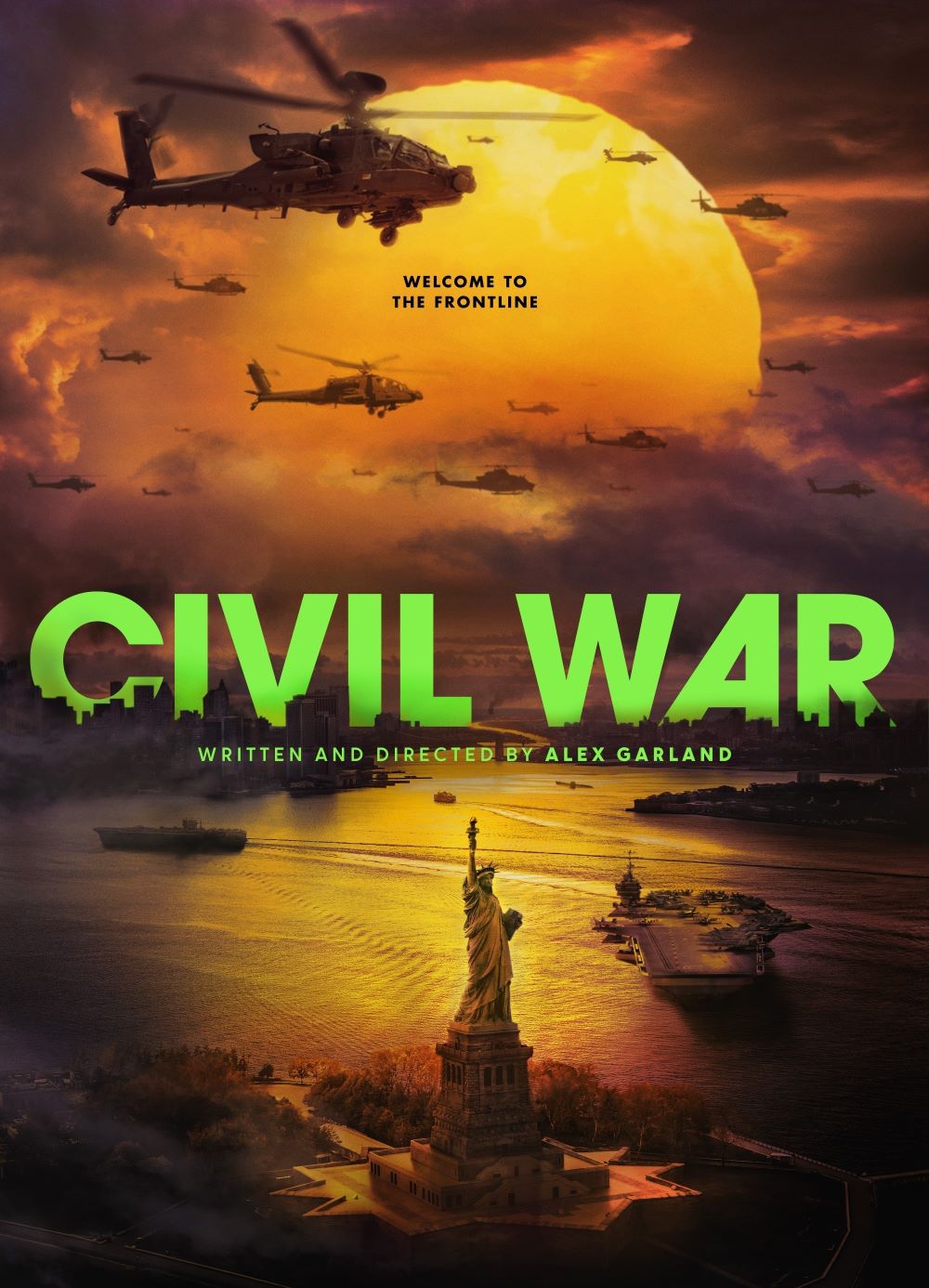
Alex Garland’s Civil War is the kind of movie that feels both uncomfortably close to reality and strangely abstract at the same time, like a nightmare built out of today’s headlines but deliberately smudged at the edges. It plays less like a political thesis and more like a road movie through a country that has already gone past the point of no return, seen through the eyes of people whose job is to look at horror and keep pressing the shutter anyway.
Garland frames the story around war journalists traveling from New York to Washington, D.C., hoping to reach the President before rebel forces do, and that simple premise gives the film a clear spine even when the politics around it stay fuzzy. Kirsten Dunst’s Lee, a veteran photographer, and Cailee Spaeny’s Jessie, a young aspiring shooter, are paired with Wagner Moura’s adrenaline-chasing reporter Joel and Stephen McKinley Henderson’s weary old-timer Sammy, forming a sort of dysfunctional road-trip family driving straight into hell. The setup is classic “last assignment” territory, but the context—an America shattered by an authoritarian third-term president and secessionist forces from places like Texas and California—is what makes the film play like speculative non-fiction rather than pure sci-fi. That Texas-California alliance as the Western Forces stands out as such strange bedfellows, two states about as diametrically opposed as you can get politically and culturally, which subtly hints at just how monstrous the president must be to drive them into the same camp against a common enemy.
The plot itself is pretty straightforward once you strip away the political expectations people bring in. The group moves from one pocket of chaos to another, crossing a patchwork United States where some areas still look almost normal while others are full-on war zones. The tension ramps as they get closer to Charlottesville and then D.C., eventually embedding with Western Forces as they push toward the capital. Along the way, the journalists encounter a series of vignettes—mass graves, roadside militias, bombed-out towns—that feel intentionally episodic, like flipping through the front page of a dozen different conflicts and realizing they all share the same language of fear and dehumanization.
Performance-wise, Dunst is the emotional anchor, playing Lee with a kind of hollowed-out professionalism that feels earned rather than performative. Her character is someone who has seen too many wars abroad and now finds herself documenting one at home, and Dunst sells that numbness without turning Lee into a complete emotional void. Spaeny’s Jessie, meanwhile, is the mirror opposite: all raw nerves and hungry ambition, constantly pushing closer to danger for the shot, until that drive becomes its own kind of addiction. Their dynamic—mentor vs. rookie, caution vs. thrill—gives the movie a human arc to track even when the bigger national stakes remain frustratingly vague.
The supporting cast makes the most of their moments. Moura brings a reckless charm to Joel, someone who clearly gets off on the chaos even as he understands the risks, while Henderson’s Sammy has that lived-in, old-school journalist vibe that makes his presence feel instantly comforting. Nick Offerman’s president shows up mostly as an image and a voice—an isolated leader giving delusional addresses about “victories” and “loyalty” while the country burns—which fits Garland’s choice to keep power distant and almost abstract. And then there’s Jesse Plemons in a late, unnerving scene as a soldier interrogating the group with the question “What kind of American are you?”, a moment that pulls the film’s subtext about nationalism and dehumanization right up to the surface.
Visually, Civil War is stunning and deeply unpleasant in the way it should be. Garland and his team lean heavily into realism: grounded battle scenes, chaotic firefights, and that disorienting sense of being in the middle of something huge and unknowable, with the camera clinging to the journalists as they scramble for cover or line up a shot. The film often uses shallow depth of field, throwing backgrounds into blur so explosions and tracers feel like ghostly streaks behind the tight focus on a face or a camera lens, which reinforces how narrow the characters’ survival focus has become. Sound design is equally aggressive—gunfire, drones, and explosions hit hard in a theater, and Garland doesn’t shy away from making violence both terrifying and, in a way, disturbingly exhilarating.
That’s one of the film’s more interesting, and arguably more uncomfortable, tensions: it’s overtly anti-war in its messaging, but it also understands that war, on a visceral level, can feel like a rush. Several characters clearly chase that feeling, and the film doesn’t let them—or the audience—off the hook for enjoying the adrenaline that comes from life-or-death stakes. There are moments where the action almost tips into “too cool” territory, but Garland usually undercuts this with the emotional fallout afterward, making it clear the cost of those images and thrills is paid in trauma and numbness.
Where Civil War is really going to divide people is in its politics—or more accurately, its refusal to spell them out. The film never fully explains how this United States got here or exactly what the sides are fighting over, beyond hints of authoritarian overreach and regional alliances like the Texas-California Western Forces. You get breadcrumbs: a third-term president who dissolved norms, references to an “Antifa massacre,” and presidential rhetoric that echoes real-world strongman language, but Garland refuses to plant a big obvious flag that says, “This is about X side being right or wrong.”
Depending on what you want from the movie, that choice either feels smartly universal or frustratingly evasive. On one hand, treating the conflict like a kind of Rorschach test lets viewers project their own anxieties onto the screen; it becomes a story about any country pushed too far by polarization, propaganda, and the normalization of violence. On the other, the vagueness around ideologies can come across as sidestepping tough specifics, especially in today’s charged climate, where audiences might crave a bolder stance on division and power.
To the film’s credit, its focus is very clearly on the experience of war, not the policy debates that preceded it. The journalists are not neutral robots; they have opinions, fears, and moments of moral conflict, but their professional instinct is to document first, analyze later, and that’s the lens the film adopts as well. You see how the job warps them: Lee’s exhaustion, Jessie’s desensitization, Joel’s thrill-seeking, Sammy’s weary sense of duty. In that sense, Civil War feels as much like an ode and a critique of war journalism as it does a warning about domestic collapse.
That said, the character work will not land equally for everyone. The emphasis on spectacle and raw incident sometimes leaves less room for layered personal depth, with figures beyond the leads feeling more archetypal than fully fleshed out. Even Lee and Jessie are shaped primarily by their roles in the chaos rather than extensive personal histories, which suits Garland’s lean, immersive style but might leave some wanting more nuance.
The last act, set during the assault on Washington and the White House, is where the film fully commits to being a war movie rather than a political allegory. The battle is staged with a mix of big, chaotic action and small, intimate beats: journalists diving behind columns, soldiers shouting directions, Jessie pushing closer to get the shot even as bullets hit inches away. It’s brutal and propulsive, driving home the film’s bleak thesis: once violence is normalized, legitimacy and process vanish, replaced by whoever has the most guns in the room.
Is Civil War perfect? No. It is at times overdetermined in its imagery and underdetermined in its world-building, and the decision to keep the “why” of the war so foggy will absolutely alienate viewers who wanted a sharper, more pointed statement about the current American moment. But it is also undeniably gripping, technically impressive, and thematically rich enough to spark real conversation about violence, media, and how far a society can bend before it breaks. As a piece of speculative near-future filmmaking, it lands somewhere between warning and reflection: not saying “this will happen,” but asking whether a country this polarized and numb to cruelty should be so confident that it won’t.
It’s been said that it’s next to impossible to make a true anti-war film because war itself is so cinematic that even the most harrowing portrayals of combat ultimately make it look exciting and, for those who survive, cool.
Now, I don’t quite believe that myself. Stanley Kubrick made three of the most effective anti-war movies ever made, Paths of Glory, Dr. Strangelove, and Full Metal Jacket, though it should be noted that the first two of those films were more critical of the incompetence of those running the war than war itself. Both Lewis Milestone and Edward Berger made strong anti-war statements by adapting All Quiet On The Western Front. Both films featured battle scenes that were devoid of the personal heroics that tend to crop up in other war films. (Platoon may have been firmly against the Vietnam War but it’s still hard not to cheer when a crazed Charlie Sheen takes on the entire VC on his own.) Robert Altman’s M*A*S*H made an effective anti-war statement by focusing on what comes after the battle. The scene where a geyser of blood suddenly erupts from a soldier’s neck shocks, terrifies, and ultimately outrages us. That said, it is true that an effective battle scene, especially one that leaves the viewer feeling as if they are actually in the middle of combat themselves, does tend to get the heart pumping and the adrenaline surging, regardless of the politics of the person watching. We tend to look up to those who have been tested by combat, those who have come under fire and who have survived. One can be anti-war while still understanding why war itself has been a popular cinematic topic since the silent era.
I’m thinking about this because of the online reaction to Warfare, a film that came out in April of this year. Based on actual skirmish that occurred in Iraq in 2007, the film plays out largely in real time and follows a platoon of Navy SEALs as they set up operations in a two-story house and then later try to escape when they come under fire from insurgents. The film was written and co-directed by Ray Mendoza, who was one of the SEALs involved in the actual incident. In the film, Mendoza is played by D’Pharaoh Woon-A-Tai while other SEALs are played by actors like Will Poulter, Michael Gandolfini, and Charles Melton. The film itself doesn’t tell us much about the individual SEALs. We don’t get any heart-breaking stories about anyone’s homelife. No one takes the time to pull out a picture of their girlfriend back home or any of the other usual stuff that happens in war movies. There’s really not time for that. For over an hour, Warfare puts the viewers directly in the middle of the battle and it does a good job of it. The bullets, the explosions, all of them seem far too real as we watch.
The online reaction to Warfare has definitely been a bit mixed. There are quite a few people who are convinced that Warfare is a pro-war, “imperialist” film. “Why did Alex Garland make this!?” cries one of the top reviews over on Letterboxd. Myself, I disagree. It’s not a political film. It’s neither pro- nor anti-war. Instead, it’s a film about a group of men who are fighting to survive. And to me, it is an effective anti-war film because it shows exactly how much damage a bullet and a grenade can do to a human being. When one of the SEALs is seriously wounded, there’s no glamour to it. Instead, you feel his pain and you realize that it’s not even that clear what the mission was in the first place. Warfare is a tough and gritty film. It’s a combat film that makes me happy that I’ll probably never come under fire while also respecting the men who refused to leave anyone behind.
If peace could be achieved by didactic speeches and heavy-handed moralizing, it would have happened long before now. Warfare presents what happened and leave it to the viewer to draw their own conclusion.
Some movies are merely good. Some movies are undeniably great. And then, a handful movies are so amazingly brilliant that, every time you watch, you’re reminded why you fell in love with cinema in the first place.
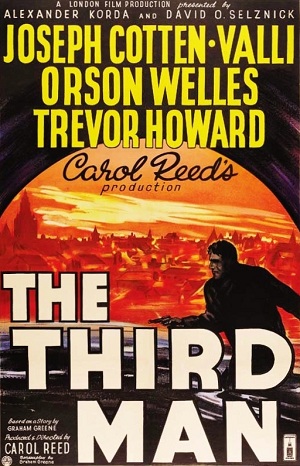
The Third Man is one of those brilliant films.
Directed by Carol Reed and scripted by novelist Graham Greene, The Third Man takes place in the years immediately following the end of World War II. Pulp novelist Holly Martins (Joseph Cotten) comes to Vienna to search for his old friend Harry Lime (Orson Welles). Upon arriving, Holly is shocked to learn that Harry makes his living selling diluted penicillin on the black market.
In the classic scene below, Harry and Holly have a clandestine meeting in a Ferris wheel and Harry justifies both his actions and the lives that have been lost as a result of them.
While Orson Welles’ performance is (rightfully) celebrated, I’ve always felt that Joseph Cotten’s work was even more important to the film’s success. While Welles made Harry Lime into a charismatic and compelling villain, it was Cotten who provided the film with a heart.
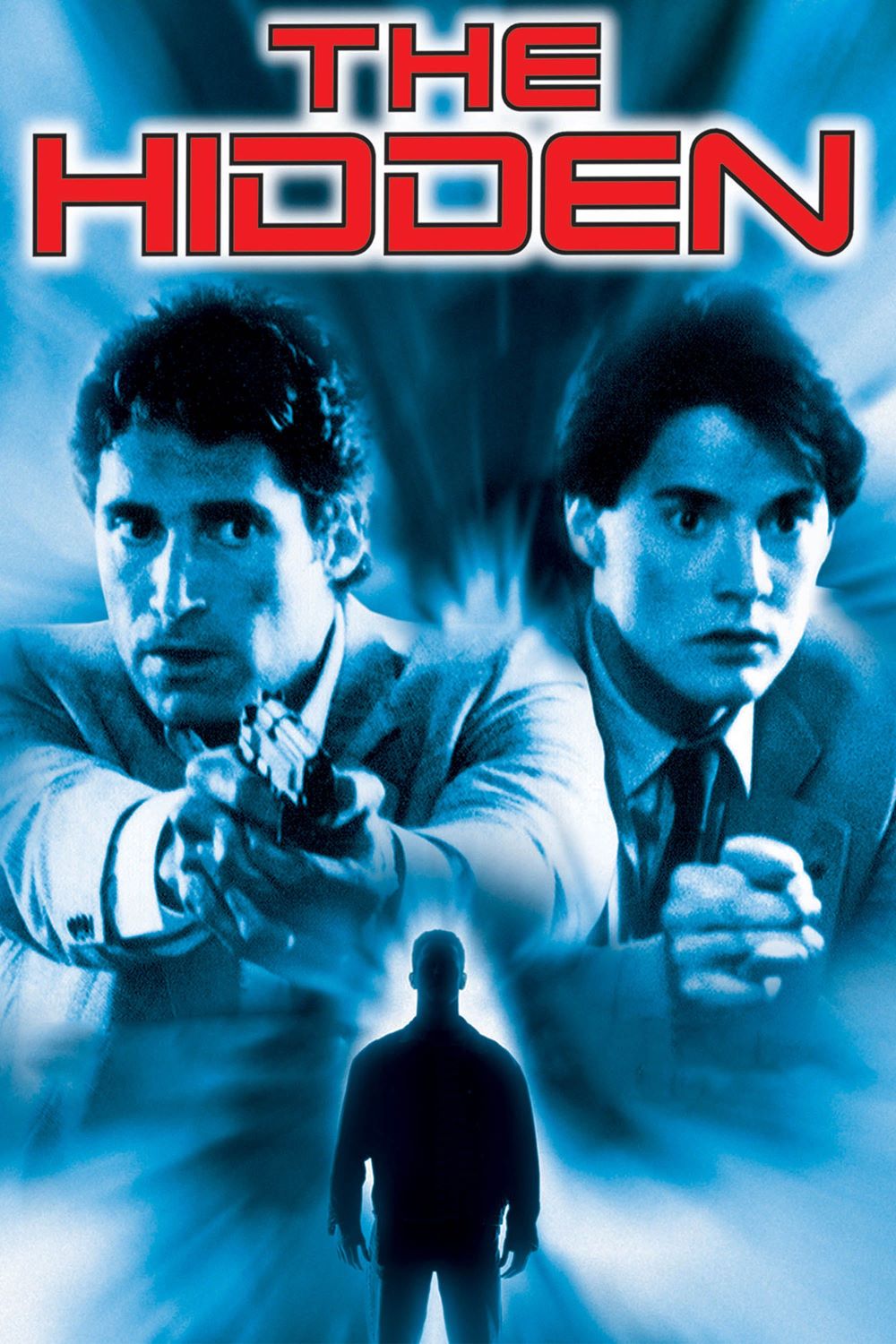
The Hidden is a guilty pleasure from 1987, a sci-fi action romp that barrels into B-movie territory with zero brakes and maximum glee. It’s the kind of flick you stash away for those late-night binges when no one’s judging.
Right from the explosive opener, a squeaky-clean bank clerk named Jack DeVries flips the script. He storms a Wells Fargo branch like a one-man apocalypse, gunning down guards and peeling out in a stolen Ferrari for a high-octane chase that leaves LAPD scrambling. Cops riddle him with bullets in a spectacular crash, but as he flatlines in the hospital, out slithers a pulsating alien parasite—a glowing, tentacled slug that prizes luxury cars, blaring rock anthems, and indiscriminate slaughter above all else.
It wastes no time hopping into fresh meat, turning an arms dealer into a walking arsenal, then a sultry stripper who turns deadly seduction into a bloodbath. Cue Detective Tom Beck, Michael Nouri’s world-weary LAPD vet with divorce papers and a pint-sized daughter sharpening his edges. He teams up with the enigmatic FBI agent Lloyd Gallagher, Kyle MacLachlan dialing up the eerie charm like he’s fresh off Blue Velvet. Gallagher’s no standard G-man—he skips the coffee, eyes suspects like prey, and knows way too much about this interstellar joykiller. Beck’s gut screams “weirdo,” but with bodies piling up, he’s along for the parasitic ride. Their mismatched partnership becomes the beating heart of this wild chase.
Diving deeper into why The Hidden earns its guilty pleasure crown, it’s all about that unapologetic mash-up of genres. Think Lethal Weapon‘s buddy-cop fireworks fused with The Thing‘s body-horror paranoia, wrapped in a low-budget package that punches way above its weight.
The alien doesn’t just possess—it corrupts with cartoonish vice. It blasts Metallica’s Master of Puppets while mowing down traffic, guzzles ice cream cones mid-rampage, and even puppeteers a German Shepherd into a jogger-shredding beast. Hosts shrug off shotgun blasts, car wrecks, and point-blank headshots, laughing through the pain like invincible demons. This cranks the tension during chases from neon-lit strip joints to posh art auctions gone haywire.
Picture Brenda Lee, played with fierce allure by Claudia Christian, grinding on a mark before ventilating him and trading bullets with highway patrol—it’s equal parts sexy, scary, and stupid fun. Then there’s the mannequin factory showdown, a claustrophobic bullet ballet with plastic dummies exploding in slow-mo glory. Director Jack Sholder, hot off A Nightmare on Elm Street Part 2, keeps the pedal floored across 98 taut minutes. He blends practical effects that ooze tangible grossness—no lazy CGI, just squelching tentacles and slime trails that still unsettle on modern screens. The creature’s big reveal, bursting from a gut in a hospital bed? Pure visceral nightmare fuel that lingers like bad takeout.
But let’s talk about the real magic: Nouri and MacLachlan’s chemistry, which transforms potential cheese into something oddly heartfelt. Beck is the everyman anchor—tough exterior hiding a soft spot for his ex and kid. She clocks Gallagher’s off vibes immediately, hiding behind Dad during their first meet-cute awkwardness. Gallagher’s the alien hunter in human skin, pursuing his nemesis from the galaxy’s edge to Earth. MacLachlan nails the wide-eyed alien tourist act: fumbling forks at pizza joints, blanking on human etiquette, yet unleashing a phaser-like zapper with cold precision.
Their dialogue zings with natural friction—Beck barking “What the hell are you?” while Gallagher parries with vague cosmic lore. It builds to warehouse confessions amid flying lead. It’s 48 Hrs. with extraterrestrials, punctuated by hilarious side beats: Beck’s partner Cliff Willis (Ed O’Ross) biting the dust early, precinct captain Ed Malvane (Clarence Felder) getting briefly slimed into a foul-mouthed tyrant, even a senator’s rally turning into invasion bait. The supporting roster shines without stealing thunder—Christian’s tragic dancer, Richard Brooks’ scumbag john. They all flesh out LA’s underbelly as the perfect playground for alien anarchy.
Layer on the sly socio-satire, and The Hidden reveals sneaky smarts beneath the schlock. This parasite’s a yuppie id unleashed, embodying Reagan-era ’80s gluttony: crashing Porsches, bankrolling hooker sprees, amassing arsenals. All while plotting to hijack presidential hopeful Senator Holt for an Oval Office coup that’d summon its mothership armada. It’s a gleeful middle finger to excess, with the slug reveling in what humans suppress—pure hedonistic rampage from Malibu beaches to political podiums. Sholder doesn’t belabor the point; he lets the absurdity sell it. Like the arms dealer’s arsenal haul or the dog’s park massacre underscoring unchecked impulses.
Sound design throbs with synth-wave synths and guitar riffs that propel every stunt. Michael Convertino’s score swells dramatically for emotional beats. Dialogue veers from pulpy gold (“Pain? What’s that?”) to poignant, especially Gallagher schooling Beck on alien resilience versus human spirit.
Flaws? Sure—the third act rushes to a flamethrower climax and bittersweet farewell. Some effects betray the budget in brighter scenes, and plot holes gape if you squint (how’d the slug learn English so fast?). Yet it owns every imperfection, turning cheese into charm.
Ultimately, The Hidden endures as peak cult guilty pleasure, outshining flashier ’80s peers by blending brains, brawn, and balls-to-the-wall entertainment. It foreshadows Men in Black‘s fish-out-of-water agents and Venom‘s symbiote chaos. All while delivering practical FX wizardry that CGI eras envy. Nouri’s magnetic lead turn should’ve rocketed him higher; MacLachlan’s proto-Lynchian quirkiness fits like a glove. Stream it on whatever dusty platform hosts it, or snag a VHS for authenticity—pair with beer and zero expectations for two hours of adrenaline-spiked joy.
The finale’s sacrificial gut-punch lands because you’ve bonded with these oddballs, capped by Beck’s wry nod to humanity’s messy soul. It’s dumb when it wants, deep when it surprises, always a rush. Slug-slinging sci-fi doesn’t get guiltier or greater. Dive in, emerge grinning, no regrets.
Cillian Murphy plays the title character in this rather downbeat British film.
Though Steve has a properly depressing British flat in a properly depressing British town, he still spends the majority of his time at the reform school that he struggles to manage. The students are rowdy and quick to fight but Steve insists that all of them can be reached if the teachers just try hard enough. Steve has taken a particular interest in a student called Shy (Jay Lycurgo). Shy alternates between moments of genuine insight and empathy and moments of pure rage. He’s practically begging for someone to take the risk to get close to him but, at the same time, he instinctively pushes people away.
Steve takes place over one 24-hour period. We first meet Shy while he’s getting high in a nearby field. Later, he takes a call from his mother and she promptly informs him that he’s no longer allowed to be a part of her life. As for Steve, he has to deal with not only a documentary crew but also the news that the building housing his school has been sold and that the school that he’s dedicated his life to will now be shutting down. Steve tries to hold back his temper, self-medicating his bad back with painkillers and alcohol.
Directed in a frenetic manner by Tim Mielants, Steve is a film that seems like it should be better than it actually is. It’s a film dealing with an important subject. Steve cares about his dysfunctional students but that’s not going to make much of a difference if his school gets shut down. Shy is intelligent but also only a few steps away from self-destructing. Cillian Murphy, who also produced the film, gives a committed performance. And yet the film is never quite as affecting as it should be.
The film itself is extremely British, which is a polite way of saying that the nonstop cursing got boring after about five minutes and the harsh lighting seemed to be designed to make sure that we understood that everyone was very, very tired. Visually, the hand-held camera work couldn’t disguise just how drab everything looked. Beyond that, though, I have to admit that, as the film reached the 60 minute mark, I realized that I was just tired of Steve. I was tired of his scraggly beard. I was tired of his constant back pain. I was tired of his stupid tennis ball. I was tired of the pained expression on his face. I was tired of his nonstop resentment and his complaining. I was tired of his inability to fight back. I was just sick to death of spending time with him. Murphy commits himself to the roll but Steve is not a compelling character. If anything, he’s a bit whiny. Seriously, Steve, don’t just lie down on the floor and talk about how much you resent things. Get out there and fight for your school, dude.
There are parts of the film that work but there are other parts that just fall totally flat. The use of the documentary crew feels unnecessary and there’s not really any payoff to their presence. A scene where a stuffy member of Parliament visits the school and talks about the importance of not allowing Britain to go communist is so poorly-executed that it almost feels like a parody of a Ken Loach film. Even when Steve finally does let go of his emotions, it feels like a false note.
In the end, I’ll give Steve credit for trying to deal with a real issue. The fact of the matter is that society — both in the UK and in the US — is far too quick to give up on those who have been deemed as delinquents. That said, the film falls flat. It’s a noble failure but failure nonetheless.
This morning my wife told me she wanted to watch a movie based on a true story. After scrolling for a bit, I came across the film INTO THE WILD, which interested me for a couple of reasons. First, it was directed by Sean Penn, whose directorial debut, THE INDIAN RUNNER (1991), gave my favorite actor of all time, Charles Bronson, a late-career character performance that critics actually took seriously. I’ve followed his directing career ever since. Second, the movie stars Emile Hirsch, who my wife and I had the rare opportunity to watch up close this summer while he was filming a movie here in Central Arkansas… an awesomely surreal experience that’s had me revisiting the work of the actors I saw that day. As such, today seemed like the perfect time to hit play on INTO THE WILD!
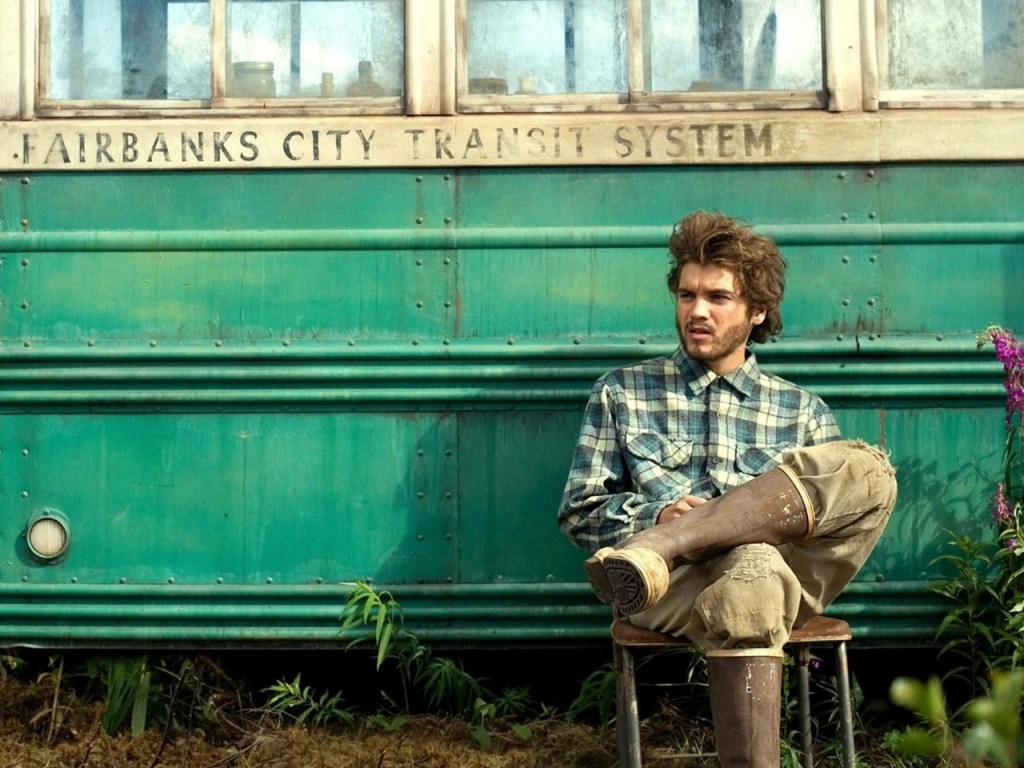
INTO THE WILD is based on the true story of Christopher McCandless (Emile Hirsch), a bright, idealistic young man who graduates from college in the early 1990s and immediately walks away from the type of life everyone expects him to live. Chris donates his savings to charity, abandons his car, burns the cash in his wallet, reinvents himself as Alexander Supertramp, and sets off across America on a great Alaskan adventure. Along the way he comes across different people who impact his life in a variety of ways, from some free-spirited hippies, to a grizzled old widower, and even a beautiful young lady who takes an immediate liking to him. Each of these encounters offer Chris a chance to form meaningful relationships, but he always decides to keep moving on. When he does eventually make it to the wilds of Alaska, it’s everything he hoped for… at first. But as the months wear on, his loneliness and inexperience take their toll, and Chris is forced to face the ultimate consequence of his decisions.
I’ll start out by saying that INTO THE WILD is a truly beautiful film. Sean Penn and his cinematographer Eric Gautier capture so many amazing images, from the Grand Canyon and Lake Tahoe, to the Denali National Park in Alaska. We see an America that is awe-inspiring, and we can at least somewhat understand why Chris might want to escape to such a world of promise. I also liked the music, especially when Eddie Vedder’s voice emerges to punctuate a scene that seems perfectly in tune with Chris’ restless spirit.
I must admit that Chris McCandless, the person, is quite the frustrating subject. He’s intelligent and sincere, but he’s also painfully naive and self-righteous. It’s noble that he wants to find ultimate truth, but he goes about it by running away from the messy parts of his life, especially the parents, played here by William Hurt and Marcia Gay Harden, that he sees as horrible people. I guess my frustration with Chris’ decisions may be the point, and Director Sean Penn doesn’t turn him into either a saint or a fool. While watching the film, I was somewhat torn between admiring Chris for the way he rejects materialism and lives his life on his own terms, while also being disappointed as he continually walks away from any person who gets too close or tries to help him.
Emile Hirsch is incredible in the lead role as Chris McCandless. He captures his restless spirit, as well as his determination to make it completely on his own, that is, until he realizes that he overplayed his hand. The other performances that stood out to me came from Vince Vaughn as a farmer that Chris stops and works for, Catherine Keener as a hippie with her own set of issues, and especially Hal Holbrook as a lonely, but perceptive old man who sees in Chris the grandson he never had.
At the end of the day, I feel that INTO THE WILD is a powerful film, but not because of what ultimately happens to Chris. Rather, what lingers with me is his too-late realization that personal freedom without meaningful relationships is not satisfying. As beautiful as this movie is to look at, its strongest moments are Chris’ interactions with the caring people he meets along the way. I just wish one of them had been able to convince him to call his mom and dad.
When architect Theo (Benedict Cumberbatch) and aspiring chef Ivy (Olivia Colman) meet in London, it is love at first sight. Ivy wants to move to America so that she can pursue her dream of opening a restaurant. Theo impulsively decides that he wants to move with her. (Take that, Britain!) They marry and the film follows them as they settle in California and pursue success in their respective fields while raising precocious twins. At first, Theo has more success than Ivy but that changes when a freak storm causes one of Theo’s buildings to collapse on the same night that it also causes hundreds of stranded tourists to suddenly show up at Ivy’s restaurant. Ivy becomes a success while Theo, who is now basically unemployable, becomes a stay-at-home dad. Theo starts to resent Ivy’s success. Ivy starts to resent the amount of time that Theo spends with their daughters. Looking to fix their fraying marriage, Theo design an ultra-modern and chic home for them. Needless to say, by the end of the movie, Theo is being chased through the house by a gun-wielding Ivy.
Oh, Benedict Cumberbatch and Olivia Colman. They’re both good actors and I’ve appreciated many of their past performances but, watching them in The Roses, I do have to admit that I realized that I’ve started to get a bit bored with both of them. Their performances here all about technique. Cumberbatch does his barely repressed anger thing until eventually he explodes into a frantic fury. Colman does her cutting barb followed by a goofy smile thing. Neither performance really has much emotional depth and, even when they’re supposed to be happy, you don’t really buy them as a couple for a second. Even when they blow up at each other and fully embrace their growing hatred, it doesn’t have much of an emotional impact because they never really seemed to like each other to begin with. Every line that Colman delivers sounds like a sarcastic attempt at a bon mot, even she’s supposed to be sincere. There’s nothing shocking about either one of their cruel comments to each other. It just feels like two actors doing their thing.
At its heart, The Roses is meant to be a satire. Theo and Ivy grow to hate each other but neither one is willing to give up their rather tacky house. Unfortunately, Jay Roach is exactly the wrong director for this material. Roach has gone from directing broad but genuinely funny comedies to becoming something of a second-rate Adam McKay. Perhaps even more so than McKay, he’s a prime example of what happens when a director decides that he can’t just be happy making movies that people actually enjoy. (Trumbo and Bombshell may have gotten mildly good reviews from critics who are sympathetic to Roach’s liberal politics but, in the end, Austin Powers is the film for which audiences will remember Jay Roach.) There’s not a subtle moment to be found in The Roses and, as a result, there’s not really much genuine emotion to be found either. Towards the end of the film, we get a montage of Theo and Ivy escalating their attacks on one another. It’s one thing for Ivy to create an AI video of Theo smoking crack. It’s another thing for Theo to spike the food at Ivy’s restaurant with hallucinogenic shrooms, leading to an slow motion orgy involving a bunch of middle-aged tourists. It all becomes so cartoonish that the film loses sight of whatever it was trying to say about marriage.
Touted as an Oscar nominee before it was released and subsequently forgotten about, The Roses was one of the many disappointing films of 2025.
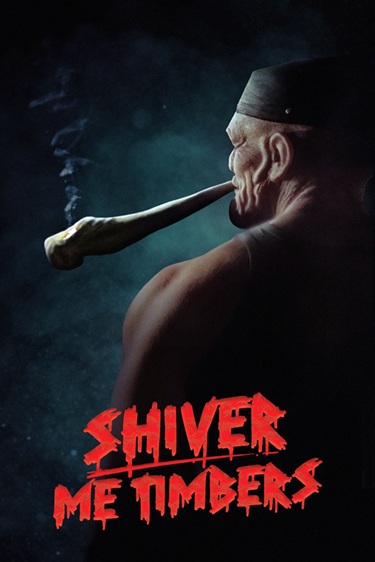
That my reaction to watching Shiver Me Timbers, one of three killer Popeye movies that came out in 2025. Online, there’s some debate over which of the three films is the worst. I’ve only seen two of them so I really can’t say. What I can tell you is that Shiver Me Timbers makes Popeye The Slayer Man look like a freaking masterpiece by comparison.
The film actually does start off with a vaguely clever premise. The year is 1986 and a group of friends are camping so that they can watch as Halley’s Comet crosses the night sky. Our main character is Olive (Amy Mackie), who isn’t sure whether or not she wants to go to M.I.T. I have to admit that I could relate to Olive, just because I wouldn’t want to go to college in Massachusetts either. Plus, Oliva wears all black and has a generally sarcastic attitude, which is pretty much the same way that I was when I was 18.
Anyway, a piece of a meteorite falls out of the sky and, after getting nearly burned up in the atmosphere, it falls into the pipe of a scrawny sailor who is fishing out at the lake. The sailor smokes the tiny meteorite and is immediately mutated into a hulking killer. He proceeds to kill all of Olive’s friends. The deaths are extremely bloody and go out of their way to shock but, oddly enough, they don’t make much of an impression. Part of the problem is that Olive’s friends aren’t that interesting and, as a result, you don’t really care that much about any of them getting killed. The film has this weird habit of featuring close-ups of decapitated heads still struggling to speak. I’m going to be charitable and assume that this was meant to be an homage to Werner Herzog’s Aguirre, the Wrath of God. Herzog, however, was smart enough to only have one decapitated head speaking.
For all the pain that the character go through as Popeye snaps their bones and removes their heads, the real pain is reserved for those watching the movie. The pacing is abysmal, the dialogue is terrible (and please, can we stop making slasher movies where the victims all keep talking about other slasher movies?), and the mutated Popeye looks so dumb that it’s hard to take him seriously as any sort of threat. (Popeye The Slayer Man at least had a vaguely credible killer Popeye.) The film ends with a shout-out to Evil Dead II and it actually would have been pretty cute if the film before it had been better. As it its, it feels like an unearned comparison.
On the plus side — because I hate to be totally negative about anything — the shots of the night sky were actually very effective. That may sound like almost a parody of faint praise and I guess maybe it is but seriously, there was some real beauty to shots of the stars moving across the sky.
Anyway, let’s stop turning public domain characters into murderers, shall we? Thanks!
My nephew told me that he liked the film BARBARIAN (2022) when we were hanging out at the family cabin for Christmas. This particular nephew loves movies and every time we get together we talk about our favorite films, and he knows his stuff. We didn’t really talk about what happens in this movie, but he just casually mentioned it was a film he thought was good. As such, the title caught my attention when I was scrolling through my Hulu app today. Knowing nothing about the plot of the film, my wife and I settled in for our initial viewing….
BARBARIAN’s setup feels quite ordinary. Tess (Georgina Campbell) arrives in Detroit for a job interview, only to discover her Airbnb has been double-booked with a stranger, Keith (Bill Skarsgård). Through a variety of circumstances, the two end up agreeing to share the house for the night. Needless to say, it takes a bit for the two to get comfortable with each other. Every polite smile, every offered cup of tea, or glass of wine for that matter, feels loaded with possibility. Is he harmless? Is she overreacting? What in the hell is about to happen? Director Zach Cregger milks these scenes beautifully, allowing the tension to build until they finally seem to find a reason to trust each other. And just when you think you’re starting to understand where the movie is going, it begins throwing curveballs at you by introducing new characters and new perspectives to everything that has been introduced thus far. Justin Long’s character of AJ McBride, the owner of the Airbnb who arrives about halfway through the film, is especially inspired as it provides both a break in the tension and another unique personality to the mix.
By the time BARBARIAN starts to come to its full conclusion, it has truly become the stuff that nightmares are made of, but it doesn’t feel completely evil. As outrageous as it all is, I actually understood why the characters behave the way they do, so there’s almost a sense of sadness under the horror. There’s real danger, but that danger is brought on by unimaginable cruelty and neglect. It’s ugly and gross, but it’s also somewhat realistic since the filmmakers have taken the time to set up both the hows and the whys of their horrific scenario.
At the end of the day, I enjoyed BARBARIAN. I’ve never been the kind of movie watcher who searches out horror movies. When I was a kid, I watched scary movies at sleepovers with friends. As an adult, I’ll watch them with my friends at #ScarySocial on X, or when they’re recommended to me as is the case here, but then I’ll seamlessly move back to my world of action or comedy films. Such is the case with BARBARIAN. With its freaky images and multiple jump scares, my wife and I were both glad that we watched the movie when it was still daylight. It’s one of those films that crawls under your skin and hangs out with you for a while even after the closing credits. I’ll have to watch some football or a Charles Bronson movie just to get my head straight!

 Through the Shattered Lens