The TSL’s Horror Grindhouse: I Was A Teenage Frankenstein (dir by Herbert L. Strock)


“I was a teenage Frankenstein!”

“Of course you were, dear.”

Sadly, that dialogue does not appear in I Was A Teenage Frankenstein.  Oh well, we can’t have everything….
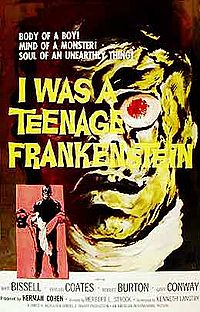
This 1957 film tells the story of Professor Frankenstein (Whit Bissell), an English scientist who comes to America and promptly sets about trying to create his own creature.  I guess we shouldn’t be surprised, considering that his name is Frankenstein and all.  I mean, when you’ve got a name like that, there are certain expectations that you have to live up to.  You’re not going to become a stand-up comedian or the janitor at the local grocery store.  When you’ve got a name like that, you’re expected to tamper in God’s domain and screw things up.  With a famous name comes great expectations.  Frankenstein …. Kennedy …. Kardashian …. it’s pretty much all the same.

Anyway, the professor is lucky enough to come across a fatal car crash.  This supplies him with exactly the dead body that he needs.  He takes the corpse to his laboratory where, with help of some spare body parts that he just happened to have lying around, he manages to bring the dead teenager back to life!

There’s just one problem.

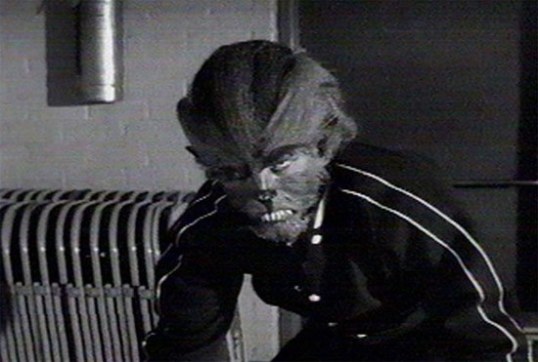
The teenager (played by Gary Conway) now looks like this:
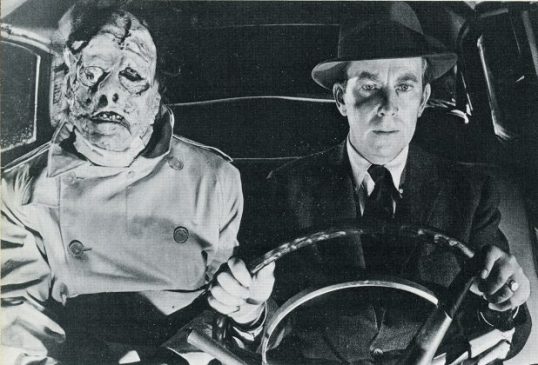
Yep, Teenage Frankenstein is definitely not ready for his public debut.  No one’s happy about this.  Not the professor.  Not the professor’s assistant.  Even the professor’s secretary is upset about what’s going on in the laboratory.  Not even the alligator that Prof. Frankenstein for some reason keeps around the lab is particularly happy about how the operation turned out.

What’s a Teenage Frankenstein to do?  Well, he can always sneak out of the lab but, whenever he does, it seems like someone inevitably ends up dead.  Obviously, Prof. Frankenstein is going to have to find a new face for his creation but from where?  Well, luckily, there is a lover’s lane nearby….

I Was A Teenage Frankenstein was produce by American International Pictures to capitalize on the success of I Was A Teenage Werewolf.  (Whit Bissell plays a mad scientist in both movies and gets the best line in It Was A Teenager Frankenstein when he yells, “Answer me!  You have a civil tongue in your head!  I know, I sewed it in there!”)  Unfortunately, while the monster makeup is indeed impressive, I Was A Teenage Frankenstein is never as much fun as I Was A Teenage Werewolf.  While the teenage werewolf had an entire town to explore, Teenage Frankenstein is pretty much stuck in that lab.  Whereas the teenage werewolf spent his movie running wild, Teenage Frankenstein spends all of his time doing whatever the professor orders him to do.  As a result, I Was A Teenage Frankenstein is a much slower film and also lacks the rebellious subtext of I Was A Teenage Werewolf.

That said, I Was A Teenage Werewolf was enough of a box office success that both the werewolf and the Frankenstein makeup were later used in How To Make A Monster.
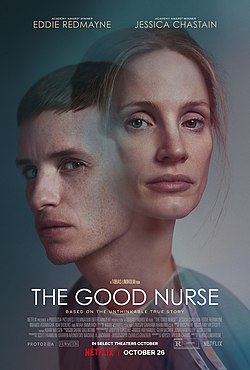
Film Review: The Good Nurse (dir by Tobias Lindholm)


It’s suspected that Charles Cullen might be the most prolific serial killer in U.S. history.

He’s currently sitting in prison, serving 18 consecutive life sentences.  (For those keeping track, he’ll be eligible for parole in the 25th Century.)  In order to avoid getting the death penalty, Cullen confessed to killing 29 people in New Jersey and Pennsylvania.  It is thought that, between the years 1988 and 2003, he actually killed over 400 people.  What made Cullen’s crimes especially horrifying is that he was a nurse and his victims were his patients.  When Cullen first confessed, he tried to portray himself as being a mercy killer, someone who only murdered those who would have no quality of life.  Cullen also claimed that he had been traumatized the first time that he saw a team of doctors fail to resuscitate a patient so he would specifically give overdoses to terminal patients so that they could die both with dignity and without leaving him traumatized.  It was subsequently discovered that few of Cullen’s victims had been terminally ill and that many of them were actually only a day or two away from being discharged from the hospital when Cullen killed them.  Cullen later said that many of his murders were impulsive acts and he wasn’t sure why he had committed them.  In the end, no one can be sure what drove Cullen to commit his murders.

Even before he was arrested, Cullen had developed a bad reputation as a nurse who lost a lot of patients.  He moved from hospital to hospital and he seemed to generate suspicion wherever he went.  Cullen would leave the hospitals whenever it became apparent that anyone was investigating any of the deaths in which he had been involved.  The hospitals were usually happy to be rid of him.  Despite all of the suspicions about him, no one ever tried to stop Cullen from getting another job.  Why risk getting sued for having had Cullen on staff when you could just dump him off on another hospital?

The Good Nurse, which just dropped on Netflix this week, stars Eddie Redmayne as Charles Cullen and Jessica Chastain as Amy Loughren, the nurse who worked with Cullen at his final place of employment.  In the film, Amy is workaholic single mother who needs a heart transplant but who still finds time to show compassion to the patients in the ICU.  She is, as the title states, the good nurse.  When Charles Cullen shows up to work the night shift, she is happy for the help and she takes an immediate liking to the polite and seemingly hardworking Cullen.  Just like Amy, Cullen has two daughters and they bond over their struggles to be both good nurses and good parents.  Cullen tells Amy about how his former coworkers were always plotting against him.  Amy, somewhat naively, invites Cullen to come to her house to meet her daughters.  But when patients start to die, Amy soon suspects that Cullen is responsible.  When she ends up as a patient in the hospital and is faced with the horrifying prospect of Charles Cullen being her nurse, Amy goes to the police and offers to to help them build their case against her former friend.

The Good Nurse is a typical Netflix true crime movie, complete with the slightly washed-out look that almost all of these films seem to share.  The film does a good of capturing the isolation of an ICU ward at night.  With only a handful of nurses and patients on the floor, it’s easy to see how someone like Charles Cullen could have committed his crimes without being caught.  Indeed, some of the film’s most disturbing moments are when Cullen appears to literally emerge from the dark shadows of the ICU ward, like some sort of ghostly hunter seeking his prey.  At the same time, there’s a few moments where the movie feels more like an extra-long episode of Law & Order than a feature film.  Noah Emmerich and Nnamdi Asomugha play the two detectives who are assigned to investigate Cullen’s crimes and their scenes often feel as if they could have been lifted from a dozen other similar true crime films.

As Amy, Jessica Chastain is well-cast, though the role itself is somewhat underwritten.  The film is stolen by Eddie Redmayne, who plays Charles Cullen with an intensity that is frightening to behold at times.  As played by Redmayne, Cullen is creepy from the first time that we see him but, at the same time, Redmayne plays the role with just enough needy charm that the viewer can understand how he was able to fool so many people at so many hospitals.  Redmayne plays Cullen as man who is incapable of compassion but who has learned how to fake it.  It’s only towards the end of the film that Cullen allows his mask to slip and what we see underneath is terrifying.  Eddie Redmayne brings to life a truly evil man, someone who is all the more nightmarish because he really exists.

In the end, The Good Nurse suffers from the same problem as Netflix’s Extremely Wicked, Shockingly Evil, and Vile.  It attempts to comprehend an evil that is beyond normal comprehension.  In the end, both films suggest that there’s no real way to understand what motivates a Ted Bundy or a Charles Cullen.  Instead, all one can do is remain vigilant and hope they’ll be stopped before they can cause any more pain. Cullen is in prison for life.  Bundy got the electric chair.  Both of them left behind many questions that will never be answered.

Horror Film Review: The Lawnmower Man (dir by Brett Leonard)


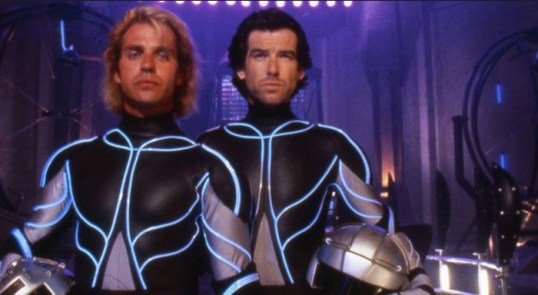
The 1992 horror/sci-fi hybrid, The Lawnmower Man, tells the story of two men.

Dr. Lawrence Angelo (played by Pierce Brosnan) is a scientist who is experimenting with ways to make less intellectually inclined people smarter. Dr. Angelo is kind of a burn out. You can tell he has issues because he needs to shave, he’s always sitting in the dark, and he’s never without a cigarette. You look at Dr. Angelo and you just imagine that he smells like smoke, bourbon, and lost dreams.

Jobe (Jeff Fahey) is the kind-hearted but intellectually disabled man who lives in a shack and spends his time mowing everyone’s lawn. Hence, he’s known as the …. wait for it …. THE LAWNMOWER MAN!

Together, Dr. Angelo and Jobe solve crimes!

No, not really. Instead, Dr. Angelo decides to experiment on Jobe. This leads to Jobe not only becoming smarter but also quicker to anger. Soon, Jobe is developing psychic abilities. He can move things with his mind. He can magically set people on fire. Basically, he can do whatever the script needs for him to do at the moment. Jobe is soon tormenting everyone who once bullied him. Father McKeen, the pervy priest, gets set on fire. Jake, the gas station attendant, is put into a catatonic state. An abusive father get run over by a lawnmower.

Dr. Angelo knows that Jobe is out-of-control and that the experiment has to be reversed. However, the sinister group behind Angelo’s research wants to use Jobe as a weapon because …. well, because they’re evil and that’s what evil people did back in 1992. Jobe, however, has other plans. He wants to become pure energy so that he can rule over a virtual world….

Or something like that. To be honest, it’s kind of difficult to really figure out what’s going on in The Lawnmower Man. The movie shares its name with a Stephen King short story but it has so little in common with its source material that King reportedly sued to get his name taken out of the credits. (Considering some of the films that King has allowed himself to be associated with, this is kind of amazing.) The film tries to be a satire, a slasher film, a conspiracy film, and a technology-gone-crazy film all in one and the end result is one big mess.

Along with all of that, The Lawnmower Man is also a time capsule of when it was made. A good deal of the film takes place in Jobe’s virtual reality universe, which looks a lot like a mix of Doom and Second Life. I imagine the film’s special effects may have seen impressive way back in the 20th Century but, seen today, they’re rather cartoonish, if occasionally charmingly retro.

On the plus side, the film does have an interesting cast. Pierce Brosnan is never convincing as burn-out but he tries so hard that he’s still fun to watch. Underrated actors like Jenny Wright, Geoffrey Lewis, Dean Norris, and Troy Evans all get a chance to show what they can do in minor roles. Finally, you’ve got the great Jeff Fahey, giving a far better performance than the script perhaps deserves. Though the film may be a mess, there’s something undeniably fun watching Jeff Fahey’s Jobe go from being meek to being a megalomaniac.

It’s a silly film and not one that’s meant to be watched alone. This is a film that has to be watched with a group of your snarkiest friends. Watch it the next time you’re looking for an excuse to avoid doing the yard work.

Horror On The Lens: Messiah of Evil (dir by Willard Huyck)


MOE Mariana HillWith only five days left until Halloween, I wanted to make sure that I shared this film with our faithful and wonderful readers.  Messiah of Evil was first released in 1973 and, since it’s in the public domain, it has since been included in a countless number of bargain box sets from Mill Creek.

I can still remember the first time that I saw Messiah of Evil.  It was on a Monday night, many years ago.  I had recently picked up a 10-movie DVD box set called Tales of Terror and I was using the movies inside to try to deal with a bout of insomnia.  I had already watched The Hatchet Murders (a.k,a. Deep Red) and The House At The Edge of the Park and, at two in the morning, I was faced with a decision.  Should I try to sleep or should I watch one more movie?

Naturally, I chose to watch one more movie and the movie I chose was Messiah of Evil.  So, there I was at two in the morning, sitting at the edge of my bed in my underwear and watching an obscure horror movie while rain fell outside.

And, seriously — this movie totally FREAKED me out!

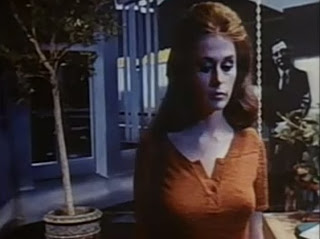
Messiah of Evil tells the story of Arletty (Marianna Hill), a neurotic woman who drives to an isolated California town in order to visit her father.  Her father is an artist who specializes in painting eerie pictures of large groups of black-clad people.  However, once she arrives at his home, Arletty discovers that her father has vanished and left behind a diary where he claims that a darkness has overtaken the town.

Meanwhile, a mysterious man named Thom (Michael Greer) is wandering about town with two groupies (played by Anita Ford and Joy Bang) and interviewing random townspeople.  One crazed man (Elisha Cook, Jr.) explains that “the dark stranger” is returning.  After meeting Arletty, they all end up moving into her father’s house.

But that’s not all.   There’s also an odd albino man who shows up driving truck and who eats mice….

Messiah of Evil is literally one of the strangest films that I’ve ever seen.  It’s shot in a dream-like fashion and the much of the film is left open to the viewer’s interpretation.  There are two classic scenes — one that takes place in a super market and one that takes place in a movie theater and the movie’s worth watching for these two scenes alone.

Messiah of Evil is a film that will be appreciated by all lovers of surrealism and intelligent horror and I’m happy to share it with you today.

October Positivity: The Secrets of Jonathan Sperry (dir by Rich Christiano)


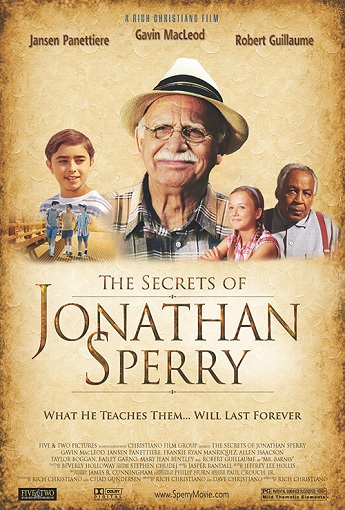
First released in 2008, The Secrets of Jonathan Sperry is a true rarity.  It’s a Christiano feature film that’s actually not that bad.

The film takes place in 1970, with the implication being that it’s based on a true story.  (The film ends with an epilogue, in which we learn what everyone did with their lives after the final scene.)  Three adolescent friends are trying to enjoy their summer.  One of them has a crush on the local waitress and is trying to figure out how to tell her.  All of them are trying to avoid getting on the bad side of Nick and his gang.  Nick is the type of bully who takes your last piece of pizza and then refuses to let you finish your game at the pinball machine.  He is one bad dude.

Jonathan Sperry (played by Gavin MacLeod) is a nice old man who needs his lawn mowed.  One of the three boys becomes his lawn guy and soon, all of them are hanging out at Mr. Sperry’s house.  Mr. Sperry gives them lemonade and encourages them to read the Bible.  At one point, he send the three of them on a race around the town, with the winner earning a piece of cake.  The catch is that he gives each of the boys different directions in order to highlight that you can only get what you want (in this case, the Cake) if you have the right directions.  Mr. Sperry explains that he’s teaching a lesson about how the only way to become a Christian is to read the Bible (i.e., only the Bible has the right directions).  Personally, I would think that the two boys who didn’t get cake because they were intentionally given bad directions would have every right to be extremely upset with Mr. Sperry but this is a movie so they’re not.

Eventually, Mr. Sperry sends one of the boys over to his neighbor’s house.  Even though his lawn looks awful, Mr. Barnes (Robert Guillaume) announces that he doesn’t want anyone to mow it for him.  Eventually, of course, Mr. Barnes relents and reveals that he’s not quite as fearsome as everyone thinks.  Meanwhile, Mr. Sperry takes it upon himself to minister Nick and Nick is also revealed to be not quite as fearsome as everyone thinks.

As I said, when compared to the other films that Rich Christiano’s been involved with, The Secrets of Jonathan Sperry isn’t that bad.  While the message is a bit heavy-handed and I doubt the film is going to change the mind of anyone who doesn’t already share the filmmaker’s beliefs, The Secrets of Jonathan Sperry is well-acted and good-natured.  (As opposed to other Christiano films, there’s very little talk of Hell or politics.)  The film makes good use of its two veteran performers, with both Gavin MacLeod and Robert Guillaume giving believable performances as two men who are dealing with their own mortality in very different ways.  In the end, the film may be about faith but it also celebrates friendship.  It’s all done surprisingly well.

The TSL’s Horror Grindhouse: I Was A Teenage Werewolf (dir by Gene Fowler, Jr.)


Tony Rivers (Michael Landon), the lead character in 1957’s I Was A Teenage Werewolf, is a teenager.  You probably already guessed that from the film’s title but, as we all know, titles can be misleading.  Teenagers were very popular in the 50s, after all.

But no, Tony is actually a teenager.  In fact, he’s one of those troubled teenagers that were all the rage in the late 50s.  He lives for kicks and spends too much combing his hair.  He skips school.  He stays out late.  He gets into fights with other teenagers.  He’s not dumb, mind you.  He has plenty of friends and a girlfriend (Yvonne Lime) who only wants the best for him.  He just has a hard time controlling his temper and his father (Malcolm Atterbury) isn’t sure what to do with him.

However, Detective Donavon (Barry Phillips) has a possible solution!  After the police are called to break up one of Tony’s fights, Donavon suggests that maybe Tony should seek professional counseling.  In fact, maybe he could go see Dr. Brandon (Whit Bissell)!  Dr. Brandon is a widely respected hypnotherapist and he has an office right next to the local airplane factory.  Only the best therapists are allowed to practice next to the airplane factory.  Everyone knows that.

Even though he doesn’t want to, Tony finally agrees to see Dr. Brandon.  Even if he doesn’t say it, you can tell that Tony is thinking, “This is totally squaresville.  Really melvin, maaaaaan….” the whole time.  But Brandon gets results!

In fact, you could argue that he gets too many results.  After twice hypnotizing Tony and telling him to think of himself as being a wild animal, Tony becomes just that!  That’s right, Tony turns into a werewolf and he’s soon running around town — in his letterman jacket! — and killing anyone that he comes across.

Whenever Tony transforms back into a human, he regrets what he’s done.  Unfortunately, it turns out that almost anything can cause Tony to turn back into a wolfman.  Most werewolves need a full moon.  All Tony needs is to hear the sound of the school bell….

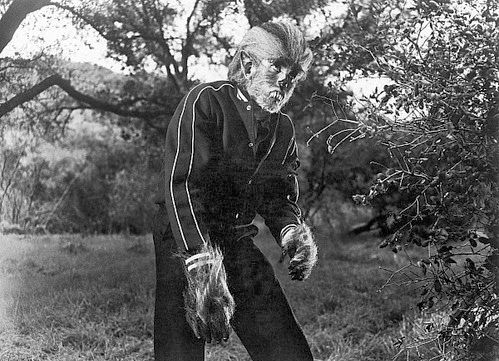
To be honest, I imagine that most people who watch this film do so because they want to see a werewolf creating chaos while wearing a high school letterman jacket.  Considering that this was a low-budget film made to play as half of a double feature, the werewolf makeup is actually fairly impressive and that letterman jacket adds just the right touch of weirdness to the whole affair.

Make no mistake, it’s an entertaining and deeply silly film but, at the same time, it does have an interesting subtext.  One could argue that Tony’s transformation into a werewolf serves as a metaphor for his struggle to grow up.  Neither werewolves nor juvenile delinquents can control themselves and Michael Landon gives a performance that’s just sensitive enough to justify calling this one Werewolf Without A Cause.

That said, the main appeal of this film is definitely the chance to see a werewolf in a letterman jacket.

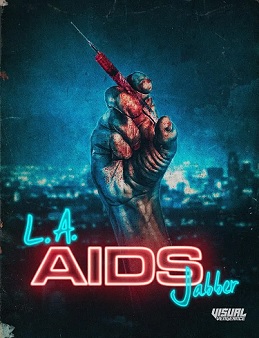
L.A. AIDS Jabber (1994, directed by Drew Godderis)


This is a real movie and that is the real title.

Jeff (Jason Majik) is an angry young man who is seeing a therapist because he has issues with women.  He worked in a furniture warehouse, where he has issues with his boss.  Jeff has issues with everyone but soon, he has an even bigger concern.  Because of a nagging stomachache, Jeff goes to see a doctor.  The doctor does some bloodwork.  He runs the results twice just to be sure.  Then he informs Jeff that he has tested positive for AIDS.  Jeff snaps.  He fills a huge hypodermic needle with his own blood and then goes on a rampage, jabbing people across Los Angeles.

The two detectives who have been assigned to the jabber case (and who appear to investigate every other homicide in Los Angeles as well) do not want the story to get into the press.  Unfortunately, a stolen boombox that belongs to the boyfriend of a local news reporter (Joy Yurada) picks up the sound of the detectives talking on their secure line.  Refusing to be intimidated, the reporter reveals the details of the investigation on the nightly news.  Jeff decides to make the reporter his newest target.

Again, this is a real movie and that is the real title.

L.A. AIDS Jabber is a shot-on-video film that was based on the urban legend about someone with AIDS going to the clubs in New York and Los Angeles and randomly pricking people with a needle.  The movie itself is pretty dire, full of bad performances and subplots that don’t lead anywhere.  To me, the most interesting thing about the movie was how little it actually seemed to know about AIDS or how it was transmitted.  For instance, no one — not even the doctor who tells Jeff that he’s tested positive — uses the term “HIV.”  The doctor tells Jeff that he has “tested positive for AIDS” and then just sends him home.  I get that this film was made in 1994 when people were still learning about this virus but the doctor could have at least informed Jeff that it can take several years for HIV to develop into AIDS.  As a last minute twist reveals at the end of the film, that’s not the only way that the doctor has failed his patient.

As for the rest of the movie, it’s all bad performances, bad acting, bad jokes, and a bad script.  Jason Majik does have one good scene where he starts punching a wall but that’s pretty much it.  This jabber’s not worth getting stuck with.

Horror Film Review: Prophecy (dir by John Frankenheimer)


First released way back in 1979, Prophecy is one of those films where a big evil corporation is selfishly polluting the environment and a group of noble Native Americans is convinced that a vengeful spirit of the forest has been awakened as a result.

We’re told that the vengeful spirit is named Katahdin and that it’s “as large as a dragon and has the eyes of a cat.” We’re also told, by someone who claims to have actually seen it, that the Katahdin is a combination of several different creatures, “a part of everything that is God’s creation.”

Sound pretty scary, right?

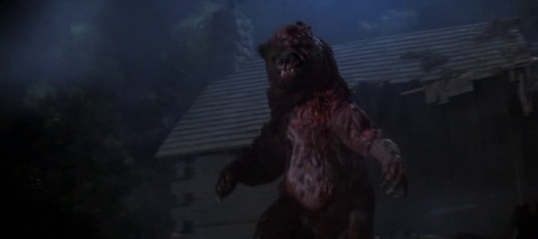
Well, it is until the bear itself actually shows up on screen. That’s when we find ourselves confronted with this:

I mean, don’t get me wrong. He certainly is ugly. But he just looks so silly and …. well, fake.

The lesson here, and it’s an important one, is that you should never put your monster onscreen unless it can actually live up to all the hype. Take a lesson from Spielberg. When it became obvious that the shark in Jaws looked like a tin model, Spielberg made the decision to not show the shark. Instead, he gave us a lot of point of view shots and, by the time the shark did appear, audiences were so frightened that it didn’t matter whether it looked convincing or not. Prophecy makes the mistake of having its monster all over the place and it just doesn’t work.

Of course, once the EPA’s Dr. Robert Verne (Robert Foxworth) shows up with his pregnant wife (Talia Shire, who somehow went from The Godfather and Rocky to this), he discovers that one reason why the Katahdinh doesn’t live up to all the hype is because it’s just a mutant bear. It turns out that all that pollution led to some crazy results and now every logger, Native American activist, and camper in the area is in danger! Can Dr. Verne and a team of disposable, forgettable characters end the threat of Katahdinh!?

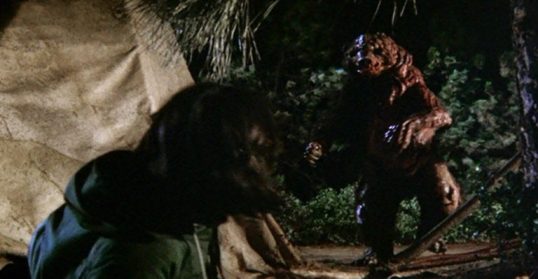
Prophecy is a big, dumb movie that’s never as much fun as you want it to be. There is one early scene that features a camper trying to hop away from Katahdinah while zipped up in a sleeping bag. That scene — which ends with one ruined sleeping back and lot of feathers floating around — is just demented enough to be kind of fun:

Otherwise, the entire film is slow-moving and rather dull. Part of the problem is that it was directed by John Frankenheimer, a major and important filmmaker who had entirely the wrong sensibility for this film. Frankenheimer was a legitimately great director (among his good credits: The Manchurian Candidate, Birdman of Alcatraz, Ronin, Seconds) but he takes the material too seriously. He spends so much time trying to sell the film’s environmental message that he forgets that the majority of the audience for a film like this isn’t watching because they want to become a better person. They’re watching for mutant bear mayhem! This is the type of film that needed to be directed by someone from the Roger Corman school of quick thrills and shameless shlock.

So, here are the twin lessons of Prophecy: know your audience and make sure your monster can live up to its reputation! Otherwise, you’ll just be known for that one scene with the exploding sleeping bag.

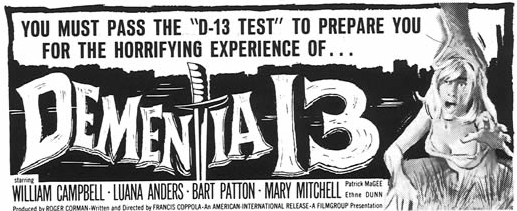
Horror on the Lens: Dementia 13 (dir by Francis Ford Coppola)


(I originally shared this film back in 2011 and 2019 — can you believe we’ve been doing this for that long? — but the YouTube vid was taken down both times!  So, I’m resharing it today!)

For today’s excursion into the world of public domain horror, I offer up the film debut of Francis Ford Coppola.  Before Coppola directed the Godfather and Apocalypse Now, he directed a low-budget, black-and-white thriller that was called Dementia 13.  (Though, in a sign of things to come, producer Roger Corman and Coppola ended up disagreeing on the film’s final cut and Corman reportedly brought in director Jack Hill to film and, in some cases, re-film additional scenes.)

Regardless of whether the credit should go to Coppola, Corman, or Hill, Dementia 13 is a brutally effective little film that is full of moody photography and which clearly served as an influence on the slasher films that would follow it in the future.  Speaking of influence,Dementia 13 itself is obviously influenced by the Italian giallo films that, in 1963, were just now starting to make their way into the drive-ins and grindhouses of America.

In the cast, keep an eye out for Patrick Magee, who later appeared as Mr. Alexander in A Clockwork Orange as well as giving a memorable performance in Lucio Fulci’s The Black Cat.  Luana Anders, who plays the duplicitous wife in this film, showed up in just about every other exploitation film made in the 60s and yes, the scene where she’s swimming freaks me out to no end.

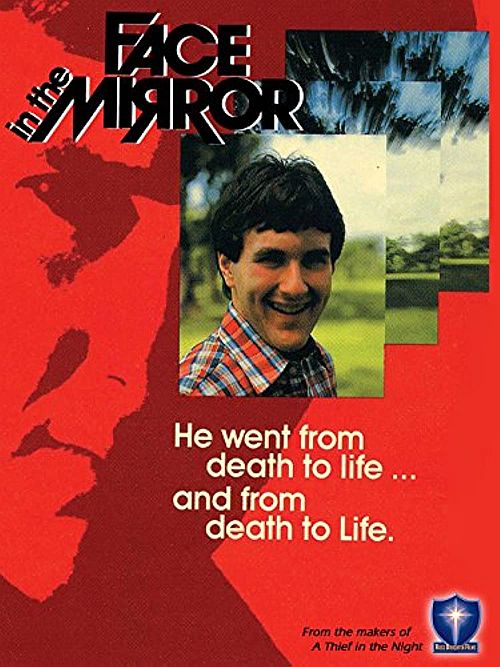
October Positivity: Face In The Mirror (dir by Russell S. Doughten Jr.)


The 1982 film, Face in the Mirror, opens with a community in crisis.

A teenager named Danny DeMarco (played by Michael Mitchell) has been shot and is being rushed to the hospital.  As we listen to the people who are following the ambulance to the hospital, it soon becomes clear that Danny shot himself and that the shooting occurred at a youth group meeting.  At the hospital, Danny is sent to the ICU.  He’s in a coma.  The doctors are not sure whether he’ll ever come out of that coma.

The first half of the 65-minute film is dominated by flashbacks as people try to figure out what could have led to Danny shooting himself.  Danny’s father remembers the time that he gave Danny a hard time for winning first place in a chess tournament.  Though I think most parents would be proud to have a son who was actually good at playing a game that required a certain amount of intelligence, Danny’s father is unimpressed.  Danny’s father was a jock in high school and he expects Danny to be the same.  Chess?  Why, that’s for wimpy youth group kids!

Speaking of wimpy youth group kids, the members of the youth group occasionally pause from the prayer to remember all of the times that they failed Danny.  They remember their own hypocritical behavior and how they would give Danny a hard time whenever he pointed it out.  They remember all of the times that Danny seemed to be confused about his faith and how they didn’t listen to his concerns.  They remember the youth group meeting in which Danny suddenly pulled out a gun and, after calling out everyone else on their hypocrisy and saying that he didn’t really believe in God, he pointed the gun at his head.  When another member of the group tried to grab the gun, it went off.  While their parents dismiss Danny as just being “a crazy kid,” the members of the youth group confront the role that they all played in Danny’s depression….

The first 30 minutes of this film is surprisingly well-acted and the theme of teen suicide is sensitively handled … up until the point that the film insinuates that Danny wouldn’t be depressed or suicidal if he was really a Christian.  I’ve known enough depressed but sincerely religious people to know that this is simply not the truth.  It’s actually a rather dangerous message to send out, as it suggests that depression is somehow a personal failing as opposed to something that everyone, to some degree, is going to have to deal with at some point in their life.

The second half of the film is all about the efforts of Danny’s friends to sneak into his hospital room so that they can pray for him and hopefully get through to him, even though he’s in a coma.  Again, the performances are sincere.  However, tonally, this half of the film is a mess.  There are some awkward moments of humor which really don’t seem like they belong in a movie about teen suicide.  The dialogue also get a bit cringey, as often happens when teenage characters are written by screenwriters who obviously were quite a bit older than the people they were writing for.

Face in the Mirror was directed by Russell Daughten, Jr.  Daughten also directed Nite Song and produced the Thief In The Night films.  Like those films, Face in the Mirror is a sincere but flawed time capsule.  The film’s tone is all over the place but I have to admit that I did kind of enjoy watching this grainy production with its amateur cast.  What can I say?  I have a weakness for low-budget indie films that feature a bunch of people who probably never made another film after this one.  Like Nite Song, watching this film is like stepping into a time machine and traveling to a simpler, if not quite innocent, past.  In the end, the film’s main message is that we should be aware that our words and our actions can hurt people without us even realizing it.  That’s not a bad one.