Film Review: My Cousin Vinny (dir by Jonathan Lynn)


In the 1992 film, My Cousin Vinny, two college students from New York City, Bill Gambini (Ralph Macchio) and Stan Rothstein (Mitchell Whitfield), make the mistake of driving through Alabama.  The two students stop off at a convenience store.  When the clerk is subsequently shot dead during a robbery, Bill and Stan are arrested for the crime.  The viewers know they’re innocent.  Bill and Stan know they’re innocent.  But the entire state of Alabama seems to be determined to send Bill and Stan to prison for life.

Fortunately, Bill’s cousin, Vinny (Joe Pesci, star of Half Nelson), is a lawyer.  Unfortunately, he just recently passed the bar exam and he has yet to actually try a case.  Still, Vinny and his fiancée, Mona Lisa Vito (Marisa Tomei), come down to Alabama.  Vinny takes the case, lying to the judge (Fred Gwynne) about his qualification as a trial attorney.  Vinny is momentarily impressed when the prosecutor (Lane Smith) shares with him all of the files about the case.  “It’s called disclosure, dickhead!” Lisa snaps at him, revealing that she actually has more common sense than Vinny.  That becomes increasingly important as Vinny tries to keep Bill and Stan from spending the rest of their lives in prison.

To be honest, considering how much I complain about stereotypical portrayals of the South, I really shouldn’t like My Cousin Vinny as much as I do.  Almost every character in the film is a stereotype to some extent or another, from the farmers and rednecks who take the witness stand to Fred Gwynne’s no-nonsense judge who rules that Vinny is in contempt of court because he’s wearing a leather jacket.  Fortunately, though, the Southern stereotypes don’t bother me because both Vinny and Lisa are New York stereotypes.  Just as the judge and the townspeople seem to confirm every prejudice that someone like Vinny would have against the South, Vinny seems to be the epitome of everything that people in the South dislike about the North.  When Vinny first shows up on the scene, he’s loud and brash and obnoxious.  But, as the film progresses, Vinny reveals himself to not only be a better attorney than anyone was expecting but he also calms down and adjusts to the more relaxed pace of life in the country.  Just as Vinny reveals himself to be not as bad as everyone originally assumed, both the Judge and the prosecutor are also allowed to reveal some hidden depths.  Neither one is the cardboard authority figure that viewers might expect.  The Judge does sincerely want justice to be done and the prosecutor sincerely wants to keep the county safe, even if he is prosecuting two innocent men.  Just as Vinny learns not to be too quick to judge them, they learn not to be too quick to judge Vinny.  The end message is that everyone is innocent until proven guilty and deserves a fair hearing, whether in a court of law or just in the courts of public and private opinion.  It’s not a bad message.  In fact, it’s one that more than a few people could still stand to learn today.

Of course, the best thing about the film is Marisa Tomei, who not brings a lot of energy to the film but whose hair is amazing and whose clothes are to die for.  Tomei won an Oscar for her performance in My Cousin Vinny, a victory that was so controversial that there were unfounded rumors that presenter Jack Palance had read the wrong name by mistake.  (As we all learned a few years ago when Warren Beatty and Faye Dunaway actually did read the wrong winner, the accountants aren’t going to let anyone get away with that.)  Watching the film last night, it was obvious to me that Tomei deserved that Oscar because Lisa is the heart of the film.  Pesci, Gwynne, and Lane Smith are all give good performances but, without Marisa Tomei’s performance, My Cousin Vinny would ultimately just be another culture clash comedy.  A lesser actress would have just played Lisa as being a stereotype.  But Tomei turned Lisa into the most believable and sincere character in the film.  While Lisa won the case, Tomei saved the movie.

(And needless to say, I’m a fan of any movie that features a Lisa saving the day.)

My Cousin Vinny holds up as an enjoyable film.  Watch it the next time you’re losing faith in humanity.

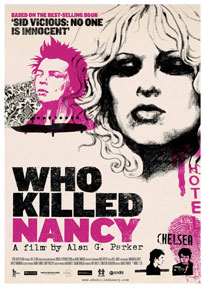
Who Killed Nancy? (2009, directed by Alan G. Parker)


On October 12th, 1978, a 20 year-old, heroin addict named Nancy Spungeon was discovered dead in the bathroom of her room at the Chelsea Hotel.  Nancy was best-known for being the girlfriend of Sid Vicious, the bassist of the Sex Pistols.  The police arrested Vicious and charged him with second degree murder.  Vicious initially said that he couldn’t remember what had happened the previous night because he had been knocked out on barbiturates.  While being interrogated, Vicious changed his story and said that he and Nancy had an argument during the night but that he hadn’t meant to kill her when he stabbed her.  Later, Vicious said that Nancy fell on the knife but Vicious was such a heavy drug user that many felt it was doubtful he had any real memory of anything that might have happened that night.  After pleading not guilty, Vicious was released on $50,000 bail but he was sent right back to Riker’s after assaulting Todd Smith (brother of Patti Smith) at a nightclub.  At Riker’s Vicious went through a detox program before being once again released on bail.  Vicious died of a heroin overdose the night after he was released.

Who Killed Nancy? is a documentary about Sid and Nancy’s relationship and Nancy’s death.  The film features interviews with friends and cotemporaries of the couple.  (Glen Matlock is the only former Sex Pistol to be interviewed, though Malcolm McLaren is heard in archival footage.)  Sid Vicious comes across as being a deeply damaged individual with no impulse control.  Listening to some of the things that Vicious did before finding fame as the sneering face of punk rock, it is easy to believe that, as much as he did love Nancy, he was also capable of losing his control and killing her.  Glen Matlock’s flatmate describes how he was traumatized for life by watching Sid strangle a stray cat.  Others describe Sid as being childlike and almost innocent, a shy virgin until he met Nancy.  But anyone who could strangle an animal has obviously got some screws loose.

However, the documentary also makes a convincing argument that, even if he was capable of impulsive violence, Vicious was so wasted on the night of Nancy’s death that he couldn’t have even lifted a knife, much less stabbed someone with it.  The documentary suggests that Nancy was murdered by one of the many drug dealers who were coming in-and-out of the couple’s hotel room.  Unfortunately, due to his own public image, it was easy for the press and the public to assume that Sid committed the crime and, suicidal after Nancy’s death, it was easy for Sid to convince himself that he must have been responsible.  If the documentary is correct about Sid’s innocence, at least one person got away with murder.  It’s an interesting documentary.  You do have to feel bad for Nancy.  Even in death, none of the interviewees seems to be willing to say anything nice about her.  After all these years, she is still being blamed for Sid Vicious’s downfall but, as this documentary makes clear, Sid was probably doomed whether or he met Nancy or not.

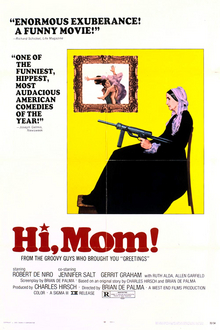
Film Review: Hi, Mom! (dir by Brian De Palma)


Released in 1970, Hi, Mom!, tells the story of Jon Rubin (played by a 26 year-old Robert De Niro).  The somewhat spacey and kind of creepy Jon has just returned to New York City from Vietnam.  After moving into a run-down apartment building and meeting the building’s superintendent (Charles Durning), Jon is hired to direct a pornographic film by producer Joe Banner (Allen Garfield).  Jon’s idea to simply point his camera at his building and to film his neighbors as they go about their day.  As quickly becomes apparent, Jon is mostly just looking for an excuse to watch and film Judy Bishop (Jennifer Salt).

Also living in the building is Gerrit Wood (Gerrit Graham), who is first seen triumphantly putting posters of Che Guevara and Malcolm X up in his apartment.  Gerrit is a freshly-minted political radical and the leader of a group of performance artists who put on a show called Be Black, Baby, in which the white audience members are forced to wear blackface and are then chased, attacked, and assaulted by black actors wearing whiteface.  (Gerrit himself is white.)  Jon is hired to play the police officer who beats and arrests the members of the audience at the end of the performance.  Of course, eventually, the real police show up….

An attempt at an episodic counter-culture comedy, Hi, Mom is definitely a product of the time in which it was made, both in its style and its thematic content.  Today, it’s best-known for being one of Brian De Palma’s early independent films and for featuring Robert De Niro in one of his first starring roles.  De Palma and De Niro aren’t exactly the first names that come to mind when one thinks about comedy and Hi, Mom shows that there’s a good reason for that.  As both a screenwriter who felt he had something important to say and a young director who was obviously eager to show off everything that he could do with a camera, Brian De Palma simply cannot get out of his own way.  Scenes are needlessly sped up.  Scenes are pointlessly slowed down.  The musical cues are obvious.  The dialogue is often so broad that it comes across as being cartoonish.  One gets the feeling that De Palma didn’t trust the audience to get the jokes so he went overboard to make sure everyone knew when to react.  All of the pointless camera trickery serves the same purpose that a laugh track would on an old sitcom.  Interestingly enough, the only sequence that really works as satire is the Be Black, Baby sequence and that’s because De Palma directs it in a semi-documentary fashion.  De Palma gets out of his own way and allow the sequence to develop a natural rhythm.  (Of course, seen today, the scene will bring to mind the upper class white liberals who pay money to have an activist lecture them about their privilege while having their friends over for dinner.)

As for Robert De Niro, he gives a typically nervy performance, one that feels like a dry run for his later work in Mean Streets, Taxi Driver, and King of Comedy.  Despite the reputation of those films, there are some genuinely funny moments to be found in all of them.  Most of them, like the classic Taxi Driver conversation between De Niro’s Travis and Peter Boyle’s Wizard, are funny because of how people react to De Niro’s obviously unhinged characters.  Both Taxi Driver and King of Comedy got mileage out of having normal people try to deal with De Niro’s unstable characters.  In Hi, Mom, everyone is equally wacky and, as such, De Niro doesn’t really have anyone to play off.  No one is really reacting to anything, De Niro-included.  (There is some spark to his scenes with Charles Durning and Allen Garfield but even those scenes seem to drag on forever.)

On the plus side, Hi, Mom! is was shot on the actual streets of New York City, guerilla-style.  (A “Re-Elect Mayor Lindsay” sign in the background confirms that the film was made on location in 1969.)  When De Palma isn’t getting in his own way with all of his fancy camera tricks, he manages to capture so memorably bleak images of New York City.  Hi, Mom! presents New York as being a dirty, crime-ridden, and menacing city but it also captures the odd grandeur of urban decay.  At its best, Hi, Mom! captures the love/hate relationship that many seem to have New York City.  The city feels both alive and dangerous at the same time.  Hi, Mom! is too uneven to work as a sustained satire but, as a documentary about New York at the end of the turbulent 60s, it’s worth watching.

I should mention that this was not the first time that De Palma and De Niro teamed up.  Indeed, De Niro was De Palma’s muse even before he met Martin Scorsese.  Hi, Mom! was a loose sequel to an earlier De Palma/De Niro film called Greetings.  (Like many of De Palma’s future films, both Greetings and Hi, Mom! were originally rated X but later re-rated R.)  De Palma and De Niro, of course, would both go onto have long Hollywood careers.  (They would later reunite for The Untouchables, a big-budget spectacle of a film that’s about as far from the grungy Hi, Mom! as one can get.)  De Palma’s career has had its ups and downs but, as of late, many of his films have been positively reevaluated.  As for De Niro, he can finally kind of play comedy.  That said, I’d rather watch Hi, Mom than Dirty Grandpa.

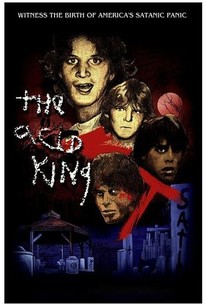
The Acid King (2019, directed by Dan Jones and Jesse B. Pollack)


In 1984, a Long Island-based teenage drug dealer and wannabe gangster named Ricky Kasso murdered a childhood friend named Gary Lauwers, reportedly because he was angry that Gary had stolen some drugs from him.  While tripping on LSD, Ricky brutally stabbed Gary to death in the woods.  Ricky later said that he demanded that Gary say “I love Satan,” while killing him.  Ricky claimed to be a Satanist, though he never actually learned how to spell the name of his supposed Dark Lord and instead would tag walls with graffiti exhorting the viewer to “Hail Satin.”

Not being the smartest drug dealer/Satanist to ever grace the state of New York, Ricky spent the next two weeks bragging about the murder and taking his friends to view Gary’s corpse.  While none of the people who saw Gary’s body ever called the police, rumors started to spread about what had happened.  Acting on an anonymous tip, the police arrested Ricky and two of his friends.  Ricky Kasso, the self-described “Acid King,” committed suicide in his jail cell a month after murdering Gary Lauwers.  Supposedly, the other inmates in the jail egged Ricky on while he hanged himself.  No one liked the Acid King.

Ricky Kasso had been in-and-out of trouble for the majority of his short life and, at the time of the murder, he was living on the streets because his family had kicked him out of the house.  What set Ricky apart from other murderous drug dealers was that he claimed to be a Satanist and that he demanded that Gary declare that he loved Satan before killing him.  This played right into the burgeoning Satanic Panic of the 80s and, in death, Ricky became a symbol of the Satanic conspiracy that many were convinced had taken hold of the teenagers.  (Especially teenagers who, like Ricky, listened to AC/DC.)  A book called Say You Love Satan was written about Kasso and his crimes.  Though the book has since been discredited, it was a best seller when initially published.  (I can still remember, when I was a kid, coming across a copy in Waldenbooks and reading a few pages.)  Ricky Kasso became a cult figure, inspiring both filmmakers and bands.  Meanwhile, all of Ricky and Gary’s former friends had to deal with the burden of being branded as Satanists by the rest of America.  Heavy metal music was blames for leading kids like Ricky into Satanism.  Tipper Gore campaigned for the labeling of offensive music.  Satin would have been proud.

The Acid King is an eye-opening documentary about the case, featuring interviews with the people who knew both Ricky and Gary.  While criticizing the way the case was reported on by the press, The Acid King also makes it clear that Ricky Kasso was a twisted individual.  (More than one interview subject describes him as being evil.)  The documentary takes a look at how Ricky and his friends were essentially abandoned by their parents in their privileged community, leaving them with next to no guidance on how to deal with the real-life consequences of their actions.  Of course, for the media, it was much easier to blame Satanism and heavy mental music than it was to ask where the parents were while Ricky Kasso was plotting to kill Gary Lauwers.

The first half of the documentary deals with Ricky and Gary.  The second half features interviews with the horror filmmakers and the musicians who were inspired by the sordid media coverage of Ricky’s crimes.  Lori S, the lead singer of Acid King, took the name of the band from a passage in Say You Love Satan while director Jim VanBebber, while being totally dismissive of the book’s claim that Ricky was directly inspired by Satan, still directed a short film about Ricky Kasso.  The second half is a less interesting than the first, until you consider that none of these people would have heard about Ricky Kasso if not for the attempts of people like Tipper Gore to turn him into the poster child for her crusade against heavy metal music.  Instead of scaring people away, the Tipper Gores of the world made Ricky Kasso, a barely literate idiot, into a cult figure.  Again, Satin would be proud.

The Acid King provides a valuable service by separating the fact from the rumors, revealing that the mundane truth is even more disturbing than the sordid fiction.

Retro Television Reviews: International Airport (dir by Don Chaffey and Charles S. Dubin)


Welcome to Retro Television Reviews, a feature where we review some of our favorite and least favorite shows of the past!  On Sundays, I will be reviewing the made-for-television movies that used to be a primetime mainstay.  Today’s film is 1985’s International Airport!  It  can be viewed on YouTube!

It’s not easy working at an international airport!

At least, that’s the message of this made-for-television film.  Produced by Aaron Spelling and obviously designed to be a pilot for a weekly television series, International Airport details one day in the life of airport manager David Montgomery (Gil Gerard).  Everyone respects and admires David, from the recently graduated flight attendants who can’t wait for their first day on the job to the hard-working members of the airport security team.  The only person who really has a problem with David is Harvey Jameson (Bill Bixby), the old school flight controller who throws a fit when he learns that a woman, Dana Fredricks (Connie Sellecca), has been assigned to work in the tower.  Harvey claims that women can’t handle the pressure of working the tower and not having a personal life.  He demands to know what Dana’s going to do during that “one week of the month when you’re not feeling well!”  Harvey’s a jerk but, fortunately, he has a nervous breakdown early on in the film and Dana gets to take over the tower.

Meanwhile, David is trying to figure out why an old friend of his, Carl Roberts (played by Retro Television mainstay Robert Reed, with his bad perm and his retired porn star mustache), is at the airport without his wife (Susan Blakely).  David takes it upon himself to save Carl’s troubled marriage because it’s all in a day’s work for the world’s greatest airport manager!

While Carl is dealing with his mid-life crisis, someone else is sending threatening letters to the airport.  One of the letters declares that there’s a bomb on a flight that’s heading for Honolulu.  David and Dana must decide whether to allow Captain Powell (Robert Vaughn) to fly to Hawaii or to order him to return to California.  And Captain Powell must figure out which one of his passengers is the bomber.  Is it Martin Harris (George Grizzard), the sweaty alcoholic who want shut up about losing all of his friends in the war?  Or is it the woman sitting next to Martin Harris, the cool and aloof Elaine Corey (Vera Miles)?

Of course, there are other passengers on the plane.  Rudy (George Kennedy) is a veteran airline mechanic.  Rudy is hoping that he can talk his wife (Susan Oliver) into adopting Pepe (Danny Ponce), an orphan who secretly lives at the airport.  Unfortunately, when Pepe hears that Rudy’s plane might have a bomb on it, he spends so much time praying that he doesn’t realize he’s been spotted by airport security.  Pepe manages to outrun the security forces but he ends up hiding out in a meat freezer and, when the door is slammed shut, it appears that Pepe may no longer be available for adoption.  Will someone hear Pepe praying in time to let him out?  Or, like Frankie Carbone, will he end up frozen stiff?

International Airport was an attempt to reboot the Airport films for television, with the opening credits even mentioning that the film was inspired by the Arthur Hailey novel that started it all.  As well, Gil Gerard, Susan Blakely, and George Kennedy were all veterans of the original Airport franchise.  George Kennedy may be called Rudy in International Airport but it’s easy to see that he’s still supposed to be dependable old Joe Patroni.  Unfortunately, despite the familiar faces in the cast, International Airport itself is a bit bland.  It’s a disaster film on a budget.  While the viewers gets all of the expected melodrama, they don’t get anything as entertaining or amusing as Karen Black flying the plane in Airport 1975 or the scene in Concorde: Airport ’79 where George Kennedy leaned out the cockpit window (while in flight) and fired a gun at an enemy aircraft.  Probably the only thing that was really amusing (either intentionally or unintentionally) about International Airport was the character of Pepe and that was just because young Danny Ponce gave perhaps the worst performance in the history of television.

International Airport did not lead to a television series.  Watching it today, it’s a bit on the dull side but, at the same time, it is kind of nice to see what an airport was like in the days before the TSA.  If nothing else, it’s a time capsule that serves as a record of the days when the world was a bit more innocent.

Retro Television Reviews: The Screaming Woman (dir by Jack Smight)


Welcome to Retro Television Reviews, a feature where we review some of our favorite and least favorite shows of the past!  On Sundays, I will be reviewing the made-for-television movies that used to be a primetime mainstay.  Today’s film is 1972’s The Screaming Woman!  It  can be viewed on YouTube!

In this made-for-tv movie from 1972, the great Olivia de Havilland plays Laura Wynant. Laura is a wealthy woman who has just been released from a mental institution. She goes to her country estate to recuperate but, as soon as she arrives, she starts to hear a woman’s voice in the back yard.

“help me …. help me….” the voice cries.

Laura looks around and she soon realizes that the voice is coming from the ground! A woman has been buried alive in the backyard and will soon die if not rescued! At first Laura tries to dig up the woman on her own but her hands are crippled by arthritis. An attempt to get a neighborhood child to help her dig just leads to Laura being confined to her home, under doctor’s orders. No matter how much Laura tries to get the people around her to listen for the sound of the woman crying for help, everyone just assume that Laura must be imagining things.

Further complicating things is the fact that the person who put the woman in the ground is still out there. And, when he discovers that Laura has been hearing voices, he decides that maybe he needs to do something about both Laura and the screaming woman….

The Screaming Woman is an effective psychological thriller and, considering that it was made for early 70s network television, surprisingly suspenseful. If the film were remade today, I imagine it would try to keep us guessing as to whether or not Laura was hearing an actual woman or if it was all in her mind.  However, by revealing early on that Laura actually is hearing what she thinks she’s hearing, The Screaming Woman puts us right into Laura’s shoes and we share her frustration as she desperately tries to get someone — anyone — to take her seriously. It helps that Laura is played by Olivia de Havilland, who gives a very sympathetic and believable performance. De Havilland, who started her career appearing in Errol Flynn movies back in the 30s and who most famously played Melanie in Gone With The Wind, was one of the longest-lived stars of Hollywood’s Golden Age, living to the age of 104 and winning two Academy Awards for Best Actress.

The film is based on a short story by Ray Bradbury. In the story, it’s a little girl — as opposed to an old woman — who hears the voice. I haven’t read the short story so I don’t know how else it compares to this adaptation but, as a film, The Screaming Woman is an entertaining and creepy thriller and, when viewed today, it serves as a reminder of what a good actress Olivia De Havilland truly was.  She takes a simple thriller and turns it into a meditation on aging and the one person’s determination to do the right thing even when the entire world seems to be against her.

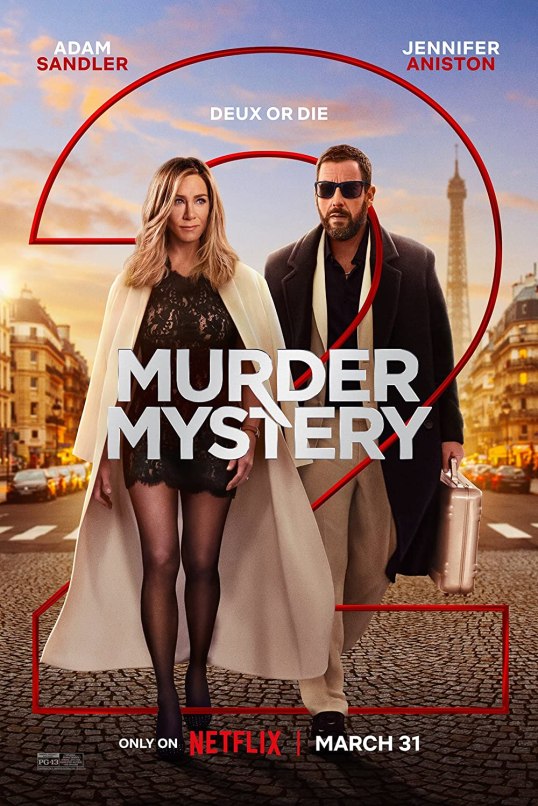
Film Review: Murder Mystery 2 (dir by Jeremy Garelick)


Four years ago, Nick and Audrey Spitz (Adam Sandler and Jennifer Aniston) solved a convoluted murder mystery and became minor celebrities.  Nick quit his job with the NYPD.  Audrey quit her job as a hairdresser.  They opened up their own private detective agency.

Unfortunately, as a narrator explains to us at the start of Murder Mystery 2, things haven’t gone smoothly for Nick and Audrey.  They’ve struggled to establish themselves as detectives.  In fact, Nick doesn’t even have a P.I. license because he has yet to pass the exam and he balks at having to actually study criminology.  While Audrey tries to convince him to, at the very least, read a book on kidnapping, Nick is more concerned with coming up with cute business cards.  His big idea to combine the traditional business card with floss and a razor.  Personally, I wouldn’t want to use a business card to take care of my teeth but maybe that’s just me.

When Nick and Audrey are invited to an exclusive wedding, it’s a chance for them to reacquaint themselves with Vikram (Adeel Akhatar) and Colonel Ulenga (John Kani), both of whom were featured in the first Murder Mystery.  When Vikram is kidnapped and one of his bodyguards is murdered, it’s a chance to Nick and Audrey to once again prove that they’re capable of solving a crime.  When former MI6 agent-turned-security consultant Captain Miller (Mark Strong) literally emerges from the sea and takes over the investigation, it’s a chance to Audrey to meet one of her heroes and for Nick to get a little jealous.  And when the action moves to France, it’s an excuse for the film’s cast and crew to hang out in Paris for a few weeks.

I enjoyed the first Murder Mystery, which was a surprisingly sweet and funny comedy that showcased Sandler and Aniston’s chemistry while also make good use of Sandler in one of his more likable comedic roles.  Like all Sandler characters, Nick may be something of a manchild but he’s not deliberately destructive.  He means well.  The first film’s mystery was enjoyably convoluted and a lot of the humor came from just how out of place Sandler and Aniston were in an Agatha Christie-style whodunit.

Murder Mystery 2, unfortunately, it not quite as much fun as the first film.  A huge part of the problem is that Nick and Audrey are no longer amateur detectives who are both shocked and secretly thrilled to be solving an actual murder.  Now, they’re professional (if somewhat incompetent) detectives.  The first film had a sweet subtext about Sandler trying to prove that he was as good a detective as thought he was.  He had something to prove, to both his wife and to himself.  In the second film, the emphasis is more on action than humor.  Suddenly, Sandler and Aniston are engaging in high-speed car chases and battles atop the Eiffel Tower.  It all feels a bit mechanical and, much as with his direction of The Binge, director Jeremy Garelick often seems to just be going through the motions.

On the plus side, Sandler and Aniston still have their chemistry and both of them still know how to make an otherwise corny joke work.  Jennifer Aniston gets to wear a lot of really pretty outfits and Adam Sandler gets a memorable scene where he tries to convince himself that he can jump over a moat.  There’s a genuinely funny moment towards the end of the film, when a character unrelated to the mystery randomly shows up and interrupts a tense showdown.  Even though I wish the film had done a bit more with character, Mark Strong also seems to be having parodying his own image.  There are moments of Murder Mystery 2 that are actually pretty amusing, though I think chuckled more than I actually laughed out loud.  Ultimately, though, Murder Mystery 2 is rather forgettable.

Retro Television Reviews: The Alpha Caper (dir by Robert Michael Lewis)


Welcome to Retro Television Reviews, a feature where we review some of our favorite and least favorite shows of the past!  On Sundays, I will be reviewing the made-for-television movies that used to be a primetime mainstay.  Today’s film is 1973’s The Alpha Caper!  It  can be viewed on YouTube!

After years of faithful service and hard work, parole officer Mark Forbes (Henry Fonda) is on the verge of mandatory retirement.  He’s spent his entire career playing by the rules and taking orders and helping recently released criminals go straight.  For all of his service, all he’s gets is a small party and a cheap retirement gift.

Still, Mark is on the job when he gets a call that one of his parolees, Harry (Noah Beery, Jr.), is currently in the middle of a stand-off with the cops.  Mark goes to the crime scene, where he discovers that Harry was trying to rob a warehouse full of weapons.  He also discovers that Harry is dying, as the result of being shot by the police.  Before Harry passes, he tells Mark that he and three other ex-cons were plotting to steal a shipment of gold bars.

Mark decides to carry out Harry’s plan.  Working with Mitch (Leonard Nimoy), Tudor (Larry Hagman), and Scat (James McEachin), Mark comes up with a plan to rob the armored cars that are going to be transporting the gold.  While Tudor and Scat are quick to join up with Mark, Mitch is a bit more hesitant.  In the end, though, they all decide to work together.  The plan they come up with is a clever one but its main strength is that it’s being spearheaded by Mark, a man who no one would ever expect to commit a crime.  No one but his colleague and friend, Lee (John Marley), that is.

I watched The Alpha Caper last night, with my friend Phil, Janeen, and Spiro.  To be honest, I selected the film because the title led me to suspect that it would be a science fiction film of some sort.  I was a little surprised when it turned out to be a crime thriller but I was even more surprised by just how good the film itself turned out to be.  Cleverly plotted and well-acted by the entire cast (and featuring a scruffy Leonard Nimoy playing a role that’s about as far from the coldly logical Mr. Spock as one can get), The Alpha Caper is an entertaining crime film but it’s also surprisingly poignant.  Mark is someone who feels that he’s lived his entire life without taking a single risk and, as a result, he has nothing to show for it.  He compares his situation to the mythical Kilroy of “Kilroy was Here” graffiti fame.  Kilroy will always be remembered, even though no one is really sure who he was.  Mark fears that he’s destined to be forgotten.  The robbery is Mark’s way of announcing that “Mark Forbes was here.”  The film ends on a surprisingly touching, if rather bittersweet, note.

The Alpha Caper originally aired on ABC on October 6th, 1973.  It was apparently meant to be a pilot for an anthology show that would be called Crime.  The series wasn’t picked up but, two years later, The Alpha Caper was theatrically released in Italy.  Today, it can be seen on YouTube.  Like Mark Forbes and Kilroy, the film has not been forgotten.

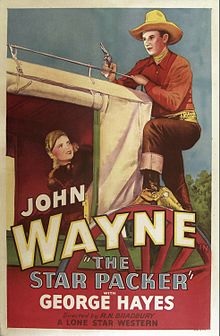
The Star Packer (1934, directed by Robert N. Bradbury)


A mysterious outlaw known as the Shadow is terrorizing turn-of-the-century Arkansas.  He and his gang have killed the last few sheriffs of Little Rock.  No one is sure who the Shadow is or how he communicates with his gang but somehow, he is always one step ahead of the law.  However, the Shadow didn’t count on federal agent John Travers (John Wayne) riding into town and declaring himself to be the new sheriff.  Working with his Native sidekick, Yak (Yakima Canutt), Travers sets out to expose the Shadow and take him down.  Along the way, he falls for Anita (Verna Hillie), the niece of rancher Matt Matlock (Gabby Hayes).  Luckily, Anita knows her way around a gun too.

This is one of the 50 B-westerns that John Wayne made before Stagecoach made him a star.  The Star Packer is more interesting than some of Wayne’s other poverty row productions because The Shadow is a more interesting and much more clever villain than the usual greedy but dumb outlaws that Wayne went up against in these movies.  The Shadow actually has a clearly thought-out plan and, for once, Wayne can’t defeat the bad guys on his own.  In The Star Packer, it takes a community to stand up to evil.  As always with Robert Bradbury’s westerns, the fights and the stunts are impressive.  Fans of Wayne’s B-period will probably especially be interested to see the legendary stuntman, Yakima Canutt, play a good guy for once.  He and Wayne both do a good job in this 52 minute programmer.

Neath The Arizona Skies (1934, directed by Harry L. Fraser)


Chris Morrell (John Wayne) is an honest cowboy who keeps an eye on Nina (Shirley Jean Rickert), a little girl whose Indian mother died when Nina was just a baby.  When oil is discovered on land that belonged to Nina’s mother, Nina is offered $50,000 for the land.  Because Nina is only eight years old, her legal guardian will be responsible for taking care of the money.  Chris and Nina set out to find Nina’s father so that he can sign the guardianship papers and make Chris into Nina’s legal guardian.

When outlaw Sam Black (Yakima Canutt) decides that he would rather be Nina’s legal guardian, Chris sends Nina to a ranch owned by his old friend, Bud Moore, while he defeats Sam and his men.  At the ranch, it turns out that Bud Moore has died and the new ranch owner is another outlaw named Vic (Jack Rockwell) and Vic wants Nina’s oil claim for himself.  What Vic doesn’t know is that Nina’s father is one of his ranch hands.

For a 52 minute programmer, there’s a lot going on in ‘Neath The Arizona Skies.  There’s actually too much going on and, with that short of a run time, it feels as if more than a few important plot points were glossed over, like how Chris came to look after Nina in the first place.  John Wayne is stiff but likable as Chris while Yakima Canutt does his usual double duty as both an outlaw and a stuntman.  There are a few good action scenes, especially when Chris runs off Sam’s gang for the first time.  Sheila Terry plays Wayne’s love interest, who has to be first convinced that Chris isn’t actually an outlaw.  As Nina, Shirley Jean Rickert is energetic but you’ll quickly get tired of her yelling, “Daddy Chris!” whenever anything happens.  This isn’t one of the best of the 50 poverty row films that Wayne appeared in before Stagecoach made him a star but, even in this film, there are still hints of the screen presence that would later become Wayne’s trademark.