Down Texas Way (1942, directed by Howard Bretherton)


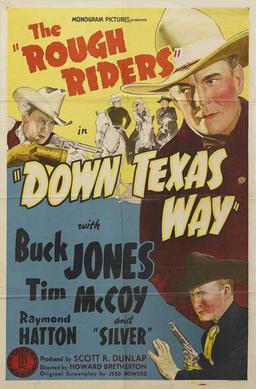
The sixth entry in the Rough Riders series finds Marshal Tim McCall (Tim McCoy) traveling from Wyoming to Texas so that he can help Sandy Hopkins (Raymond Hatton) celebrate his birthday.  When he arrives, he discovers that the birthday celebration is on hold because Sandy has been accused of murdering his best friend, John Dodge (Jack Daley).  Dodge was the richest man in town and the townspeople think that Sandy murdered him as a result of a disagreement over a card game.  What they don’t know is that Sandy and Dodge were only pretending to be mad at each other as a practical joke.

Dodge was really murdered by Bert Logan (Harry Woods), an outlaw who has hired an actress named Stella (Lois Austin) to pretend to be Dodge’s long-lost wife.  When all of Dodge’s property is given to Stella, Stella will then give it all to Dodge.  While Tim tries to keep the sheriff (Glenn Strange) from prosecuting Sandy, Marshal Buck Roberts (Buck Jones) goes undercover and infiltrates Logan’s gang.

After five previous films that just featured the Rough Riders talking about what their lives were like when they weren’t chasing outlaws, Down Texas Way shows us Sandy Hopkins’s life in Texas.  It’s about what you would expect.  Sandy likes to spend his time playing cards and hanging out in the lobby of his hotel.  It seems like an nice life, at least until Bert Logan tries to frame him for murder.  Luckily, the other Rough Riders are always there to have his back.  Down Texas Way is not one of the better Rough Riders films because Bert’s scheme never makes much sense but Hatton is relaxed and engaging and McCoy and Jones are their usual tough selves.  As with the previous film, the appeal of this Rough Riders film is the Rough Riders themselves and the way that they always stick together and have each other’s back.  That’s especially true in Down Texas Way, in which both Tim and Buck show that they’ll travel across several states if it means helping out a friend in a jam.

One final note, the town’s sheriff is named Trump, though I assume he’s no relation.  Glenn Strange, who played Sheriff Trump, would later play Frankenstein’s Monster in the last of the Universal horror movies.

Previous Rough Rider Reviews:

  1. Arizona Bound
  2. The Gunman From Bodie
  3. Forbidden Trails
  4. Below the Border
  5. Ghost Town

Film Review: Missing (dir by Will Merrick and Nick Johnson)


Single mother Grace Allen (Nia Long) goes on a week-long vacation to Colombia with her boyfriend, Kevin (Ken Leung).  In doing so, she leaves her 18 year-old daughter, June (Storm Reid), alone at the house.  She tells June to be responsible.  She tells June to only use the emergency cash in case of emergencies.  She tells June not to throw any wild parties.  She tells June to clear out her voice mail so Grace can actually leave a message.  As soon as Grace leaves, June starts spending the emergency money on beer and parties and she also fails to clear out her voice mail.

It’s hard to blame June, however.  She’s 18 and she’s rebellious and it doesn’t help that her mother is extremely overprotective.  June feels that there is something off about Kevin and his awkward attempts to talk to her do nothing to make her like him.  June spends most of her time wishing that she could have spent more time with her father, James (Tim Griffin), a man who she can barely even remember.

At the end of the week, June drives out to the airport.  She makes a sign that reads, “Welcome back from prison,” and she stands in the airport, waiting to see her mom and Kevin.  However, neither one of them shows up.  The plane has landed.  The passengers have disembarked.  But Grace and Kevin are nowhere to be seen.  June realizes that they are …. MISSING!

Missing was made by the same production team behind Searching and, like that film, it’s a screenlife thriller, one that is told via computer desktops, security cameras, smartphones, and a smartwatch.  Early on, June watches an episode of a true crime show called Unfiction, which is based on the missing person case at the heart of Searching, establishing that the two films take place in the same universe.  Much as with Searching, the app-heavy visual style of Missing feels a bit gimmicky but it’s also undeniably effective.  Indeed, it’s interesting to think that, even as technology connects us in new ways and as cameras film our every move, people can still somehow disappear off the face of the Earth.  As June goes through both Grace and Kevin’s social media and email accounts, the film’s format lets us view the world through her eyes.  Like her, we read every email and search for hidden meanings and missed clues.

The mystery at the heart of Missing is an intriguing one and the film is full of twists and turns.  Unfortunately, many of the film’s later twists are more improbable than clever.  For all of the film’s strengths, things pretty much fall apart during the film’s final third.  That’s when the film comes up with a twist that’s surprising only because of how little sense it makes.  It’s one thing to fool an audience by being clever.  It’s another thing to fool an audience by just pulling a plot point out of thin air.  The final big twist requires a huge suspension of disbelief on the part of the audience but Missing isn’t a horror or a sci-fi or a Fast & Furious-style action film.  It’s a mystery and anyone who was actually trying to look for clues and come up with the solution on their own would have every right to be annoyed by the way the film handles its finale.

That said, it’s a well-acted film and, much like John Cho in Searching, Storm Reid deserves a lot of credit for bringing some genuine emotion to the lead role.  With Reid in the lead role, Missing manages to become something more than just the latest twist on the found footage genre.  I also liked the performance of Joaquim de Almeida as Javi, the local Colombian who aids June in the search for her mother.  (As long as we’re going to keep spinning off new Searching and Missing films, I think the next one should be about Javi.)  There are some genuinely funny moments in the film.  Be sure to keep an eye on the messages that June gets from Angel (Michael Segovia) over the course of the film.  Despite its flaws, Missing is an enjoyable thriller and, undoubtedly, it will make a good episode of Unfiction.

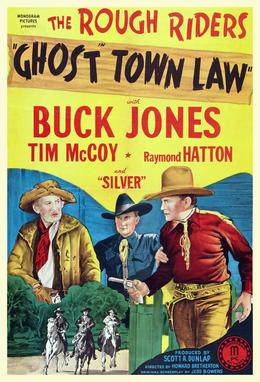
Ghost Town Law (1942, directed by Howard Bretherton)


When two U.S. marshals are ambushed and killed while searching for a group of outlaws in a nearly deserted ghost town, Marshal Tim McCall (Tim McCoy) leaves his ranch in Wyoming to investigate the crime.  He was friends with the two murdered men, making this case personal.  Of course, McCall’s two fellow Rough Riders ride into town to help McCall out.  Buck Roberts (Buck Jones) and Sandy Hopkins (Raymond Hatton) arrives separately and pretend to be prospectors.  Their investigation leads to the outlaws (led, as usual, by Charles King), a corrupt member of the community, and a network of underground tunnels that might lead to a gold mine.  As with all of the Rough Rider films, Ghost Town Law features a younger secondary protagonist who was there to appeal to audiences who didn’t remember Jones, McCoy, and Hatton from their silent and pre-code era heyday.  Virginia Carpenter plays Josie Hall, who comes to the town to search for her grandmother and brother.

Starting with the two marshals getting gunned down in the line of duty, this is one of the more violent of the Rough Riders films.  Since the Rough Riders are as interested in getting revenge as they are in getting justice, the Rough Riders themselves are quicker on the draw than usual.  The identity of the main villain will not be a shock to anyone who has watched any of the other Rough Rider films but the use of the underground tunnels adds a new element of danger to the movie.  For once, the outlaws and the Rough Riders seem evenly matched.  The film also features the very lovely and likable Virginia Carpenter, making the last of her five film appearances.

As always, the main appeal is watching Jones, McCoy, and Hatton acting opposite each other.  Due to the nature of the case, all three of them are more serious than usual in Ghost Town Law but it is still enjoyable to watch them discuss what’s been happening at their ranches since the last movie.

Previous Rough Rider Reviews:
  1. Arizona Bound
  2. The Gunman From Bodie
  3. Forbidden Trails
  4. Below the Border

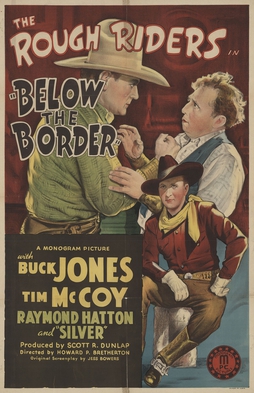
Below The Border (1942, directed by Howard Bretherton)


In the fourth Rough Riders film, the boys head down to Mexico City to defend the Garcia Ranch from a gang of cattle rustlers who are also planning on stealing the Garcia Family Jewels.  (Would the Rough Riders have any legal jurisdiction in Mexico?)  This time, Buck Roberts (Buck Jones) assumes the identity of a well-known outlaw who deals in stolen goods, Tim McCall (Tim McCoy) pretends to be a cattle buyer, and Sandy Hopkins (Raymond Hatton) gets a job sweeping up the local saloon.  As with almost all of the Rough Riders films, the owner of the saloon, Steve Slade (Charles King), is also the leader of the thieves.  Slade is blackmailing a reformed outlaw named Joe (Dennis Moore) into helping Slade and Scully (Roy Barcroft) steal the family jewels.  Joe is in love with Rosita Garcia (Linda Brent).

Below the Border has much in common with Forbidden Trails, the Rough Riders film that came before it, right down to a villainous saloon owner and a former outlaw being blackmailed to return to his old ways.  As usual, the outlaws try to humiliate Sandy Hopkins, just for Tim McCall to show up at the saloon and turn the tables.  Scully is a despicable bully and it feels good when McCall forces him to grab Hopkins’s mop and clean up the bar himself.

It’s not the strongest of the Rough Riders films. The plot is predictable, Linda Brent gives a terrible performance as Rosita, and even the action scenes are by-the-numbers.  The main appeal of Below the Border is to watch the three Rough Riders themselves.  Jones, McCoy, and Hatton all seem to have genuinely enjoyed working together and that comes through in their scenes together.  You never have any doubt that, even though they live in different parts of the country, all it would take is one telegram for them to get back together.  The highlight of each film is the final scene, where the Rough Riders tell each other what they’ve been up to between adventures.  This time, Buck invites everyone to visit him in Arizona but Tim has to get back to Wyoming and Sandy’s running a hotel in Texas.  They ride off separately but there’s little doubt they will reunite as soon as there’s a new rustler who needs to be brought to justice.

Previous Rough Rider Reviews:
  1. Arizona Bound
  2. The Gunman From Bodie
  3. Forbidden Trails

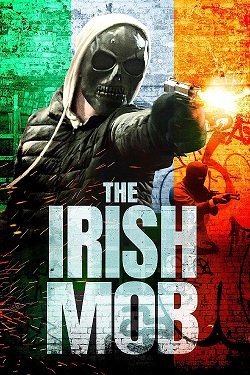
Film Review: The Irish Mob (dir by Patrick McKnight)


Valentino “Val” Fagan (played by Rob McCarthy) was named after Rudolph Valentino but he didn’t grow up to be a chivalrous lover, the type whose romantic eyes make hearts swoon.  Instead, Val grew up to be a mobster, the head of the Irish mob.  His eyes view the world with mistrust and anger.  As he tells us in the cocky voice-over that runs through The Irish Mob, Dublin is his city.  Whether its drugs, theft, or dealing weapons with the IRA, Val is involved.

However, it’s not easy being the boss.

For one thing, Val has the Garda after him.  Detective Liz Delahunt (Pauline O’Driscoll) is obsessed with taking Val down.  She’s got the wall of her office set up with one of those crazy charts that links Val and his associates to a series of unsolved murders throughout Ireland.  Liz is clever and she’s determined.  In one of the film’s funnier moments, she puts Val under a protection order so that he ends up with Detective Kevin Hogan (David Greene) following him around 24 hours a day and staking out his home.  Whenever Val looks out of a window, Hogan gives him a friendly wave.

As well, the Corrigan Brothers, who are Val’s Amsterdam-based drug connections, have just lost a fairly large shipment of drugs and the money that they would have made from selling them.  The Corrigans expect their associates to kick in to help make up for the loss and it’s pretty clear that failure to do so will lead to something not good happening.  Val may be rich but he’s not that rich and he soon finds himself taking risks in order to raise the money.  Right when it appears that Liz’s funding has been cut, one of Val’s brazen robberies leads to Liz being told that she’ll have all the money that she needs to pursue her case against Val.

Finally, there’s Dessie Corrigan (George Bracebridge), a monstrous sociopath who has just been released from prison and who is looking to get back into the Dublin rackets.  A misunderstanding leads to Corrigan deciding that Val sold him out to the Garda.  Corrigan soon starts to attack Val’s men and makes plans to come after Val himself.  As with so many of the criminals in The Irish Mob, Corrigan is an idiot but he’s a very determined idiot.  He’s also someone who can easily be manipulated by those looking to take over Dublin.

Val has his ways of dealing with the stress.  He genuinely loves his son and comes about as close to being human as he probably can whenever he’s just being a father.  Though he spends a lot of time fighting with his wife, he does have a mistress who he enjoys spending an hour or two with.  And, of course, there’s always cocaine.  The more stressed Val gets, the more he does.  The more paranoid Val becomes, the more people he kills.  It’s not easy being in charge but, as Val tells us, Dublin is his city,

Plotwise, The Irish Mob is a standard Mafia movie, complete with a philosophical voice over and scenes of random violence.  Val reached his position of power by being smarter than everyone else but, now that he’s in charge, he’s forced to depend on people who are stupid, sadistic, and impulsive.  Val thinks that he can control the cycle of violence but what he doesn’t understand is that the cycle controls him and not the other way around.  Rob McCarthy gives a steely performance as Val and the Dublin locations give the film a gritty feel.  Unfortunately, the plot itself doesn’t really feature many surprises and the film’s concluding twist, while being appropriately tragic, is still one that most audiences will see coming from a mile away.  Then again, that may be the point.  Val’s fate is as predestined as those who came before him and those who will come after him.  In the end, the cycle just keeps repeating.

Retro Television Reviews: The Great Niagara (dir by William Hale)


Welcome to Retro Television Reviews, a feature where we review some of our favorite and least favorite shows of the past!  On Sundays, I will be reviewing the made-for-television movies that used to be a primetime mainstay.  Today’s film is 1974’s The Great Niagara!  It  can be viewed on YouTube!

The Great Niagara takes place during the Great Depression.

With the world mired in economic uncertainty and the threat of war right around the corner, people are more desperate than ever for entertainment.  One of the latest fads is attempting to conquer the Niagara by going over the falls in some sort of raft.  If done correctly, it can lead to fame and fortune.  But, if one mistake is made while trying to steer the raft against the rapids and the rocks, it can lead to death.  In fact, death is the usual outcome of most people’s efforts to conquer the Niagara.  It’s actually illegal to try to ride anything over the falls but people still try to do it and crowds still gather to watch the attempts.

Old Aaron Grant (Richard Boone) is obsessed with conquering the Niagara but, because he’s been injured in too many attempts, all he can do now is sponsor and try to help others who are willing to take the risk.  Aaron is the type who will look out at the Niagara and angrily shake his fist.  He hates the river and he hates the falls but they’re also the only thing that gives his life meaning.  After Aaron’s latest protegee, Ace Tully (Burt Young), fails in his attempt to go over the falls, Aaron starts to put pressure on his sons to make the attempt.  Lonnie Grant (Michael Sacks) knows that Aaron has allowed his obsession to drive him mad and he’s also promised his wife, Lois (Jennifer Salt), that he won’t go over the falls.  However, Carl Grant (Randy Quaid) is desperate for his father’s approval and it’s not long before he’s getting ready to enter the barrel and risk his life.

The Great Niagara is a short but interesting film.  It’s based on historical fact.  There’s been a long history of people risking their lives with stunts at Niagara Falls.  A few years ago, there was a live television broadcast of someone walking over the falls on a tightrope.  It was a huge rating success and it was, of course, sold as a tribute to the human spirit.  That said, it’s entirely believable that a good deal of the people watching were doing so because they were curious about what would happen if the guy fell off the wire.  By that same token, the crowds that we see in The Great Niagara are far more concerned with seeing someone go over the falls than they are with whether or not that person survives the experience.  Richard Boone gives an obsessive, half-mad performance as Aaron and Michael Saks does a good job as the voice of reason.  Randy Quaid gives a poignant performance as poor Carl, who is so desperate for his father’s approval that he’s willing to risk his life to try to get it.  That said, the true star of the film is the Niagara itself, which is beautiful but obviously dangerous.  When Aaron shakes his fist at the falls, it’s hard not to feel that the Niagara isn’t doing the same back at him.

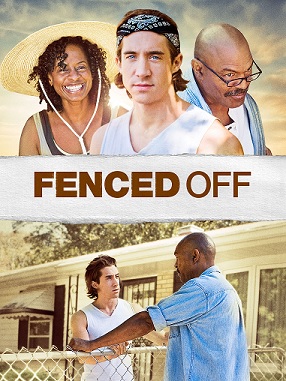
May Positivity: Fenced Off (dir by Brad Wise)


2011’s Fenced Off tells the story of Josh (Joshua Zirger) and George (Reggie Willis).

Josh is a young white social worker who has just moved onto a street where all of his neighbors are black.  His mother worries that Josh and his wife, Anne, are going to become crime statistics.  All of Josh’s friends tend to say things like, “Isn’t that neighborhood a little urban for you?”  Josh’s dumbass brother thinks that it would be a good idea to show up at Josh’s house wearing a durag and pouring a bottle of wine out on the driveway.  Josh is a nice guy but he sure does know a lot of dumb people.

Meanwhile, George (Reggie Willis) has lived on the block for 17 years.  He’s not at all happy when Josh shows up and he goes out of his way to avoid talking to his new white neighbors.  George’s best friend suggests that George might be a “bigot” but George denies it.  He says that he has a lot of reasons to not want to talk to Josh.  The fact that Josh is a dorky white guy is just one of them.

One week, while his wife is out of town, Josh’s life falls apart.  He offends a group of teenagers when he assumes that they’re approaching him because they want to mug him.  (Instead, they just want to return the $4.00 that he dropped while running.)  He freaks out when he hears a gunshot in the distance and, when George makes a joke about gangs in the area, Josh briefly worries that George might be a gang member.  Josh finds a white package on his property and automatically assumes that some drug dealers dropped a package of cocaine on his front lawn.  George grabs the package and reveals that it just a bag of  diapers.

It’s certainly a well-intentioned film and Josh and George are both portrayed as being complex characters who are sometimes right and sometimes wrong.  There’s actually a rather insightful scene in which Josh attempts to soothe things over with George by talking about how his family struggled financially when he was a kid just for George to call him out for assuming that George must be from a poor background.  When Josh argues that his best childhood friend was black, George wonders why every white guy claims to have had a black best friend who moved away in the 8th grade.  George has a point with both comments.  “I didn’t grow up rich” and “my best friend was/is black” are two of the most regularly repeated claims in white America today.

But, that said, Fenced Off doesn’t really work. Due to a lot of unnecesssary padding, the otherwise slight story unfolds a bit too slowly and the acting is often amateurish.  The actor who played Josh’s brother especially tended to overact.  (I’ve noticed that, when it comes to indie films like this one, it seems like there’s always at least one former theater kid who gets cast as a sidekick who proceeds to shout out all of his lines.)  Fenced Off has good intentions but the film is ultimately left down by its execution.

The Eric Roberts Collection: Joker’s Poltergeist (dir by Christopher S. Lind)


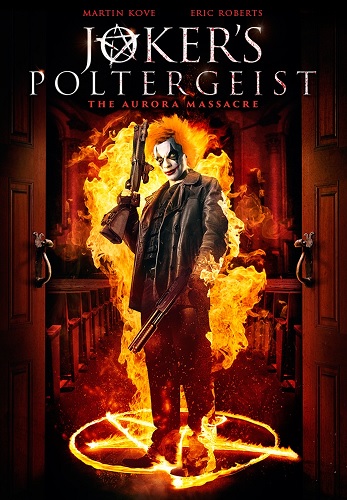
In 2020’s Joker’s Poltergeist (also known as Joker’s Wild), Eric Roberts plays James Jennings.  Jennings was a part-owner of the Palace Theater Chain until his partner, Rand Place (Martin Kove), forced him out and gave the business to his daughter, Aurora Place (Lacie Marie Meyer).  After apparently filming himself discussing how he is going to be starting a movement and how no one is ever going to forget him, James dresses up like a clown, goes down to the theater, and guns down the audience of a film called Joker’s Wild.  He also kills Rand before being shot himself by another theatergoer, William Remmington (Ari Boyland).

Clips of James’s final message are shown throughout Joker’s Poltergeist but we never actually see Roberts interacting with the rest of the cast.  (When James starts shooting people at the theater, he does so under a mask that he never removes and the end credits indicate that an actor other than Roberts played James in those scenes.)  This is obviously one of those films where Roberts filmed his scenes over the course of an hour or two, probably in his own office.  He certainly wasn’t on the set.  The same can be said of Martin Kove, who only appears as a part of a video message that Rand taped for Aurora before the shooting.  For that matter, Dustin Diamond appears for a few brief seconds and again, only as a part of a filmed message that Aurora watches.

Instead, the majority of the film takes place a year after the shooting.  Aurora is fighting to not only re-open her theater but to also keep concealed carry legal in her state.  She is now dating William and is a part of a support group made up of other survivors of the massacre.  From the moment Aurora reenters the old theater, she starts to have strange visions of killer clowns, demonic doctors, and sleazy politicians.  “You shouldn’t like guns….” the evil doctors chant at her.  At one point, she and her friends are trapped in the theater and being taunted by the spirits of the dead and, at another point, Aurora is suddenly in a hospital and being menaced by killer nurses.  Aurora struggles to figure out what is real and what is a dream, with the film suggesting that theater itself has become a separate dimension that is populated by James’s victims.  At its best, the film plays out like an unsettling nightmare, the type that doesn’t necessarily cause you to wake up screaming but which still remains fresh in your mind throughout the day.

On the one hand, the film is obviously based on the 2012 Dark Knight Rises shooting that it feels more than a little distasteful.  On the other hand, the film is intriguingly surreal and Lacie Marie Meyer gives a really good performance as Aurora.  (Yes, it would appear that she was named after Aurora, Colorado, which is one reason why the film feels so distasteful even though it has a handful of effective moments.)  The film does attempt to say something about guns, with Aurora being a proponent of the 2nd amendment and the gun-grabbing mayor and his wife being behind the efforts to tear down the theater.  It’s hard to really say which side the film comes down on, though I think it’s ultimately more pro-gun control than anything else.  That said, the film’s portrayal of the mayor and his wife as being vapid politicians who want to keep their own guns while taking away everyone else’s felt true to life.

Joker’s Poltergeist is ultimately a bit too icky and exploitive to really work but it still has its moments.  It’s a movie that keeps you guessing, if nothing else.

Previous Eric Roberts Films That We Have Reviewed:

  1. Star 80 (1983)
  2. Blood Red (1989)
  3. The Ambulance (1990)
  4. The Lost Capone (1990)
  5. Love, Cheat, & Steal (1993)
  6. Love Is A Gun (1994)
  7. Sensation (1994)
  8. Doctor Who (1996)
  9. Most Wanted (1997)
  10. Mr. Brightside (2004)
  11. Six: The Mark Unleased (2004)
  12. Hey You (2006)
  13. In The Blink of an Eye (2009)
  14. The Expendables (2010) 
  15. Sharktopus (2010)
  16. Deadline (2012)
  17. Miss Atomic Bomb (2012)
  18. Lovelace (2013)
  19. Self-Storage (2013)
  20. This Is Our Time (2013)
  21. Inherent Vice (2014)
  22. Road to the Open (2014)
  23. Rumors of War (2014)
  24. A Fatal Obsession (2015)
  25. Stalked By My Doctor (2015)
  26. Stalked By My Doctor: The Return (2016)
  27. The Wrong Roommate (2016)
  28. Stalked By My Doctor: Patient’s Revenge (2018)
  29. Monster Island (2019)
  30. Seven Deadly Sins (2019)
  31. Stalked By My Doctor: A Sleepwalker’s Nightmare (2019)
  32. The Wrong Mommy (2019)
  33. Free Lunch Express (2020)
  34. Her Deadly Groom (2020)
  35. Top Gunner (2020)
  36. Just What The Doctor Ordered (2021)
  37. Killer Advice (2021)
  38. The Poltergeist Diaries (2021)
  39. My Dinner With Eric (2022)

The TSL Grindhouse: Killing American Style (dir by Amir Shervan)


Filmed in 1988 but apparently not released until 1990, Killing American Style is a low-budget variation on The Desperate Hours.

The film opens with a ruthless criminal named Tony Stone (Robert Z’Dar, of Maniac Cop fame) leading a daring robbery of an ice cream truck depot.  All of the ice cream trucks have come back for the day and, when Tony and the boys show up, the money is still being counted.  Tony quickly takes control of the situation, intimidating everyone with both his weaponry and his amazing jawline.

Unfortunately, for Tony, the robbery is not as successful as he thought.  Yes, he gets away with a lot of money but the police quickly track him down to his home, where he’s in the process of having sex with his stepmother.  Tony is arrested and, in record time, sentenced to a maximum security prison.  (Seriously, the arrest, conviction, and sentencing all seem to happen on the same day.)  Tony is put on a prison bus but then the bus itself stops to help out a stranded motorist.  The motorist turns out to be Tony’s brother, Jesse (Bret Johnston).  In the resulting shootout, all of the guards are killed but Jesse is wounded.  Tony and his associate, Lynch (John Lynch …. hey, I wonder if that’s just coincidence?), take Jesse to a nearby ranch house.

The house belongs to John Morgan (Harold Diamond), who is a long-haired kickboxing champion.  When Tony arrives, John is out of the house and beating up the dad of a kid who bulled Morgan’s son, Brandon.  John is not happy to come home and discover Tony holding his entire family hostage.  For that matter, Morgan’s son isn’t amused by it either.

Because they are being pursued by a grim and determined police detective (played by Jim Brown …. yes, the same Jim Brown who starred in countless blaxploitation films in the 70s), Tony and his men do not want to run the risk of leaving the house to retrieve the loot from the robbery themselves.  So, they send Morgan out to pick up the suitcase from Tony’s stepmother.  I guess they assume that Morgan will be able to move around inconspicuously despite the fact that Morgan is a 6’1 kick boxer with long hair.  I mean, there’s no way that Morgan is going to be able to move around without being noticed by the cops.

Of course, before Morgan can get the money, he also has to get a doctor for Jesse.  Dr. Fuji (Joselito Rescober) agrees to help, despite the fact that he never seems to be quite sure what’s actually going on with all the angry men who keep pointing guns at each other.  When Dr. Fuji mentions that he wants to kill Tony “Japanese style,” Morgan promises that he’s going to kill Tony “American style.”  It’s never really made clear what the difference is between the two styles, though the American version does seem to involve a bit more kickboxing.

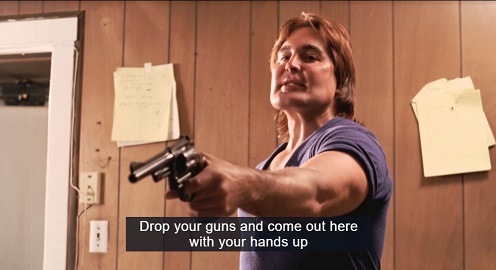
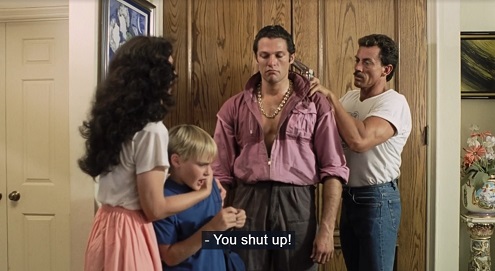
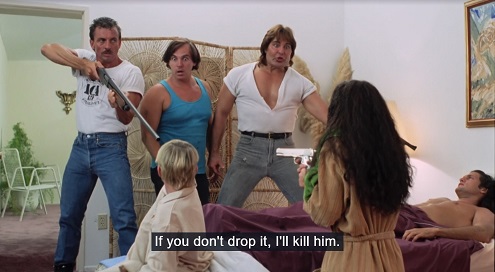
Anyway, this is an incredibly cheap and dumb movie but Robert Z’Dar seems like he’s having fun as Tony and …. well, to be honest, Robert Z’Dar is really the only reason to recommend this film.  He gives an enjoyably over-the-top performance, one that certainly contrasts with the more subdued performance of Harold Diamond.  (For his part, Diamond often seems to be struggling to stay awake.)  Hostage movies usually bore me to tears and this one had a lot of slow spots but it also had shots like the one below:

Eh.  Let’s call it even.

Forbidden Trails (1941, directed by Robert N. Bradbury)


Marshal Buck Roberts (Buck Jones) has finally retired after a long and a legendary career.  Two men who Buck arrested are not planning on allowing him to enjoy his retirement.  Having served their sentence for robbing a stagecoach, Fulton (Charles King) and Howard (Bud Osborne) are released from prison and head to Yucca City, Arizona.  They try to recruit their old partner, Jim Cramer (Dave O’Brien), into helping them get revenge on Buck but Cramer wants nothing to do with it.  He’s gone straight and is running his own general store with his fiancée, Mary (Christine McIntyre).  Cramer considers Buck to be a friend because Buck looked after Cramer’s children while Cramer was serving his sentence.

Fulton and Howard ambush Buck and nearly kill him.  With the help of his horse, Silver (of Lone Ranger fame), Buck is able to escape but he’s seriously injured.  His two fellow rough riders, Sandy Hopkins (Raymond Hatton) and Tim McCall (Tim McCoy), head down to Arizona to bring Fulton and Howard to justice.  (Sandy even rides away from his own wedding when he hears that Buck has been injured.)  While the Rough Riders search for Fulton and Howard, saloon owner Ed Nelson (Tris Coffin) works with the outlaws to steal a shipment of goods.

The third of the Rough Riders film, Forbidden Trails is memorable for acknowledging that the three Rough Riders were older than the most of the other contemporary western stars.  Buck Jones, Tim McCoy, and Raymond Hatton were all veteran stars who began their careers during the silent era and who transitioned to B-movies in the sound era.  At a time when their contemporaries were retiring, they were still appearing before the camera and riding the range.  Like the actor playing him, Buck Howard has reached the age when most people retire but he cannot escape his past.  Neither can Jim Cramer, who can’t live the law-abiding life that he desires as long as Fulton and Howard are free.  While Cramer has to escape from his former friends, Buck is lucky to have friends like McCall and Hopkins.  The movie showcases their loyalty and their friendship together and leaves no doubt that will never change, no matter how old the Rough Riders get.  Along with showcasing the friendship of its three stars, the movie is full of chases and gunfights.  The scene where Buck is ambushed is exiting and there’s also a good saloon shootout.  Jones and McCoy are as authentically western as ever.

Dave O’Brien and Christine McIntyre both appeared in the previous Rough Riders film but they’re playing different characters here.  Tris Coffin also played a similar crooked businessman in the first Rough Riders film, Arizona Bound.

Previous Rough Rider Reviews:
  1. Arizona Bound
  2. The Gunman From Bodie