The year is 1898 and the frontier is still a tough and harsh place where even horses can face the long arm of justice. Because a horse named Duke is viewed as being wild and uncontrollable, a judge is on the verge of sentencing him to death. Fortunately, John Drury (John Wayne) happens to be passing through town and he agrees to take the horse for himself. Duke is so grateful for being rescued that he not only allows Drury to ride him but he also looks out for Drury when Drury announces that he is going to go after a mysterious outlaw known as the Hawk.
Underneath his mask, the Hawk is actually Henry Simms (Frank Hagney), who everyone thinks is a trustworthy member of the community. When Simms and Drury go searching for the Hawk, Simms ties Drury to a tree and then frames Drury for murder. Fortunately, both Duke and Ruth Gaunt (Ruth Hall) are determined to clear Drury’s name and help him stop the Hawk’s reign of terror.
This was one of John Wayne’s early films, from the pre-Stagecoach days when he was getting small roles in A-list films but was spending most of his time appearing in in the type of B-westerns that were typically shown as the bottom part of a double bill. Though it is obvious that Wayne was still getting used to being in front of the camera when he made Ride Him, Cowboy, Wayne shows hints of the charisma that eventually led to John Ford casting him as the Ringo Kid in Stagecoach. The true star of the film is Duke, the horse that is smart enough to unsaddle another horse, untie the bound Drury, and keep the bad guy from escaping. Without Duke, John Drury would have spent the rest of his life tied to that tree and the Hawk would never have been stopped. Duke did such a good job that he was rewarded with a film career and he would go on to co-star with John Wayne in five more films.
I broke a few rules with Spider-Man: Across the Spider Verse last Thursday at my local theatre. It was near empty, so thankfully, I didn’t disrupt things too much. I became that guy down in front that needed to be shushed because he was either finger pointing at something or exclaimed “Oh crap!” a little too loud. 2023 has given us many great films so far, but right now, Spider-Man: Across the Spider Verse is the frontrunner for the any awards for animation. As the ending credits rolled, I took a deep breath & rose on shaky legs, an experience that only hits me when I’m up very high staring over a ledge or adrenaline kicks in. I lost myself in that movie.
Or perhaps I’m just growing old.
Either way, Across the Spider Verse takes everything great about the Academy Award Winner Into the Spider Verse and turns it up a notch. The best experience is to go in as blind as you can. There are no real spoilers here (or at least, only a few), though times are changing. Within 20 hours of the film’s release, we already had videos on YouTube to help understand the ending and tons of Tiktokers posting in-theatre video. There’s almost no real reason to ever have to watch a movie in the theatre or maybe even write about one, although the experience is worth it. I’m somewhat jaded, though writing about movies is still fun, at least. Across the Spider Verse and it’s message of doing one’s own thing is inspiring. This is less of a review and more of just my experience with the movie.
Across the Spider Verse continues the tale of Miles Morales (Shameik Moore, Dope), the Official Spider-Man for his universe. Where the first story helped to flesh out the notion that anyone can put on the mask and use their abilities, this film focuses on the weight of responsibility that comes with it. Miles is doing great for himself. He’s come into his own with his powers, and does good with the city. He’s okay with his grades, but his relationship with his parents Rio (Luna Lauren Velez, The First Purge) and Jefferson (Brian Tyree-Henry, Bullet Train) could use some help since he’s keeping his other identity a secret . When Miles is visited by Gwen (Hailee Steinfeld, Bumblebee) on a mission of her own, he finds himself thrust into an adventure he’s not quite ready for. I missed the main trailers for this, which does give away some major plot points. That could also be a factor in why I enjoyed it so much. Everything, or most of it was new to me.
Three new directors are taking on the mantle for this sequel. This time around we have Avatar: The Legend of Korra’s Joachim Dos Santos, Cloudy With a Chance of Meatballs Producer Justin K. Thompson (who also was a producer for Into the Spider Verse) and One Night In Miami’s Kemp Powers (who also wrote Disney/Pixar’s Academy Award Winner, Soul). The story still belongs to Christopher Miller and Phil Lord, who are best known for the 21 Jump Street , The Lego Movies and most recently, The Mitchells vs. The Machines. I still argue that Lord Miller’s version of Solo could have been magic, but that’s another story.
The story in Across the Spider Verse builds off of the original in a number of ways, and the cast helps to flesh things out. New additions include Oscar Isaac’s (Triple Frontier) Miguel O’Hara, a Spider Man charged with protecting the Spider Verse. We also have Issa Rae (HBO’s A Black Lady Sketch Show, Little) as the motorcycle riding Jessica Drew, Academy Award Winner Daniel Kaluuya (Judas and the Black Messiah) as a punk rock Spider-Man named Brodie. As everyone’s seen in the trailers, Jake Johnson (Tag) is back as Peter B. Parker with a new addition in his life. The film is peppered with other cast members and cameos – much like the party sequence in The Lego Batman Movie, but ultimately, it’s Moore and Steinfeld’s characters that carry the most weight. It felt great and nerve wracking to worry about the fates of these characters.
My cousin would be particularly happy to find that the film passes what she refers to as the “Supernatural” Test. From her point of view, when Bela Talbot was introduced to the series Supernatural, Sam and Dean Winchester were rendered stupid in her presence. It was almost as if they just discovered hunting monsters. Miles and Gwen make for a great pair while still managing to be amazing at what they do separately. This doesn’t mean there’s a lack of vulnerability and/or quirkiness between the two, but when it counts, they both manage to bring something to the table.
There’s love and creativity flowing through every frame of Across the Spider Verse. Much like the original, colors are vibrant, and you truly feel as if you’re moving through the pages of your favorite comic book (dots and all). There are tons of blink-and-you’ll-miss-them moments thoughout the movie that warrant a 2nd (or 3rd) viewing or at least a major scrub through when the film reaches streaming. The cities are full of life and the action sequences are wonderful to behold. I can’t begin to wonder how any of it looks on an IMAX screen.
Composer Daniel Pemberton (The Bad Guys) also deserves a lot of love, as well as as the additional side music. He builds on the original themes, while adding some new ones in the process. If anything, some of the music may have been too loud.
Overall, Spider-Man: Across the Spider Verse is a near perfect sequel that had me cheering on the heroes and biting my nails at the unfolding story.
It’s the little things that has Sony Pictures Animation and Spider-Man: Across the Spider Verse working some magic.
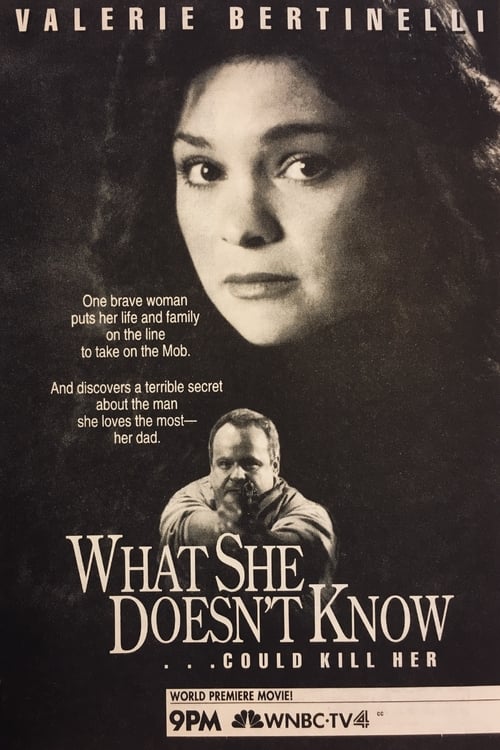
Welcome to Retro Television Reviews, a feature where we review some of our favorite and least favorite shows of the past! On Sundays, I will be reviewing the made-for-television movies that used to be a primetime mainstay. Today’s film is 1992’s What She Doesn’t Know! It can be viewed on YouTube!
Molly Kilcolin (Valerie Bertinelli) has graduated from law school!
In fact, she’s not only graduated from law school but she’s graduated from Harvard Law School, the most prestigious and most expensive law school out there. And she’s graduated at the top of her class. She’s the one who gets to give the speech at graduation, where she says that everything she knows about justice she learned from her father.
It’s really quite an accomplishment when you consider that Molly isn’t even from a rich family. She’s from a family of blue collar, New York City cops. Her father, Jack Kilcoin (George Dzundza), certainly never had a chance to go to Harvard. How did Molly even afford to go to Harvard? Apparently, her tuition was paid out of a trust fund that her aunt set up for her when she was a child. Seriously, that must have been a helluva trust fund because Harvard is not cheap or easy to get into.
Unfortunately, Molly disappoints her father when she tells him that she will not be accepting a job with a high class law firm but instead, she plans to work for the District Attorney’s office. Her fellow prosecutors are skeptical of her as well. Why does she want to go from Harvard to making next to no money in the trenches? Someone asks her if she has political ambitions but no, Molly just wants to do the right thing. She grew up in the neighborhood, don’t you know. She knows the people who are getting caught up in the Mafia’s schemes.
After Molly convinces a young mobster named Joey Mastinelli (Peter Dobson) to testify against his boss, she is shocked to discover that over half of the NYPD is on the Mob’s payroll. She is even more shocked to discover that her father is one of those dirty cops. For years, her father has been taking bribes and hiding the money away in Molly’s trust fund. Molly’s Harvard education was paid for by the Mafia!
As you can probably guess, family dinners are about to get awkward!
I usually enjoy films like What She Doesn’t Know because I’m always interested in the Mafia and there was a time when I briefly thought it might be fun to grow up and go to law school. I don’t know if I would have wanted to become a prosecutor, of course. Unlike Molly, I probably would have taken that ritzy law firm offer. The idea behind What She Doesn’t Know had potential but it was let down by the execution. Valerie Bertinelli tries hard but she’s just not convincing as a tough-as-nails Harvard grad. George Dzundza is a bit more believable as an aging New York cop but he’s still a bit on the dull side. (It would have been nice if this film could have been made a few years later, with Mira and Paul Sorvino in the lead roles.)
The film’s biggest flaw is that it portrays Molly as being so totally clueless about her father’s activities that it makes her seem to be impossibly naïve. I mean, did she never wonder how she could possibly afford to go to Harvard?
The 2013 film, Online, opens with a bunch of male co-workers going out for pizza. They’re celebrating the promotion of John Wild (Morgan Ayers), who has gone from being a preacher’s kid to being the youngest executive at their company. Before they dig into the pizza, one of the older men says a quick blessing over it….
Yes, it’s one of those films!
John has a well-paying job, a big house, and a beautiful and supportive wife named Mary (Kelsey Sanders). For most people, that would probably be enough to be happy for at least a few years but not for John! John finds himself thinking about his high school girlfriend, Adrianna (Esseri Holmes). John was in love with Adrianna, or at least he thought he was. But then, one day, she told him that her father’s company was forcing them to relocate to France. Both John and Adrianna were heart-broken.
(My family moved around a lot when I was growing up. Whenever my Dad got a new job, we moved to a new town and often a new state. Personally, I would happily trade that month in Tulsa for a few years in France.)
Despite the fact that he’s happily married and he knows that he shouldn’t, John decides to look Adrianna up online. He uses a site called SocialFriends.com because everyone knows better than to run the risk of getting sued by Facebook. (My favorite Facebook’s substitute was Degrassi‘s Facerange.) It turns out that Adrianna has not only returned to America but she also lives nearby!
Unfortunately, Adrianna is married now. Even more unfortunately, her husband is a French cosmetics heir named Pierre (Byron Herlong). Pierre spends all of his time complaining about Americans being materialistic and arrogant. Adrianna replies that, if it wasn’t for those “arrogant Americans,” he would “be speaking German right now.” Boom! You tell him, girl! Pierre doesn’t have a snarky reply for that!
John reaches out to Adrianna. They have dinner at a fancy restaurant. They talk. They catch up on old times. They eventually share one kiss. Of course, John doesn’t bother to tell his wife about any of this and instead, he just tells a lot of lies about having to work late. However, Mary’s not dumb. She knows that there is something her husband isn’t telling her, especially after the credit card bill comes in and she discovers how much he’s been spending on dinner. Mary’s mother, who has never gotten over being cheated on by her own husband, hires a private detective to follow John around.
John’s mistake, one of his co-workers explains, wasn’t just that he reached out to Adrianna and then lied to his wife about it. John’s mistake is that he allowed himself to dine alone with another woman to begin with!
Online is one of those low-budget indie films that really makes you appreciate directors and editors who know how to keep the action moving at a steady pace because the film was filled with so many slow spots that it was next to impossible for me to really focus on it. My mind kept wandering as I watched the film. I also got a bit annoyed that, while John was given a chance at redemption, Adrianna was not. If John was portrayed as being someone who, in the midst of a mid-like crisis, made a mistake than Adrianna was essentially portrayed as just being a brazen homewrecker. That said, the film did feature Pierre being put in his place and I appreciated that. Arrogant Americans for the win!
Welcome to Retro Television Reviews, a feature where we review some of our favorite and least favorite shows of the past! On Sundays, I will be reviewing the made-for-television movies that used to be a primetime mainstay. Today’s film is 1996’s Dark Angel! It can be viewed on YouTube!
Eric Roberts is Walter D’Arcangelo!
Walter was raised in the Louisiana foster system and eventually a series of Catholic orphanages. With a last name like D’Arcangenlo, it’s hard not to feel that Walter was destined to eventually become an eccentric homicide detective who does things his way and that’s exactly what happened. After starting his career in Baton Rouge, Walter has recently transferred to New Orleans. He arrives just in time to help investigate a series of gruesome murders, the victims of which are all women who cheated on their husbands. Walter even starts to get phone calls from someone who claims to be the murderer.
Unfortunately, for Walter, he’s somehow become a suspect in the murders. The rest of the homicide division doesn’t quite know what to make of the somewhat nervy Walter. When they discover that he went missing for several months while working in Baton Rouge, that makes him even more suspicious in the eyes of his new colleagues. Even while she personally is falling for him, Detective Anna St. Cyr (Ashley Crow) investigates Walter’s past and discovers that Walter does indeed have a link to the murders but not in a way that anyone was expecting.
Dark Angel was clearly intended to be a pilot for a weekly detective show. I imagine that Detective D’Arcangelo would have spent every week investigating a different murder in New Orleans. The show is full of moments that don’t have much to do with the case but which seem to have been included to make viewers say, “Wow, Eric Roberts is a really interesting guy! I wish he was starring in TV series that I could watch every Tuesday night!” Roberts does give a pretty good performance as Walter, hinting that, even if he isn’t a killer, the detective is still someone who could snap at any minute. Roberts plays Walter as if Walter himself is a little bit scared of the darkness that’s lurking inside of him. Walter’s an interesting character, though one gets the feeling that the demands of a weekly show would have led to the character becoming a bit less enigmatic if Dark Angel had been turned into a series.
The film takes place in New Orleans and it’s somewhat shameless about indulging in every “Big Easy” cliché possible. Yes, Walter listens to jazz. Yes, there are scenes of rain and shots where the steamy humidity seems to be rising from the French Quarter. Yes, Walter visits a voodoo priestess and yes, there’s even a scene set during Mardi Gras. Though there’s nothing unexpected about the show’s portrayal of New Orleans, the pilot does do a good job of capturing the city’s unique atmosphere. Eric Roberts and New Orleans feel like a perfect match,
Of course, Dark Angel did not become a series. Still, the pilot is entertaining and Eric Roberts gives another memorable performance. Dark Angel is a enjoyably macabre diversion.
Previous Eric Roberts Films That We Have Reviewed:
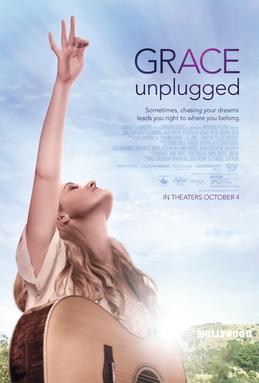
The 2013 film, Grace Unplugged, is about Grace Trey (AJ Michalka) and her father, Johnny Trey (James Denton). Back in the 80s, Johnny was a rock star who had one hit song and then basically wasted away with his career with drugs and alcohol. Eventually, he got clean and turned his back on rock stardom. Instead, he started writing and performing faith-based music. Like her father, Grace is musically talented but, at the age of 18, she is chafing at the idea of living under his strict rules. Though she plays in his band, she resents the fact that he won’t left her play the songs the way that she wants to.
One day, Johnny is visited by his former manager, Mossy Mostin (Kevin Pollack). (Never trust anyone named Mossy.) Mossy explains that, because it was performed by the winner of an Australian singing competition, Johnny’s one hit is suddenly popular again. Mossy wants Johnny to start recording again. “None of the religious stuff, obviously,” Mossy says. Johnny turns Mossy down but Grace, looking for an escape, records her own version of her father’s song and sends it to Mossy.
After she ditches youth group so that she can go to a movie and subsequently gets yelled at about it by her father, Grace decides to leave home and go to Mossy. Mossy offers to manage Grace. He also tells Grace that he will be totally taking over her image. Soon, Grace finds herself in a phony relationship with a vapid television star (Zane Holtz) and she’s told that she has to be willing to sex up her image if she’s going to be a star. Johnny continually asks her to come back home. Mossy continually pressures her to stop thinking and just listen to her management.
On the positive side, Grace Unplugged avoids the many of the cliches that one might normally expect to come along with a film like this. Grace, for instance, doesn’t get hooked on pills or any other drugs. At worse, she has too much to drink one night and then wakes up with a bad hangover. Grace may often feel confused about what she wants to do with her career and she doesn’t appreciate her father’s strict ways but she never becomes self-destructive or strung out or any of the other things that usually happen in movies like this. As well, Mossy is portrayed as being a bit insensitive but he’s not some sort of a mustache-twirling villain. In fact, the film is smart enough to understand that Grace does have a point about her father. Johnny is too over-protective and over-controlling, especially when it comes to her music. He fears that she’ll make the same mistakes that he did but the viewers never have any doubt that she’s not going to. Grace is often naïve and unsure of what she should do but she’s never portrayed as being weak and I appreciated that.
That said, the film ends on a bit of a heavy-handed note as it reveals itself to be yet another adaptation of the parable of the Prodigal Son. The film’s script conspires to only leave Grace with two options, which is either abandon her family or abandon stardom. In the end, the film’s conclusion feels just a little bit too simplistic.
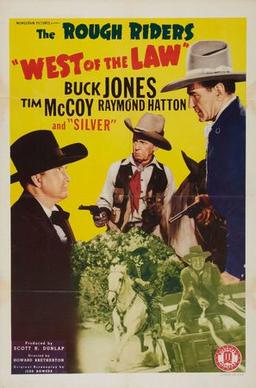
In the mining town of Gold Creek, an outlaw gang has been hijacking shipments of gold. Newspaper publisher Rufus Todd (Milburn Morante) has learned that the head of the gang is saloon owner Jim Rand (Harry Woods). Todd is planning on publishing a story identifying Rand as the outlaw leader on the front page of his newspaper so Rand’s secret partner, businessman John Corbett (Jack Daley) arranges for Rufus’s printing press to be blown up.
Rufus calls in his old friend, Marshal Buck Roberts (Buck Jones). Buck arrives in town with his fellow Rough Riders, Tim McCall (Tim McCoy) and Sandy Hopkins (Raymond Hatton). As usual, everyone is working undercover. Buck pretends to be an outlaw named Rocky Sanders. Tim claims to be a preacher who is not afraid to draw his gun and force everyone in the saloon to put down their drinks and listen while Rufus identifies Rand as being an outlaw. Sandy is the new undertaker and his coffins prove useful for smuggling in some much needed equipment.
The eighth Rough Riders film trods familiar ground. Once again, Buck is framed for a crime he didn’t commit and, as always, the villains are a businessman and a saloon owner. Still, I enjoyed seeing Tim to pretend to be a preacher and Sandy had some funny moments are the town’s garrulous undertaker. As always, McCoy, Roberts, and Hatton possessed an authentic western toughness that made them compelling heroes even in B-westerns like this one.
Since Tim McCoy reenlisted in the U.S. Army following Japan’s attack on Pearl Harbor, this was the last Rough Riders film to feature the original three riders and their chemistry and friendship are as strong as when the series first began. The movie ends with the promise that the Rough Riders would ride again but sadly, it was not to be. Though West of the Law doesn’t break any new ground, it’s still a decent finale for the original team.
Amityville Emanuelle is the latest film about the dumbass Amityville Haunting.
In order to watch any of the many films about the supposed haunted house in Amityville, New York, you need to be aware of two real-life events.
In 1974, a 23 year-old junkie named Ronald DeFeo, Jr. gunned down his entire family in their Amityville home. DeFeo first claimed that unknown gunmen had killed his family while he was out. He then changed his story and said that he killed his family but he did it because he knew they were plotting to kill him. He then suggested that the whole thing was a mafia hit. He then moved on to claiming that his sister was the one who actually killed everyone. And, finally, he claimed that he had been possessed by demonic spirits.
One year later, the Lutz family moved into the Amityville House. After a month, the Lutzes left the house and George Lutz claimed that the house was haunted and that the family had been forced to flee for their lives. Thanks to a book and a few movies based on that book, the Lutzes made some money and eventually ended up suing a lot of other people in order to make even more money. Subsequent owners of the house have never reported anything strange happening while living in the house, other than strangers stopping by to view the supposedly haunted structure.
So, we can either believe that Ronald DeFeo was a junkie who killed his own estranged family or we can accept that the Devil took one look at Ronald DeFeo shooting up heroin and decided, “I’m tired of possessing the innocent and the naïve. I’m going to possess someone who is already so screwed up that no one will even notice that he’s been possessed. That’ll show ’em!”
And we can either believe that a bunch of demons chased George and Kathryn Lutz from their home or we can believe that the Lutzes looked at the success of books and films like The Exorcist and The Omen and they decided that they might as well cash in as well.
Amityville Emanuelle accepts, from the start, the everything was due to the paranormal, which is fine. It’s a movie and Occam’s razor goes out the window when it comes to the movies. George Lutz’s daughter, Laura (Dawn Church), moves into a new house and is soon visited by a strange woman who claims that she is delivering some of George’s belongings. Laura discovers that George owned an urn that was full of Ronald DeFeo’s ashes. Apparently, George and DeFeo had a psychic connection and George, who is insinuated to have been some sort of an occultist, knew that DeFeo was going to murder his family before he even did it.
(Wow, those are some pretty mean things to say about the late George Lutz, who was a real person and not really around to defend himself. Then again, George Lutz would be totally forgotten today if not for the fact that he made up a bunch of stuff about a haunted house so really, Lutz being portrayed as an occultist feels like karma.)
Laura soon finds herself acting in strange ways, picking up random men at bars and then barely noticing when they’re subsequently killed by someone who looks just like Ronald DeFeo.
Meanwhile, Ronald DeFeo’s son, Gordon (Shane Ryan-Reid, himself a director of transgressive films), makes the mistake of using a Ouija Board with his friends and he’s soon having visions of his father killing people.
(Now, I know that some of you are now saying, “Where does Emanuelle fit in with this?” because, after all, the symbol of sexual freedom and experimentation is namechecked in the film’s title. Well, Emanuelle really doesn’t fit into it, unless you include the scene where Laura goes to a bar and picks up two men. But those watching this film because they’re expecting it to be some sort of soft-core haunted house flick are going to be disappointed.)
Amityville Emanuelle is a low-budget and rather dumb film but it is at least partially redeemed by the fact that it doesn’t appear to be taking itself seriously at all and there’s no attempt to convince the viewer that they’re somehow watching anything that could be based on fact. There’s not much in the way of suspense and both the gore and the sex are rather tame but there is a medium (played by Saint Heart) whose generally annoyed attitude is occasionally fun to watch. The Amityville Haunting has always been a particularly stupid story and the cynicism of the majority of people who continue to try to sell it as being fact has always been more than a bit icky so, at this point, Amityville Emanuelle is kind of what the legend deserves.
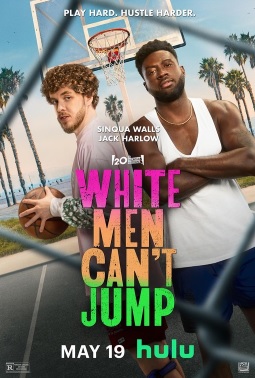
Hulu’s White Men Can’t Jump is the story of two aging basketball players who have never lived up to their potential but who have yet to totally give up on their dreams.
Even when he was in high school, Kamal Allen (Sinqua Walls) was considered to be one of the best basketball players in the country. A lot of that was due to how he was raised by his father, Benji (Lance Reddick, giving a strong performance in one of his final roles). Benji was a basketball star himself and, as we see in several flashbacks, he trained Kamal to be the best. Benji was so obsessed with turning Kamal into a great player that he even drove away Kamal’s mother. Benji taught Kamal all that he needed to know about playing basketball but not enough about how to survive once his playing days were over. Unfortunately, after Benji was diagnosed with MS, Kamal lost his concentration. When he responded to being taunted during a game by going into the stands and punching a guy out, Kamal ended up getting arrested and he also ended up losing his chance of entering the NBA.
Jeremy (Jack Harlow) was a college basketball star who blew out his knee and lost his chance to go pro. He makes his living hustling other basketball players, knowing that they’ll assume that he can’t shoot because he’s white. He also sells highly suspicious health tonics and he spends a lot of time meditating. Though he can barely walk without taking his pain pills first, Jeremy still wants to make the NBA. When he hears that stem cell treatment might help his knee, Jeremy starts to scheme to win the money to cover the cost.
Together, Jeremy and Kamal hustle other players, make some money, and become unlikely friends.
It took me three days to get through White Men Can’t Jump, largely because the film itself was so boring that I struggled to actually pay attention to it for more than a few minutes at a time. This film is a remake of a 1992 film that starred Wesley Snipes and Woody Harrelson. I have not seen the original White Men Can’t Jump but I have seen enough films featuring both Snipes and Harrelson to know that they are both talented and charismatic actors who both have strong comedic timing. In short, they don’t have much in common with the two leads of the new version of White Men Can’t Jump. In the role of Kamal, Sinqua Walls is solid but dull. Walls is convincing but he’s never particularly interesting. Making his film debut in the role of Jeremy, rapper Jack Harlow is so incredibly obnoxious that I found myself wanting to throw something at the screen whenever he popped up. The film repeatedly emphasizes that no one wants to play with Jeremy because he’s white but I think it’s equally probable that they’re just reacting to the fact that he is an incredibly annoying human being. Director Calmatic does all the usual choppy editing and slow-motion dunking that most viewers have come to expect from movies about basketball but with little chemistry between the leads and a script that tends to repeat the same jokes over and over again, this film never takes flight.
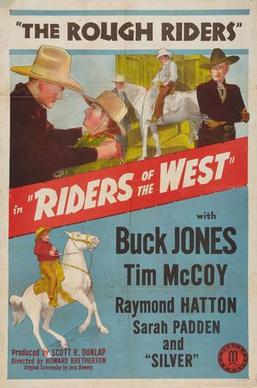
In a frontier town, a gang of rustlers are stealing cattle as a part of a plot to force cash-strapped ranchers to take out exorbitant mortgages on their ranches. Ma Turner (Sarah Padden) summons her old friend, Marshal Buck Roberts (Buck Jones), to come to town and take on the rustlers. When the town’s corrupt banker is murdered and Ma Turner’s son, Steve (Dennis Moore), is framed for the crime, Roberts calls in his fellow Rough Riders, Tim McCall (Tim McCoy) and Sandy Hopkins (Raymond Hatton), to help him take down the gang.
In many ways, this is a familiar Rough Riders film, right down to the main bad guy being the owner of the town’s saloon and Charles King showing up as a member of the gang. What sets it apart from the film that came before it is that, this time, Tim pretends to be an outlaw while Buck sets himself up as the new law in town. Tim takes on the identity of Tim Steele, a sarsaparilla-drinking ne’er do well who has just gotten out of prison. Jones and McCoy both seem to enjoy getting to switch their typical roles. As for Sandy Hopkins, he goes undercover as a peddler of snake oil and provides the comic relief. Riders of the West is a typical B-western but the chemistry between the three leads continues to shine through.
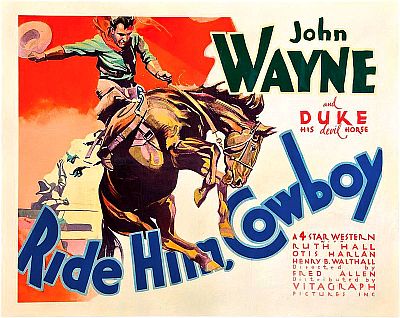 The year is 1898 and the frontier is still a tough and harsh place where even horses can face the long arm of justice. Because a horse named Duke is viewed as being wild and uncontrollable, a judge is on the verge of sentencing him to death. Fortunately, John Drury (John Wayne) happens to be passing through town and he agrees to take the horse for himself. Duke is so grateful for being rescued that he not only allows Drury to ride him but he also looks out for Drury when Drury announces that he is going to go after a mysterious outlaw known as the Hawk.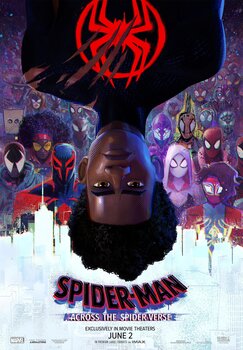


 Through the Shattered Lens