Film Review: Your Place or Mine (dir by Aline Brosh McKenna)


Your Place or Mine asks the eternal question: Can a woman and man be best friends without also being lovers?

The answer to that is that of course they can.  It happens all the time.  The more important question is whether or not to physically attractive people can be friends without eventually falling love.  The answer there is of course not.  Being the most attractive person in your social circle means that you eventually have no choice but to pursue a relationship with the second most attractive person around.  That’s just the way it works.

Your Place or Mine opens in 2003, with two attractive 20 somethings named Peter and Debbie having sex for the first and what they initially believe will be the final time.  The action than jumps forward to 2023.  Peter (Ashton Kutcher) lives in New York City and has seemingly given up his dream of being a writer.  Instead, he makes a lot of money doing …. well, I’m not really sure what Peter’s job was.  It had something to do with banking and it allowed him to afford a really big apartment.  Meanwhile, Debbie (Reese Witherspoon) lives in Los Angeles.  Recently divorced, she is the overprotective mother of 13 year-old Jack (Wesley Kimmel) and she is a teacher.  Apparently she’s not supposed to be as rich as Jack but, for a teacher, she has a surprisingly big house.  She also has eccentric neighbor, played by Steve Zahn and an eccentric co-worker played by Tig Notaro.  Everyone was so eccentric that it made me miss the days when the lockdowns gave me an excuse not to talk to anyone.

Peter and Debbie are still best friends, even though they haven’t actually been in the same room together since 2008.  Still, that’s about to change.  Debbie’s coming to New York so that she can complete an accounting program and get a better job.  (Ha!  Take that, teachers!)  However, when her eccentric babysitter is cast in a movie, it looks like Debbie will have to cancel because there won’t be anyone around to keep Jack from accidentally eating something with nuts in it.  Peter, who has recently been dumped by his eccentric girlfriend and who is having a bit of a midlife crisis, volunteers to come to Los Angeles to look after Jack while Debbie goes to New York and stays in his apartment while taking her super-exciting accounting class.

Okay, let’s pause while I catch my breath.  This is one of those comedies where it takes way too long to set up the central premise.  Sometimes, it’s best to keep things simple.

Anyway, Peter bonds with Jack and helps him to find some confidence.  Living in Debbie’s house, Peter realizes that he has always loved Debbie.  Meanwhile, Debbie goes to New York, bonds with Peter’s eccentric ex-girlfriend (Zoe Chao), and discovers that Peter has written a novel!  Debbie takes it upon herself to read the novel.  She takes manuscript out of Peter’s apartment and is seen reading it at various New York locations.  I found myself cringing as I worried that a sudden gust of wind would blow the pages away or maybe someone would spill coffee on it.  (For all of Debbie’s happiness to discover that Peter is still writing, she’s not particularly careful with his manuscript.)  Without talking to Peter, Debbie gives the manuscript to an eccentric publisher named Theo Martin (Jesse Williams) and explains that the story is about a 13 year-old boy who can’t go out in the sun.  It sounds like an extremely dreary read but Theo is impressed with both the manuscript and with Debbie.

I usually enjoy romantic comedies and I like Reese Whitherspoon and I’m coming around on accepting the idea of Ashton Kutcher being a movie star (especially after his excellent performance in Vengeance) so I was really hoping that I would enjoy Your Place or Mine.  Unfortunately, the film itself suffered from what I call the Apatow Syndrome, in that every character had to be quirky, every joke had to be repeated ad nauseum, and there was a deliberate awkwardness to the dialogue that got old pretty quickly.  As individuals, Witherspoon and Kutcher were likable but I never really bought them as lifelong friends, much less a romantic couple.  They just didn’t have the right spark.  Unfortunately, Your Place or Mine just didn’t work for me.

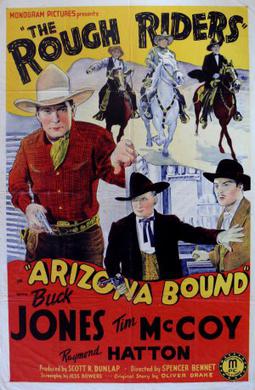
Arizona Bound (1941, directed by Spencer Gordon Bennett)


The town of Mesa City, Arizona has a problem.  A gang of thieves are holding up stagecoaches and shooting the drivers.  Stagecoach lines are removing Mesa City from their list of destinations and the town is having to depend on the services of corrupt businessman Steve Taggert (Tristram Coffin).  After the death of her father and the shooting of her boyfriend, Ruth Masters (Launa Walters) takes over her family’s stagecoach line and is determined to keep it running.  But who will drive her coaches?

Cattle salesman and former marshal Buck Roberts (Buck Jones) rides into town and volunteers to drive the next stagecoach.  Because the stagecoach is carrying a gold shipment, everyone suspects that it will probably be targeted by the thieves.  Volunteering to help Buck is another cattleman named Sandy Hopkins (Raymond Hatton) and the town’s newly arrived preacher, Parson McCall (Tim McCoy).  McCall has already run afoul Taggert because of his crusade to close down Taggert’s saloon.  What Taggert and the other citizens of Mesa City don’t know is that Buck, Hopkins, and McCall are the Rough Riders, undercover government agents who have a plan to both protect the gold and to reveal the identities of the culprits.

Arizona Bound was the first of seven films about the Rough Riders.  While the plots were never anything special, these films stood out because they paired Buck Jones and Tim McCoy, two B-western mainstays who had been active since the silent era and who both brought a good deal of authentic toughness to their performances.  In Arizona Bound, both Jones and McCoy don’t hesitate to show that they’re not going to put up with any nonsense from Taggert and his men.  There’s a great scene where McCoy proves that even a preacher can outdraw and intimidate an entire saloon full of roughnecks.  Jones, McCoy, and Hatton made a good team, though world events would come together to prevent the Rough Riders from having too many adventures.  After the U.S. entered World War II, McCoy volunteered for active duty.  Meanwhile, Jones died in a tragic night club fire.  Raymond Hatton continued to play Sandy Hopkins in other films but none with the original Rough Riders.

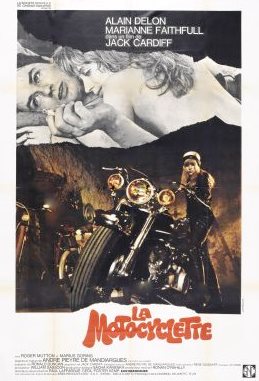
Film Review: The Girl On A Motorcycle (dir by Jack Cardiff)


Who would have guessed that a film from 1968, starring Marianne Faithfull and Alain Delon, would be a little bit pretentious?  I’m as shocked, as anyone.

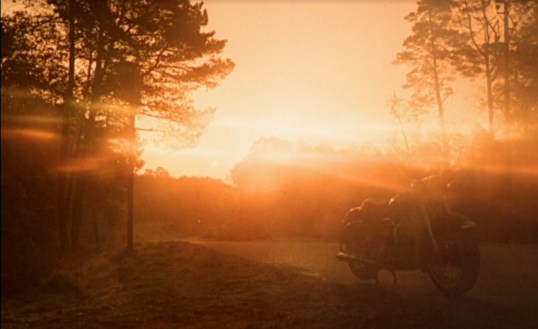
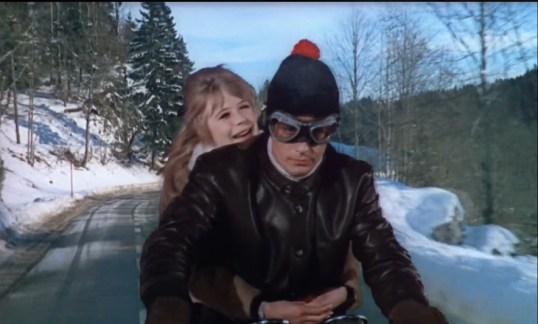
The Girl On A Motorcycle is Rebecca (Marianne Faithfull), the wife of Raymond (Roger Mutton).  One day, Rebecca wakes up, puts on a black leather jumpsuit, and gets on her motorcycle.  Abandoning her husband and her home, she rides through France and eventually reaches Germany.  Along the way, she thinks about how the motorcycle represents freedom and how no one is truly free unless they’re doing what they want to do.  We hear her inner monologue and it’s hard not to notice that, for someone riding a motorcycle across two countries, she often doesn’t seem to be paying that much attention to the road.  Rebecca has more important things to think about, like free love and Vietnam.  She watches as a transport of soldiers drive past her and she silently tells them not to look at her.  She drives through a city and starts to laugh while shouting “Bastard!” at the top of her lungs.  Pedestrians, all of whom are unhappy and middle-aged, stare at her in shock.

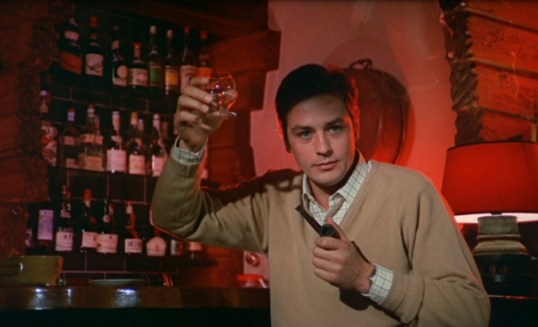
Along the way, Rebecca thinks about her life.  She’s married to Roger, who is a mild-mannered teacher who is so ridiculed by his students that even the local gas station attendant mentions how little respect anyone has for him.  However, Rebecca is haunted by memories of Daniel (Alain Delon), who is very, very French.

How French? This French.

Rebecca first met Daniel while working in her father’s bookstore and they had a passionate affair, despite the fact that Rebecca was already engaged to boring old Raymond.  Daniel even taught her how to ride a motorcycle.  When Rebecca got married, Daniel sent her the motorcycle that she is now riding as a wedding gift.  Rebecca is racing through Germany to be reunited Daniel, though it’s never quite clear if she’s truly leaving her husband or if she just wants to have a quick tryst before returning home.  Will Rebecca make it or will the unpredictable whims of fate intervene?

The Girl on a Motorcycle was directed by Jack Cardiff, a veteran cinematographer who first found acclaim working with directors like Michael Powell, Alfred Hitchcock, and John Huston.  Not surprisingly, the film is full of striking shots.  Unfortunately, Cardiff was 54 when he directed The Girl On A Motorcycle and he had been involved in the film industry since he was a child.  Watching the film, one gets the feeling that Cardiff was trying a bit too had to appeal to a young counterculture audience that he didn’t really have much of a natural affinity for.  As such, Cardiff drags out every psychedelic trick in the book.  Do you want excessive use of the zoom lens, ludicrously skewed camera angles, pointlessly surreal flashbacks, portentous narration, extreme close-ups, retina-burning solarization effects, and an ending that feels like it was stolen from Godard?  The Girl On A Motorcycle has all of them!  For every impressive shot of Rebecca riding on her motorcycle, there are several more shots that feel as if they were filmed in migrainevision.

There’s also quite a few shots that make remarkably poor use of rear projection.

The Girl On A Motorcycle is definitely a film of its time.  To give credit where credit is due, Alain Delon is handsome and charismatic as the enigmatic Daniel.  The viewer gets the feeling that Rebecca is probably idealizing him and assuming that he has more depth than he actually does but it’s still easy to understand why she would not be able to resist the temptation.  Marianne Faithfull seems a bit lost as Rebecca.  She smiles a lot and she laughs a lot but her inner monologue is flatly delivered and, as a result, the character comes across as being vapid.  The ideal Rebecca probably would have been a young Helen Mirren.

As it is, The Girl On A Motorcycle is a time capsule of the 60s aesthetic (albeit an aesthetic translated through the lens of a director who seems to be trying too hard to remain relevant).  Due to a few flashes of nudity and some sex scenes that are so psychedelic that they’re nearly impossible to watch, Girl On A Motorcycle was the first film to be slapped with an X rating in the United States.  It seems rather tame today.

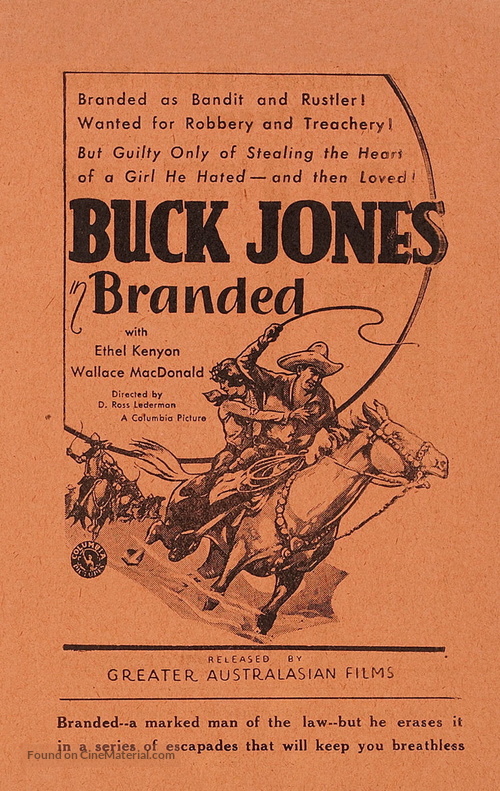
Branded (1931, directed by D. Ross Lederman)


Tom Dale (Buck Jones) and his employee, Swede (John Oscar), come across a stage coach robbery.  Though the robber gets away, Tom and Swede recover a stolen mailbag.  Tom finds a letter to himself and it is revealed that his real name is Cuthbert Chauncey Dale.  After explaining that he goes by Tom because that was his uncle’s name, Tom says that he’ll shoot anyone who calls him Cuthbert and he’s the movie’s hero!

When the local posse comes upon Tom and Swede, they accuse them of having robbed the stagecoach.  Tom and Swede manage to escape from jail during the dead of night and ride to a neighboring town, where Tom has inherited his uncle’s ranch.  Tom and Swede work on the ranch, building fences and branding cattle.  Tom starts to fall for Lou Preston (Ethel Kenyon), earing him the enmity of Joe Moore (Albert J. Smith), who is also in love with Lou.  Joe frames Tom and Swede for cattle rustling.  Tom and Swede attempt to clear their names with the help of their new friend, the same man (Wallace MacDonald) who previously robbed the stage coach!

This short but complicated B-western has its share of gunfights and chases on horseback but it still has some slow spots.  There are a lot of scenes of Tom and Swede working around the ranch.  When you’re ready for another gunfight, Tom and Swede have to go work on the fence.  Still, fans of early westerns will probably enjoy Branded.  Wallace MacDonald is a likable rouge as the Stagecoach Robber and the movie ends on a little more of a serious note than the typical poverty row western.  Buck Jones was an authentic cowboy before he went into the movies and he’s believable whenever he’s riding a horse, shooting a gun, or just walking around his ranch.  Just don’t call him Cuthbert!

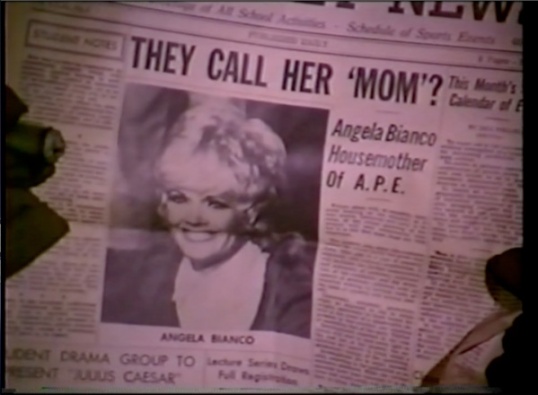
Retro Television Reviews: Call Her Mom (dir by Jerry Paris)


Welcome to Retro Television Reviews, a feature where we review some of our favorite and least favorite shows of the past!  On Sundays, I will be reviewing the made-for-television movies that used to be a primetime mainstay.  Today’s film is 1972’s Call Her Mom!  It  can be viewed on YouTube!

While all of the other college campuses across America are in turmoil with protests and student walk-outs, Beardsley College remains at peace.  It’s a place where the 50s never ended.  Everyone is perfectly behaved.  No one is into politics.  Fraternity Row is a peaceful place, largely due to the elderly housemothers who keep the frats in order.

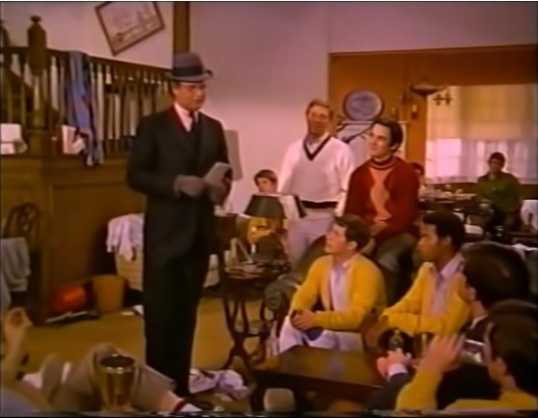
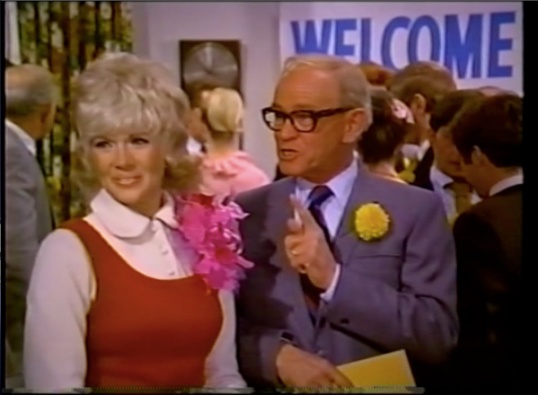
Except for Alpha Phi Epsilon, that is.  The A.P.E. House is known for being the wildest house on campus and every housemother that they get walks out on them.  If they can’t find a new housemother, they’ll lose their charter.  President Chester Hardgrove (Van Johnson) and Assistant Dean Walden (Charles Nelson Reilly) are practically salivating at the possibility of kicking A.P.E. off of campus.  And who can blame them?  Take a look at how wild these guys are:

These guys are crazy!  They wear yellow sweaters!  They play tennis indoors!  Occasionally, they leave a towel or two hanging on the bannister.  A.P.E. is out of control!

A.P.E. tries to find a new housemother but the word is out that A.P.E. is no good.  Not a single elderly woman in town is willing to work with them.  However, when the members of the frat realize that there’s not actually an age requirement for housemothers, they offer the job to Angie Bianco (Connie Stevens), who works as a waitress at the local pizza place.  Angie accepts the job.

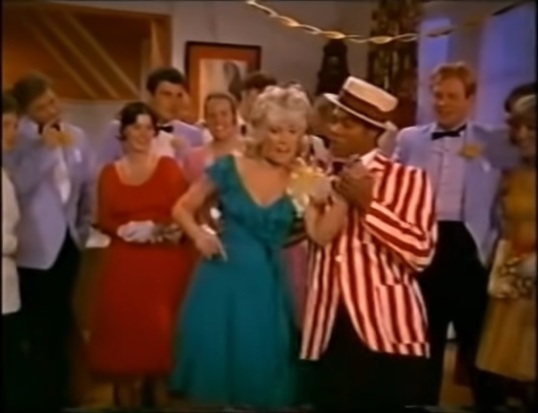
It’s a scandal!  All of the older folks say that Angie is too young and too attractive to be trusted as the housemother for A.P.E.  Angie, however, proves herself to be a lot tougher than anyone was expecting.  The members of the frat soon come to respect her.  However, President Hardgrove is determined to force her out of the job and off of the campus.  Rumor has it that she’s encouraging the A.P.E. brothers to hold rollicking 20s style parties and she’s also allowing them to dance!

Check out this decadence!

The attempts to force Angie out of her job makes national news.  Soon, Angie and the frat brothers are featured in Time Magazine.  President Hardgrove points out that he’s never appeared in Time Magazine.  While an group of middle-aged women march outside of the A.P.E. House and demand that Angie be fired, the younger female students rally to Angie’s side.  Suddenly, Beardsley College is home to a protest!  (The protest is about as a wild as the 20s dance party at the A.P.E. House.)  President Hardgrove realizes that keeping Angie at the A.P.E. House will actually lead to the college getting more donations but Angie has decided that she has to quit.  Not only is she in love with A.P.E.’s sponsor, Prof. Calder (Jim Hutton), but a member of the fraternity has decided that he’s in love with her and he’s going to drop out of school to be with her.

Can A.P.E. convince Angie to come back?

Call Her Mom is a silly movie that was obviously meant to serve as a pilot for a television show, one in which I imagine Angie would have solved the fraternity’s problems on a weekly basis.  Seen today, it’s mostly memorable for its thoroughly innocent portrayal of college life.  A.P.E. House is the wildest frat on campus but no one is ever seen drinking.  Certainly no one is indulging in anything stronger than perhaps a Coke or a Pepsi.  I imagine this show was an accurate portrayal of what most parents hoped college was like.  That said, Connie Stevens and Jim Hutton made for a cute couple.  Hopefully, there were many good times in the future for the residents of A.P.E. House.

Film Review: The Mother (dir by Niki Caro)


Jennifer Lopez is …. THE MOTHER!

The Mother is a professional assassin, a former U.S. military operative who has spent the last 12 years isolated in Alaska, hiding out from two of her former associates, drug lord Hector Alvarez (Gael Garcia Bernal) and mercenary Adrian Lovell (Joseph Fiennes).  In the past, The Mother went to the FBI when she discovered that Alvarez and Lovell were involved in human trafficking.  Lovell reacted by killing a bunch of FBI agent and attempting to kill The Mother’s unborn child by stabbing The Mother in the belly.  (I actually gasped in shock at this act of violence.)  Both The Mother and her daughter, Zoe, survived.

The Mother left her daughter to be raised by an FBI agent named William Cruise (Omari Hardwick).  But, twelve years later, Zoe (Lucy Paez) is kidnapped and The Mother has to come out of hiding to rescue her.  It’s a mission that will lead The Mother and Cruise to Cuba and which will eventually bring Lovell and his men back to Alaska.  Along the way, The Mother learns how to forgive herself and to how to open up emotionally and Zoe learns why her mother abandoned her so many years ago.  Zoe also learns that nature can be ruthless and unforgiving.

The Mother isn’t really a bad film as much as it’s just a very predictable film.  It’s very much from the Taken school of cinematic action, with a parent doing whatever is necessary to protect their children.  This is another one of those films where everyone tends to be very grim and there’s a lot of scenes of people coldly threatening each other.  The film opens with the FBI interrogating The Mother and the dialogue was so familiar and the attitudes so reminiscent of every single action film and television show that I’ve seen recently that I had to take a few minutes to remember which film I was watching.  Even The Mother’s eventual trip to snowy Alaska caused me to have flashbacks to both Those Who Wish Me Dead and the recent Dexter revival.  Oddly enough, it also reminded me of Sound of Metal, if just because The Mother‘s one friend in Alaska was played by Paul Raci.  It was nice to see Raci again.  With his haunted eyes and his kindly voice, he’s the type of guardian angel that everyone would want to have.  But again, it just all felt so familiar.

Jennifer Lopez gives a convincing performance as The Mother.  Though the film may be predictable, her commitment to protecting her daughter no matter what was undeniably moving and she and Lucy Paez has a believable mother/daughter relationship.  That said, Jennifer Lopez is always at her best when she’s allowed to play a character with a sense of playfulness and there’s little of that to be found in The Mother.  It’s a grim film about serious characters and it hits all of the expected beats with efficiency but not much more.  When it comes to 2023 Jennifer Lopez films, I still prefer the appealingly silly Shotgun Wedding.

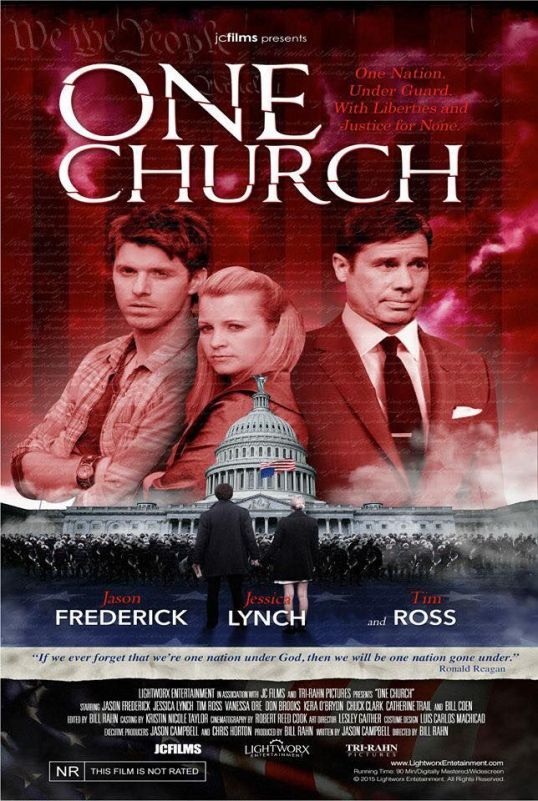
May Positivity: One Church (dir by Bill Rahn)


Originally released in 2016, this low-budget political/religious thriller opens with a rather unsettling scene.  An obviously disturbed woman wanders down a suburban street, loudly singing This Little Light of Mine.  She stops in front of one house and starts to screech the lyrics, like a banshee predicting future doom.

The house is the home of Congressman Neil Barlow (Don Brooks) and both he and his wife Catherine (Kera O’Bryan) are about to discover that their teenage daughter has been taken away.  She has left home and she is now living with a religious communal cult.  When the FBI approaches the cult’s headquarters, all of the members drink poison in a mass suicide.  Neil Barlow becomes determined to one day become President so that he can stamp out the scourge of religious extremism.

18 years later, Neil Barlow is president and he’s just announced the creation of the Department of Religious Freedom.  Televangelist Randy Mason (Tim Ross) is put in charge of the Department but it turns out that this is just the beginning of Barlow’s plan to change America.  Barlow soon announces that all religions are going to come together under the umbrella of one state-run church.  Across America, people watch the press conference and say things like, “This will cut down on division,” and “We all believe the same thing anyways.”  The Department of Religious Freedom proceeds to outlaw all of the old religious texts and requires that all religious leaders preach the same pre-approved sermon.  Failure to do so can lead to being sent to a reeducation camp.

Randy’s brother, Jake Mason (Jason Frederick), knows a little about what has happened but not everything.  He’s been down in Mexico, ministering to a small village.  When Jake returns to America, he discovers that it’s no longer the country that he once thought it was.  Along with his girlfriend, Beth Barlow (Jessica Lynch), Jake tries to stand up against the One Church.  Beth also happens to be the President’s daughter and she, more than anyone, understands the anger that is fueling Neil Barlow’s actions.

I have an admitted weakness for low-budget, conspiracy-themed movies and One Church is definitely qualifies.  Say what you will about the film’s plot and themes, it’s hard not to appreciate a film in which the President gives a major, history-changing press conference in what appears to be a high school auditorium.  The offices of a major news network are represented by a small room that has several televisions propped up against the wall.  The White House dining room is about the same size as my dining room.  The future president of the United States lives in a house that’s about the size of the house where I live.  Suddenly, I’m feeling very important!

As for the film itself, it actually makes the perfect case for maintaining the separation of Church and State.  As soon as the State gets involved in religion, it starts using the Church as a way to control the citizens and to make itself more powerful.  Preachers like Randy Mason are easily corrupted once they’re in partnership with the government.  As for the citizens, they’re portrayed as being eager to be ordered about, which is perhaps the most realistic thing about One Church.  Beth is played by the same Jessica Lynch who was, in 2003, captured by and subsequently rescued from the Taliban.  She has appeared in a few films over the past few years, usually in small roles.  She’s actually a surprisingly good actress and she certainly gives the best performance in One Church.

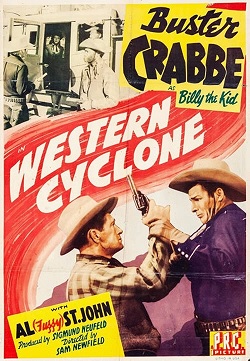
Western Cyclone (1943, directed by Sam Newfield)


Feeling that the old west has become a dangerous place, law-abiding gunslinger Billy the Kid (Buster Crabbe) fakes a stagecoach robbery and pretends to kidnap the governor’s daughter, all to show him that the west needs more law enforcers.  The governor is so impressed by Billy’s ruse that he agrees to stand tough on crime.  This upsets Dirk Randall (Glenn Strange, who also played Frankenstein’s monster is some of the later Universal horror films), a businessman who has been funding the criminals in order to make the governor look weak so that Randall could defeat him in the next election.

Randall orders one of his men to pull a gun on Billy while Billy is leaving the local saloon.  Billy pulls and fires his own gun in self-defense but it’s Randall who actually kills the man by shooting him in the back and then running off in the confusion.  Because the man was shot in the back, Billy is accused of murder, arrested, and sentenced to death in record time.  With Billy in jail, it falls to his comic relief sidekick, Fuzzy Jones (Al St. John), to prove that Billy didn’t actually fire the shot that killed the man.

By most accounts, Billy the Kid was a nasty piece of work who would kill anyone who look at him in the wrong way but, in the 30s, the character was the hero of a series of 42 Westerns that all featured him as a hero and a valued member of the community.  (Originally, Bob Steele played Billy.  Buster Crabbe took over the role with the seventh film.)  Western Cyclone was the 17th Billy the Kid film and, as long as you’re not a stickler for historical accuracy, it’s an entertaining B-western.  The plot is formulaic but Crabbe was a good hero, Strange was a diabolical villain, and, for once, Al St. John got to play an important role in resolving the film’s story.  Fuzzy Jones did some impressive detective work.  The real Billy the Kid probably could have used someone like Fuzzy in his corner.

Film Review: Darkest of Lies (dir by Kelly Schwarze)


Travis (Christopher Brown) is a military veteran who is struggling with both PTSD and an addiction to pills.  After some unspecified troubles in New York City, Travis and Rochelle (Hailee Lipscomb) move into a new home.  The house isn’t particularly fancy and Travis isn’t really sure who Rochelle is renting it from but it does seem like a place where they can start to rebuild their lives.  Rochelle has a job at a law firm and is excited that the house has a pool.  “I’m going to swim everyday,” she says.  Travis, meanwhile, can work on his sculptures in the basement.  Travis has a show coming up and it’s important that he get his work done.  Perhaps not surprisingly, he spends most of his time sculpting replicas of heads.  Perhaps he feels that if he can create someone else’s head, he can figure out what is going on inside of his.

From almost the moment that Travis moves into the house, he starts to feel that there is something wrong with the place.  He is haunted by nightmares of finding a body in the pool and of Rochelle calling out for help.  He has sudden bursts of rage and paranoia and he soon becomes convinced that Rochelle is cheating on him.  It doesn’t help that Rochelle’s friends from college, the materialistic Linda (Sabrina Cofield) and the douchey Tom (Michael Forsch), keep coming by the house.  Rochelle is always happy to see her friends but Travis doesn’t feel that he has much in common with either of them.  As well, it’s hard not to notice that Tom seems to be obsessed with trying to get Travis, a recovering addict, to drink wine.  With Travis convinced that Rochelle is cheating on him with almost everyone that he sees, it doesn’t take much to set him off.  Even a simple card game is not a safe activity when Travis is around.

Early on, we discover that Travis and Rochelle’s house is sitting on a street called Shining Way and I imagine that was a deliberate decision on the part of the director.  The film has much in common with Stephen King’s classic novel and the subsequent Kubrick film version.  Much like Jack Torrance, Travis struggles with addiction and the dark memories of the past.  Jack Torrance tried to escape his demons through writing while Travis tries hold them at bay with his sculpting.  Much like Jack, Travis has to deal with people who seem to be intent on forcing him to drink despite the fact that they know that Travis has issues with substance abuse.  The viewer is left to wonder whether it’s the house that’s driving Travis mad or if Travis was always mad and the house just provided him with an excuse to embrace that madness.

It’s a deliberately paced film, one that occasionally feels a bit too slow for its own good.  The movie has a nearly 2-hour running time and it’s hard not to feel that some of the nights with Tom and Linda could have been trimmed down a bit.  That said, the overall film did hold my interest (which is no small accomplishment when you consider just how short my attention span actually is) and the film created a suitably ominous atmosphere of growing dread.  Travis, bearing both the physical and mental scars of his service, become a symbol of the damage that the horrors of war and addiction can do to both the individual and to society as whole.  Darkest of Lies is currently streaming on Tubi.

The Lucky Texan (1934, directed by Robert N. Bradbury)


After graduating from college, Jerry (John Wayne) travels down to the ranch owned by his uncle, Grandy (George “Gabby” Hayes).  Jerry wants to look after the cattle but it turns out that Grandy doesn’t have any more cattle.  They’ve all been stolen by rustlers.  What Grandy does have is a dog, some horses, and a granddaughter named Betty (Barbara Sheldon) who Jerry is eager to marry even though the two of them are related.  Things start to look up when Grandy and Jerry discover gold in a nearby creek.  When a crooked assayer named Mr. Harris (Lloyd Whitlock) and a rustler named Joe Cole (Yakima Canutt) find out about the creek, they scheme to steal both it and the ranch from Grandy.  It’s up to Jerry to save the ranch and to expose the bad guys, even after they attempt to frame him for murder.  Fortunately, both Jerry and Grandy have a few tricks up their sleeves.

This was one of the many B-westerns that John Wayne did for the poverty row studios in the years before Stagecoach made him a star.  (Though the film is a western with its ranches and its search for gold, the climax features Gabby Hayes driving a car so it’s hard to say for sure when it’s supposed to be taking place.)  Though he seems too old to be playing a recent college graduate (John Wayne was 27 when he starred in The Lucky Texan but he looked closer to 40), Wayne gives a relaxed and likable performance as Jerry.  Watching him in this film, it’s possible to see hints of the screen presence that led to John Ford casting him as the Ringo Kid in Stagecoach.  As always, Yakima Canutt is on hand to do some impressive stuntwork during the film’s many chase scenes and Gabby Hayes provides the comic relief.  Like most of the poverty row productions, the film can seem more than a little creaky by today’s standards but fans of John Wayne will not be disappointed with either his performance or the film’s action.