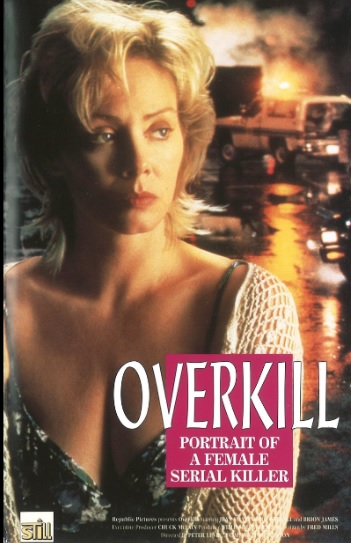
October True Crime: Overkill: The Aileen Wuornos Story (dir by Peter Levin)


Made for television in 1992, Overkill: The Aileen Wuronos Story opens with Aileen (Jean Smart) and her friend, Tyria Moore (Park Overall), hitchhiking their way through Florida.  Aileen is outspoken and unpredictable, quick to lose her temper with anyone who doesn’t give her a ride or money and also very possessive of Tyria.  Tyria is naïve and a bit spacey, though she is smart enough to have figured out that Aileen is financing their trip through sex work.

Of course, if you’ve seen Monster, you already know the story of Aileen and Tyria and you also know that Aileen is eventually going to end up in a lot of trouble and Tyria is going to be pressured to betray her.  Monster made it clear that Aileen and Tyria were a romantic couple and it even suggests that, for all of her crimes, Aileen sincerely loved Tyria.  Overkill, probably due to being a made-for-television movie from the 90s, treats Aileen and Tyria’s relationship a bit more ambiguously.  While Aileen is portrayed as being very possessive and very protective of Tyria, their relationship is portrayed as being more of a roommate situation than a romantic one.  Indeed, Aileen is often portrayed as being almost stalkerish in her behavior towards Tyria.  Aileen comes across as being much more interested in Tyria than Tyria is in Aileen.

While Aileen and Tyria travel across Florida, men are turning up dead up and down the interstates.  The victims were all shot and they were all middle-class, white professionals.  Most of them are found in circumstances that suggested that they had picked someone up and that person subsequently shot and then robbed them.  When Detective Brian Munster (Brion James) suggests that all of the men could have fallen victim to a female serial killer, his colleagues are skeptical.  Everyone knows that serial killers are always men.  But Munster continues to insist that the murderer must be a woman and soon, he comes to suspect that the killer could be Aileen.  However, all of the evidence that Brian has is circumstantial and it won’t be enough to get a conviction.  He and the member of his investigative team start to watch Aileen, waiting for her to make a mistake that will give them what they need to make an arrest….

After she was convicted of murdering seven men, Aileen Wournos claimed that the police always knew that she was the one committing the murders but that they didn’t arrest her because they wanted to reap the publicity from pursuing America’s first female serial killer.  As evidence, she cited this movie and it must be admitted that this movie does feature a lot of scenes of Munster and his detectives waiting for Aileen to make her next move.  That said, one would think that Overkill would be the last movie that Aileen would want to bring attention to because the film essentially presents Aileen Wournos as being a petulant and trashy psychopath who turned to crime because she was too stupid to do anything else with her life.  If Monster portrayed Aileen as being someone who had been so damaged by society that she could no longer function, Overkill portrays Aileen as being someone who uses her childhood trauma as a convenient excuse for her own antisocial tendencies.

Overkill is a considerably more simplistic portrayal of Aileen’s crimes than Monster.  That said, Jean Smart does a good job in the role and is convincingly angry at the world.  Overkill is more about the effort to catch Aileen than Aileen herself and character actor Brion James, who usually played villains over the course of his career (like Leon in Blade Runner and the killer in The Horror Show), makes for a convincingly no-nonsense cop.  Overkill is a well-made and well-acted film, even if it does ultimately feel a bit shallow in its storytelling.

Horror Film Review: Lake of Dracula (dir by Michio Yamamoto)


All of her life, Akiko (Midori Fujita) has been haunted by a dream in which, as a little girl, she followed her dog into an abandoned house and ran into a pale man (Mori Kishida) who had golden eyes and fangs for teeth.  Even living a somewhat idyllic life on the shores of a lovely lake and dating a handsome young doctor (Osahide Takahashi), Akiko cannot shake the feeling that what she has been telling herself was a dream may have actually happened to her.

One day, a large crate is sent to a nearby boat operator.  When the man opens the crate, he discovers that it contains a coffin.  Can you guess what’s in that coffin?  Soon strange things are happening all around town.  Bodies start to show up at the hospital with bite marks on their necks.  Akiko’s dog disappears and the formerly friendly boat operator suddenly starts to act in an aggressive manner.  Even worse, Akiko’s sister, Natsuko (Sanae Emi), vanishes.  Akiko comes to believe that it is somehow all linked to her dream, which might not have been a dream at all.  She and her boyfriend head back to her hometown, searching for the house from her dreams so that they may finally find out the truth about the pale man with the golden eyes and fangs and…. well, I don’t know why exactly they think they have to find out the truth.  It’s pretty obvious that he’s a vampire, right?  I mean, the fangs were kind of a dead giveaway.

When I came across the 1971 film, Lake of Dracula, on Tubi, my initial response was to say, “Oh, cool!  A Japanese Dracula film!  I wonder what that’s going to be like!”  Having watched the film, I can say that, along with being a Japanese Dracula film, Lake of Dracula is also an extremely conventional vampire film.  This is one of those films where it’s so obvious from the start that the villain is a vampire that you can’t help but get a bit annoyed at the other characters for not figuring it out as quickly as you did.  While I’m not really sure if the vampire in the film is meant to be the Dracula (and, despite the title, I’m actually pretty sure that he’s not), the character is obviously a vampire and, beyond the golden eyes, this film doesn’t really bring anything new to the vampire mythos.  If you’re hoping that this film will feature the hopping vampires that made films like Kung Fu Zombie so memorable, you’re destined to be disappointed.

That said, it’s a lovely film to look at, full of vibrant colors and properly ominous shadows and the golden eyes are definitely a memorable effect.  The film is full of nicely creepy locations, with the house from Akiko’s dream being exactly the type of place that would inspire a lifetime full of nightmares.  It’s a conventional film but it’s full of genuine melancholy and a good deal of ominous atmosphere, all of which keeps the film watchable even if it never quite takes the viewer by surprise.

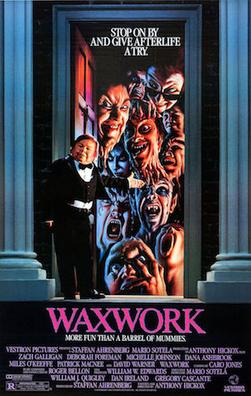
Horror Film Review: Waxwork (dir by Anthony Hickox)


First released in 1988, Waxwork asks the audience with a very important question.

Let’s say that you and your best friend were walking to school one day when you suddenly noticed a gigantic mansion that you had never seen before, sitting in the middle of your neighborhood.  And what if a tall, somewhat sinister Englishman (played by David Warner, none the less) suddenly appeared out of nowhere and told you that the mansion was actually a waxwork.  And what if that Englishman than invited you to come to the waxwork at midnight and specifically asked you to come in a group of 6.  Would you do it?

Now, I know that your first instinct is to say, “Of course, I wouldn’t!”  That’s the type of answer that we’ve been conditioned to give because no one wants to admit that they can be as dumb as a character in a horror movie.  But really, I would go.  Especially if, like the characters in Waxwork, I was a teenager.  (Actually, most of the characters in Waxwork are described as being college students but they all act like high school students and their college appears to be a high school so draw your own conclusions.)  When you’re a certain age, you feel like you’re immortal and an invitation to hang out in a creepy building with a bunch of strangers at midnight feels totally reasonable.

Anyway, four rich kids — Mark (Zach Galligan), China (Michelle Johnson), Sarah (Deborah Foreman), and Tony (Dana Ashbrook, a year before he was cast as Laura Palmer’s boyfriend in Twin Peaks) — visit the waxwork at midnight.  What they discover is that the building is full of macabre exhibits that recreate various moments from horror history.  There’s werewolves, vampires, and Jack the Ripper.  There’s also the Marquis de Sade, a figure that the seemingly innocent Sarah becomes fascinated with.  And, as two of the visitors discover, stepping past the red rope and entering an exhibit transports them into an alternate world where they become the victim of the star of each display.

Not surprisingly, the film is at its best when imagining the world inside each exhibit.  Each exhibit has its own backstory and its own set of guest stars.  John Rhys-Davies shows up as a werewolf.  Miles O’Keeffe is a properly urbane Count Dracula.  J. Kenneth Campbell plays the Marquis de Sade, who the film imagines as a swashbuckling sadist.  That said, I think the most effectively frightening exhibit was one that featured no special guest stars but a very determined and very strong mummy.

What’s going on at the waxwork!?  As explained by Sir Wilfred (Patrick Macnee, bringing some welcome wit and style to the film), it’s all a part of a scheme to bring the most evil beings ever back into existence so that they can conquer the world.  It’s important that none of the waxworks be allowed to enter the real world and soon, Sir Wilfred and his ragtag army are laying siege to the waxwork and bringing things to an apocalyptic conclusion.  The final battle is a bit haphazardly edited and it’s impossible to really keep track of who is fighting on which side.  (Indeed, I’m still not sure where Sir Wilfred even found his army.)  But it does feature plenty of in-jokes for horror fans, including a cameo appearance by the carnivorous plant from Little Shop of Horrors.

Waxwork is entertaining film.  It doesn’t take itself particularly seriously and, indeed, Mark, China, Sarah, Tony, and all of their friends feel as if they could just as easily have been found in the pages of a Bret Easton Ellis novel about pretty but vapid alcoholics.  Mark is the type who gets his maid to write his term papers.  Tony just wants to drink (but, because he’s played by the adorable Dana Ashbrook, he’s still the most likable character in the film).  China says, “I do what I want, when I want,” when confronted about cheating on her boyfriend.  Sarah is the “innocent” one but just seeing the words “Marquis de Sade” causes her to swoon.  Dropping these four idiots into a situation where the fate of the world is at stake feels like a wonderfully sardonic cosmic joke.

In the end, the true pleasure of Waxwork is watching old pros like David Warner, Patrick Macnee, and the exhibit guest stars hamming it up.  Macnee, in particular, seems to enjoy leading the final charge against the forces of evil and, indeed, it’s hard not to wish that he had even more screen time than he did.  David Warner, meanwhile, rolls his eyes at just how difficult it can be to bring the 18 most evil figure in history back to life.  It’s hard work but I guess someone has to do it!

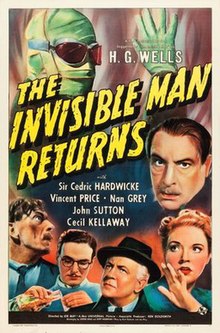
Horror Film Review: The Invisible Man Returns (dir by Joe May)


1940’s The Invisible Man Returns opens with Sir Geoffrey Radcliffe (Vincent Price) sitting on Death Row.  Convicted of the murder of his brother, Radcliffe is due to soon be executed.  Radcliffe claims that he was framed and his girlfriend, Helen Manson (Nan Grey), has spent the past week of her life begging for someone to order a stay on the execution.  However, with the home secretary out of the country, there is no hope of a reprieve.

Dr. Frank Griffin (John Sutton), brother of the original Invisible Man, visits Radcliffe in prison and gives him the same serum that his brother previously developed.  Now invisible, Radcliffe is able to escape from the prison.  Radcliffe is determined to prove his innocence but Dr. Griffin is more concerned with developing a way to reverse the serum’s effects before Radcliffe is driven insane, just as the original Invisible Man was.  Radcliffe becomes convinced that his brother was murdered by their cousin, Ricard Cobb (Sir Cedric Hardwicke) but is Radcliffe correct or is the serum just making him paranoid?  With Inspector Sampson (Cecil Kellaway) searching for Radcliffe and fully aware of what effects the serum are going to have on his mind, can Radcliffe clear his name before he loses his sanity?

The Invisible Man Returns went into production after the success of Son of Frankenstein proved that there was a market for sequels to previously successful horror films.  (Yes, there was a time when sequels were not an automatic thing.)  This was also one of the first horror films in which Vincent Price made an appearance.  (Today, we’re so used to the image of Vincent Price as a somewhat campy horror icon that it’s easy to forget that he originally started his career as a romantic leading man and was even seriously considered for the role of Ashley Wilkes in Gone With The Wind.)  As he spends the majority of the film wearing the same tight bandages that hid Claude Rain in the first film, Price’s actual face is only visible for slightly less than a minute and, without his famous mustache, it’s actually rather difficult to recognize him.  That said, there’s no mistaking Price’s voice, heard as the invisible Radcliffe bitterly complains about everything from a barking dog to other people’s doubts about Cobb being the murderer.  While this film does find Price in a slightly more subtle mood than many of us horror fans are used to, it still features plenty of hints of what the future would hold.

I enjoyed The Invisible Man Returns, which featured some witty invisibility sequences (watch invisible Vincent Price toss off those clothes!) and also managed to take the story’s violence about as far as it could without violating the production code.  While it’s always a pleasure to watch any film featuring Vincent Price, I also liked the performance of Cecil Kellaway, who played the inspector as being the epitome of the the upstanding but dryly humorous British policeman.  One gets the feeling that absolutely nothing could ever take the Inspector by surprise …. not even an Invisible Man!

Previous Universal Horror Reviews:

  1. Dracula (1931)
  2. Dracula (Spanish Language Version) (1931)
  3. Frankenstein (1931)
  4. Island of Lost Souls (1932)
  5. The Mummy (1932)
  6. The Invisible Man (1933)
  7. The Bride of Frankenstein (1935)
  8. Dracula’s Daughter (1936)
  9. Son of Frankenstein (1939)
  10. The Wolf Man (1941)
  11. Ghost of Frankenstein (1942)
  12. Frankenstein Meets The Wolf Man (1943)
  13. Son of Dracula (1943)
  14. House of Frankenstein (1944)
  15. House of Dracula (1945) 
  16. Creature From The Black Lagoon (1954)

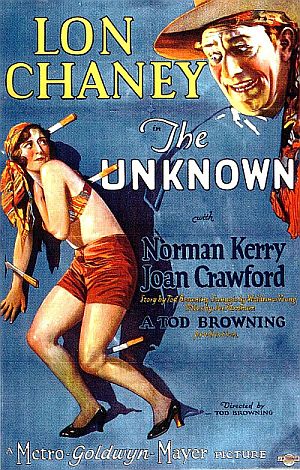
Horror on the Lens: The Unknown (dir by Tod Browning)


First released in 1927, The Unknown tells the story of circus performer Alonzo the Armless (Lon Chaney, Sr.).  As you might guess from his name, everyone thinks that Alonzo is armless.  Of course, he’s not.  He’s just a contortionist who pretends to have no arms.  People thinking that he has no arms gives him the perfect alibi whenever he has to strangle someone.

However, Alonzo has fallen in love with Nanon (Joan Crawford), his beautiful circus assistant.  Unfortunately, Malabar the Mighty (Norman Kerry) is also in love with her and there’s no way that Alonzo could allow her to get too close because then she might discover that he not only has arms but that his hand has an unusual deformity that would identify Alonzo as the man who strangled Nanon’s father.

Alonzo’s solution?  Maybe he could just get someone to amputate his arms for real!  But will that be enough for him to win Nanon away from Malbar?  Or will he pursue an even more macabre plan to get Malabar out of the picture?

The Unknown was, for years, considered to be a lost film.  In 1968, a 49-minute print of the film was found in France.  That’s the version that I’m sharing here.  Reportedly, several early scenes were missing but those scenes were not important to the overall story.  Even in truncucated form, The Unknown is a wonderfully surreal and atmospheric film and it’s widely considered to be the best of Tod Browning and Lon Chaney’s collaborations.  Since this film was made in the age before CGI, whenever Alonzo hides his arms, Chaney was having to do the same thing.  This is one of Chaney’s best performances.  Alonzo is both frightening and rather sad in his way.  Having won the role over Greta Garbo, Joan Crawford was 18 when she played Nanon.

Enjoy!

Rain, The Teskey Brothers – Rev. Case Wright


Happy Horrothon! “I know you’re gonna say, this isn’t horror! This is Thor singing the blues!” I hear your critique and I reject it! The greatest horror stories especially in science fiction have trauma, fear, and hope. Alien, for example, terrible things happen to this crew of…. I guess…. miners, but at the end – there’s hope because Ripley overcomes. I always have a bit of anxiety at the end of the New “Outer Limits” or films like “Life” because it’s a good twist, but everyone is now dead and the heroes failed- that’s too much like life!

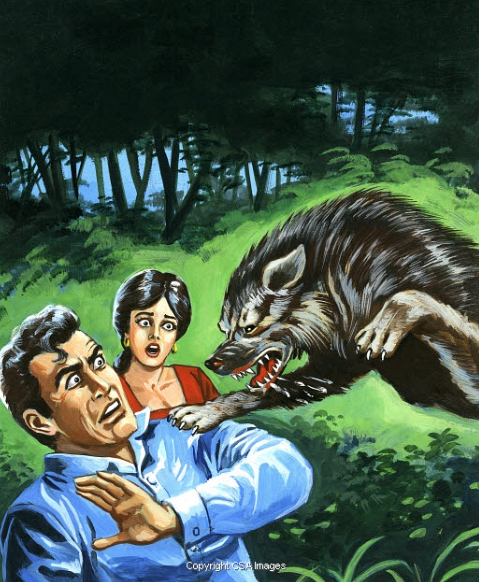
In “Rain”, a woman is alone and there appears to be a guy in the friendzone who REALLY wants to be with her and can sing and looks like Thor. For the interest of Horrorthon, we’re going to presume that- I don’t know this lady’s name but I’ll call her Susan- that Susan’s previous guy was eaten by a …got it…. a werewolf! Take that doubters told you I could contrive this into a horror review- BWAHAHAHA!

Side note: Susan, you’re being too picky. I’m sure that you had a rough time, but this guy even wrote a song for you, looks like Thor, and sounds like Otis Redding reincarnated. Maybe your standards are just WAY too high?

Susan’s boyfriend was werewolf puppy chow and Thor is trying to tell her that it will be okay. He has felt her pain because there is probably at least another werewolf in town that probably ate his girlfriend too. Can you imagine that support group? They must hate Iams and Doggy costumes! The line “Is that rain or are you crying again?” gets to me because when you’re broken-hearted – it’s like the tears can’t stop. “A soul with no face is a lonely embrace” this line is all about not seeing your soulmate again- Fucking Werewolves, we gotta do something about them, but then this song wouldn’t exist; so, I’m torn!

As they try console each other, “now’s there clouds between us all”; so, they likely hooked up, but they also have to worry about the full moon coming- probably. I like that at the end of the song – he says – “You ain’t gonna be ain’t gonna be alone” and notice, he doesn’t say- With me – Wonderful me. He’s left her better off and maybe he will be alone and live out his days as a werewolf hunter?

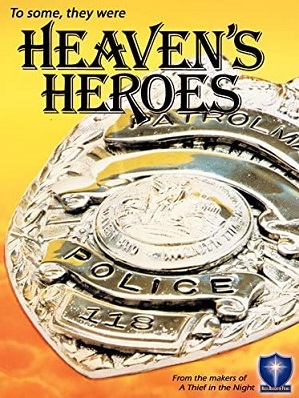
October Positivity: Heaven’s Heroes (dir by Donald W. Thompson)


The 1980 film, Heaven’s Heroes, is a cop film that takes place in Des Moines, Iowa!

Now, it’s tempting to make a joke about a film taking place on the “mean streets of Des Moines” and I know that I did when the film started and I saw that it was another Russell S. Doughten production.  In the late 70s and early 80s, Doughten directed several low-budget faith-based films, most of them shot on location in Iowa.  (I previously reviewed Doughten’s Nite Song, among others.)  Though Doughten is only credited as executive producer on Heaven’s Heroes, it features all the hallmarks of Doughten’s other films.  The budget is low, some of the actors are a bit amateurish, and the ultimate message is undeniably heartfelt.  What Doughten’s film may have lacked in technical polish, they made up for sincerity.

To its credit, Heaven’s Heroes doesn’t try to present Des Moines as being any more edgy that it actually is.  But the film makes the point that a cop’s life can be dangerous, even in a relatively quiet town like Des Moines.  In fact, the film opens with police responding to the shooting of Officer David Hill (played by David Ralphe).  His wife, Cindy (Heidi Vaughn), is taken  to the hospital where she talks to the comatose David until he dies.  The doctor explains that if the bullet had entered David’s head just a few inches higher, his life probably could have been saved.

The rest of the film is taken up with flashbacks to David’s life before he was shot.  We watch as he and Cindy meet each other in college.  A helicopter hovering over a Des Moines mall leads to a flash to David’s service in Vietnam.  His partner (James O’Hagen) remembers the training that he went through with David.  Through it all, David comes across as the ideal cop, the type who treats everyone fairly and who doesn’t draw his gun unless it’s absolutely necessary.  (At one point, David does fire at a man who is holding a shotgun, just to miss.  Later, he discovers that the man was only holding the shotgun for self-defense.)  David saves the life of a child who has swallowed a button but later finds himself unable to help another child who has been hit by a drunk driver.  Some people thank David and some people call him a pig.  A lot of the film deals with David and his partner trying to deal with the stress of their job.  There’s an interesting scene, early on, in which a lecturer at the Academy explains that a good cop has to be able to deal with the frustrations of the job without taking those frustrations out on the public.  He warns about giving into paranoia and assuming that everyone is looking to commit a crime.  David struggles with stress but never gives in.  Of course, it’s a religious film so David gives all the credit for his success to God and, when he’s later shot, his wife takes solace in the idea that David has gone to Heaven.  Your mileage may vary on that but no one can deny the sincerity of the film’s simple message.  The film, which was based on a true story, was shot on location in Des Moines and featured a lot of actual Des Moines police officers.  The acting is sometimes amateurish but they all bring an authenticity to their roles.

It’s interesting to compare the cops in this 1980 film to the cops of today.  None of the cops in Heaven’s Heroes wear body armor.  None of them patrol the streets in modified tanks.  They don’t shout at suspects or bark orders at bystanders.  They’re not bulked-up gym rats with shaved heads.  Though both David and his partner did serve in the military, both of them understand that they’re not fighting a war on the streets of Des Moines.  Instead, they are there to protect the citizens.  They’re the ideal cops and sadly, they’re almost unrecognizable when compared to much of what we see today.

October Hacks: Madman (Dir by Joe Giannone)


First released in 1982, Madman takes place on the last night of camp.

Max (Carl Fredericks), the jovial and beloved owner of the camp takes his senior counselors and his campers on one last outdoor adventure.  As they sit around the campfire, he tells them the story of a farmer named Marz who, years before, went crazy and hacked up his family with an axe.  The local townspeople attempted to hang Marz but somehow, he escaped from the noose and disappeared into the wilderness, along with the bodies of all of his victims.  The locals say that Madman Marz is still out there in the wilderness, waiting for someone to shout his name so that he can return to life and kill again.  Max tells his campers that it’s very important that they only whisper the name of Madmam Marz.

“MADMAN MARZ!” Richie (Jimmy Steele), one of the campers, shouts.

Everyone tells Richie not to shout his name so Richie shouts it again.

Max announces that it’s time to return to camp.  He specifically tells none of the campers to deviate from the path back to the camp.  He tells everyone to follow their counselor.  He makes the directions very specific and clear.

So, of course, Richie decides to wander off by himself.  As he wanders through the wilderness, he comes across Madman Marz’s old cabin and he breaks a window….

Now, if you’ve ever seen a slasher film before, you are probably expecting Richie to be the first victim of rejuvenated Madman Marz.  Well, you would be incorrect.  In fact, Richie turns out to be a bit of a Karma Houdini because, while Madman Marz does return with his axe, he never actually goes after Richie.  Instead, Madman Marz just stalks the various counselors who go into the woods in search of Richie.  Don’t get me wrong.  Richie is definitely a bit traumatized by what he sees inside of Madman Marz’s cabin.  But it’s still hard not to feel that Richie got off pretty easy when compared to everyone else.

But that’s really what makes Madman a superior slasher film.  It defies our expectations when it comes to who dies and who doesn’t.  Though it was obviously inspired by the camp-centric horror of Friday the 13th, Madman isn’t afraid to break the rules of the genre.  It’s one of the rare slashers where it feels like anyone could fall victim to the killer depending on how their luck goes that night.  As opposed to slashers where it sometimes seems that the victims are being punished for having sex or doing drugs or going against the rules of society, the victims in Madman tend to just be in the wrong place at the wrong time.  Marz doesn’t really have a complicated motivation.  He’s a madman and he’s so ruthless and relentless that he becomes a genuinely frightening monster.

Madman Marz is not only genuinely frightening but so is the film featuring him.  Madman was a low-budget, non-union production, with the majority of the cast and crew credited under pseudonyms.  (Dawn of the Dead‘s Gaylen Ross, who appears as one of the counselors, is credited as Alexis Dubin.)  But that low budget does prevent Madman from being an atmospheric and suspenseful slasher film, one that will not only inspire nightmares but also probably cure most people of any desire to go camping.

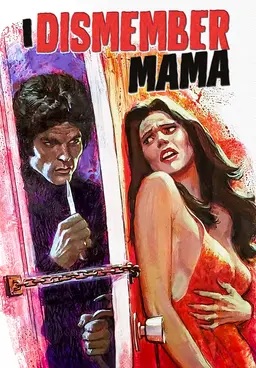
The TSL Horror Grindhouse: I Dismember Mama (dir by Paul Leder)


Ugh.  It’s hard for me to think of any film that left me feeling as icky as the 1972 film, I Dismember Mama.  Seriously, who would have guessed that a film with a title like I Dismember Mama would be disturbing and offensive?

Zooey Hall stars as Albert, a puritanical young man who idealizes the Victoria Age, when “men were gentlemen and women were pure.”  Albert has tried to murder his rich mother three times for being “a whore,” and he’s now living in a minimum security mental hospital where he spends his time watching pornographic movies.  When Albert escapes from the mental hospital, he heads straight to his mother’s house.  His mother isn’t there but Alice (Marlene Tracy), the maid, is.  After raping and murdering Alice, Albert heads down to the living room where he meets Alice’s 9 year-old daughter, Annie (Geri Reischl, who would later take on the role of Fake Jan on the Brady Bunch Variety Hour).  Albert doesn’t know Annie but Annie instantly recognizes Albert from the pictures that his mom has up around the house.

Suddenly enchanted by Annie and her innocence, Albert lies and tells Annie that Alice has been taken ill and had to go see a doctor but she asked Albert to keep an eye on Annie until she got back.  (Is there a reason why everyone’s name starts with an A?  My ADD is going crazy just trying to type this up.)  Albert then takes Annie for a ride around town, telling her about how much he loves the Victoria era and eventually checking into a motel with her.  (Ewwwwww!)  When Albert murders a woman that he picked up at a bar, Annie runs away from the hotel and Albert, suddenly convinced that Annie is now a harlot, chases after her.  It all leads to a properly violent conclusion.  Say what you will about the film but the final five minutes make great use of slo mo of doom as Albert and Annie run through a mannequin factory in slow motion.

My favorite character in this film was the police detective played by Greg Mullavey.  When Albert’s liberal doctor (Frank Whiteman) argues that even Albert can be cured with the right amount of treatment, the detective just smirks and complains about how his tax dollars are being used “to baby murderers.”  Normally, I would argue that the doctor has a point but Albert is such a creep and his fixation on Alice is so disturbing that I was totally on the Detective’s side.  Whether he could be cured or not, Albert deserved a bullet in the head.

It’s a competently-made and well-acted film and Zooey Hall deserves a lot of credit for making Albert into an all-too plausible madman.  It’s also a thoroughly icky film, the type of film the features flashbacks to scenes of rape and violence that occurred mere minutes before.  This is one of those grimy films that leaves the viewer feeling as if they’re going to need to take multiple showers after watching.

The film is today is best remembered for the gimmicks that were used to promote it.  Theater patrons were given an upchuck cup, in case the film proved to be too intense for them.  And, of course, the film’s famous trailer featured people who had been driven insane by watching the film.

Director Paul Leder and Greg Mullavey would reunite for another grindhouse horror film, My Friends Need Killing.  Look for my review of that film tomorrow!

Murderbot (2023, directed by Jim Wynorski)


“Blow harder!”

— Val (Lauren Parkinson) in Murderbot

In a remote army base, three busty scientists create a busty robot named Raquel (Melissa Brasselle).  General Griffin (Arthur Sellers) is impressed that Raquel has mastered all forms of combat but he is not happy by her dominatrix outfit because, according to him, America’s enemies don’t fear cleavage.

One night, while the scientists all have hot dates, Raquel escapes from the base and goes to a nearly deserted desert town, where she kills a leering gas station attendant and a busty diner owner.  Meanwhile, a group of busty teenagers and their boyfriends run out of gas while driving through town and find themselves being stalked by Raquel.

This is a Jim Wynorski film so you know what you’re going to get, a lot of cleavage (though, for once, no actual nudity), a splattering of blood, and some deliberately corny humor that is sometimes self-aware enough to be funny.  Murderbot was originally named Killbot, a reference to Wynorski’s first film, Chopping MallMurderbot even duplicates that film’s famous exploding head scene, though it’s the entire body that explodes this time.

This is pretty dumb but Wynorski fans should be happy.  Even though no one will be watching this movie for the acting, I actually did like the performances of Walker Mintz and Sylvia Thackery, playing respectively a trumpet player and the girl that he likes.  As Raquel, Melissa Brasselle is no Arnold Schwarzenegger but she still handles dreadful one-liners like “You’ve been deleted,” with enough aplomb to make them tolerable.

Murderbot is proof that, no matter how much things change, Jim Wynorski will always by Jim Wynorksi.