October True Crime: Ricky 6 (dir by Peter Filardi)


Filmed in 2000 but never given an official release (though it can now be found on YouTube), Ricky 6 takes place in the town of Harmony, New York in the mid-80s.  Harmony is an upper class community, a place where the houses are big, the yards are pristine, and every father expects his son to try out for the high school football team.  It’s a place that celebrates winners and exiles losers to the nearby woods.  It’s the sort of town that seems like it exists primarily to give teenagers something to rebel against.

Tommy Pottelance (Chad Christ) and Ricky Cowen (Vincent Kartheiser) are two of those rebels.  They both have long hair.  They both listen to music that is designed to terrify their conservative parents.  They both smoke a lot of weed and spend a lot of time obsessing on how alienated they feel from everyone else around them.  Tommy and Ricky are best friends, bonded by their mutual feelings of isolation.  They often talk about running off to California together and they’re not above committing a few minor crimes in order to do it.

Bullied by his father and laughed at by the local drug dealers, Ricky spends his time hiding out at the library and reading books on demons and magic.  He meets Pat Pagan (Kevin Gage), a self-styled Satanist who appears to live in the woods and who, despite being middle-aged, spends all of his time hanging out with teenagers.  Ricky starts to describe himself as being a Satanist, begging his friends to announce that they love Satan as a part of a ritual that he wants to perform.  Most of his friends humor him, not knowing that Ricky hears voice and has frequent hallucinations.  (The fact that his dealer keeps selling him dusted joints definitely doesn’t help as far as that’s concerned.)  Ricky starts out the film as somewhat passive and very much in Tommy’s shadow but, as his interest in Satanism grows, so does Ricky’s confidence and, soon, Ricky is the one giving orders.  Ricky goes from looking up to Tommy to being the one who issues the commands.  When Ricky becomes convinced that one of his friends stole some drugs from him, he decides to get a very violent and bloody revenge….

Ricky 6 is based on a true story, one that was examined in a documentary that Jeff reviewed earlier this year, The Acid King.  Because the film has never been given an official theatrical release and has mostly been distributed through bootleg tapes and DVDs, Ricky 6 has developed a reputation for being a bit more extreme than it actually is.  Yes, the murder scene is brutal and yes, the permanently stoned and occult-obsessed Ricky does have some memorably surreal hallucinations.  For the most part, though, Ricky 6 is more a study of Ricky and Tommy’s friendship than a straight horror and/or true crime film.  Ricky and Tommy are both angry at a world that doesn’t seem to understand them, with the main difference being that Tommy rejects the world while Ricky tries to bring some sense of order and meaning to his chaotic existence by worshipping Satan.  When Tommy angrily tells Ricky that there is no God and no Satan, Ricky rather innocently asks, “How could you want to live in a world without magic?”  Of course, for Ricky, part of the magic means dragging his friends into helping him commit a murder.

Ricky 6 is a well-acted film, especially by Vincent Kartheiser, Kevin Gage, and, in the role of Tommy’s girlfriend, Emmanuelle Chriqui.  Kartheiser plays Ricky as being someone who is so lost in his own head that he’s lost the ability to understand the enormity of his actions.  And yet, it’s hard not to have some sympathy for Ricky because one look at his homelife and his overbearing father reveals that he probably never had much of a chance.  There are a few scenes where Kartheiser flashes an appealingly vulnerable smile and, for a minute or two, it’s easy to forget that he is also a ruthless killer.

With a two-hour running time, Ricky 6 is a bit too long for its own good and the use of Tommy as the story’s narrator means that the film often tells us about things that it should be showing us.  It’s an imperfect film but, due to the strength of the cast and the way the film captures the atmosphere of suburban ennui, it’s not a bad one.


Horror Film Review: The Killer Is Still Among Us (dir by Camillo Teti)


The 1986 Italian film, The Killer Is Still Among Us, is based on the crimes of the Monster of Florence, the serial killer who is Italy’s version of the Zodiac Killer.

The film opens with two young lovers being brutally killed by an unseen killer.  The killer shoots both the man and the woman multiple time and then drags the woman out of the car, with the film suggesting that he’s going to further abuse the dead woman with both a knife and a tree branch.  It’s a graphic scene and the first of three murders, each one of which is more explicit than the previous one.

Christiana Marelli (Mariangela D’Abbraccio) is young criminology student who has written her thesis on the Monster of Florence.  Her theory is that the murderer is either a doctor or a butcher, someone who is good with a knife.  (“Perhaps he is a boy scout,” her professor says, “they are good with knives as well.”)  For some reason, Christiana’s thesis scandalizes both her professor and the police, even though there’s nothing particularly shocking about her conclusion.  Her basic argument is that a killer who mutilates his victims with a knife might work in a profession where he regularly handles sharp instruments.  Wow, that’s really thinking outside the box.

Anyway, Christiana continues to investigate the crimes, to the point of becoming obsessed with them.  At an autopsy, she meets a medical intern named Alex (Giovanni Visentin) and soon, she and Alex are a couple.  However, Christiana cannot fail to notice that Alex doesn’t even seem to be that interested in talking about the murders and that Alex always seems to be out of the apartment whenever the murders occur.  Is Alex the murderer or is Christiana’s paranoia getting the better of her?

There’s one interesting and genuinely frightening scene in The Killer Is Still Among Us, in which Christiana goes to a séance.  The idea is to contact the spirit of the Monster’s last victim but instead, Christiana and everyone else at the séance has a violent vision of the Monster’s latest murder, with the medium even getting wounds on his body corresponding to the wounds suffered by the Monster’s victims.  When Christiana hears that they’ve just seen a murder that’s currently happenings, she runs from the room to find Alex.  It’s an effectively shot and performed scene but it’s the exception to the majority of this slow-moving film.

The main problem with this film is that Christiana often behaves in a way that only makes sense if you accept that she’s a total idiot.  One night, while she’s at the police station, she spots a gynecologist named Doctor Franco M. Benincasa (Luigi Mezzanotte) being brought in after being arrested for being a peeping tom.  One of the cops mentions that they arrest the doctor nearly every night.  (And yet he still has his medical license?)  Christiana and the doctor both stare straight at each other.  Christiana decides that the doctor is an obvious suspect so what does she do?  She makes an appointment to see him on the following day.  Christiana goes to his office and pretends to be a patient but Dr. Benincasa looked straight at her the night before so how does Christiana, who makes no attempt to disguise her appearance, think that she’s going to get away with pretending not to know who he is?  Needless to say, the doctor recognizes Christiana as soon as he sees her and Christiana has to flee from the office.

(Christiana did bring her friend, Chiara, played by Yvonne D’Abbraccio, with her but Chiara promptly abandons Christiana at the office of a potential murderer because Chiata’s suffering from cramps.  To be honest, I would probably do the same.)

The Killer Is Still Among Us ends without resolution, just a title card informing us that this movie was made as a warning to young people about the Monster of Florence.  Whatever.

The Gift, Dir. Brian E-RAD Simmons, Review by Case Wright


This is the Horrorthon short that I am used to seeing: a true James Nguyen level of garbage. There was nothing on IMDB to give me a title card; so, I went with this cute Crab-Dog. One note about this film is the outrageous number of easter eggs referring to people no one has ever heard of. It’s like giving yourself a nickname. I don’t understand. It’s also just a terrible short and what makes it worse is that it purports to be a comedy- WHY?

There’s a woman who gets home from a bad date and the date is presumably stalking her or might be Michael Myers from the Halloween films- I really can’t tell. I hope John Carpenter does a Cease and Desist order. She tries to block the creep and he shows up at her house and stabs her- laugh riot…it’s like some people want me to feel pain. Maybe I deserve the pain? Maybe they know that if they make this horribleness that I’ll have to watch it and reflect upon my failed existence?

If you want to punish yourself and the pain of 7 minutes feeling like 7000, this is for you! Maybe Pinhead made this film and I’m in a Hell Dimension in the Houston Suburbs?

This is the 7 minutes and change of my discontent.

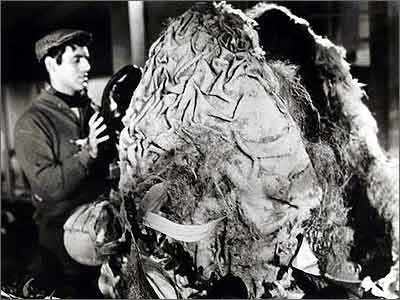
Horror on the Lens: The Little Shop of Horrors (dir by Roger Corman)


(It’s tradition here at the Lens that, every October, we watch the original Little Shop of Horrors.  And always, I start things off by telling this story…)

Enter singing.

Little Shop…Little Shop of Horrors…Little Shop…Little Shop of Terrors…

Hi!  Good morning and Happy October 24th!  For today’s plunge into the world of public domain horror films, I’d like to present you with a true classic.  From 1960, it’s the original Little Shop of Horrors!

When I was 19 years old, I was in a community theater production of the musical Little Shop of Horrors.  Though I think I would have made the perfect Audrey, everybody always snickered whenever I sang so I ended up as a part of “the ensemble.”  Being in the ensemble basically meant that I spent a lot of time dancing and showing off lots of cleavage.  And you know what?  The girl who did play Audrey was screechy, off-key, and annoying and after every show, all the old people in the audience always came back stage and ignored her and went straight over to me.  So there.

Anyway, during rehearsals, our director thought it would be so funny if we all watched the original film.  Now, I’m sorry to say, much like just about everyone else in the cast, this was my first exposure to the original and I even had to be told that the masochistic dentist patient was being played by Jack Nicholson.  However, I’m also very proud to say that — out of that entire cast — I’m the only one who understood that the zero-budget film I was watching was actually better than the big spectacle we were attempting to perform on stage.  Certainly, I understood the film better than that screechy little thing that was playing Audrey.

The first Little Shop of Horrors certainly isn’t scary and there’s nobody singing about somewhere that’s green (I always tear up when I hear that song, by the way).  However, it is a very, very funny film with the just the right amount of a dark streak to make it perfect Halloween viewing.

So, if you have 72 minutes to kill, check out the original and the best Little Shop of Horrors

October Positivity: To Hell and Back (dir by Christine Swanson)


The Book of Job is a bit of a Biblical Rorschach test.

Job is a prosperous man who always obeys and give thanks to God.  The Devil claims that Job’s faith is only due to the fact that he’s successful and has a large family.  The Devil boasts that, if he’s allowed to ruin Job’s life, Job will respond by cursing the name of God.  Instead of asking the Devil what he’s doing outside of Hell, God says, “Go ahead, just don’t kill him.”  The Devil kills Job’s family.  The Devil kills all of Job’s servants.  The Devil takes away all of Job’s wealth and afflicts Job with terrible sores.  Job’s friends tell Job that he should blame and reject God but, because Job refuses to do so, he is rewarded with a new family and even more servants.

Some people look at the story of Job and they see it as being a story about the importance of having faith, even in the most troubling of times.  Job refuses to surrender his faith and he is rewarded.  Even though Job cannot understand why bad things are happening to him, he refuses to surrender to despair and anger and puts his faith in the idea that God has a plan.

Others look at this story and see Job as a pawn in some private game between God and the Devil.  Job keeps his faith and is ultimately rewarded but his family and his servants still all die.  Job may be rewarded but why should he have to suffer just to prove a point to the Devil?  Indeed, what is the Devil doing in Heaven, debating with God in the first place.  I mean, the Devil got kicked out of that place.  He’s in Hell for a reason.

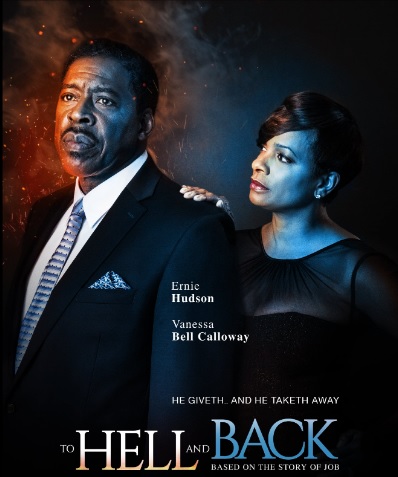
The 2015 film, To Hell and Back, is a modern-day retelling of the Book of Job.  Joe (Ernie Hudson) is a successful businessman, a man who built his company up from nothing and who now lives in a mansion with his wife (Vanessa Bell Calloway) and his five children.  Joe gives money to worthy causes and he is never without his Bible.  God and the Devil are heard in voice-over, debating the sincerity of Joe’s faith.  God agrees to allow Joe to be tested.  One tragedy after another befalls Joe and his family.  One son is killed during a burglary.  One daughter commits suicide.  A car crash leaves another daughter dead and another son in a wheelchair.  Joe’s company is driven into bankruptcy by a lawsuit while the last of Joe’s sons leaves to start his own company.  Abandoned by even his wife, Joe grows ill and soon finds himself homebound.

Even if the film leaves us wondering why God would hurt someone just to prove a point, To Hell and Back is a well-directed and well-acted film.  Ernie Hudson gives a heart-breaking performance as Joe, a man who always tries to do the right thing and is basically punished at every single turn.  Joe definitely deserves better than to just be a pawn in a cosmic waver but at least Ernie Hudson gets a chance to show off what a good actor he can truly be.

October Hacks: The Redeemer (dir by Constantine S. Gochis)


A truly odd film that was first released in 1978, The Redeemer opens with a young boy named Christopher (Christopher Flint) emerging from a country lake, fully clothes and also completely dry.  Christopher walks to a road, where he’s picked up by a church bus.  He’s dropped off at the church, where he sings in the choir and then listens as a preacher (T.G. Finkbinder) delivers a fire-and-brimstone message about the nature of sin and how six 1967 graduates of a nearby abandoned high school have all grown up to live a life of nonstop sin.

Those six graduates all receive invitations to a reunion at the old high school but, when they arrive, they discover that, with the exception of a janitor, they’re the only ones there.  The janitor allows them to enter the high school and to celebrate their mini-reunion.  Of course, it’s not long before one of the graduates stumbles upon the rotting, maggot-covered corpse of the real janitor.

The Redeemer of the title has invited the six graduates back to the school specifically so he can kill them as a way to punish them for representing what he considers to be the sins of the world.  John Sinclair (Damien Knight) is a criminal defense attorney who will defend anyone as long as the price is right.  Terry (Nick Carter) is a lazy mooch who still doesn’t have a real job.  Roger (Michael Hollingsworth) is an impossibly vain actor.  Jane (Nikki Barthen) is a superficial, upper class housewife.  Cindy (Jeanetta Arnette) is still too busy partying to grow up.  And finally, Kirsten (Gyr Patterson) coldly refuses her girlfriend’s request to attend the reunion with her because she doesn’t want her former classmates to know that she’s a lesbian.  The six of them find themselves being pursued by a killer who can apparently change his appearance at will, going from being the janitor to a seemingly friendly hunter to even a clown.  This is definitely not a film to watch if you have a thing about clowns.

As I said at the start of this review, The Redeemer is a bit of an odd film.  On the one hand, it’s a slasher film, complete with the usual collection of victims, a masked killer, and an isolated location.  On the other hand, because it was released the same year as Halloween and before the success of films like Friday the 13th defined the rules of the genre, The Redeemer is a bit different than some of the other slashers of the era.

For one thing, the killer is considerably less quippy than some of the slasher killer who would follow.  There are no snappy one-liners in The Redeemer.  Instead, the killer spends most of his time ranting about “avarice, lust, decadence” and everything else that he considers to be a sin.  Compared to the slasher film that followed, The Redeemer is a grim film, one that offers little in the way of deliberate humor and next-to-no-hope for the prospect of a final girl who will somehow get the upper hand on the killer.  If other slasher films were defined by the stupidity of their victims, the unfortunate people in The Redeemer die not because they were stupid but because this is a film that offers up absolutely no chance of survival.  It’s a dark and ominous film, with the a supernatural element giving the film a surreal edge.  It’s a film that requires a bit of patience on the part of the viewer, especially since the opening few minutes are so disjointed that it’s next to impossible to know what’s really  going on.  But the kills are memorable and the acting is adequate, particularly when compared to some of the other low-budget, indie horror films of the era.  The Redeemer is a memorable villain.  Horror fans will find much to enjoy here, even if they’ll also probably find plenty of things that will leave them scratching their head.

As was often the case with films like this, The Redeemer was released under several different titles.  It’s also known as Son of Satan, which I guess is a reference to the mysterious Christopher emerging from that lake.  Finally, The Redeemer has been released on video under the title Class Reunion Massacre.  Personally, I prefer The Redeemer as the film’s title.  As a title, it’s enigmatic …. just like the film itself.

What Lisa Watched Last Night #226: Double Threat (dir by Shane Stanley)


Last night, I watched the 2022’s action film, Double Threat!

Why Was I Watching It?

I attended two watch parties on Monday and Double Threat was the second feature.  Jeff, Leonard, and I watched Double Threat with out friends Brad and Sierra and a few others.  Sierra was the one who recommended the film, having seen it while at work the previous week.  It was a fun night!  We enjoy watching movies together.

What Was It About?

Natalie (Danielle C. Ryan) has a job at a huge convenience store that is sitting in the middle of nowhere.  She does a good job working at the place, though her only regular customer is just an old man who enjoys asking Natalie to climb a ladder for him.

When an army of gunmen show up looking to kill Natalie, Natalie slips into her second personality of Natasha and goes on the run with a mild-mannered guy named Jimmy (Matthew Lawrence) who just happened to be in the store at the wrong time.  As Nat explains it to Jimmy, the convenience store was actually a front of the mob and Natasha (but not Natalie) was skimming money.  So now, the entire mob is looking to kill her.  Meanwhile, Jimmy just wants to make it to the coast so that he can spread the ashes of his dead brother.  (Awwwwwww!)

Heading up the search for Nat is Ask (Dawn Oliveri) and Ellis (Kevin Joy).  Ellis is the son of a mob boss and he’s eager to prove that he’s more than just the boss’s son.  However, he’s also Natasha’s former boyfriend and, whenever he has a chance to shoot her, he tends to instead start demanding to know why they broke up.  No wonder Ask keeps getting frustrated!

What Worked?

Danielle C. Ryan did a good job playing both Natalie and Natasha and she had very likable chemistry with Matthew Laurence.  They made for a natural couple and I did find myself really hoping that things would work out for the two of them.

Most of the action took place in the country.  I’m a city girl at heart but I do still have a soft spot for the natural, undeveloped corners of America and this film provided a lot of nice scenery.

What Did Not Work?

The plot was a bit too overly complicated.  To be honest, I think the film would have worked just as fine (and would probably have flowed a bit better) if it had abandoned the whole idea of Nat having multiple personalities and had instead just had her be a badass who happened to work at a convenience store.

While I did occasionally laugh at Ellis’s inability to corner Natasha without demanding to know why she had dumped him, the scenes with Ellis and Ask got a bit repetitive.

“Oh my God!  Just Like Me!” Moments

Nat and I definitely have the same philosophy when it comes to driving.  Of course, Nat had the excuse that she had a bunch of mob assassins after her.  I just like to drive fast.

Lessons Learned

Never accept a job working at a mob front.  Not only do you have like absolutely no job security but apparently, you’ll end up having to run the entire store by yourself.

The TSL Horror Grindhouse: Crypt of Dark Secrets (dir by Jack Weis)


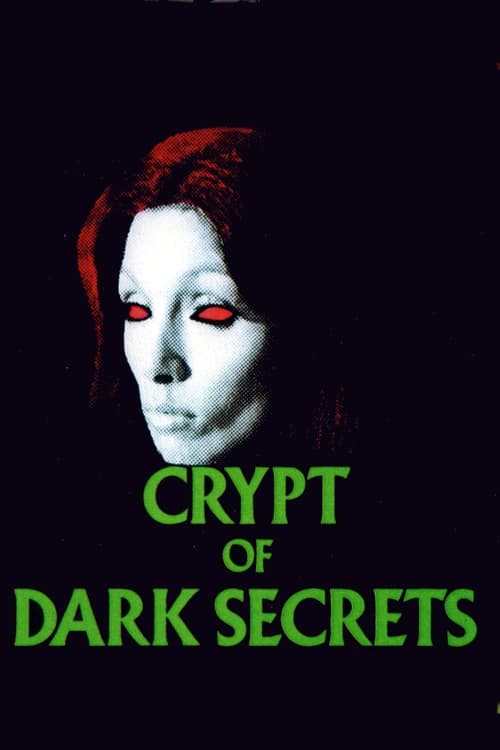
1976’s Crypt of Dark Secrets is yet another low-budget horror film that takes place in the bayous of Louisiana.

Seriously, what is it about the bayous that seems to attract the darker side of everyone’s imagination?  I’ve been to the Louisiana bayous and …. well, actually they are pretty creepy.  I guess if you were going to make a horror movie, the Louisiana bayou would be a good place to film.  It’s not like you have to spend a lot of money trying to create atmosphere or anything like that.  That bayous have got their own built in, free atmosphere.  You just have to start filming.

Anyway, Crypt of Dark Secrets does not feature a crypt but it does feature an island that’s sitting in the middle of the Louisiana swamp.  There are many legends about the island, with the locals saying that it’s protected by voodoo and “the ghosts of Aztec priests.”  There is always a fog on the island, regardless of how hot or otherwise sunny the day may be.  And there’s always a cool breeze in the middle of the fog.

There’s also a black snake that is often seen swimming in the water around the island.  Whenever the snake slithers onto the land, it turns into Damballa (Maureen Ridley), a swamp witch who is apparently at least a century old.  She protects the island and she has the power to not only conjure quicksand but to also raise the dead.  She also knows where a pirate’s treasure has been buried on the island but she’s certainly not going to let anyone find it.

Damballa has fallen for the island’s latest resident, a Vietnam vet named Ted Watkins (Ronald Tanet), who just wants the world to leave him alone.  He lives in a small house on the island and he refuses to keep his money in the bank, despite the fact that his military pension has made him a very wealthy man.  When three local losers, Max (Harry Uher), Earl (Butch Benit), and Louise (Barbara Hagerty), overhear that Ted keeps all of his money in a breadbox, they decide to pay him a visit and take that money for themselves.  Ted ends up dead and Max and Earl are shocked to discover that money is now covered with blood and basically useless to them.

Damballa does a naked dance over Ted’s body, which brings Ted back to life.  Despite Ted telling Damballa that he isn’t interested in vengeance and that he decided to leave hate and violence behind when he got out of Vietnam, Damballa teams up with the local voodoo priestess to get revenge on the three thieves.  As Damballa explains it, evil has to be punished.

Ted’s status as Vietnam vet adds an interesting subtext to Crypt of Dark Secrets.  During the same year that Taxi Driver was solidifying the image of the crazed Vietnam vet in the minds of many American filmgoers, Crypt of Dark Secrets featured a vet who just wants to be left alone to his own devices and who has no desire for further violence.  Indeed, for a film that centers around vengeance, Ted is remarkably forgiving.

As for the film itself, it’s fairly slow but, having been shot on location in Louisiana, it’s got a lot of authentic swamp atmosphere and its portrayal of voodoo is an interesting one.  (Voodoo, the film suggests, is the way that unwritten laws are enforced in the swamp.)  The performance are a mixed bag, with Ronald Tanet giving a convincing performance as Ted while Maureen Ridley delivers her lines in a strangely formal fashion that doesn’t feel right for her swamp witch character.  The actors playing the thieves are all convincing, as are the actors playing the inevitably portly Southern cops.

Crypt of Dark Secrets is flawed but it gets by on atmosphere.

Demonoid (1981, directed by Alfredo Zacarias)


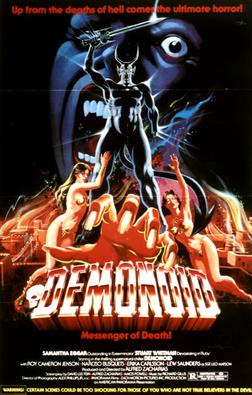
Demonoid has a great title and it had a good one sheet but don’t be fooled.  The sword-wielding devil is barely in the move and the women at his feet may have appeared on the cover of every heavy metal album in the 80s but they’re not in the movie.

Exploring a recently uncovered tomb in Mexico, Jennifer (Samantha Eggar) and Mark Baines (Roy Jenson) are intrigued by a number of bodies that are missing their left hand.  Their guide explains that, centuries ago, men, women, and children were sacrificed to the Devil by having their left hands cut off.  When Mark and Jennifer discover a casket with a severed hand, they decide to take it back to the hotel with them.  Of course, the hand is not dead.  It springs from its casket and possesses Mark.  This leads to Mark fleeing back to the United States, trying to find a way to get rid of his possessed hand.  Unfortunately, the hand has a mind of its own and, even after Mark ends up getting set on fire, the hand continues to live and possess one person after another.  Jennifer teams up with Father Cunningham (Stuart Whitman), trying to bring an end to the hand’s reign of terror and giving the audience a chance to wonder how these two actors went from being Oscar nominees to co-starring in Demonoid.

Demonoid is a strange film that starts out as a leisurely travelogue of Mexico and then suddenly turn into a cinematic Grand Guignol, with person after person trying to figure out how to chop off their left hand without doing permanent damage to themselves.  Because the hand is immortal, it has no problem trying to kill whoever it is currently attached to, which leads to not only several scenes of actors fighting with themselves but also several detached hands running across the screen.  A detached but moving hand is creepy the first time you see it but it becomes progressively less so the more time that you spend with it.  The plot is ridiculous enough to be initially intriguing but ultimately, Demonoid is a handsy bore.

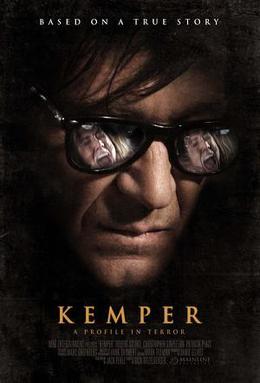
October True Crime: Kemper: The CoEd Killer (dir by Rick Bitzelberger)


The city of Santa Cruz, California is gripped by fear as two separate serial killers stalk and murder young women.  Detective Tom Harris (Christopher Stapleton) may not have many clues but he does have a brilliant best friend named Edmund Kemper (Robert Sisko).  Though most people just see Kemper as being a nerdy, middle-aged house painter who lives with his abusive mother, Harris understands that Kemper is actually a genius who has an instinctive understanding of the criminal mind.  With Kemper’s help, Harris is able to take down one of the killers.  Kemper celebrates by murdering his own mother and then calling Harris and revealing himself to be the other killer.  Harris must now track down Kemper before he can murder again.

2008’s Kemper: The CoEd Killer is very loosely based on the true story of serial killer, Edmund Kemper.  And by loosely, I mean that it has next to nothing in common with what actually happened.  In real life, Kemper was indeed a genius who lived with his mother and he did kill several hitchhikers.  However, Kemper committed the majority of his murders in the early 70s and, by most accounts, he did not have any friends on the police force.  Nor did he play a cat-or-mouse game with the police.  Instead, he committed ten murders and turned himself into the police after killing his mother and her best friend.  He was sentenced to life imprisonment.  Once in prison, he was frequently interviewed by FBI agents who were looking to understand how the mind of a serial killer works.  According to veteran profile John Douglas, Kemper proved to be an amiable and honest interview subject and much of the science behind what is known as profiling is a result of the insights that Kemper provided.  Douglas has described Kemper as being the most likable serial killer that he ever met, which is something that I’m sure provided little comfort to the families of the women that he killed.

In the movie, Kemper is a modern-day serial killer who calls the police on his cell phone.  (A major plot point involves Detective Harris trying to trick Kemper into getting frustrated enough to call the police station’s landline so it will be easier to trace his call.)  Kemper taunts the police and kidnaps a woman and holds her hostage in an attempt to mess with Detective Harris’s mind.  Kemper doesn’t so much come across as being particularly clever as much as the police themselves just come across as being amazingly bad at their jobs.  Somehow, they can’t find Kemper in the city, even though he never makes an attempt to disguise his distinctive appearance and continues to eat at the same diner where he and Harris ate at before Kemper revealed himself to be a killer.  The film’s version of Edmund Kemper takes the idea of hiding in plain sight quite literally.

The film has the same flat, made-for-video look that one tends to find in a lot of these low-budget serial killer biopics.  None of the acting is particularly effective, though Patricia Place does have a few memorable moments as Kemper’s foul-tempered mother.  For the most part, this is a true crime film that you can safely skip.