Catching Up With The Films of 2023: The Equalizer 3 (dir by Antoine Fuqua)


Robert McCall (Denzel Washington), the Equalizer, is killing people again.

This time, he goes to Sicily, where he invades a local winery, kills all of the guards, and then shoots the winery’s owner in the ass while the already wounded man pathetically crawls away.  Admittedly, everyone that McCall killed was bad and the winery owner would have killed McCall if things had worked differently but still, it’s an awful lot of death and violence just to retrieve some money that was stolen in a cyber-heist.

As McCall leaves the winery, he sees the owner’s young son and he declines to kill a child because, in the movies, adults only kill other adults.  Otherwise, the viewer might lose sympathy for them.  The kid, however, does not live under the rules of Hollywood so he grabs a shotgun from his father’s car and shoots McCall in the back.  McCall falls to the ground and attempts to shoot himself in the head.  However, his gun is out of bullets.

That’s right, our hero nearly shot himself in the head.  If he had succeeded, the movie would have been much shorter.  But since he wasted all of his bullets on the guards at the winery, McCall just passes out from the shock.  Eventually, he is found and taken to a village doctor named Enzo (Remo Girone).  Enzo removes the bullet.  When McCall awakens, Enzo asks him if he’s a good man or a bad man.  Enzo later says that McCall’s inability to answer was all the proof the he needed to know that McCall was a good a man.

McCall recuperates in the village and soon, he becomes an accepted member of the community.  He starts to contemplate leaving behind his life of violence and, in a well-done sequence, is haunted by the memory of how many people he killed at the winery.  But when the local Camorra starts to harass the villagers and threaten McCall’s new friends, it’s time for McCall to once again go to action.

If I sound a bit snarky, it’s because I’ve lost track of the number of films that I’ve seen about stoic former intelligence agents who kill a lot of people.  The Equalizer 3 is actually a well-made film, one that makes good use of its star’s charisma and the beautiful Sicilian scenery.  Denzel Washington isn’t getting any younger but he’s still believable as someone who could take down an army single-handedly and, even more importantly, he does a good job of portraying what a life of violence would do to a man’s soul.  Appropriately enough given the Sicilian setting, the film is full of religious imagery and The Equalizer 3, at its best, becomes a story about a man searching for redemption and a higher calling.

That said, the film is entertaining and it holds your interest (and I’m thankful that this is one mainstream film that does not feature an excessive running time) but the plot is undeniably formulaic and the villains aren’t particularly interesting.  There’s a subplot featuring Dakota Fanning as a young CIA agent that feels tacked on.  On a personal note, I find myself growing weary of CGI violence and stories about one-man killing machines.  (When I was younger, I could easily celebrate a hundred henchmen getting taken out by our hero.  Now, I found myself saying, “He probably had a family.”)  The film ends on a note of redemption for McCall and I hope he takes it for all it’s worth.
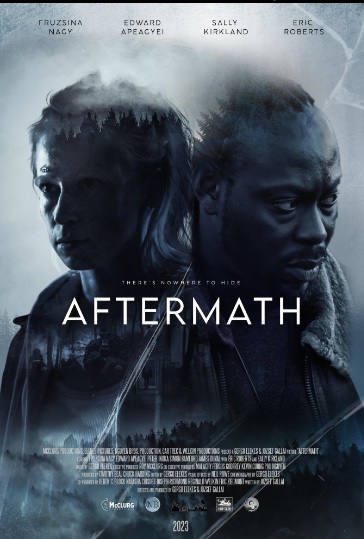
Film Review: Aftermath (dir by Jozsef Gallai and Gergö Elekes)


A woman named Kate (Fruzsina Nagy) drives down a road.  We don’t know where she is driving to but we can tell that she’s driving quickly and she’s not in the mood for any delays.  It’s the way that someone drives when they’re trying to escape but they’re not sure where they want to go.  It’s way you drive when you just want to convince yourself that you can somehow leave everything behind.

We hear what sounds like an accident and suddenly, Kate is waking up in a forest.  Her car is nowhere to be seen and Kate has no idea how she came to be in the forest.  In fact, she’s not even sure who she was before she woke up.  She has no memories of her past life, beyond fleeting visions that don’t always seem to fit together.  Eventually, she meets another apparent amnesiac, Bubba (Edward Apeagyei).  Bubba wears a locket around his neck and there’s a picture of a woman in the locket but he doesn’t seem to be quite sure who she was.

Bubba and Kate are not alone in the forest.  There are other wanderers and then there’s a group of men who appear to be soldiers, wearing crude uniforms and gas masks and carrying machine guns.  (The sight of the soldiers, with their crude uniforms, bring to mind the horrific militias that often spring up in the aftermath of a war and attempt to seize power out of the chaos.)  Receiving cryptic orders from their leader (Eric Roberts), the soldiers patrol the forest and execute anyone that they come across.  Their leader repeatedly tells them that they have to track down and execute everyone because the future of the world depends upon it.  Failure is not an option.

Aftermath deals with a very real fear.  The idea of suddenly waking up and discovering that you have not only lost your identity but also control over your own fate is at the heart of many horror stories and it’s also a reflection of the way many people feel about living in today’s world.  One wrong word, thought, or move and you can find yourself exiled into both a real and metaphorical wilderness.  When Kate wakes up with little memory of what the world was like before she ended up in that forest, she’s feeling what a lot of people have felt when they try to remember the world and their lives before the lockdowns of 2020 and all of the political and societal events that followed.  We live in a world that seems to change from day to day and, as result, everyone has had that moment when, like Kate, they’ve struggled to understand what’s happening.  From the minute that Kate wakes up with the feeling that she has no control over what’s happening to her, she becomes an instantly relatable character.  The audience not only wants to know what’s happening to her but they also want her to regain control of her fate.  If Kate can regain control, then those watching in the audience can also regain control.

The film’s cinematography emphasizes both the grandeur and the ominous atmosphere of the forest, making it a place that manages to be beautiful and threatening at the same time and the deliberate pace builds up suspense as Kate tries to discover why she is in the forest.  Fruzsina Nagy and Edward Apeagyei both give sympathetic and relatable performances as Kate and Bubba and the audience does care what happens to them.  Aftermath is both an intriguing thriller and a meditation on life and love.

Aftermath will be released on digital and blu-ray by Bayview Entertainment on January 30th.


Catching Up With The Films of 2023: Golda (dir by Guy Nattiv)


In Golda, Helen Mirren stars as Golda Meir, the 4th Prime Minister of Israel and the first woman to lead a government in the Middle East.

The film opens in 1974, with a visibly unwell Golda Meir braving a line of protestors as she testified before a commission that is investigating the events that led to the 19-day Yom Kippur War.  Sitting before the members of the commission, Meir lights a cigarette and, as the smoke forms around her, she speaks with a confidence that belies her physical frailness.  It’s the first of many cigarettes that we will see Golda Meir smoke throughout this film.  While Golda Meir was known for being a chain-smoker in real life, her smoking also plays an important thematic role in the film.  Golda Meir is terminally ill throughout the film, secretly undergoing chemotherapy and continually being told that her high-stress job, her cigarettes, and her coffee are not helping her health.  Golda, however, knows what she has to do to keep herself focuses and to handle the stress of being the leader of a small country that is surrounded by enemies and for her, that means drinking a lot of coffee and smoking a lot of cigarettes.  Much like Israel, she is not going to be told what to do by people who do not understand what she has to deal with on a daily basis.  Throughout the film, Golda willingly sacrifices her physical health for Israel, telling her more trusted aide (Camille Cattin) that the only thing that worries her is developing dementia in her old age.  A leader who cannot think cannot lead.

The majority of the film takes place in 1973, during the 19-day Yom Kippur War.  Israel is caught off-guard by a surprise attack led by Egypt and Syria.  Vastly outnumbered, the IDF struggles to repel the invaders.  While dealing with not only her own bad health but also the personal and ideological conflicts within her government, Meir also reaches out to the U.S. Secretary of State, Henry Kissinger (Liev Schreiber) for help.   Unfortunately, Washington D.C. is more concerned with Watergate than with the latest war in the Middle East and, as Meir quickly deduces, there is also worry that Saudi Arabia will cut off its supply of oil to any country that supports Israel.  Though Meir uses a combination of charm and shrewd political gamesmanship to convince Kissinger to put pressure on the Nixon administration, Meir still finds herself being pressured to accept an internationally-brokered ceasefire rather than pursue a strategy of forcing Egypt into negotiations….

Does this sound familiar?  A vicious surprise attack is launched on Israel during a holy day.  The Israeli Prime Minister, who is loved by some and vilified by others, is accused of not being sufficiently prepared for the attack.  Israel is initially isolated from the world, just to be pressured to accept a ceasefire as soon as it starts to prove its resiliency and humiliate its enemies.  Golda completed production before the October 7th attacks but the film feels like a direct response to them, a reminder that Israel has always had to fight for its existence and that it has always proven itself to be stronger than its enemies realize.

Much like Darkest Hour, another film about a leader who was underestimated, Golda plays out like a dream of history, with the emphasis being on Golda Meir moving from one meeting to another, somehow managing to hold everything together while the world sometimes seem to be falling apart around her.  A good deal of the film’s tension comes from the moments when Golda and her advisors wait to hear whether or not their latest move has been a success.  One of the film’s most harrowing scenes features Golda listening over a radio as a group of Israeli volunteers are wiped out by the invading Egyptians.  It’s a scene that reiterates the human cost of war, regardless of which side wins.  (The film makes good use of historical footage of the war, mixing it with scenes of Golda and her cabinet planning their strategy.  Again, it serves to remind the audience that there are real consequences to every decision.)  Held together by Mirren’s intelligent and authoritative performance, Golda is a film full of details that stick with you.  I’ll always remember the scenes of Golda being led through an underground morgue so that she can secretly be treated for the cancer that is slowly killing her.  With each trip, the morgue become more and more filled with bodies.

Though Mirren’s performance was acclaimed, Golda itself opened to mixed reviews.  I suppose in today’s political atmosphere, that’s to be expected.  After all, Golda is not only a pro-Israel film but it’s also a film that portrays Henry Kissinger as being something other than a one-dimensional Bond villain.  For many of today’s very online film reviewers, all of that is heresy.  At a time when some so-called educated people are driven to a rage at just the sight of posters of abducted Israeli children, Golda‘s reception is not a surprise.  At a time when people are making excuses for terrorists who would attack farmers and concert-goers, a films as otherwise different as You Are So Not Invited To My Bat Mitzvah and Golda can feel like acts of beautiful cultural defiance.

History repeats itself, Golda tells us.  Golda may largely take place in 1973 but, ultimately, it’s a film about 2023 and 2024.

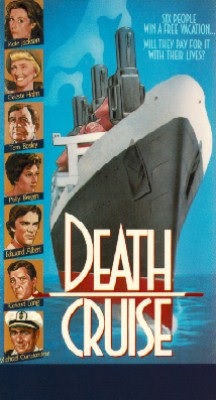
Retro Television Reviews: Death Cruise (dir by Ralph Senesky)


Welcome to Retro Television Reviews, a feature where we review some of our favorite and least favorite shows of the past!  On Sundays, I will be reviewing the made-for-television movies that used to be a primetime mainstay.  Today’s film is 1977’s Death Cruise!  It  can be viewed on Tubi and YouTube.

The thing with the Love Boat is that it promises something for everyone.  It’s a place where you set a course for adventure and put your mind on a new romance.

The same cannot be said of the Death Cruise.

Death Cruise opens with three couples winning an all-expenses paid trip on a luxury liner.  None of the couples are in a happy marriage.  Sylvia Carter (Polly Bergen) is tired of her husband, Jerry (Richard Long), and his philandering ways.  Elizabeth Mason (Celeste Holm) is frustrated with David Mason (Tom Bosley) and his loud dinner jackets.  Mary Frances Radney (Kate Jackson) is fed up with James (Edward Albert) and his smug refusal to start a family.  Of course, it’s not just martial problems that connects these passengers.  It’s also the fact that someone on the boat is stalking and killing them, one-by-one.  Can Dr. Burke (Michael Constantine) and Captain Vettori (Cesare Danova) track down the killer before it’s too late?

Death Cruise is an enjoyably twisty little murder mystery.  It aired in 1974, a good two years before the first Love Boat pilot film appeared on television.  However, both Death Cruise and The Love Boat were produced by Aaron Spelling so the two productions definitely have a shared DNA.  The Love Boat is basically Death Cruise with the addition of a laugh track and considerably less murder.  That said, I have my doubts as to whether Doc Bricker would have been as effective a detective as Dr. Burke.

One of the most interesting things about Death Cruise is how little anyone on the boat really seems to care about the fact that the passengers are turning up dead.  In fact, one widower is asking a widow to be his date to dinner within a few hours of the deaths of their spouses.  Of course, the murderer makes sure that dinner date is canceled but it’s still hard not to wonder whatever happened to an appropriate time of grieving.  Then again, I guess if you’re on a boat for a weekend, you just do whatever feels right at the moment.

(And certainly, if they were on The Love Boat, the walking HR nightmares that was Doc Bricker wouldn’t have wasted any time asking the widows to come by his office for a examination.)

Of the victims and suspects, Richard Long and Edward Albert are memorably sleazy while Tom Bosley plays up just how annoyed he is with the whole situation.  Michael Constantine is a good detective and the movie’s final twist is nicely executed.  Personally, when it comes to cruises, I will always prefer the safety and romance of The Love Boat but Death Cruise was an entertaining nautical diversion.

Godzilla Minus One (dir. by Takashi Yamazaki)


Although I’ve watched a number of Godzilla movies growing up, I’ve only gone to the movies for two. There was Roland Emmerich’s 1998 Godzilla, which was fun for the effects and cringe worthy for the acting. There was also Gareth Edwards 2014 Godzilla, that focused so heavily on the humans, it dodged fighting sequences until the last 30 minutes. Takashi Yamazaki’s Godzilla Minus One is an amazing piece of work that gives the audience a small group of humans to focus on versus a beast that’s a true terror to behold. I laughed, cheered, and gasped at times with this one.

Godzilla Minus One takes place over the course of a few years. When Kamikaze fighter pilot Koiji Shikishima lands on a secret refueling island, the soldiers there discover he’s been trying to dodge his responsibilities. Before anyone can react, however, a large beast arrives, laying waste to the entire base and only leaving Shikishima and head mechanic Tashibana alive.

A year later, Shikishima returns to his home villiage, which is damaged from the war. He happens upon a young woman, Noriko (Minami Hamabe, Shin Kamen Rider) and a little girl named Akiko. He takes them in and gives them shelter, but is haunted by nightmares of the beast. Can Shikishima confront his fears? Can Godzilla be stopped?

The script is one of Godzilla Minus One‘s best strengths. It does borrow from a number of different films, true. There are homages to Jaws, King Kong and even Dunkirk, but at the heart of it all are characters to cheer for (Doc was the stand out for me). Granted, there’s only so many storylines you can come up with when it comes to Kaiju stampeding through a city. Godzilla Minus One keeps things simple enough to make one wonder why their story angle wasn’t tried in any of the recent American adaptations. While I won’t say that American filmmakers don’t know how to handle Godzilla – Godzilla: King of the Monsters was enjoyable as well as Godzilla vs. Kong to a degree – Japan knows how to get the best of their creation, and it shows here.

Working off of a budget of about $15 Million (with some speculation that it’s less than that), Takashi Yamazaki also spearheaded the visual effects, along with Kiyoko Shibuya. The effects are used sparingly, and there are moments where you could think that maybe you’re looking at a guy in a suit. Still, the effects run that line between appearing practical and fully CGI. Some of it gets to be a little wild in the film’s 3rd act, but there’s so much fun involved that you might not notice any inconsistancies with the plot (“He’s just gonna stand there for all this?”, my cousin quipped as I relayed the movie to her scene by scene). From a sound and music standpoint, the film keeps all the classic Godzilla themes you know and love while varying things up a bit. The Godzilla screams are all there, as well. No real surprise there, of course.

Overall, Godzilla Minus One is a fun watch, raising the bar for what Godzilla films could be and puts Takashi Yamazaki’s name on the radar for future projects.

.

Catching Up With The Films Of 2023: Gran Turismo: Based On A True Story (dir by Neill Blomkamp)


Having had a rough day, I decided that I needed to watch a crowd-pleaser tonight.

Gran Turismo: Based on a True Story is definitely that.  The film may have an unwieldy title and it might not really break any new ground as far as sports films are concerned but it’s still definitely a film that will leave viewers feeling satisfied.  It tells the story of Jann Mardenborough (Archie Madekwe), who gets a chance to turn his love for and skill at the Gran Turismo video game into a real life career when he is selected for GT Academy, a school in which the world’s best simulation drivers are trained to be real-life racers.  Though GT Academy may have started out as a PR stunt that was masterminded by executive Danny Moore (Orlando Bloom), both Jann and his trainer, Jack Salter (David Harbour), are determined to prove that the simulation drivers deserve to be taken seriously.

Gran Turismo hits all of the expected moments.  Jann’s father (Djimon Hounsou) is a former professional soccer player who worries that his son is going to waste his life pursuing an impossible dream.  Jann’s mother (played by my favorite Spice Girl, Geri Halliwell-Horner) worries that Jann is going to be one of the drivers who wrecks his car and doesn’t emerge from the remains.  Jann has a pretty and supportive girlfriend named Audrey (Maeve Courtier-Lilley).  Jann has a quirky love for the music of Kenny G and Enya.  Jann has to win everyone’s respect, including Jack’s.  Jann has to deal with arrogant rivals.  Jann has to conquer his own insecurities before he can win and Jack has to conquer his own past before he can truly help to lead Jann to victory.

And, of course, Jann is involved in a massive car wreck that causes him to lose his confidence right before the big race.  The wreck is actually based on something that truly did happen to Jann Mardenborough, though it occurred two years into his racing career as opposed to at the beginning of it.  Tragically, in both the movie and in real life, the crash resulted in the death of a spectator.  One can understand why the car crash was moved (because otherwise, Jann would have been too confident going into the big race and there wouldn’t be as much suspense as to whether or not he would be able to conquer his fears) while also feeling that it was a bit of a tacky thing to do.  The film reducing a real-life tragedy to a plot point feels all the more gauche when you consider that the filmmakers could have just made up some incident to cause Jann to lose his confidence.  I mean, we all know that “based on a true story” doesn’t actually mean that a film’s story is 100% (or even 10%) true.

If you can overlook that bit of narrative tackiness, Gran Turismo is a well-made and likable sports film.  Not a single moment really took me by surprise but, more often than not, I still found myself smiling whenever Jann proves the naysayers wrong and finished strong.  Director Neill Blokamp made a huge splash with his first film, 2009’s District 9, but, his subsequent films have struggled to recapture the energy and narrative verve of his debut.  Gran Turismo proves that Blokamp is still capable of directing a crowd-pleaser.

Catching Up With The Films Of 2023: May December (dir by Todd Haynes)


What comes after a life of tabloid infamy?

That’s one of the many questions posed by Todd Haynes’s latest film, May December.

Elizabeth Berry (Natalie Portman) is an actress who comes to Savannah, Georgia in order to research her next role.  We don’t learn much about Elizabeth’s career as an actress but it appears that, while it has brought her a certain amount of fame, it hasn’t exactly been full of acclaimed work.  One person mentions seeing a picture from a film that she did in which she was involved in a blood sacrifice.  (“I googled ‘naked Elizabeth Berry,'” he explains.)  Several other people mention how much they love her TV show, Norah’s Ark, in which Elizabeth plays a veterinarian.  Elizabeth’s latest film features her playing a real person, someone who was at the center of a scandal 20 years previously and who has since faded from the public view.  Elizabeth seems to believe that this role could redefine her career.

(Hey, it worked for Margot Robbie in I, Tonya.)

Elizabeth is going to play Gracie Atherton-Woo in an upcoming indie film.  Way back in 1992, the real-life Gracie (Julianne Moore) was 36 years old and married when she was caught having sex with a 13 year-old named Joe in the back of a pet store.  Joe was a classmate of Gracie’s son and Gracie was the one who was responsible for him getting hired at the pet store in the first place.  Gracie was sent to prison, where she gave birth to Joe’s daughter.  During her trial, Gracie and Joe were both tabloid mainstays.  The nation was transfixed by their affair before eventually moving on to the next scandal.  When Gracie was eventually released from prison, she married Joe.  Now, decades after appearing on the front of every trashy magazine, Gracie and Joe (Charles Melton) are still married and they now have three children.  They live in a big house in Savannah, Gracie has a career as a pastry maker, and, from the outside, they would appear to have a perfect domestic life together.

Wearily, Gracie and Joe allow Elizabeth to spend time with the family so that she can research her role.  Elizabeth interviews other people who were effected by Gracie’s actions.  Gracie’s ex-husband (D.W. Moffett) is surprisingly forgiving.  Gracie’s children are considerably less forgiving.  Georgie (Cory Michael Smith), who was Gracie’s son from her first marriage and a schoolmate of Joe’s, is bitter and describes his mother as being mentally unbalanced while, at the same time, trying to leverage his knowledge of Gracie’s past into a job on the film.  As for Gracie and Joe’s first daughter (Piper Churda), she states that she doesn’t want the film to be made.

Cracks start to appear in the perfect image that Gracie and Joe present to the world.  Gracie can be rigid and controlling while insisting that Joe was the one who initiated the encounter in the pet store.  Gracie talks about growing up with four brothers, two of whom were older and two were younger.  Gracie mentions that one of her brothers is an admiral and it’s implied that she grew up in an atmosphere where failure was not an option.  Gracie’s daughter talks about how, when she graduated, her mother gave her a scale as a graduation gift.  When someone cancels an order for a cake, Gracie takes it as a personal rejection and breaks down into tears.  Gracie is friendly towards Elizabeth but never totally lets down her guard.

As for Joe, he emerges as well-meaning but confused, someone who is still often treated like a child by bother his wife and, eventually, the woman who is studying his wife.  Whenever we see Joe with any other adults, he’s awkward as if he’s not sure how to behave.  (When he tells his elderly father that he can hardly believe that all of his children will soon be in college, the old man’s silence tells us everything that we need to know about their relationship.)  Joe is nearly forty but it’s clear that a good deal of his emotional development stopped when he was thirteen, leaving him desperate for approval.  When he catches his teenage son smoking a joint, Joe isn’t angry as much as he’s curious.  Smoking weed is one of the many things that Joe never did when he was younger.  When Joe get high, he becomes a paranoid and emotional mess as all the feelings that he’s repressed for 23 years come spilling out.  At the same time, when Gracie has a breakdown, Joe knows exactly what to say to help her through it.

Do Gracie and Joe truly love each other or is their marriage just their way of denying the reality of what happened?  Did Gracie groom Joe or, as Gracie insists, was their affair consensual?  At first, the audience’s natural tendency is to sympathize with Elizabeth and to expect her to play some sort of role in clarifying what actually happened in that pet store.  But Elizabeth soon proves herself to be a rather detached observer, a mimic who copies the emotions of others but who, even after she gets to know Gracie and Joe as human beings, still views them as just being characters in a story.  In the end, Elizabeth can’t help us understand what happened in the pet shop because, the film suggests, not even the people who were actually there understand what happened.  All Elizabeth can do, as an actress and an observer, is try to recreate what she imagines happened.

It’s a well-made film, with Haynes deftly mixing scenes of high drama with the awkward comedy of people trying to rationally discuss the irrational.  It can also be a frustrating viewing experience, if just because Haynes often does not seem to be sure what he’s trying to say about the characters or why we should even care about either Gracie or Elizabeth.  Fortunately, the film is lucky enough to have a wonderful cast.  While Moore and Melton gets the big, dramatic scene, it’s Portman who takes the audience by surprise, giving a performance that goes from being likable to being rather chilling as Elizabeth transforms herself more and more into Gracie.  For all the film’s themes about conformity, morality, and tabloid culture, it’s main message may very well be to never trust a method actor.

May December sticks with you, even if it’s not up to the level of Haynes’s Carol.  It’s a film about what happens after the infamy, with Gracie, Joe, and Elizabeth destined to be forever defined by what happened over the course of a few minutes in the backroom of a pet store.

Catching Up With The Films of 2023: After Everything (dir by Castille Landon)


The saga of the world’s most boring and tedious couple finally comes to an end in After Everything.

When last we checked in on Tessa Young (Josephine Langford) and Hardin Scott (Hero Fiennes Tiffin), they were probably both wondering how they ended up with the type of names that most people would expect to find attached to fake profiles on a dating app.  Tessa had also just left Hardin, upset that he used the details of their relationship to write his first novel, After.

After Everything opens with best-selling, voice-of-his-whiny-generation Hardin being pressured to come up with a follow-up novel but he has writer’s block because Tessa won’t even return his texts.  As he explains it, he’s lost his muse and he can’t write anything without her.  (Maybe he should send her some of the money that he made off of her life story then.)  Despondent, Hardin starts drinking again.  This would be a big plot point if not for the fact that, in every After film, the alcoholic Hardin starts drinking again.  Hardin has gotten sober and given up his sobriety so many times that, at this point, it’s more about being indecisive than anything else.  Either be a drunk or don’t be a drunk but make up your freaking mind.

Hardin does what any struggling writer would do when confronted with writer’s block.  He goes to Portugal and reunites with a woman whose life he ruined.  Natalie (Mimi Keene) had a scholarship and a promising future until Hardin filmed himself having sex with her in order to win a bet.  When Hardin’s friends made the film public, Natalie was humiliated, she lost her scholarship, and she spent years mired in depression before she escaped to Portugal.  In a plot twist that is not only dumb but also rather offensive, she’s surprisingly forgiving of Hardin when he shows up in Lisbon.  Sure, he took her virginity to win a bet and sent a video to all of his friends without her consent but hey, Hardin’s had a rough life as the privileged child of two wealthy people who give him everything that he wants.  Natalie’s life may have been ruined, the film tells us, but Hardin has recently spent a few weeks feeling bad about it so they’re even.  Natalie introduces him to all of her friends.  (It doesn’t take long because Natalie only has two.)  Everyone is really impressed to discover that Hardin wrote After.

“I hear they’re making a movie!” one friend says.

“Harry Styles should play you!” the other friend shouts, a reference to the fact that the whole damned After franchise started as Harry Styles fan fiction.

(It’s a moment so awkwardly executed and so self-congratulatory that it reminded me of the moment in the second film when the author of the original book made a cameo appearance.  “What do you write?” she was asked.  “Oh,” she replied, smirking directly at the camera, “this and that.”  I threw a shoe at my TV but, fortunately, I have terrible aim.)

If Natalie forgiving Hardin isn’t bad enough, Hardin also decides to write a book about the time that he ruined her life, a book that he cleverly entitles Before.  You really do have to wonder if Hardin has ever met anyone that he didn’t end up exploiting in some terrible way.  Having learned his lesson with Tessa, Hardin allows Natalie to read the book before sending it off to the publisher.  Natalie happily gives her consent for it to be published because what girl wouldn’t want the guy who sexually humiliated her to use the memories of that humiliation as a way to make money for himself?

As you may have noticed, Tessa is not present for the majority of After Everything, though she does appear in several flashbacks to the earlier films.  She shows up briefly at the beginning and then the end of the film and there’s a point about halfway through the film where she wakes up and discovers that Hardin has sent her a weepy text.  When Hardin gives his best man speech at his half-brother’s wedding reception and, as usual, makes it all about himself, there’s a shot of Tessa looking moved.  But, for the most part, this installment is all about Hardin thinking about the past and saying stuff like, “I’m trying to be a better person.”  Of course, we do still get the franchise’s signature overheated but discreetly-shot sex scenes, though one of them is just Hardin having a dream about a flight attendant while most of the rest are just flashbacks.

(This film has so many flashbacks to the previous films that it’s hard not to notice that the franchise’s makeup artists could never quite remember the exact locations of all of Hardin’s tattoos.)

Unfortunately, Hero Fiennes Tiffin’s bland performance as Hardin has always been one of After’s biggest problems so basing an entire movie around his petulant screen presence was perhaps not the best way to go.  We are continually told that Hardin Scott is the most exciting writer in the world but there’s nothing about Tiffin’s performance that suggests that Hardin can even think in complete sentences, let alone write them down.  Hardin spends a lot of time whining and a lot of time drinking and there comes a point where you just want someone to say, “You’re a twenty-something alcoholic who is still bitching about stuff that most people get over when they’re 16.  Grow up.”  Unfortunately, no one does say that.  However, about 52 minutes into the film, Hardin totally gets his ass kicked by some beach bullies.  That was emotionally satisfying to watch.

In the end, Hardin and Tessa are reunited.  After five movies, Josephine Langford and Hero Fiennes Tiffin still do not have a shred of romantic chemistry.  It’s nice that Hardin and Tessa worked everything out but I would still dread getting stuck in a conversation with either one of them.

Apparently, this is the last of the After films and that’s probably for the best.  At this point, I think the only place left to go would be After Life, with Tessa and Hardin boring everyone in Purgatory with their story about how they first bonded over their shared love of an obscure novel called The Great Gatsby.  Writing this review, I was shocked to discover that this franchise is only 4 years old.  Seriously, I thought had been suffering for at least ten years because of these two.

Other After Films:

  1. After
  2. After We Collided
  3. After We Fell
  4. After Ever Happy

Death Warrant (1990, directed by Deran Sarafian)


A series of murders have occurred at Harrison State Prison in California.  What better way to investigate the crimes and catch the guilty than to send in an undercover cop?  Who can enter a California prison and investigate the crime without drawing too much attention to himself?  It would have to be someone who could blend in with the population without seeming out of place.

How about Jean-Claude Van Damme?

Van Damme, in one of his early films, stars as Louis Burke, a Canadian with a Belgian accent who comes to Los Angeles to track down a serial killer known as the Sandman (Patrick Kilpatrick, who was last seen running for governor of California in 2021) and then just sticks around.  Burke enters the prison and somehow, he is not immediately tagged as being a B-movie star who is working for the police.  I guess California prisons are full of Belgian kickboxers.

A realistic portrait of prison and police work, this is not.  But it is Van Damme at his most berserk, flexing his muscles and shouting at his enemies and getting hit in the head by a flying wrench at one point.  To the surprise of no one, the Sandman eventually ends up in the prison with Burke and it leads to an epic showdown that takes place in the middle of a prison riot.  The fight is exciting because Van Damme and Kilpatrick were two tough actors who, at that point in their careers, had nothing to lose by going all out on screen.

(Of the three major B-action stars of the 90s, Dolph Lundgren was the one you watched because he could actually act.  Steven Seagal was the one you watched because you hoped someone would beat him up.  Jean-Claude Van Damme was the one you watched because he could actually do everything he did in the movies in real life as well.)

There are many good actors to be found in Death Warrant, playing paper-thin characters.  Robert Guillaume is the one-eyed clerk who takes Burke under his wing.  Larry Hankin is the biggest weasel in the prison.  Art LaFleuer is the prison guard from Hell.  George Dickerson is the obviously corrupt official.  Abdul Salaam El-Razzac is the voodoo priest who watches over the prison.  Cynthia Gibb is the attorney who pays Burke a conjugal visit.  It’s good to see them all.

Death Warrant is a dumb and entertaining B-movie that doesn’t take itself too seriously.  It’s not Van Damme’s best but it’s not his worst either.  It’s Damme fun.

The Eric Roberts Collection: Top Gunner: America vs Russia (dir by Christopher Ray)


The latest addition to the quasi-franchise that started with 2020’s Top Gunner, 2023’s Top Gunner: America vs Russia takes place in the near future.

Russia’s war with Ukraine has led to a stalemate.  When the United States starts to take a more active role in defending Ukraine and arming the dissidents in Russia, it leads to a coup in Russia.  President Vasiliev (Alex Veadow) wants to bring about a new era of peace but, when he’s assassinated, the new president of Russia, the evil Borovsk (Pavel Kuzin), accuses the United States of being behind the murder and declares war on the U.S.A.  Soon, Russian jets are invading the airspace of Washington D.C. and blowing up the Washington Monument.  (The White House gets hit by a bomb as well but, fortunately, it’s not a very impressive bomb.)  Borovsk is such a fanatic that he is even prepared to launch his country’s nuclear arsenal against America.  Such an action would, of course, lead to the end of the world.

Fortunately, America is not just going to roll over and accept defeat.  (Or, at least, it’s not going to accept defeat in the movies.  In the real world, it seems to be a different story.)  America has fighter pilots, like Footloose (Andrew Rogers) and Firefly (Kayla Fields), who are dedicated to defending the nation.  America has a super-secret new jet than can even fly into deep space so it can fire missiles at a Russian satellite.  America has got CIA operatives like Veronica Vachs (Simone Posey) operating in Moscow.  America has got a Vice President (Gary Poux) who believes in the country’s destiny.  And, perhaps most importantly of all, America has got Eric Roberts.

Eric Roberts also appeared in the first Top Gunner, though he was playing a different character in that film.  In Top Gunner, Eric Roberts was a flight instructor.  In Top Gunner: America vs Russia, Eric Roberts is …. PRESIDENT OF THE UNITED STATES!

As President Jeremiah Stewart, Eric Roberts gives orders and refuses to be pushed around and always puts America first.  When he hears that Washington D.C. might soon be attacked, he doesn’t show a hint of fear.  He doesn’t run off to a bunker.  He doesn’t whine about not being popular.  He doesn’t desert America’s allies.  Seriously, he’s one of the best president that I’ve ever seen and I would certainly vote for Jeremiah Stewart in 2024 before I even considered casting a ballot for any of the other jokers that are running.  Just by casting Eric Roberts as the President, Top Gunner: America vs Russia wins the war.  When Roberts says that he doesn’t care what the official protocol is, you believe him.  I bet when he’s not fighting the Russians, President Stewart is working to repeal the 16th Amendment.  (That’s the one about income tax.)  Seriously, I want to see this guy on Mt. Rushmore.

Anyway, this is a typical Asylum film.  The special effects are cheap but it seems like everyone had fun working on the film and it’s hard not get swept up in the silliness of it all.  I mean, at one point, a fighter plane literally flies into space without a bit of concern for stuff like oxygen or heat shields or anything else.  It’s so shamelessly absurd that it feels rather churlish to nitpick.  Most importantly, it’s a movie about how America kicks ass and, in these troubled times, who can’t appreciate that?  I mean, how could we not kick ass with Eric Roberts leading us?

Previous Eric Roberts Films That We Have Reviewed:

  1. Star 80 (1983)
  2. Blood Red (1989)
  3. The Ambulance (1990)
  4. The Lost Capone (1990)
  5. Love, Cheat, & Steal (1993)
  6. Love Is A Gun (1994)
  7. Sensation (1994)
  8. Dark Angel (1996)
  9. Doctor Who (1996)
  10. Most Wanted (1997)
  11. Mr. Brightside (2004)
  12. Six: The Mark Unleased (2004)
  13. Hey You (2006)
  14. In The Blink of an Eye (2009)
  15. Enemies Among Us (2010)
  16. The Expendables (2010) 
  17. Sharktopus (2010)
  18. The Dead Want Women (2012)
  19. Deadline (2012)
  20. The Mark (2012)
  21. Miss Atomic Bomb (2012)
  22. Lovelace (2013)
  23. The Mark: Redemption (2013)
  24. Self-Storage (2013)
  25. This Is Our Time (2013)
  26. Inherent Vice (2014)
  27. Road to the Open (2014)
  28. Rumors of War (2014)
  29. Amityville Death House (2015)
  30. A Fatal Obsession (2015)
  31. Stalked By My Doctor (2015)
  32. Joker’s Poltergeist (2016)
  33. Prayer Never Fails (2016)
  34. Stalked By My Doctor: The Return (2016)
  35. The Wrong Roommate (2016)
  36. Dark Image (2017)
  37. Black Wake (2018)
  38. Stalked By My Doctor: Patient’s Revenge (2018)
  39. Clinton Island (2019)
  40. Monster Island (2019)
  41. Seven Deadly Sins (2019)
  42. Stalked By My Doctor: A Sleepwalker’s Nightmare (2019)
  43. The Wrong Mommy (2019)
  44. Exodus of a Prodigal Son (2020)
  45. Free Lunch Express (2020)
  46. Her Deadly Groom (2020)
  47. Top Gunner (2020)
  48. Deadly Nightshade (2021)
  49. Just What The Doctor Ordered (2021)
  50. Killer Advice (2021)
  51. The Poltergeist Diaries (2021)
  52. A Town Called Parable (2021)
  53. Bleach (2022)
  54. My Dinner With Eric (2022)