A Quickie With Lisa Marie: Smashed Blocked (performed by John’s Children)


Four years ago, I was in Recycle Books in Denton, Texas and I came across a book called something like “Unknown Legends of Rock and Roll.”  The book came with a CD that featured music by some of the bands featured in that book.  The first song on that CD (and my personal favorite) was Smashed Blocked, a song from a band called John’s Children. 

(It’s a good book, too.)

A Few Thoughts On The Girl With The Dragon Tattoo Remake


Have I mentioned how much I loved The Girl With The Dragon Tattoo?  Have I suggested that the late Stieg Larsson, in the Millenium Trilogy, did for Europe what James Ellroy did for America with the American Tabloid trilogy?  Have I gone into the fact I think Noomi Rapace’s performance as Lisbeth in both the original film and its sequels will probably be remembered as one of the greatest film performances of all time?  Have I explained that I think, even beyond Rapace’s performance, Lisbeth herself is one of the best characters in the history of film?  For that matter, have I talked about the hours that I’ve spent standing with my back to a mirror and looking over my shoulder and debating on which shoulder-blade a dragon would look most appropriate?  Personally, I think my left shoulder-blade is a bit nicer than my right but last night, my friend Jeff was telling me that…

Sorry, I’m losing focus here.  Okay, getting the ADD under control.  Anyway, the point of the matter is that I love The Girl With The Dragon Tattoo. 

That’s why I feel a lot of caution about the upcoming, David Fincher-helmed remake.  First off, quite frankly, I really don’t see what can be improved on the original films.  It’s not as if the original film version of the Girl With The Dragon Tattoo failed to do justice to the book (if anything, the book fails to do justice to the film that eventually made from it).  I suppose a remake would give people who can’t handle subtitles the chance to see the story but honestly, who cares about those losers?  Speaking of the story, the rumors I hear seem to indicate that this remake is going to be an “Americanized” version of The Girl With The Dragon Tattoo, which I’m not really sure can be done as the entire book is basically meant to act as a metaphor for Swedish society.  Of course, it is possible that the remake is going to be set in Sweden as well but if that’s the case, what’s the point of the remake?

I know the usual argument to these concerns is that, as a director, Fincher will not allow the film to be Hollywoodized.  At one point that may have been true but, judging from The Curious Case of Benjamin Button, Fincher’s got more Hollywood in him than most people want to admit.  The fact that he’s also teamed up with Aaron Sorkin (an establishment figure if there ever was one) to direct a movie about Facebook doesn’t exactly fill me with confidence but I’ll hold off on judging until the Social Network actually shows up in theaters.
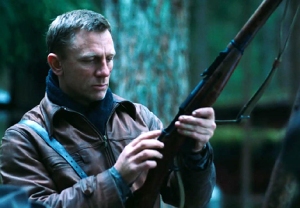
However, I am encouraged by the news (announced yesterday) that Fincher has cast Daniel Craig as the male lead, Mikael Blomkvist (or whatever his name is going to be in the Hollywood version).  Craig’s name had been mentioned for the role ever since the remake was first announced but there were also reports that the role would go to Brad Pitt (who, of course, has already made 3 films with Fincher).  Nothing against Brad Pitt (who I think is a truly underrated actor) but it’s hard to think of a worst choice for the role of Mikael.  Mikael’s defining characteristic is just how ineffectual he is.  He’s the ultimate well-meaning intellectual, the type of guy who wants to fight injustice but is to insulated from the harsh realities of life to effectively do so.  (That’s why he needs Lisbeth, she represents everything he wishes he could do but can’t.)  In short, Mikael is a hero by default and casting an actor like Brad Pitt would throw the entire movie off-balance.

Mikael is not a role for a star.  Mikael is a role for a character actor and, James Bond aside, that’s exactly what Daniel Craig is.  (That’s one reason why Craig’s Bond is dull, regardless of how good a performance Craig gives in the role.)  Not only is Craig the right age, he projects just the right amount of idealistic weariness for the role.  Admittedly, it helps that Craig bears a passable physical resemblance to the original Mikael, Michael Nyqvist which, if nothing else, will make it easier for fans of the original film — like me — to accept him.

(For the record, my personal choice for Mikael would have been Tim Roth.)

Of course, the question now is who will win the role of Lisbeth and why would they want it?  For me, Noomi Rapace is Lisbeth.  She is the girl with dragon tattoo.  It’s hard to think of single mainstream actress in her 20s or early 30s who could hope to match Rapace’s performance.  (Perhaps a young Angelina Jolie could have though physically, Jolie is all wrong for the part.)  However, even beyond what Rapace did with the character, Lisbeth is one of the most vivid and memorable characters in recent literary history.  Even without having to worry about the shadow of Rapace’s previous performance, the role is not an easy one.

Originally, rumor had it that Kristen Stewart was a lock for the role.  At the risk of being burned at the stake as a heretic, I’m going to say that I think Stewart could have been an adequate (though not a great) Lisbeth except for the fact that she’s about ten years too young.  (While Lisbeth is described as looking like a teenager, she also projects a worldliness of someone much older.  Physical appearance can be faked but life experience can not.)  Carey Mulligan, star of An Education (the best film of 2009, by the way), was another actress who was frequently mentioned.

Well, according to Entertainment Weekly, neither Stewart nor Mulligan will play Lisbeth Salander.  Neither will Natalie Portman who, according to EW, was offered the role but turned it down.  The offer to Portman makes sense as she’s physcially right for the role and she’s an undeniably talented actress.  However, much as Pitt could never have been convincing as Mikael, Portman would have been miscast as Lisbeth.  Portman may be a talented actress but she’s also a rather passive one.  Even in her previous “action” roles (Leon, V For Vendetta), Portman essentially played a lost, damaged character (much like Lisbeth) who needed an older male figure to serve as her mentor (which, needless to say, is nothing like Lisbeth).

Again, according to EW, the role of Lisbeth has been narrowed down to four actresses: Rooney Mara, Lea Seydoux, Sarah Snook, and Sophie Lowe.  It’s probably a good sign that none of these actresses are household names exactly.  Competing with the shadow of Noomi Rapace’s Lisbeth is going to be difficult enough without also having to deal with the shadow of their own previous performances.  (For instance, even if Stewart gave a brilliant performance as Lisbeth, it would still be impossible for me to get through the remake without making at least one Twilight joke.)

For me, the real question is not who is going to be cast as Libseth but if Fincher and his producers are going to give us the real Lisbeth — this would be the unapologetically lesbian Lisbeth who can only befriend Mikael once she’s sure that she doesn’t any sort of sexual attraction towards him — or if we’re going to get a more mainstream, Hollywood version of Lisbeth.  Are we going to get the real Lisbeth who needs no one or are we going to get another version of what Hollywood claims to be a strong woman, one who can fight up until the final 30 minutes of the film at which point she’s suddenly rendered helpless by the demands of Mainstream Filmmaking 101.

More than anything, that will be the test that Fincher’s Girl With The Dragon Tattoo will have to pass if it wants to be anything more than an unneeded imitation of the original.

(Incidentally, the perfect Lisebth Salander would be Jena Malone.  End of story.)

My Top Ten Books About The Movies


I love movies and I love books so I guess it would stand to reason that I love books about movies the most of all.  (I also love movies about books but there are far fewer of those, unfortunately.)  Below are my personal favorites.  I’m not necessarily saying that these are the ten greatest film books ever written.  I’m just saying that they’re the ones that I’m always happy to know are waiting for me at home.

10) Soon To Be A Major Motion Picture by Theodore Gershuny — This is one of the great finds of mine my life.  I found this in a used bookstore and I bought it mostly because it only cost a dollar. Only later did I discover that I had found one of the greatest nonfiction books about the shooting of a movie ever written!  Gershuny was present during the filming of a movie called Rosebud in the early 70s.   I’ve never seen Rosebud but, as Gershuny admits, it was a critical disaster that managed to lose a ton of money.  The book provides a fascinating wealth of backstage gossip as well as memorable portraits of director Otto Preminger and actors Robert Mitchum (who was originally cast in the lead role), Peter O’Toole (who took over after Mitchum walked off the set), and Isabelle Huppert.   If nothing else, this book should be read for the scene where O’Toole beats up critic Kenneth Tynan.

9) Suspects by David Thomson — A study of American cinema noir   disguised as a novel, Suspects imagines what would happen if George Bailey from It’s a Wonderful Life fell in love with Laura from the movie of the same name.  Well, apparently it would lead to Sunset Boulevard’s Norma Desmond having an affair with Chinatown’s Noah Cross and to one of George’s sons, sensitive little Travis, getting a job in New York City as a Taxi Driver.  And that’s just a small sampling of what happens in this glorious mindfuck of a novel.

8 ) Profondo Argento by Alan Jones — Long-time fan Alan Jones examines each of Dario Argento’s films (even Argento’s obscure historical comedy The Five Days of Milan) and proceeds to celebrate and (in many cases) defend Argento’s career.  Jones also interviews and profiles several of Argento’s most frequent collaborators — Daria Nicolodi, Asia and Fiore Argento, Simon Boswell, Claudio Simonetti, Keith Emerson, George Romero, Lamberto Bava, Michele Soavi, and many others.  Jones’ sympathetic yet humorous profile of Luigi Cozzi is priceless.

7)  Spaghetti Nightmares by Luca Palmerini — Spaghetti Nightmares is a collection of interviews conducted with such Italian filmmakers as Dario Argento, Ruggero Deodato, Umberto Lenzi, Lucio Fulci, and others.  Among the non-Italians interviewed are Tom Savini (who, as always, comes across as appealingly  unhinged) and David Warbeck.  (Sadly, both Warbeck and Fulci would die shortly after being interviewed.)  What makes this interesting is that, for once, Argento, Fulci, et al. are actually being interviewed by a fellow countryman as opposed to an American accompanied by a translator.  As such, the subsequent interviews turn out to be some of the most revealing on record.

6) Sleazoid Express by Bill Landis and Michelle Clifford — Landis and Clifford’s book is both a history and a defense of the old grindhouse theaters of New York City.  Along with describing, in loving and memorable detail, some of New York’s most infamous grindhouses, they also write about some of the more popular movies to play at each theater.  Along the way, they also offer up revealing profiles of such legendary figures as David Hess and Mike and Roberta Findley.  Reading this book truly made me mourn the fact that if I ever did find myself in New York City, I won’t be able to hit the old grindhouse circuit.

5) Beyond Terror: The Films of Lucio Fulci by Stephen Thrower — Fulci has always been a terribly underrated director and, indeed, it’s easy to understand because, in many ways, he made movies with the specific aim of alienating and outraging his audience.  It requires a brave soul to take Fulci on his own terms and fortunately, Stephen Thrower appears to be one.  Along with the expected chapters on Fulci’s Beyond Trilogy and on Zombi 2, Thrower also devotes a lot of space to Fulci’s lesser known works.  Did you know, for instance, that before he became the godfather of gore, Fulci specialized in making comedies?  Or that he also directed two very popular adaptations of White Fang?  Thrower also examines Fulci’s often forgotten westerns as well as his postapocalyptic sci-fi films.  And, best of all, Thrower offers up a defense of the infamous New York Ripper that, when I read it, actually forced me to consider that oft-maligned film in a new light.  That said, Thrower does admit to being as confused by Manhattan Baby as everyone else.

4) Immoral Tales by Cathal Tohill and Pete Toombs — Tohill and Toombs offer an overview of European “shock” cinema and some of the genre’s better known masters.  The book contains perhaps the best critical examination of the work of Jean Rollin ever written.  The authors also examine the work of Jesus Franco and several others.  This is a great book that reminds us that the Italians aren’t the only ones who can make a great exploitation film.

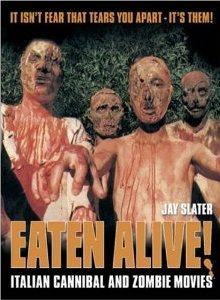
3) Eaten Alive by Jay Slater — This book offers an overview of the Italian film industry’s legendary cannibal and zombie boom.  Along with reviewing every Italian movie to feature even the slightest hint of cannibalism or the living dead (this is one of the few books on Italian cinema that discusses both Pasolini and Lucio Fulci as equals), Eaten Alive also features some very revealing interviews with such iconic figures as Catriona MacColl, Ian McCullough, and especially Giovanni Lombardo Radice.  Radice, in fact, also contributes a memorable “guest” review of one of the movies featured in the book.  (“What a piece of shit!” the review begins.)  Memorable reviews are also contributed by Troma film founder Lloyd Kaufman who brilliantly (and correctly) argues that Cannibal Holocaust is one of the greatest films ever made and Ramsey Campbell who hilariously destroys Umberto Lenzi’s infamous Nightmare City.

2) The Book of the Dead by Jamie Russell — If, like all good people, you love zombies then you simply must do whatever it takes to own a copy of this book.  Starting with such early masterpieces as White Zombie and I Walked With A Zombie, Russell proceeds to cover every subsequent zombie film up through George Romero’s Land of the Dead.  Russell offers up some of the best commentaries ever written on Romero’s Dead films, Fuci’s Beyond Trilogy, Rollin’s Living Dead Girl, and Spain’s Blind Dead films.   The pièce de résistance, however, is an appendix where Russell describes and reviews literally ever zombie film ever made.

1)  All The Colors Of the Dark by Tim Lucas  — This is it.  This is the Holy Grail of All Film Books.  If you’ve ever asked yourself if any book is worth paying close to 300 dollars, now you have your answer.  This one is.  Tim Lucas offers up the most complete biography of director Mario Bava ever written.  In fact, this may be the most complete biography of any director ever written!  Lucas examines not only Bava’s life but also every single movie that Bava was ever in any way connected to, whether as a director or as a cameraman or as the guy in charge of the special effects.  This is 1,128 pages all devoted to nothing but the movies.  This is the type of book that makes me thankful to be alive and I owe a huge debt of gratitude to Tim Lucas for writing it.

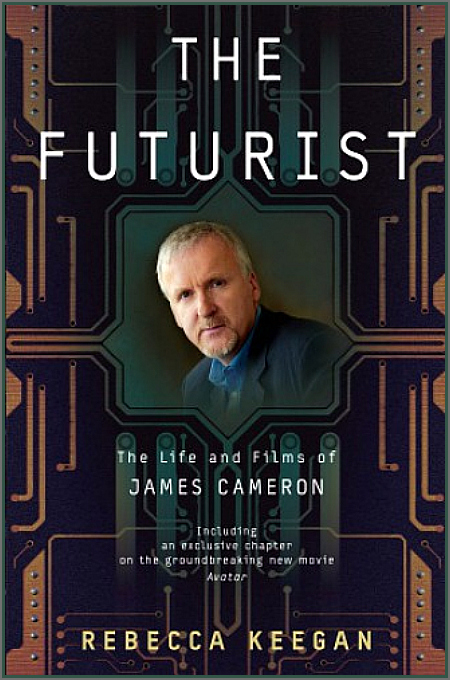
Review: The Futurist – The Life and Films of James Cameron (by Rebecca Keegan)


2009 will probably go down as the year James Cameron returned from a self-imposed exile from feature-lenght filmmaking. It has been 12 years since his last major film for a big Hollywood studio. Titanic became the all-time box-office king with Cameron winning accolades and awards for his efforts. He was no flushed with money which has allowed him to take a break from making films audiences have come to expect from him. Instead he decided to go back to his first true-love growing up in Chippewa, Canada. Cameron went exploring the deepest parts of the ocean not just as a filmmaker but a scientists, researcher and explorer. This time of his life after proclaiming himself “King of the World” in the 1998 Academy Awards shows the dichotomy of James Cameron’s life and personality: the artist and scientist in one body.

It is the task of Rebecca Keegan’s biography of this modern-day renaissance man to give an insight as to how the two sides of Cameron made him the success he is today and one of the pioneers in filmmaking. The Futurist will look back to his childhood and, with unprecedented access to Cameron’s family, close friends, associates and, best of all, James Cameron himself, show us a glimpse at the very reclusive filmmaker. The book doesn’t overly fawn over Cameron’s talents and achievements, but if there was a man deserving such attention it would be Cameron.  Keegan never really points out and concentrate on the negatives of Cameron’s life and personality, but does allow these traits to show how committed and focused an individual Cameron was when it came to his work and demanded nothing less from those who worked with him.

The book details how Cameron’s parents may have had a major influence in how he turned out in life. Born of a father who was a mechanical engineer and an artist of a mother with a self-reliance and powerful personality which would imprint the young Cameron at an early age. In fact, Keegan devotes the early sections of the book to showing how gifted the Cameron brood was from Jim’s parents to his four other siblings. But in the end, it was Cameron who was the take-charge of the litter. Even at an early age it was he who led the other kids on his projects (which included building a plane from scraps and junk around the neighborhood). Right from the beginning Keegan was able to show us the many experiences and influences that both lead to him being one of the world’s foremost filmmakers to one also renowned for his dictatorial-style on the film set.

The Futurist really offers just a glimpse on the life of Cameron. It is a life that could almost be a primer for all young people dreaming to be filmmakers themselves or just whatever they want to do in life with something they love. Keegan’s casual writing style doesn’t have the dry, academic tone of most biographies. She almost treats the biography’s many chapters as a behind-the-scenes look into every film project Cameron has been a part of. From his early days as model builder in Roger Corman’s New World Pictures right up to his latest project for 20th Century Fox, Avatar. While each film discussed was already quite interesting for a fan of the filmmaker and those films, I was even more interested in finding out how Cameron’s own dedication and laser-like focus on each project showed both the genius and madman aspect of the man. Here was an individual so intelligent that he could converse with artists and scientists and keep up, if not, hold his own.

One specific anecdote in the biography which shows a lot about Cameron as a modern renaissance man was his time between Titanic and Avatar. This was a part of Cameron’s life where the scientist in him took precedence. He was working on a Mars film project and had come to work with NASA engineers and scientists on future plans to try and reach the Red Planet. Having access to unofficial papers and technical papers on such a project, Cameron was able to come up with a hybrid Mars lander which would also double as the rover. He submitted the plans and design specs to this “lander rover” to the NASA team who ended up more than impressed. A similar-looking lander rover would soon land on a later Mars mission and all thanks to the outside the box thinking Cameron was able to add to the scientists who had been working for years on the project. One of the NASA engineers was so impressed that he was heard to have commented that if Cameron wasn’t a filmmaker he definitely would’ve turned out to be an exceptional engineer.

It’s that admiration from those who have worked with Cameron which comes up more than once in Keegan’s book. She shows not just his artistic side but his love of science and research. Cameron definitely comes off as the know-it-all in the room. Whether one sees that as a negative or a positive it doesn’t change the fact that he probably does know it all and do it better than most in a room of contemporaries. We learn from Keegan’s inside-look at Cameron’s life how he could easily be a one-man film set. Most filmmakers, even great ones, rarely pick up a camera or become a major part of the editing process. Cameron could do everything that needs to be done on a set minus the acting. The Futurist also goes to great lenghts to point out that while Cameron was great at pretty much anything the needs to be done to make a film as a writer he admits to her how much he struggles at it. He sees the writing side of the film equation as something he wished he could do better and always trying to improve at it. This goes towards the many criticisms about Cameron’s film being cardboard cutouts of stories already done and done better. It goes to explain Cameron’s need to control every aspect of his film projects that he only trusts himself and, maybe close friends, to write the script for his films.

He wants to film his stories, his ideas and not other people. It definitely shows how many in Hollywood could equate that with him being very egocentric in how he deals with his peers. Some may admire this trait and others may see it as a man over his head and banking on the simple taste of the general population to make his films succeed. While I do not subscribe to the latter, I do think that much of the backlash he has received with his last two films go back to his ego and superiority over others. It is not easy for people who think they know what they talk about when it comes to film and everything that goes in making one be made to feel stupid when he makes it known. But then he has made a habit of being vindicated in the end despite these trait flaws. As the saying goes, “Sometimes the truth hurt.” James Cameron definitely comes across in the book as a no-nonsense, bullshit-free dictator who is smarter than everyone else.

In the end, Rebecca Keegan’s The Futurist is an engaging look-inside the mind of the man who has proclaimed himself “King of the World” and who others have called under their breath as a tyrannical dictator of a filmmaker. While the book could’ve been much longer and gone into even more detail about Cameron, his life and his films Keegan has definitely laid down the groundwork on any future Cameron biographies both official and unofficial. There’s definitely more to learn about this unique blending of romantic artists and dedicated science genius in one mind and body. For fans of James Cameron this book is definitely a must-have and read. For those just wanting to know more about this pioneer filmmaker then this book is a great primer to learning more about him.

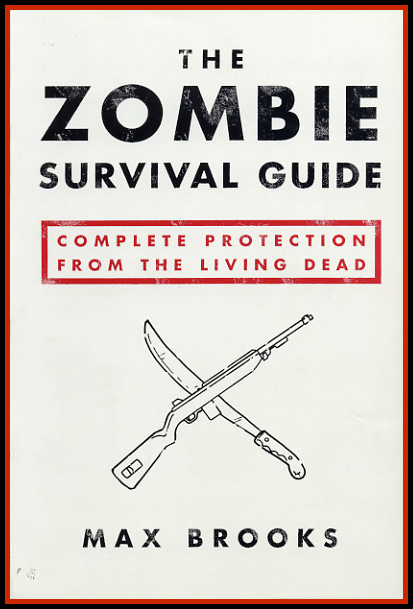
Review: The Zombie Survival Guide (written by Max Brooks)


I am what one would call an aficionado of all things zombie. The subject has been an interest of mine since I saw my very first true zombie film: Night of the Living Dead. Romero’s seminal work made such an impact in my young mind that, despite the primal sensation of fear I felt while watching it, my curiosity and imagination won out. I was stilled scared shitless for the next couple weeks once night arrived, but it didn’t stop me from thinking about it then letting my young mind start thinking of what I would do if put in a similar situation. It’s almost two decades since that moment and I still think about such things whenever the topic turns to things zombies.

I first came across Max Brooks’ book when I was browsing the web and decided to check out a site a fellow zombie-fan had recommended I visit: HomePageoftheDead.com. It was my first time visiting the site and right from the beginning I saw a link that had Brooks’ book title on it. I clicked it to see what it was all about. Lo and behold it was a for real survival guide on what to do if and when a zombie outbreak ever occurred. I knew it was one of those satire, gag books taking a ludicrous, albeit funny situation and writing a faux-serious work of instructions and guidelines around it. It didn’t take me long to check if Amazon had the book for sale and it did to my surprise. The moment I received the book I sat down and read it from beginning to end in a day’s time.

Max Brooks’ experience as a comic staff writer for Saturday Night Live and being Mel Brooks’ son probably helped in keeping the book from being too campy and also overly serious. Brooks’ hit the right balance of seriousness and yet giving every procedural instructions on how to survive and the optimal way of surviving a darkly black comedic tone to it all. Part of me was thoroughly amused and even laughed out loud a few times as I read through the guide, but part of me also felt a bit of dread in how real his descriptions were and how much common sense his survival guide had for the reader to take note of. I thought the final chapter describing documented reports of zombie outbreaks throughout man’s history was especially well-done. It sure made some of the darker moments in man’s history take on a much more horrifying note.

Max Brooks’ Zombie Survival Guide has been a great addition to my collection of dvds, comics and novels about the zombie subgenre. It also helped continue my on-going interest in the what-if scenarios of such an event from ever happening. His writing balances both satire and horror and the book is much better than it should be because of it. Being a zombie aficionado I would highly recommend this to like-minded readers and would gradually introduce it to those who have no notion of such a topic. One never knows when the fantastic suddenly becomes horrifyingly real. When and if it ever does happen, I know this book will have served me and mine well.

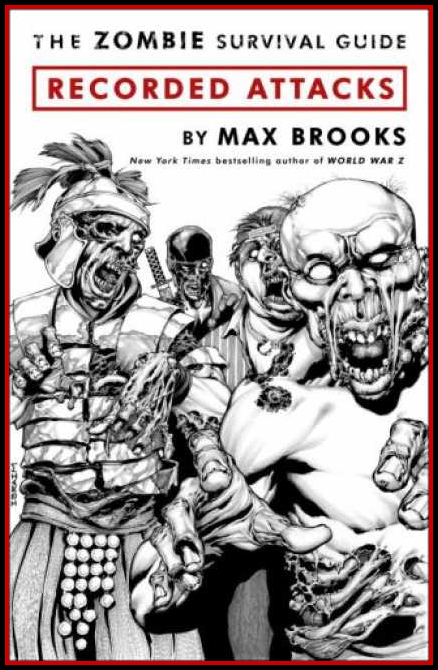
I would also like to point out that in addition to this book is a companion volume released by the comic book publisher, Avatar Press which takes those so-called historical accounts of zombie outbreak incidents and creates a graphic novel out of it. Again, Max Brooks has a hand in writing this book. He took some of the longer entries in the survival guide’s last chapter and rewrites them to better fit the comic book format.

The artwork by Ibraim Roberson for The Zombie Survival Guide: Recorded Attacks are some of the finest black & white inks I’ve seen and definitely one of the best zombie artwork. Roberson really captures the grotesque and hungry nature of the undead as Brooks’ describes them. Even though there’s no color involved in all the visuals it still doesn’t diminish the scenes of gore. I think it actually makes the scenes even more effective as the reader imagines the colors being there while reading them. There was no need to add to the shock value when it was already shocking.

While I wish they could’ve included every historical entry from The Zombie Survival Guide in this graphic novel I understand that to do so would mean a book at least over a hundred pages or more in size. Maybe there’ll be a plan to make a second volume if this first one sells well. Fans of Max Brooks’ guide can only hope that this indeed is what he and Avatar Press have in mind. Despite not having everything I expected it to the graphic novel was still a find companion piece to Brooks’ Zombie Survival Guide with some of the best looking zombie artwork outside of The Walking Deads Tony Moore and Charlie Adlard.

The Zombie Survival Guide

The Zombie Survival Guide: Recorded Attacks


Review: World War Z (written by Max Brooks)


I was one of many who heard about Max Brooks’ satirical guide book The Zombie Survival Guide: Complete Protection from the Living Dead. Being a huge fan of George A. Romero’s Dead series of films and just the zombie subgenre in general, I was intrigued by the release of this guidebook. From the first page to the last I was impressed, entertained, and hooked on Brooks’ serio-comic take on how to survive a zombie outbreak. One section of the book which really caught my interest and has remained a favorite to reread over and over was the final one which details the so-called “historical” instances of past zombie outbreaks throughout history. From as far back as Ancient Egypt and Rome up to the late 1990’s. My only gripe about that section of the book was that it was all-too-brief. I felt that it could’ve been made longer and even would’ve made for a fine book on its own. Maybe I wasn’t the only one to have wished for such a thing to happen for it seems that Brooks himself might have thought the same thing. His latest book in his trip through the zombie genre is titled World War Z: An Oral History of the Zombie War and it takes the final chapter of his previous book and expands on it. But instead of using past “historical events” to tell his story Brooks goes into the near future to describe what would happen if the zombies ever did bring the human race to the brink of extinction and how humans finally learned how to fight back and take back the world.

World War Z is a fictional account of a worldwide outbreak of the living dead in the near future and judging from some of the descriptions of places and events in the beginning of the book it won’t be too far in the future. WWZ is done in an interview-style format with each chapter consisting of first-person interviews of individuals who lived through the Zombie War from its initial outbreak to it’s final battles and mop-up operations. The sampling of survivors interviewed range from soldiers who fought the losing battles in the early going of the war when lack of information, outdated tactics, and illogical reactions to the zombie outbreak contributed to humanity almost losing the war. These soldier survivors explain how humanity became its own worst enemy when it came to protecting its own and combating the growing ranks of the zombies. Some of the mistakes were unavailable as information on how to combat the zombies were far and few and even then most were unreliable. Some mistakes on the other hand many today would consider as unconscionable as war-profiteers and those willing to keep a hold on their own power and who would sacrifice their own people to keep it so.

There’s also the regular people who survived the war and who made great contributions during the dark days when humanity were pushed into isolated and fortified pockets of resistance as everywhere around them the zombie army grew exponentially. Some of these people were just children when the outbreak first began as rumors and unsubstantiated news reports. It’s the words of those children now adults that show how war and conflict really takes the biggest toll on the smallest and helpless. One could substitute the wars in Iraq, Afghanistan, The Balkans and even Africa in lieu of Brooks zombie war and this book would still resonate. There’s a particular entry of how children left to their own devices to try and survive alone in the wild with zombies all around have turned feral to the point that their capacity to learn and develop into adulthood has become stunted or even halted permanently.

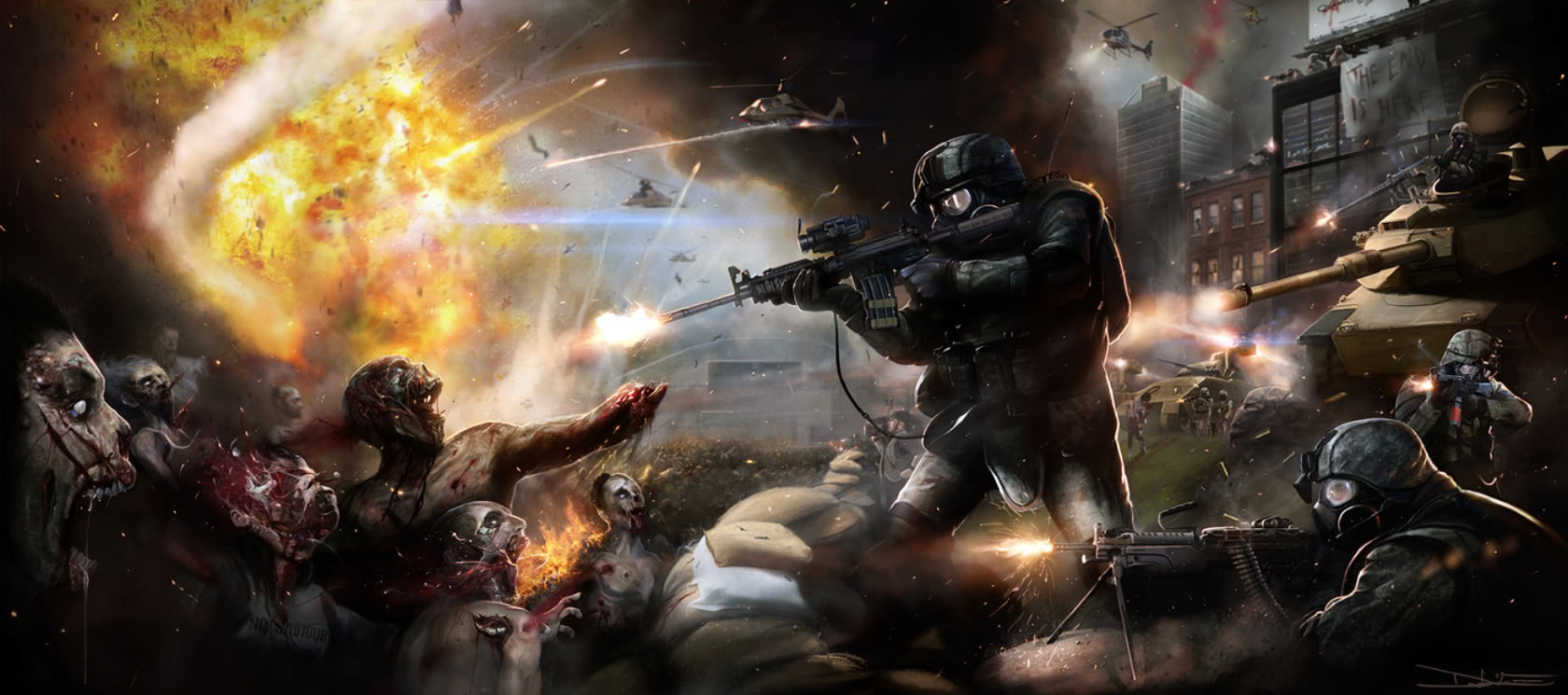
World War Z: Battle of Yonkers

Battle of Yonkers

Brooks’ novel also puts in little veiled references to the events occurring now in the real world. There’s mention of the unpopular war in the Persian Gulf as having a detrimental effect on the morale of troops once they returned home and how this helped make the initial fight to stem the tide of the zombies a losing proposition from the outset. There’s also mention of Iran as having acquired a nuclear arsenal and how this leads to an incident early in the Great Panic of the zombie outbreak that speaks volume of what could happen if unstable states acquire weapons of mass destruction. Brooks’ also gives a prescient look into a near future where the US and Europe stop being the economic superpowers of the world and step aside for the economic juggernaut that is China and India. All these inferences of today’s geopolitical and economical events mirrors what might just come into fruition.

The interview format really gives the book a sense of realism despite the outrageous and fantastical nature of the book. As I read the book I was reminded of Stephen A. Ambrose’s books on the men and women who fought during World War 2. Ambrose also used interviews and personal accounts to make up the bulk of his books like in Citizen Soldiers and Band of Brothers. Having a personal take on the events gave his books more emotional impact and really brought the emotions of the conflict to those who never experienced it. The same could be said about Max Brooks’ World War Z. Even though the novel was speculative fiction from beginning to end it still made the reader think of how such an event, if it ever came to pass, could be so tragic, disheartening but in the end uplifting as it once again shows that humanity could still pull itself together through all its petty misunderstandings to survive. On a more stylistic point, Brooks’ novel shares some similarities to Theodore Judson’s sci-fi epic Fitzpatrick’s War. Judson’s book also tries to chronicle a future war which was shaped by religious and ideological forces. Where Judson goes way into the future of an alternate Earth, Brooks smartly stays to a more foreseeable future that readers of his book would most likely see happen; hopefully a much brighter and less-zombified one.

Brooks’ decision to forgo the usual linear and narrative style for this book also allowed him a certain bit of freedom to introduce one-shot characters in addition to those who appear regularly. In a more traditional novel such one-shot characters would seem useless and even unnecessary, but in this interview format it makes more sense since it’s really just a collection of personalities trying to describe their own take of the Zombie War they lived through. Some people I know who have read the novel have said that there’s little or no talk of love and relationships in World War Z. I, for one, was glad that Brooks didn’t try to force certain “interviews” where it talks of survivors finding love and relationships during the outbreak, through the war and all the way to the mop-up. This book chronicles tales of survival and horror. As much as a tale of love would’ve been a change of pace to all the death and horror in the interviews it would’ve been too drastic a change of pace. I would think that the last thing that most people would have in their minds when trying to survive day-to-day, if not hour-to-hour would be to stop for a moment and have sex, cuddle or other less-than survival behaviors.

All in all, Max Brooks’ World War Z: An Oral History of the Zombie War takes a serious look at a fictional and fantastical premise and event with a serious eye. The book manages to be tragic and terrifyingly spot-on about how the world governments today could fail when confronted by such a horror of tremendous proportions. Unlike his more satirical first book on the zombie subject, World War Z shows the flaws and failings of humanity and how it almost led to its extinction, but it also shows humanity’s stubbornness in the face of total annihilation and how it could come together in cooperation to not just survive but take back the world. In times of extreme adversity man can be brought to his knees but also show his resilience. A great novel and one that deserves reading from not just fans of the horror and zombie subgenre, but those who enjoy taking a peek into what could be, no matter how outrageous.