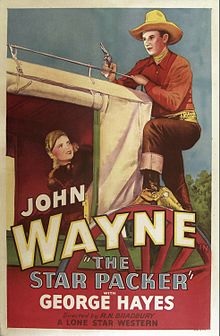
The Star Packer (1934, directed by Robert N. Bradbury)


A mysterious outlaw known as the Shadow is terrorizing turn-of-the-century Arkansas.  He and his gang have killed the last few sheriffs of Little Rock.  No one is sure who the Shadow is or how he communicates with his gang but somehow, he is always one step ahead of the law.  However, the Shadow didn’t count on federal agent John Travers (John Wayne) riding into town and declaring himself to be the new sheriff.  Working with his Native sidekick, Yak (Yakima Canutt), Travers sets out to expose the Shadow and take him down.  Along the way, he falls for Anita (Verna Hillie), the niece of rancher Matt Matlock (Gabby Hayes).  Luckily, Anita knows her way around a gun too.

This is one of the 50 B-westerns that John Wayne made before Stagecoach made him a star.  The Star Packer is more interesting than some of Wayne’s other poverty row productions because The Shadow is a more interesting and much more clever villain than the usual greedy but dumb outlaws that Wayne went up against in these movies.  The Shadow actually has a clearly thought-out plan and, for once, Wayne can’t defeat the bad guys on his own.  In The Star Packer, it takes a community to stand up to evil.  As always with Robert Bradbury’s westerns, the fights and the stunts are impressive.  Fans of Wayne’s B-period will probably especially be interested to see the legendary stuntman, Yakima Canutt, play a good guy for once.  He and Wayne both do a good job in this 52 minute programmer.

Neath The Arizona Skies (1934, directed by Harry L. Fraser)


Chris Morrell (John Wayne) is an honest cowboy who keeps an eye on Nina (Shirley Jean Rickert), a little girl whose Indian mother died when Nina was just a baby.  When oil is discovered on land that belonged to Nina’s mother, Nina is offered $50,000 for the land.  Because Nina is only eight years old, her legal guardian will be responsible for taking care of the money.  Chris and Nina set out to find Nina’s father so that he can sign the guardianship papers and make Chris into Nina’s legal guardian.

When outlaw Sam Black (Yakima Canutt) decides that he would rather be Nina’s legal guardian, Chris sends Nina to a ranch owned by his old friend, Bud Moore, while he defeats Sam and his men.  At the ranch, it turns out that Bud Moore has died and the new ranch owner is another outlaw named Vic (Jack Rockwell) and Vic wants Nina’s oil claim for himself.  What Vic doesn’t know is that Nina’s father is one of his ranch hands.

For a 52 minute programmer, there’s a lot going on in ‘Neath The Arizona Skies.  There’s actually too much going on and, with that short of a run time, it feels as if more than a few important plot points were glossed over, like how Chris came to look after Nina in the first place.  John Wayne is stiff but likable as Chris while Yakima Canutt does his usual double duty as both an outlaw and a stuntman.  There are a few good action scenes, especially when Chris runs off Sam’s gang for the first time.  Sheila Terry plays Wayne’s love interest, who has to be first convinced that Chris isn’t actually an outlaw.  As Nina, Shirley Jean Rickert is energetic but you’ll quickly get tired of her yelling, “Daddy Chris!” whenever anything happens.  This isn’t one of the best of the 50 poverty row films that Wayne appeared in before Stagecoach made him a star but, even in this film, there are still hints of the screen presence that would later become Wayne’s trademark.

Paradise Canyon (1935, directed by Carl Pierson)


Someone is passing counterfeit bills on the Mexican border and the government thinks that it might be Doc Carter (Earle Hodgins), the manger of a traveling medicine show.  Working undercover, Treasury agent John Wyatt (John Wayne) joins Doc Carter’s medicine show as a trick shooter.  John discovers that Doc Carter is a quack and the miracle cure that he sells is 90% alcohol but that Doc Carter isn’t a counterfeiter.  Instead, Doc Carter is being framed by his former partner, Curly Joe (Yakima Canutt).  When John tries to tell the Mexican authorities about Curly Joe is doing, he discovers that Curly Joe has framed him as well!

This was the last of the B-programmers that John Wayne made for Monogram Pictures and it was the only one of Wayne’s films to be directed by Carl Pierson.  As he did in almost all of his early B-pictures, John Wayne gives a tough but likable performance.  He’s the most cheerful undercover agent that I’ve ever seen.  The action scenes are rudimentary and Pierson was obviously not as creative a director as some of the other filmmakers that Wayne worked with early in his career.  Carl Pierson was no Robert Bradbury.  But the medicine show angle does bring a different angle to the story, with Wayne getting to show off his trick shooting skills and Earle Hodgins providing comedic relief with his miracle cure.  Of course, John has a romance with pretty Linda (Marion Burns), who is Doc Carter’s daughter and who is also known as Princess Natasha.

Though it may not be one of the best of the 50 movies that John Wayne made before getting his star-making role in Stagecoach, Paradise Canyon will still be appreciated by fans of both the Duke and the simple but entertaining B-westerns of the past.

Sagebrush Trail (1933, directed by Armand Schaefer)


Accused and convicted of a murder that he didn’t commit, John Brant (John Wayne) breaks out of prison in Maryland and, following the advice of Horace Greeley, he goes west.  After making a narrow escape from the authorities, he meets and befriends Joseph Conlan (Lane Chandler).  Conlan brings Brant into his gang, where Brant starts out as a cook but is soon being assigned to help rob stores and stagecoaches.  Despite his time in prison, Brant is no criminal and he secretly thwarts every robbery that the gang tries to pull off.  When the gang starts to suspect that Brant might be an undercover cop, Conlan is the only one willing to stand up for him and help him.  Conlan is also responsible for the murder that Brant was accused of committing.

John Wayne as a hardened escaped convict?  Maybe the older John Wayne could have pulled that off but, in 1933, Wayne was still too cheerful and easy going to be believable as someone who had spent the last few months doing hard time.  Fortunately, even early in his career, Wayne was convincing when riding a horse or shooting a gun and that’s probably all that the audience for these short programmers demanded.  There’s also an exciting scene where Wayne is forced to swim across a pond while his pursuers shoot at him.  As the criminal with a conscience, Lane Chandler steals the film.

Fans of westerns will want to keep an eye out for legendary stuntman Yakima Canutt, playing yet another outlaw gang leader.  Yakima Canutt started out his career risking his life as a rodeo rider and then went on to risk his life ever more as Hollywood’s most daring stunt performer.  When he got too old to continue doing stunt work, he became a second unit director, for John Ford and others.  He staged Ben-Hur‘s famous chariot race and was credited with making sure that not a single horse was hurt and not a single human was seriously injured during filming.  Yakima Canutt lived to be 90 years old, outliving most of the actors from whom he doubled as a stuntman.

The Dawn Rider (1935, directed by Robert N. Bradbury)


Cowboy John Mason (John Wayne) rides into a frontier town.  He is planning on working with his father, rancher Dad Mason (Joseph De Grasse).  Unfortunately, John arrives just in time to witness his father being killed by a gang of thieves.  John is wounded while chasing the thieves but, once he recovers, he’s determined to get vengeance against the man who killed his father.  That man is Rudd Gordon (Dennis Gordon), who is also the brother of Alice Gordon (Marion Burns), the woman who nursed John back to health and who is also engages to marry John’s best friend, Ben McLure (Reed Howes).

There is a little deliberate humor to be found in The Dawn Rider.  Every time someone is shot, the undertaker (Nelson McDowell) steps out of his office and measures the body while the town doctor celebrates having some business coming his way.  Otherwise, this is one of the most serious films that John Wayne made in the years before Stagecoach made him a star.  John Mason is determined to get revenge, even if his obsession means hurting his best friend’s fiancé.  (Though John Mason is less fanatical, it is easy to imagine him growing up to be The Searchers‘s Ethan Edwards.)  Ben has to decide whether to support his friend or the woman that he loves.  (Complicating matters is that John is in love with Alice, too.)  John Wayne and Reed Howes are a good team and Dennis Gordon is a convincing villain.  There’s a good action scene involving John protecting a gold shipment from the gang and the final shootout is handled well.  This 55-minute programmer undoubtedly taught many young viewers about frontier justice, even if they didn’t pick up on the film’s ambiguity.  The Dawn Rider is one of the more mature of John Wayne’s early films and offers hints of the actor that John Wayne would eventually become.

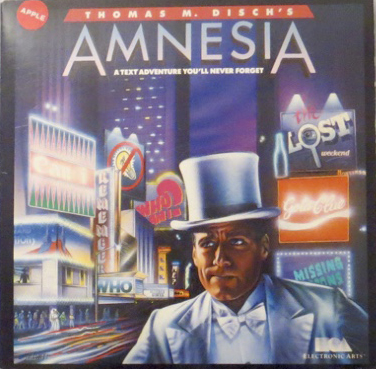
Game Review: Amnesia (1986, Electronic Arts)


You wake up in a hotel room in New York City.  You have no idea how you got there.  You have no idea who you are.  And you have no clothes.

So starts Amnesia, the semi-legendary text adventure game from 1986.  Amnesia was Electronic Arts’s attempt to challenge Infocom’s domination of the text adventure genre.  To write the game, they brought in author Thomas M. Disch.  Disch came up with a twisty and complex story where each choice often led to unexpected tangents.  The game featured a detail recreation of Manhattan, one that you could experience only if you could figure out how to find some clothes and get out of the hotel without getting arrested.  Of course, even after finding something to wear, it’s probable the many players decided to go ahead and marry the mysterious woman who claimed to be the main character’s fiancée.  Those players found themselves suddenly whisked off to an Australian sheep farm, where they lived out their days happy but unsure of who they actually were.  For them, the game ended quickly but without many answers.  Others, however, braved the streets of a virtual Manhattan is search of their identity.

Who are you?  Throughout the game, there are clues but they’re not always easy to find.  There’s a large collection of eccentric and bizarre characters who can help you or hinder you.  You have to avoid the police who want to arrest you and the people who are trying to kill you.  Of course, even if you defeat those assassins, the game also features random encounters with people who will ask you for directions and who will shoot you if you give them the wrong answer.  This feature was actually something that EA added to the game to punish anyone who had borrowed the game disk from a friend.  The game originally came with code wheel that you could use to determine which streets intersected with each other.  If you bought the game, you would be able to give people the proper directions.  If you didn’t buy the game or, if you’re playing the game in 2023 at the Internet archive, you would end up making a random guess and hoping that it didn’t lead to you getting shot by a tourist.

(Fortunately, there’s an online version of the code wheel.)

Even if you die, the game doesn’t necessarily end.  You might find yourself waiting in Purgatory.  After a certain number of turns, Charon might approach and ask if you’ve figured out your name.  If you give him the right name, you can move on.  If you don’t know your name, Charon leaves with a promise that he’ll return in another thousand years.

Amnesia is a challenging game.  It’s also a frequently frustrating game.  Thomas M. Disch was an author and the game reads like a long and dense novel.  There are times when Disch seemed to forget that the point of Interactive Fiction is that the player is supposed to have complete control over their actions.  At the same time, Amnesia’s descriptions are so detailed and many of the events are so unexpected that this is a game that benefits from frequent replaying.  And the game itself is so difficult that when you actually manage to accomplish anything, whether it’s getting out of the hotel or finding a place to sleep or even giving someone the right directions, you feel as if you’re the greatest player alive.

Or at least you do until the next puzzle comes along.

Play Amnesia.
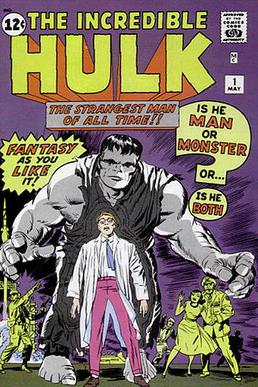
Great Moments In Comic Book History #32: The Hulk Makes His Debut


Somehow, it slipped my mind that this month is the 61st anniversary of the debut of one of the characters who would come to define Marvel Comics, The Incredible Hulk.  Though it was dated May of 1962, the first issue of The Incredible Hulk actually came out in March.  Here’s the cover, featuring artwork from Jack Kirby and Paul Reinman.

It’s obvious from the cover that The Incredible Hulk was still a work in progress when he made his debut.  First off, he’s grey instead of green.  Secondly, while Bruce Banner was always portrayed as being a scientist who kept a tight grip on his emotions, I don’t think he ever looked as nerdy as he did on this cover.  Third, the Hulk himself looks more like an oversized version of Frankenstein’s Monster than the Hulk that readers would eventually come to know and love.  Though it is not mentioned on the cover, Banner initially transformed into the Hulk whenever the sun went down, like a werewolf.  The Hulk coming out whenever Banner got mad was a later invention.

Because Marvel could never decide whether they wanted the Hulk to be a hero or a monster, the first run of The Incredible Hulk came to an end after just six issues but Marvel kept the character around and eventually gave him a regular feature in Tales to Astonish.  He was even one of the founding members of The Avengers, though that didn’t last for long.  Marvel eventually figured out that Hulk worked best as a loner and he was embraced by a counterculture who disliked the military almost as much he did.  The character proved to be so popular in Tales of Astonish that he eventually took over the entire comic and the name was changed (again) to The Incredible Hulk.  Hulk’s been a Marvel mainstay ever since, appearing on both television and in the movies.

And it all started 41 years ago, this month.

Previous Great Moments In Comic Book History:

  1. Winchester Before Winchester: Swamp Thing Vol. 2 #45 “Ghost Dance” 
  2. The Avengers Appear on David Letterman
  3. Crisis on Campus
  4. “Even in Death”
  5. The Debut of Man-Wolf in Amazing Spider-Man
  6. Spider-Man Meets The Monster Maker
  7. Conan The Barbarian Visits Times Square
  8. Dracula Joins The Marvel Universe
  9. The Death of Dr. Druid
  10. To All A Good Night
  11. Zombie!
  12. The First Appearance of Ghost Rider
  13. The First Appearance of Werewolf By Night
  14. Captain America Punches Hitler
  15. Spider-Man No More!
  16. Alex Ross Captures Galactus
  17. Spider-Man And The Dallas Cowboys Battle The Circus of Crime
  18. Goliath Towers Over New York
  19. NFL SuperPro is Here!
  20. Kickers Inc. Comes To The World Outside Your Window
  21. Captain America For President
  22. Alex Ross Captures Spider-Man
  23. J. Jonah Jameson Is Elected Mayor of New York City
  24. Captain America Quits
  25. Spider-Man Meets The Fantastic Four
  26. Spider-Man Teams Up With Batman For The Last Time
  27. The Skrulls Are Here
  28. Iron Man Meets Thanos and Drax The Destroyer
  29. A Vampire Stalks The Night
  30. Swamp Thing Makes His First Cover Appearance
  31. Tomb of Dracula #43

Winds of the Wasteland (1936, directed by Mack V. Wright)


When the invention of the telegraph puts the Pony Express out of business, two veteran riders — John Blair (John Wayne) and Larry Adams (Lane Chandler) — decide to start their own stagecoach line.  The richest man in Buchanan City, “Honest” Cal Drake (Douglas Cosgrove), sells them the line to nearby Crescent City.  Though initially grateful, Blair and Larry soon discover that Crescent City is now a ghost town that serves as home to exactly two inhabitants.  Rather than give up, Blair and Larry set up their stagecoach and they suddenly get lucky as settlers start to find themselves in Crescent City.  Blair is even able to convince the local telegraph company to run the wire though Crescent City, which leads to an influx of even more people.  Now, Blair just needs to land the contract delivering mail for the area.  To do that, he’ll have to win a stagecoach race against Drake, who turns out to not be very honest at all.

Winds of the Wastelands is one of John Wayne’s better pre-Stagecoach programmers.  While it has the western action that most people would expect from a B-western, it also has a lot more comedy than some of Wayne’s other poverty row productions.  For instance, a skunk tries to turn the stagecoach into his home and, of course, shows up at a key moment during the big race.  When one of bad guys tries to convince Blair to take his donkey to Crescent City in the stagecoach, Blair asks if there are any other “jackasses” who want a ride while casting a look at Drake’s men.  The movie takes a more serious turn when Drake goes to extreme methods to try to stop Blair and, as a result, Larry is wounded in a gunfight.  Doc Forsythe (Sam Flint), the founder of Crescent City, has to rediscover his confidence to perform the operation that can save Larry’s life.  Fortunately, the doctor’s daughter (Phyllis Fraser) is there to both help him out and to fall in love with John Blair.

This 55-minute programmer featured John Wayne playing the type of character for which he best known, the level-headed westerner who wasn’t going to let anyone push him around but who still fought fair.  Watching this movie, it’s easy to see why, just three years later, John Ford used him in Stagecoach.

Great Moments In Television History #30: The Greatest American Hero Premieres


43 years ago today, The Greatest American Hero premiered on ABC and America first heard the theme song that no one would ever forget.

The show only lasted for three seasons and it was never a huge success in the ratings.  The mix of comedy and super heroics was unusual for the time and audiences, critics, and network executives didn’t know what to make of it.  But even if the show struggled, people loved the theme song.  “Believe It or Not” was composed by Mike Post and Stephen Geyer.  Sung by Joey Scarbury, the song debuted in the Top 40 of the Billboard Hot 100 and reached number 2 on the charts.

A decade after The Greatest American Hero was canceled, audiences still got the joke as soon as they heard George Costanza’s answering machine message.

When The Greatest American Hero premiered, William Katt was playing a teacher named Ralph Hinkley.  After John W. Hinkley tried to assassinate President Reagan, Ralph’s last name suddenly become Hanley and remained that for the rest of the first season.  By the time the second season began, he was back to being Ralph Hinkley.

Even though the show wasn’t a ratings success when it first aired, it has since developed a strong cult following.  Some shows are just ahead of their time.

Previous Moments In Television History:

  1. Planet of the Apes The TV Series
  2. Lonely Water
  3. Ghostwatch Traumatizes The UK
  4. Frasier Meets The Candidate
  5. The Autons Terrify The UK
  6. Freedom’s Last Stand
  7. Bing Crosby and David Bowie Share A Duet
  8. Apaches Traumatizes the UK
  9. Doctor Who Begins Its 100th Serial
  10. First Night 2013 With Jamie Kennedy
  11. Elvis Sings With Sinatra
  12. NBC Airs Their First Football Game
  13. The A-Team Premieres
  14. The Birth of Dr. Johnny Fever
  15. The Second NFL Pro Bowl Is Broadcast
  16. Maude Flanders Gets Hit By A T-Shirt Cannon
  17. Charles Rocket Nearly Ends SNL
  18. Frank Sinatra Wins An Oscar
  19. CHiPs Skates With The Stars
  20. Eisenhower In Color
  21. The Origin of Spider-Man
  22. Steve Martin’s Saturday Night Live Holiday Wish List
  23. Barnabas Collins Is Freed From His Coffin
  24. Siskel and Ebert Recommend Horror Films
  25. Vincent Price Meets The Muppets
  26. Siskel and Ebert Discuss Horror
  27. The Final Scene of Dark Shadows
  28. The WKRP Turkey Drop
  29. Barney Pops On National TV

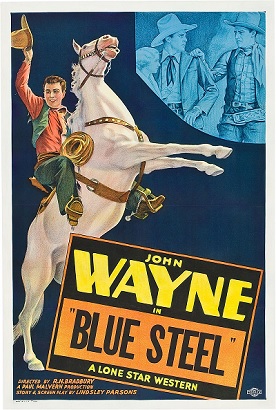
Blue Steel (1934, directed by Robert N. Bradbury)


On a stormy night, frontier Sheriff Jake Withers (George “Gabby” Hayes) and undercover U.S. Marshal Carruthers (John Wayne) both check into the same inn.  They are both searching for the infamous Polka Dot Bandit (Yakima Canutt), who has been burglarizing homes and businesses all over California.  They both figure that, on a rainy night like this, there’s no way that the Bandit is going to be out.  It turns out they are both wrong.  The Bandit breaks into the inn and robs the safe but also leaves behind one of his spurs.  The sheriff comes across Carruthers investigating the safe and mistakenly believes that Carruthers is the bandit.

Later, when Sheriff Winters goes out to Carruthers’s cabin, he’s planning on arresting Carruthers.  Before he can do so, they both hear gun shots.  Outside, another group of bandits is chasing Betty (Eleanor Hunt) and her father.  The Sherriff and Carruthers manage to save Betty but her father is killed.  The grieving Betty is taken in by a local rancher named Malgrove (Edward Peil, Jr.) but it turns out that Malgrove is the head of the Polka Dot Gang and he is planning on killing Betty in order to keep a shipment of supplies from coming to the town!  Carruthers and the sheriff have to work together to thwart Malgrove’s plan and bring the Polka Dot Bandit to justice.

This 54-minute programmer was one of the many B-westerns that John Wayne made for Monogram Pictures in the days before John Ford made him a star by casting him in Stagecoach.  Though Wayne was still learning how to act on camera, the screen presence that would make him a star can be seen in Blue Steel and he and Hayes make a good team.  The story is simple enough but there’s enough horse riding and fistfights to keep most B-western fans entertained.  It’s still hard not to imagine how much different the movie would have been if the sheriff had arrested Carruthers at the scene of the crime instead of letting him ride out to his cabin.  It’s a good thing these old programmers never had to make too much sense.