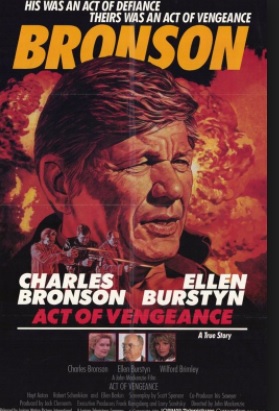
 Act of Vengeance is an uncompromising look at union corruption and how it hurts the workers while benefitting the bosses.
The year is 1969 and the United Mine Workers of America is one of the biggest and most powerful labor unions in the country. The UMWA was founded to protect the rights of miners but the current union president, Tony Boyle (Wilford Brimley), is more concerned with enriching himself and consolidating his own power. Despised by the workers that he represents, Boyle has managed to stay in power through fixed elections and his own fearsome reputation. When 80 West Virginia miners are killed in an accident, Boyle defends the owners. That is the last straw for Jock Yablonski (Charlies Bronson), a lifelong miner and proud union man. Yablonski runs against Boyle for the UMWA presidency and, when the election is stolen from him, Yablonski challenges the results.
Boyle’s solution? Working through one of his supporters (played by Hoyt Axton), Boyle hires three assassins (Robert Schenkkan, Maury Chaykin, and a young Keanu Reeves) and orders them to kill not only Yablonski but his entire family too.
With a name like Act of Vengeance and a star like Charles Bronson, it would be understandable to assume that this is another Cannon action film where Bronson gets vengeance by blowing away the bad guys. That’s not the case, though. Made for HBO, Act of Vengeance is based on a true story of union corruption and murder. There is violence but very little of it comes from Bronson. Instead, this is a well-made docudrama about what happens when workers are betrayed by the very people who are supposed to be looking out for them.
Bronson grew up working in the mines and he never forgot the poverty of his youth. He knew men like the men depicted in this movie and Bronson gives one of his most naturalistic performances as Yablonski. Brimley is at his gruffest as Boyle and the performances of the actors playing the three hapless but deadly assassins also feel authentic. Ellen Burstyn and Ellen Barkin are also well-cast as, respectively, Yablonski’s wife and the wife of the main assassin.
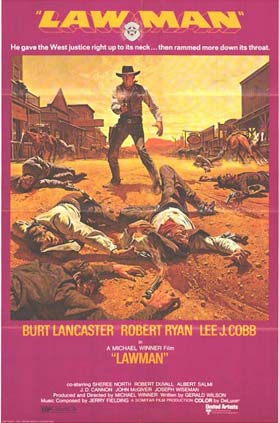 In the 1880s, Jared Maddox (Burt Lancaster) is the marshal of the town of Bannock. After a night of drinking and carousing leads to the accidental shooting of an old man, warrants are issued for the arrest of six ranch hands. Maddox is determined to execute the arrest warrants but the problem is that the six men live in Sabbath, another town. They all work for a wealthy rancher (Lee J. Cobb) and the marshal of Sabbath, Cotton Ryan (Robert Ryan), does not see the point in causing trouble when all of the men are likely to be acquitted anyway. Maddox doesn’t care. The law is the law and he does not intend to leave Sabbath until he has the six men.
 It’s Die Hard in a school!
 Though it is sometimes hard to remember, there more on late night Cinemax than just Shannon Tweed films like
 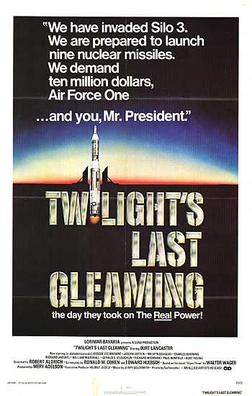 In Montana, four men have infiltrated and taken over a top-secret ICBM complex. Three of the men, Hoxey (William Smith), Garvas (Burt Young), and Powell (Paul Winfield) are considered to be common criminals but their leader is something much different. Until he was court-martialed and sentenced to a military prison, Lawrence Dell (Burt Lancaster) was a respected Air Force general. He even designed the complex that he has now taken over. Dell calls the White House and makes his demands known: he wants ten million dollars and for the President (Charles Durning) to go on television and read the contents of top secret dossier, one that reveals the real reason behind the war in Vietnam. Dell also demands that the President surrender himself so that he can be used as a human shield while Dell and his men make their escape.
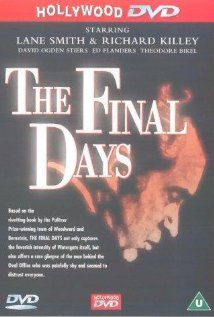 Since yesterday’s entry in movie a day featured Philip Baker Hall playing Richard Nixon in
 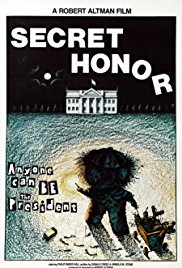 Disgraced former President Richard M. Nixon (Philip Baker Hall) sits alone in his study. He has a bottle of Scotch, a loaded gun, and a tape recorder. He is surrounded by security monitors and paintings. All but one of the paintings are portraits of former presidents, all of whom are destined to be more fondly remembered than Nixon. The only non-presidential painting is a portrait of Henry Kissinger. Over the course of one long night, Nixon drinks and talks. He talks about his Quaker upbringing and his early political campaigns. He rails against all of his perceived enemies: Eishenhower, the Kennedys, the liberals, the conservatives, and everyone in between. As he gets drunker, he starts to talk about the real story behind Watergate and why his resignation actually shielded the country from a greater scandal. As Nixon explains it, his resignation was his greatest act of patriotism, his secret honor.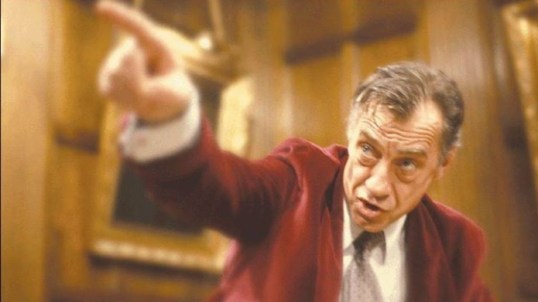
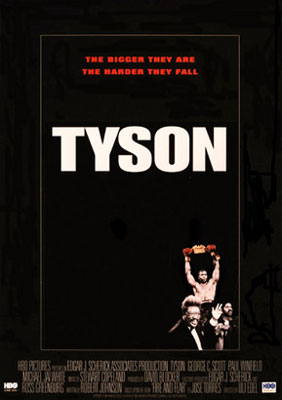 If any heavyweight champion from the post-Ali era of boxing has lived a life that seems like it should be ready-made for the biopic treatment, it is “Iron Mike” Tyson. In 1995, HBO stepped up to provide just such a film.
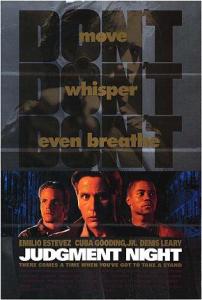 Four suburbanites (Emilio Estevez, Stephen Dorff, Jeremy Piven, and Cuba Gooding, Jr.) are driving to a boxing match in pricey RV when Piven takes a wrong turn and they end up lost in the wrong side of the city. Not only are they lost but they also witness Fallon (Denis Leary) and his gang murdering a young man. Jeremy Piven thinks that he can negotiate with Fallon and get his friends out of the situation by pulling out his wallet and flashing a few bills. Guess how well that works out for them? With Fallon chasing them through the city, these formerly smug and complacent yuppies are forced into a battle for survival.
 Bernard Hopkins. Evander Holyfield. Mike Tyson. Three men who came from similar backgrounds and who eventually became three very different heavyweight champions. Bernard Hopkins was the ex-con who transformed himself through boxing. Mike Tyson was the ferocious and self-destructive fighter whose legendary career eventually became a cautionary tale. Evander Holyfield was the underrated fighter, whose discipline and self-control made him a champ but also ensured that he would never get as much attention as the other boxers of the era.
 Through the Shattered Lens