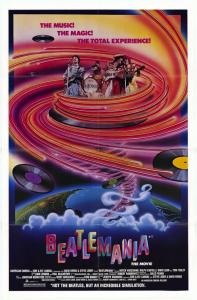
 In this filmed version of a hit Broadway musical, four musicians who look like the Beatles from a distance play 3o Lennon/McCartney songs while newspapers headlines scroll over their heads and famous events and figures from the 60s appear on the screen behind them. The camera sometimes follows the musicians backstage as they switch from dark suits to white Magical Mystery Tour tuxedos and later into the uniforms of Sgt. Pepper’s Lonely Hearts Club Band. They also try on a variety of wigs and fake facial hair.
The main problem with Beatlemania is that the four musicians may be good but they are still not the Beatles and, regardless of how hard they try, they never really sound like the Beatles either. At first, I was impressed by the fact that they did, at least, physically resemble the Beatles but then I realized that musician I thought was George was actually supposed to be John and that the musician who actually was supposed to be George looked more like Keith Richards. Ringo, meanwhile, looked like Keith Moon. On the other hand, the show’s Paul looked exactly like the real Paul but was so stiff and precise in his movement that it was like watching one of the robots from Disney’s Hall of Presidents.
I can understand why nostalgic baby boomers made the original stage show a hit but, ultimately, it is best just to stick with the originals.
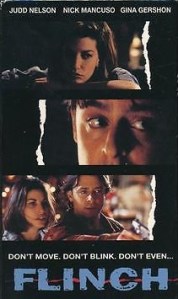 Harry (Judd Nelson) is a law student who has failed the bar exam three times. Daphne (Gina Gershon) is an aspiring actress who has an unfaithful boyfriend. With neither of them making much headway in their chosen careers, they end up working as living mannequins in a department store display window. If they flinch even the least little bit, they will lose their jobs. At first, it does not seem that there is much of a romantic future for Harry and Daphne. But when Daphne breaks up with her boyfriend, Harry invites her to join him in breaking into the store after hours and partying. But while Harry and Daphne are celebrating, they witness a crazed artist (Nick Mancuso) strangling one of his models.

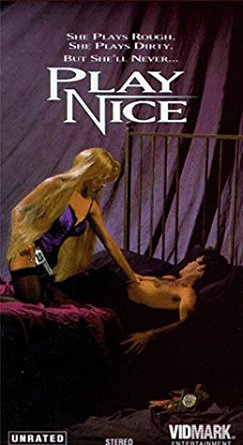 Homicide Detective Jake “Mouth” Penucci (Ed O’Ross) is the most hated man on the police force. His partners hate him. His ex-wife hates him. His daughter will hate him once she is old enough. Penucci is obnoxious, tells terrible jokes, and is haunted by his abusive childhood. The only person that does not hate Penucci is Jill (Robey), who works in the records office. Jill and Penucci are soon an item but it turns out that Jill has some kinky tastes, which make even Penucci nervous. She wants him to beat her during sex and sometimes ask him to pretend that she’s a little girl. At the same time that Penucci is trying to figure out how to have a normal relationship with Jill, he has been assigned to catch Rapunzel, a female serial killer who only targets men who have been accused of sexually abusing their daughters. Could it all be connected?
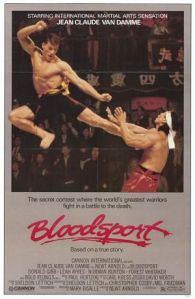 Bloodsport is one of Jean-Claude Van Damme’s earliest films and it is Damme good!
 After Tom Logan (Jack Nicholson) and his gang of rustlers (played by Randy Quaid, Frederic Forrest, and Harry Dean Stanton) rob a train, Logan uses the money to buy a small ranch. Their new neighbor is Braxton (John McLiam), a haughty land baron who considers himself to be an ambassador of culture to the west but who is not above hanging rustlers and hiring gunmen. One such gunman is the eccentric Robert E. Lee Clayton (Marlon Brando), a “regulator” who speaks in a possibly fake Irish brogue, is a master of disguise, and uses a variety of hand-made weapons. Braxton hires Clayton to kill Logan and his men, despite the fact that his daughter (Kathleen Lloyd) has fallen in love with Logan.
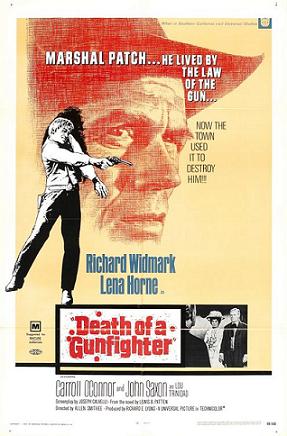 At the turn of the 20th century, the mayor and the business community of Cottonwood Springs, Texas are determined to bring their small town into the modern era. The Mayor (Larry Gates) has even purchased one of those newfangled automobiles that have been taking the country by storm. However, the marshal of Cottonwood Spings, Frank Patch (Richard Widmark), is considered to be an embarrassing relic of the past. Patch has served as marshal for 20 years but now, his old west style of justice is seen as being detrimental to the town’s development. When Patch shoots a drunk in self-defense, the town leaders use it as an excuse to demand Patch’s resignation. When Patch refuses to quit and points out that he knows all of the secrets of what everyone did before they became respectable, the business community responds by bringing in their own gunfighters to kill the old marshal.
 Joe Louis, also known as the Brown Bomber, is generally agreed to have been one of the greatest heavyweight boxers of all time. Despite the barriers put up by both poverty and racism, Louis held the world heavyweight championship from 1937 to 1949 and successfully defended his title in 26 fights (ranking him second to only Julio Cesar Chavez, who had 27 title defenses). In 1938, he defeated German Max Schmelling, disproving Nazi claims that a black man could not defeat an Aryan and making Louis, along with Jesse Owens, one of the first African-American athletes to achieve nationwide hero status in America.
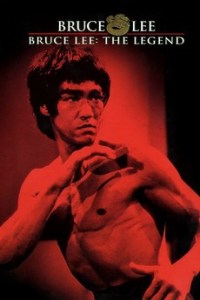 From Golden Harvest comes this tribute to their biggest star, Bruce Lee.
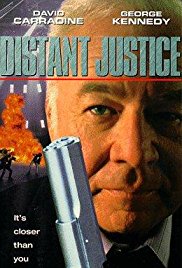 Inspector Rio (
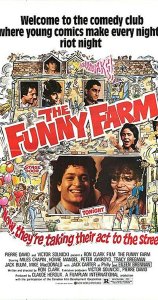 Mark Champlin (Miles Chapin) is a fresh-faced, aspiring comedian from Cleveland who drives across the country, listening to tapes of Steve Martin. He arrives in Los Angeles, hoping to become a star. Despite being too naive and trusting, Mark starts to find success in the cut-throat entertainment industry. Soon, he is performing at the Funny Farm, a comedy club owned by Gail Corbin (Eileen Brennan, giving the exact same performance that Melissa Leo gave in Showtime’s I’m Dying Up Here). Mark befriends the other comedians, finds love, and hopes for his big break.
 Through the Shattered Lens