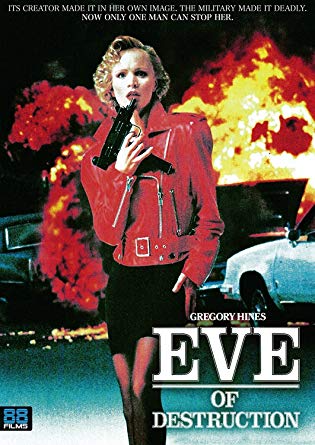
Terminator Redux: Eve of Destruction (1991, directed by Duncan Gibbins)


When Eve VIII (Renée Soutendijk), a robot that has been designed so that she can pass for a human, is taken on a test run though the city, things go terribly wrong when she gets caught up in a bank robbery.  When one of the robbers shoots her, it scrambles her circuits and causes her to switch into combat mode.  For some reason, someone thought it would be a good idea to install the equivalent of a nuclear bomb inside the robot so now, Eve VIII is wandering around the city, killing anyone who shes views as being a danger, and threatening to send both herself and everyone up in a nuclear fireball.

Realizing that Eve VIII’s test run has become a national emergency, the military calls in the best operative they’ve got and he turns out to be … Gregory Hines!?  The legendary Broadway song-and-dance man plays Colonel John McQuade, a special operative who has seen action in all of the world’s hot spots.  McQuade works with Eve VIII’s creator, Dr. Eve Simmons (also played by Renée Soutendijk) to try to track down the robot before it’s too late.  In a move that makes as much sense as installing the equivalent of a nuclear bomb inside of her, Eve VIII has also been programmed to have the same traumatic memories as her creator.  When Eve VIII destroys a cheap motel that Eve Simmons used to wonder about, McQuade announces that the key to trapping the robot is for Dr. Simmons to reval all of her “teenage sexual fantasies!”

The idea of a robot having and acting upon all of the repressed memories and desires of its creator is a good one but Eve of Destruction doesn’t do much with it.  Once McQuade and Dr. Simmons head off in pursuit of Eve VIII, it becomes just another low-budget Terminator rip-off.  Gregory Hines deals with being miscast by yelling all of his lines.  Renée Soutendijk does better as both Eve VIII and Dr. Simmons and even manages to generate some sympathy for the killer robot.  Interestingly, Soutendijk is best known for her work with Paul Verhoeven, whose RoboCop was an obviously influence on Eve of Destruction.

Eve of Destruction is a forgettable killer robot film from an era that was full of them.  Most disappointing of all is that Barry McGuire is nowhere to be heard.  If you do see the film, keep an eye out for the great Kevin McCarthy, playing yet another befuddled victim and, for some reason, going uncredited.

Game Review: The Haunted House of Hideous Horrors (2002, David Whyld)


You’re a pizza delivery man!  Mr. Desther has ordered a pizza but when you arrives at his house, he tells you that he has a problem with ghosts.  They’re all over his home and he wants you to get rid of them.  And if you don’t get rid of them, he’s not going to give you a tip.  At first, you’re reluctant to get involved but then he offers you £15.  (That’s $18.88 for our American readers.)  You’ll get rid of the ghosts at the risk of your own life and sanity.  And if you don’t do it, Mr. Desther’s pizza is free!

The Haunted House of Hideous Horrors is a short and simple text adventure.  It was designed for ADRIFT 4.0, which is the easiest IF interpreter to program for.  Unfortunately, ADRIFT’s vocabulary is also extremely limited so playing an ADRIFT game can often feel like an extended session of guess-the-verb.  That’s not as much of a problem in The Haunted House of Hideous Horrors as it is in other ADRIFT games.  David Whyld keeps things from getting too complicated or frustrating, though there is one notable moment when you’re told that you’ve entered a room that contains a dead body but, whenever you try to “look body” or “examine corpse,” you get a “There’s no such thing here” message.

There’s only one way to die in this game but you’re given so much advance warning that, if you die, it’ll mostly be due to your lack of reading comprehension.  Once you get used to the natural limitations of the ADRIFT story engine, this is a simple but enjoyable haunted house game that doesn’t take itself too seriously.  Download the game and, if need be, ADRIFT for free, get in that house, and earn your tip!

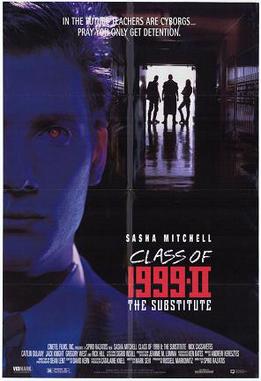
Robot Without A Cause: Class of 1999 II: The Substitute (1994, directed by Spiro Razatos)


There’s a new substitute teacher at a local high school in Oregon and he’s not going to put up with any disrespectful punks.  John Bolen (Sasha Mitchell) can educate minds and change lives but only when he’s not busy killing any student with a bad attitude and trying to protect his fellow teacher, Jenna McKenzie (Caitlin Dulany).  Jenna is scheduled to testify against the local gang leader so every punk at school is trying to intimidate her and her boyfriend, Emmett (Nick Cassavetes!).  It takes Jenna and Emmett a while to realize that John is killing all of their students but soon, a mysterious man named G.D. Ash (Rick Hill) shows up and insinuates that John might be connected to the robot teachers that, two years earlier, terrorized a high school in Seattle.

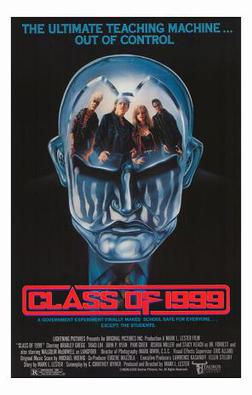
This sequel to The Class of 1999 is mostly more of the same, with the main difference being that the focus is not on the students being hunted but instead on the teachers being “protected.”  If the first Class of 1999 was about the dangers of a no tolerance discipline policy, the sequel is all for it and suggests that maybe the world really would be better off if teachers could just kill some of their more disruptive students.  The first film’s director, Mark L. Lester, did not return for the sequel and directing duties were given to stunt coordinator to Spiro Razatos who, not surprisingly, emphasized action and stunts over characterization.  Fortunately, Sasha Mitchell was a champion kickboxer so he’s believable in the action scenes and he’s such a stiff actor that you could believe that he might be an android.  There’s a good and unexpected twist towards the end of the movie but, ultimately, the victims are too interchangeable and the direction is too flat for this sequel to duplicate the demented pleasures of either Class of 1999 or Class of 1984.

Game Review: Mystery House Possessed (2005, Emily Short)


Mystery House Possessed is an Interactive Fiction game by Emily Short.  It was one of the first IF games to be developed with Inform 7 and it is a classic of its kind.

Your friend Eulalie has died.  As per her instructions, her greedy heirs will be allowed to enter her house and spend the day searching for where she has hidden her diamond necklace.  However, she has also hidden something in the study and, in her final letter to you, she asked you to retrieve it.  She didn’t specify what it was, only that you would know it when you saw it.  And, Eulalie writes, if you happen to find the necklace, that’s cool too!

When you arrive at Eulalie’s house, her six heirs are already present and preparing to tear up the house in their search for her necklace’s hiding place.  It turns out that one of the heirs is a murderer and, unless you can figure out the killer’s identity, everyone in the house is going to die.  Including you!

What sets Mystery House Possessed apart from other interactive fiction games is the amount of randomization involved.  At the start of every new game, not only is a new killer selected but the location of the necklace changes as well.  The movements of the 6 NPCs also change from game to game and you’ll have to keep track of who has picked up each of the potential weapons that have been left around the house.  You might even have to pick up one of those weapons yourself so that you can be ready if the killer comes after you.

It’s a short game, with a clear goal and time limit.  Because of the heavy randomization, it’s also a game that can played over and over again.  Like almost all of Emily Short’s games, Mystery House Possessed is well-written with a careful attention to detail and challenging without being impossible to win.  If you’ve never played an interactive fiction game before, Mystery House Possessed is a good place to start.


Robots With A Cause: Class of 1999 (1990, directed by Mark L. Lester)


The year is 1999 and John F. Kennedy High School sits in the middle of Seattle’s most dangerous neighborhood.  Teenage gangs have taken over all of the major American cities and just going to school means putting your life in danger.  However, Dr. Bob Forest (Stacy Keach!), the founder of MegaTech, has a solution.  He has taken former military androids and reprogrammed them to serve as educators.  JFK’s principal, Miles Langford (Malcolm McDowell!!), agrees to allow his school to be used a testing ground.  Soon, Miss Conners (Pam Grier!!!) is teaching chemistry.  Mr. Byles (Patrick Kilpatrick) is teaching gym.  Mr. Hardin (John P. Ryan) is teaching history.  When they’re not teaching, these robots are killing truant students and manipulating two rival street gangs into going to war.

Imagine mixing Rebel With A Cause with The Terminator and you get an idea of what Class of 1999 is like.  Two of the only good teenagers (played by Bradley Gregg and Traci Lind) figure out that the teachers are killing their classmates but they already know that they won’t be able to get anyone to listen to them because they’re just kids who go to school in a bad neighborhood.  Meanwhile, the teachers have been programmed to do whatever has to be done to keep the peace in the school.  Why suspend a disruptive student when you can just slam his head into a locker until he’s dead?  Director Mark L. Lester (who previously directed Class of 1984) is an old pro when it comes to movies like this and he’s helped by a better-than-average cast.  Any movie that features not only Stacy Keach and Malcolm McDowell but also Pam Grier is automatically going to be cooler than any movie that doesn’t.

When Class of 1999 was made, 1999 was considered to be the future and, in many ways, the movie did prove to be prophetic.  We may not have robot teachers (yet) but the idea of arming teachers and expecting them to double as cops has become a very popular one over the past few years.  Personally, I wouldn’t want to send my children to a school where the teachers all have to carry a gun while teaching but that may just be me.

Game Review: Don’t Fire Until You See The Yellow Of Their Niblets (1999, Dan Shiovitz)


“There is a sharp hiss, as if millions of kernels cried out in pain and then were suddenly silenced. And then it arises — dear god, it arises. Something like Venus arising from the waters, or your fat Uncle Albert arising from his arm-chair, the Yellow Beast of Corn draws itself up from the pile of stalks. The broom drops from your nerveless fingers as you contemplate the apparition that has appeared before you. “Why me, why now, why here?” you can’t help but ask yourself, even knowing that the question is futile. To kill, to kill, that is the purpose of the Nibleted One, and anyone in its path will perish.”

Don’t Fire Until You See The Yellow Of Their Niblets by Dan Shiovtiz

In this text adventure game, you are working the night shift at Big Foods Super Market.  You have just finished sweeping up the produce aisle and you are looking forward to finally getting off work when suddenly, the Yellow Beast of Corn rises up, looking to destroy you.  This may be because Big Foods has started receiving it’s corn from The Dark Brotherhood instead of Pete’s Produce Wholesalers.

You have three directions in which to run and two aisles in which to hide.  Each aisle features a different way to kill the Yellow Beast of Corn but you’ll have to figure it out quick.  Take too long and the day crew will only find a few pieces of you left in the morning.

Don’t Fire Until You See The Yellow Of Their Niblets is a game that was specifically designed to be played in less than a minute.  Figuring out how to destroy the corn monster is not difficult.  Instead, the challenge is making sure that you get to the aisle with enough time left to put a plan into action.  It’s a fun game and you may have already guessed that it’s not meant to be taken too seriously.

Don’t Fire Until You See The Yellow Of Their Niblets can be downloaded from here.  You’ll also need a TADs interpreter to play the game, which can be downloaded, for free, from TADS.org.

When Bronson Met Perkins: Someone Behind The Door (1971, directed by Nicolas Gessner)


Dr. Laurence Jeffries (Anthony Perkins) is an American-born neurosurgeon living in the UK.  One night, as Dr. Jeffries is preparing to head home, he meets a confused and frightened man who is identified in the credits as being The Stranger and who is played by Charles Bronson.  The Stranger has no memory of who he is or how he came to be where he is.  Dr. Jeffries takes the Stranger back to his house.  Dr. Jeffries says that he often takes patients back home for overnight observation but it turns out that he has more than treatment on his mind.  Dr. Jeffries knows that his wife, Frances (Jill Ireland, who was Bronson’s offscreen wife), has been cheating on him with her French lover.  What if Dr. Jeffries can convince the Stranger that Frances is married to and cheating on him?  Could The Stranger, who may have already attacked another woman on the beach, be manipulated into murdering Frances’s lover?
Before Death Wish made Charles Bronson a box office force in the United States, he was a huge star in Europe.  Someone Behind The Door is one of many films that Bronson made in France before he returned to America.  It’s always interesting to see Bronson’s European films because European directors were willing to cast him as something other than just a vengeance-driven vigliante.  In Someone Behind The Door, Bronson actually gets to play someone who isn’t in control of his fate and who doesn’t always have the perfect tough guy quip on the end of his tongue and Bronson gives a surprisingly good performance.  He brings The Stranger’s inarticulate fear and eventual rage to life.  Indulging in his usual nervous mannerisms, Anthony Perkins matches him every step of the way.

Someone Behind The Door largely takes place in just one location and it’s really too stage-bound to be successful.  Still, fans of Perkins and Bronson should find the pairing of the two to be interesting.  The pair play off each other surprisingly well, with Perkins nervy energy bouncing off of Bronson’s physicality.  It’s too bad that this was the only time that these two actors appeared opposite each other.

Video Game Review: Vacation Gone Away (2002, Milibus)


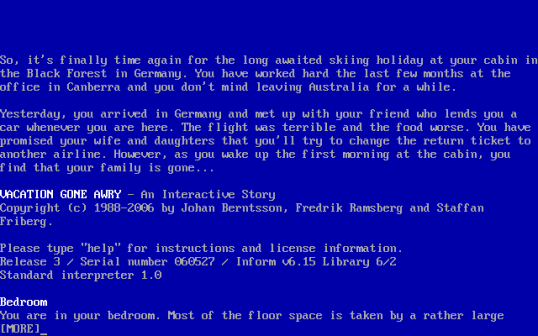
Vacation Gone Awry is an old-fashioned text adventure where you wake up on the first day of your vacation in Germany and you discover that your family has disappeared!

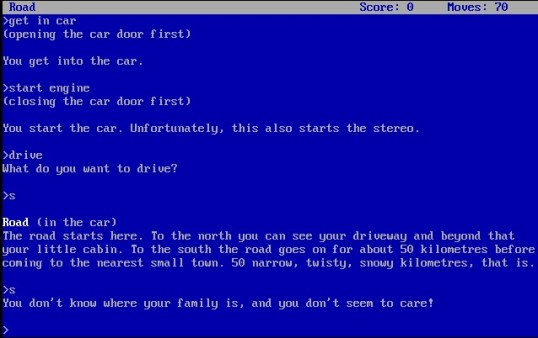
Searching your three-room cabin doesn’t do much good.  Your wife and your daughters are nowhere to be found.  Even looking under the bearskin rug doesn’t reveal the trap door that I had been led, by years of playing text adventure games, to expect.  Finally, I went outside, got in the car, and decided to just drive away.

Right, it’s not going to happen.  Your family may have abandoned you but you abandoning them is not an option.

If you do go back to the cabin, you will eventually discover what has happened to your family.  Like many of the puzzles in Vacation Gone Awry, the solution to this problem is to specifically look at everything.  That may sound easy but the cabin is do detailed that it can be easy to get distracted.  I wasted ten turns in the cabin’s bedroom, trying to open my wife’s makeup bag before I finally accepted that it wasn’t an important clue.

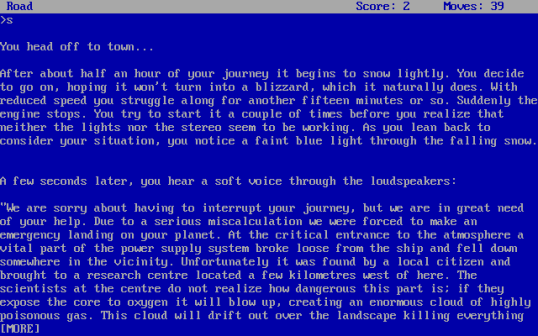
Once you discover what has happened to your family, you are free to once again get in your car and attempt to drive into town.  However, while driving, this happens:

It seems that aliens have accidentally lost a piece of their spaceship and now a group of research scientists are on the verge of opening it up and killing everyone in the vicinity, including you and your family.  You have no choice but to make your way through a blizzard, find the research station, and stop them!

Your enjoyment of Vacation Gone Awry will depend on how much patience you have for searching locations and solving puzzles.  This is one of those text adventures where no door can simply be opened.  Instead, you have to figure out how to unlock it.  Finding the solution will often depend on not only carefully reading the descriptions of the location but also taking a closer look at things that you may have already examined.  Especially when compared to more recent works of Interactive Fiction, Vacation Gone Awry is puzzle-driven instead of plot-driven.

It’s challenging but, if you’re a puzzle person, there is enjoyment to be found in the game.  Vacation Gone Awry is available for free on several sites.  I played it at the Internet Archive.

Good luck saving your family!

Robotic Vengeance: Steel and Lace (1991, directed by Ernest Farino)


On trial for raping concert pianist Gally Morton (Clare Wren), evil businessman Daniel Emerson (Michael Cerveris) gets four of his sleazy buddies to provide a fake alibi for him.  After Emerson is acquitted, Gally goes to the roof of the courthouse and leaps to her death.
Five years later, Daniel and his four friends have made a fortune by illegally foreclosing on people’s houses.  They may think that they’ve gotten away with their crimes but what they don’t know is that Gally’s brother, Albert (Bruce Davison), has been building a robot version of his sister.  Soon, Robot Gally is killing off all of Emerson’s friends while a courtroom sketch artist named Alison (Stacy Haiduk) and a detective named Dunn (David Naughton) attempt to figure out what’s going on.

A mix of The Terminator and I Spit On Your Grave, Steel and Lace is a classic of its kind.  While the deaths are inventive and, considering who Robot Gally is killing, deserved, what really sets the film apart is the strong cast and the inventive direction.  Director Ernest Farino wastes no time getting down to business and he inventively opens the film by cutting back and forth between Emerson assaulting Gally and the jury acquitting him of the crime that we just saw him commit.  Davison is not in the film as much as you might expect but he still makes an impression as the fanatical Albert and Naughton and Haiduk are likable even if their scenes sometimes feel like padding.  Best of all is Clare Wren, an actress who deserved to be a bigger star and who is convincing both as the fragile Gally and as the vengeance-driven robot.  Robot Gally eventually comes to question whether justice is truly be served by all of the killings and Wren sells it.  Also be sure to keep an eye out for David L. Lander, playing the prerequisite eccentric coronor.  (Has there ever been a movie coroner who wasn’t an eccentric?)  Finally, Brian Backer — who will be forever known for playing nice guy Mark Ratner in Fast Times At Ridgemont High — is effectively cast against type as one of Emerson’s stooges.

Steel and Lace is one of the best low-budget films to come out of the early 90s, a deeply satisfying tale of robotics and vengeance.

Video Game Review: Hamburger Hell (1986, J.P. Jansen)


In this game, you are working in a fast food restaurant.  Your goal is to make as many hamburgers as possible.  The more hamburgers you make, the more money the restaurant makes and the more your boss likes you.

Sounds simple, right?

Think again!

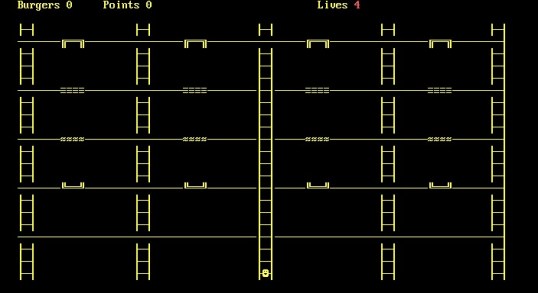
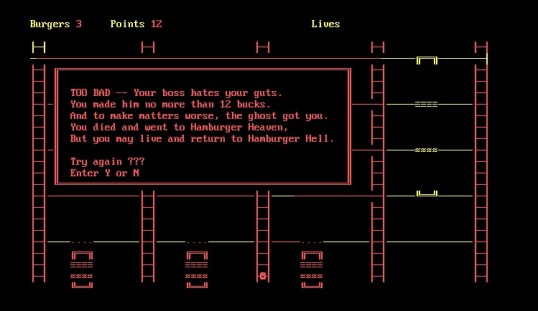
In this restaurant, it’s not just about knowing when to flip the burger.  Instead, you have to climb to the top of a ladder and push each ingredient down a level, one-by-one.  (That’s you, at the bottom of the third ladder.)  Making things extra difficult is that there’s a ghost running up and down the ladders.  The more hamburgers you make, the faster the ghost becomes.  If the ghost touches you, you die.  You come right back to life the first four times.  But after the fourth time, this happens:

This is an intentionally dumb but very addictive game.  You can play it at the Internet Archive.

Eat well and watch out for that ghost!