Porky’s II: The Next Day (1983, directed by Bob Clark)


The teens of Angel Beach, Florida are back!  They’re still trying to get laid, they’re still playing pranks on each other, and, this time, they’re …. FIGHTING THE KLAN!?

Porky’s II continues with the first Porky’s mix of raunchiness and social commentary.  While Pee Wee (Dan Monahan) tries to get back at his friends for spending the whole previous movie making fun of the size of his dick, the other members of the large ensemble cast thwart an attempt by the Klan to keep them from putting on a Shakespearean showcase.  The Klan is upset that a Seminole has been cast as Romeo so they burn a cross and do everything they can to sabotage the production.  Also trying to keep the show from going on is the hypocritical Rev. Bubba Flavel (Bill Wiley) and Mrs. Balbricker (Nancy Parsons), who both consider Shakespeare’s plays to be obscene.  When Wendy (Kaki Hunter) discovers that one of the county commissioners has been lying about supporting the play, she humiliates him in public by pretending to vomit in a fountain and accusing him of impregnating her.  It’s slightly funnier than it sounds but just slightly.

The first Porky’s took a stand against anti-Semitism while the second Porky’s takes a stand against censorship and the Klan.  That’s actually pretty cool when you consider that both of these films are usually just thought of as being dumb sex comedies.  Just like the first film, Porky’s II may be raunchy but it has a conscience.  That was due to director Bob Clark, who obviously meant for the Porky’s films to be about more than just T&A.

Unfortunately, Porky’s II is never as funny as the first Porky’s.  Too many of the jokes are recycled from the first film and the cast’s habit of laughing at their own “humorous” lines is even more grating the second time around.  Even the film’s most famous scene, where Wendy humiliates the duplicitous commissioner, goes on for too long and doesn’t have as much of a payoff as it should.  The best scenes in the film are the scenes that were lifted from Hamlet, Romero & Juliet, and A Midsummer Night’s Dream.  You wouldn’t expect the ensemble of Porky’s to feature that many Shakespearean actors but apparently it did.  Fans of A Christmas Story, which was also directed by Clark and which came out the same year as Porky’s II, will especially want to pay attention to the MacBeth sword fight scene just because the famous holiday leg lamp makes an appearance.

Porky’s II is nowhere near as good or memorable as the first Porky’s but its heart is in the right place.  While not as big of a success as the first Porky’s, it still did well enough to lead to Porky’s III, which I’ll review tomorrow.

Porky’s (1981, directed by Bob Clark)


Porky’s.

On the one hand, it’s a crude, juvenile, and raunchy sex comedy where a bunch of teenagers in 1960s Florida think that it’s a hoot and not at all problematic to spy on the girls shower and to hire a black man to scare all of their (white) friends.

On the other hand, it’s a heartfelt plea for tolerance where Tim (Cyril O’Reilly) finally stands up to his abusive father (Wayne Maunder) and makes friends with Brian Schwartz (Scott Colomby), who is apparently the only Jewish person living in Angel Beach, Florida.

What’s strange about Porky’s is that everyone knows it for being the template for almost every bad high school film that followed, with tons of nudity, jokes about sex, and characters with names like Pee Wee, Miss Honeywell, Cherry Forever, and Porky.  But, when you sit down and watch the movie, you discover that, for all the raunchiness, it actually devotes even more time to Brian Schwartz dealing with the local bigots than it does to any of the things that it’s known for.  Everyone remembers the shower scene but it’s obvious the film’s heart is with Brian and his attempts to make the world a better place.  Porky’s is a sex comedy with a conscience.

Porky’s is an episodic film about a group of teenage boys trying to get laid and also trying to get revenge on the owner of the local brothel.  There’s a lot of characters but I’d dare anyone to tell me the difference between Billy, Tommy, and Mickey.  I went through the entire movie thinking that Billy was Mickey until I turned on the subtitles and discovered who was who.  Porky’s has a reputation for being a terrible movie but it’s actually a pretty accurate depiction of the way that most men like to imagine how their high school years went.  It captures the atmosphere of good-spirited teenage hijinks if not the reality.

One of the interesting things about Porky’s is that Bob Clark went from directing this to directing A Christmas Story.  The innocence of A Christmas Story might seem like it has nothing in common with raunchiness of Porky’s but, actually, they’re both nostalgic films that are set in an idealized past.  (If you still think A Christmas Story has nothing in common with Porky’s, just remember that Ralphie didn’t actually say “fudge.”)  Of course, A Christmas Story struggled at the box office and only became a hit when it was released on video while Porky’s is still the most successful Canadian film to ever be released in the U.S.  Sex sells.  As cool as it was to see Brian Schwartz stand up for himself, I doubt the people who made Porky’s a monster hit were buying their tickets because they had heard the film struck a blow against anti-Semitism.  They were going because they knew there was a shower scene.

Porky’s deserves its reputation for being a not-so great movie but I would be lying if I said that I didn’t laugh more than once while watching it.  (Of course, I still didn’t laugh as much as the characters in the films laughed.  I’ve never seen a cast that was as apparently amused with themselves as the cast of Porky’s.)  There’s a lot of bad moments but it’s hard not to crack a smile when Miss Honeywell demonstrates why she’s known as Lassie or when one of the coaches suggests that wanted posters can be hung around the school to help catch the shower voyeur.  Plus, everyone learns an important lesson about tolerance and how to destroy a brothel.  As bad as it is, it’s hard to really dislike Porky’s.

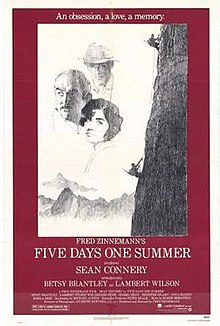
Five Days One Summer (1982, directed by Fred Zinnemann)


In 1932, Dr. Douglas Meredith (Sean Connery) is living in Switzerland with a much younger woman named Kate (Betsy Brantley), whom Meredith introduces as being his wife.  When Meredith and Kate go on a climbing holiday in the Alps, they hire a young guide named Johann (Lambert Wilson).  As they climb the mountains they not only discover a dead body but Meredith becomes suspicious that Kate might be falling for their guide.  Meanwhile, Johann discovers that truth between Meredith and Kate’s forbidden relationship.  Two men may go up the mountain but, in the end, only one man comes down.

Director Fred Zinnemann had a long career behind the camera, starting as an apprentice in Germany before coming to Hollywood in 1929.  (He was one of the many German and Austrian directors to immigrate as things grew steadily worse in post-war Germany.  He would soon be joined by Fritz Lang, Billy Wilder, Robert Siodmak, and many others.)  Zinnemann was a master craftsman who made several good film without ever really developing a trademark style.  Among his best-known (and Oscar-nominated) movies are High Noon, From Here To Eternity, The Nun’s Story, A Man For All Seasons, and Julia.  Unlike a lot of his contemporaries, Zinnemann never resorted to changing his filmmaking habits in an effort to keep up with the new wave of the 60s and the 70s.  As a result, he never humiliated himself the way that some of the other Golden Age directors did during the final years of their careers.  Instead, he continued to put together well-constructed but old-fashioned and occasionally stodgy movies.  Five Days One Summer was his final film.  It was one that he had been trying to make for close to 40 years and the combination of the critical drubbing that greeted the film and its failure at the box office inspired Zinnemann to retire from filmmaking.

The love story at the center of Five Days One Summer is a bland one and Brantley doesn’t have much in the way of chemistry with either Connery or Wilson.  But the love story is just a distraction from the true star of the movie, the mountain.  Some of the mountain climbing segments are amazing to watch and knowing that the three stars were actually putting their lives at risk to get some of the shots makes it all the more impressive.  At its worse, the film is a visually impressive but old-fashioned travelogue.  At its best, it puts you right on the mountain.  The film is far from perfect and it’s certainly not one of Zinnemann’s best but, at the same time, it is hardly the disaster that it’s often described as having been.  I think some critics are so wedded to the narrative of the once-great director making a film that proves how out of touch he is with contemporary audiences (think of the final films of Otto Preminger, Richard Brooks, Elia Kazan, and George Stevens) that they overlooked that Zinnemann’s final film is a respectable, middle-of-the-road feature.

Ignore the film’s wan story and instead just concentrate on the amazing scenery and you’ll see that Five Days One Summer was not a terrible film for an old craftsman like Fred Zinnemann to go out on.

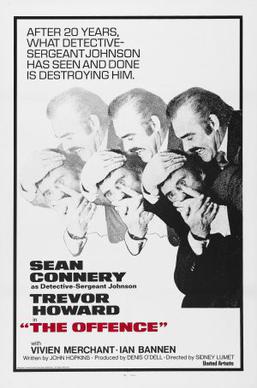
The Offence (1972, directed by Sidney Lumet)


After a suspected child molester named Baxter (Ian Bannen) dies while being interrogated in police custody, Detective Superintendent Cartwright (Trevor Howard) head up the internal affairs investigation.  Baxter was beaten to death by Detective Sergeant Johnson (Sean Connery), a 20-year veteran of the force who has seen the worst that humanity has to offer.  Did Johnson allow his anger over Baxter’s crimes to get to him or did something else happen during the interrogation?

When Sean Connery agreed to play James Bond for a final time in Diamonds are Forever, he did it under the condition that United Artists agree to back two of Connery’s non-Bond film projects.  UA agreed, though they did insist that neither film cost more than $2,000,000.  One of those projects was an adaptation of Macbeth, which was canceled in the wake of Roman Polansi’s version of the Scottish play.  The other project was The Offense.

Based on a play by John Hopkins, The Offence is the type of movie that probably would have never been made if not for the interest of a big star, like Connery.  The story is downbeat and grim and audiences are essentially asked to spend nearly two hours in the presence of two very unlikable men.  Baxter is an accused child molester while Johnson is a bully who has been driven so mad by the things that he’s seen that he’s not only violent on the job but also on at home.  Director Sidney Lumet directs with a cold and detached style, refusing to provide any sort of relief from the intensity of the film’s interrogations.  The film is set up as an acting showcase for Connery and Bannen, giving both of them a chance to show what they could do with two unpredictable characters.

Unfortunately, not many people got a chance to see their performances.  Even though Connery kept the budget under a million dollars and despite both the film and his performance being critically acclaimed, United Artists barely released The Offence and it took 9 years for the film to make back it’s meager budget.  It didn’t even get released in France until 2007.  Connery, however, often cited The Offence as being one of his best films and said that his performance in the film was his personal favorite.

The movies is too stagey and talky to be entirely successful but Connery was right about his performance.  It’s one of his best and it retains its power to disturb to this day.  Connery often chafed at being typecast as James Bond.  With The Offence, Connery plays a character who is nothing like Bond.  Everything about Johnson is brutal and seedy.  While it’s impossible not to initially sympathize with his anger towards the state of the world, Connery reveals that Johnson’s self-righteous anger is actually a shield for his own dark thoughts and desires.  He’s a bully, an angry man who grows more and more insecure as the film progresses and Baxter continues to see through him.  Connery makes Johnson sympathetic, frightening, pathetic, and dangerous all at the same time.  The Offence is a film that proves that Sean Connery was not only a good Bond but also a great actor.


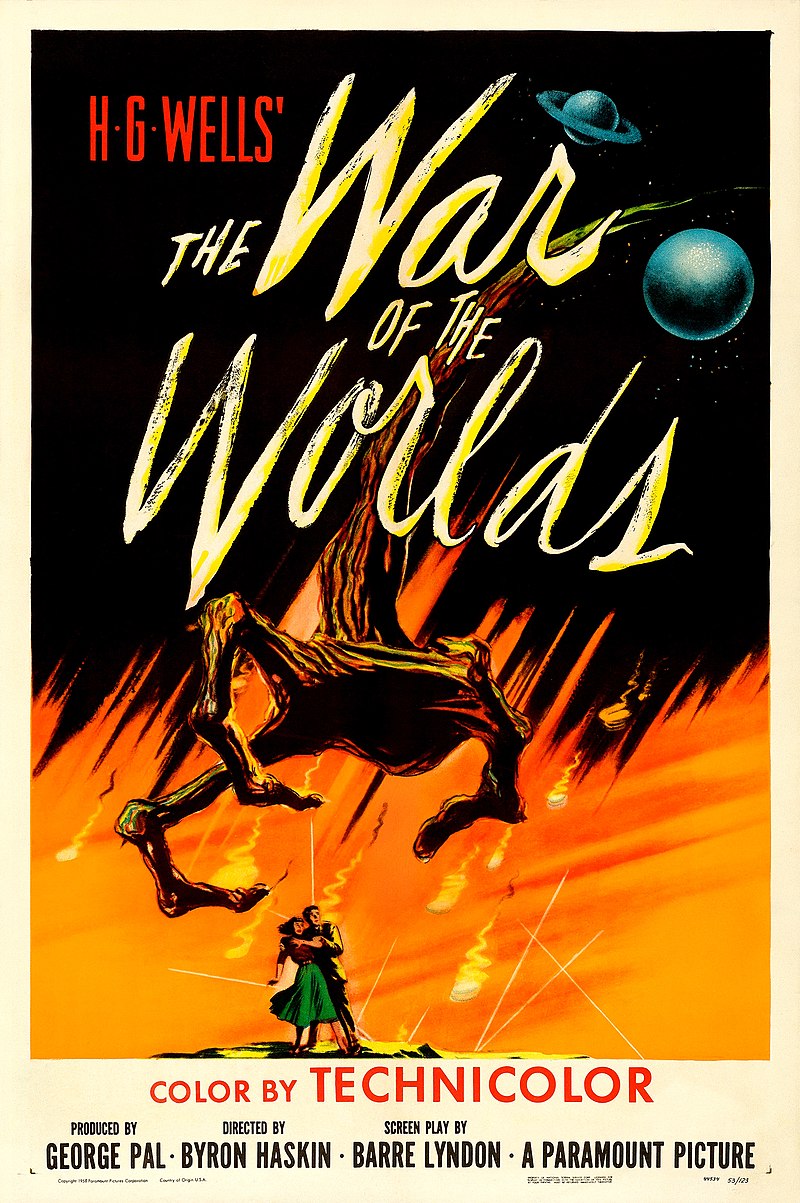
War of the Worlds (1953, directed by Byron Haskin)


Earlier today, when I saw that Lisa had posted a video of the infamous 1938 radio version of The War of the Worlds, it brought back memories of how much the first film version of War of the Worlds freaked me out.

I can’t remember how old I was when I first saw the 1953 version of War of the Worlds.  I think I must have been 10 or maybe 11.  I could have even been 9, I’m not sure.  I came across the original War of the Worlds at Blockbuster and begged my Dad to rent it for me because, back then, I was into anything that looked like it involved an alien invasion.  I watched it that night and I have no shame in admitting that it totally freaked me out.

I knew that the aliens were the bad guys but nothing prepared me for the scene where the three men approached the alien ship while waving a white flag and shouting that they came in peace.  The Martians took one look at them and…

And then there was the scene where the priest approached the aliens while reciting the Lord’s Prayer.  The Martians took one look at him and…

Today, everyone makes jokes about the scene where the military tries to nuke the aliens and then casually brushes the nuclear fallout off of their jackets.  Yes, that’s definitely not something that you want to try in real life but, when I first saw the movie, the only thing registered with me was that they dropped the greatest weapon known to man on the aliens and…

IT DIDN’T WORK!

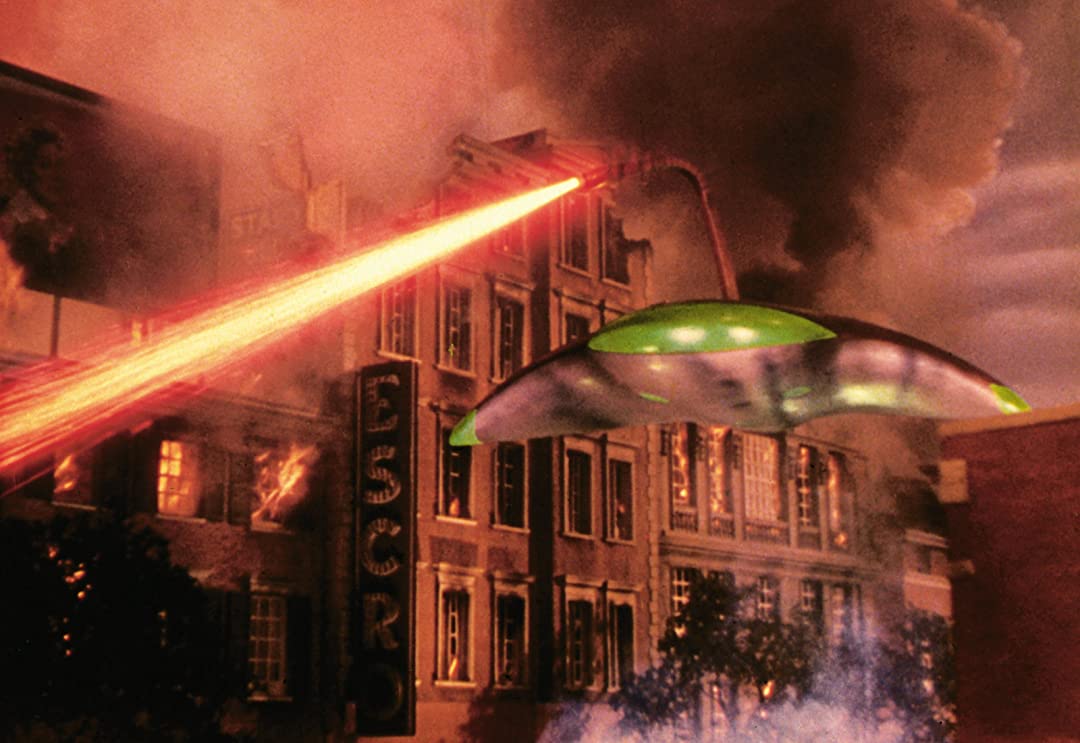
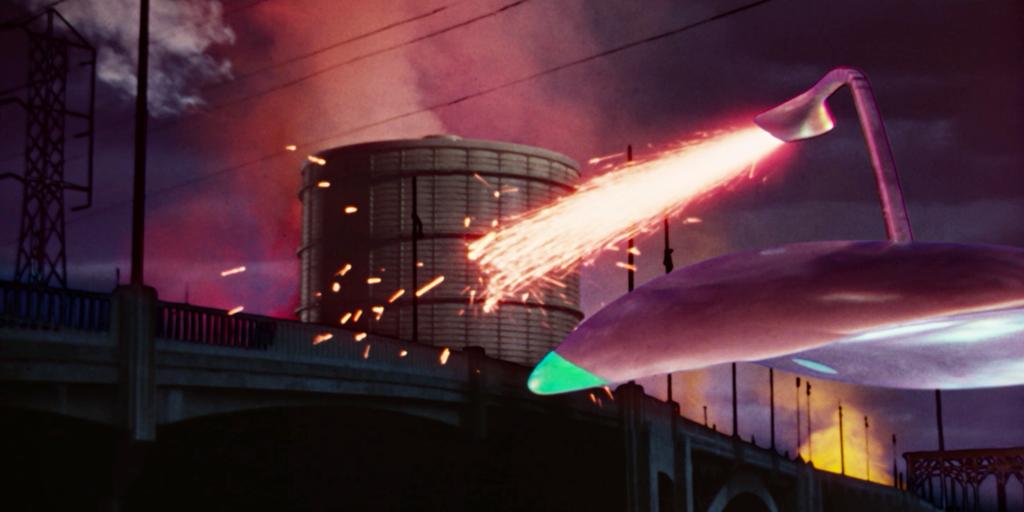
When the Martians attacked all of the great cities of the world, they destroyed every famous landmark that they saw and they set the template for every Roland Emmerich film that would follow.  But for me, all that mattered was that they destroyed London, the city that I was looking forward to visiting in the summer.

Another scene that people tend to poke fun at is everyone gathering in the church and praying.  H.G. Wells was a noted skeptic when it came to religion so he probably would not have cared for that scene.  But when I first watched the movie, that didn’t matter.  What mattered was that the world was on fire and the only thing that could stop the aliens were germs.  Mankind’s weapons were useless.  We were doomed.  In the end, only nature could save the world.

I’ve rewatched War of the Worlds several times since then and it holds up well.  It may no longer freak me out but it still gets to me every time.  It’s still one of the best alien invasion films ever made and it still gets to me whenever I hear, “Everyone knows what a white flag means!”  No, they don’t.

Actually, I might have to watch it again, tonight.

Happy Halloween, readers!

Welcome To Silent Hill


Instead of reviewing an IF game today, I decided to instead share what I consider to be one of the greatest video game opening scenes of all time.

I know people who still play Silent Hill just for the opening alone.  Though it may look primitive compared to what we’re used to today, this game really blew everyone’s mind when it first came out in 1999.  This is the game that showed a generation just how good a game could be.  The opening not only set the mood but also let us know that there was more to Silent Hill than just walking down streets and shooting monsters.  This was a game that told a comple story.  That’s something that we take for granted now but, at the time, Silent Hill was revolutionary.

The score was composed by Akira Yamaoka.  He was influenced by Angelo Badalamenti’s work for David Lynch.

Happy Halloween!  I’ve really enjoyed participating in this year’s Horrorthon and I look forward to doing it all over again next year!

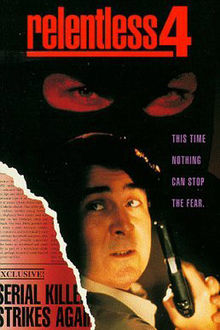
Cinemax Friday: Relentless IV: Ashes to Ashes (1994, dir by Oley Sassone)


Sam Deitz (Leo Rossi) is back to hunt one last serial killer in this, the last of the Relentless films.

This time the killer is a boring nonentity.  He’s not as interesting as the killers played by Miles O’Keeffee or William Forsythe.  Nor is he as unintentionally funny as the one played by Judd Nelson in the first Relentless film.  Instead, he’s just your run-of-the-mill religious fanatic, killing sinners and performing rituals.  His trademark is that he only kills the person that he wants to kill.  Anyone else who might be around is just taken out with a stun gun.  That’s a boring if considerate trademark.

Deitz is assigned to track down the killer, along with his new partner, Jessica Pareti (Colleen Coffey).  While Deitz is trying to solve the case, he’s also having to deal with his rebellious teenage son (Christopher Pettiet).  Between this film and the last, Deitz’s ex-wife died and now Deitz is a single father.  He and his son barely know each other.  Deitz tries to keep his son under control while all his son wants to do is spend time with his girlfriend, Sherrie (Lisa Robin Kelly).

Relentless IV is the least interesting of the Relentless film.  It’s so trapped by the now-stale Relentless formula that not even the casting of Famke Janssen as a possible femme fatale can save it.  Janssen is a psychiatrist who is connected not only to one of the victims but possibly to the killer as well.  She and Deitz are obviously attracted to each other and Deitz is torn between that attraction and treating her like a possible suspect.  The relationship between Deitz and the doctor has potential but it keeps getting sidetraced by scenes of Deitz trying to deal with his teenage son and it never really lives up to what it could have been.  Janssen is beautiful and Rossi gives a typically good performance but watching the film, it’s obvious that there wasn’t much left to do with the character of Detective Sam Deitz.

Direct-to-video mainstay Oley Sassone directs in a flat and unmemorable manner and the entire film just seems tired.  When the best your serial killer can do is kill someone with a Campbell’s soup can, you know you’re running on empty.  There would not be a Relentless V.  Hopefully, Sam Deitz finally found some peace and figured out how to balance being an intense New Yorker with living in laid back California.

Great Moments In Television History: Freedom’s Last Stand


I have recently started rewatching Hill Street Blues on Hulu and there are two things I can say for sure about the characters who appeared on this seminal cop show.

Anyone who thinks that anything in the world can be defined as simply being all-good or all-bad is due for a rude awakening.

Anyone who spends any time with Detective Mick Belker is destined to die on a sidewalk.

Unfortunately, Captain Freedom made both of those mistakes.

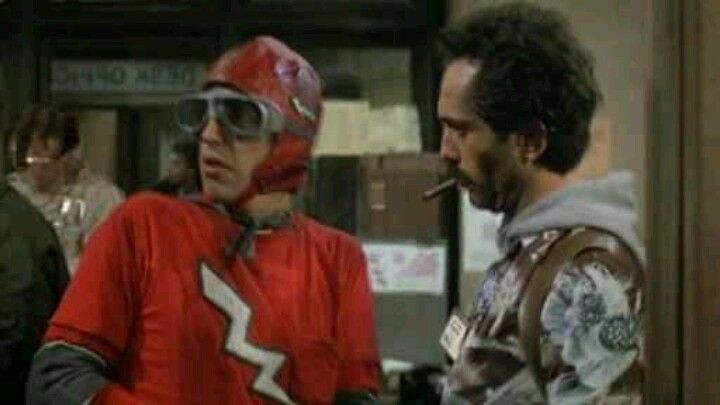
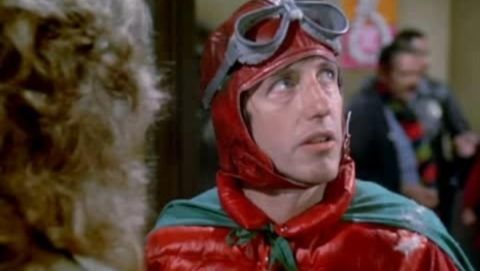
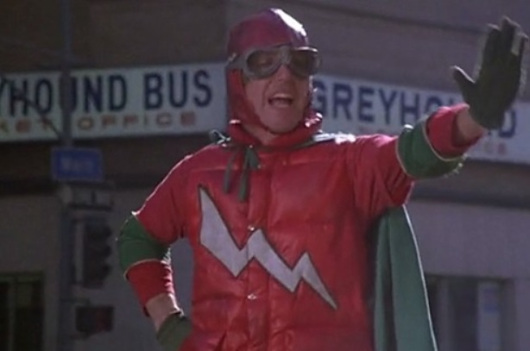
Played by Dennis Dugan, Captain Freedom appeared on four episodes during the second season of Hill Street Blues.  He was a goofy and friendly man who dressed in a red lycra suit with green shorts and Chuck Taylor running shoes.  He believed that he had super powers and would jump in front of muggers and shout, “Stop this criminal act, or I shall be forced to use violence!”

As always happened whenever an eccentric appeared on the show, he spent three episodes annoying Bruce Weitz’s Detective Belker, a streetwise detective who always looked filthy and who often growled at criminals.  Belker told Captain Freedom to stop following him and to stop trying to help.  Captain Freedom said that it was his duty to protect Belker and keep the city safe.

During Freedom’s Last Stand, the 11th episode of the second season of Hill Street Blues (aired on January 28th, 1982), Captain Freedom’s dedication to keeping the city safe got him killed.  In the middle of a dramatic shoot out between robbers and some of the Hill’s best cops, Captain Freedom jumped on top of a car and shouted, “Stop this criminal act!”  The shocked robber responded by shooting Captain Freedom in the chest.

The show pulled out all the stops for the death of Captain Freedom.  Not only did he get shot in slow motion, but he even got a monologue before finally dying of his wounds.  He gave Belker his gloves, explaining that all of his powers were stored in the gloves.  Belker sobbed as the Captain went on to become the first of many Belker acquaintances to die on a sidewalk.

After his death, Captain Freedom was never mentioned again and Dennis Dugan went to become a comedy director but the character made an undeniable impact.  He only appeared in four episodes but Captain Freedom is better remembered than some of the show’s regulars.  Few people can tell you who Ken Olin played for three seasons (Det. Harry Garibaldi) but anyone who has binged through the early seasons of Hill Street Blues remembers Captain Freedom.  He was someone to whom everyone can relate.  Who doesn’t want to be a super hero?  Who doesn’t want to stop evil doers and make the streets safe again?  His death was the show’s loss of innocence.  If even the likable and funny Captain Freedom can die, than anyone can die.

This Halloween, pour one out for Captain Freedom, the man who tried to make his costume a reality.  Evildoers beware!

Don’t try this at home.

Previous Great Moments In Television History:

  1. Planet of the Apes The TV Series
  2. Lonely Water
  3. Ghostwatch Traumatizes The UK
  4. Frasier Meets The Candidate
  5. The Autons Terrify The UK

Game Review: Doppeljobs (2020, Lei)


Doppeljobs is an entrant in the 2020 Interactive Fiction Competition.  All of the entries can be browsed and experienced here.

You are a Doppelganger.  All you have to do is bite someone and, for a limited amount of time, you can assume their appearance and voice.   Having just graduated from the School of Humanity, you’re ready to set up your own business.  For a generous but fair fee, you will assume the identity of anyone who hires you.  If someone has something that they have to do in person that they would rather not do, they can hire you.  You’ll be the one getting fired from their job.  You’ll be the one getting your license renewed.  You’ll be the one sitting through a boring old recital.

You’ll have to be careful, though.  Let anyone catch on that you’re a doppelganger and the job will be ruined.  Plus, each time you take on someone’s appearance, you also take on some of their traits and some of those traits stick around after the job is done.

I really enjoyed Doppeljobs.  It’s a Twine game, in which you go through a series of clients and you can do as good a job or as bad a job as you may want.  There’s a lot of different decisions to be made and almost every choice leads to a different consequence so this is a game that rewards being replayed.  The best part of the game is seeing which traits you pick up from job to job and how that changes who you are after your final job.  The last time I played, I became not only more paranoid but I also learned to sing.

Doppeljobs can be played here, by either your or your doppelganger.

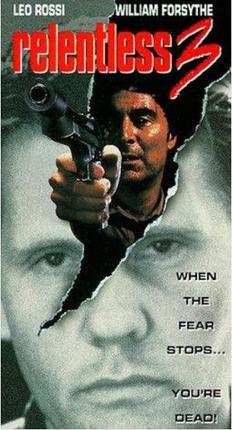
Relentless 3 (1993, directed by James Lemmo)


Detective Sam Deitz (Leo Rossi) is back and somehow, his life is even more crappy than before.

Detective Deitz is still an intense New Yorker struggling to fit in with the laid back California lifestyle.  Watching a Relentless film, you would think that it’s a crime to be laid back in New York.  After three films,  Deitz should no longer be as much of a fish out of water as he is in Relentless 3.

Deitz is now divorced and he hardly ever sees his son.  That bothers him but also means that there aren’t anymore arguments between Deitz and his wife about him bringing his work home.  Deitz is now out on the dating scene.  The movie spends a lot of time on scenes of Deitz trying to pick up women.  It’s not easy because he’s an intense New Yorker and they’re all laid back California girls.  He eventually meets and falls for Paula (Signy Coleman).

Meanwhile, there’s a new serial killer on the scene.  Walter (William Forsythe) lives with a mentally unstable woman and is always bragging about how he’s a star.  He picks up women in bars, take them home, kills them, and then has sex with their dead bodies before eventually dumping them around Los Angeles.  Even though Deitz no longer wants to chase serial killers, he agrees to serve as a consultant.  When Walter finds out that the famous Sam Deitz is working the case, he decides to make it personal.  Being a “star,” Walter wants to compete with the best.

Relentless 3 gets off to a good start but it runs out of gas quickly.  William Forsythe is an effective villain and some of the early scenes of him picking up women are suspenseful.  Also, there’s an effective scene where Walter mails Deitz a patch of tattooed skin and proves, as if there was any doubt, that Walter was one sick puppy.  But the movie, which should be a relentless cat-and-mouse game between Deitz and Walter, gets sidetracked with all of the scenes of Deitz trying to get back into the dating scene.  For all the build-up, the final confrontation between Deitz and Walter feels like a let down. This Relentless film just isn’t relentless enough.

Leo Rossi still does a good job as Deitz but it seems like we learned as much as we need to know about the character during the first two Relentless films and nothing that Deitz does surprises us anymore.  Despite good performances from Rossi and Forsythe, Relentless 3 never comes together.