Thank you, Destroy All Humans!


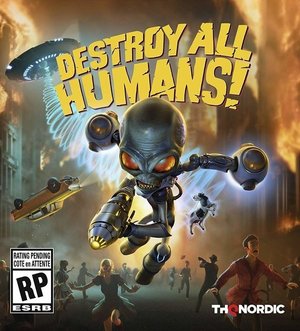
When I reviewed Destroy All Humans! last year, I ended the review by saying that I couldn’t wait for the remake to be released in 2020.  When I wrote those words, I didn’t know just how much 2020 would sometimes make me want to destroy all humans.  It’s been a hell of a year and distractions from reality have been not only welcome but necessary.  I’m happy to say that the remake of Destroy All Humans! lived up to all of my expectations and it’s often been just the distraction that I needed.

With the exception of one new mission (which was planned for but cut from the original), the remake of Destroy All Humans! is the same game as the original.  Some of the images are a little crisper and the sound quality has been improved but there really aren’t any major differences as far as gameplay is concerned.  For me, that’s not a problem because I consider the original Destroy All Humans to be about as perfect as game from the period can be.

For me, Destroy All Humans! is the perfect game for 2020.  If there’s ever been a year that’s called for a full scale alien invasion, it’s been this one.  I’ve destroyed Santa Modesta and the Turnipseed Farm more times than I care to count.  When the news is bad, there’s something very gratifying about boarding a spaceship and blowing up a grain silo.  Normally, I’m not a fan of mindless violence but the key to Destroy All Humans! is that, no matter how many times you blow Santa Modesta, the town is always rebuilt by the time you return.  Destroy All Humans! may not have been made to show that humans are resilient but it really one of the main lessons of the game.

Thank you, Destroy All Humans!, for being there when we needed you.  Now, let’s just hope for a remake of Destroy All Humans 2!

Video Game Review: Spider-Man: Miles Morales (2020, Insomniac Games)


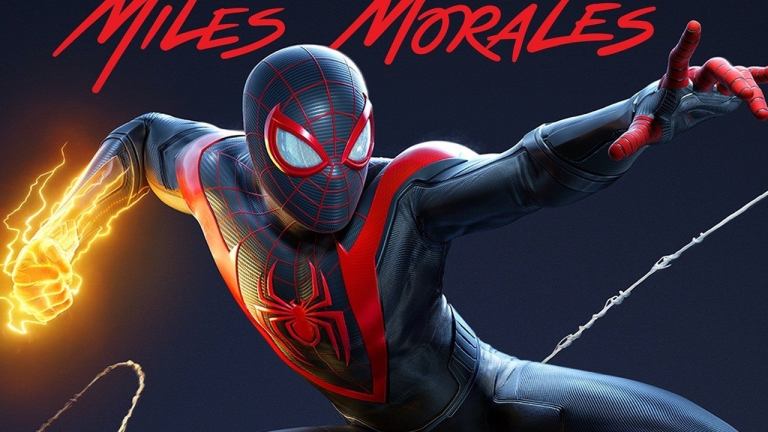
The much anticipated sequel to PS4’s Spider-Man, Spider-Man: Miles Morales puts you in control of the title character, a teenage super hero and scientific genius who is still struggling to learn how to use his powers.  It’s been a year since the conclusion of the previous game and, in that time, Manhattan has struggled to recover from the Devil’s Breath incident.  Crime is still rampant but, luckily, Spider-Man has an assistant to help him out.  Now living in Harlem, Miles Morales can not only do everything that a spider can but he also has a whole host of new powers that the original Spider-Man could only dream of.  Miles is going to need all of them because the original Spider-Man is going to be in Europe for the next few weeks and Miles is going to have to protect New York City on his own.

The main mission finds Miles caught in the middle of a war between Roxxon Oil and the mysterious Tinkerer.  The side missions give Miles a chance to do everything from looking for lost cats to preventing another old foe from engineering a criminal takeover of Harlem.  Along the way, Miles discovers that his uncle is the mercenary known as the Prowler and that his oldest friend, Phin Mason, has a big secret of her own.  He also discovers that he has an entire community willing to support him in his time of need.

I have to admit that it took me a while to get into Spider-Man: Miles Morales.  At the start of the game, Miles is so inexperienced and nervous about filling in for Spider-Man that he actually came across as being a little whiny.  As the game progressed, Miles got more confident and stronger and so did the story.  Spider-Man: Miles Morales is best viewed as a coming of age story.  In the first game, Peter Parker was already an experienced Spider-Man and he knew what he was capable of doing.  Spider-Man: Miles Morales gives us a chance to watch as Miles first comes to realize just how powerful he can be.  The game is all about Miles learning what it means to be a hero and coming to realize that it takes more than just super powers to make the world a better place.  Miles not only discovers his own inner strength but he also the strength of his community.  The game is as much about the people that Miles helps as it is about Miles himself.

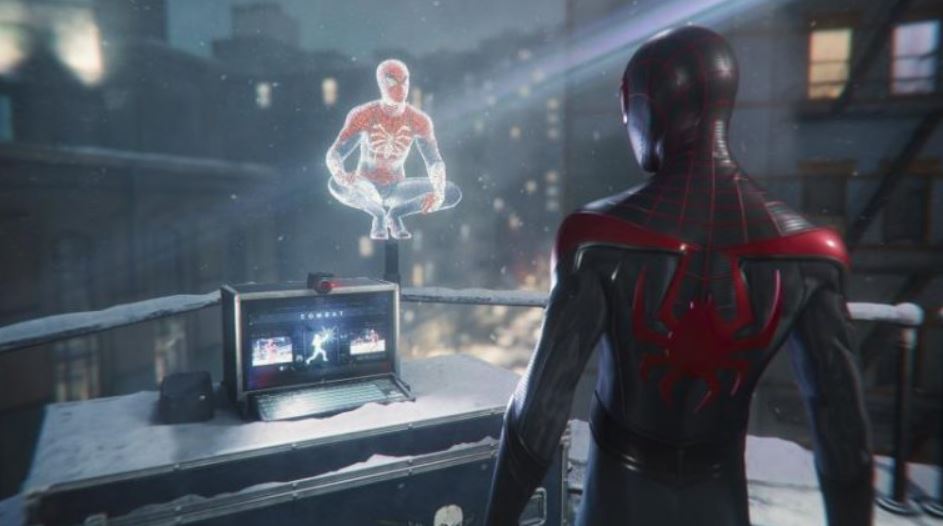
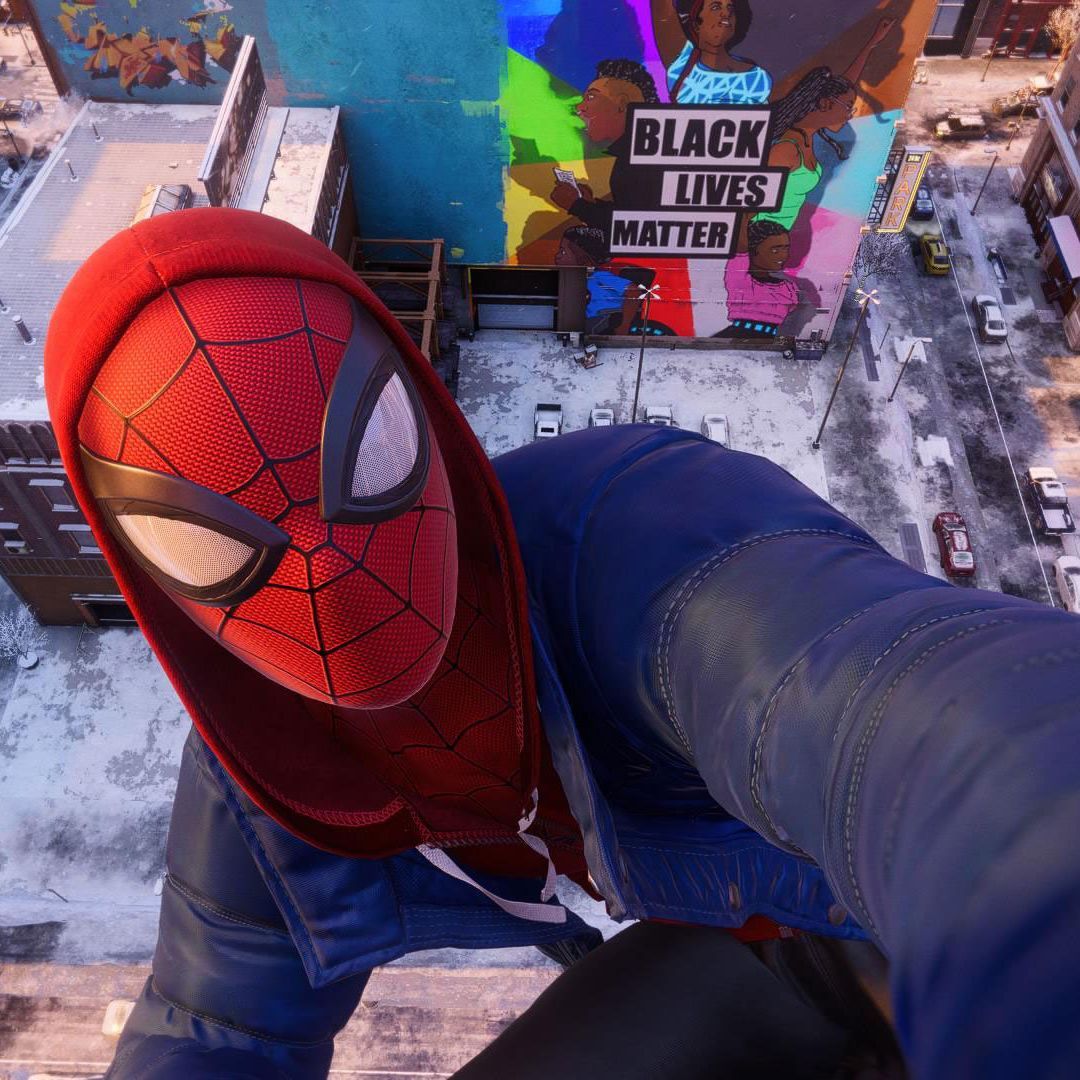
Spider-Man: Miles Morales looks great.  While I would like to see a Spider-Man game that takes place in a location other than Manhattan, the island still looks great and one of the joys of the game is just to swing form building to building and appreciate the amount of detail that has been put into the setting.  The game takes place during the holidays, which means that it never stops snowing.  The final battle takes place during a fierce blizzard and it’s a visual tour de force.  The game controls are still simple and easy to master.  Once you figure out how to throw a venom punch, it’s hard not to resist the temptation to do it every single chance that you get.

If I do have a complaint with the game, it’s that it’s too short.  The main mission resolves itself too quickly and the game could have used a few more side missions.  The side missions are often fun and diverting but none of them can really compare to the first game.  None of them are as exciting or as challenging as trying to take down Tombstone or battle the Taskmaster.  Spider-Man: Miles Morales is still a fun game but, because of its shortened length, it feel very much like just one chapter in a much bigger saga.  Fortunately, the main story ends with a hint as to what’s waiting in the future and you’ll definitely want to play the game to the end so that you can see it for yourself.

For the most part, I enjoyed playing Spider-Man: Miles Morales and I look forward to seeing what the future holds for the Spider-Man video game franchise.


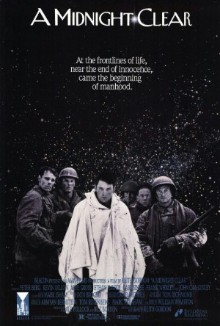
A Midnight Clear (1992, directed by Keith Gordon)


In December of 1944, with the world at war and Christmas approaching, a small U.S. Army Intelligence squad is sent to a deserted chateau near the German lines.  The squad, which was decimated during the Battle of the Bulge, is made up of six young soldiers who all have genius IQs.  They’ve been hardened by war but they’re still young enough to have some hope for the future.  Leading them is “Mother” Wilkinson (Gary Sinise), an officer who cares about his men but who has been mentally struggling with not only the war but also with the recent death of a child back home.

At first, the chateau seems like a perfect sanctuary, a place to wait for the war to end.  But then the Americans discover that there is a regiment of German soldiers nearby.  The Germans are just as young as the Americans and when the two groups meet each other, they don’t fire their guns but instead have a snowball fight.  The Germans say that they know the war is about to end and that they want to surrender before the Russians arrive.  However, the Germans are worried about their families back home and what will happen when word gets back that they’ve surrendered.  They request a staged fight so that it will appear that they were captured in combat.  Almost everyone is down with the plan but it turns out that it’s not easy to fake a war in the middle of a real one.

Based on a novel by William Wharton, A Midnight Clear is one of the best Christmas films that hardly anyone seems to have heard of.  It’s a war film that is more concerned with the men who fight the wars than with the battles. Along with Sinise, the ensemble cast includes Ethan Hawke, Peter Berg, Kevin Dillon, Ayre Gross, Frank Whaley, and John C. McGinley and all of them make an impression, bringing their characters to life.  By the end of the movie, you feel like you know each member of the squad and their individual fates hit you hard.  Some of them make it to the next Christmas and tragically, some of them don’t.  The film starts out almost gently and all of the soldiers are so intent on just letting the war end while they hide out at the chateau that you find yourself believing that it could actually happen.  When reality intrudes, it’s tragic and poignant.  Intelligently directed by Keith Gordon (making his directorial debut), A Midnight Clear is an unforgettable anti-war story that has an amazing final shot.  A Midnight Clear makes an impression on Christmas and every other day.

Great Moments In Comic Book History: “….And To All A Good Night”


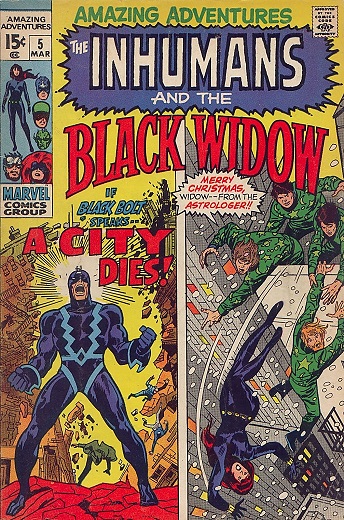
In 1970, Marvel finally gave Black Widow her own solo series.

Of course, she had to share the spotlight with The Inhumans.  When Marvel revived their anthology series, Amazing Adventures, each issue featured two stories.  The Inhumans starred in the first story while the second story would feature Natasha Romanoff (a.k.a., The Black Widow) and her assistant, Ivan.  While The Inhumans dealt with cosmic concerns and royal intrigue, Natasha and Ivan would battle more down-to-Earth criminals.  It was not a perfect combination as the Inhumans had little to do with the Black Widow and vice versa.  But, for 8 issues, they made it work.

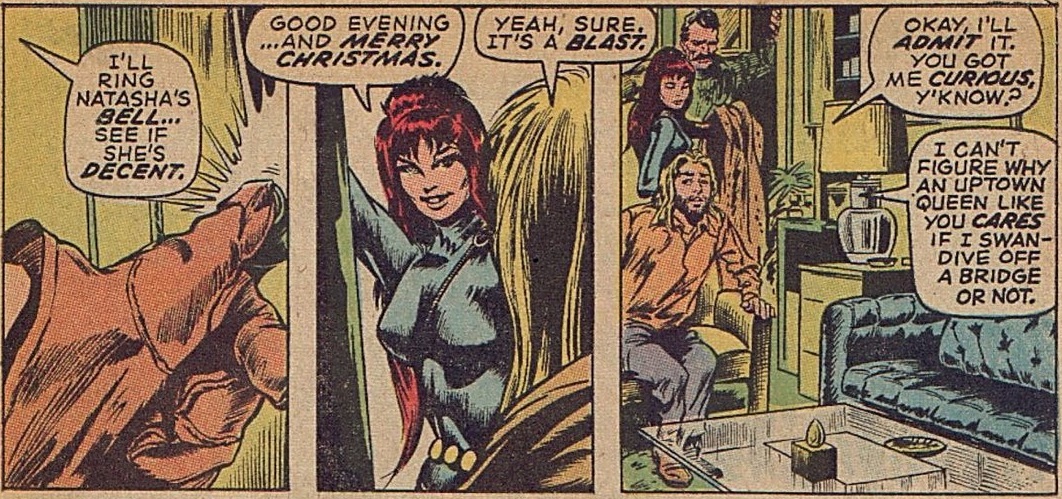
The 5th issue of Amazing Adventures was a Christmas issue and it featured a story that was dark even by the standards of Marvel in 1970.  Ivan comes across a teenage boy who is about to jump off a bridge.  Ivan grabs him and takes him to the Black Widow’s luxury apartment, located at the top of Manhattan’s Mammon Towers.  “You mean that jet set chick who cooled the Young Warriors’s scene a while back?” the teenager says, showing that he knows all of the hip lingo.

When Ivan and the teenager arrive at the apartment, the Black Widow has just stepped out of the shower.  (Every issue of Amazing Adventures featured at least one scene of the Black Widow either showering or getting dressed.)  The Black Widow wishes Ivan and the still nameless teenager a Merry Christmas but the teenager isn’t impressed.
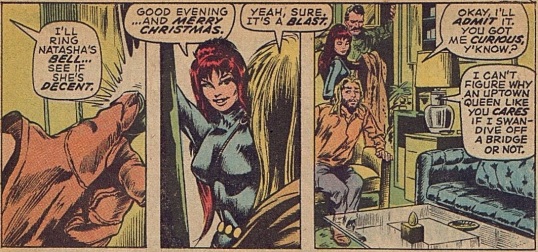
The teenager explains that he’s from Utah.  He came to New York with “a dime in my pocket, sawdust in my skull” and eventually, he ended up crashing at the pad of a cult leader called The Astrologer.  Using the stars as his guide, the Astrologer sent his cult out to commit crimes.  At first, the teenager was cool with all of the the petty theft but when the Astrologer suggested robbing a blood bank and holding all of New York’s O-type blood hostage, that was a bridge too far.

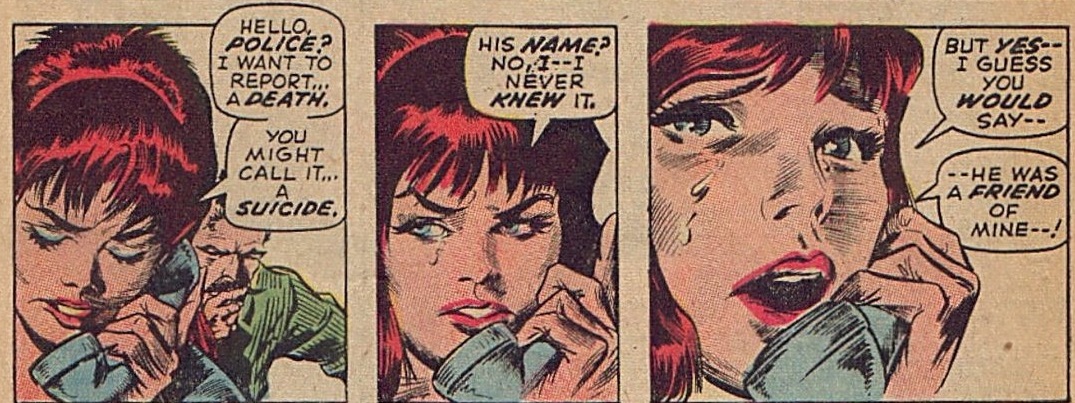
As the teenager finishes his story, the members of the cult show up.  Out on the balcony of her apartment, Natasha fights several of them off before a cult member named Willie gets in a lucky punch and knocks her down.  The teenager shouts that he won’t allow the Black Widow to die because of his mistakes and he jumps at Willie.  Both of them fall off the balcony and plummet several stories to their death.

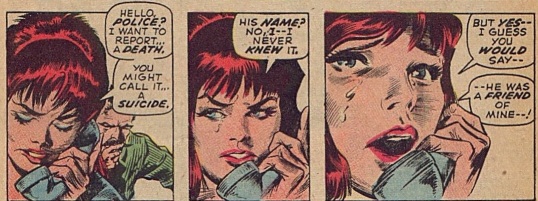
With tears in her eyes, Natasha calls the police to report a death.  No, she and Ivan never learned the teenager’s name. “But yes,” Natasha says, “I guess you would say — he was a friend of mine!”
Merry Christmas, right?

Three issues later, Black Widow would get her revenge on the Astrologer and the villain was never seen again.  She never did learn the teenager’s name but his brief appearance was one of the key moments in her brief run in Amazing Adventures.  His sacrifice not only established that the Black Widow lived in a dangerous world where even Christmas could end with a sudden death but it also epitomized the concepts of sacrifice and redemption.  He may have been a runaway and a petty criminal with “sawdust in my skull” but could still save the life of a hero.

Amazing Adventures (Vol. 2 #5, March, 1970)

“…And To All A Good Night”

  • Writer — Roy Thomas
  • Artist — Gene Colan
  • Inker– Bill Everett
  • Letterer — Artie Simek

Previous Great Moments In Comic Book History:

  1. Winchester Before Winchester: Swamp Thing Vol. 2 #45 “Ghost Dance” 
  2. The Avengers Appear on David Letterman
  3. Crisis on Campus
  4. “Even in Death”
  5. The Debut of Man-Wolf in Amazing Spider-Man
  6. Spider-Man Meets The Monster Maker
  7. Conan The Barbarian Visits Times Square
  8. Dracula Joins The Marvel Universe
  9. The Death of Dr. Druid
Great Moments In Television History: Bing Crosby and David Bowie Share a Duet


In 1977’s Bing Crosby’s Merrie Olde Christmas, Bing and his family travel to the UK to visit Bing’s long-lost relative, Sir Perceval Crosby.  It’s while staying at the Crosby estate that Bing celebrates Christmas and discovers that Sir Percy lives next door to David Bowie!

You might not expect Bing Crosby and David Bowie to have much in common as far as musical tastes are concerned but that’s where you’re wrong.  After discussing their parenting techniques and their favorite songs, Crosby and Bowie share a duet that has become a classic.

From Bing Crosby’s Merrie Olde Christmas (which aired on ITV 33 years ago today), here are David Bowie and Bing Crosby performing Little Drummer Boy/Peace on Earth.

Previous Great Moments In Television History:

  1. Planet of the Apes The TV Series
  2. Lonely Water
  3. Ghostwatch Traumatizes The UK
  4. Frasier Meets The Candidate
  5. The Autons Terrify The UK
  6. Freedom’s Last Stand

Music Video Of The Day: Wonderful Christmastime by Paul McCartney (1979, directed by ????)


Since Ringo Starr provided yesterday’s video, it seems appropriate to give today’s video to Paul McCartney.

As a group, The Beatles never released an “official” Christmas song, though the members of their fan club received a recording of Christmas Time Is Here Again in 1967.  After the band broke up, all four of the members recorded Christmas songs on their own.  Paul McCartney’s Wonderful Christmastime is probably the most remembered.  I don’t know if I would say it was the most popular but anyone who has ever had to rush out to do some last minute Christmas shopping has heard it playing in countless stores on December 24th.  Whenever I’ve been in a store while Wonderful Christmastime was playing, I’ve always felt as if the song was taunting me but it is definitely a part of the season.

McCartney recorded this song at his farm.  He was just getting into what was then known as “electropop,” which is why he used a Sequential Circuits Prophet-5 synthesizer in the song.  More than anything, that weird bouncing noise probably explains why this song is so well-known.  Whenever I hear this song, I imagine that this is what Christmas sounds like on Mars.

The video was shot at at the Fountain Inn in Ashurst, West Sussex.  Though the members of Wings had nothing to do with recording the song, they all appeared in the video because they were all hanging out with McCartney on the night that it was filmed.

Reportedly, Paul McCartney receives $400,000 a year in royalties from Wonderful Christmastime.

Enjoy!

Happy Festivus!


Friday is Christmas.

Tomorrow is Christmas Eve.

But today is the most important holiday of all!

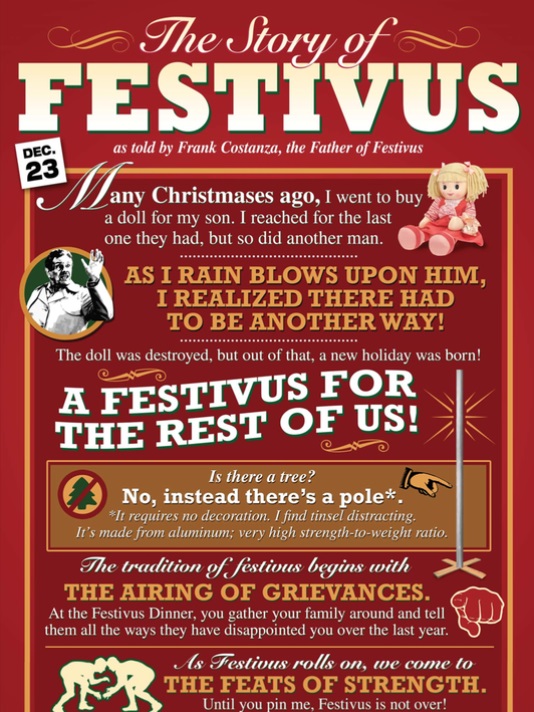
Happy Festivus!  It’s 2020 so you better believe I’ve got a lot of grievances to air!  But they’ll wait until after the aluminum pole goes up and after we’ve had our Festivus dinner.  Some people say that the Feats of Strength are more important than the Airing of Grievances but I say the grievances should always be at the center of any Festivus celebration.

If you need a refresher course on the origins of Festivus, listen to Frank Costanza (Jerry Stiller, RIP):

Enjoy your Festivus dinner.  Let the people in your life know how the have let you done.  And who knows?  Maybe you’ll even experience a Festivus miracle because this is Festivus for the rest of us!

Happy Festivus!

Music Video of the Day: Here’s To The Night by Ringo Starr (2020, directed by ????)


Though it may not be a Christmas song, the latest single from Ringo Starr feels appropriate for the season.  Ringo sings for peace and hope in this song and he’s brought along an impressive supporting cast to help him make his case.  Among those featured in the song and the video: Paul McCartney & Joe Walsh, Corinne Bailey Rae, Eric Burton, Sheryl Crow, FINNEAS, Dave Grohl, Ben Harper, Lenny Kravitz, Jenny Lewis, Steve Lukather, Chris Stapleton, and Yola.

I searched but I could not find a credited director for this video.

Enjoy!

Star in the Dust (1956, directed by Charles F. Haas)


The time is the late 1800s and the place is the town of Gunlock.  Gunlock is split between the ranchers and the farmers, with the ranchers eager to buy all of the land around the town and the farmers refusing to sell.  Trying to keep the peace is Sheriff Bill Jorden (John Agar), who not only wants to keep war from breaking out in Gunlock but who also wants to live up to the example of his legendary father.

There’s a prisoner in the Gunlock city jail.  Sam Hall (Richard Boone) is a notorious gunman who has been convicted of killing three farmers.  He’s due to hang at sunset but everyone in town believes that Sam will somehow escape the executioner.  (They’re even taking bets down at the local saloon and casino.)  Everyone knows that Sam was hired by the ranchers but Sam has yet to name which rancher specifically invited him to come to town.  The farmers want to lynch Sam.  The ranchers want to break him out of jail and arrange for him to be killed in the resulting firefight.  Meanwhile, Sheriff Jorden insists that he’s going to carry out Sam’s sentence by the letter of the law.  Complicating matters for Jorden is that he’s engaged to Ellen Ballard (Mamie Van Doren), the sister of the main rancher, George Ballard (Leif Erickson).

I was really surprised by Star in the Dust, which turned out to be far better than I would normally expect a John Agar/Mamie Van Doren western to be.  Though Agar, Boone, and Van Doren get top-billing, Star in the Dust is really an ensemble piece, with several different people responding to the possible hanging of Sam Hall in their own way.  Sam’s girlfriend, Nellie Mason (Colleen Gray), tries to figure out a way to keep Sam alive.  One of the ranchers, Lew Hogan (Harry Morgan), is morally conflicted about whether or not to honor his word to help Sam escape, especially after he finds out that Sam tried to rape his wife (Randy Stuart).  Even the old deputies (played by James Gleason and Paul Fix) get a few minutes in the spotlight before the shooting begins.  The town of Gunlock comes to life and everyone, from the villains to the heroes, has a realistic motivation for reacting in the way that they do to Sam’s pending execution.

Mamie van Doren’s role is actually pretty small.  She doesn’t have enough screen time to either hurt or help the film overall.  John Agar is as stiff as always but, for once, it works for his character.  Sheriff Jorden isn’t written to be a bigger-than-life John Wayne type.  Instead, he’s just a small town lawman trying to do his job and keep the peace.  Not surprisingly, the film is stolen by Richard Boone, who brings a lot of unexpected shading and nuance to the role of Sam Hall.  Hall may be a killer but he has his own brand of integrity and, if he’s going to die, he’s determined to do it his way.

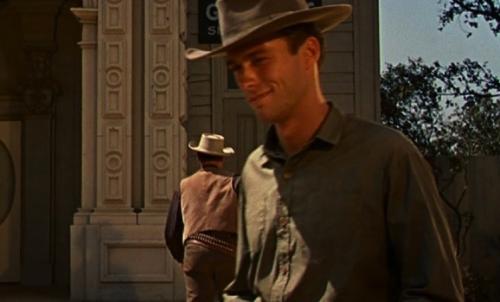
Produced by the legendary Albert Zugsmith, Star in the Dust is a surprisingly intelligent and well-acted B-western.  If you watch carefully, you might even spot Clint Eastwood playing a ranch hand named Tom who wants to know if he should put money down on Sam Hall being hanged.  Though he was uncredited in this tiny role, Star in the Dust was Eastwood’s first western.

Frontier Uprising (1961, directed by Edward L. Cahn)


In the 1840s, frontier scout Jim Stockton (Jim Davis) is hired to lead a wagon train down the Oregon Trail.  Accompanying him and the settlers are a group of calvarymen, commanded by Lt. Kilkpatrick (Don Kelly).  When the wagon train is attacked by a group of Native Americans who have been given rifles by Mexican soldiers, Stockton can’t figure out why,  When he suggests that the settlers take an alternative route through California (which was then controlled by Mexico), Kilkpatrick explains that such a detour would be considered an act of war and that he and his men cannot be a part of it.  What Stockton and Kilkpatrick don’t know (but soon find out) is that Mexico has already declared war on the United States.  Complicating matters even further is that both men have fallen for a Mexican woman named Consuela (Nancy Hadley) and her loyalties are now in question.

A 68-mintue B-western, Frontier Uprising is mostly interesting because of the amount of stock footage that was used to try to make this low-budget film seem like an epic.  For instance, when the rifle-bearing Natives attacked the settlers, I recognized a lot of footage from a lot of other movies.  One particular shot, of a wounded Native falling off of his horse, was used in so many films of the period that I’ve lost track of how many times I’ve seen it.  Much of the stock footage features Monument Valley prominently in the background, which suggests that Stockton was not doing a very good job of leading the settlers to Oregon.

Frontier Uprising is one of the 11 (!) films to be directed by Edward L. Cahn in 1961.  Cahn is credited with directing 127 films over the course of 30 years.  Some of them were good.  Most, like Frontier Uprising, were competent but forgettable.