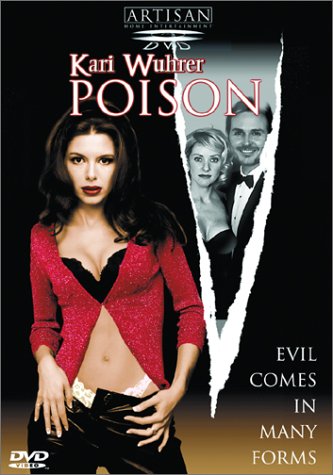
Poison (2001, directed by Jim Wynorksi)


After her husband commits suicide, Ann Stewart (Kari Wuhrer) seeks revenge on the CEO who fired him and Nicole Garrett (Barbara Crampton), the woman who get the promotion that he was counting on.  Ann has good reason for being upset, seeing as how she slept with the CEO specifically so he wouldn’t fire her husband.  When she finds out that the her husband was never even being seriously considered for the promotion and all of that extramarital sex was for nothing, Ann snaps.  Somehow, Ann not only knows how to blow up the CEO and his family but also how to get away with.  However, her plot against Nicole is more complicated.  After murdering Nicole’s housekeeper, Ann takes her place.  Soon, Ann is trying to seduce both Nicole’s husband (Jeff Trachta) and her son (Seth Jones) while encouraging Nicole’s teenage daughter (Melissa Stone) to be even more slutty than before.  Ann discovers that Nicole can be a demanding boss and that she and her husband are on the verge of splitting up.  Ann also learns that Nicole is diabetic and has to be careful what she eats.  That’s good information to have, now that Ann is the one preparing all of her meals!  Ann sets her plan in motion.  To quote the song of old, that girl is poison.

Poison is typical of the films that used to show up on Cinemax late at night.  It’s also a Jim Wynorski film and you always know what you’re getting into with Wynorski.  Poison has all of the gratuitous shower scenes and naked midnight swims that you would expect from a film like this.  It also has the same basic plot as Scorned, with Kari Wuhrer taking on the Shannon Tweed role of the vengeance-obsessed widow.  It’s hard to say who did the role better.  Tweed was more calculated in the way she destroyed the family while Wuhrer is more obviously unhinged and impulsive in her actions.  Perhaps because Jim Wynorski directed Poison while Andrew Stevens was responsible for Scorned, Poison is a little more self-aware that Scorned and has more of a sense of humor about itself than Scorned did.  Ann is eventually as angry about Nicole being a demanding employer as she was about her husband committing suicide.  Fans of these movies will want to see Poison for the chance to watch Barbara Crampton and Kari Wuhrer face off against each other.  Both of them bring their best.

It’s Wynorski.  You know what you’re getting.
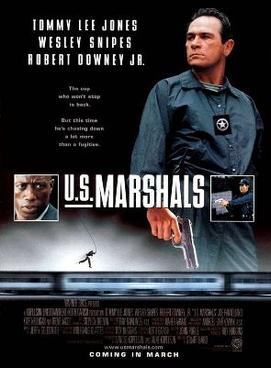
U.S. Marshals (1998, directed by Stuart Baird)


Mark Roberts (Wesley Snipes), formerly of the Diplomatic Security Service and wanted for murder, escapes when his prison transport aircraft crashes into an Illinois swamp.  U.S. Marshal Sam Gerard (Tommy Lee Jones) was on the same flight and quickly assembles his team so that they can track down and capture the fugitive.  That’s what Sam Gerard does.  He’s the best fugitive hunter around.  Complicating matters is that an inexperienced DSS agent named John Royce (Robert Downey, Jr.) has been assigned to the team.  Royce says that the men that Mark killed were friends of his and this hunt is personal for him.  However, Sam suspects that Mark might not be as guilty as he seems.  Considering that the last high-profile fugitive that Sam chased was also innocent, I have to wonder why Sam has any faith in the system at all.

Based on the classic televisions how, The Fugitive was one of the biggest film hits of 1993 and it also became one of the few action films to receive an Oscar nomination for Best Picture of the Year.  Even though the film starred Harrison Ford as a doctor wrongly convicted of murdering his wife, it was Tommy Lee Jones who got all the best lines and all the critical attention.  Tommy Lee Jones was also the one who received an Oscar for his work on the film.  The Fugitive was such a hit that it was pretty much guaranteed that there would be a sequel.  Since there were only so many times that Richard Kimble could reasonably be wrongly convicted of murder, it also made sense that future films were focus on Sam Gerard and his team.

U.S. Marshals was the first Fugitive sequel and, as a result of terrible reviews and a lackluster box office performance, it was also the only sequel.  I saw U.S. Marshals when it was first released in 1998.  I enjoyed it but I was also a teenage boy.  Back then, I liked everything as long as it featured a car chase, a gunfight, and a leggy female lead.  Last night, I rewatched the film for the first time since it was originally released and I still enjoyed it but I could also understand why U.S. Marshals didn’t lead to a Sam Gerard franchise.  

The plane crash was as cool as I remembered.  So was the scene where Wesley Snipes escaped from Sam by jumping onto a train.  (That scene was featured in all of the commercials.)  The scenes of Tommy Lee Jones getting frustrated with incompetent local law enforcement were still entertaining, as were the scenes of him interacting with his team.  I even liked the much-criticized cemetery stakeout.  There was much about the film to like but the main problem was that Sam Gerard works better as a supporting player than as a leading character.

Harrison Ford really doesn’t get enough credit for the success of The Fugitive.  One the main reasons why that film works is because Ford is so likable and sympathetic as Richard Kimble.  It’s entertaining to check in on Sam and his team but it’s Ford who makes us care about the story.  In U.S. Marshals, Wesley Snipes’s character is never as clearly defined as Kimble.  We learn very little about him, other than he tries not to actually hurt anyone while escaping.  There’s no emotional stakes to whether Mark is innocent or guilty and no real suspense as Sam goes through the motions of hunting him.  Sam may still have a way with words but, in U.S. Marshals, he’s just doing his job.  Things do get personal when Sam and his team are betrayed by one of their allies and a member of the team is killed but even then, it doesn’t make sense that the bad guy, who had been pretty careful up until that point, would mess up his plans by impulsively killing someone who hadn’t really witnessed anything that incriminating.

I think U.S. Marshals missed its calling.  Sam and his team were entertaining enough that, if they had starred in a weekly television show called U.S. Marshals, it probably would have run for ten seasons.  As a movie, though, it can’t escape the long shadow of The Fugitive.


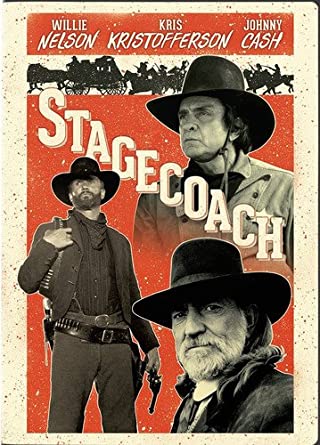
Stagecoach (1986, directed by Ted Post)


The year is 1880 and Geronimo and his Apaches are on a warpath against the people who have taken their land.  Despite the warnings of the local Calvary officers, one stagecoach tries to make the long journey from Arizona to New Mexico.  The seven passengers may start out as strangers but they’re going to have to work together to survive the journey.  The most famous passenger is dentist-turned-gunslinger Doc Holliday (Willie Nelson).  The most infamous is the Ringo Kid (Kris Kristofferson), an outlaw who has recently escaped from prison and who is looking for revenge against the men who framed him for a crime that he didn’t commit.  Henry Gatewood (Anthony Fraciosa) is a banker who has embezzled money and is looking to make a quick escape.  Foppish Trevor Peacock (Anthony Newley) sells liquor.  Dallas (Elizabeth Ashley) is a former prostitute looking to start a new life.  Mrs. Mallory (Mary Crosby) is nine months pregnant and traveling to reunite with her husband, an officer in the Calvary.  Finally, Hatfield (Waylon Jennings) is a chivalrous gambler.  Riding atop the stagecoach is Buck (John Schneider), who gets paid 8 dollars a month to risk his life taking people through Apache country, and Curly (Johnny Cash), the tough-but-fair town marshal who plans to arrest the Ringo Kid as soon as they reach civilization.

Made for television, Stagecoch is an adequate remake of the John Ford classic.  The story remains basically the same, with the main difference being that the majority of the characters are now played by country-western singers who are a few years too old for their roles.  Doc Holliday, who died of “consumption” when he was in his 30s, is played by Willie Nelson, who doesn’t look a day under 70.  The Ringo Kid is played by Kris Kristofferson, who, despite having literally played Billy the Kid a decade earlier, still doesn’t look like he’s ever been called a “kid” at any point in his life.  Compared to their original counterparts, the remake’s characters have been slightly tweaked so that they fit with the outlaw country images of the singers playing them.  Doc Holliday sympathizes with Geronimo and says that his use of whiskey is “medicinal.”  Kristofferson’s Ringo Kid is more openly contemptuous of authority than John Wayne’s.  Waylon Jennings is less of a cynic in the role of Hatfield than John Carradine was and Johnny Cash sits atop the stagecoach like a man on a holy mission.

The cast is the main reason to watch this version of Stagecoach.  The film can’t match the original but Nelson, Kristofferson, Jennings, and Cash obviously enjoyed playing opposite each other and, even if Nelson and Kristofferson are miscast, all of them bring some needed country-western authenticity to their roles.  As for the non-singers, Mary Crosby, Elizabeth Ashley, and John Schneider all make the best impressions while both Franciosa and Newley seem too 20th Century for their western roles.  Director Ted Post does a good job with the action scenes and keeps the story moving, even if the remake’s status as a TV production keeps him from capturing visual grandeur of Ford’s original.  Stagecoach is a respectful remake of a classic, one that can be appreciated when western fans on its own merits.

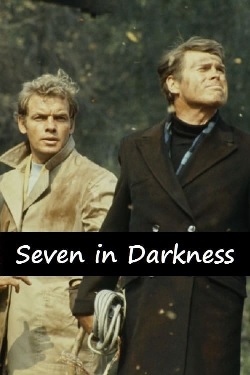
Seven in Darkness (1969, directed by Michael Caffey)


A group of blind people, led by teacher Alex Swain (Barry Nelson), are flying to a convention for the blind in Seattle.  When their flight is knocked off-course by an unexpected storm, the plane crashes into a remote forest.  The plane’s crew and the one sighted passenger are all killed in the crash, leaving the eight blind passengers to fend for themselves.  The plane is perched on the edge of a mountain, there are wolves all around, and no one can see the surrounding terrain.  And one of the passengers is pregnant and could give birth at any minute!  To Alex’s resentment, the group turns to Mark (Sean Garrison) to help them survive in the wilderness.  Mark was blinded while serving in Viet Nam and he’s still haunted by what happened during the war.  At first, he resists being thrust into a leadership role but finally, it becomes clear that he has no choice.  Under Mark’s leadership and despite Alex’s protestations, the eight survivors try to find their way back to civilization.

Filmed for television and based on a novel by Leonard Bishop, Seven in Darkness is a tense and well-acted movie.  It’s not easy to watch the survivors feeling around in the darkness, trying to find their way to safety.  That we can see what they don’t makes things all the more suspenseful.  Even more importantly, the film does a good job of presenting the survivors of being individuals.  Even though they all share a disability, they still have their own personality quirks, strengths, and flaws.  Surprisingly the stand-out amongst the cast is none other than Milton Berle, cast in a dramatic role and giving a nuanced performance as the angriest of the survivors.  Watching Seven in Darkness, you come to care about all of the survivors and you get very wrapped up in whether or not they’re going to be able to make it to safety.

Seven in Darkness was the first film to be shown as a part of ABC Movie of the Week.  It can be found on YouTube.


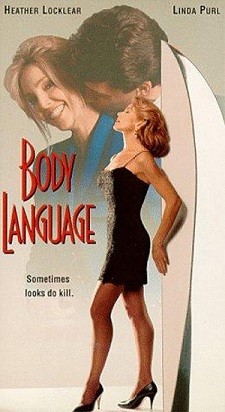
Body Language (1992, directed by Arthur Allen Seidelman)


Betsy (Heather Locklear) is a workaholic executive who has finally gotten the prize promotion at the Orpheus Capital Corporation.  Along with her new office, Betsy also gets a new assistant but when that assistant mysteriously disappears, she is replaced by Norma (Linda Purl).  Norma is just as ambitious as Betsy but she just can’t seem to make her way up the corporate ladder, no matter how hard she tries.  Norma soon grows indispensable to Betsy, comforting her when she breaks up with her boyfriend (James Acheson) and also supporting her when Betsy refuses to sleep with her sexist new boss (Edward Albert).  Before you can say “Single White Female,” Norma is dressing like Betsy, talking like Betsy, dating Betsy’s ex, and trying to take over Betsy’s life.  When Betsy eventually catches on, she discovers just how far Norma will go to be her.

It is easy to compare this film to Single White Female, though Body Language actually aired on the USA Network two months before Single White Female was released.  The main difference between the two films is that Single White Female was an R-rated theatrical release whereas Body Language is unmistakably a television production.  That means no bad language, no nudity, no graphic violence, only a little sex, and not a hint of psychological nuance beyond Norma being the type of girl who snuffs out candles with her fingers.  Single White Female‘s main strength was the effort that Jennifer Jason Leigh went to make her unstable stalker into a believable character who had more motivation than just being crazy.  The script for Body Language is less concerned with why Norma does what she does.  Betsy is glamorous and successful.  Norma is neither of those things and, in this film’s view of things, that is more than enough motivation for her to try to take over Betsy’s life.

Still, the underrated Linda Purl does the best that she can with the role of Norma and she has a few good moments where Norma lets the mask slip and reveals how unstable she actually is.  Heather Locklear matches her as the workaholic who learns that climbing the corporate ladder can be murder and she shows why she was so often cast in films like in-between appearing on shows like T.J. Hooker, Dynasty, and Melrose Place.  If you grew up in the 90s, it’s hard to watch any old Heather Locklear tv movie without feeling nostalgic.

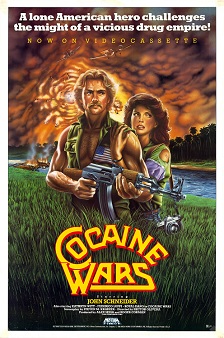
Cocaine Wars (1985, directed by Hector Olivera)


In 1980s Bolivia, the most powerful drug lord is Gonzalo Reyes (Federico Luppi).  Working with General Lujan (Rodolfo Ranni), Reyes runs his own concentration camp, where people are forced to process the cocaine that is then sold in the United States.  Reyes’s pilot is an American named Cliff Adams (John Schneider).  Reyes eventually gives Cliff a very important assignment.  He wants Cliff to assassinate Marcelo Villalba (John Vitali), a crusading journalist who is running for president of the country.

What Reyes and Lugan don’t know but soon learn is that Cliff is actually a Miami-based DEA agent who has been working deep undercover.  Despite his assignment and the fact that even the U.S. government seems to consider Villalba to be expendable, Cliff refuses to carry out the assassination.  Soon, he and his girlfriend (Kathryn Witt) and their friend Bailey (Royal Dano) are being pursued by Reyes and Lujan.  Cliff’s girlfriend is also a reporter and she has compiled a story that, if it is published, will blow the lid off of Reyes and Lujan’s partndership.

Produced by Roger Corman and filmed in Argentina, Cocaine Wars is very much a product of its time.  In the 1980s, America was all about the War on Drugs, especially the War on Cocaine.  However, some of the world’s biggest drug lords were working with the tactic approval of some of America’s most important allies in South and Central America.  For as long as it was convenient and strategically useful, the American government would look the other way.  It was only when the situation became internationally embarrassing, as in the case of Panama’s General Manuel Noriega, that the U.S. would actually step in.  This was certainly the case in Bolivia, where drug lords were so essential to overthrowing the government that the subsequent coup was referred to as being “the cocaine coup.”  General Lujan is a stand-in for a large number of Bolivian military men who continually overthrew the country’s democratically-elected leaders.  By including several Germans among Reyes’s organization, Cocaine Wars also acknowledges the role that Nazi war criminal Klaus Barbie played in not only propping up a series of Bolivian strongmen and drug organizations but also teaching the Bolivian secret police how to torture information out of political prisoners.  While Cocaine Wars is not primarily a political film, it is still notable as an early example of a film that pointed out why the War on Drugs was destined for failure.

As for the film itself, it is a standard low-budget action film.  There aren’t any huge surprises to be found but, at 82 minutes, it moves quickly and it has enough action to satisfy fans of the genre.  John Schneider may not have been Sylvester Stallone, Arnold Schwarzengger, or even Chuck Norris but that works to the movie’s advantage.  Unlike those bigger-than-life heroes, Schneider does not come across as being indestructible and that adds a little more suspense to the inevitable gunfights and torture scenes.  Schneider is a likable and effective action lead, even if you never do forget that you’re essentially watching a TV actor taking a stab at the big screen.

Music Video of the Day: Wild Thing by Sam Kinison (1988, directed by ????)


In 1988, evangelical preacher-turned-comedian Sam Kinison had a hit with his cover of Wild Thing.  For the music video, he not only recruited Rodney Dangerfield and a host of other 80s rockers, he also cast Jessica Hahn, who was at the center of the scandal that took down two other evangelical preachers, Jim and Tammy Faye Bakker.

For completists, here is who can be seen in this video, backing up Sam, Rodney, and Jessica: Joe Perry and Steven Tyler (Aerosmith), Steve Adler and Slah (Guns ‘n Roses), Sebastian Bach (Skid Row), Jon Bon Jovi, Alec John Such, and Richie Sambora (Bon Jovi), Jonathan Cain and Deen Castronovo (Journey), Robbin Crossby and Warren DeMartini (Ratt), C.C. Deville (Poison), Tommy Lee (Motley Crue), Rudy Sarzo (Quiet Riot), Billy Idol, and Dweezil Zappa.

Enjoy!

Class Warfare (2001, directed by Richard Shepard)


Kristen Marshall (Lindsey McKeon) is a rich high school girl with a problem.  She’s not rich anymore!  Her parents have lost all of their money due to a shady business deal and now, Kristen might not even be able to afford to go to Harvard!  Even the fact that she’s the senior class president and drives an expensive car might not be enough to convince those Boston brahmins to give her a scholarship.  Looking to get away from all of her problems, Kristen and her boyfriend, Jason (Wade Carpenter), decide to spend the weekend at their friend Graham’s (Dave McGowan) lakehouse.  Kristen, however, is upset to discover that Graham has also invited Richard Ashbury (Robin Dunne).

Richard is a high school activist, a self-professed Socialist who spends his time putting up flyers for a food and clothing drive.  Kristen first met Richard when she accidentally hits him with her car.  (Kristen was in a hurry and she didn’t notice Richard riding by on his bicycle.)  Though Richard was uninjured, Kristen’s car was slightly dented and Richard told her that he was sure that her family would be able to pay for it.  Now, Kristen is stuck spending the weekend with him and, to make things even worse, Richard looks at a newspaper and discovers that he has got a winning lottery ticket.  As soon as the weekend ends, he’ll turn in the ticket and get $25 million dollars!  Meanwhile, Kristen is having nightmares about her guidance counselor denying her application for a college loan while Richard lights a cigar with a hundred dollar bill!

Eager to that get that ticket for herself, Kristen first tries to seduce Richard.  When that doesn’t work, Kristen orders Jason to kill him.

Class Warfare definitely has a made-for-TV look about it but, when taken on its own terms, it’s not bad.  Lindsey McKeon is an effective villain and the other actors are all credible in their roles, even if it’s obvious that most of them haven’t been in high school for a good couple of years.  The movie’s class warfare theme was sometimes simplistic but the film still did a good job of ratcheting up the stakes as one mistake led to another.  Nowadays, people take the lottery for granted but Class Warfare does capture that moment when people really did feel like their lives could be changed in an instant.

Class Warfare was produced by the USA Network and originally aired on December 24th, 2001.  I guess that was USA’s way of saying, “Merry Christmas!”

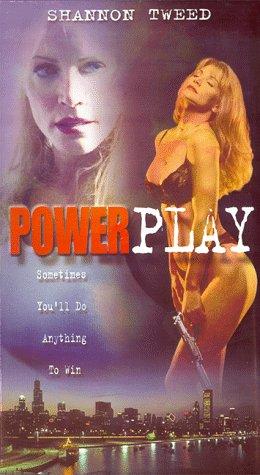
Powerplay (1999, directed by Chris Baugh)


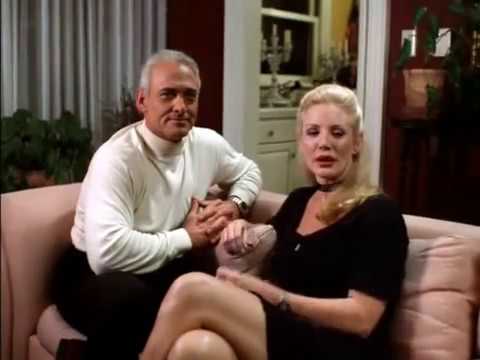
Shannon Tweed plays Jacqueline, a sexy con artist who seduces older men and then, after she poisons them, runs away with all of their money.  After her latest target, Benjamin Alcott (Bryan Kent), ends up floating dead in his swimming pool, Jacqueline heads off to find her next target.  Ben’s estranged daughter, Candice (Danielle Ciardi), is upset to learn that Ben only left her his library of book while leaving all of his money to Jacqueline.  Along with her sleazy boyfriend, Steve (Jim Richer), Candice tracks Jacqueline down and tries to con the con artist.

Shannon Tweed is top-billed in Powerplay but she’s not in much of the movie.  Both onscreen and off, this was clearly a take the money and run job for Tweed.  Still, a little bit of Tweed is better than no Tweed at all, especially where a film like Powerplay is concerned.  Of all the actresses who regularly appeared in late night Cinemax in the 90s, Tweed was definitely the most talented and she brings some needed energy to her scenes.  Tweed’s main strength as a star was always that she could be appealing and sexy even while she was smirking about killing someone and Powerplay makes good use of that ability.

The majority of the film, though, follows Candice and Steve as they try to track Jacqueline down.  In a nice twist, Candice is just as greedy, voracious, and cold-hearted as Jacqueline and Danielle Ciardi (who bore a probably not coincidental resemblance to Neve Campbell in Wild Things) does a good job of playing her.   This was Ciardi’s film debut and, according to the imdb, her only starring role.  That is too bad because it seems like she had the talent to do much more.  Unfortunately, Jim Richer is far less effective in the role of Steve.  In fact, all of the male performances in Powerplay are lousy and are not helped by an overly convoluted script that features a few plot twists that are incoherent even by the standards of the typical direct-to-video neonoir.  Powerplay ends with multiple cons and double-crosses but none of them feel earned.  There’s a difference between something like Stephen Frears’s The Grifters, where the con is obvious once you know what to look for, and Powerplay, where the con feels like a last minute addition to the script.

But who am I kidding?  This film wasn’t made for an audience that’s going to be watching for the plot.  They’re going to be watching because Shannon Tweed takes a shower while the man she poisoned dies nearby and because Candice is written and portrayed as almost being a nymphomaniac.  (Candice has a creative way of handling things when a hotel employee knock on the door of a room that she’s not supposed to be in.)  Powerplay has enough sex and nudity that it was undoubtedly popular when it showed up on late night Cinemax in 1999.  But it doesn’t have enough of a story to be memorable for any reason beyond that.

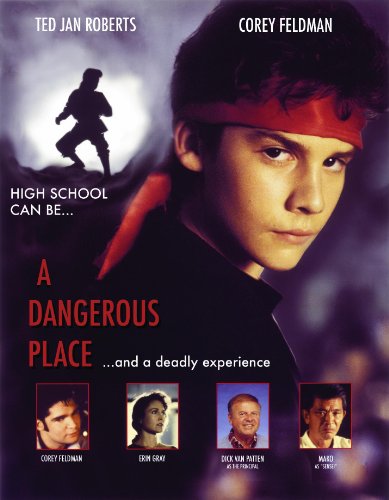
A Dangerous Place (1994, directed by Jerry P. Jacobs)


In A Dangerous Place, a young karate student avenges his brother’s death and Corey Feldman impersonates Christian Slater.

Greg (Dean Cochran) and his younger brother, Ethan (Ted Jan Roberts), are both students of a sensei (Mako) who teaches that sparing an enemy is the best way to make a friend and that true martial artists do not compete in tournaments.  Greg wants more out of karate so he starts hanging out with The Scorpions, a gang led by Taylor (Corey Feldman).  The Scorpions all belong to a dojo owned by Gavin (Marshall R. Teague), who teaches that mercy is a weakness.  When the Scorpions aren’t beating up people at the beach, they’re “scavenging.”  They break into houses and businesses, steal what they can, and claim that homeowners insurance means that they’re actually doing everyone a favor.  When one robbery goes wrong, Greg tries to stop Taylor from killing a homeowner.  Taylor fights back and the end result is Greg falling over a railing and dying.  

The Scorpions leave Greg hanging in the high school gym.  The police think that Greg committed suicide but Ethan knows that his brother would never end his own life.  Ethan knows that the Scorpions are responsible.  He leaves his old dojo and joins Gavin’s dojo.  Ethan now has an in with the Scorpions but, if Gavin and Taylor are going to trust him enough to reveal the truth about what happened to Greg, Ethan is going to have to betray his old sensei and set up a match between the two dojos.  Ethan is going to have to abandon his own peaceful principles about become as bad as the people he is trying to take down.

For a low-budget Karate Kid rip-off, A Dangerous Place is not as bad as it sounds.  Some of the fight scenes are exciting, Mako is a decent stand-in for Pat Morita, and Marshall R. Teague does a passable Martin Kove impersonation as the leader of the bad dojo.  Corey Feldman imitating Christian Slater imitating Jack Nicholson does eventually get old but, since Feldman is playing the bad guy here and we’re not supposed to like him, it actually works to the film’s advantage.  Finally, Dick Van Patten, of all people, has a small role as the high school’s principal.  Mako, Feldman, Van Patten, and karate?  A Dangerous Place is dumb but entertaining.