Did you see the Great Pumpkin?
Did you see the Great Pumpkin?

1910
It is hard to say when Halloween first became truly popular in the United States. Most historians seem to agree that the traditions of Halloween were first brought to the U.S. in the 19th century by immigrants from Scotland and Ireland. Though Halloween had its roots in pagan holidays, most Americans initially knew Halloween as being an evening of celebration before All Saints Day.
The commercialization of Halloween began in the early 1900s. That was when postcards featuring pumpkins and black cats and even the occasional witch first started to become popular. The postcards from this era were more playful than frightening, with several wishing their recipient a “Merry Halloween!” Below are a few vintage Halloween postcards that show how Halloween was viewed at the start of the 20th Century.

1900

1900

1900s

1908

1909

1910

1911

1913
Happy Halloween!

1910

1913
To all of our readers
To all of our friends
To every ghoul and fiend out there,
HAPPY HALLOWEEN FROM THE SHATTERED LENS!
May your Halloween bring you more candy than rocks and we hope you enjoy the last day of our annual horrorthon! Be safe, be sincere, and don’t forget the true meaning on Halloween!
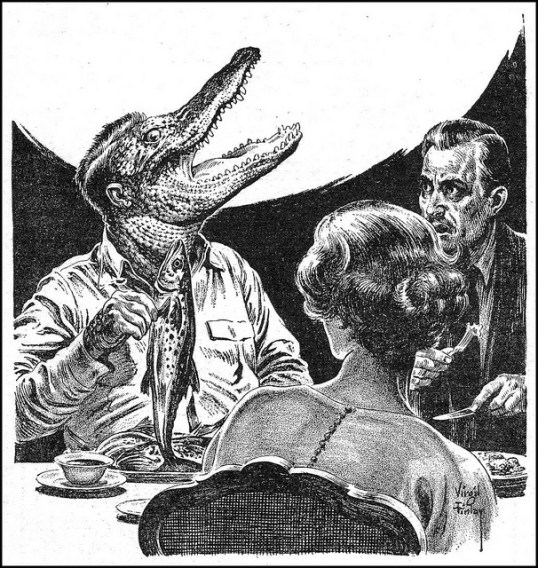
by Virgil Finlay
“I think perhaps all of us go a little crazy at times.”
― Robert Bloch, Psycho

by Erin Nicole
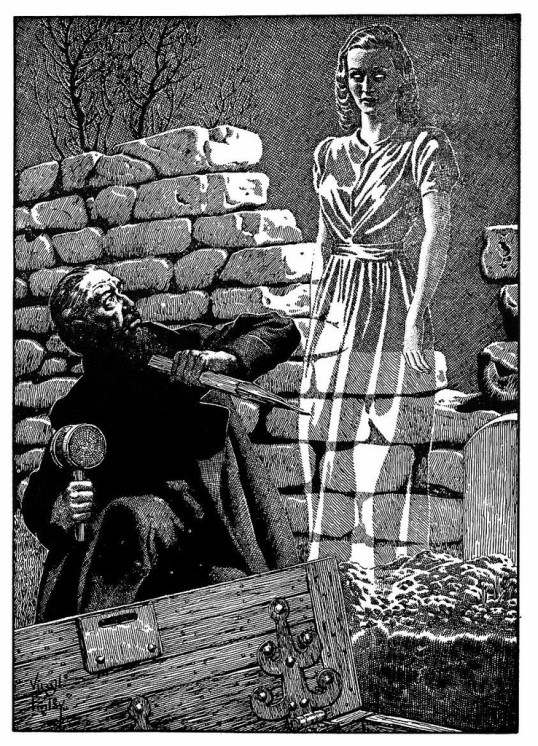
“There is something at work in my soul, which I do not understand.”
― Mary Wollstonecraft Shelley, Frankenstein

by Madge Geyer

Since I was pretty much indifferent to who won the World Series this year (Congratulations, Boston), I’ve been watching baseball movies instead. I just finished watching The Jackie Robinson Story.
The Jackie Robinson Story was made in 1950, back when Robinson was still playing second base for the Brooklyn Dodgers. The movie not only tells the story of how Jackie Robinson became the first black man to play in the major leagues but it also stars Jackie Robinson as himself!
Starting with Jackie’s childhood in Pasadena, the movie follows Jackie as he attends UCLA, serves a brief stint in the Army, and then plays baseball on an all African-American team (Jackie played for the Kansas City Monarchs but, in the movie, the team is renamed the Black Panthers!) before eventually getting signed to join the Dodgers and integrate major league baseball. While the movie skips over a lot of Jackie’s early life, it doesn’t gloss over the prejudice that he encountered at every step of the way. When he wins a scholarship to UCLA, people complain that the college has already recruited too many black athletes. Even when he’s a star player in the Negro Leagues, he still has to ask permission to enter and use the washroom in a diner. And when he joins the Dodgers, riots are threatened if he plays anywhere in the South. During one game, his wife (Ruby Dee) overhears the whites in the stands talking about how “the Lodge” is going to visit Jackie. Through it all, Jackie Robinson keeps his cool and refuses to give the racists the satisfaction of getting to him. Jackie answers every bigoted comment with the crack of his bat, leaving no doubt that he belongs in the major leagues.
Jackie Robinson was a great baseball player and a great man. He wasn’t a great actor and, in this movie, he comes across as being stiff and nervous whenever he has to play any dialogue scenes. But then he swings a bat or catches a ball and it doesn’t matter that he can’t act. Jackie Robinson was an amazing player and it’s still exciting to watch footage of him today.
The Jackie Robinson Story is a rousing, feel-good baseball movie and a condemnation of racism and bigotry, in all of its insidious forms.

Jackie Robinson
Skeleton and skulls are naturally creepy, especially when they’re still moving and talking! Skulls and bones were a mainstay on the covers of pulp and especially horror related magazines. For this Halloween, take a trip back into the bony past with a few skeletal covers from the pulp era!


by Norman Saunders

by Rafael De Soto

by Robert Gibson Jones

by Robert Stanley

by Rudolph Belarski
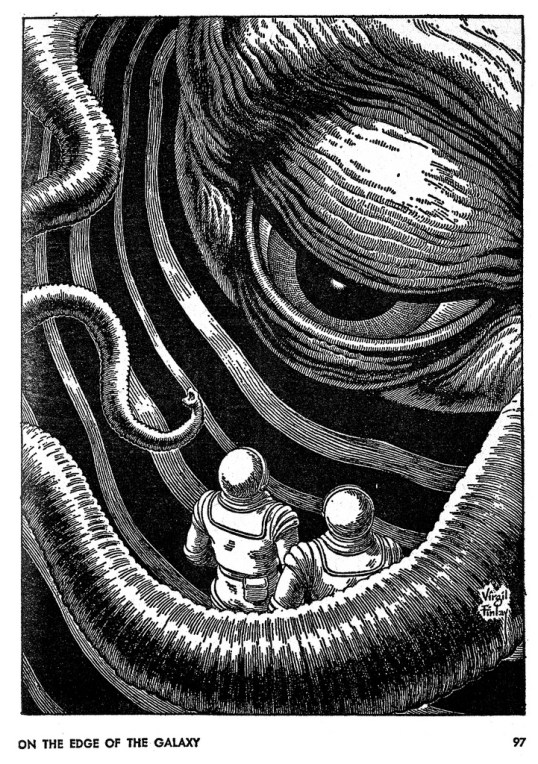
by Virgil Finlay
“I have seen the dark universe yawning
Where the black planets roll without aim,
Where they roll in their horror unheeded,
Without knowledge, or lustre, or name.”
― H.P. Lovecraft, Nemesis
 Through the Shattered Lens