
Brad’s Thoughts on Season 1 of LANDMAN, Starring Billy Bob Thornton!


Taylor Sheridan has become a fairly big part of my life over the last decade. It started when I saw HELL OR HIGH WATER in the movie theater back in 2016. It was one of my favorite movies of the year, and it was written by a guy named Taylor Sheridan. Well, the next year brought us WIND RIVER, which was both written and directed by Taylor Sheridan, and it was one of my favorite movies of 2017. Then came the series YELLOWSTONE, which was created by Taylor Sheridan and began airing in 2018. I didn’t watch the first couple of seasons, but I thought it looked good and even bought the first season on DVD when I saw it for sale at Wal Mart. When my wife Sierra came home from performing her nursely duties at the hospital and told me that everyone was saying that we needed to watch YELLOWSTONE, I informed her that I just so happened to own Season 1 on DVD. So, we popped it in the DVD player, and we were soon obsessed with the world of the Duttons. My wife took special joy in the characters of Beth (Kelly Reilly) and Rip (Cole Hauser), while John Dutton (Kevin Costner) and Rip kept my attention. I’ll admit that it scared me a little bit that Sierra enjoyed Beth so much, and I’m glad to report that, up to this point, she has not started trying to emulate her actions in real life!

When YELLOWSTONE ended its run at the end of 2024, the Paramount network was putting a major marketing push into their latest “Taylor Sheridan” series, that being LANDMAN, which had started its first season around the same time YELLOWSTONE was wrapping up its final season. I’m a huge fan of actor Billy Bob Thornton, so the fact that he was headlining a series set in Texas oil country automatically piqued my curiosity. Not ready to commit to 10 hours’ worth of LANDMAN episodes quite yet, we put the show on the backburner for a bit, knowing that we could jump in and watch it whenever we wanted to. Well, this past weekend, we got snowed in here in Central Arkansas, so I asked Sierra if she’d like to watch a few episodes of LANDMAN. Needless to say, over the course of the day we watched every episode of Season 1. I really enjoyed the first season and decided to share some of my thoughts with you.

First off, if I’m going to commit to watching 10 hours’ worth of anything, I need to really like at least some of the characters. I don’t just like Billy Bob Thornton’s portrayal of the “Landman” of the title, his Tommy Norris is now one of my favorite characters that he’s ever played. He’s the ultimate realist, because no matter what situation he finds himself in, whether he’s dealing with the head of a drug cartel, the head of his oil company, or his ex-wife, he tackles every situation by uniquely framing the specific issues in a matter of moments and then providing solutions that appeal to his audience’s most base instincts. Alternatively hilarious, serious, heartbreaking and genius, Thornton gives a masterful performance that I don’t think anyone else could have pulled off any more effectively. His ex-wife Angela (Ali Larter) is probably the toughest of all for him to deal with as his own sense of self-preservation seems to go out the window whenever she’s around. Ali Larter’s performance as Angela is loud, brash, attention-seeking, hypersexual, and every so often, just vulnerable enough that you can kind of like her. I think she’s great, and quite sexy, in the role. Michelle Randolph and Jacob Lofland get a lot of screen time in the first season as their children, Ainsley Norris and Cooper Norris. Michelle is cute and spunky, definitely her mother’s daughter, but she also loves her dad so much. I like her. Lofland, who, like Thornton, is from my state of Arkansas, has a meatier role, having to deal with tragedy from the very beginning and then serious family drama as the season plays out. It’s not a showy role, but he does a solid job. The other performance that I really enjoy throughout season 1 comes from Jon Hamm as the head of the oil company, Monty Miller. I kept referring to him as J.R. Ewing as I watched because he’s the big boss. He’s the person that Tommy Norris calls when he can’t solve their problems. Unlike J.R. Ewing, although Miller is a tough businessman, he’s also a committed family man who tries to be there for his wife Cami (Demi Moore) and their daughters when they need him. He is as hard-nosed as it gets in his business dealings, though, and it’s easy to see why he had emerged as the main guy over Tommy. I did want to shout out the actors Colm Feore, James Jordan and Mustafa Speaks as various employees of the oil company who provide different elements of humor and toughness to the proceedings over the course of the season. Finally, as far as the primary cast, while prominently credited throughout the first season, Demi Moore has relatively little to do until the very end of season 1. If you’re a big fan of hers, just know that going in. Her character seems primed to be a big part of season 2, though, so it will be interesting to see where that goes.

Second, like with any popular dramatic TV series, LANDMAN Season 1 contains some storylines that I really enjoy, while there are some that I don’t really care for. Where LANDMAN really works for me is when it features Billy Bob Thornton’s Tommy Norris as a fixer of some sort. It was in these storylines that we get to see his ability to use his intelligence, communication skills, and understanding of human nature to come up with solutions that are best for everyone. It might not always be easy, and he might have to take a beating every now and then, but Tommy knows how to get things done, and the show is at its best when it’s focused on him. We see this throughout season 1 as Norris deals with a variety of cartel henchmen, hotshot attorneys, and unhappy leaseholders in order to advance his company, M-Tex’s interests. There are also a few badass moments when it becomes clear that talking won’t get the job done, and even more direct methods will have to be used to get his point across. This usually happens when Tommy’s feeling the need to protect his children. If there is a weakness to the show, for me, it’s the fact that when Tommy Norris isn’t part of the proceedings, I don’t like it nearly as much. For example, while scenes involving Jacob Lofland’s character, Cooper, and the recently widowed young mother Ariana (Paulina Chavez), whose husband was an employee of the company, ramp up the melodrama, they also take up a lot of time, and I don’t find them very appealing. The same can be said when Ali Larter’s character, Angela, and her daughter Ainsley, decide they’re going to volunteer at a nursing home, and then proceed to hook the residents up with alcohol and even take them to a strip club. While I smiled at some of the proceedings, they weren’t realistic and didn’t really add anything to the story. I even found myself worrying about some of the residents, I mean, I’m sure some of their medication was NOT compatible with tequila! I’m guessing that these quibbles really just come down to a matter of personal preference, as I’m sure there are some who enjoy these moments more than I do. I will admit that these scenes are well-acted and performed even if they’re not advancing my favorite parts of the story.  

Overall, I really enjoyed season 1 of LANDMAN, and I’m looking forward to jumping into season 2 soon, which is now streaming. The last couple of episodes of season 1 introduced or elevated some very interesting characters who will have more prominent roles moving forward (played by Andy Garcia and Demi Moore), and peaking ahead, season 2 also appears to have some interesting additions to the cast (I’m looking at you Sam Elliott). I’m looking forward to the next 10 hours of fun!
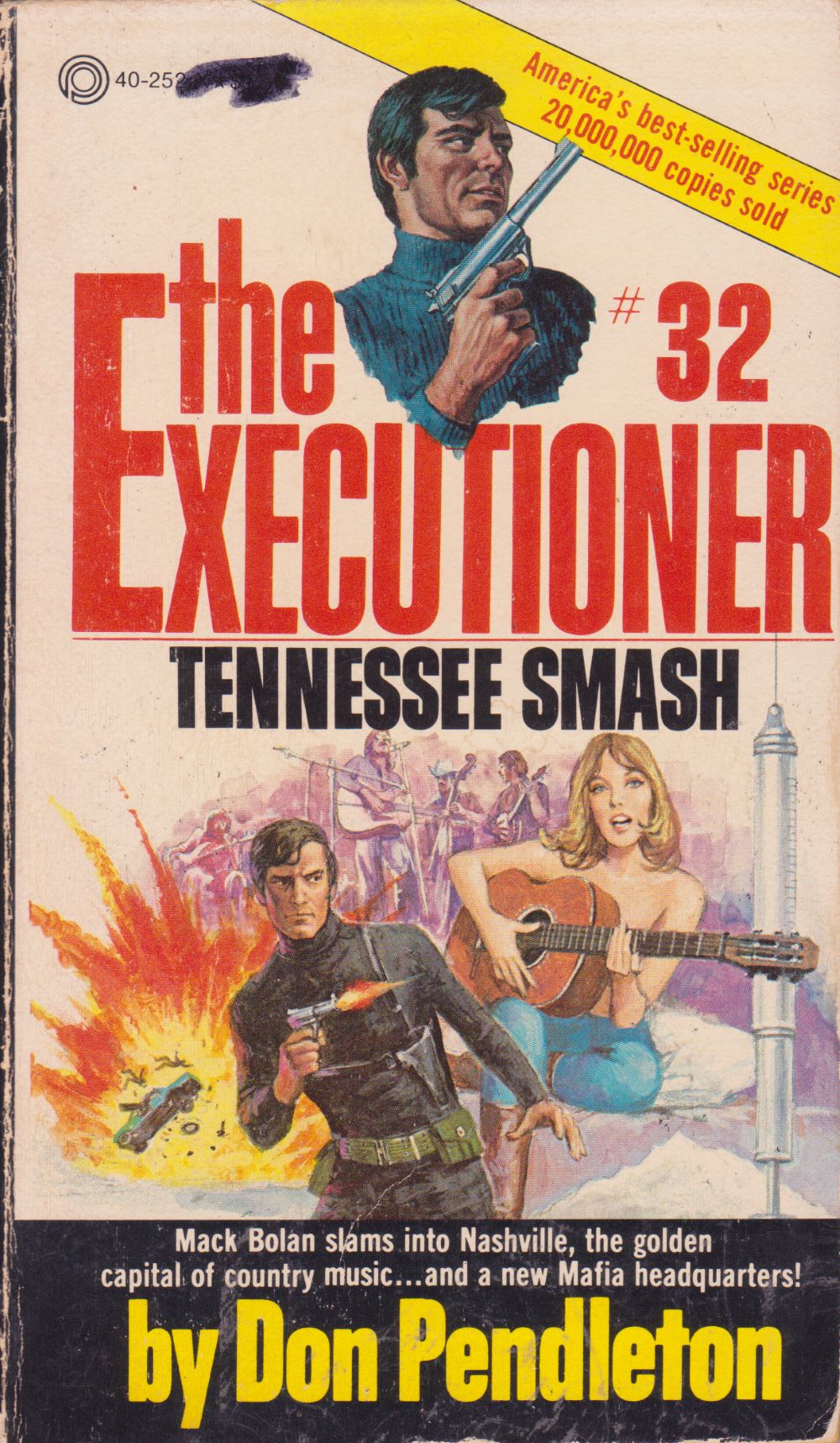
Guilty Pleasure No. 101: The Executioner Series (by Don Pendleton)


The Executioner series by Don Pendleton is one of those long-running action sagas that practically defines the phrase “guilty pleasure.” Kicking off in 1969 with War Against the Mafia, it introduces Mack Bolan, a Vietnam veteran whose homecoming turns into a nightmare and pushes him into a one-man war against organized crime. With an astonishing total of over 600 books across the main series and its spin-offs, it stands as one of the most prolific runs in pulp fiction history, delivering a steady diet of ambushes, car bombs, and last-stand shootouts, all orbiting a hero who lives somewhere between soldier, avenger, and urban legend. It’s even seeing a resurgence lately, with many original titles now available as e-books through Open Road Media, drawing in a new wave of digital readers hungry for retro action thrills.

The hook is simple and primal. Bolan comes back from Vietnam to discover his family destroyed by Mafia loan sharks, their lives shattered by debt, intimidation, and violence. The man who survived jungle warfare as a sniper becomes a domestic insurgent, redirecting the tactics of war onto American soil. In War Against the Mafia and the early novels, there’s a grim, almost workmanlike edge as he stalks mobsters through streets and back alleys, treating cities like new combat zones. Chapters move quickly, with Pendleton leaning into clear, muscular prose: weapons described with fetishistic precision, tactics laid out like field reports, and action beats that rarely pause for introspection longer than a sentence or two.

Those first runs of books form a surprisingly cohesive arc. Bolan’s war starts local and then scales outward: first the hometown syndicate, then larger crime families, then international networks and political entanglements. Titles like Death SquadBattle Mask, and Miami Massacre escalate the conflict, dropping Bolan into fresh arenas—new cities, new bosses, new layers of corruption—without ever really changing the fundamental formula. Each volume is basically a new operation: recon, infiltration, explosion. There’s comfort in that clockwork repetition, especially if you’re coming to the series for the thrill of seeing how Bolan will dismantle this week’s nest of villains, a pattern that sustains all 600-plus entries.

As pulp entertainment, the series doesn’t pretend to be anything but what it is: ruthlessly efficient action storytelling. Bolan isn’t written as a richly conflicted psychological study; he’s a vector. He thinks tactically, talks sparingly, and acts decisively. When he pauses to reflect, it’s usually to reaffirm his personal code—his obligation to protect innocents, his hatred for predators, his sense that the “jungle” followed him home from the war. That stripped-down approach makes the books read almost like mission logs. You don’t linger with him; you move with him, from weapon cache to kill zone to escape route.

The “guilty pleasure” part comes from how unapologetically the series indulges in its own extremes. Villains are drawn in thick strokes: sadistic enforcers, greedy bosses, corrupt officials, each more deserving of a bullet than the last. Bolan is judge, jury, and firing squad, and the narrative rarely questions whether that’s a good thing. The violence is frequent and often spectacular—blown-up cars, shredded safehouses, street battles that leave staggering body counts. It channels the same energy as grindhouse action cinema and ’70s vigilante films, but in prose form that you can tear through in a single sitting.

Taken purely as escapism, this is the series’ appeal: it offers a fantasy of absolute efficacy. Problems are solved through planning, courage, and overwhelming firepower, not through compromise or negotiation. If you’ve ever been frustrated with red tape and institutional inertia, Mack Bolan is the fantasy of ripping all that away and going straight to the source with a rifle. That’s also where the discomfort starts to creep in if you read the books with a more critical eye.

From a contemporary perspective, the vigilante ethos can feel both dated and unsettling. The books largely treat legal systems as ineffectual and police as either helpless, compromised, or quietly cheering Bolan from the sidelines. There’s little space for nuance when it comes to morality. That black-and-white worldview gives the action its propulsive drive, but it also flattens complexity: systemic issues collapse into a handful of “bad guys” to be eliminated. The series reflects the anxieties of its time—post-Vietnam disillusionment, fear of organized crime, distrust of institutions—but it rarely interrogates them.

Characterization is another weak spot, though it’s almost a feature of the genre. Outside of Bolan, most people function as types rather than fully realized individuals: the honorable cop, the tragic informant, the doomed love interest, the sneering mob lieutenant. Women, in particular, often feel like afterthoughts—romantic interludes, victims in need of saving, or temporary allies who don’t really alter the trajectory of Bolan’s mission. If you’re looking for layered relationships, you won’t find many here; the stories are built on momentum, not emotional intricacy.

As the series goes on and other writers take over, the tone and focus inevitably shift. The core template—lone warrior versus entrenched evil—remains, but the enemies expand from the Mafia to terrorists, cartels, rogue states, and shadowy conspiracies. Depending on your taste, that either keeps the concept fresh or dilutes Pendleton’s original blue-collar vendetta into something more generic and interchangeable with other men’s adventure titles. The early books carry a rough, personal edge; later entries sometimes feel more like franchise installments than deeply felt passion projects, stretched across hundreds of volumes.

All of that said, it’s hard to deny the series’ impact. Mack Bolan is a clear ancestor to a long line of fictional warriors and vigilantes, from paperback commandos to gun-toting comic book anti-heroes. You can see echoes of his DNA in countless characters who blend military skill with personal trauma and a private war against evil. In that sense, The Executioner isn’t just a pulpy distraction; it’s a foundational text for a whole corner of modern action storytelling.

Reading it today, the best way to approach The Executioner is with eyes open and expectations calibrated. It is not subtle, not especially nuanced, and not interested in long philosophical digressions about the nature of justice. It is fast, blunt, and engineered to scratch a very specific itch—now even more accessible thanks to Open Road Media’s e-book editions breathing fresh life into the saga. If you’re comfortable with that—if you want a hard-edged, morally stark, action-first series that feels like flipping through a stack of R-rated VHS tapes—then Mack Bolan’s war is easy to fall into and surprisingly hard to quit, even after 600 books.

If you’re curious, the ideal entry point is still the beginning: War Against the Mafia and the couple of books that follow. Those early volumes give you the raw version of the character and the template everyone else later imitates. If they don’t work for you, the rest of the series almost certainly won’t. But if you find yourself staying up late to squeeze in “just one more chapter,” that’s when you know the guilty pleasure has done its job.

Previous Guilty Pleasures

  1. Half-Baked
  2. Save The Last Dance
  3. Every Rose Has Its Thorns
  4. The Jeremy Kyle Show
  5. Invasion USA
  6. The Golden Child
  7. Final Destination 2
  8. Paparazzi
  9. The Principal
  10. The Substitute
  11. Terror In The Family
  12. Pandorum
  13. Lambada
  14. Fear
  15. Cocktail
  16. Keep Off The Grass
  17. Girls, Girls, Girls
  18. Class
  19. Tart
  20. King Kong vs. Godzilla
  21. Hawk the Slayer
  22. Battle Beyond the Stars
  23. Meridian
  24. Walk of Shame
  25. From Justin To Kelly
  26. Project Greenlight
  27. Sex Decoy: Love Stings
  28. Swimfan
  29. On the Line
  30. Wolfen
  31. Hail Caesar!
  32. It’s So Cold In The D
  33. In the Mix
  34. Healed By Grace
  35. Valley of the Dolls
  36. The Legend of Billie Jean
  37. Death Wish
  38. Shipping Wars
  39. Ghost Whisperer
  40. Parking Wars
  41. The Dead Are After Me
  42. Harper’s Island
  43. The Resurrection of Gavin Stone
  44. Paranormal State
  45. Utopia
  46. Bar Rescue
  47. The Powers of Matthew Star
  48. Spiker
  49. Heavenly Bodies
  50. Maid in Manhattan
  51. Rage and Honor
  52. Saved By The Bell 3. 21 “No Hope With Dope”
  53. Happy Gilmore
  54. Solarbabies
  55. The Dawn of Correction
  56. Once You Understand
  57. The Voyeurs 
  58. Robot Jox
  59. Teen Wolf
  60. The Running Man
  61. Double Dragon
  62. Backtrack
  63. Julie and Jack
  64. Karate Warrior
  65. Invaders From Mars
  66. Cloverfield
  67. Aerobicide 
  68. Blood Harvest
  69. Shocking Dark
  70. Face The Truth
  71. Submerged
  72. The Canyons
  73. Days of Thunder
  74. Van Helsing
  75. The Night Comes for Us
  76. Code of Silence
  77. Captain Ron
  78. Armageddon
  79. Kate’s Secret
  80. Point Break
  81. The Replacements
  82. The Shadow
  83. Meteor
  84. Last Action Hero
  85. Attack of the Killer Tomatoes
  86. The Horror at 37,000 Feet
  87. The ‘Burbs
  88. Lifeforce
  89. Highschool of the Dead
  90. Ice Station Zebra
  91. No One Lives
  92. Brewster’s Millions
  93. Porky’s
  94. Revenge of the Nerds
  95. The Delta Force
  96. The Hidden
  97. Roller Boogie
  98. Raw Deal
  99. Death Merchant Series
  100. Ski Patrol