I watched an episode on Sunday. A woman was suing her former friend for smelling like marijuana when they got pulled over for failing to use their turn signal in Texas. The patrolman searched their car, found even more weed, and issued both of them citations. The woman felt that the friend should pay her ticket because the patrolman wouldn’t have searched the car if she hadn’t smelled like weed. The friend pointed out that the patrolman wouldn’t have stopped the car in the first place if the woman has used her turn signal. Personally, I didn’t think the woman really had a case because it was her car and she knew the marijuana was there even before she was pulled over. Judge Williams partially agreed, ruling that the friend should only have to pay half of the woman’s ticket as opposed to the entire ticket.
Saved By The Bell: The New Class (Prime)
This continues to be my go-to cure for insomnia.
The Simpsons (Disney+)
I watched two Christmas episodes. In one, Bart got caught shoplifting. That one made me cry. The second one featured Gil moving in with The Simpsons. “Eggs a la Harold Stassen, because they’re always running.” That made me laugh.
My nephew told me that he liked the film BARBARIAN (2022) when we were hanging out at the family cabin for Christmas. This particular nephew loves movies and every time we get together we talk about our favorite films, and he knows his stuff. We didn’t really talk about what happens in this movie, but he just casually mentioned it was a film he thought was good. As such, the title caught my attention when I was scrolling through my Hulu app today. Knowing nothing about the plot of the film, my wife and I settled in for our initial viewing….
BARBARIAN’s setup feels quite ordinary. Tess (Georgina Campbell) arrives in Detroit for a job interview, only to discover her Airbnb has been double-booked with a stranger, Keith (Bill Skarsgård). Through a variety of circumstances, the two end up agreeing to share the house for the night. Needless to say, it takes a bit for the two to get comfortable with each other. Every polite smile, every offered cup of tea, or glass of wine for that matter, feels loaded with possibility. Is he harmless? Is she overreacting? What in the hell is about to happen? Director Zach Cregger milks these scenes beautifully, allowing the tension to build until they finally seem to find a reason to trust each other. And just when you think you’re starting to understand where the movie is going, it begins throwing curveballs at you by introducing new characters and new perspectives to everything that has been introduced thus far. Justin Long’s character of AJ McBride, the owner of the Airbnb who arrives about halfway through the film, is especially inspired as it provides both a break in the tension and another unique personality to the mix.
By the time BARBARIAN starts to come to its full conclusion, it has truly become the stuff that nightmares are made of, but it doesn’t feel completely evil. As outrageous as it all is, I actually understood why the characters behave the way they do, so there’s almost a sense of sadness under the horror. There’s real danger, but that danger is brought on by unimaginable cruelty and neglect. It’s ugly and gross, but it’s also somewhat realistic since the filmmakers have taken the time to set up both the hows and the whys of their horrific scenario.
At the end of the day, I enjoyed BARBARIAN. I’ve never been the kind of movie watcher who searches out horror movies. When I was a kid, I watched scary movies at sleepovers with friends. As an adult, I’ll watch them with my friends at #ScarySocial on X, or when they’re recommended to me as is the case here, but then I’ll seamlessly move back to my world of action or comedy films. Such is the case with BARBARIAN. With its freaky images and multiple jump scares, my wife and I were both glad that we watched the movie when it was still daylight. It’s one of those films that crawls under your skin and hangs out with you for a while even after the closing credits. I’ll have to watch some football or a Charles Bronson movie just to get my head straight!
The Georgia Film Critics Association has announced its picks for the best of 2025. The winners are listed in bold.
Best Picture Black Bag Hamnet It Was Just an Accident Marty Supreme One Battle After Another (WINNER) Sentimental Value Sinners (RUNNER-UP) Sorry, Baby Train Dreams Weapons
Best Director Hamnet – Chloé Zhao One Battle After Another – Paul Thomas Anderson (WINNER) Sentimental Value – Joachim Trier Sinners – Ryan Coogler (RUNNER-UP) Train Dreams – Clint Bentley
Best Actor Timothée Chalamet – Marty Supreme (WINNER) Leonardo DiCaprio – One Battle After Another Joel Edgerton – Train Dreams Ethan Hawke – Blue Moon Michael B. Jordan – Sinners (RUNNER-UP)
Best Actress Jessie Buckley – Hamnet (WINNER) Rose Byrne – If I Had Legs I’d Kick You Chase Infiniti – One Battle After Another Renate Reinsve – Sentimental Value (RUNNER-UP) Eva Victor – Sorry, Baby
Best Supporting Actor Benicio Del Toro – One Battle After Another (WINNER) Jacob Elordi – Frankenstein (RUNNER-UP) Sean Penn – One Battle After Another Adam Sandler – Jay Kelly Stellan Skarsgård – Sentimental Value
Best Supporting Actress Ariana Grande-Butera – Wicked: For Good Regina Hall – One Battle After Another (RUNNER-UP) Inga Ibsdotter Lilleaas – Sentimental Value Amy Madigan – Weapons (WINNER) Teyana Taylor – One Battle After Another
Best Original Screenplay If I Had Legs I’d Kick You Marty Supreme Sentimental Value (RUNNER-UP) Sinners (WINNERS) Sorry, Baby Weapons
Best Adapted Screenplay Frankenstein Hamnet No Other Choice One Battle After Another (WINNER) Train Dreams (RUNNER-UP)
Best Cinematography F1 Frankenstein One Battle After Another Sinners (WINNER) Train Dreams (RUNNER-UP)
Best Production Design The Fantastic Four: First Steps Frankenstein (WINNER) Hamnet Marty Supreme Sinners (RUNNER-UP)
Best Original Score F1 – Hans Zimmer Hamnet – Max Richter One Battle After Another – Jonny Greenwood Sinners – Ludwig Göransson (WINNER) Train Dreams – Bryce Dessner (RUNNER-UP)
Best Original Song “Golden” – KPop Demon Hunters (RUNNER-UP) “Highest 2 Lowest” – Highest 2 Lowest “I Lied to You” – Sinners (WINNER) “Last Time (I Seen the Sun)” – Sinners “Train Dreams” – Train Dreams
Best Ensemble Black Bag Marty Supreme One Battle After Another (WINNER) Sentimental Value Sinners (RUNNER-UP)
Breakthrough Award Miles Caton (WINNER) David Corenswet Chase Infiniti (RUNNER-U) Jacobi Jupe Eva Victor
Best Animated Film Arco (RUNNER-UP) Elio KPop Demon Hunters (WINNER) Scarlet Zootopia 2
Best Documentary The Alabama Solution (WINNER) The Librarians My Mom Jayne The Perfect Neighbor(RUNNER-UP) Predators
Best International Film It Was Just an Accident No Other Choice (RUNNER-UP) The Secret Agent Sentimental Value (WINNER) Sirāt
Oglethorpe Award for Excellence in Georgia Cinema Bugonia (RUNNER-UP) Meta Take One The Naked Gun Sister Salad Days (Short) Superman Swimming Holes (Short) Thunderbolts Weapons (WINNER) Withdrawl Zora Head: The Life and Scholarship of Valerie Boyd (Short)
“An idea, a feeling became clear to me. The hunter did not hate the wolf. The wolf did not hate the sheep. But violence felt inevitable between them. Perhaps, I thought, this was the way of the world. It would hunt you and kill you just for being who you are.” — the Creature
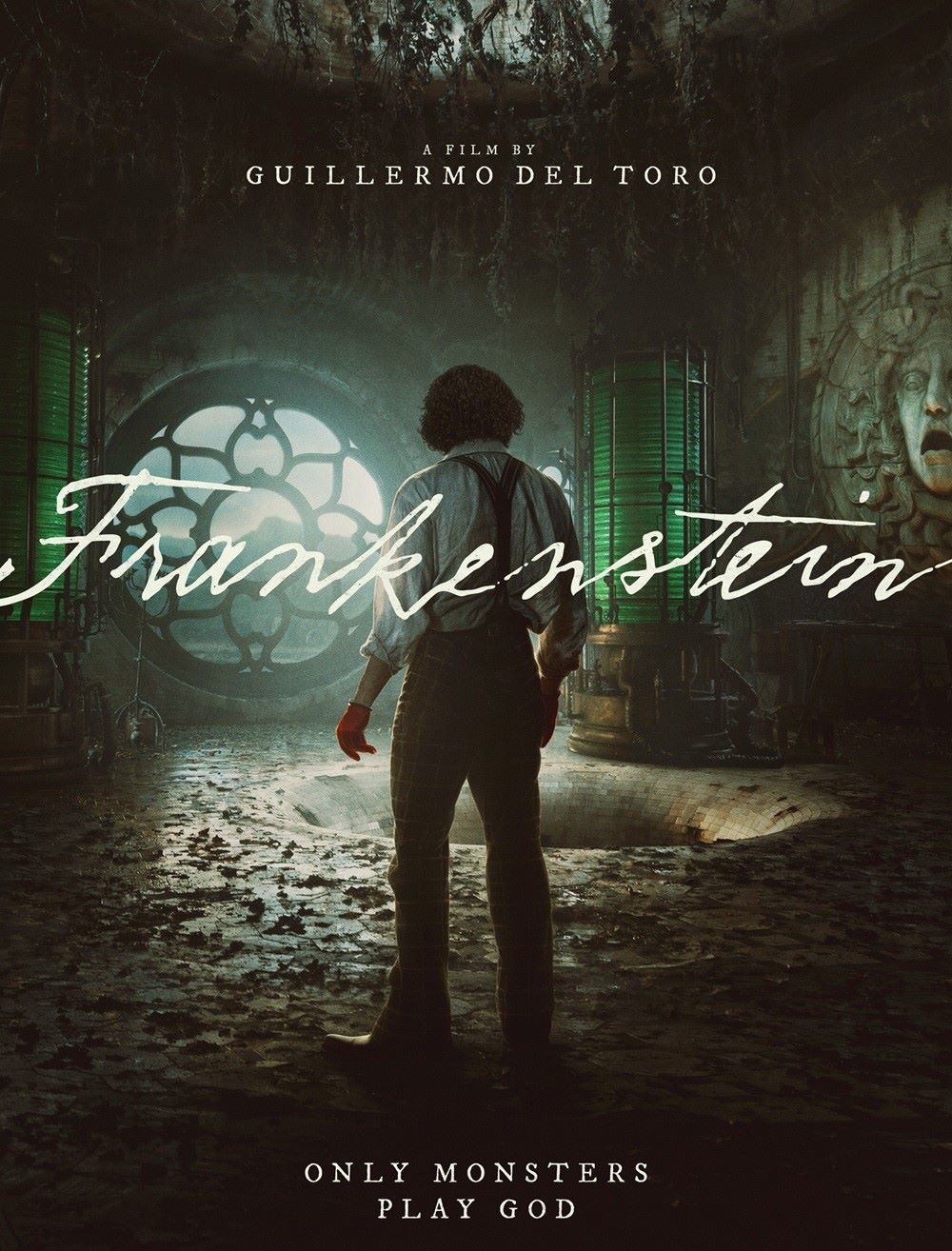
Guillermo del Toro’s long-awaited take on Frankenstein finally lumbers to life after years of speculation and teases, and it’s every bit the dark, hypnotic fever dream you’d expect from his imagination. The film, a Netflix-backed production running close to two and a half hours, stars Oscar Isaac as the guilt-ridden Victor Frankenstein and Jacob Elordi as his tragic creation. The result lands somewhere between Gothic melodrama and spiritual lament—a lush, melancholy epic about fathers, sons, and the price of neglect. It’s both a triumph of aesthetic world-building and a case study in overindulgence, the kind of movie that leaves you haunted even when it occasionally tests your patience.
From the very first frame, del Toro plunges us into a Europe steeped in rot and beauty. His world feels more haunted than alive—every misty street lamp and echoing corridor loaded with centuries of decay. Victor, introduced as both a visionary and a failed son, is shaped by years of cruelty at the hands of his domineering father, played with aristocratic venom by Charles Dance. That upbringing lingers in every decision he makes, especially when he turns to science to defy death. Del Toro shoots his laboratory scenes as though they were sacred rituals: the flicker of candlelight reflecting off glass jars, the close-up of trembling hands threading sinew into flesh. When the Creature awakens, lightning cracks like some divine act of punishment. It’s a birth scene that feels more emotional than monstrous—Elordi’s raw, wordless confusion gives it a painful tenderness that lingers longer than the horror. Del Toro discards the usual clichés of flat heads and neck bolts, opting for something far more human: an imperfect body full of scars and stitched reminders of mortality.
One of the most striking choices del Toro makes is reframing Victor and the Creature as mirror images rather than opposites. Instead of playing Victor as a simple mad scientist, del Toro paints him as a broken man desperate to reclaim the control he never had as a child. That fear and obsession ripple through the Creature, who becomes his unacknowledged shadow—an extension of Victor’s failure to love or take responsibility. The movie often frames the two in parallel shots, their movements synchronized across different spaces, suggesting that creator and creation are locked in a tragic loop. The audience watches both sides of the story—Victor’s guilt and the Creature’s anguish—without clear moral lines. This emotional split gives the film its heartbeat: the Creature isn’t a villain so much as a rejected child, articulate and lonely, begging to know why he was made to suffer.
Jacob Elordi’s performance is revelatory. He channels something hauntingly human beneath the layers of prosthetics and makeup. There’s a fragility to the way he moves—those long, uncertain gestures feel less like a monster testing its strength and more like someone trying to exist in a world that never wanted him. His eyes carry the movie’s emotional weight; the moment he sees his reflection for the first time is quietly devastating. Oscar Isaac, meanwhile, leans hard into Victor’s manic idealism, all sweat-soaked ambition and buried grief. He makes the character compelling even at his most despicable, though at times del Toro’s dialogue spells out Victor’s torment too bluntly. Still, the scenes between them—particularly their tense reunion in the frozen north—achieve the Shakespearean tragedy that del Toro clearly aims for.
Visually, Frankenstein is pure del Toro—sumptuous, grotesque, and alive in every corner of its composition. Each frame looks painted rather than filmed: flickers of gaslight reflecting on wet marble, glass jars filled with organs that seem to breathe, snow settling gently on slate rooftops. The film feels drenched in the texture of another century, yet vibrates with modern energy. Costume designer Kate Hawley, longtime collaborator of del Toro, deserves special recognition here. Her work helps define the story’s emotional tone, dressing Victor in meticulously tailored waistcoats that hint at obsession through precision, and the Creature in tattered fabrics that seem scavenged from several lives. Elizabeth’s gowns chart her erosion from warmth to mourning, using color and texture as silent narration. Hawley’s palette moves from opulent golds and creams to bleak greys and winter blues—visually tracing how ambition and grief drain the light from these characters’ worlds. The costumes, much like del Toro’s sets, feel alive with history, heavy with stories stitched into every seam.
Mia Goth gives a strong, if underused, turn as Elizabeth, Victor’s doomed fiancée. Her early scenes bring a spark of warmth to the story’s coldness; her later ones turn tragic in ways that push Victor toward his final breakdown. Minor characters—the townspeople, the academics, the curious aristocrats who toy with Victor’s discovery—carry familiar del Toro trademarks: grotesque faces, eccentric manners, glimmers of compassion buried in callousness. The composer’s score matches this tone perfectly, alternating between aching melodies on piano and surging orchestral crescendos that make even the quiet scenes feel mythic. Combined, the sound and visuals give Frankenstein a grandeur that most modern horror films wouldn’t dare attempt.
Still, not every gamble lands cleanly. Del Toro’s interpretation leans so hard into empathy that it dulls the edges of the original story’s moral conflict. Shelley’s Creature grows into a murderous intellect, acting out of vengeance as much as sorrow; here, his violence is softened or implied, as though del Toro can’t quite bring himself to stain the monster’s purity. The effect is powerful emotionally but flattens some of the tension—Victor becomes the clear villain, and the Creature, the clear victim. It fits del Toro’s worldview but leaves the viewer missing some ambiguity. The pacing also falters in the middle third. There are long, ornate monologues about divinity, creation, and guilt that blur together into a swirl of purple prose. The visuals never lose their grip, but the script occasionally does, especially when it slows down to explain what the imagery already tells us.
Those fits of overexplanation aside, del Toro’s Frankenstein stays deeply personal. The story connects directly to the themes he’s mined for years: innocence cursed by cruelty, love framed in pain, beauty stitched from the broken. The Creature isn’t just man made from corpses; he’s a kind of prayer for grace—a plea for understanding in a world defined by rejection. Victor’s failure to nurture becomes an act of spiritual cowardice rather than scientific arrogance. The parallels between them give the film its emotional voltage. Every time one character suffers, the other feels it by proxy, as if their bond transcends life and death.
By the final act, all the grand tragedy is distilled into the silence between two beings who can’t forgive each other—but can’t let go, either. The closing image of the Creature, trudging across a barren arctic plain beneath a rising sun, borders on mythic. His tear-streaked face and quiet acceptance of solitude bring the story full circle: a being born of man’s arrogance chooses forgiveness when his maker couldn’t. It’s sad, tender, and surprisingly spiritual, hinting at del Toro’s constant fascination with mercy in a cruel universe.
As a whole, Frankenstein feels like the culmination of del Toro’s career obsessions condensed into one sprawling film. It’s not perfect—it wanders, it sermonizes, and it sometimes sacrifices fear for sentiment—but it’s haunted by sincerity. You can see del Toro’s fingerprints in every gothic curve and crimson hue, and even when he overreaches, you believe in his conviction. Isaac anchors the film with burning intensity, Elordi gives it wounded humanity, and Goth tempers the heaviness with grace.
In the end, this version of Frankenstein isn’t about horror in the traditional sense. It’s not there to make you jump—it’s there to make you ache. The film trades sharp scares for bruised hearts, replacing terror with empathy. Del Toro reanimates not just flesh but feeling, dragging one of literature’s oldest monsters into our modern reckoning with parenthood, grief, and the burden of creation. It’s daring, messy, and undeniably alive. For better or worse, it’s exactly the Frankenstein Guillermo del Toro was always meant to make.
Though Magazine Dreams did not get a brief theatrical release until 2025, the film first made an impression two years earlier. At the 2023 Sundance Film Festival, Magazine Dreams was one of the most buzzed about entries. A film about a mentally unbalanced body-building fanatic, the film starred Jonathan Majors. Majors was on top of the world at that time. Not only was he being groomed to be the new center of the Marvel Cinematic Universe but he was also just a few months away from playing the antagonist in the highly anticipated Creed III. The U.S. Army was using Majors in recruitment commercials. Both Magazine Dreams and Majors’s performance were lauded at Sundance. Some critics started to say that Majors had, at the very least, an Oscar nomination in his future.
Then, on March 25th, 2023, Jonathan Majors was arrested and charged with assaulting his ex-girlfriend. Several other women came forward and said that they had also been abused physically and emotionally by Majors. The Army stopped airing his commercials. Marvel announced that Majors would no longer be appearing in their films and that the storyline around his character would simply be abandoned. (Indeed, the fallout over Majors’s arrest was so much a problem for Marvel that they eventually resorted to bringing back Robert Downey, Jr. to try to staunch the bleeding.) Creed III took on a whole new meaning as the relatively likable Michael B. Jordan beat the hell out of Jonathan Majors’s snarling ex-con.
As for Magazine Dreams, it fell into limbo. Fox Searchlight had acquired the film at Sundance and had given it an Oscar-friendly December release date. After Majors’s arrest, Searchlight removed the film from its schedule and, eventually, the rights were sold back to the film’s producers. Eventually, Briarcliff Entertainment released the film on March 21st, 2025. The film made barely a million at the box office.
With all of the behind the scenes drama, it’s tempting to overlook the most important question. Was the film itself any good?
It’s …. okay. Jonathan Majors plays Killian Maddox, a grocery store worker who, as a child, was traumatized by the murder-suicide of his mother and father. Maddox is obsessed with body building. He studies body building magazines the way that some people study ancient texts. One gets the impression that Maddox feels that having the perfect body will make up for all of the imperfections in his life. He shoots steroids. He uploads painfully earnest videos to YouTube. He doesn’t know how to express his emotions, allowing his anger to come out at inappropriate times. He wants to connect with someone but he doesn’t know how to do it.
To the film’s credit, it understands just how intimidating Killian Maddox can be. A scene in which Maddox confronts the nephew of his boss initially seems as if it’s going to be about Maddox standing up for himself but instead becomes increasingly disturbing as Maddox upsets the man’s family. Martin Scorsese’s Taxi Driver was obviously an influence on the film but Magazine Dreams doesn’t have that film’s wit or its subversive edge. There are scenes that work. The scene where a bloody Killian Maddox tries to compete despite being seriously injured is effective, even if it does owe a debt to Whiplash. Another scene, in which Killian reads the trolling comments that have been left on one of his YouTube videos, actually does make you feel a bit of sympathy for him. Ultimately, though, the film is so downbeat and unpleasant that you start to wonder why it was made in the first place. Was Killian Maddox really so interesting a character that the audience needed to spend two hours with him? Is there really anything to be learned from Killian Maddox and his experiences?
As for Jonathan Majors, he gives a believable performance. He was a good actor, even if he couldn’t quite make Killian Maddox into a truly compelling character.
When the infamous epic Caligulawas first released back in 1979, a disco version of Caligula’s love theme — We Are One — was also released as a promotional gimmick.
This song is so over-the-top, so blatantly exploitive, so insidiously catchy, and so totally inappropriate for so many reasons that become clear after you watch the film it was written for that it simply cannot be ignored. To me, this song represents everything that makes the Grindhouse great.
(As well, I hope whoever was playing bass got paid extra…)
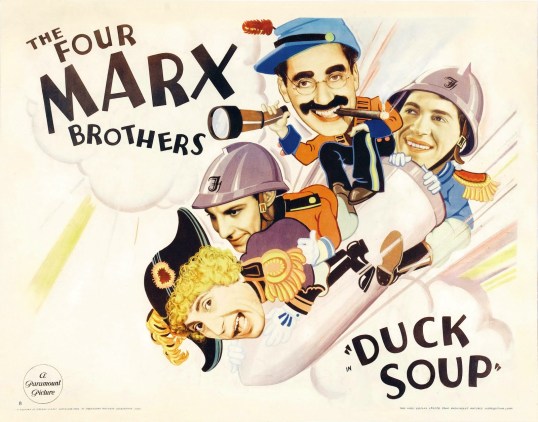
Believe it or not, when Duck Soup was initially released in 1933, it was considered to be something of a failure. Especially when compared to previous Marx Brothers films, it was seen as being a box office disappointment. The critics didn’t care much for it, either. They felt that the film’s political satire was preposterous and tasteless. Critics in 1933 attacked Duck Soup for being a cynical, anti-government satire released during the Great Depression.
Of course, today, Duck Soup is justifiably viewed as being a classic comedy. It’s certainly my favorite Marx Brothers film. In the classic scene below, Harpo pretends to be Groucho’s reflection in a shattered mirror. It’s a marvelous piece of physical humor so enjoy it!
4 Shots From 4 Films is just what it says it is, 4 shots from 4 of our favorite films. As opposed to the reviews and recaps that we usually post, 4 Shots From 4 Films is all about letting the visuals do the talking.
Today, the Shattered Lens wishes a happy birthday to director Charles Band. It’s time for….
4 Shots From 4 Charles Band Films
Meridian: Kiss of the Beast (1990, dir by Charles Band, DP: Marc Ahlberg)
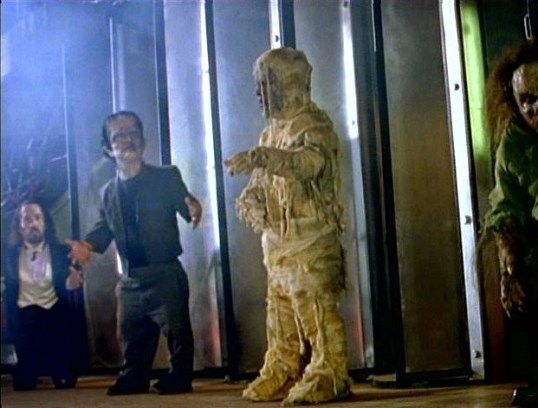
The Creeps (1997, dir by Charles Band, DP: Adolfo Bartoli)
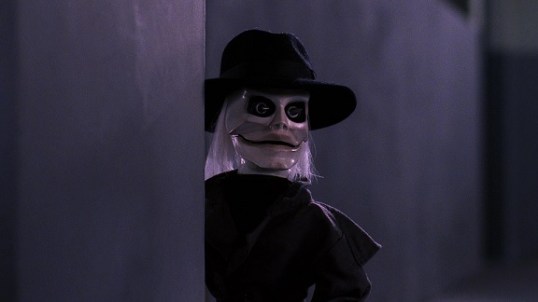
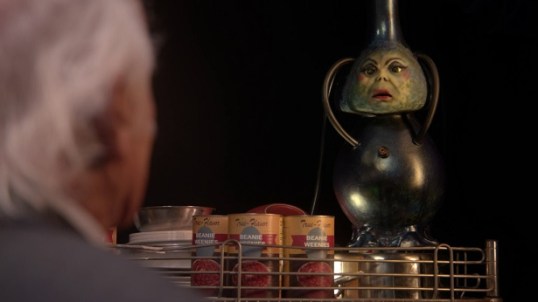
Puppet Master: The Legacy (2003, dir by Charles Band, DP: Marc Ahlberg)
Evil Bong 888: Infinity High (2022, dir by Charles Band, DP: Alex Nicolaou)
As some of our regular readers undoubtedly know, I am involved in a few weekly live tweets on twitter. I host #FridayNightFlix every Friday, I co-host #ScarySocial on Saturday, and I am one of the five hosts of #MondayActionMovie! Every week, we get together. We watch a movie. We tweet our way through it.
Tonight, for #ScarySocial, I will be hosting 1957’s Attack of the Crab Monsters!
If you want to join us on Saturday night, just hop onto twitter, start the film at 9 pm et, and use the #ScarySocial hashtag! The film is available on Prime and Tubi! I’ll be there co-hosting and I imagine some other members of the TSL Crew will be there as well. It’s a friendly group and welcoming of newcomers so don’t be shy!





 Through the Shattered Lens