Parkour was quite a thing for a while, though I’m not sure if it’s as big a deal now as it used to be. Back in the day, YouTube was full of videos of people jumping off of roofs, skipping up walls, jumping over tables, and rolling around in the dirt. The main thing I remember about parkour was that, whenever anyone jumped over a bench, everyone watching had to go, “Whoa! HE JUMPED OVER A BENCH!” I also remember that the Divergent films were an attempt to present parkour as the key to surviving a dystopian future.
2010’s Leap opens with a college student spotting a guy named Shane (Alexander J. Bonda) leaping over a railing on campus. When Shane is asked what he’s doing, Shane replies, “Parkour. It’s from France.”
Now, really, that should have been a red flag right there. It’s from FRANCE! You know, the same France that surrendered to the Nazis and then spent years whitewashing the activities of the Vichy government? French is a beautiful language and the country has given us some of the greatest films ever made. Actually, to be honest, I love visiting France but still, when it comes to self-defense, they’re perhaps not the the best role model.
Soon, Shane is teaching a group of college students how to do parkour. There’s a lot of parkour in this movie and, for the most part, it’s scored to some of the mellowest heavy metal out there. When Shane’s students invite him to Bible Study, it upsets Shane’s girlfriend, Crystal (Chelsea Raugast). When Shane and his students decide to build a Christian outreach program around parkour, they start getting threatening letters. “Who could be threatening us?” one of the student asks. “Atheists,” comes the reply. Soon, Crystal is chasing Shane across campus and the two of them get to show off their parkour skills.
I really do have to mention the chase scene because it goes on for several minutes and it really doesn’t make much sense. (Crystal, who is apparently looking to kill Shane, drops her gun just so she can chase him.) What’s funny about it is that, even while running for his life, Shane still has to show off his parkour skills. For instance, when he sees a picnic table in front of him, he doesn’t simply run around it. Instead, he jumps on top of it and then rolls off. It reminded me a bit of the classic 80s action film Gymkata, in which a city in Eastern Europe was full of random pommel horses so that the gymnast hero could show off his moves while fighting the bad guys.
Leap was made for $200 and the cast was largely made up of volunteers. I have a weakness for low budget passion projects and I was willing to cut this film a bit of slack but then I reached the Bible Study scene where a youth minister explained that HIV was God’s way of punishing the nonbelievers for failing to follow him and that was such an icky statement that I can’t overlook it. The film ends with the end times approaching and the promise of a sequel. Can parkour defeat the Beast? We’ll find out, I guess.
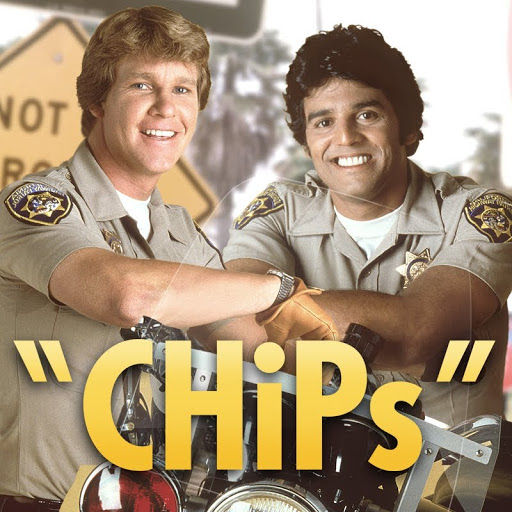
Welcome to Late Night Retro Television Reviews, a feature where we review some of our favorite and least favorite shows of the past! On Mondays, I will be reviewing CHiPs, which ran on NBC from 1977 to 1983. The entire show is currently streaming on Prime!
This week, Ponch reveals even more hidden talents!
Episode 4.16 “Karate”
(Dir by Leslie H. Martinson, originally aired on March 8th, 1981)
Ponch and Baker have been assigned to patrol Ponch’s old neighborhood. Ponch says that he feels as if he can see a ghost on every corner. Baker laughs and says that at least they have an easy assignment.
Not so fast, Baker!
Andy Macedon (Lewis Van Bergen) is paying teenagers to steal dirt bikes for him. Macedon went to school with Ponch. Macedon was a few years ahead of him and he was always a bully. Now, Macedon is setting up a crime ring. He’s even got Donny Bonaduce working for him!
Ponch’s solution? Ponch decides to encourage the neighborhood kids to come to the local youth center by having Bonnie teach gymnastics while Ponch teaches karate. Are you surprised to discover that, on top of everything else, Ponch knows karate? You shouldn’t be. You’re watching….
Admittedly, it doesn’t start off well. When Andy Macedon comes down to the Youth Center and personally challenges Ponch to a fight, Ponch backs off. He does it because he doesn’t want to make trouble for the Youth Center but the kids view him as being a coward. If Ponch is ever going to stop Andy Macedon and keep young Rivas (Mario Marcelino) from falling under Macedon’s evil spell, he’s going to have to beat Andy in a karate street fight with everyone watching.
And that’s exactly what Ponch does. Why? Because it’s the Ponch Show and there is nothing that Ponch cannot do!
This episode featured a combination of bass-heavy music and not just Erik Estrada but also Danny Bonaduce doing karate moves so you know it was a classic. I related to Terri (Kari Michealson), the teenager who couldn’t decide if she wanted to be a gymnast or a criminal. I went through the same thing when I was 16. Ballet or crime? Crime or ballet? I compromised by shoplifting makeup after my dance classes.
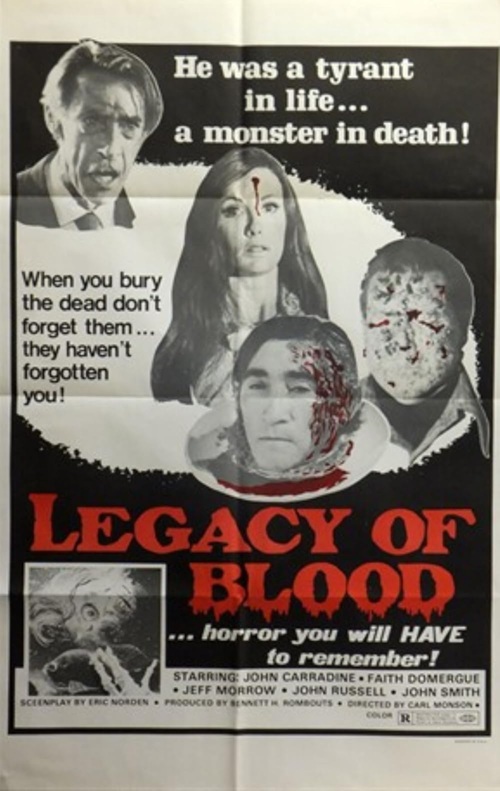
In this 1971 film, John Carradine briefly plays Christopher Dean, a wealthy man who hated his family and his servants. He dies before the film actually begins but we do get to see him in flashbacks and we also hear his voice at the reading of his will. Dean leaves a fortune to his children and his servants, but he does so only on the condition that they spend a week at Dean’s estate. If anyone dies or leaves the estate, they will lose their inheritance and the money will be split amongst those who stayed and/or survived. You can see where this is leading, right?
This is actually a promising premise and it’s easy to imagine how it could have inspired an American version of Mario Bava’s Bay of Blood, where one person is killed by another just for that killer to then be killed by someone else until eventually, there’s no one left. Unfortunately, while the characters are all unpleasant and greedy, none of them are as memorable as anyone in Bava’s classic shocker. They’re all generic jerks and, as such, it’s hard to have much of a reaction when they start dying. The film does feature several familiar B-movie stars. Jeff Morrow and Faith Domergue (both of whom were in This Island Earth) appear as brother and sister. Richard Davalos (who played James Dean’s brother in East of Eden) has an eccentric role. Western character actor Rodolfo Acosta plays the sheriff who eventually takes an axe to the forehead. B-movie veteran Buck Kartalian plays Igor, the butler. (His name is actually Igor!) Some of the members of the cast were good actors but few of them are particularly good in this film. I did appreciate the weird energy of Buck Kartalian. John Carradine doesn’t do much but he does deliver his lines with the proper amount of contempt.
The film does have a few vaguely interesting kills. Bees are used as a weapon at one point. A head is found in a refrigerator and Richard Davlos says, “This is just like a horror movie.” Wow, Richard, thanks for sharing! There’s a big twist ending but it really not that impressive of a twist.
Probably the most interesting thing about Blood Legacy is that it’s essentially a remake of Andy Milligan’s The Ghastly Ones. (Director Carl Monson had a habit of ripping off other films. In 1973, he remade Roger Corman’s Little Shop of Horrors. Monson called his remake Please Don’t Eat My Mother. The film starred Buck Kartalian.) Blood Legacy was originally released under the title Legacy of Blood but Milligan was so annoyed at being ripped-off that he later made his own remake of The Ghastly Ones and decided to give it the same title as Carl Monson’s rip-off. Monson changed his film’s title and distributed it under the names Will To Die and Blood Legacy so that it wouldn’t be confused with Andy Milligan’s Legacy of Blood. It makes sense. Why would anyone want their Andy Milligan rip-off to be confused with an actual Andy Milligan film?
The next episode of Hammer House of Horror is The House That Bled To Death but I’ve decided not to share it for this Halloween because it features the death of a kitty and I’m kind of tired of pets dying in horror films. It’s an effective and scary episode, though. It’s on YouTube so if you want to watch it, feel free.
Moving right along, tonight’s episode is CharlieBoy. Graham (Leigh Lawson) and his wife Sarah (Angela Bruce) inherit an statue that they don’t realize also doubles as a really big voodoo doll. After stabbing the statue a bit too many times, Graham comes to realize that he’s accidentally condemned almost everyone he knows to death, including both him and his wife. Thanks to the fast-paced director of Robert Young and the committed performances of the cast, this is an entertainingly macabre episode. It originally aired on October 18th, 1980.
In 1975’s Mary, Mary, Bloody Mary, Cristina Ferrare plays Mary, an American painter who lives and works in Mexico.
Mary seems to be living her ideal life. She paints. She travels. Her work is popular. She has glamorous and wealthy friends. She has her independence. Even when she starts a relationship with a young American diplomat named Ben (David Young), he seems like a genuinely nice guy who respects her need to have a space of her own.
However, Mary has a secret.
Mary is a vampire. She doesn’t have fangs, she doesn’t sleep in a coffin, and she can go out in the daylight. But she has an obsessive need to drink blood. Whenever she can get away from Ben, she’ll pull out a knife and slit the nearest throat. On the beach, a pushy, middle-aged man falls victim to her. Back in the city, she kills her former lover (Helena Rojo), who is not happy that Mary is now dating a man. Mary does her best to hide her murderous inclinations from Ben, even as she finds herself tempted to taste his blood.
However, someone else has recently arrived in Mexico and he appears to be looking for Mary. The Man (John Carradine) dresses in black and wears a mask over his face. The Man also carries a blade and, like Mary, he drinks the blood of his victims. When Mary reads a newspaper story about a murder that she didn’t commit, she realizes that she’s not the only vampire in Mexico. At the film progresses, we learn that Mary and the Man share a very close connection and Mary is forced to confront whether or not she can be both in love and a vampire.
One thing that I appreciated about Mary, Mary Bloody Mary is that it didn’t leave much ambiguity as to whether or not Mary was actually a vampire. At first, it seemed like the movie was going to play the “Is-she-or-isn’t-she” game and maybe suggest that Mary was just mentally disturbed, But instead, the film makes it clear that Mary is dependent upon drinking the blood of others. It’s suggested that vampirism is something that was passed down to her, much like how I inherited my red hair from my father’s side of the family. But, in the end, there’s no doubt that Mary actually is a vampire. Cristina Ferrare occasionally seems miscast as a ruthless killer but, ultimately, she brings the right amount of sophistication to the role and John Carradine is, as always, a nice addition to the cast.
Unfortunately, the majority of Mary, Mary, Bloody Mary is very slowly paced. I can appreciate a film that takes it time but the first 45 minutes of Mary, Mary, Bloody Mary really does sometimes feel like an endurance test. Once The Man shows up, the film’s pace starts to pick up and Mary is very quickly forced to confront the truth of her cursed existence. At times, I got the feeling that the director was trying too hard to convince me that there was more to Mary, Mary, Bloody Mary than there actually was. The film is littered with scenes that suggest the story was meant to be a statement on the human condition but …. nah. Ultimately, it’s just a film about a woman who drinks blood.
When I was growing up and watching Doctor Who on PBS, I had a friend whose mother forbid him from watching the show because she thought that it promoted Satanism.
Her opinion was almost totally based on the cover of the novelization of one of the Third Doctor’s most popular adventures.
She took one look at that cover and decided that both the book and the show were promoting Satan. I warned him that would happen when he first bought the book but, back in the day, it was nearly impossible to resist the temptation of the shelf of Doctor Who novels at Walden Books. It was almost as if the books had been put there by you know who.
If my friend’s mother had read the book or even watched the serial when it eventually aired on PBS, she would have discovered that The Daemons did not feature the Devil. Instead, it features Azal (Stephen Thorne), an evil horned alien who had spent centuries experimenting on humans and who had inspired many ancient myths and religions. If my friend’s mother had watched the show, she would have seen that, rather than celebrate Satan, the show instead suggested that there was no Satan and that all of mankind’s Gods were actually visiting aliens. She would have also seen that while The Master (played by Roger Delgado) disguised himself as a vicar, it fell to a local white witch to warn everyone in a quaint British village that the local archeological dig was a mistake. Because of the Master’s religious disguise, everyone followed him when they should have been listening to the pagan…
In hindsight, it’s probably a good thing my friend’s mother never watched the show.
The Daemons has a reputation for being one of the best of the Third Doctor’s adventures and I’m inclined to agree. The Doctor (Jon Pertwee) and his latest companion, Jo Grant (Katy Manning), try to stop the dig and instead find themselves trapped by a heat shield that has suddenly sprung up over the village. One of the defining images of this episode was a helicopter busting into flame when it hit the invisible barrier. With the Brigadier and the majority of UNIT outside of the village, The Doctor, Jo, Sgt. Benton (John Levene), and Captain Yates (Richard Franklin) try to stop the plans of The Master and Azal. Unfortunately, the villagers themselves have fallen under the sway of evil and are planning a special maypole sacrifice.
So many different actors have played The Master (and the character has become so overused) that it is easy to forget just how good Roger Delgado, the first Master, was in the role. Delgado played the Master as being incredibly evil but he also played him as having a sense of humor and style about his evil, which is something that subsequent Masters have often failed to do. Delgado’s Master appeared in every serial of the eighth series and he proved to be more than a worthy opponent for Pertwee’s Doctor. Off-screen, Pertwee and Delgado were close friends and Pertwee later said that Delgado’s death in a traffic accident was one of the factors in Petwee’s decision to step away from the show. The Daemons featured Delgado at his best as the Master did his worst and tried to claim the powers of someone who humans considered to be Satan.
The Daemons is also remembered for one of the best lines in the history of Doctor Who. When confronted by Azal’s gargoyle servant, the Brigadier calls over a UNIT solider and orders, “Chap with wings there, five rounds rapid.” I can only imagine how tired Nicholas Courtney got of having that line repeated to him over the years but his delivery of it is perfect. The Brigadier was such a uniquely English character, imbued with the unflappable attitude of a country that had survived the collapse of an Empire, the Blitz, and the Suez Crisis. Nicholas Courtney took a line that sounds like something Graham Chapman would have said on MontyPython and instead made it into an iconic piece of dialogue that reminded those of us American watching on PBS that, in DoctorWho, the entire universe was British.
Though it led to the show being forever banned in my friend’s house, TheDaemons is a DoctorWho classic.
On the planet of Arous, Taura (Sandy Brooke) leads a group of dwarf miners in rebellion against the international empire. The empire sends Captain Bantor (Ross Hagen), Krago (Michael D. Sonye), and the Inquisitor (Aldo Ray) to capture Taura and put down the revolution. When Bantor attempts to attack Taura, he sticks his hand in a volcanic acid plume and screams as it dissolves. Taura is arrested. Judge John Carradine sentences her to a term on Vehemence, a spaceship that serves as an intergalactic women’s prison.
StarSlammer is a Women In Prison film that happens to be set in space. Taura makes an enemy of the sadistic warden (Marya Grant) and her henchwoman, Muffin (Dawn Wildsmith). Taura also befriend Mike (Susan Stokey) and the two of them plot to overthrow the guards and make their escape. When the now crazed Bantor boards the ship, Taura sees her chance. Meanwhile, the prisoners have to deal not only with pervy guards but mutant rats.
Legend has it that Fred Olen Ray had rented Roger Corman’s New World Pictures studio for four days so that he could shoot some extra scenes for his film Biohazard. Ray finished his Biohazard work in one day and then spent the other three days filming promotional footage for the film that would become StarSlammer. He used props that were left over from Galaxy of Terror and was able to get Aldo Ray to come in for a day so that the footage would feature “a name.” Producer Jack H. Harris looked at the footage and put up the money to shoot the rest of the film on the condition that Ray change the title from PrisonShip to Star Slammer.
Amazingly, the resulting film itself is not that bad. Ray used the outer space setting as a way to both indulge in and poke fun at the common tropes of the Women In Prison genre and Sandy Brooke and Susan Stokey both turn in committed performances. Ross Hagen laughs like a maniac and demands vengeance for his missing hand while trying to get his remaining hand on a mind control device. The prisoners are kept in check by promises of prizes and free trips in return for good behavior. A thoroughly deformed guard is promoted as a sex symbol and there’s a sharp wit to many of the scenes. Star Slammer is much more clever and fun than anyone would have any right to expect it to be.
Welcome to Retro Television Reviews, a feature where we review some of our favorite and least favorite shows of the past! On Mondays, I will be reviewing Miami Vice, which ran on NBC from 1984 to 1989. The entire show can be purchased on Prime!
This week, we start the fifth and final season of Miami Vice.
Episode 5.1 “Hostile Takeover”
(Dir by Don Johnson, originally aired on November 4th, 1988)
The fifth and final season of Miami Vice gets off to a good start with this episode. After opening with some appropriately glitzy scenes of the drug-fueled Miami nightlife, the episode then shows us that Sonny Crockett is still convinced that he’s Sonny Burnett. He has now returned to Miami and, along with Cliff King (Matt Frewer), he is one of the key advisors to drug lord Oscar Carrera (Joe Santos).
Carrera is at war with El Gato (Jon Polito), the brother of Sonny Burnett’s former employer, Miguel Manolo. El Gato, who wears gold lamé, cries over the body of one of his henchmen, and flinches when forced to deal with direct sunlight, is a flamboyant figure. In fact, he’s so flamboyant that it’s initially easy to overlook how determined he is to get revenge for the death of his brother. That means taking down the Carreras family and Sonny Burnett as well.
The Vice Squad knows that Sonny is moving up in the drug underworld but Castillo is firm when asked what they should do about it. Sonny has an active warrant out for murdering a corrupt cop. “Sonny’s not Sonny anymore,” Tubbs says at one point and Castillo seems to agree.
Tubbs goes undercover, making contact with the Carreras cartel. When Sonny meets Tubbs, Tubbs introduces himself as “Ricardo Cooper” and starts speaking in his terribly unconvincing Jamaican accent and that was when I said, “Miami Vice is back!” Sonny doesn’t trust Cooper from the start. “Maybe you’re a cop,” Sonny says. “Not I, mon,” Tubbs replies.
People are dying and, while Sonny doesn’t have a problem with that, the show is also careful to show that Sonny only shoots in self-defense. (It appears the most of the cold-blooded murders are farmed out to Cliff King.) When Oscar Carreras dies, it’s because his poofy-haired son (Anthony Crivello) accidentally shot him when Oscar discovered him with his stepmother. When the son dies, it’s because he was about to shoot Sonny after he caught Sonny with …. his stepmother, again. The Carreras family is so dysfunctional that it shouldn’t come as a surprise that Sonny steps up to take it over.
After promising Castillo that he’ll take out Sonny if necessary, Tubbs meets up with Sonny at beach-side tower. Tubbs looks at Sonny and suddenly says, “Sonny, it’s me, Rico.” Sonny stare at Tubbs. “Do you remember me?” Tubbs asks.
“Sure,” Sonny suddenly says, “You’re Tubbs.”
Three gunshots ring out as the episode ends.
OH MY GOD, DID SONNY KILLS TUBBS!?
We’ll find out next week. For now, I’ll say that — after a disappointing fourth season — this was exactly how Miami Vice needed to start things off for Season 5. Seriously, if you’re going to have Sonny get hit with amnesia, you might as well just go for it and take things to their logical extreme.
I’ve always loved the interview with the chief of police in the original Night of the Living Dead. I love the delivery of that classic line. “….they’re all messed up.” Yes, they are. The chief doesn’t seem to be particularly perturbed by the fact that the dead are coming back to life. Instead, his attitude is very straight-forward. To quote Tommy Lee Jones in Rolling Thunder, “Let’s go clean ’em up.”
When we first see this interview, it’s easy to laugh at the sight of the chief’s posse and everyone’s odd confidence that the dead will somehow just go away. (Death, after all, is the one thing that is guaranteed to happen to everyone eventually.) Once you know how the story’s going to end, though, this scene becomes much more ominous.
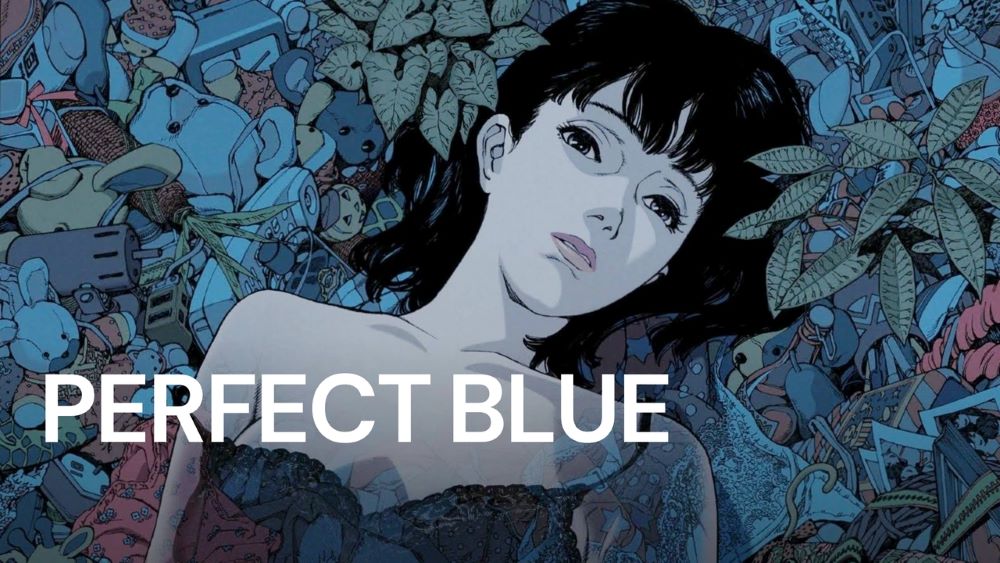
Satoshi Kon’s 1998 psychological thriller Perfect Blue remains a striking and influential work nearly three decades after its release. Despite being an animated film, it evokes the unsettling style and tension found in the classic Italian giallo thrillers of the 1970s and ’80s—films by directors like Dario Argento and Mario Bava—and melds them admirably with elements of 1970s Eurotrash exploitation and arthouse psychological thriller reminiscent of Brian De Palma. Kon’s debut feature is a haunting exploration of fractured identity, blending show-business satire, Hitchcockian suspense, and surreal nightmare imagery into a profoundly relevant story in today’s age of parasocial fandom and digital voyeurism.
The film centers on Mima Kirigoe, a member of the bubblegum J-Pop group “CHAM!” who decides to leave the idol world to pursue a career in serious acting. This choice, rooted in her desire for personal growth and artistic expression, sets off devastating consequences. For her managers and many fans, Mima’s break from the manufactured idol persona is viewed as betrayal—a dissolution of a carefully crafted image designed for maximum market appeal. The pristine, innocent figure worshipped by fans begins to crumble, replaced by the complicated reality of adulthood and the harsh glare of fame.
To fully grasp the horror underpinning Perfect Blue, it’s important to understand the nature of Japanese idol culture. These idols are not merely singers or performers—they are highly managed brands. Every lyric, outfit, choreographed move, and public appearance is tightly controlled to project purity and accessibility. This system bears close resemblance to the meticulously produced Western pop acts of the late 1990s and early 2000s like Britney Spears and the Backstreet Boys. Both rely on constructing polished, artificial personas that maximize commercial appeal, often at the expense of genuine selfhood. When an idol deviates from this script, it frequently provokes obsession, confusion, and even violent reactions from a subset of fans unable to reconcile the constructed image with evolving reality.
Mima’s transition from ingénue pop star to serious actress thrusts her into an intense psychological crucible. Her first major acting role requires her to perform a deeply disturbing rape scene, one that blurs lines between professional obligation and personal violation. Kon lingers on Mima’s shocked expression—a powerful mask of confusion and repressed trauma. This sequence sets the tone for the film: a world where performance, identity, and exploitation intertwine irrevocably, creating a landscape where self and roles imposed by society become indistinguishable.
As Mima’s public persona shifts, darker forces emerge. An eerie fan website titled “Mima’s Room” chronicles her life with disturbing accuracy but is clearly authored by an unknown party. Even more threatening is an obsessed fan fixated on the idol version of Mima, stalking her and insisting that the “real” Mima no longer exists. This duality—between reality and imitation, self and construct—becomes the film’s thematic centerpiece. The narrative loops and fractures, cutting between dreams, televised drama, and supposed reality until neither Mima nor the viewer can be sure what is authentic. This masterful ambiguity immerses us in the protagonist’s psychological collapse.
The horror in Perfect Blue operates on two deeply intertwined levels. First, it is a psychological portrait of a young woman’s unraveling, echoing themes explored in Roman Polanski’s Repulsion and Darren Aronofsky’s Black Swan—films focused on fragile female psyches under immense pressure. While Aronofsky has publicly denied that Black Swan was directly inspired by Perfect Blue, the similarities in theme and specific visual motifs suggest otherwise. Both films explore the disintegration of identity in a young woman caught between innocence and adult roles, with dreamlike, unsettling sequences blurring reality and hallucination. The parallels in their portrayal of psychological breakdown, stalking, and the pressure of performance are striking, though Aronofsky’s work is set in the world of ballet rather than pop music and acting.
Second, Perfect Blue channels the lush, stylized dread characteristic of giallo cinema. Kon borrows Argento’s fascination with voyeuristic camera angles, saturated color palettes, and the interplay of beauty and violence. Like Argento’s heroines trapped in a hall of mirrors, Mima finds herself caught in a labyrinth where surreal horror becomes tangible and murder might be just another staged act in a disturbing performance.
Yet unlike Suspiria’s occult grotesques, Kon’s horror resides not in supernatural forces but within the mind and media itself. Animation becomes a revelatory choice—rather than softening violence, it frees Kon from physical constraints, allowing reality to fracture visually with startling fluidity. Identities shift from frame to frame, reflections move independently of their sources, and timelines collapse and fragment like psychic glitches. The medium’s flexibility intensifies the film’s psychological disorientation, blurring fact and fantasy in ways live-action cinema would struggle to capture so viscerally.
Kon’s prescient understanding of media obsession resonates more strongly than ever today. Long before social media reshaped how identity is constructed and perceived, Perfect Blue envisioned the internet as a distorting mirror that erases the line between self and performance. The “Mima’s Room” website serves both as diary and prison—a disturbing precursor to the carefully curated digital personas that dominate social media platforms now. As Mima reads falsified diary entries that resemble her life more “truthfully” than her own memory, she grows alienated from reality. The omnipresent gaze of fans, stalkers, and producers merges into an oppressive force she cannot escape.
This taps into a modern phenomenon: parasocial relationships. These one-sided emotional bonds fans develop with celebrities or fictional characters foster a dangerous illusion of intimacy and knowledge, often masking boundaries between admiration and entitlement. In Perfect Blue, the deranged fan believes he “knows” Mima in a way that justifies controlling her, even committing violence to preserve the image he idolizes. This mirrors the darker side of parasocial dynamics today, where fans demand absolute authenticity or control over public figures’ identities, sometimes leading to harassment or stalking. Kon’s film foreshadows how internet culture can exacerbate these fragile boundaries, blurring realities and fueling destructive obsession.
The film’s editing amplifies this psychological suffocation. Kon intercuts scenes from Mima’s TV drama—ironically titled Double Bind—with moments from her “real” life until one blurs imperceptibly into the other. Viewers are drawn deeper into uncertainty: are we witnessing actual events, staged fiction, or yet another deceptive layer? This deliberate manipulation creates unease without relying on cheap jump scares or graphic violence. The horror is existential—losing trust not only in others but in one’s own mind.
This theme has become exponentially more relevant with the rise of social media influencers and online streaming personalities. Today, countless individuals cultivate personal brands that blend their private lives with public personas online, often with blurred or deliberately ambiguous boundaries. The intense fan interaction, constant scrutiny, and expectation of accessibility echo the pressures Mima faces. As social media blurs the line between “real” self and online performance, the risks of losing grip on one’s identity—as Mima does—feel more immediate and widespread than ever.
It is extraordinary that Perfect Blue was Kon’s first feature film. His command of cinematic language is masterful—harnessing animation as a means to probe psychological depths rather than as mere escapism. His subsequent works—Millennium Actress, Tokyo Godfathers, Paprika—build on themes of identity, memory, and the fluid borders of reality, but Perfect Blue remains his rawest and most unsettling contribution. His untimely death from pancreatic cancer in 2010 at just 46 left the film community mourning a visionary whose full promise was tragically unfulfilled.
One of Perfect Blue’s greatest achievements is rejecting outsider stereotypes about anime. It is neither childish fantasy nor gratuitous erotica, though it fearlessly explores sexual anxiety, trauma, and performance under intense scrutiny. Kon’s film proves that animation can tackle mature themes—mental illness, societal pressure, gender identity—with subtlety and emotional gravitas usually reserved for live-action cinema. It challenges the misinformed Western association of adult anime with “hentai,” affirming animation’s capacity as a serious art form.
Kon’s film also critiques fandom’s darker impulses, asking difficult questions about ownership and identity. How much of a celebrity’s life belongs to the public? How much of one’s self must be sacrificed under the weight of expectation? In today’s hyperconnected online world, Kon’s portrayal of obsessive fans demanding idealized idols is uncannily relevant and urgent.
Ultimately, Perfect Blue transcends genre and era. It is not merely a psychological thriller or celebrity critique but a mirror held to an increasingly performative world. Long before social media dissolved the lines between private and public selves, Kon foresaw how image can consume reality. The result is a masterful fusion of paranoia, empathy, and stunning visual style—a giallo-inspired fever dream painted in blood-red and neon blue. For animation, it remains a landmark in artistic maturity; for cinema as a whole, it stands as one of the most chilling and insightful portraits of fame’s corrosive gaze and the dark side of parasocial obsession.





 Through the Shattered Lens