Warrior Queen (1987, directed by Chuck Vincent)


The place is Pompeii in the year 79 A.D.

One of the jewels of the Roman Empire, Pompeii is overseen by the decadent Clodius Flaucus (Donald Pleasence).  Despite the warning that the statues of the Temple of Jupiter have been crying salt and that a goat was recently born with the head of a human, Clodius refuses to believe that anything bad could happen to Pompeii.  (“I’d like to see the cow!” Clodius exclaims with  a laugh.)

In the arena, the gladiator Goliath (Marco Tullio Cau) throws deadly frisbees and demands slave girls as his reward for victory.  In the streets, all the women adore Marcus (Rick Hill) but he has eyes only for one of the new slaves, the comely virgin Vespa (Tally Chanel).  Vespa has been purchased by Berenice (Sybil Danning), a former mistress of Caesar who is secretly working to free the slaves.

Warrior Queen was directed by Chuck Vincent.  Vincent was a veteran of the adult film industry and was considered to be one of the best hardcore directors around.  His X-rated films were even positively written up in the New York Times.  In the 80s, he tried to go mainstream and ended up making movies like this one.  Produced by British B-movie impresario Harry Alan Towers and filmed largely in Italy, Warrior Queen was an attempt to capitalize on the minor sword-and-sorcery revival that followed the success of Conan the Barbarian.  There’s plenty of nudity and violence but there’s not much plot and the film feels much longer than its 70-minute run time.  When the volcano does erupt, it’s represented by stock footage and someone shaking the camera while filming the extras.  Pompeii has never looked so cheap.

The main attraction here is Sybil Danning and Donald Pleasence.  Pleasence gives it his all and earns however much he made for this movie.  Danning is only in a handful of scenes and can be seen yawning at several points in the movie.  I think she’s supposed to be the title character but she’s actually neither a warrior nor a queen.  Rick Hill (of Deathstalker fame) and Tally Chanel are at least appealing as the leads, even if Chanel looks more like a lost cheerleader than a Roman slave girl.

The main thing that I learned from watching this film is that the lava that hit Pompeii wasn’t actually that thick, wide, or deep and everyone should have been able to just hop over it and escape.  Anyone who died at Pompeii has no one but themselves to blame.

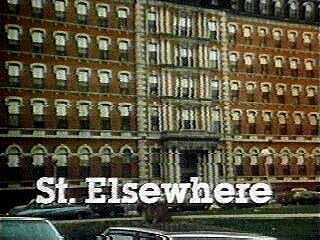
Retro Television Review: St. Elsewhere 2.18 “Equinox”


Welcome to Retro Television Reviews, a feature where we review some of our favorite and least favorite shows of the past! On Fridays, I will be reviewing St. Elsewhere, a medical show which ran on NBC from 1982 to 1988.  The show can be found on Hulu and, for purchase, on Prime!

This week, Peter White returns to the hospital.

Episode 2.18 “Equinox”

(Dir by David Anspaugh, originally aired on March 14th, 1984)

A college student (Thomas Byrd) comes in after taking a hit to the groin during a touch football game.  It turns out that he might have testicular cancer and it falls to Dr. Cavanero to let him know that he will soon be down a ball.

Dr. Chandler is upset when his new girlfriend prefers to hang out with Luther.  Chandler accuses Luther of “shuckin’ and jivin’.”  Chandler’s girlfriend dumps him for being “mean.”  In a well-acted scene, Chandler talks to Morrison about how he’s expected to act one way as a black man and another way as a black doctor.

Fiscus makes the mistake of giving Elliott Axlerod (Stephen Furst) his lucky baseball cap.  Axelrod spills a urine sample on it and then accidentally sets the hat on fire while attempting to dry it.  Axlerod is having a terrible day until a man dressed like Paul Revere brings his horse into the ER for treatment.  It turns out that Axlerod’s father was veterinarian.  Axlerod cures the horse but he still has to get Fiscus a new hat.

Finally, Dr. White returns.  His charges have been reduced from attempted rape to assault.  Wendy Armstrong is not happy and starts to binge eat.  (And yet, as several nurses point out, she doesn’t gain a pound.  We all know what that means….)  When Kathy Martin sees Peter in the cafeteria, she yells that he raped her.  “You’re crazy,” Peter lies.

The episode ends with Dr. Chandler going for a run outside, stopping, and screaming into the air.

This episode was a bit uneven.  The Axlerod story worked because of the likability of Stephen Furst and not because the story itself was particularly clever.  The Philip Chandler/Jack Morrison conversation was the highlight of the episode, though the ending with Chandler screaming into the void was a bit overdone.

As for Dr. White, I’ve reached the point where I can’t even stand to look at him and I feel foolish for having any sympathy for him earlier in the season.  Hopefully, this season will end with Dr. White going to prison for life because I’m not sure how many more episodes I can handle of him wandering around the hospital with that smug look on his face.

Seriously, St. Elsewhere, take care of this guy soon….

Horror Scenes That I Love: Neve Campbell in Scream


Today, the Shattered Lens wishes a happy birthday to actress Neve Campbell!

This horror scene that I love comes from 1996’s Scream.  In this scene, Sidney Prescott (Neve Campbell) explains to Ghostface why she doesn’t like horror movies.  Unfortunately, when you’re trapped in the middle of one, it really doesn’t matter whether you enjoy the genre or not.

4 Books For The Weekend (10/3/25)


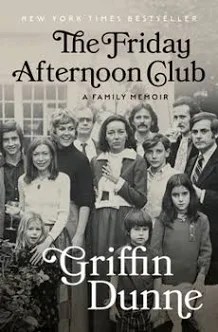
I want to start by recommending The Friday Afternoon Club, Griffin Dunne’s memoir of growing up amongst the rich and famous in Hollywood and Manhattan.  The son of Dominick Dunne and the nephew of John Gregory Dunne, Griffin Dunne came of age in the 60s and the 70s.  Reading his memoir, it’s easy to wonder if there’s anyone who he didn’t rub shoulders with at one time or another.  Sean Connery saves him from drowning when he’s just eight.  He attends one of Ken Kesey’s acid tests with John Gregory Dunne and Joan Didion.  A pre-stardom Harrison Ford does carpentry work at the Dunne family home and shares his weed with the young Griffin.  In New York, Griffin’s roommate and (for the most part) platonic best friend is a hyperactive young actress named Carrie Fisher.  While Griffin tries to find himself in Hollywood and New York, his father Dominick drops in and out of the film business.

For it’s first half, The Friday Afternoon Club is, at times, a laugh-out-loud memoir.  Griffin Dunne is a very funny storyteller and his command of language reveals a bright and insightful mind.  However, the second half of the book takes a dark turn with the murder of his sister, Dominique.  Dominique, who had just appeared in Poltergeist, was strangled by her abusive boyfriend, a chef named John Thomas Sweeney.  Griffin Dunne writes unsparingly of the horror of watching as Sweeney’s lawyers tried to present Dominique as somehow being to blame for her own death.  After the judge refused to allow the prosecution to introduce evidence showing that Sweeney had a history of abusing and choking women, the jury found Sweeney guilty of manslaughter.  (The jury foreman later said that, if the jury had been allowed to hear the evidence of Sweeney’s past abusive behavior, they would have found Sweeney guilty of murder.)  Sweeney was sentenced to six years in prison and was paroled after only 30 months.  Griffin Dunne writes of the years that both he and his father spent obsessing on Sweeney’s whereabouts.  (Sweeney, for those curious, continued to find work as a chef even after his prison sentence.  He currently goes by the name of John Maura.)

It’s a powerful memoir.  Griffin writes honestly about his dysfunctional family, describing even their conflicts with a good deal of love.  Probably the most touching passages in the book are about his relationship with his brother Alex, the one member of the family to see through Sweeney from the start.  Those looking for Hollywood gossip will find plenty, though Griffin is never malicious.  Those looking for details about the filming of An American Werewolf in London and After Hours will find those as well.
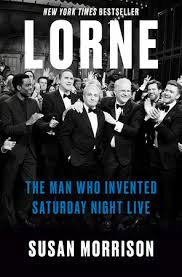
Published earlier this year, Susan Morrison’s Lorne is a biography of Lorne Michaels, the man behind Saturday Night Live.  Lorne has actually produced quite a few other shows and movies but, as this book makes clear, his legacy will always be Saturday Night Live.  The book follows Lorne from his beginnings in Canada to his time as a counter-culture tastemaker to his current position as a senior member of America’s cultural establishment.  Lorne went from being a rebel to being a member of the club and, reading about the process, one comes to suspect that he was always more comfortable in the club than outside of it.  It’s an interesting journey and the Lorne Michaels who emerges is occasionally idealistic, occasionally pragmatic, and — even after 595 pages — rather enigmatic.  It’s a fascinating story, one that provides insight into American culture has changed and developed over the past 50 years.  There’s certainly more insight to be found in this book than in Jason Reitman’s Saturday Night.

On a similar note, Todd S. Purdum’s Desi Arnaz: The Man Who Invented Television argues that Arnaz deserves far more credit for …. well, inventing television than he’s usually given.  Often dismissively described as being Lucille Ball’s less talented husband, Purdom persuasively argues that Arnaz deserves far more credit for the success of I Love Lucy than he is commonly given.  The book details how Arnaz’s family lost their fortune in one of Cuba’s many revolutions, how Arnaz came to America and built a career for himself, and how Arnaz revolutionized television as the producer of I Love Lucy.  The book deals with both the good and the bad of Lucy and Desi’s marriage.  Desi emerges as a complex and flawed character, one whose career never really recovered after his divorce from Lucille Ball.
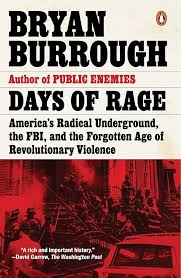
Finally, an old friend recommended that I read Bryan Burrough’s 2015 book, Days of RageDays of Rage takes a look at the the domestic terrorism of the 70s, the bombings, kidnappings, and even murders that were committed by members of such groups as the Weatherman, the BLA, the SLA (they kidnapped Patty Hearst), and the FALN.  Along with taking a look at the motivations of the terrorists themselves, Burrough also writes about how the FBI reacted.  In the end, it’s a book without any heroes.  The FBI frequently violated the law in their pursuit of domestic enemies.  Meanwhile, the radicals often come across as being a collection of hypocrites who were essentially more interested in playing revolution than actually accomplishing anything.  The Weathermen, in particular, come across as being a bunch of smug and overly privileged LARPers.  It’s an interesting book and one that feels very relevant in our current cultural moment.

Check out my previous book recommendations here!

October True Crime: Cries Unheard: The Donna Yaklich Story (dir by Armand Mastroianni)


In 1994’s Cries Unheard: The Donna Yaklich Story, Jaclyn Smith is miscast as Donna, a naive young woman who is charmed by a cop named Dennis Yaklich (Brad Johnson).  The film is told in flashback and, for some reason, it was decided to have Jaclyn Smith (who was 49 when this film aired) not only play the middle-aged Donna but also to play her where she was just supposed to be in her 30s and looking for a husband.

Anyway, Dennis starts out charming but he soon turns out to have some problems.  He is easily angered.  He spends all of his time lifting weights.  He’s possessive.  He pops pills and shoots up steroids and, by the end of the movie, he’s grown out one of those madman beards that crazy men in movies always end up with.  When Dennis discovers that Patty (Hillary Swank), his daughter from his first marriage, is pregnant, he flies into a rage.  Donna does some research and comes to the conclusion that Dennis murdered his first wife.  When she confronts Dennis with this, he just laughs.

Donna is too frightened to grab her toddler son and run away from home, despite the fact that Dennis is hardly ever at home.  (In fairness, Dennis is a cop so he would definitely have the resources to track her down if she did leave.)  Instead, Donna hires two no-good trailer park boys to shoot Dennis when he comes home from work.  Dennis dies in his driveway, still holding the toy truck that he hoped to give his son.  It’s also raining when he dies because that’s the type of movie this is.

Donna made the mistake of hiring the dumbest people possible to carry out the crime and soon, she is getting arrested and being put on trial for murder.  Later, she tells her story to her now-teenage son, Denny (David Lascher).  Denny is angry because he had to grow up without a dad but he still assures his mother that she’s a wonderful person and the he can’t wait to pick her up from prison in 40 years.

Watching Cries Unheard was an odd experience for me.  By all logic, I should have been on Donna’s side but I found myself getting pretty annoyed with her.  Some of it was because Jaclyn Smith was totally miscast in the role.  Donna is supposed to be naive and meek and easily gaslit by her husband but Jaclyn Smith seemed as if she had just returned from a Paris shopping trip.  The other problem is that the film, which was heavy-handed even by the standards of a made-for-TV movie from the 90s, tried too hard to pretend as if hiring a hitman is something that anyone would have done in Donna’s situation.  The film ends with a Jaclyn Smith voice-over in which she points out that husbands who hire hitmen to kill their wives usually get a shorter sentence than women who do it and I really wanted to throw a shoe at the TV.  Regardless of the circumstances, hiring a hitman is an extreme step to take.  Most people will go through their entire life without ever hiring a hitman.  Most people don’t even know anyone who they could hire to be a hitman.  So, don’t sit there and act like this is the equivalent of women not getting paid as much men for the same amount of work.  I did a little research and discovered that this film was based on interviews that Donna gave in prison.  Dennis’s other daughter– who was not portrayed in the film — called the film a complete fabrication.

I should note that this film was directed by Armand Mastroianni, who also directed some of the best episodes of Friday the 13th: The Series and the classic slasher film He Knows You’re Alone.  (That film was also Tom Hanks’s feature debut.)  His direction embraces the melodrama but it can’t overcome a weak script and a miscast lead.

Horror Film Review: It Hatched (dir by Elvar Gunnarsson)


When I was growing up, I was fascinated by Iceland.

I didn’t really know much about Iceland, other than it was a sparsely-populated island that was known for its volcanic eruptions.  I think the main source of my fascination was the name.  Iceland made me imagine a country that was totally and completely covered in ice.  Of course, I’ve since learned that wasn’t true at all.  Just as Greenland is not entirely green, Iceland is not made of ice.  There’s a legend that the original settlers of the island picked the name “Iceland” as a way to keep other people from coming.  The legend probably isn’t true but still, that’s the type of attitude that I can respect.

The main reason that I watched the 2021 film, It Hatched, was because it’s an Icelandic film.  Iceland actually has a very busy film industry but sadly, few Icelandic films seem to make it over to the United States and, whenever we do get a good one, it’s promptly remade as a Liam Neeson revenge flick.  When I saw that It Hatched was not only an Icelandic film but that it was streaming for free on Tubi, there was no way I could resist watching.

The film tells the story of Petur (Gunnar Kristinsson) and Mira (Vivian Ólafsdóttir), a married couple who are living abroad when we first meet them.  Mira is German while Petur is Icelandic.  Petur has convinced Mira to return with him to Iceland, where he hopes to open a bed-and-breakfast.  Mira is not happy when she discovers that the house is sitting in middle of nowhere and that the nearest store is several miles away.  Petur is convinced that the location will bring a lot of bird watchers who will need a place to stay.  Mira is not sure and, as soon as she looks around the cluttered and messy house that Petur has purchased, you can see her mentally trying to figure out the quickest way to return to Germany.

Mira is not happy when Petur casually mentions that he had found a hole in the basement floor and he’s going to have to call someone to check it out.  Of course, by the time that Petur tells Mira this, she is suffering from morning sickness despite Petur having earlier been told that, with his low sperm count, it was doubtful he would ever get Mira pregnant.  Soon, Mira is giving birth to an egg and that egg is hatching to reveal a baby.  Petur has visions of a naked demon that lives in the hole and starts to lose his mind….

On the plus side, the demon in the hole is truly frightening and the film does a good job of capturing the feeling of being isolated from the rest of the world.  I found it somewhat interesting that, while Petur and Mira spoke to each other in English, all of the demons spoke Icelandic.  On the negative side, the film’s action moved a bit too slowly for its own good and Petur was an amazingly unsympathetic character.  Even before the character started to lose his grip on reality, I was already sick of Petur wandering around with the same dumbass expression on his face.  Towards the end of the film, Petur goes crazy and that would have been effective if not for the fact that Gunnar Kristinsson both looks and sounds like Charlie Day.  As a result, this film felt like a strange episode of It’s Always Sunny In Philadelphia.

Yeah, something like that.

It’s a shame.  It was not a bad premise but the execution was lacking.  (For the record, I am aware that the film is listed as being a “horror-comedy.”  There were definitely some laughs in the film but none of them seemed to be intentional.)  That said, I look forward to watching more Icelandic films in the future.

4 Shots From Horror History: The 1910s


This October, I’m going to be doing something a little bit different with my contribution to 4 Shots From 4 Films.  I’m going to be taking a little chronological tour of the history of horror cinema, moving from decade to decade.

Today, we take a look at the 1910’s.

4 Shots From 4 Horror Films

Frankenstein (1910, dir by J. Searle Dawley)

Frankenstein (1910, dir by J. Searle Dawley)

Dr. Jekyll and Mr. Hyde (1913, dir by Herbert Brenon)

Dr. Jekyll and Mr. Hyde (1913, dir by Herbert Brenon)

The Student of Prague (1913, dir by Stellan Rye and Paul Wegener)

The Student of Prague (1913, dir by Stellan Rye and Paul Wegener)

Eerie Tales (1919, dir by Richard Oswald)

Eerie Tales (1919, dir by Richard Oswald)

Horror Film Review: The Haunting of Julia (dir by Richard Loncraine)


1977’s The Haunting of Julia (also known as Full Circle) opens with a truly horrifying incident.

Julia (Mia Farrow) is an American housewife who is living in London.  One morning, her young daughter Kate starts to choke on her breakfast.  The panicked Julia attempts to perform a tracheotomy (!) on her daughter.  It should be noted that Julia is not a doctor and her attempts to perform a difficult medical operation on her daughter do not go well.  In fact, Kate dies.  The traumatized Julia demands a divorce from her husband Magnus (Keir Dullea).  While Magnus is reluctant to actually sign the papers, he does agree to a separation.

Julia moves into a new home.  As soon as she moves in, strange things start to happen.  There are odd noises.  Appliances turns on by themselves.  At first, Julia blames Magnus but soon, she spots a girl who looks like Kate in a nearby park.  Julia runs after the girl, just to discover that she’s vanished.

Was the little girl Kate or is Julia seeing something else?  Julia starts to research the history of the house and even consults a psychic who, after conducting a seance, informs Julia that she should leave the house immediately.  The mentally fragile Julia refuses to leave the house, feeling that doing so would mean abandoning the spirit of her daughter.  Meanwhile, Julia’s acquaintances are turning up dead….

Based on a novel by Peter Straub, The Haunting of Julia is an atmospheric ghost story.  (While I haven’t read Straub’s original novel, the film version seems to be owe more than a little bit of a debt to Don’t Look Now.)  I think I was eleven years old when I first came across The Haunting of Julia airing on one of the local stations down in Shreveport.  I didn’t watch the entire film.  In fact, I only caught the final ten minutes and I had to watch the movie with the volume turned down very low because my mom didn’t like me watching horror movies.  In this case, my mom was probably correct because what I did see of The Haunting of Julia left me totally traumatized and scared to go to sleep.  No matter what else one might say about this film, it has an absolutely haunting and terrifying ending.  Trying to get that final image out of your head is not easy.

When I recently rewatched The Haunting of Julia on TCM, I discovered that it was still just as frightening as I remembered it being.  I also discovered that, for the most part, Julia is a remarkably unlikable character.  While Julia is not solely responsible for all of the terrible things that happen over the course of this film, it’s still hard not to wonder just how stupid you would have to be to try to perform a tracheotomy with no medical training.  Afterwards, it’s understandable that Julia’s in denial and one can understand how she convinced herself that Kate’s spirit was trying to contact her.  But it’s still hard not to feel that a lot of people end up dying because she’s essentially an idiot.  Mia Farrow gives a typically eccentric performance as Julia, one that suggests that she wasn’t all there before she accidentally killed her daughter.  The rest of the cast is full of dependable British character actors, all of whom bring the film to frightening life.  This is a film where you have more sympathy for the people around the main character than for the main character herself.

That ending still packs quite a punch.  Don’t watch The Haunting of Julia alone.

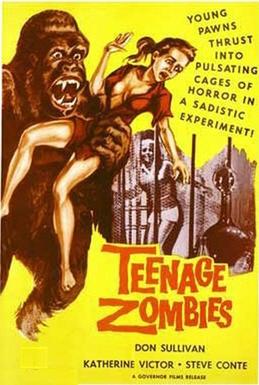
Horror Film Review: Teenage Zombies (dir by Jerry Warren)


1959’s Teenage Zombies tells the story of a quartet of “teenagers.”

Reg (Don Sullivan), Skip (Paul Pepper), Julie (Mitzie Albertson), and Pam (Brianne Murphy) don’t really look like teenagers.  Julie could probably pass for her early 20s.  Reg looks like he’s getting close to 40.  Pam appears to be about 30.  Skip is maybe in his mid-20s.  One could chalk that up to bad casting on the part of director Jerry Warren but I like to think that the film is actually commenting on the education system.  While most of their contemporaries are out getting jobs and starting careers, these four people have failed their classes so often that they are stuck in permanent teenager mode.  They still hang out at the local malt shop and the owner lets them because money is money.

Our four aging teenagers decide to spend the day waterskiing.  Woo hoo!  What fun!  (I don’t water ski because of my morbid fear of drowning but I do like hanging out at the lake and watching other people risk their lives.)  During their water skiing adventures, the teens come across a mysterious island.  They decide to explore because why not?  They’re 30-something teenagers!  Life is about taking risks.

The Island turns out to be home to Dr. Myra (Katherine Victor).  Dr. Myra, who is apparently working for the Godless communists, has developed a mind-control gas that can turn people into her slaves.  Living on the island with Dr. Myra is a hunched over zombie named Ivan the Zombie (Chuck Niles) and a gorilla (Mitch Evans).  Gorillas really aren’t native to the United States and, even if they were, I doubt you would find one living on an unchartered island in the middle of a lake but then again, you also don’t find many mad scientists at the lake either.  Most mad scientists understand that mountain laboratories are easier to defend than their island equivalent.

With the teens missing, two of their friends go to the local sheriff (Mike Concannon) for help.  Unfortunately, it turns out that the sheriff is actually working with Dr. Myra and has been providing her with prisoners to experiment on!  All of the teenagers realize that they have to stop Dr. Myra before she perfects her mind control gas and uses it to conquer the world!  Unfortunately, the teens themselves are pretty stupid.  Their plan for getting Dr. Myra to tell them how to reverse is the process is to put her in the zombie gas chamber herself.  What they don’t seem to have considered is that the zombies don’t talk so turning Dr. Myra into a zombie isn’t going to be that helpful.

Teenage Zombies is definitely a film of its time, a low-budget mix of teen hijinks and zombie “horror.”  It’s the type of film where the “wild” teens come across as being as wild as a church youth group.  My favorite thing about the film is that the climax depends on a random gorilla attack.  My second favorite thing is that the teens are told that, if they save America, they might even get a chance to meet the President!  Well, I should hope so!

That said, Dwight Eisenhower was pretty cool.  If Eisenhower couldn’t inspire those teens to save America, then nobody could.

Horror Song of the Day: The Dead Are After Me by George Edward Lott


The dead!  Are after me!

The 1986 film, Raiders of the Living Dead, features what may be the greatest song ever written about zombies.  For your listening pleasure, here is George Edward Lott’s The Dead Are After Me!