
This is from 1930. I especially like the cat.
This is from 1930. I especially like the cat.
Rest in Peace, Mark Lanegan.

I’ve seen some wild shit in my time as a comics critic, but for sheer conceptual bravado, few things can match Ukrainian cartoonist Andrew Zakolodny’s new Strangers-published surreal mindfuck Deadnauts, a combustible admixture of high-concept science fiction, drug-addled paranoia, black humor, militaristic uber-violence, and gross-out body horror — among other things. If you’re even remotely squeamish, this is a book you want less than zero to do with. But, hey, if you’re not —
Well, if you’re not, one of the first things you’ll learn is that the curious term “otherside” in this review’s title is no misprint — it’s a place beyond death, or maybe that should be the place beyond death, and serves as the extra-dimensional battlefield which much of Zakolodny’s story takes place in. We’ve all heard of suicide bombers who believe they’ll live eternally after death, but the terrorists in this yarn know it because they actually go there — or part of them does, at any rate. They’re in possession, you see, of some sort of largely-unexplained (probably because it’s flat-out inexplicable) occult technology that allows them to project their consciousness over to this “otherside” in hopes of affecting some kind of takeover of the place, which sounds to me like it’d be a pretty tough thing to organize any kind of opposition or resistance to — unless, ya know, people are willing to die to go over there and stop them. Good luck getting volunteers for that.

Still, this is comics — since when does logic apply? So, yeah — if you’re getting the idea that “death is just the beginning” here, you’re getting the right idea. Because the otherside is so fucked up that it’s actually enough to make a person — or any sort of life form — wish they were alive again. Yes, even the members of the special forces (or whatever) team that goes over to stop the dastardly terrorists — a team full of individuals who are all technically suicidal by definition. I told you this book was effing crazy.
What I’ll also tell you is that it’s crazy in the best possible way — you’ll never know what’s coming next because you can barely figure out what’s going on right now, and even when you do get something resembling a kind of metaphorical footing, you’ll find it’s ripped out from under you pretty quickly. Zakolodny is a master at not just keep you off-balance, but keeping you off your rocker — if he were a prize fighter, his first punch would be a TKO and he’d pummel you repeatedly after the bell just to make good and sure you didn’t get up off the mat. Your job, then, as a reader, is to learn to enjoy the beating.

Which, believe it or not, isn’t actually all that tough a task. The art in this comic is arresting and addictive, all inky blacks and squiggly lines and imaginative forms and even more imaginative locations — it looks and feels like your worst-ever acid trip committed to paper, only cool. There’s a lot to decipher — both narratively and, especially, visually — but doing so doesn’t feel like work by any stretch, even if it is exceptionally goddamn challenging. I know my readers, though (at least, I like to think I do), and so I know that if you’re not up for a challenge, chances are you’re not paying any attention to this blog in the first place. I mean, who are we kidding? Getting through one of my reviews can sometimes be challenging enough in and of itself.

Is this a qualified recommendation, then? You bet it is. Most are. There are a lot of perfectly rational, nice, fair-minded people who will take one look at Zakolodny’s ‘zine and give it a hard pass. But for those who revel in the refined pleasures of the heretical, the extreme, the foreboding and forbidden — for those who consider “beyond the pale” to be the starting line rather than the off-ramp — this isn’t just memorable, visceral, mind-bending stuff : it’s the kind of comic you live for. Or should that be the kind of comic you die for?
***************************************************
Deadnauts is available for $7.00 from Strangers at https://strangerspublishing.com/products/deadnauts-by-andrew-zakolodny
Also, this review is “brought to you” by my Patreon site, where I serve up exclusive thrice-weekly rants and ramblings on the worlds of comics, films, television, literature, and politics for as little as a dollar a month. Subscribing is the best way to support my continuing work, so I’d be very appreciative indeed if you’d take a moment to give it a look by directing your kind attention to https://www.patreon.com/fourcolorapocalypse
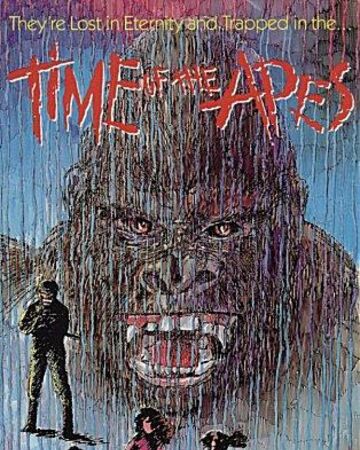 Stop me if you’ve heard this one before.
As a result of a natural disaster, three people are frozen. By the time that they thaw it, several hundreds of years have passed and Earth is now a very different place. Humans are now second-class citizens and the planet is ruled by apes, who speak English, live in their own cities, and have their own militaristic society. The humans go on the run, to avoid being possibly destroyed by the ape leaders who either cannot accept or are trying to cover up the fact that Earth was once dominated by humans. In fact, it’s almost as if the humans have found themselves on a planet of the…
You get the idea.
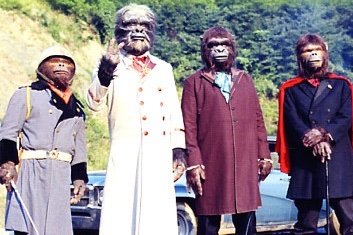
Time of the Apes may sound like a blatant Planet of the Apes rip-off but there are a few differences. First off, instead of Charlton Heston, humanity is represented by Catherine and two children who, for reasons that are not exactly clear, thought it would be a good idea to ride out an earthquake in a cryogenic chamber. (You science teacher right. That’s exactly how you accidentally freeze yourself for several centuries.) Secondly, the apes in Time of the Apes don’t ride horses or wear their leather outfits. Instead, they were suits and police uniforms and they drive Buicks and station wagons. Time of the Apes may take place far in the future but the ape way of life is still trapped in 1974. Catherine and the two brats eventually meet another human named Godo (Tetsuya Ushio). Unlike the nearly-naked future humans in Planet of the Apes, Godo wears a turtleneck.
To understand Time of the Apes, you have to understand that it was originally a 26-episode Japanese television series that aired in 1974, at the height of Planet of the Apes mania. 13 years later, America producer Sandy Frank got the rights to the series and decided to edit it down from 26 hours to 93 minutes so that he could release it as a movie. As a result, Time of the Apes is a disjointed movie in which the action seems to frequently repeat itself but it’s never boring. Between the apes and the sudden appearance of a flying saucer, there’s always something to watch. It’s never really good either, though. The ape makeup is terrible. The dubbing is worse. If you can watch the movie for five minutes without laughing at the ineptitude of it all, you’re a stronger movie watcher than me.
Time of the Apes is pretty much impossible to see unless you’re watching the Mystery Science Theater version. The MST 3K gang liked the film so much that they actually did it twice, once during the show’s later disowned first season (when it was basically just a cable access program in Minnesota) and once more after the show started to air nationally. It’s rightfully considered to be one of MST 3K’s best episodes and it’s probably the best possible way to watch Time of the Apes. You need Joel and the Bots there to assure you that you did actually just see and hear what you think you saw and heard. Sandy Frank was apparently not amused by the show’s lampooning of Time of the Apes but he really should lighten up. MST 3K brought Time of the Apes to an entirely new and appreciative audience.
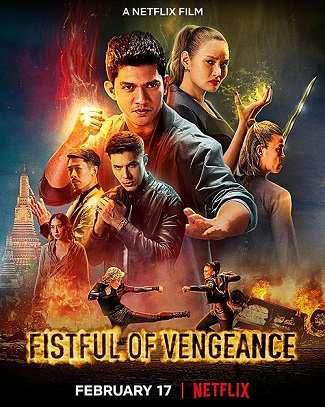
I just finished watching Fistful of Vengeance on Netflix. The film has a running time of 95 minutes and I have to admit that I spent a good deal of the film in a state of confusion. While some of that was undoubtedly due to my ADD, there are two other factors to consider:
First off, Fistful of Vengeance is based on a show called Wu Assassins. (Wu Assassins is also available on Netflix.) The movie takes place immediately after the end of the show’s first season. At this point, I should go ahead and admit that I have never seen the show. The movie does start with a quick recap of who everyone is and why they’re running around the world and fighting supernatural warriors and, from what I’ve read, the film itself is meant to be stand-alone work of entertainment. That said, I’m sure it can be argued that my lack of knowledge of Wu Assassins effected my ability to actually follow the plot of Fistful of Vengeance. If you’re a fan of the show, you should probably just watch the movie and ignore my review.
The second thing to consider about Fistful of Vengeance is that the plot really didn’t matter. Yes, there’s a lot of people conspiring against each other. Yes, there’s a lot of talk of talismans and spirits and monsters and ancient powers. And, yes, there’s international cartels and magical warriors. There’s a mystery to be solved, as Tommy (Lawrence Kao) and his friends try to track down the person or persons responsible for the death of Tommy’s sister. New allies are found and a few surprisingly enthusiastic sex scenes are staged. Enemies are fought and I assume that there’s a reason for it all. However, when watching the film, it soon becomes obvious that all of that plot is just there as an excuse for the action and the glossy images. Fistful of Vengeance is not plot-driven. Instead, Fistful of Vengeance is driven by style.
And you know what?
There’s not a damn thing wrong with that.
Seriously, you don’t watch a film like this because you’re searching for the meaning of life or because you’re hoping for some form of greater enlightenment. You watch a movie like Fistful of Vengeance because you want to see good-looking people wearing nice clothes and kicking ass. One fight follows another and all you really need to know is that you want Kai Jin (played by action specialist Iko Uwais), Tommy, and their team to win. You don’t really need to know who they’re fighting or why they’re fighting. Instead, the appeal is watching the artistry of the kicks and the punches and the tossing of weapons. Add in some monsters and some magical powers and a nice propulsive soundtrack and the movie pretty much has everything that an audience needs to be entertained. It’s a big, glossy, colorful, and rather silly movie. I had no idea what was going on for most of it but I still found myself watching. It’s fun, it’s entertaining, and it really doesn’t demand much. It’s not really a film that’s going to stick with you but watching it is also not terrible way to spend 95 minutes of your day.
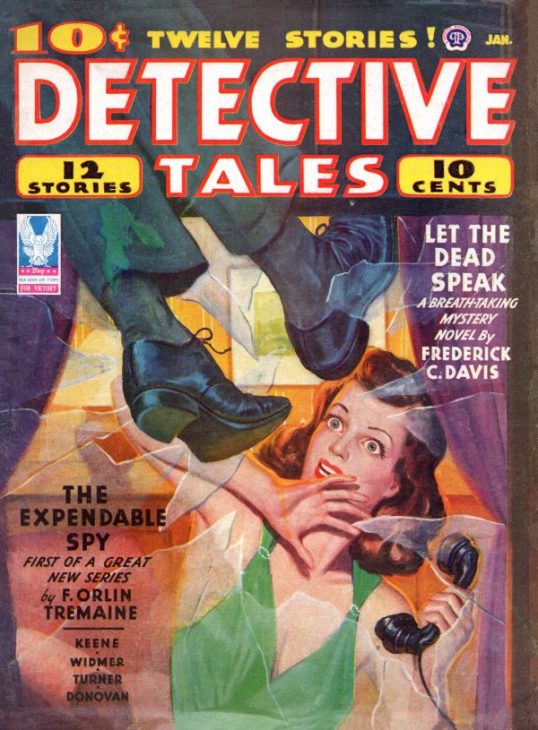
(by Rafael DeSoto)
This is from 1940. Broken glass and a landline phone, it’s everyone’s nightmare come to life.
I have a long-standing fear of heights so the video for this song kind of freaks me out.
Whenever I’m on a plane, I find myself wondering what would happen if I somehow found myself plunging through the clouds. I would hope that I would achieve a state of grace during the experience but …. well, it probably wouldn’t happen. I’ve seen any number of shows that featured people skydiving. Usually, it’s presented as being this great experience but it’s definitely something that I could go without.
James Bond, I will say, was a good sky driver. Seriously, Bond could do just about anything back in the day. That was before he got all whiny. Oh well.
Don’t fall out of planes, everyone. D.B. Cooper was a cool guy and he made a lot of money but he’s not a role model that one needs to emulate.
Enjoy!
Why? You only say you love me when you’re high
It’s like we go through the same shit every night
Oh why, oh why?
You always swear that it’s gonna change, but it never does
Why? You’ll only say you love me when you’re high
It’s like we go through the same shit every night
Oh why, oh why?
You always swear that shit’s gonna change, but it never does
Tell me that you’re gonna change
Then act like this instead
I’m too old to want somebody who’s always switching up their friends
I can’t make you love me but at least you could pretend
Scripts gonna leads to fifths until I’m fucked out of my head
You play the same old songs I know that you’re different in your Air Force Ones
Filling my prescription I could bite your tongue
Like I got an addiction yeah
You always say this shit’s gonna change, but it never does
Why? You only say you love me when you’re high
It’s like we go through the same shit every night
Oh why, oh why?
You always swear that it’s gonna change, but it never does
Why? You’ll only say you love me when you’re high
It’s like we go through the same shit every night
Oh why, oh why?
You always swear that shit’s gonna change, but it never does
I know it’s my fault I pick up your phone call
When it’s half past one and you’re halfway drunk
You say you love me and it sounds so dumb
But you’re the only one I can run away from the same old songs
I know that you’re different in your Air Force Ones
Filling my prescription I could bite your tongue
Like I got an addiction yeah
You always say this shit’s gonna change, but it never does
Why? You only say you love me when you’re high
It’s like we go through the same shit every night
Oh why, oh why?
You always swear that it’s gonna change, but it never does
Why? You’ll only say you love me when you’re high
It’s like we go through the same shit every night
Oh why, oh why?
You always swear that shit’s gonna change, but it never does

Once upon a time, Pat Pitsenbarger (Udo Kier) was one of the most important citizens of Sandusky, Ohio. He was the town’s leading hairdresser. He was the man who the wealthy trusted with their appearance. When he wasn’t cutting hair, he performed drag as Ms. Pat and when he wasn’t cutting or performing, he built a nice home with his partner. He often remembers the two of them working in the garden.
All of that is in the past, though. Pat’s partner died years ago and Pat was reminded of his place in the community when some of his wealthiest clients didn’t even bother to come to the funeral. Pat lost his business. He lost his home. He’s spent the past decade or so living in a nursing home. Pat may be the best-groomed and best-spoken resident of the nursing home but he’s still definitely a man who is waiting for death.
One day, a lawyer shows up at the home and informs Pat that one of his most faithful clients, Rita Parker Sloan (played by Linda Evans), has died. Rita had one last request. She wanted Pat to do her hair and makeup for the funeral. At first, Pat is hesitant. His memories of Rita are not particularly pleasant. But finally, he decides to do it. He escapes from the nursing home and starts to walk to the funeral home. To do Rita’s makeup, he’s going to need supplies, some of which haven’t even been existed since the 80s. Unfortunately, he has no money and, as he soon discovers, his old home no longer exists either. The world has changed.
As quickly becomes clear, there’s more to Pat’s journey than just wanting a final chance to do Rita’s hair. As he walks through the town, he tries to reconnect with his past, just to discover that much of his past has been torn down. His old beauty shop is under different management. His old house has been torn down. Few people seem to remember or recognize him. One of the few people who does remember Pat is his former protégé, Dee Dee (Jennifer Coolidge), who now basically hates his guts. Meanwhile, Rita waits in the funeral home, her hair and makeup a mess.
Released last year, Swan Song is an imperfect but ultimately touching movie. The shadow of death hangs over almost every scene. It’s not just that Pat is doing one last favor for the deceased Rita. Nor is it just that Pat is haunted by memories of his dead partner. (The scene where Pat visits his grave is one of the most effective in the movie, thanks to Kier’s heartfelt performance.) It’s the fact that Pat himself knows that he’s getting older and he only has a certain amount of time left. His walk across Sandusky is not just about traveling to the funeral home. It’s also his final chance to see the world, remember the past, and experience how things have changed (or not changed as the case may be). The journey is about Pat coming to terms with his anger, his sadness, and his past. It’s also about Pat’s desire to go out the same way that he’s always lived, on his own terms.
As I said, it’s not a perfect film. There are a few scenes that threaten to get a bit mawkish. But even the most overwritten scenes are saved by the brilliant lead performance of Udo Kier, who gives a wonderfully complex performance as Pat. Since the 70s, Kier has been a mainstay in European exploitation cinema. He stared in Flesh For Frankenstein and Blood For Dracula. He had key supporting roles in two Dario Argento films. He appeared in art films, horror films, dramas, comedies, and thrillers. He’s appeared in blockbusters and small indie films. At times, it can seem like Kier is one of those actors who basically accepts anything that’s offered to him, regardless of whether the material is worthy of his talents or not. Kier has appeared in good films and bad and, perhaps because he’s been such a ubiquitous cinematic presence, he’s often been unfairly taken for granted as an actor. In Swan Song, Udo Kier gives one of his best performances as the sometimes brutally snarky but ultimately kind-hearted Pat Pitsenbarger. If for no other reason, watch this movie to appreciate the often underrated talent of Udo Kier. A lesser actor would have turned Pat into a cliché. Udo Kier transforms Pat into a complex and rather heart-breaking character.
Swan Song is currently streaming on Hulu.
On this day, 41 years ago, Saturday Night Live was nearly canceled.
In 1981, Saturday Night Live was in its 6th season and things weren’t going so well. Lorne Michaels had left the program and he had taken what was left of the original cast with him. The new producer, Jean Doumanian, had hired an entirely new group of writers and performers. Doumanian felt that her biggest star would be a former news anchorman-turned-comedian named Charles Rocket. In order to prop up Rocket, she surrounded him with a cast that included Gilbert Gottfried, Denny Dillon, and Joe Piscopo. (Among those who auditioned but were not selected: Jim Carrey, John Goodman and Paul Reubens.) Seeking a black comedian who could take over the roles that were previously played by Garrett Morris, Doumanian tried to recruit a performer named Charlie Barnett. When Barnett skipped his second audition, she then considered hiring Robert Townsend before she finally settled on a 19 year-old stand-up comedian named Eddie Murphy.
To no one’s surprise, the initial reviews of the new Saturday Night Live were brutal. Everyone knew it would be difficult, at first, to win over the critics who were used to Bill Murray, Gilda Radner, Belushi, Aykroyd, and Lorne Michaels. What no one expected was that the reviews would never get better and that, instead of Charles Rocket, it would be Eddie Murphy and Joe Piscopo who would emerge as the new fan favorites. Reportedly, a few of the cast members resented Murphy and Piscopo’s success. No one was happy with the way Doumanian was running the show. It didn’t take long until Season 6 was better known for its backstage tension than for it comedy. As ratings plunged, there were even rumors that the show might not be renewed.
On February 21st, 1981, those tensions went from being backstage to being on thousands of televisions. The night’s episode was hosted by Charlene Tilton, a cast member of what was then the most popular show in prime time, Dallas. Everyone in the country was debating who had shot J.R. Ewing. Saturday Night Live decided to do its own tak on the phenomenon by asking, “Who shot Charles Rocket?” Over the course of the show, Rocket was shown having a conflict with every member of the cast. Finally, towards the end of the episode, Rocket was shot. During the traditional goodbyes, Rocket appeared sitting in a wheelchair and smoking a cigarette. With the rest of the cast surrounding him, Tilton asked him how he was feeling.
Here’s what happened:
“Oh, man.” Rocket said, “I’ve never been shot before. I wish I knew who the fuck did it.” It can be difficult to hear him in the video above but you can tell from the reactions of the cast that everyone immediately knew what Rocket had said.
This may not seem like a big deal today but this happened in 1981. This was before HBO started producing their own shows. This was before anyone had ever heard of a streaming service. This was when there was only three major networks and they were all closely watched by the FCC. Dropping an F-bomb on live television, with no tape delay or chance to bleep it out, was a big deal.
Later, Charles Rocket would say that he didn’t even realize what he had said. That could have been true but the look on his face after he said it suggests that Rocket was aware of what he was saying. Before Rocket said it, there had been reports that NBC was planning on firing the entire cast at the end of the season. Did Rocket make an honest mistake (one that has since been made a few more times by cast members and guests on SNL) or was he going out with a bang? Was this Rocket’s way of getting back at a network that didn’t appreciate him?
The reports about NBC planning to make changes were true, to an extent. The plan was to fire Doumanian and replace her with Dick Ebersol. Most of the cast was going to be fired but NBC was specifically planning on keeping the three performers who it was felt were the strongest members of the ensemble: Eddie Murphy, Joe Piscopo, and Charles Rocket! Needless to say, after Rocket’s bit of improvisation, NBC changed its mind.
At first, it seemed like the show itself might also get canceled as a result. In1981, the networks had to deal with people like Jerry Falwell leading crusades to cleans up network television. Just as Fredric Wertham once blamed juvenile delinquency on comic books, all sorts of problems were being blamed on television. Jean Doumanian was fired after one more episode, along with Charles Rocket, Gilbert Gottfried, and cast member Ann Risley. Tragically, Charles Rocket’s career never recovered from this moment. Today, it probably wouldn’t be as big a deal. NBC would get hit by a fine but the moment itself would go viral and lead to even bigger ratings. But in 1981, saying the F-word on national television was a career killer. Rocket did appear in several movies, usually playing smarmy villains. But he never reached the stardom that had been predicted for him and ended up taking his own life in 2005.
In the end, the only thing that saved Saturday Night Live was that the Writers Guild went on strike and production on every NBC show shut down. By the time the strike was settled, the season was over and Dick Ebersol had managed to convince NBC to let him keep the series going by focusing on Eddie Murphy and Joe Piscopo. When Saturday Night Live returned for its seventh season, Murphy was the undisputed center of the show. He achieved the stardom that had originally been predicted for Charles Rocket.
Previous Moments In Television History:

In 1980, John Anderson was briefly a viable third party presidential candidate so it made sense that Marvel would come up with a storyline in which a group of activists attempt to convince Captain America to make a third party bid of his own. When The Daily Globe broke the news that Captain America was being courted by the New Populist Party, both the Democrats and the Republicans offered to nominate him. The Beast offered to be his campaign manager. (Imagine that!) The Wasp said that Captain America was the people’s choice. Iron Man warned that the red tape would get frustrating while the always logical Vision argued that, other than having a patriotic spirit, Captain America knew nothing about politics and international relations.
As a patriot, Captain America was tempted though, in typical Marvel fashion, his actual positions were kept vague. Ultimately, Cap turned down their offer because he felt that it was important that he remain above the pettiness of partisan politics. Captain America was meant to protect all the people of America, regardless of whether they voted for Ronald Reagan, Jimmy Carter, John Anderson, Ed Clark, Barry Commoner, or even Gus Hall!
(In the end, the activists approached the wrong Avenger. Despite what he told Cap, Iron Man would have done it in a heartbeat.)
A later issue of What If… revealed that, if Captain America had run, he would have easily been elected President. Then, he would have been assassinated because almost every issue of What If… ended with everyone dead. It’s a good thing he didn’t run. By not running, he not only saved his own life but he also set a precedent that has kept a countless number of super powered individual from taking the plunge into electoral politics. It didn’t stop J. Jonah Jameson from running for mayor of New York but I doubt anything could have.
Could Captain America win the election if he ran today? As a fictional character who has a history of making questionable decisions and who is now over a hundred years old, it’s doubtful. Despite what happened in What If, it was probably just as much of a lost cause in 1980. If Howard the Duck couldn’t beat Carter and Ford in 1976, it’s doubtful Captain America could have beaten both Reagan and Ed Clark in 1980. Still, who better to rebuild America than America himself?
Captain America Vol. 1 No. 250 (October, 1980)
“Cap President”
Previous Great Moments In Comic Book History:
 Through the Shattered Lens