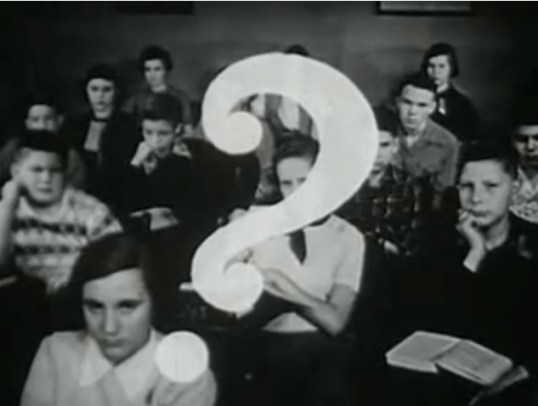
She says it’s because Jack “won’t stop teasing me.” Is Jack to blame or does Judy need to toughen up? Should Jack’s classmates have said, “Lay off?” Should Judy’s friends have tattled to the teacher? Should Judy have teased Jack back? What would you do?
This short film from 1951 considers all of those issues and yet, it’s hard not to feel that the ultimate message is that Judy needs to stop taking everything so personally. Sorry, movie. Sorry, judgmental narrator. I disagree. Myself, I think the skinny kid with the glasses should have followed through with his threat to beat Jack up. Up until I was 12, I had a really severe stutter so I know what Judy was going through. Fortunately, in my case, I also had three older sisters and a bunch of overprotective cousins that were always looking after me. Judy doesn’t seem to have that type of support system. To be honest, in most cases like this, I put the blame on the teachers. Jack and Judy are sitting up at the front of the class so there’s really no excuse for no one noticing what was going on.
This short film is another one that feels like a Herk Harvey production but it was actually directed by Arthur Wolf. My favorite shot is the entire class staring at the camera while the narrator asks, “What would you do?” Seriously, someone’s in a lot of trouble once these kids come to a consensus on who is to blame.
From 1951, it’s time to consider …. The Other’s Fellow’s Feelings.
Today, the Shattered Lens wishes a happy 81st birthday to the one and only Faye Dunaway. In honor of this day, I want to share a scene that I love from 1967’s Bonnie and Clyde.
Now, Bonnie and Clyde was not Dunaway’s first film. After appearing on Broadway, she was cast as a hippie kidnapped in a forgettable crime comedy called The Happening. Otto Preminger, who could always spot talent even if he didn’t always seem to understand how to persuade that talent to work with him, put her under contract and featured her as the wife of John Phillip Law in his legendary flop, Hurry Sundown. (Dunaway later said she had wanted to play the role of Michael Caine’s wife, a part that went to Jane Fonda and she never quite forgave Preminger for giving her a less interesting role.) Dunaway reportedly did not get along with Preminger and didn’t care much for the films that he was planning on featuring her in. One can imagine that she was happy when Warner Bros. bought her contract so that she could star opposite Warren Beatty in Bonnie and Clyde.
Despite the fact that the real-life Bonnie Parker was notably shorter and certainly nowhere as glamorous as as the actress who was selected to play, Faye Dunaway proved to be the perfect choice for the role. Bonnie and Clyde proved to be a surprise hit and an Oscar contender. It made Dunaway a star, a fashion icon, and it resulted in her first Oscar nomination. Dunaway would go on to appear in such classic 70s films as Chinatown, The Towering Inferno, Three Days of the Concord, and Network before her unfortunate decision to star as Joan Crawford in Mommie Dearest would slow the momentum of her career. Unfortunately, she would later become better known for having a difficult reputation and for engaging in some very public feuds, with the press often acting as if Dunaway was somehow uniquely eccentric in this regard. (To Hollywood, Dunaway’s sin wasn’t that she fought as much as it was that she fought in public.) Though Dunaway’s career has had its ups and downs, one cannot deny that when she was good, she was very, very good.
In this scene, from Bonnie and Clyde, Bonnie Parker (played by Faye Dunaway) writes a poem and tries to craft the future image of Bonnie and Clyde. Though it has none of the violence that made Bonnie and Clyde such a controversial film in 1967, this is still an important scene. (Actually, it’s more than one scene.) Indeed, this scene is a turning point for the entire film, the moment that Bonnie and Clyde goes from being an occasionally comedic attack on the establishment to a fatalistic crime noir. This is where Bonnie shows that, unlike Clyde, she knows that death is inescapable but she also knows that she and Clyde are destined to be legends.
(Of course, Dunaway and Beatty — two performers who one epitomized an era but only work occasionally nowadays — are already legends.)
I can relate to the title of this song, as I think almost everyone can. The love of the title doesn’t just have to refer to romantic love. It can also just mean being loved as in being appreciated or admired or praised or …. well, really whatever you mean for it to mean. There’s all sorts of love out there. Everyone wants to be loved and sometimes, that mean exhausting yourself trying to see every movie released in one year in just two weeks. Not that I’m speaking from personal experience, of course…. heh heh….
Watching this video, I found myself a bit upset with myself for having never learned how to play the violin. It’s a neat little instrument and there’s no way you can’t look transcendent while playing it. Oh well. We’ll chalk that up as missed opportunity, I guess. To be honest, I have a feeling I’d end up putting out someone’s eye with that big bow that they use so I guess it’s for the best that I never learned.
Good song, though. You can dance to it. You can laugh to it. You can cry to it. This song came out in 1979 and, as we all know, the 70s were the best!
Enjoy!
I want your love I want your love I want your love I want your love
Do you feel like you ever want To try my love and see how well it fits? Baby, can’t you see when you look at me I can’t kick this feelin’ when it hits
All alone in my bed at night I grab my pillow and squeeze it tight I think of you and I dream of you all of the time What am I gonna do?
I want your love I want your love I want your love I want your love
I want your love I want your love I want your love I want your love
Sometime, don’t you feel like you Never really had a love that’s real? Well, here I am and who’s to say A better love you won’t find today
Just one chance and I will show you love Like no other, two steps above On your ladder I’ll be a peg I want your lovin’, please don’t make me beg
I want your love I want your love I want your love I want your love
I want your love I want your love I want your love I want your love
I want your love I need your love I’ll share my dreams and make you see I’m really there, your love I need
I want your love I need your love Just like the birds need sky above I’ll share my dreams and make you see I’m really there, your love I need
I want your love I want your love I want your love I want your love
I want your love I want your love I want your love I want your love
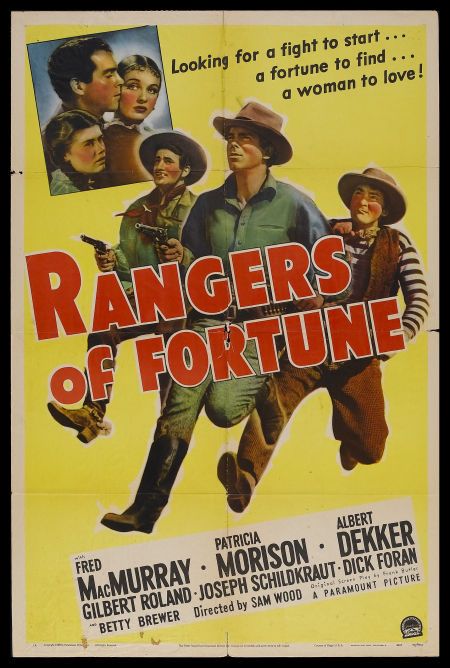
After narrowly avoiding execution by a firing squad in Mexico, three good natured outlaws head back to Texas. Gil (Fred MacMurray) is their leader, a former army officer. Antonio (GIlbert Roland) is the charming caballero. George (Albert Dekker!) is the punch-drunk former prizefighter who provides comedic relief. When they reach Texas, they meet and become involved in the efforts of a newspaper publisher (Brandon Tynan) and his daughter (Betty Brewer) to free their hometown from the control of an aristocratic landowner named Col. Rebstock (Joseph Schildkraut), who rules the town with the help of a sadistic group of cowboys. It turns out that the three outlaws aren’t so bad while the respectable and wealthy Col. Rebstock is as bad as they come.
Rangers of Fortune is a standard 1940’s western programmer, though it’s distinguished by a better than usual cast and the quick-paced direction of Sam Wood. It starts out almost as a comedy, with MacMurray, Roland, and Dekker cracking jokes and getting the better of almost anyone that they come across. The screenwriter of Rangers of Fortune, Frank Butler, also wrote some of Bing Crosby and Bob Hope’s road films and he’s just as good as coming up with comedic dialogue for the team of MacMurray, Roland, and Dekker as he was for Hope and Crosby.
But the movie takes a serious turn once MacMurray, Roland, and Dekker cross the Texas border and they discover that Col. Rebstock will do almost anything and kill just about anyone to keep his hold on the town. Even a successful scheme to install Gil as sheriff just leads to more innocent people dying. When Rangers of Fortune turns dark, it turns very dark, with characters, who we usually don’t expect to die in a film like this, meeting a violent end. Though it won’t convert any skeptics, it’s an interesting film for those who are already fans of old Hollywood westerns.
Rangers of Fortune has never gotten a proper video release but it is on YouTube. Unfortunately, the copy uploaded to YouTube was in terrible condition so it’s difficult to fairly judge the film’s production values. However, even on a damaged print, the natural authority of Fred MacMurray’s lead performance comes through and Joseph Schildkraut is as good a villain as always. Patricia Morrison plays the prettiest girl in town and, even on YouTube, it’s easy to see why every man in town is competing for her attentions. Seeing Albert Dekker, usually cast as intelligent and often conniving character, playing dumb is also an interesting experience, even on a bad print. Hopefully, someday, Rangers of Fortune will get a decent restoration.
Throughout the 30s and the 40s, Detective Short Stories offered readers 12 stories for ten cents. That seems like a pretty good deal to me! Today, of course, issues of the magazine cost a lot more but they are still highly sought after by collectors for their covers.
Below is just a small, chronological sampling of the covers of Detective Short Stories!
Yes, everyone, I am still in a 70s-type of mood. I imagine this will be the case for the rest of January. Once February comes around, I’ll probably be in a Canadian mood so get ready for a lot of songs off of the Degrassi soundtrack.
Anyway, this video is for Jive Talkin’, which was I guess one of the Bee Gees’s earliest disco songs. (Apparently, they were originally a non-disco band, which I just can’t imagine what that was like. Yes, I know that it would be very easy for me to listen to their non-disco music. That’s not the point. The 70s are all about disco and dancing. The 70s didn’t need any folk rock.) Jive Talkin’ is one of those songs that feels like it should have been written for the Saturday Night Fever soundtrack but it actually came out two years before that film appeared in theaters. That said, it does appear in Saturday Night Fever. Unfortunately, the song did not appear in Stayin’ Alive. That’s a shame since that film was all about jive and I think Frank Stallone could have done wonders with it.
Enjoy!
It’s just your jive talkin’ You’re telling me lies, yeah Jive talkin’ You wear a disguise Jive talkin’ So misunderstood, yeah Jive talkin’ You really no good
Oh, my child You’ll never know Just what you mean to me Oh, my child You got so much You’re gonna take away my energy
With all your jive talkin’ You’re telling me lies, yeah Good lovin’ Still gets in my eyes Nobody believes what you say It’s just your jive talkin’ That gets in the way
Oh my love You’re so good Treating me so cruel There you go With your fancy lies Leavin’ me lookin’ Like a dumbstruck fool With all your
Jive talkin’ You’re telling me lies, yeah Jive talkin’ You wear a disguise Jive talkin’ So misunderstood, yeah Jive talkin’ You just ain’t no good
Love talkin’ Is all very fine, yeah Jive talkin’ Just isn’t a crime And if there’s somebody You’ll love till you die Then all that jive talkin’ Just gets in your eye
Jive talkin’ You’re telling me lies, yeah Good lovin’ Still gets in my eyes Nobody believes what you say It’s just your jive talkin’ That gets in the way
Love talkin’ Is all very fine, yeah Jive talkin’, just isn’t a crime And if there’s somebody You’ll love till you die Then all that jive talkin’ Just gets in your eye, yeah yeah
I wonder, if Dan Clowes knew that he’d be starting a decades-long “cottage industry” in comics with his “Art School Confidential” strip, if he’d take it all back?
Not that it was a bad strip, mind you — quite the opposite. It still makes me laugh to this day. But the art school memoir has grown and metastasized from that point into a beast that literally will not die, even if the critical and box office failure of Clowes and Terry Zwigoff’s film adaptation of the aforementioned story probably should have, by all rights, put it to rest. Okay, sure, it hasn’t been all bad : Matthew Thurber’s Artcomic, Joseph Remnant’s Cartoon Clouds, and Walter Scott’s Wendy series stand out as high-water marks, but on the shallow end we’ve got, well — everything else.
Welcome to everything else — or, at the least (and the most), a fairly standard representative example of everything else. Clio Isadora’s Sour Pickles (Avery Hill, 2021) is certainly okay enough for what it is, sure, but the problem I have with it is that it’s not appreciably different or distinctive as far as art school memoirs go apart from the fact that her authorial stand-in protagonist, Pickles (hence the title) and her friend/fellow classmate, Radish (noticing a pattern here?) temporarily become speed freaks in order to power their way through finals. Which is one of the older tricks in the book for students cramming their way to the finish line, admittedly, but hasn’t been explored, to my knowledge, on the comics page before — and, to be honest, Isadora’s frenetic art style, which might best be described as a kind of “Peow Studio aesthetic on crank plus an intentionally garish color scheme,” works well for the instances when Pickles and Radish are wired as fuck, and really brings a reader inside their racing minds. Unfortunately, however, that’s only part of the book.
It honestly doesn’t take long for Isadora’s admittedly interesting art to begin to grate, especially when her adherence to it negates the emotional impact of certain scenes like a “friend of a friend” funeral and a decidedly anticlimactic graduation, but I do have to admit I admire her determination to present everything in a uniform visual language, as well as the confidence it takes to stick to those guns, even if I’m not convinced doing so was necessarily the greatest idea. Art is all about bold choices — or should be — but Isadora’s cartooning style for this book is one of those double-edged swords in that works really well in terms of communicating certain things, but falls flat when it comes to communicating others. I could see warming up to it more upon a second reading as being a distinct possibility, but my next task here, as fate would have it, is to let you know precisely why said hypothetical second reading probably isn’t in the offing.
Stop me if you’ve heard this one before : Pickles is the only hard-working student in an arts program overflowing with spoiled trust-fund kids. Her instructors are hopelessly out of touch with their students. Her parents can’t relate to her, nor she to them. Life after graduation looks to be fraught with uncertainty. Her love life’s DOA. Why, it’s like she’s always stuck in second gear. It just hasn’t been her day, her week, her month, or even her year. And while I’m not saying this book is anywhere near as vapid as any given episode of Friends, that’s partly down to the simple fact that, let’s face it, nothing can be. I don’t think Isadora’s a cartoonist without ambition, or without the ability to see that ambition through to a reasonably compelling finished product (I haven’t seen her Is It Vague In Other Dimensions? ‘zine, but it comes highly recommended by people whose opinions I generally trust), but thematically she’s playing it really safe here : “write and draw what you know” is solid advice and all, but should come with the caveat “if you have something new to add to the conversation.” Isadora herself may, but unfortunately this comic does not.
On the plus side of the ledger, Isadora’s dialogue is sharp, clear, and natural, even if no one’s really saying anything we haven’t read before, and her sense of comic timing is spot-on : this story is frequently quite funny. But one can’t help but feel she’s going for a crowd-pleaser with this project rather than pushing her talents to their utmost. There’s enough here to ensure that I’ll be keeping an eye out for her next book in the hopes that she’ll do just that, but not quite enough that I can recommend this one.
Also, this review is “brought to you” by my Patreon site, where I serve up exclusive thrice-weekly rants and ramblings on the worlds of comics, films, television, literature, and politics for as little as a dollar a month. Subscribing is the best way to support my continuing work, so I’d be very appreciative if you’d take a moment to give it a look by directing your kind attention to https://www.patreon.com/fourcolorapocalypse



 Through the Shattered Lens