The Films of 2020: Bloodshot (dir by David S. F. Wilson)


As a result of the COVID-19 pandemic, 2020 is the first year since 2008 not to feature any new Marvel films.  Despite the fact that Wonder Woman 1984 still has a Christmas release date, it wouldn’t surprise me if it still got moved back into 2021.  With the exception Tenent, 2020 has been the year of the anti-blockbuster.

I have to admit that, at first, it really bothered me that I was going to have to wait to see both Black Widow and the new Wonder Woman film but, as more time has gone by, the less I actually care about either one of them.  I think one reason why comic book films have been so popular over the past few years is because they were relentless.  There was always a new one coming out.  If you were disappointed with Captain Marvel, you could still say that the trailer for Endgame looked really good.  If you were less than thrilled with Batman v Superman, you could at least look forward to Wonder Woman.  Now that we’re no longer being inundated on a daily basis with new MCU trailers and DCEU gossip. it’s a lot easier to realize that a few of those films were surprisingly good (and I stand by my declaration that Guardians of the Galaxy was the best film of 2014) and some of them were notably bad but the majority of them were entertaining without being particularly memorable.

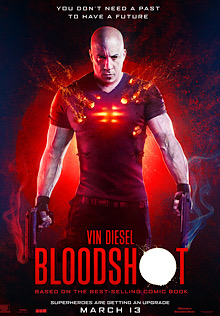
That bring us to Bloodshot.  Depending on whether or not Wonder Woman 1984 holds onto that Christmas release date and if The New Mutants are forgotten about, Bloodshot could down in history as the only major comic book film released in 2020.  It stars Vin Diesel as Ray Garrison, a dead Marine who is revived and turned into an invulnerable super soldier.  Dr. Emil Harting (Guy Pearce) sends Ray after the people who previously killed him and his wife, Gina (Talulah Riley).  Ray kills a lot of people over the course of Bloodshot.  He also continually wakes up in that laboratory, with no memory of who he is.  Could Harting just be using Ray to kills own enemies?  It’s possible, if just because I don’t think there’s been a heroic character named Emil in a comic book movie.

As a film, Bloodshot is …. well, it’s okay.  If you’re going to make a movie about a relentless super soldier who can’t be killed, Vin Diesel is probably the best actor that you could get to star in it.  (Yes, Dwayne Johnson could play the physical aspect of the role but his natural likability would go against the whole relentless killer thing.  Diesel, on the other hand, can actually convince you that he’s planning on murdering everyone that he sees.)  And if you need someone to play a smarmy mad scientist named Emil Harting, Guy Pearce seems like the obvious choice.  The action scenes are well-done, even if they do go a bit overboard on the slow motion.  The CGI is convincing.  When Ray gets a bit of his face blown off, it legitimately looks like a chunk of his face is breaking off of him.  (Fear not, Ray has super healing.)  Much like Ray, the film has a job to do and it doesn’t let much get in the way of doing that job.

And yet, the film itself is never exactly memorable.  There’s none of the little quirks or unexpected moments that distinguish the better comic book films.  Instead, Bloodshot feels like a throwback to the days before comic book films became a big deal.  We know that Guy Pearce is evil from the minute he shows up, just as we know that the film is going to end with a battle the involves a lot of flashy CGI.  No effort is really made to take anyone by surprise.  Bloodshot goes through the paces and hits all of the expected notes but it’s never really lively enough to be engaging on anything more than a “Hey, did you just see Vin Diesel kill that guy!?” sort of way.  Bloodshot is a film that’s just there.  Occasionally, it’s entertaining but ultimately, it’s rather forgettable.
Lisa Marie’s Week In Review: 9/21/20 — 9/27/20


October’s nearly here and, with it, our annual Horrorthon!  Just a few more days to go.

Along with getting ready for October, what else did I do this week?  Uhmmm …. not much.  That sucks.  I really hate having to admit that.  Oh well!  I’ll definitely be making it up for it next week.  For now, here’s what I did watch and read and listen to:

Films I Watched:

  1. Bad Boys For Life (2020)
  2. The Beginning of the End (1957)
  3. Bloodshot (2020)
  4. Coda (2020)
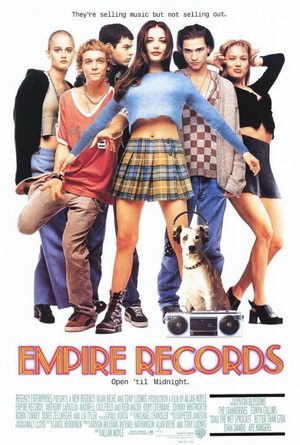
  5. Empire Records (1995)
  6. Errementari (2017)
  7. Go For It! (2011)
  8. Her Deadly Sugar Daddy (2020)
  9. I Still Believe (2020)
  10. John Henry (2020)
  11. Murder to Mercy: The Cyntonia Brown (2020)
  12. Slice (2018)
  13. Soul Surfer (2011)

Television Shows I Watched:

  1. Bar Rescue
  2. Baywatch Nights
  3. Big Brother 22
  4. Cold Case Files
  5. Dancing With The Stars
  6. Filthy Rich
  7. Love Island
  8. The Office
  9. The Powers of Matthew Star
  10. Seinfeld
  11. South Park
  12. The Third Day
  13. The Vow

Books I Read:

  1. Made Men: The Story of Goodellas (2020) by Glenn Kenny

Music To Which I Listened:

  1. Above & Beyond
  2. Aimee Mann
  3. Big Data
  4. Boh Doran
  5. David Bowie
  6. The Killers
  7. Kylie Minogue
  8. Lindey Stirling
  9. Lysandra
  10. Muse
  11. Phantogram
  12. Pixies
  13. Saint Motel
  14. SALEM
  15. Talking Heads
  16. Tiesto
  17. The Verve

Links From Last Week:

  1. Turner Classic Movies October 2020 Schedule
  2. Film Historian Seeks to Make Chaplin Keaton Lloyd Alley an “International Destination”

Links From The Site:

  1. I reviewed Filthy Rich and The Secret Life of a Celebrity Surrogate.  I shared music videos from SALEM, Boh Doran, Lindsey Stirling, Lysandra, Above & Beyond, Pixies, and Kylie Minogue!  I guess I slept a lot too.
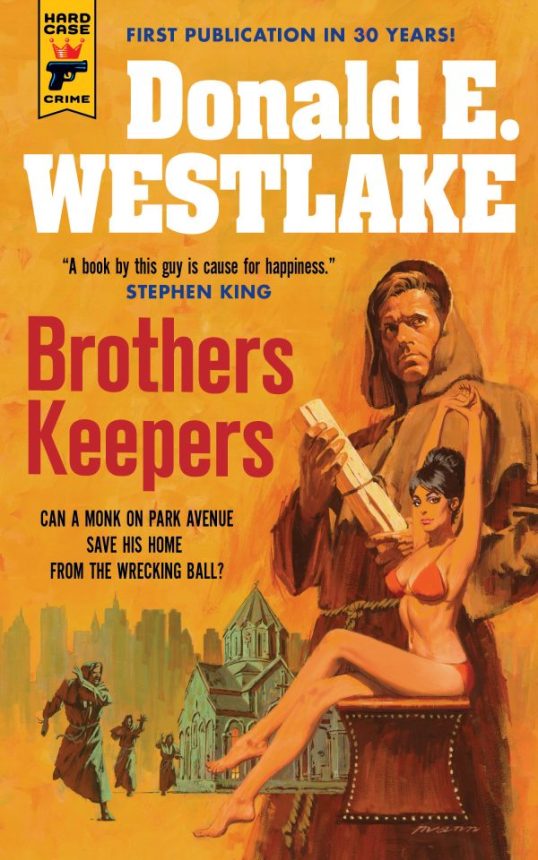
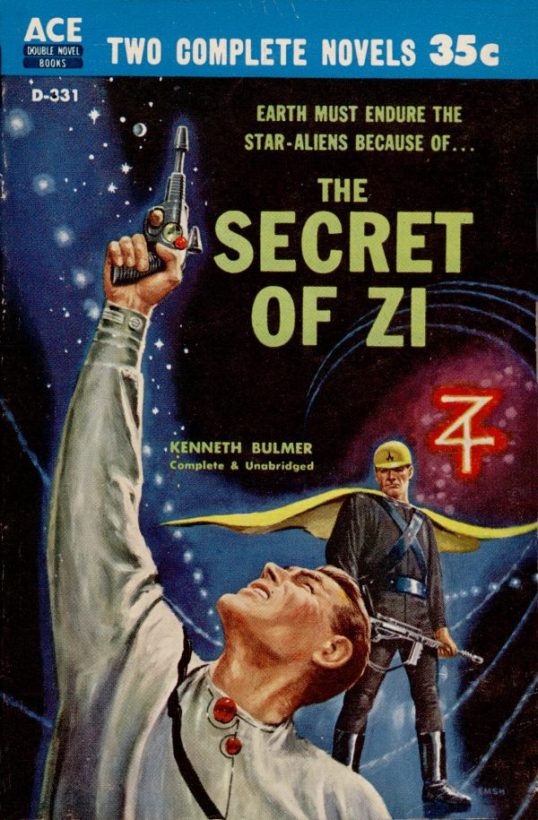
  2. Erin shared the Many Adventures of Dan Turner along with Killing Quarry, Secret Agent of Terra, The Colorado Kid, The Pursuit of Agent M, You Asked For it, The Secret of Zi, and Brothers Keeper!
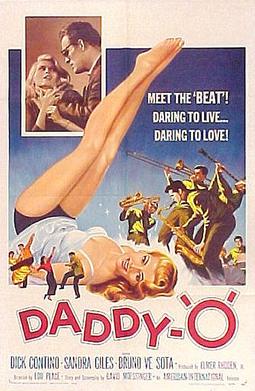
  3. Jeff reviewed Four Rode Out, High Noon Part II, A Town Called Bastard, The Lonesome Trail, Young Nurses In Love, Daddy-O, and Fever Pitch!
  4. Ryan reviewed Cabra Cabra, The Lie of the Land, Scribbles, and Sticky Sweets!

More From Us:

  1. I wrote about Big Brother for the Big Brother Blog!
  2. Ryan has a patreon!  You should consider subscribing!
  3. On her photography site, Erin shared Creek and Clouds, Brick Path, Deserted Campus, Even Dolls Need Pets, Lights, Danger Sign, and Wrong Way!
  4. On my music site, I shared songs from Saint Motel, The Verve, Aimee Mann, David Bowie, Tiesto, The Killers, and Saint Motel again!

Want to see what went on last week?  Click here!

Fever Pitch (1985, directed by Richard Brooks)


It takes a great director to come up with a movie as bad as Fever Pitch and, in his day, Richard Brooks was a great director.  Among Brooks’s films as a director you’ll find titles like Blackboard Jungle, Cat on a Hot Tin Roof, Elmer Gantry, The Professionals, and In Cold Blood.  These were all films that took risks and broke new ground and which were willing to defy the conventions of the time.  Brooks was a director who told hard-boiled stories that dealt honestly with real-life issues.

Unfortunately, as often happens with great filmmakers, Brooks struggled to remain relevant as he got older.  Hollywood’s sensibility eventually caught up with Brooks’s sensibility and then moved past it.  While Brooks remained an interesting director, his final films often seemed to be the work of a grumpy old man who just wanted all those young people to stay off his lawn.

Fever Pitch, Brooks’s final film, stars Ryan O’Neal as Steve Taggart.  Taggart is a sports writer for The Los Angeles Herald Examiner.  He’s been writing a series of stories about a compulsive gambler named Mr. Green.  The stories are so popular that his editor (John Saxon) has no problem giving Taggart $10,000 so that Taggart can then give the money to Mr. Green so that Mr. Green can continue to gamble.  What anyone, especially the editor of a major newspaper, should be able to figure out is that Mr. Green is actually Steve Taggart.

Taggart takes the money to Las Vegas, where he hits the casinos while also researching the root causes of gambling.  On the one hand, Brooks includes a lot of scenes of Taggart listening to real people explain the history and the dangers of gambling, often in the most didactic ways possible.  (Hank Greenspun, the legendary publisher of The Las Vegas Sun, appears as himself and shows why he became a publisher and not an actor.)  On other other hand, MGM not only produced the film but allowed it to be filmed at the MGM Grand Resort & Casino in Las Vegas.  Fever Pitch is anti-gambling film that also doubles as a commercial for a casino.  It’s like an anti-smoking film that gives everyone in the audience a free pack of Camels.

Steve hooks up with an unbelievable wholesome prostitute played by Catherine Hicks.  He also has to deal with several shady characters, including a veteran gambler named Charlie (Giancarlo Giannini) ad a debt collector named The Hat (played by William Smith).  Taggart is obsessed with gambling but he doesn’t seem to be very good at it, as he keeps getting beat up and threatened.  Eventually, he goes to a Gamblers Anonymous meeting and he seems to be ready to admit that he has a problem and that it’s keeping him from being a good father to his daughter.  That might seem like the ideal place for the movie to end but instead, Taggart has to try his luck with just one last slot machine.

Fever Pitch is doomed from the minute Ryan O’Neal starts his narration.  Nothing about O’Neal suggests that he could be capable of writing a hard-hitting expose about the life of a compulsive gambler.  In this film, he doesn’t even come across like he would be capable of reading it. O’Neal is too passive of an actor to be a convincing gambler and his wooden performance clashes with Brooks’s attempts to create a hyperkinetic feel to the Vegas scenes.  While everyone in the film is lecturing him about the dangers of gambling, O’Neal sit there with same blank look on his face.

A critical and a commercial failure, Fever Pitch was Brooks’s final film.  He died seven years later, leaving behind a legacy of important movies that cannot be tarnished even by something like Fever Pitch.

Daddy-O (1958, directed by Lou Place)


Like Elvis before him, Phil Sandifer (Dick Contino, who played a mean accordion back in the day) is a truck driver who wants to be a rock and roll star.  He’s also a street racer who has just fallen in love with Jana (Sandra Giles), the one woman fast enough to run him off the road.  However, before Phil can pursue either Jana or rock and roll fame, he has to investigate the mysterious death of his friend, Sonny.  Someone drove Sonny off the side of the road and the police aren’t willing to investigate.  Instead, they’re more interested in giving Phil a hard time, taking away his license and making it impossible for him to do his thing.

Working with Jana, Phil goes undercover as Daddy-O, the world’s greatest rock and roller.  He gets a job singing at a club owned by the shady Sidney Chillas (Bruno VeSota), the man who Phil believes was responsible for the death of Sonny.  Phil investigates and also finds time to sing a deathless song called Rock Candy Baby.

Today, Daddy-O is probably best known for being featured on Mystery Science Theater 3000.  In fact, I didn’t even mention Phil’s strange habit of hiking his pants nearly halfway up his chest just because Joel and the Bots pretty much said everything that needed to be said about that when they watched the show.  The same can be said of the song Rock Candy Baby, which is both terrible and insanely catchy.

Beyond the pants and Contino’s performance of Rock Candy Baby, Daddy-O is a typical delinquent youth B-movie.  Contino was best known as an accordionist but this film tries to rebrand him as a rock and roller.  He was 28 when he starred in Daddy-O but Contino looked closer to 40 and his discomfort in obvious in every scene.  Far more convincing are Sandra Giles and Bruno VeSota.  Sandra Giles has the right look to be convincing as a 50s bad girl who actually isn’t that bad while Bruno VeSota specialized in playing crooked club owners.

Daddy-O is mostly interesting as an example of how filmmakers tried to reach teenagers in the early days of rock and roll.  Contino was not a rock and roller and he looks plainly uncomfortable trying to be one but it was 1958 and Elvis was everywhere.  Of course, Elvis would have known better than to have called himself Daddy-O.  That’s totally squaresville.

Cinemax Friday: Young Nurses In Love (1987, directed by Chuck Vincent)


Chuck Vincent was widely considered to be one of the best directors to work in the adult film industry during the Golden Age of Porn.  As a director, he put as much emphasis on characterization and plot as he did on getting the so-called money shots.  One of his adult films, Roommates, even got a favorable write-up in The New York Times.

Unfortunately, Vincent was less successful when he tried to move over into mainstream filmmaking.  Vincent directed B-movies, most of which went straight to video.  The majority of them were either dumb sex comedies or erotic thrillers and they often featured porn stars in “straight” roles.  Though the majority of Vincent’s mainstream films were adequately put together, they never got the attention that his adult films did.  In the adult film industry, Vincent was an artist but, when it came to mainstream films, he was viewed as just being another competent director who churned out B-movies.  One of the few places where Vincent’s movies were appreciated was on late night Cinemax.

Young Nurses In Love is  typical example of Vincent’s mainstream work.  It takes place at Hoover Hospital, where the doctors are all rich and strange and the nurses all wear the tightest uniforms around.  The plot, as it is, involves a sperm bank where sperm from some of the most brilliant people in history is being stored.  Nurse Ellis Smith (Jeanne Marie) is an agent of the KGB who has gotten a job at the hospital so she can steal that sperm and the Russians can use it to create supercommunists.  Dr. Reilly (Alan Fisler) is also a CIA agent and he hopes to use his “bedside” manner to convince Nurse Smith to turn against her employers.  Can he do the trick?

Young Nurses In Love is meant to be a satire of medical soap operas.  (It was advertised as being a sequel to Garry Marshall’s Young Doctors In Love, though Marshall himself was in no way involved with the production.)  While Dr. Reilly is trying to save the super sperm, the rest of the hospital staff get caught up in their own softcore dramas.  There’s a mafia subplot.  There’s plenty of nurses trying to land a rich doctor husband subplots.  Jamie Gillis, Annie Sprinkle, and Veronica Hart all have small roles.  The humor is frequently forced.  Instead of letting the jokes develop naturally, Young Nurses In Love just piles one incident on top or another without much comedic rhyme or reason.  With the exception of Jamie Gillis, none of the actors seem to have a natural talent for comedy and the stiff delivery of their “funny” lines will probably inspire more groans than laughs.  For all the attempts to be racy, this R-rated film is mild enough to qualify as a PG-13 today.

This was one of Chuck Vincent’s lesser mainstream films.  For a better Chuck Vincent-directed comedy, check out Student Affairs.