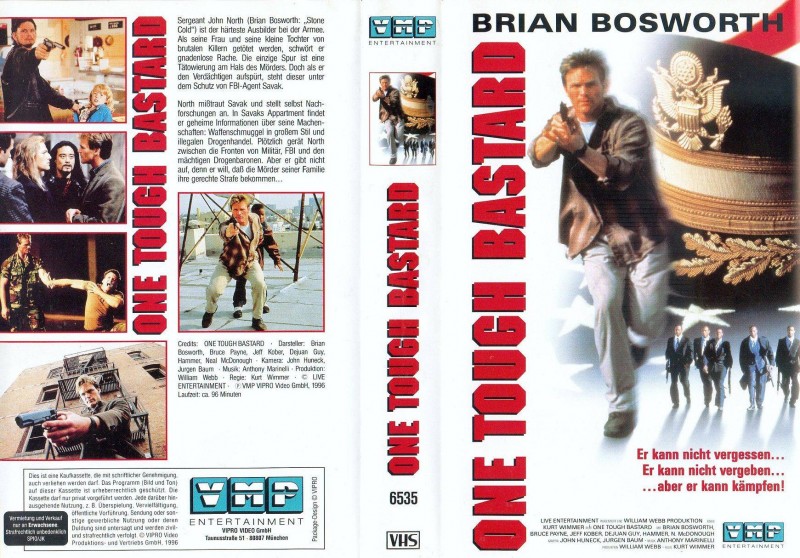
When the wife and the daughter of John North (Brian “The Boz” Bosworth) are gunned down by a mysterious gunman (Jeff Kober), North refuses to accept that they were just the victims of a robbery gone wrong. Working with a tough street kid (DeJuan Guy) who needs a mentor to show him that violence is not the solution to all of the world’s problem, North sets out to discover the truth and get revenge in the most violent ways possible. What North discovers is that the gunman who killed his family works for a corrupt FBI agent named Karl Slavak (Bruce Payne) and that Slavak is selling guns to a drug lord named Dexter Kane (played by … wait for it … MC HAMMER!)
You would think that any movie featuring M.C. Hammer as a drug lord would be worth seeing but the man who brainwashed a generation into making “U Can’t Touch This” jokes is actually pretty forgettable as Dexter. This movie was made when Hammer had dropped the M.C. from his name and he was trying to reinvent himself as a harder-edged rapper. That reinvention didn’t work because there’s absolutely nothing edgy about M.C. Hammer (much like Will Smith, he was the rapper whose music wouldn’t cause your parents to have an aneurysm) and One Tough Bastard proves it.
Instead, One Tough Bastard is worth seeing because of the epic meeting between two action stars who epitomized everything great about straight-to-video movies in the 90s, Brian Bosworth and Bruce Payne! The Boz may have been a bust as a football player but he was a good action star, delivering one-liners and viscous beat downs with aplomb and, unlike some action stars (*cough* Seagal *cough*), he could play the dramatic scenes without embarrassing himself. With his long hair and his nosering, Bruce Payne may be an unlikely FBI agent but he’s a great villain and he has no fear of shouting almost all of his dialogue. Add in Jeff Kober and you’ve got a dumb but fun movie that’s enlivened by three actors who know how to be convincingly tough on camera.
One Tough Bastard lives up to the promise of its title.
Since today would have been Dennis Hopper’s 84th birthday, I decided to watch the 1971 documentary, The American Dreamer.
Filmed in 1970, between the success of Easy Rider and the release of Hopper’s infamous follow-up to that film, The Last Movie, The American Dreamer is a cinematic portrait of a very specific time in both Dennis Hopper’s life and American film history. Dennis Hopper was 34 years old at the time The American Dreamer was shot and he was at the top of his career. As a result of the success of Easy Rider, he was regularly touted as being the future of American film. He was a self-styled revolutionary who specialized in spacey yet compelling monologues about how American movies were about to enter into a new age. Eager to try to capture the same audience that had made Easy Rider a success, Universal Pictures gave Dennis Hopper a million dollars and allowed him to take the money to South America, where he used it to film The Last Movie, a film that was designed to show who Hopper truly was as a filmmaker. The American Dreamer was filmed while The Last Movie was in post-production and we do see a few scenes of Hopper editing the film.
That said, Hopper doesn’t really seem to be too interested in talking about the specifics of The Last Movie. He does talk a lot about how he’s leading a revolution that’s going to forever alter the American cultural scene but again, Hopper doesn’t really go into too many specifics when it comes to his artistic vision. He’s more into slogans than details. Fortunately, Hopper was a compelling speaker so he holds your attention regardless of how incoherent his frequent monologues are. The American Dreamer may not convince you that Dennis Hopper was a great director but it does prove that he was a good actor. In this film, he’s acting the role of being an outlaw and a visionary.
As vague as he is about his artistic vision, Hopper gets a bit more specific whenever he’s talking about his love of weed, sex, and guns. In between leading encounter groups with all of the women who are living with him in New Mexico, Hopper brags about being such a considerate love that he’s a “male lesbian.” In another scene, Hopper talks to three giggling girl in a bathtub. He explains that free love is a part of the revolution and that he’s helping people get over their hang-ups. It’s impossible not to cringe as Hopper comes across less like a lovable eccentric and more like one of those cult leaders who ends up living in a compound in Nevada and getting into a stand-off with the government.
Hopper’s a bit more likable when he’s filmed rolling a joint. Watching the film, you can tell that he was a man who truly loved getting stoned and he actually lets down his guard a bit and grins once he’s ready to light up. However, Hopper is probably at his most natural and likable when he’s shooting a gun in the desert. Hopper spends a good deal of the film talking about his love for guns. On the one hand, it’s a bit alarming as Hopper doesn’t exactly come across as being the most stable person on the planet. On the other hand, Hopper appears to be having such a good time that it’s hard not to be happy for him. Hopper explains that, when you’re an outlaw and you’ve living in New Mexico, you have to have guns for your own protection and he makes a pretty good argument. One of the frequent misconceptions about Hopper is that he was a hippie. (This despite the fact that Easy Rider more or less ridiculed the hippies.) The American Dreamer, with its emphasis on individual freedom and the right to protect yourself, shows that, even during the height of the Hollywood counterculture, Hopper’s outlook was essentially libertarian. Watching The American Dreamer, it’s easier to understand how Hopper went from directing Easy Rider to becoming one of the few Republicans in Hollywood. Indeed, whenever the bearded and often unwashed Hopper is seen walking through the desert or firing a gun at a cross, he comes across less like the revolutionary visionary that he’s trying to be and more like an old soul in a new world.
With its frequent use of freeze frames and its intentionally ragged editing, The American Dreamer is very much a film of its era. That’s actually the main appeal of The American Dreamer. It captures a very unique and very specific point of time. It captures an artist during the brief period between his biggest success and his greatest failure and while the film may be frustrating on a narrative level, it’s fascinating as a time capsule. The film is probably more poignant when viewed today than it would have been back in 1971 because, today, we know that The Last Movie bombed and that Hopper’s revolution ended as quickly as it began. It was not Dennis Hopper who determined the future of American film but instead Steven Spielberg and George Lucas. Hopper struggled, both professionally and personally, through the rest of the 70s and the early 80s before finally kicking drugs and emerging as not just as an in-demand character actor but also something of a pop cultural icon. Watching The American Dreamer, it’s fascinating to compare the older Hopper — the one who gave witty interviews and who joked about his past excesses — with the pretentious and self-serious Hopper of the early 70s.
Still, The American Dreamer shows that Dennis Hopper was always a compelling figure. It’s impossible not to roll your eyes while watching and listening to the youngish Dennis Hopper but, nonetheless, you do continue to watch and listen.
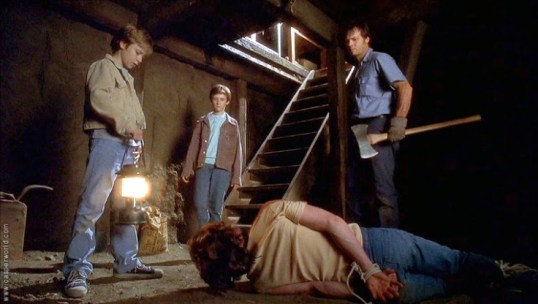
4 Shots From 4 Films is just what it says it is, 4 shots from 4 of our favorite films. As opposed to the reviews and recaps that we usually post, 4 Shots From 4 Films lets the visuals do the talking!
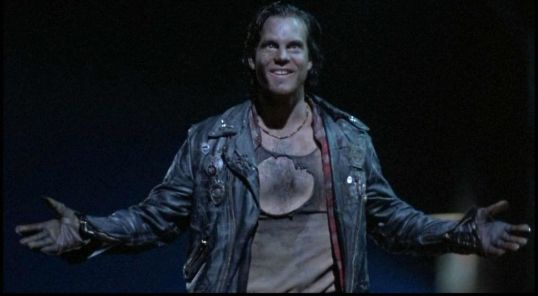
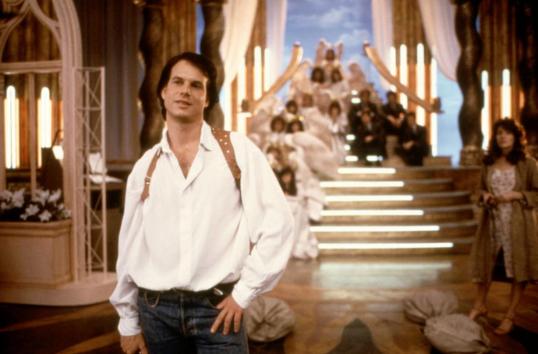
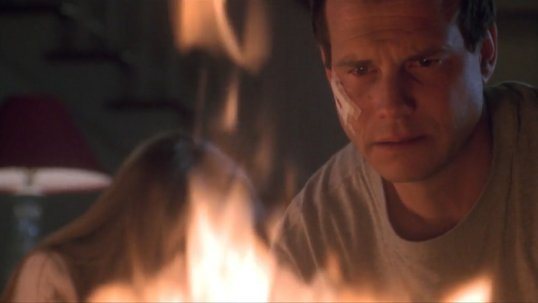
Bill Paxton would have been 65 years old today. One of the greatest of the modern character actors, Bill Paxton passed away three years ago and the loss is still felt. Paxton was one of those actors who was often taken for granted but who was capable of bring almost any character to life. He was an exciting actor to watch, not to mention being one of the best actor to ever come out of Ft. Worth, Texas. He is definitely missed.
Today, we pay tribute to the great Bill Paxton with….
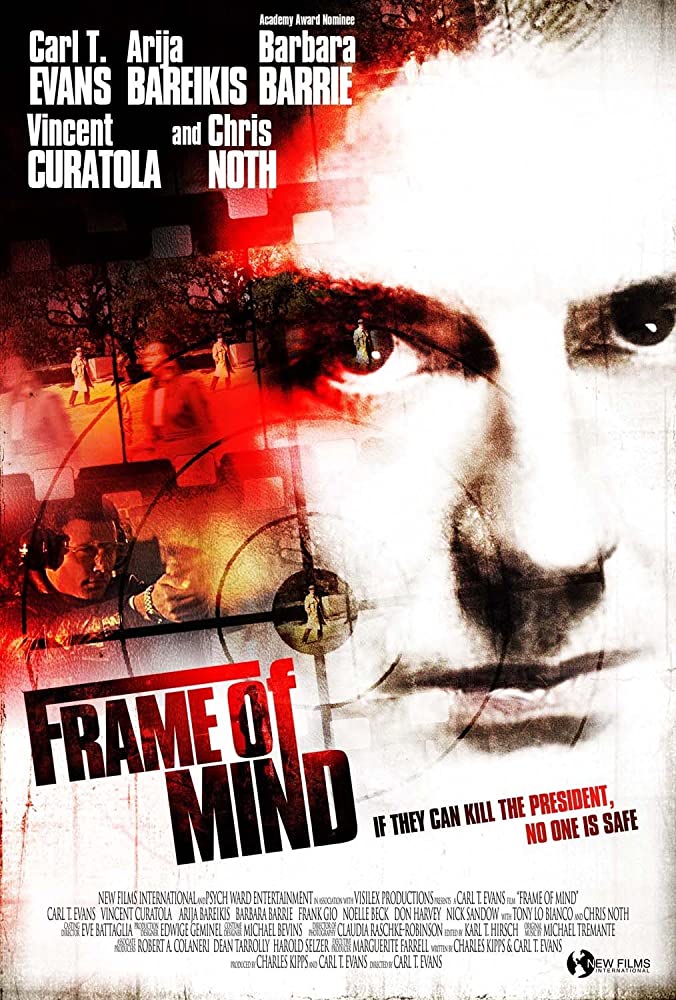
David Secca (Carl T. Evans, who also directed) is a New York cop who has just transferred to a town in New Jersey. His wife, Jennifer (Arija Bareikis) has a new job as a teacher. One day, while they’re out antiquing, they purchase a box that contains a roll of film. Looking at the film reveals pictures of a dangerous looking man who has a gun and who appears to be standing on the infamous grassy knoll in Dallas, Texas.
Convinced that he’s uncovered new evidence in the assassination of John F. Kennedy, Secca carries out his own investigation of the film. He tracks down the woman (Barbara Barrie) who actually shot the film and discovers that she is now 85 and confined to a nursing home. He talks to a skeptical conspiracy theorist (Chris Noth). As Secca investigates, his progress is monitored by people who, after all these years, still don’t want the truth about the Kennedy assassination to get out. As Secca discovers, these people are still willing to kill to protect the conspiracy.
Frame of Mind is an attempt to make a conspiracy thriller that, unfortunately, is done in by its own low budget. It’s difficult to make a conspiracy seem convincing when you don’t really have the money to hire more than a few extras. Probably the most interesting thing about the film is that, despite the low budget, there are a few established actors in the cast. Along with Barrie and Noth, Tony Lo Bianco, Don Harvey, Vincent Curatola, and even KISS’s Peter Criss all have small roles. The strangest cameo of all goes to former New York Mayor David Dinkins, who plays a senator. Being mayor of New York may be a dead end politically (just ask John Lindsay, Rudy Guiliani, Michael Bloomberg, and Bill De Blasio) but it can still serve as a launching pad for a career in the entertainment industry.
Frame of Mind might hold some interest for JFK assassination hobbyists, though it doesn’t really bring anything new to the able. It’s mostly interesting just to see who shows up in the cast.
Rest in Peace, Fred Willard. The veteran comedian died, in his sleep, last night. He was 86 years old.
It’s hard to think of anyone who was as naturally funny as Fred Willard. Here’s one of my favorite Willard performances, from Rob Reiner’s This is Spinal Tap:
Willard appeared in all of Christopher Guest’s improvised mockumentaries. Here he is, with Catherine O’Hara, in Waiting for Guffman:
He was also in Best of Show, where his commentary on the dog show proved to be one of the film’s highlights:
4 Shots From 4 Films is just what it says it is, 4 shots from 4 of our favorite films. As opposed to the reviews and recaps that we usually post, 4 Shots From 4 Films lets the visuals do the talking!
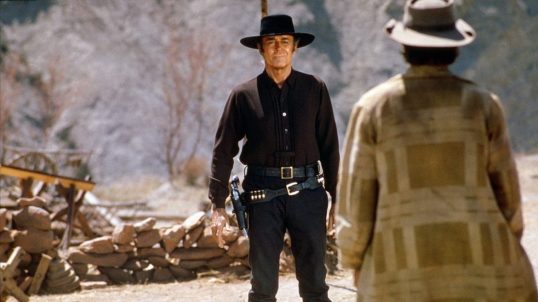
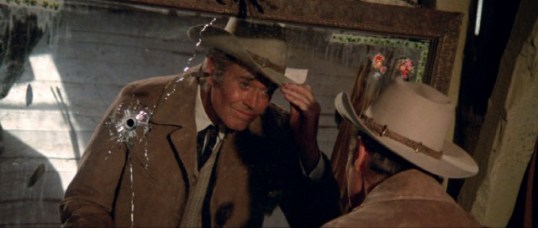
Today, we celebrate the birthday of Henry Fonda! Fonda was born 115 years ago today and, over the course of his long career, he was often cast in role the epitomized everything great about America. It’s rare to find a Henry Fonda film in which he played an out-and-out villain, though he did just that in Sergio Leone’s Once Upon A Time In The West. (Leone, in fact, cast Fonda as the evil Frank because he knew audiences would be shocked to see Fonda coldly gunning down settlers and their families.)
In honor Henry Fonda’s legacy, here are….
4 Shots From 4 Films
My Darling Clementine (1946, dir by John Ford)
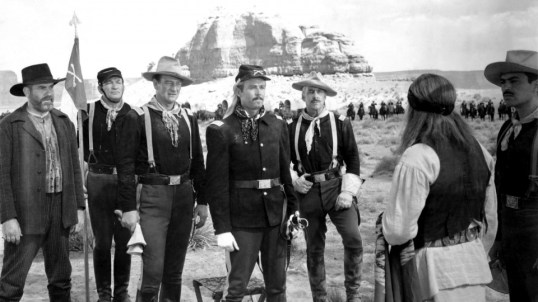
Fort Apache (1948, dir by John Ford)
Once Upon A Time In The West (1968, dir by Sergio Leone)
Today’s music video of the day features Danny Trejo riding a motorcycle through the desert and doing other badass, Danny Trejo-type things. I know that a lot of people will watch this video and think to themselves, “My God, he can sing too!” However, believe it or not, Trejo is just lip-syncing. I know. I was shocked to find that out, too. That said, Trejo does a pretty good job lip-syncing and it’s possible that he may have been singing during the filming.
Seriously, who doesn’t love Danny Trejo? Not only is he a good actor who appears to sincerely want to improve the lives of other people but he’s got a pretty inspiring personal story too. So today, we happily wish the best of birthdays and we invite you to….




 Through the Shattered Lens