Short Film Review: What Did Jack Do? (dir by David Lynch)


In a dark, black-and-white station, the train has been delayed.  Though we never actually see them, a waitress (Emily Stofle) says that there are cops swarming the station.  At a small table, a Capuchin monkey named Jack (voiced, according to the credits, by Jack Cruz) waits for his order.  A white-haired Detective (played by director David Lynch) takes a seat across from the monkey.  Both the Detective and the monkey are wearing dark suits.

The Detective and Jack have a conversation.  At first, it seems like they’re just tossing out random comments.  The Detective mentions farm animals and says that he knows why the chicken cross the road.  Jack says that he works as a pipe cleaner.  The Detective asks Jack if he’s ever been a card-carrying member of the communist party.  Jack avoids the question.

As the interrogation continues, we start to pick up on small patterns and a story emerges.  Jack is in love with a hen named Toototaban.  The Detective thinks that Jack murdered a musician named Max Clegg.  Jack says that it was probably the janitor.  The Detective is firm in his belief that Jack is guilty.  Jack is only interested in talking about how much he loved Tootataban.  He even sings a song about her and it’s about as touching as a song sung by a monkey in love with a chicken can be.

What does it all amount too, this 17-minute noir film from David Lynch?  Who knows?  With an artist like Lynch, it’s always tempting to read too much into what you’re seeing.  I’m personally of the theory that many of Lynch’s most debated films and celebrated images were constructed with no particular logic beyond the fact that it would be an interesting film or a striking image.  Lynch is an artist who creates cinematic dreams and most dreams are simply a collection of random feelings and concerns.  It’s not until we start trying to piece it all together that we find any deeper meaning and that meaning is usually dependent on our own individual thoughts and obsessions.

What is What Did Jack Do about?  Personally, I think it’s about exactly what it says it’s about.  It’s about a detective interrogating a monkey in a train station.  Why is he interrogating a monkey?  Why not?  Why is the monkey in love with a hen?  Even Jack admits that part is weird but I guess it could happen.  Personally, I wouldn’t worry too much about the why of it all.

Instead, just enjoy it for what it is, an intriguingly weird 17-minute film.  David Lynch has developed into a pretty good actor and he does a great job playing the law-and-order detective.  He delivers his dialogue in a rapid-fire, staccato manner.  Meanwhile, Jack is as crude as you would expect a monkey to be.  The film is both funny and also somewhat ominous.  That dark train station is full of shadows and, as you listen to the Detective and Jack try to outwit each other, it’s hard not to think about what might be lurking in the those shadows.

What Did Jack Do? has actually been around for a while.  Apparently, it was first screened in France way back in 2017.  (The copyright notice at the end of the film lists 2016.)  That said, it didn’t premiere in the United States until it showed up on Netflix back in January.  So, as far as I’m concerned, this is one of the best films of 2020 so far.  Be sure to watch it if you haven’t already.  Can you figure out what Jack did?

Film Review: There’s Always Vanilla (dir by George Romero)


You can probably guess how you’ll react to the 1971 film, There’s Always Vanilla, by seeing how much the title annoys you.

To some people, a title like There’s Always Vanilla may sounds innocuous and even a little innocent.  After all, vanilla is a flavor and it will always exist and the movie has to be titled something, right?  On the other hand, people like me see a title like There’s Always Vanilla and we just cringe because it’s such a cutesy collection of words.  We see the title and then we see the fact that the film was made in 1971 and we immediately assume that the film must be some sort of annoying-as-Hell counter-culture romance.  There’s Always Vanilla just sounds like something someone would say while trying too hard to be profound.

And we’re right.

There’s Always Vanilla tells the story of Chris Bradly (Raymond Laine), who is an annoying-as-Hell freeloader who the audience is supposed to find to be charming.  There are several scenes in which he talks directly to the audience, which is a technique that has always been annoying but which is somehow even more annoying than usual in this film.  Chris has just gotten out of the army and now he’s drifting around the country.  He makes his money through doing odd jobs.  Sometimes, he works as a pimp.  Sometimes, he works as a guitar player.  Do you remember when you were in college and there was always this kind of annoying 30-something dude who wanted to hang out on campus with all the students and he never seemed to realize how creepy everyone thought he was?  Well, that’s Chris.

Anyway, Chris’s father owns a factory that makes baby food because, in 1971, movies always featured people having important jobs that sounded slightly silly.  Chris’s father wants him to work at the factory.  Chris wants to wander the country being annoying.  The movie seems to think that we should, at the very least, understand where Chris is coming from but you know what?  BABIES NEED FOOD!

Anyway, Chris eventually meets a beautiful model named Lynn (Judith Ridley, who also appeared in Night of the Living Dead) and he moves in with her.  They have a falling in love montage where they run through the park and eat ice cream together.  Unfortunately, Lynn knows that Chris is an irresponsible freeloader and, when she gets pregnant, she knows that Chris will be a less than satisfactory father.  But, in 1971, getting a safe and legal abortion isn’t really an option either.  (There’s an effectively unsettling scene where Lynn meets a back alley abortionist who isn’t willing to take no for an issue.)  Lynn is forced to make a decision about her future and Chris is forced to realize that, while life offers up several different flavors of ice cream, there’s always vanilla….

So, this film is a bit infamous because it was directed by George Romero.  It was one non-horror film and it’s also a film that he practically disowned.  Apparently, it stated out as a 20-minute acting reel for Raymond Laine, which explains all the time that he spends talking to the audience.  There’s some disagreement  as to who exactly decided to extend it to being a feature film.  It’s been suggested that Romero didn’t want to get pigeonholed as being just a horror director after the success of Night of the Living Dead but Romero said, in numerous interviews, that There’s Only Vanilla was only something he directed as a favor to some friends and that he didn’t even consider it to be one of his films.

Of course, a lot of the dispute about who is responsible for There’s Always Vanilla is probably the result of the fact that it’s not a very good film.  It’s not as terrible as you may have heard but it’s definitely not good.  Judith Ridley gives an excellent performance as Lynn and the scenes that satirize advertising have a real bite, probably due to the fact that they spoke to Romero’s own background.  Unfortunately, almost all of those good things are eliminated by just how annoying the character of Chris was.  There’s Always Vanilla is one of those counter-culture films that tries to be progressive (for instance, Chris briefly goes into advertising but refuses to do a commercial for the Army) but which still displays an unmistakable streak of misogyny.  Chris is basically an irresponsible jerk who freeloads off of everyone but yet we’re still expected to feel sorry for him when Lynn quite reasonably decides that she needs something better in her life.

Anyway, there’s always vanilla and, fortunately for Romero fans, there’s always Martin as well.


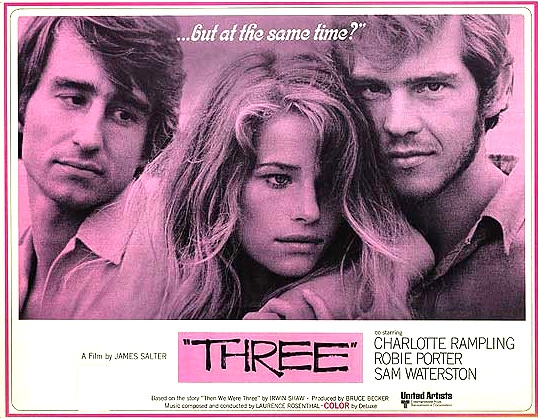
Film Review: Three (dir by James Salter)


Coming to us from 1969, Three is a film about three of the most boring people on Earth taking a vacation together.

Bert (Robie Porter) and Taylor (Sam Waterston, in his 20s but looking like he’s in his early 40s) are two American college students who are taking a trip through the Mediterranean.  We really don’t learn much about Bert and Taylor, beyond the fact that they’re close friends and they go to college together.  Though they visit several historical sites, they don’t really seem to get much out of it.  Though they both appear to be wealthy, they still make it a point to drive an old car.  It’s one of those affectations of poverty in which a certain type of rich person has always enjoyed indulging.

Anyway, Bert and Taylor wander around for a while and basically act like a bunch of stereotypical American tourists.  “Do you speak English?” they ask far too many people.  They drink too much at night.  They stare at every young woman who walks by.  They spend some time lying in a field and talking about life.  Unfortunately, since neither one of them has much depth, it’s kind of a boring conversation.  Bert, it appears, is a bit more experienced with the “ways of the world” that Taylor.  Taylor’s an idealist.  Yawn.

Eventually, Taylor meets an English tourist named Marty (Charlotte Rampling) and, despite the fact that she could obviously do better, she decides to travel around with Taylor and Bert.  Both Bert and Taylor find Marty to be attractive but they decide that all of three of them will just be friends, with no romance and no commitment.

Of course, it doesn’t really work out that way.  Taylor quickly falls in love with Marty but Marty is more attracted to Bert.  Bert, meanwhile, is kind of a jerk who picks up a French girl even after it’s obvious that Marty has feelings for him.  There’s an odd close-up of Bert blowing cigarette smoke on the French girl’s hands.  I’m not really sure why the shot was included in the film, beyond the fact that Three was made in 1969 and filmmakers in the late 60s were bizarrely obsessed with unnecessary close-ups.

Anyway, Three is an oddly lethargic story.  Sometimes, I enjoy films where nothing happens but with this one, it didn’t really feel as if either Taylor, Bert, or Marty had earned the right to suffer from ennui.  Instead, they just seemed like three shallow people who bumped into each other on vacation.  Films like this are only interesting if the characters are interesting but these three seem like they’re all destined to end up working in real estate and boring everyone with stories about the trip they took overseas during their senior year of college.  To be honest, the story is really only interesting if you assume that Taylor and Bert are actually in love with each other and that their obsession with Marty is their way of dealing with their own suppressed feelings for one another.  That’s pretty obviously the subtext of the story, though Three is too much of a product of its time to openly admit it.

It is somewhat interesting to see Sam Waterston playing a character who isn’t in his 60s but again, Waterston is one of those actors who comes across as if he was born middle-aged and that’s certainly the case in Three.  For the most part, Three is a pretty forgettable film, though the Mediterranean scenery is certainly nice.

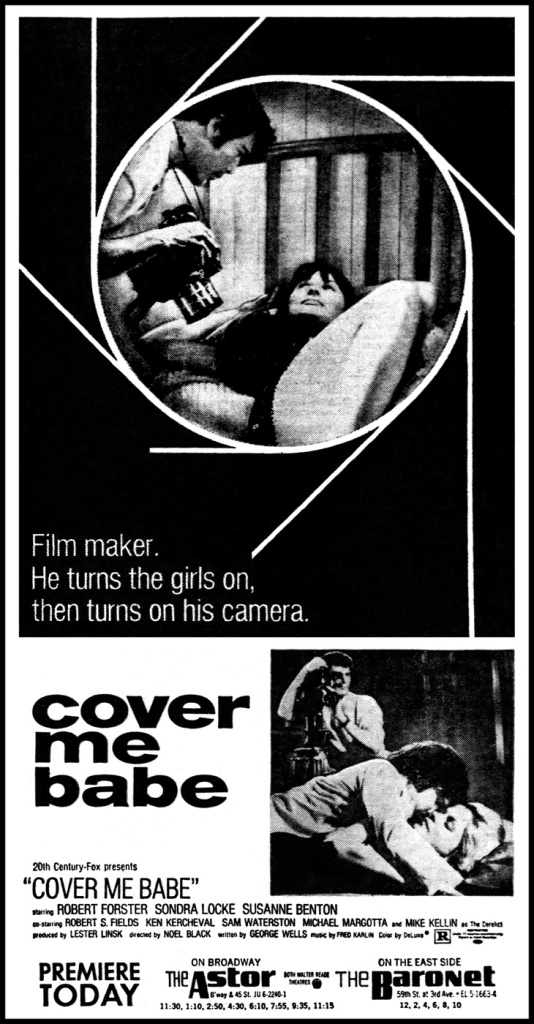
Film Review: Cover Me, Babe (dir by Noel Black)


I don’t know if I’ve ever come across a non-horror film that featured a more off-putting lead character than Tony, the protagonist of 1970’s Cover Me, Babe.

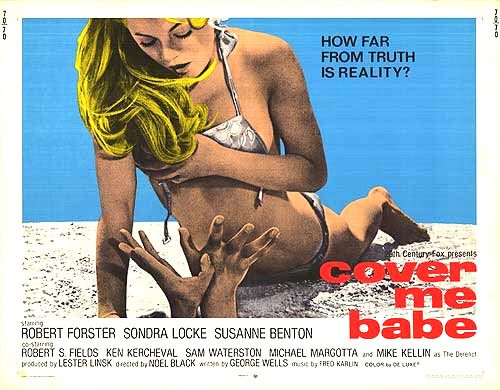
A film student, Tony (Robert Forster, even in 1970, who was too old for the role) aspires to make avant-garde films.  Everyone in the film continually raves about how talented Tony is.  The footage that we see, however, tends to suggest that Tony is a pretentious phony.  The film opens with footage of a student film that Tony shot, one that involves his girlfriend, Melisse (Sondra Locke) sunbathing in the desert and getting groped by a hand that apparently lives under the sand.  It was so self-consciously arty that I assumed that it meant to be satirical and that we were supposed to laugh along as Tony assured everyone that it was a masterpiece.  And, to be honest, I’m still not sure that Cover Me, Babe wasn’t meant to be a satire on film school pretension.  I mean, that explanation makes about as much sense any other.  (Hilariously enough, Tony’s film had the same visual style as the film-within-a-film around which the storyline of Orson Welles’s The Other Side of the Wind revolved.  At least in the case of Welles, we know that his intent was satirical.)

Tony is not only pretentious but he’s also a bit of a prick.  He treats Melisse terribly and he manipulates everyone around him.  He wanders around the city with his camera, filming random people and then editing the footage together into films that feel like third-rate Godard.  He answers every criticism with a slight smirk, the type of expression that will leave you dreaming of the moment that someone finally takes a swing at him.  Tony’s arrogant and he treats everyone like crap but, for whatever reason, everyone puts up with him because …. well, because otherwise there wouldn’t be a movie.  Of course, eventually, everyone does get sick of Tony because otherwise, the movie would never end.

A Hollywood agent (Jeff Corey) calls up Tony and offers to get him work in Hollywood.  Tony is rude to the guy on the phone.  Tony meets a big time producer who could get Tony work.  Tony’s rude to him.  Guess who doesn’t get a job?  Tony has to get money to develop his latest film from one of his professors so he’s rude to the professor.  Guess who doesn’t get any money?  Tony cheats on his loyal girlfriend.  Tony’s cameraman (played by a youngish Sam Waterston) walks out when Tony tries to film two people having sex.  By the end of the movie, no one wants anything to do with Tony.  Tony goes for a run on the beach.  He appears to be alienated and disgruntled.  We’re supposed to care, I guess.

The problem with making a movie about an arrogant artist who alienates everyone around him is that you have to make the audience believe that the artist is talented enough to justify his arrogant behavior.  For instance, if you’re going to make a movie about a painter who is prone to paranoid delusions and obsessive behavior, that painter has to be Vincent Van Gogh.  He can’t just be the the guy who paints a picture of two lion cubs and then tries to sell it at the local art festival.  You have to believe that the artist is a once-in-a-lifetime talent because otherwise, you’re just like, “Who cares?”  The problem with Cover Me, Babe is that you never really believe that Tony is worth all of the trouble.  The film certainly seems to believe that he’s worth it but ultimately, he just comes across as being a jerk who manipulates and mistreats everyone around him.

That said, from my own personal experience, a lot of film students are jerks who treat everyone them like crap.  So, in this case, I think you can make the argument that Cover Me, Babe works well as a documentary.  The fact of the matter is that not every film student is going to grow up to be the next Scorsese or Tarantino or Linklater.  Some of them are going to turn out to be like Tony, running along the beach and wondering why no one agrees with him about George Stevens being a less interesting director in the 50s than he was in the 30s.  As a docudrama about the worst people that you’re likely to meet while hanging out on campus, Cover Me, Babe is certainly effective.  Otherwise, the film is a pretentious mess that’s done in by its unlikable protagonist.  Everyone in the film says that Tony has what it takes to be an important director but, if I had to guess, I imagine he probably ended up shooting second unit footage for Henry Jaglom before eventually retiring from the industry and opening up his own vegan restaurant in Vermont.  That’s just my guess.

The poster has little to do with the film.

Film Review: Some Call It Loving (dir by James B. Harris)


1973’s Some Call It Loving tells the story of Robert Troy (Zalman King).  He’s rich.  He has a girlfriend (or maybe she’s his wife, we’re never quite sure) named Scarlett (Carol White).  He lives in a big, beautiful mansion with Scarlett and Scarlett’s girlfriend, Angelica (Veronica Anderson), and several different women who Robert and Scarlett bring home so that they can all pretend to be someone other than who they are.  (When the film begins, Scarlett is pretending to be the strict head mistress of a finishing school.  Later, she’ll pretend to be a nun.)

Robert seems like he should be happy but, from the minute we see him, it’s obvious that he’s not.  He’s mired in deep ennui and even playing in a jazz band at a nightclub doesn’t seem to bring him any real joy.  Robert plays saxophone.  His best friend in the band is Jeff (Richard Pryor), a barely coherent junkie who is probably only alive because of the pills that Robert keeps him supplied with.

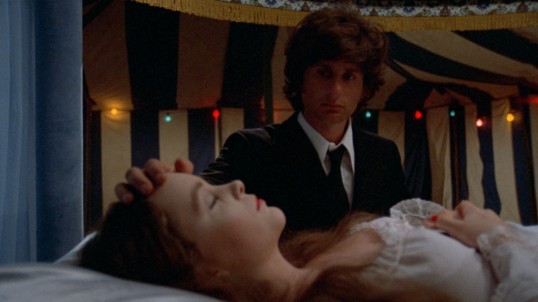
One night, Robert goes to a carnival.  He stops at a tent that apparently houses “Sleeping Beauty.”  Inside the tent, a young woman named Jennifer (Tisa Farrow, later to star in Lucio Fulci’s classic Zombi 2).  Jennifer is in a comatose state.  People pay a dollar so that they can enter the tent and kiss her.  Her “owner” says that Robert can do more with her if he’s willing to pay $50.  Robert instead buys her for $20,000.

It turns out that Jennifer has been in a coma for eight years.  She’s been kept in that state by a “sleeping potion,” a cocktail of drugs that has to be administered on a daily basis.  Robert takes her back to his mansion and doesn’t give her the potion.  Eventually, Jennifer wakes up.

Now, speaking for myself, if I woke up in a strange place after being in a forced coma for eight years, I’d probably be pretty pissed off.  Jennifer, however, cheerfully accepts that the fact that she’s been asleep for eight years and now she’s living with a somewhat creepy man and his two girlfriends.  She’s just happy to have her mansion and her Prince Charming!

While Scarlett and Angelica view Jennifer as being someone new to play games with, Robert starts to develop real feelings for her.  He wants to have a real life with Jennifer but, unfortunately, the only life that Jennifer knows is the fake one that he’s created with Scarlett and Angelica.  Robert finds himself torn between deciding whether or not to commit to Jennifer or to the fake world that he and Scarlett have created at the mansion….

Some Call It Loving is a strange film.  It’s incredibly pretentious in the way that only an art film from 1973 could be.  Reportedly, the film was a box office disaster in America but the European critics loved it.  That’s not surprising because the film’s sensibility is far more European than American.  Not only does the film refuse to judge its characters but it also ends on the type of ambiguous note that seems specifically designed to alienate mainstream audiences.  Though the film’s plot has all the making for a kinky melodrama, it’s actually far more of an erotic fairy tale.  Jennifer really is Sleeping Beauty but, unfortunately, Robert may not be quite prepared to be a true life Prince Charming.  In the end, both Jennifer and Robert are trapped by their own fantasies.

As I said, it’s pretentious but it’s also strangely watchable.  From the opening of the film, director James B. Harris achieves a properly dream-like feel and Zalman King manages to be both compelling and creepy at the same time.  Tisa Farrow is perfectly cast as Jennifer and the mansion where the majority of the film takes place is simply to die for.  Even if Robert is a creep, he at least has good taste when it comes to interior design.  Some Call It Loving is obviously not a film for everyone.  What some will find dream-like, others will find to be muddled and annoying.  But it’s an intriguing artifact of early 70s arthouse cinema.

Short Film Review: When Cary Grant Introduced Timothy Leary to LSD (dir by Geoffrey Sax)


The year in 1959 and Cary Grant (Ben Chaplin) is filming North by Northwest.  From what we see of him, he’s the Cary Grant that we’ve all read about — the handsome, charming, witty, but very guarded movie star who never seems to truly trust anyone.

On set, Grant is visited by a pushy Harvard professor named Timothy Leary (Aidan Gillen).  Leary explains that he’s recently read an interview in which Grant discussed using a new drug called LSD for therapeutic purposes.  Leary believes that the drug could possible be used to help humanity evolve into something better.  He says that he wants to take LSD and he wants Grant to guide him through his trip.  Grant rather stiffly explains that LSD should only be taken under medical supervision.  Leary, however, doesn’t have time for that.

Eventually, Leary and Grant do end up dropping acid together and, as you might have guessed, that’s where things start to get strange.  First off, Leary and Grant find themselves sharing the same trip.  While Grant tries to escape from Leary, they travel through Grant’s poverty-stricken childhood and they even find themselves being chased by the famous North By Northwest cropduster.  They also take a trip to Leary’s future, where he will someday be just as famous as Grant.  Leary proclaims that LSD will be the start of the counter culture while the far more conservative Grant grumbles that Leary is a charlatan and that most people won’t be able to handle the drug.  Along the way, we go through the usual innuendos about both men.  Even under the influence of LSD, Grant remains guarded about his sexuality while Leary struggles to convince Grant that he actually is prophet and not just a con artist looking to get rich through revolution.

Clocking in at just 20 minutes, When Cary Grant Introduced Timothy Leary to LSD is an enjoyably weird little film that makes sense once you realize that Chaplin and Gillen are not actually meant to be playing the real-life Grant and Leary but instead are playing fictionalized versions who both understand that, along with being historical figures, they’re also characters in a film.  By the end of the film, they’re less concerned with dealing with each other and more concerned with convincing those of us in the audience that one of them is right and the other one is wrong.  Ben Chaplin may not look like Cary Grant but he has the right brooding quality to be convincing as a troubled man who often feels trapped by his own persona.  Aiden Gillen, meanwhile, is far more cheerful as Timothy Leary, who he plays as being a bit of a trouble-making sprite.

Interestingly enough, the film is loosely based on fact.  Cary Grant did take LSD for therapeutic reasons and Timothy Leary did later go on to become a public figure as a result of his pro-acid advocacy.  It has been rumored that Leary and Grant actually did meet, though not necessarily during the filming of North by Northwest.  In the end, When Cary Grant Introduced Timothy Leary to LSD is an enjoyably weird short film that shows up occasionally on Showtime so keep an eye out for it.

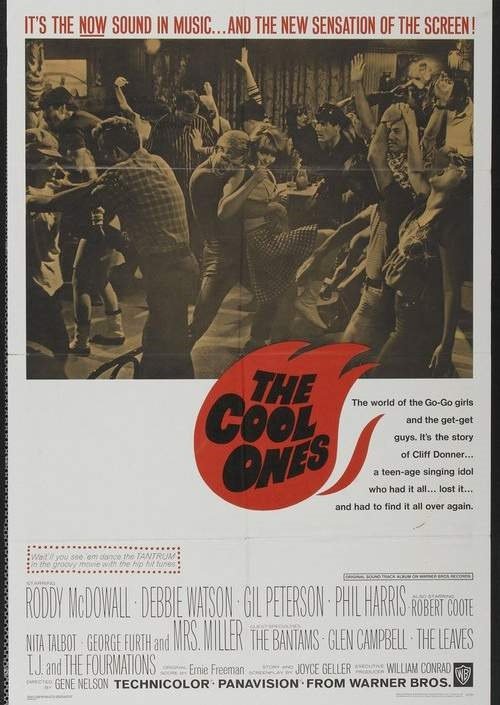
Film Review: The Cool Ones (dir by Gene Nelson)


The year is 1967 and who are The Cool Ones?

They’re the kids, of course!  They’re the wild and crazy kids who go to Palm Beach and who listen to rock music and who wear open vests and short skirts and who are all doing the latest dance!  You may see that this movie was made in 1967 and you might assume that this is going to be a film about hippies, like Psych-Out.  But no, these kids aren’t hippies.  Instead, they’re the 1967 equivalent of the clean-cut teens who used to appear in beach party movies and 1950s rock and roll films.

The kids are all dancing the Tantrum!  What’s the Tantrum?  It’s a dance that was created by accident.  Hallie Rogers (Debbie Watson) was a dancer on an American Bandstand-style show but, when she realized that the show’s producers lied to her about eventually allowing her to sing on the show, she threw a fit.  She grabbed the microphone of special musical guest Glen Campbell and attempted to turn his performance into a duet.  When security showed up to drag her off the set, she struggled with them.  Those watching the show assumed that Hallie had just created a new dance called The Tantrum.

After getting fired from the show, Hallie goes to a club, where she witnesses a performance by a former teen idol named Cliff Donner (Gil Peterson).  After Hallie fights off an obnoxious wannabe beatnik who refuses to accept that she doesn’t want to dance with him (Go, Hallie!), Cliff immediately recognizes her as the creator of the Tantrum.  Hallie wants to be a star.  Cliff once was a star.  Maybe they can work together!

Fortunately, the owner of club, Herbert Krum (Robert Coote), just happens to be the older brother of Tony Krum (Roddy McDowall), a notoriously egocentric rock promoter.  How egocentric is Tony?  Well, he’s played by Roddy McDowall and, even by the standards of a typical Roddy McDowall character, Tony is eccentric.  Tony demands that Herbert prove that they’re actually brothers.  He cries when he discovers that his psychiatrist is pregnant.  He’s given too sudden moods swing and sudden bursts of inspiration, the majority of which involve Tony holding up his finger and shouting, “Ah ha!”  Tony has a plan.  He can make Cliff and Hallie into superstars by convincing the world that they’re in love with each other!  He can even get them their own TV show!

However …. what if Cliff and Hallie actually are in love?  Unfortunately, Cliff has some paranoia issues of his own and he’s convinced that Hallie is only pretending to love him so that she can become a star.  Will Cliff and Hallie finally end up together and free from the manipulative hand of Tony Krum?

As you may be able to guess just from reading the plot description, The Cool Ones is an extremely silly film.  The plot makes little sense and Tony Krum is such an over-the-top character that it becomes impossible to take anything involving him seriously.  That said, The Cool Ones is also an incredibly fun movie and it’s obvious that Roddy McDowall had so much fun playing Tony that it’s impossible not to enjoy watching him dig into the role.  The Cool Ones is a big, flamboyant, and colorful film, the type of movie that represents less what the 60s were and more what we wish they were.  Admittedly, Gil Peterson is a bit of stiff in the role of the self-righteous Cliff but Roddy McDowall and Debbie Watson bring so much energy to the film that it doesn’t matter that Cliff doesn’t seem like he would be a cool one is real life.  The music is airy and fun, the dance scenes are entertaining and energetic, and the whole film is just like a pop art time capsule.  The Cool Ones is a cool way to spend 90 minutes.

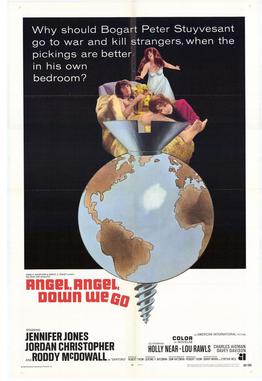
Film Review: Angel, Angel, Down We Go (dir by Robert Thom)


Oh dear Lord.

Listen, I’ve seen some bad movies before.  I’ve seen some annoying films before.  I’ve seen some pretentious movies before.  I don’t know if I’ve ever seen a movie as dedicated to being all three of them as 1969’s Angel, Angel, Down We Go appears to be.

Yes, this movie came out in 1969 and it’s one of those late 60s, counter culture films that’s so intent on impressing you by being daring that it doesn’t bother to actually come up with an interesting story or anything like that.  It’s a film that talks a lot but has nothing to say.  It’s a film that’s obviously meant to be very counter cultural and left-wing but it has a streak of such cruel misogyny running through it that it’s nearly impossible to watch certain scenes.

Singer Holly Near stars as Tara Steele, the teenage daughter of two wealthy parents.  Tara’s mother (Jennifer Jones) is a former actress who brags about having starred in over a hundred stag film without ever “faking an orgasm.”  Tara’s father (Charles Aidman) is a former military man who knew Douglas MacArthur and who is gay but closeted.  (The film handles the issue of his sexuality with all of the sensitivity that you would expect from an episode of the 700 Club.)  Tara is insecure because she’s overweight and her family doesn’t show her any love.  The film, it should be said, doesn’t really show her any love either.  Whether its the close-ups of her messily eating with food smeared across her face or the scenes in which other characters casually insult her, the film seems to have little sympathy for her.

Tara meets a rock singer named …. seriously, this is his fucking name …. Bogart Peter Stuyvesant (Jordan Christopher).  With his tight leather pants and his shirtless performances, Bogie (yes, he’s called Bogie) is supposed to be a Jim Morrison-style sex symbol.  Unfortunately, Jordan Christopher doesn’t have enough screen presence to pull off the role.  Bogie pretends to be in love with Tara (“Your breath stinks!” he shouts, “I dig it!”) but it’s just so he can seduce her mother and her father and make off with all of their money.  It’s supposed to have something to do with the hypocrisy of the American establishment or something but …. oh, who cares?

So, this movie is annoying for any number of reasons.  Robert Thom directs as if he was getting paid extra for every time he used a zoom lens or tossed in a jump cut.  Yet, despite all of the camera trickery, the story drags like you wouldn’t believe.  The walls of Jordan’s pad are decorated with a collage of American icons like Humphrey Bogart and Dwight Eisenhower and Thom often pointlessly zooms into the collage whenever he thinks it will help him make his point but since the film doesn’t really seem to have a point, the collage itself gets as boring as Bogie playing a harp.  Yes, Bogie does play a harp.  It goes over forever.

As I watched the film, I found myself growing more and more pissed off.  Every pretentious line of dialogue and arty camera angle just made me angrier and angrier.  Didn’t Jennifer Jones and Holly Near deserve better than this?  Who the Hell decided to cast bland, doughy Jordan Christopher as a sex symbol?  WHY WAS RODDY MCDOWALL IN THIS MOVIE!?  WHY CAST RODDY MCDOWALL AND THEN NOT HAVE HIM DO ANYTHING!?  Why did every scene have to drag on?  Why couldn’t the film just get to the freaking point!?  WHY WERE THEY SKY DIVING!?  WHY DID WE HAVE TO SIT THROUGH FIVE SONGS FROM JORDAN CHRISTOPHER!?  WHY?  WHY?  WHY!?

Anyway, I don’t really recommend this one.

Film Review: Psych-Out (dir by Richard Rush)


There’s a scene in the 1968 film, Psych-Out, in which a group of hippies are talking to be a liberal-minded minister, asking him if a mysterious figure known as “The Seeker” has even come by his church.  The minister tells them that he has not seen the Seeker, though he has heard of him.  As the hippies politely leave the church, one of them accidentally brushes past a middle-aged woman.  Though the hippie politely apologizes, the woman is still obviously disgusted by his presence in the church.  She asks her companion how the minister can possibly allow people who “dress like that” into the church.

As the woman complains, the camera focuses in on the stained glass window directly over her shadow.  There’s Jesus and the disciples.  They’ve all got beards.  They all have long hair.  They’re all wearing simple clothing …. oh my God, they’re hippies!

That’s actually one of the more subtle moments to be found in Psych-Out, an entertainingly heavy-handed film about hippies and wanderers in California.  Psych-Out was made at the height of the counter culture.  It was filmed on location in the San Francisco neighborhood of Haight-Ashbury, where both the love and the clothes are free and no one is about judging anyone else’s thing.  Into this neighborhood comes Jenny Davis (Susan Strasberg), who has run away from home and who is looking for her brother, Steve (Bruce Dern).  Jenny may have been raised in a conservative household but she’s eager to embrace the counter-culture.  Jenny is also deaf but she can read lips.  She also has the police looking for her but fear not!  The residents of Haight-Ashbury look after one another!  They have to, considering that there are still cops and even a few rednecks hanging out around the neighborhood.

No sooner has Jenny arrived in San Francisco than she falls in with a 30-something hippie named Stoney (Jack Nicholson, with a pony tail).  Stoney is a member of a band, along with Elwood (Max Julien) and Ben (Adam Roarke).  Even though Stoney says that he doesn’t care about material goods, he’s still eager to become a rock star.  Stoney also says that he doesn’t want to get tied down by any commitments.  He wants to do his own thing.  He may sleep with Jenny but that doesn’t mean that either one belongs to the other.  Stoney may say that but he certainly gets jealous when he sees Jenny talking to the local guru, Dave (Dean Stockwell).  Dave calls Stoney for being a phony.  “You may be righteous but you’re not hip,” Dave tells him.   Can Stoney become both righteous and hip before the film ends?  Can Jenny find her brother?  Will the band get signed to a recording contract and will the menacing junkyard rednecks ever see the errors of their fascist ways?

Today, of course, Jack Nicholson is probably the main reason why most people would want to see Psych-Out.  Ironically, for a figure who is so identified with the counter-culture, Jack Nicholson did not make for a very convincing hippie.  A lot of that is because Nicholson’s trademark sarcasm (which is on full display in Psych-Out, as this is a far more typical Nicholson performance than the one that would make him a star a year later in Easy Rider) owed more to the beats than to the hippies.  Nicolson’s persona always had more in common with Jack Kerouac than Abbie Hoffman.  In Psych-Out, he comes across as being too much of a natural skeptic to fit in with the free-spirited hippies all around him.  Nicholson is fun to watch because he’s Jack Nicholson but you never buy him as someone who would really want to live in a commune where no one has any possessions and money is frowned upon.

Dean Stockwell, on the other hand, is a totally believable hippie guru though, to his credit, his still brings some welcome wit to his role.  The script may call for him to recite some fairly shallow platitudes but he does so with just enough of a smile to let use know that not even Dave takes himself that seriously.  As for the rest of the cast, Bruce Dern gets to do his spaced-out routine and Henry Jaglom, who would later become an insufferably self-important director, plays an artist with huge sideburns who tries to chop off his hand while having a bad trip.  Jenny is horrified but everyone tells her not to judge.  Susan Strasberg is sympathetic as Jenny and is convincing as a deaf character.  Unfortunately, the film doesn’t give her much to do other than walk around San Francisco with a dazed expression on her face and stare lovingly up at Jack Nicholson.

Psych-Out‘s greatest value is probably as a time capsule.  It was filmed on location and it features actual hippies.  Watching it is like getting a chance to step into a time machine and go back to San Francisco in 1968.  Of course, judging from this film, San Francisco in 1968 wasn’t that appealing of a place but still, Psych-Out remains an entertainingly silly historical document.  Just a year after the release of Psych-Out, Charles Manson and his followers would come out of the canyons and the Altamont Free Concert would end in murder and the 60s would come to an abrupt end.  Watching Psych-Out, it’s hard to believe all of that was right around the corner.

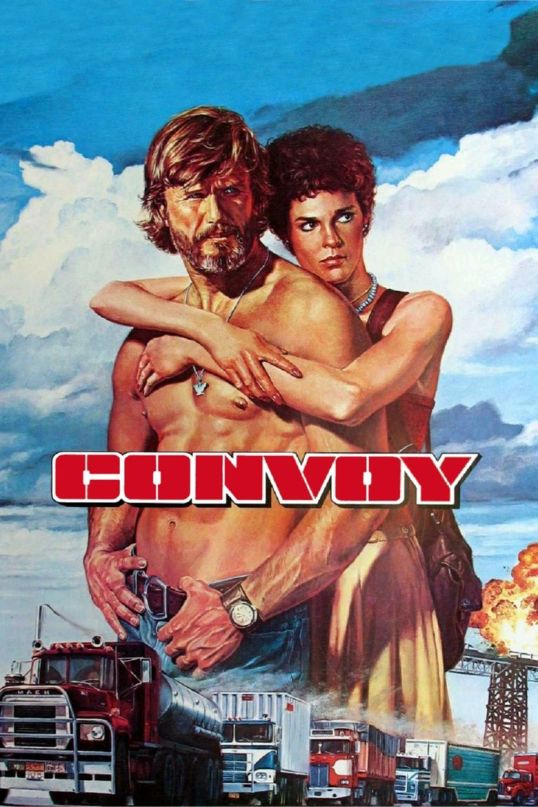
Film Review: Convoy (dir by Sam Peckinpah)


Well, it looks like we’ve got ourselves a Convoy!

The 1978 film Convoy opens with the image of a truck passing by some hills that have been covered with snow.  At a certain point, it actually looks like the truck is descending into a sea of white powder.  It’s an appropriate image because, to film lovers and cinematic historians, Convoy will always be associated with cocaine.

Convoy was meant to be a relatively small-scale B-movie, one that was meant to capitalize on the popularity of a novelty song, as well as the recent success of other car chase films.  Instead, it became a notoriously troubled production that went famously overbudget and overschedule as director Sam Peckinpah turned Convoy into a personal statement about modern cowboys and independence.  When the film was finally released, it was the biggest box office hit of Peckinpah’s storied career.  However, because so much money had been spent making the film, it still failed to make a profit and the film is regularly described as being one of the many flops of the late 70s that eventually led to the power in the film industry shifting away from the directors and over to the studio executives.  Many in Hollywood grumbled that it was Peckinpah’s well-known cocaine use that led to him having such trouble with what should have been a simple B-movie.  That’s probably a bit unfair to Peckinpah as it’s been written that just about everyone in Hollywood was using cocaine in 1978.

Add to that …. Convoy‘s not that bad.

Convoy tells the story of Rubber Duck (Kris Kristofferson), a legendary trucker who has never joined the Teamsters.  He’s an independent.  Rubber Duck’s nemesis is Sheriff Dirty Lyle (Ernest Borgnine), who is also an independent.  He’s never joined the policeman’s union.  As Rubber Duck puts it, “There’s not many like us anymore.”

Anyway, for reasons that are only vaguely defined, Rubber Duck leads a convoy of trucks across the southwest while being pursued by the police.  It has something to do with protesting the law enforcement tactics of Dirty Lyle, despite the fact that Rubber Duck appears to kind of like Lyle.  Soon hundreds of other independent truckers are joining Rubber Duck’s convoy, all to protest law enforcement.  Among those in the convoy are Pig Pen (Burt Young), Widow Woman (Madge Sinclair), and Spider Mike (Franklyn Ajaye), who just wants to get home to his pregnant wife.  Traveling with Rubber Duck is Melissa (Ali MacGraw), who is supposed to be some sort of photojournalist.  Rubber Duck and Melissa fall in love but there’s only so much you can do with a love story when it centers around two of the least expressive stars of the 70s.  During the chase, Rubber Duck picks up some non-truckers supporters, including some religious fanatics in a microbus.  He and the truckers also drive through and destroy a lot of buildings, which kind of makes it look like the cops might have had a point.

What sets Convoy apart from other chase films of the 70s is just how seriously it takes itself.  There’s an undercurrent of melancholy that runs through the entire film.  Rubber Duck seems to know that America is changing and as people become more comfortable with the idea of sacrificing their freedoms, his days as an independent trucker are numbered.  Dirty Lyle also seems to be stuck in a permanent existential crisis, taking no joy in being a crook but still forced to do so by being a part of an inherently corrupt government system.  There’s a scene where a truckstop waitress offers herself up as a gift to Rubber Duck on his birthday and Peckinpah films it as if he’s making an Italian neorealist drama about Rome after the war.  When Spider Mike says that he has to get home to his wife, he says it with the pain of a man who knows that the system only cares about control and not happiness.  These aren’t just truckers.  These are men and women who are on the front lines battling a creeping culture of oppression.

Surprisingly enough, the film’s serious tone actually works to its advantage.  You may not fully understand why Rubber Duck is leading that convoy but you hope that it succeeds because you get the feeling that the world might end if it doesn’t.  When the film ends with Ernest Borgnine laughing like a maniac, it comes across less like a moment of amusement and more like an acknowledgment that the universe is a tragic farce.  Life is a riddle wrapped inside an engima and only Rubber Duck and Dirty Lyle seem to understand that fact.

Add to that, this is a film about independents refusing to allow themselves to be limited by the regulatory state.  In its way, it’s one of the most sincerely Libertarian films ever made and, with all of us currently living under “lockdowns” and hoping that our governors don’t join those who have already surrendered their better instincts to their inner tyrant (sorry, Michigan, Kentucky, and New Jersey), Convoy remains an important film.  Go, Rubber Duck, go!