Film Review: The Top Rope (dir by Cody Broadway)


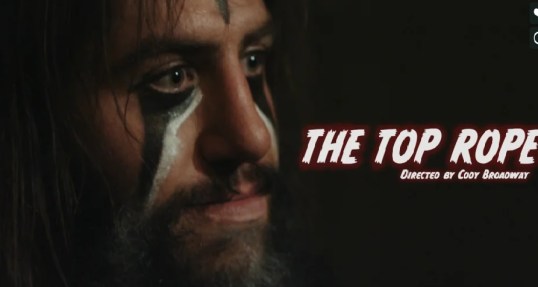
About halfway through the 20 minute documentary, The Top Rope, a soft-spoken, bearded man named Billy Gray says, “It’s how I’m wired.”

Billy is explaining why he spends most of his time playing a character named Hunter Grey, a viking who is, at one point, seen carrying a big axe.  (By being a viking, he explains, he can make people laugh while still being believably intimidating.)  Billy, who was a championship wrestler in high school and who comes from a long line of wrestlers, now makes his living traveling the pro wrestling circuit in Colorado.  It’s hardly glamorous.  Billy tells us stories about having to change in parking lots and says that if you have a locker room, you should consider yourself to be lucky.  He also tells us about how his family was initially dismissive of his career and how it took a while before they actually started coming to his matches.  But, whenever we actually see Billy performing and in the ring, we understand why he does it.  The crowds love watching him.  When Billy Gray’s in that ring, he’s a star.

Billy is one of several wrestlers to be interviewed in The Top Rope.  Considering that one of the main appeals of pro-wrestling is the flamboyance of the people involved, it’s tempting to be surprised to discover that, outside the ring, the majority of the participants come across as being rather soft-spoken.  Then again, maybe we shouldn’t be surprised at all.  One of the joys of performing, after all, is assuming a new and different persona.

For instance, a wrestler named Zach Anaya is obviously somewhat bemused with his villain status but, when we see him in the ring, we see someone who is truly enjoying playing his role.  A scene in which he jumped off a ledge and landed on top of two wrestlers below left me cringing because you could tell that, for all the talk about how pro-wrestling matches are essentially a type of performance art, the participants can still get seriously injured.  Scripted or not scripted, you have to be willing to push yourself to extremes in order to pursue it.

Also interviewed is Curtis Cole, a wrestler who rather touchingly talks about how he used to watch wrestling with his mother.  You get the feeling that, to a certain extent, he’s wrestling in her memory.  Cole also discusses the importance of having a storyline in the ring.  Without a storyline, it’s just two guys jumping on each other.  With a storyline, it becomes an epic battle of good and evil.  Cole tears up while discussing once past storyline and I have to admit that he got so emotional that even I, who has never even watched a wrestling match, started to get emotional too.  In a film full of great storytellers, Curtis Cole might be the best.

This documentary was directed by Cody Broadway, who previously directed 4 Quarters of Silence, a film about the Texas School for The Deaf’s football team.  He brings the same empathetic touch to this film.  Though the film did not make me a pro wrestling fan (to misquote Billy Gray, it’s just not how I’m wired), it did make me a fan of the men who were interviewed and it made me happy that they have this in their lives.  We’re all wired differently but, as this film demonstrates, there’s a place for all of us if we’re willing to look for it.
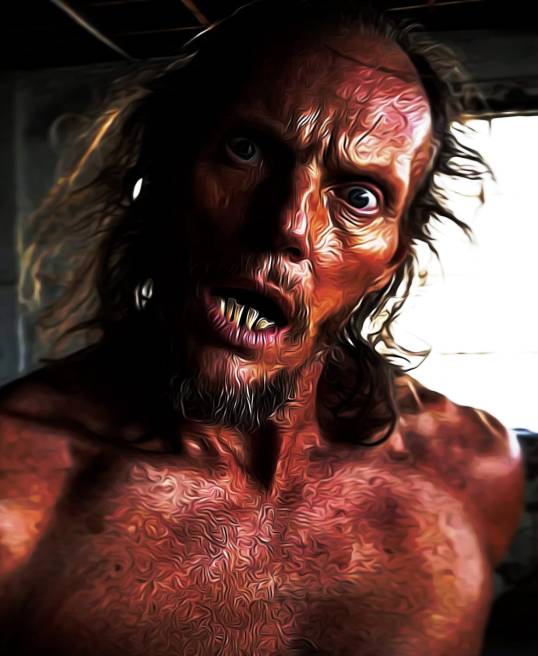
Short Film Review: Fried Barry (dir by Ryan Kruger)


I just watched a three-minute short film called Fried Barry.  Now, you may ask: “How much of a story can you tell in three minutes?”  Well, the answer is that you can tell a lot more than you might think.  For instance, Fried Barry might only last 180 seconds but it tells the story of a lifetime.

Fried Barry tells the story of Barry (Gary Green), a man who has obviously fallen on hard times.  When we first see him, he’s dirty, he’s scruffy, he’s twitching, and he’s wandering around in what appears to be a deserted warehouse.  His eyes appear to be full of madness as they dart from one side of the warehouse to the other.  A series of quick cuts, taking us from extreme close-ups of Barry to medium shots back into Barry’s face (and potentially his mind), keep us just as disorientated as he is.  The soundtrack is full of the sounds of the chaos that is erupting in Barry’s mind and we wonder if Barry is insane or maybe if we’ve just entered someone else’s dream.  It’s when we see the spoon and the hypodermic needle that we come to understand that Barry is a heroin addict.

When he shoots up, the short film just gets more chaotic.  Shots of Barry looking somewhat blissful are followed by shots of Barry looking even more pissed off.  Occasionally, a peaceful image appears but the sounds of chaos continue to erupt in the background.  By the time Barry is using his tongue to catch flies like a frog, we find ourselves wondering once again if we’re watching Barry from the outside or if we’ve entered his head.

Looking over the notes that I jotted down while watching Fried Barry, I see that I originally wrote that Barry was “a crazy dude in a warehouse.”  That’s probably not entirely fair to Barry.  When you see someone at a certain point in their life, you never fully understand how they reached that point.  That’s true of the desperate people that we see everyday and certainly, that’s true of someone like Barry.  Who knows who Barry was before he became “a crazy dude in a warehouse.”  The film is full of hints but it’s up to us, as the viewer, to put them together.

David Lynch once describes Eraserhead as being “a dream of dark and disturbing things,” and I think the same description applies to this 3-minute film.  It’s a film that will definitely stick with you.  iHorror released it this week so check it out.

The short film Fried Barry has been adapted into a feature film, which has just completed post-production and should be coming out at the end of 2019.

Music Video of the Day: Sharp Dressed Man by ZZ Top (1983, directed by Tim Newman)


“Sharp-dressed depends on who you are. If you’re on a motorcycle, really sharp leather is great. If you’re a punk rocker, you can get sharp that way. You can be sharp or not sharp in any mode. It’s all in your head. If you feel sharp, you be sharp.”

— Dusty Hill, bassist, ZZ Top

The video for Sharp Dressed Man picks where the video for Gimme All Your Lovin’ left off.  The three girls are still driving the Eliminator, the ghosts of ZZ Top are still giving away the keys to the car, and Peter Tramm is still stuck in a job where he gets no respect.  In Gimme All Your Lovin’, Tramm was a gas station attendant.  In this video, he’s working as a valet at an exclusive club and not even Truman Capote is willing to give him any respect.  Luckily, the ghosts of ZZ Top have not forgotten about Tramm and, after one ride in the Eliminator, Tramm is ready to hit the dance floor and win the love of the young woman (played by Galyn Gorg) who earlier looked back at him while being dragged into the club by her boorish boyfriend.  By the end of the video, even Truman Capote is getting down!

Sharp Dressed Man remains one of ZZ Top’s signature songs and this video is still among their best-remembered.  It’s not surprising that the video was an MTV hit because, for many members of the then-young network’s audience, it was the ultimate in wish-fulfillment.  No matter who you were or who was treating you with disrespect, there was always a chance that ZZ Top might appear and toss you the keys to Billy Gibbons’s car.

Like Gimme All Your Lovin’, this video was directed by Randy Newman’s brother, Tim.  Tim Newman would return to direct the next installment in the adventures of the Eliminator and the ZZ Top Girls, Legs.  Anyone want to guess what tomorrow’s music video of the day is going to be?

Enjoy!

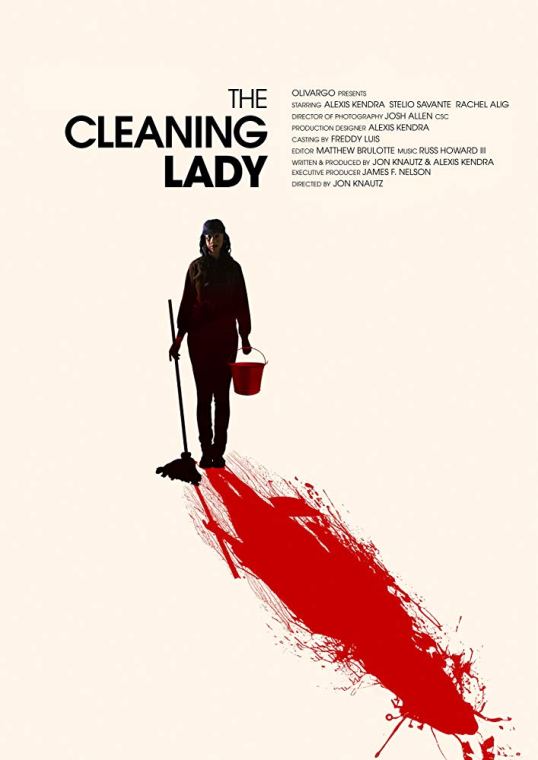
Film Review: The Cleaning Lady (dir by Jon Knautz)


The Cleaning Lady opens with a close-up of several mice in a box.  A hand reaches down and scoops up the mice, one-by-one.  The mice are dropped into a blender.  We watch as a finger turns the blender on.  Now, before anyone panics, we don’t actually see the mice get turned into puree or anything like that.  (Indeed, if we had, I would have stopped watching the movie right at that moment.)  Still, just the sound of that blender coming to life was enough to make me cringe.

It’s also a signal of the type of film that The Cleaning Lady is going to be.  This is a dark horror movie about some seriously damaged individuals.  If you think that things can’t get any darker than mice being dropped in a blender, just you wait.

The film opens with the travails of Alice (Alexis Kendra), who has a nice apartment and a married boyfriend.  The problem with having a married boyfriend is that, no matter how much you love him, you still have to deal with the guilt of being a homewrecker.  Unfortunately, Alice is “addicted to love” and she simply cannot seem to resist the urge to call Michael (Stelio Savante) and ask him to come over to her place.  Not even attending a support group seems to help.  (Of course, Michael does invite her to to go to Italy with him and, seriously, who could resist a free trip to Italy?)

As for Alice’s apartment, it’s nice and big but what’s the point if you can’t keep it clean and neat?  Fortunately, Shelly (Rachel Alig) is here to help!  Shelly is the cleaning lady and she has a habit of mysteriously materializing in Alice’s apartment.  At first, Alice is a little bit nervous around the heavily scarred and withdrawn Shelly.  However, Alice soon comes to appreciate Alice’s ability to unplug a drain and dispose of dead rodents.  Soon, Alice is making Shelly dinner and inviting her to stay over and watch movies.  Alice even drives Shelly home one night and is shocked to discover that Shelly apparently lives out in the middle-of-nowhere.

Now, admittedly, Alice’s motives aren’t entirely altruistic.  There’s a hint of elitism to Alice’s attempts to be nice to “the help.”  Even more importantly, spending time with Shelly gives Alice something to do other than calling up Michael.  Alice is using Shelly to break her addiction.

What Alice doesn’t realize is that 1) Shelly’s become a bit addicted to her company and 2) Shelly is willing to do just about anything to get closer to Alice.  I’m not going to spoil things by discussing just how far Shelly goes but let’s just say that things do a get a bit extreme.  And that’s even before the knives and the axes come out!

The Cleaning Lady is hardly the first horror film to be made about obsession, nor will it be the last.  That said, it’s still an effectively creepy film.  By making Alice as obsessed with Michael as Shelly is with Alice, the film brings a few unexpected wrinkles to its plot and both Alexis Kendra and Rachel Alig do a good job bringing their characters to life, with Alig even managing to generate some sympathy for poor, scarred Shelly.  Alig especially deserves credit for underplaying a few key scenes, as opposed to going full psycho.  The fact that Shelly rarely speaks above a whisper actually makes her far more intimidating than she would have been if she had spent the entire movie screaming at her prey.

All in all, this is an effective indie horror film.  Of course, after seeing the film, it’s possible that you might never look at a blender the same way again….

http://www.youtube.com/watch?v=o7ag_AujLAI

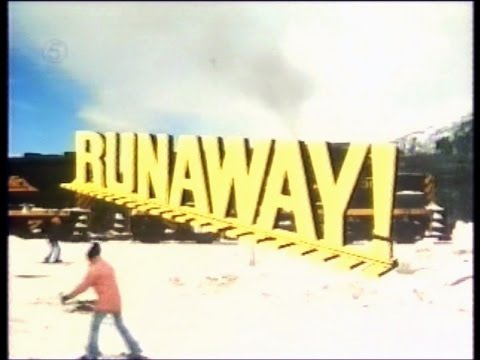
Coming Down The Mountain: Runaway! (1973, directed by David Lowell Rich)


Runaway! begins with a train starting a slow descent down a snowy mountain.  On board the train are collection of skiers, gigolos, conductors, and engineers.  One couple discusses their upcoming divorce.  An athletic father tries to bond with his less-athletic son.  A slick con artist tries to convince a depressed young woman not to throw herself from the train.  A group of skiers put on an impromptu concert, banging on their suitcases like bongo drums.  They get so loud that the conductor doesn’t even hear the engineer desperately trying to contact him.  What none of the passengers realize is that the train’s brake engines have frozen and the train is about to start hurtling down the mountain.  Unless the chief engineer can figure out a way to stop the train, everyone’s going to die!

Made for television in the year between the release of The Poseidon Adventure and The Towering Inferno, Runaway! is a low-key but entertaining disaster movie.  With a running time of only 70 minutes, Runaway! doesn’t waste any time getting down to business and, even if it is a low-budget movie, there’s no way that an out-of-control train racing down a mountain can’t be exciting.

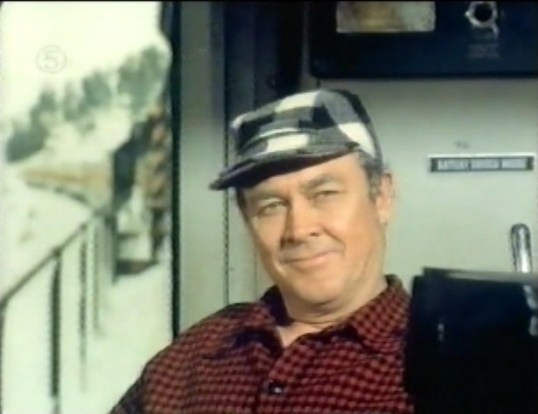
Compared to the other disaster movies of the era, Runaway! does not exactly have an all-star cast though there are some familiar faces.  Vera Miles and Ed Nelson are the divorcing couple while Martin Milner is the father who puts too much pressure on his son.  Ben Murphy is the gigolo who refuses to pay for a ticket on general principle while Darleen Carr is the woman who wants to jump to her death.  Most of them are just there as placeholders.  It’s obvious from the start that the real stars of the film are going to be the train and the mountain.  However, the famously gruff character actor Ben Johnson manages to make an impression just by being Ben Johnson.  Johnson plays the chief engineer and, as long as he’s manning the engine, you know that the train’s passengers are in good hands.

Runaway! has never been released on DVD or even VHS but it is currently available on YouTube.

The Fast Covers of Speed Mystery


Speed Mystery was one of the many magazines of the pulp era that specialized in violence, sex, and crime.  It was originally called Spicy Mystery Stories and was first published in 1934.  It was popular at the time but, after nine years of being known as Spicy, the title was changed in 1944 to Speed Mystery.  The new, more sedate title was probably meant to placate the moral guardians of the time but the magazine’s content remained the same.  Under the title Speed Mystery, the magazine ran another 2 years, publishing its final issue in 1946.

Here are a few of the covers of Speed Mystery.  When known, the artist has been credited.

by Allen Gustav Anderson

by Hugh Joseph Ward

by Hugh Joseph Ward

by Hugh Joseph Ward

by Hugh Joseph Ward

The artist or artists responsible for the rest of these covers is unknown.  If I had to guess, I’d say the majority of them were done by Hugh Joseph Ward, as well.  However, I can’t say for sure:

Music Video of the Day: Gimme All Your Lovin’ by ZZ Top (1983, directed by Tim Newman)


Judging from this video, the early 80s were a mystical time when the ghosts of ZZ Top haunted the desert and improved the lives of random people.  That was the plot of three of ZZ Top’s best-known videos, the first one of which was for Gimme All Your Lovin’.

This video follows a gas station attendant (played by Peter Tramm) as he not only gets to go on an adventure with the “ZZ Girls” but also gets to drive the ZZ car, a red, 1933 Ford coupe known as “The Eliminator.”  At the end of the video, he wakes up to discover that it was all a dream.  Or was it?

Though ZZ Top had been performing since 1969 and had a dedicated fan base of Southern rock enthusiasts, the video for Gimme All Your Lovin’ was largely responsible for introducing them to the MTV generation.  It also introduced some of the best-known parts of the ZZ Top mythology.  In particular, the famous ZZ Top hand gesture started with this video.  It wasn’t planned ahead-of-time.  Instead, the members of the band had done several shots in which they watched the Eliminator drive by them and they came up with the gesture out of pure boredom.

The Eliminator belonged to Billy Gibbons and, by putting it in the video and on the cover of the band’s latest album (which was also named after the car), Gibbons was able to write off, as a business expense, all the money that he had previously spent buying and restoring the car.  Gibbons may have simply been trying to get out of debt but the car went on to become the best-known symbol of the band.

This video was directed by Tim Newman, who was the brother of Randy Newman.  Newman would also direct the two sequels to Gimme All Your Lovin’, Sharp-Dressed Man and Legs.

Enjoy!